Month: August 2024

Some of the Motivations for Clinging to Falsehood When the Truth Is Clarified By Another Person

In The Name of Allah, The Most Merciful, The Bestower of Mercy.

Imam Ibn Al-Qayyim, may Allah have mercy upon him, said:

Ignorance: This particular reason predominantly overwhelms the majority of people, as the one ignorant of something will exhibit hostility towards it and its adherents. Furthermore, if such an individual harbours animosity towards the one who presents the truth and feels envy, the intensity of this hostility escalates. When this animosity extends to those he holds dear, his traditions, his nurturers, the customs of his ancestors, and those he cherishes and reveres, the intensity increases even further. Additionally, if he possesses a misguided belief that the truth poses a threat to his status, honour, aspirations, and objectives, the intensity reaches a peak. Moreover, if he fears for himself, his wealth, and his standing in the eyes of his companions, family, and people—similar to the situation faced by Heraclius, the Christian king in the Levant during the time of Allah’s Messenger—this reason intensifies even more. Heraclius was aware of the truth and had a desire to embrace Islam; however, due to the disobedience of his people, he feared for his safety and ultimately chose disbelief over the clear guidance presented to him.

Envy: This is one of the most significant causes because it is deeply rooted within the soul. The individual who harbours envy perceives that the person he envies possesses virtues or has been given what he does not possess; consequently, this envy hinders his ability to accept and comply. Iblees was unable to prostrate to Adam, peace be upon him, solely due to envy, for upon witnessing Adam’s elevation and the virtues bestowed upon him, he opted for disbelief instead of faith, despite having been in the company of angels. This same affliction obstructed the Yahud from accepting Isa, the son of Maryam, peace be upon him and his mother, even though they were fully aware that he was a Messenger of Allah, sent with undeniable signs and guidance. Nevertheless, their envy led them to reject faith and embrace disbelief, despite being a community that included Rabbis, scholars, ascetics, judges, kings, and rulers. [1]

Al-Allamah Abdur Rahman Ibn Yahyah Al-Mu’allimee, may Allah have mercy upon him, said:

Opposing desires through action in pursuit of truth is a clear matter, given the inherent obligations and challenges it presents. This situation can be examined from various perspectives:

An individual considers that accepting the truth implies recognising that he has previously adhered to falsehood. That is because a person is raised within a particular religion, creed, way or views imparted by their mentors and teacher, which they have long regarded as the truth; then when eventually becomes evident to him that these beliefs are erroneous, he finds it challenging to acknowledge, just as when he his ancestors or those he follows follow a way and its falsity is made known to him. This is because he considers that their shortcomings would also mean confronting his own, and an acknowledgement of their misguidance or errors necessitates his own.

It is possible that his attachment to falsehood provided him with status, recognition, and financial support, making it challenging for him to admit this, as doing so would result in the loss of all those benefits.

It may be that a person is in a state of ignorance or falsehood until another individual presents clear evidence that illuminates the truth for him, thus he considers that accepting such evidence implies his deficiency and that it was that (other) person who guided him. Due to this, we observe that while some individuals who are regarded as knowledgeable can readily admit their errors when these become apparent through their own investigations, they often struggle to accept such corrections when pointed out by others.

When another person clarifies the truth for him, he considers that accepting this truth requires recognising the clarifier’s virtue, knowledge, and accuracy, thus this would become great in the eyes of the people, leading many to follow him. So, you will find some individuals who are regarded as knowledgeable are eager to prove the errors of other scholars, even resorting to falsehoods driven by envy and a desire to diminish their standing among the people.

To oppose desires for the sake of the truth -in affairs of knowledge and creed- can indeed be difficult to accomplish, therefore it requires research and contemplation. In this regard, one needs to ask the scholars and benefit from them, adhering to the fear of Allah, and seeking the Tawfeeq of Allah and guidance. (2)


[1] An Excerpt from “Hidaayah Al-Hayaaraa Fee Ajwibah Al-Yahud Wan-Nasaaraa”. pages 17-19

[2] An excerpt from “At-Tankeel Bimaa Fee Ta’need Al-Kawthariy Minal Baatil” 2/180-181 with the checking of Imam Albaanee, may Allah have mercy upon him.

An Advice of Al-Allamah Rabee on Unity and Brotherhood, and The Recent Events That Demonstrates This Unity

In The Name of Allah, The Most Merciful, The Bestower of Mercy.

Al-Allaamah Rabee Bin Hadi Al-Mad’khali, may Allah preserve him, stated:

فعلى الطائفة المنصورة التي بشر رسول الله ﷺله ببقائها وبنصرها، وأنه لا يضرها من خذلها ولا من خالفها حتى يأتي وعد الله – تبارك وتعالى-، على هذه الجماعة المباركة الطيبة أن تتأخى في الله، وأن تتعاون على البر والتقوى، وأن تشمر عن سواعد الجد، لتبقى بهذه الميزة العظيمة أنهم على الحق ظاهرون، لا يضرهم من خذلهم ولا من خالفهم، ولا يعرفون هذا الحق إلا بالعلم الموروث عن أنبياء الله ورسله، وعن خاتم الأنبياء – عليهم
الصلاة والسلام
إذ العلماء هم ورثة الأنبياء في تبليغ دعوة الله في تبليغ رسالات الله في الأمر بالمعروف، في النهي عن المنكر، وكم للأمة من خير في الدعوة إلى الله، وفي الأمر بالمعروف، وفي النهي عن المنكر، والدعوة إلى الله
والأمر بالمعروف والنهي عن المنكر يتطلب علمًا واسعا

It is obligated to the victorious group, this blessed and virtuous group – concerning which Allah’s Messenger, peace and blessings of Allah be upon him, conveyed the glad tidings that it will remain and be victorious, neither harmed by those who forsake it nor by those who oppose it until the divine promise is fulfilled (i.e. the Day of Judgment)- to foster brotherhood for the sake of Allah, co-operate in righteousness and piety, and to ardently strive to maintain the remarkable distinction of being manifest on the truth; neither harmed by those who forsake them nor by those who oppose them. This truth is not known except through the knowledge inherited from Allah’s Prophets and Messengers, and from the seal of the Prophets, peace and blessings be upon them. The Scholars are the heirs of the Prophets in the propagation of Allah’s call and His message, in enjoining good and forbidding evil. Abundant good is (received) by the Ummah from the call to Allah’s path, from enjoining good and forbidding evil. The call to Allah’s path, enjoining good and forbidding evil requires extensive knowledge….[1] Paraphrased

We wholeheartedly endorse all that Al-Allamah Rabee Bin Hadi Al-Mad’khali, may Allah preserve him, has articulated above, as well as the subsequent insights found in the book from page 200 onward. Nevertheless, the particular themes we wish to highlight from the aforementioned discourse are brotherhood and the collaborative pursuit of righteousness and piety.

In this context, Shaikh Abu Khadeejah, may Allah protect him, recently stated:

The last seven days have been days of knowledge—and all praise is for Allah—days filled with the remembrance of Allah, studying the Sunnah, clarifying the Methodology and ‘Aqeedah of the Salaf, Ahlul-Hadīth and Ahlul-Athar—and these are praiseworthy titles that refer to Ahlus-Sunnah wal-Jamā’ah—they are one body, united upon the truth. Thousands gathered at these venues, brothers and sisters, from across the UK, Europe and elsewhere.

First at the Birmingham Summer Conference 2024 with @SalafiPubs at @MasjidSalafi from Friday to Sunday last weekend, then in Bradford at @albaseerah on Monday, Manchester at @SalafiCentre on Tuesday, Wednesday in Cardiff at @TawheedCardiff and Saturday at a packed conference in West London organised by @DaarusSunnah @_MuSunnah and @MasjidusSunnah.

May Allāh reward the rest of the speakers who participated over the last week, travelling and teaching: @AbuIyaadSP @AbuIdrees @uwaysT @Abdulilah_UK @IbnAkhdar @AbuHafsahKK

During these days, we saw the heads of over 20 Islamic centres in the UK visiting their brothers, and cooperating with them for Allah’s sake—some we’ve known for three decades and others for only a few years: @MasjdIbnSeereen @MrkzIbnMubarak @Athariyyah @MarkazMuaadh @MarkazSalafi @IslamStoke @DawahTH @Oxford_Dawah @SalafiDawahMK to name a few. Thousands of free leaflets were shared through the @SalafiBookstore and @CCDawah.

All of this is by the grace and bounty of Allah, the Mighty and Majestic, upon us. The da’wah of Ahlul-Sunnah and Salafiyyah in the UK has reached heights today not seen before. So, let us maintain the momentum and the striving—remain sincere and steadfast, seeking the Face of Allah. Learn this Deen, act upon it, and share its message with your family, friends, and community. Begin with Tawheed (the worship of Allah alone) and the ‘Aqeedah, cling to the Sunnah, purify your hearts, perform righteous deeds, avoid innovations, and hold fast to the Rope of Allāh, altogether united—with that, you will attain Allah’s pleasure.

Our elder scholars such as Shaikh Rabee’, Shaikh Muqbil Al-Wādi’ī, Shaikh ‘Ubaid, Shaikh An-Najmi, Shaikh Zayd Al-Madkhali, Shaikh Muhammad Al-Banna and his brother Shaikh Hasan always advised us with brotherhood and avoiding the paths that lead to differing. Likewise, this is what we heard from the great ones of their age such as Shaikh Al-Albānī, Shaikh Ibn Bāz, Shaikh Muhammad Amān Al-Jāmī, and Shaikh Ibn ‘Uthaimeen (rahimahumullāh).

We keep reminding ourselves, our brothers and sisters, the youth and the elders to be grateful to Allah, and ‘proclaim the bounties of your Lord’! Do not allow Shaytan or unguided good intentions to deceive you into thinking that there is any good in dividing or separating the Salafi ranks, and ‘doing your own thing’ independent from the rest of the Salafis, especially those who have preceded you. Take the advice of these scholars, and the elders because ‘the barakah is with your elders’.

And the scholars such as our Shaikh, the ‘Allāmah, Rabee’ Al-Madkhalī always advised with cooperation, love, and brotherhood among the Salafis and to avoid all means that lead to division and differing—and I translated some beautiful words from him in a recent post, so may Allah reward the noble scholar. I advise the Muslims who have love for the Sunnah and the Truth to study the belief, methodology, and fiqh of the Sahābah and the early generations—may Allah bless you. In clinging to their path, there is salvation—and by leaving their path, and choosing other paths, there is misery and misguidance.

I ask Allāh to maintain our unity here in the UK, the US, Canada, Europe, the Caribbean, and across the world based on the Book of Allah and the Sunnah of the Prophet (peace and blessings of Allah be upon him) with the understanding of the Companions (may Allah be pleased with them). This is the path of guidance and success, and every other path is astray—and we seek Allah’s aid. [End of quote]

First, indeed, all praise and thanks are due to Allah, and may He bless our Scholars and their students in the East and the West. The centers of Salafiyyah and the Salafiyyoon stand united in their commitment to the authentic Aqeedah and Manhaj, striving to counsel one another, promote virtue, and discourage wrongdoing. Umar Ibn Abdul Azeez, may Allah have mercy upon him, said, “Whoever advises his brother to rectify matters related to his religion and gives him insight into a worldly affair of his, indeed he has perfected their relationship and fulfilled his obligation towards him”. [2]

Second, the Salafiyyoon are still returning to their scholars, transmitting their books and Fatawa in their Masajid and Marakiz. They completely emphasise a return to the senior scholars in times of adversity and when critical decisions are needed. We recall a recent incident where certain people in the biased mainstream media highlighted that in the UK, it is against the law to separate boys and girls in secondary education unless they are taught in separate buildings, otherwise, they cannot be segregated. Because of this difficult situation and a lack of resources to provide enough space, some of our elder teachers sought advice from Al Allamah Ubaid Bin Abdillah Al-Jaabiri, may Allah have mercy upon him. However, he declined to answer the question and directed them to Al Allamah Salih Al Fawzaan, may Allah preserve him, who also refused to respond and suggested that they reach out to the Lajnah Daa’imah (Saudi). Thankfully, Allah, in His great mercy, made it easier when the females were facilitated with the means to carry on being segregated from the males. This incident happened not too long ago. The senior Salafi teachers involved in this matter didn’t rush to mix those teenagers in with the rest of the students and claimed, “We understand our situation better than the Scholars.” They also didn’t resort to the principle of “the lesser of two evils.” Instead, they sought guidance from the senior Scholars of the Ummah and patiently waited for Allah to make things easier. Furthermore, our Salafi teachers, both senior and junior, at the Maraakiz, do not hinder anyone from seeking guidance from scholars or insist on being consulted before reaching out to them. Rather, what they advise and remind us constantly is that we are honest in every affair we pursue from the Scholars. Therefore, the phrase “return to the scholars” should not be employed as a means to cherry-pick fatwas or to solidify one’s positions solely based on the alleged existence of differing opinions, while disregarding clear proofs.

The Salafiyyoon consistently steer clear of insignificant arguments that lack importance and issues that provide no real benefit. They actively motivate each other to delve into the pursuit of knowledge. This commitment, however, does not lead them away from being truthful or the necessity of encouraging good conduct while discouraging negative actions. Each of them strives to avoid poor behavior and to offer sincere advice. They approach this with understanding, aiming to inspire positive change while practicing patience. It’s common for anyone to occasionally struggle to recognise their own shortcomings or to realise how they could have acted differently or given more attention to certain matters. This is where the Salafiyyoon step in with their genuine counsel, rooted in brotherhood and a desire for mutual goodness. Even those who are unaware of their faults are treated with patience, but none of us expect to escape accountability for recognised misdeeds. Additionally, they remain alert, ensuring that Ahlul Bidah do not disrupt their collective efforts. May Allah grant us lasting unity in the UK and every place.

The Salafiyyoon hold tightly to the teachings of senior scholars like Al-Allamah Rabee, Al-Allamah Salih Al-Fawzan, and Al-Allamah Abdul Muhsin Al-Abbad. They show great respect for the students of these scholars, including Shaikh Abdullah Al-Bukhari, Shaikh Khalid Adh-Dhufiri, and Shaikh Abdullah Adh-Dhufiri, among others. The writings of the senior scholars and their students are in high demand at centers with bookstores, available in both Arabic and English translations. Most importantly, during challenging times or crises, they turn to the senior scholars for guidance, as previously mentioned regarding the issue of mixing between teenage boys and girls.

In summary, the unity of the Salafis has been evident to all, as highlighted by Shaikh Abu Khadeejah. Consequently, every Salafi is open to reminders from scholars in Muslim countries about the importance of unity, as well as from their reliable and well-known students in the East and the West. Lastly, we ask Allah to protect us from anything that may lead to division and to grant us the ability, knowledge, and resolve to avoid such pitfalls. We conclude with a piece of advice from Al-Allamah Rabee Bin Hadi Al-Mad’khali, may Allah preserve him, concerning the dangers of seeking leadership, which can sometimes lead to problems. Listen here: “Many of those who love leadership, split the Salafis”: https://youtu.be/8VxgOXt72iw?si=ZdLsiG-KLRkUqUFr

Shaikh Al-Islaam Ibn Taymiyyah, may Allah have mercy upon him, said: There are many cases where the souls are mixed with Ash-Shahawaat Al-Khafiyyah [i.e. desires that are concealed, subtle, etc] that corrupts its fulfillment of (perfect) love of Allah, servitude to Him and establishment of the religion sincerely for the sake of Allah, just as Shaddaad Ibn Aws, may Allah be pleased with him, said, “O Arabs! Indeed, the affair I fear for you the most is Riyaa and Shahwa Al-Khafiyyah”. It was said to Abu Dawud As-Sijistaani, may Allah have mercy upon him, “What is Ash-Shahwa Al-Khafiyyah?” He said, “Love of leadership”. [4]

We ask Allah:
اللَّهُمَّ أَصْلِحْ لِي دِينِي الَّذِي هُوَ عِصْمَةُ أَمْرِي
وَأَصْلِحْ لِي دُنْيَايَ الَّتِي فِيهَا مَعَاشِي
وَأَصْلِحْ لِي آخِرَتِي الَّتِي فِيهَا مَعَادِي
وَاجْعَلِ الْحَيَاةَ زِيَادَةً لِي فِي كُلِّ خَيْرٍ
وَاجْعَلِ الْمَوْتَ رَاحَةً لِي مِنْ كُلِّ شَرٍّ

O Allah! Rectify my religion for me, which is the safeguard of my affairs; rectify my worldly [affairs], wherein is my livelihood; and rectify my Afterlife to which is my return, and make life for me [as a means of] increase in every good and make death for me as a rest from every evil. [4]


[1] An Excerpt from “Marhaban Yaa Talibal Ilm. page 200

[2] Tarikh At-Tabari 6/572]

[3] Majmoo Al-Fataawaa 10 /214-215

[4] Saheeh Muslim Number: 2720

Part 8: O Faris Al-Hammadi! The time has arrived for your deceitful and absurd statements to be unveiled for all to see! [Self-styled Peacemaker and Deceiver]

In The Name of Allāh, The Most Merciful, The Bestower of Mercy.

Allāh, The Exalted, says:

وَإِن طَآٮِٕفَتَانِ مِنَ ٱلۡمُؤۡمِنِينَ ٱقۡتَتَلُواْ فَأَصۡلِحُواْ بَيۡنَہُمَا‌ۖ فَإِنۢ بَغَتۡ إِحۡدَٮٰهُمَا عَلَى ٱلۡأُخۡرَىٰ فَقَـٰتِلُواْ ٱلَّتِى تَبۡغِى حَتَّىٰ تَفِىٓءَ إِلَىٰٓ أَمۡرِ ٱللَّهِ‌ۚ فَإِن فَآءَتۡ فَأَصۡلِحُواْ بَيۡنَہُمَا بِٱلۡعَدۡلِ وَأَقۡسِطُوٓاْ‌ۖ إِنَّ ٱللَّهَ يُحِبُّ ٱلۡمُقۡسِطِينَ
إِنَّمَا ٱلۡمُؤۡمِنُونَ إِخۡوَةٌ۬ فَأَصۡلِحُواْ بَيۡنَ أَخَوَيۡكُمۡ‌ۚ وَٱتَّقُواْ ٱللَّهَ لَعَلَّكُمۡ تُرۡحَمُونَ

If two parties among the believers should fight (each other), then make settlement between them (through the Book of Allāh). But if one of them revolts against the other (and refuses compliance with the judgement of Allāh’s Book), then fight you (all) against the one that revolts until it complies with the command of Allāh. Then if it complies (by returning to truth), then make reconciliation between them (by making the transgressing party abide by) justice and act justly (between them). Verily, Allāh loves those who are just. The believers are but brothers (to one another in Islām), so make reconciliation between your brothers (individuals or parties) (if they differ or fight). And fear Allāh (in all of your affairs by not opposing His command and not disobeying Him) that you may receive mercy. [1]

In this discourse, we shall present a selection of insights from Imam Ibn Al-Qayyim concerning reconciliation amidst conflict.

Quote: “Allah commanded the reconciliation between the two warring factions initially. However, if one side oppresses the other, then the obligation shifts to fighting against the transgressor rather than seeking peace, as they are unjust. Attempting to reconcile in the face of such injustice undermines the rights of the oppressed group. Many unjust individuals who claim to be peacemakers often mediate between the powerful oppressor and the weak victim in a way that favours the powerful, believing they have achieved harmony, while in reality, they deny the oppressed their rightful claims. This is injustice; rather, the wronged party should be allowed to reclaim their rights. They can then be asked, with their consent, to forgo a portion of their rights without favouritism towards those in power, ensuring that there is no coercion involved in favouring others”.

Quote: “A reconciliation that permits the forbidden and prohibits the permissible is akin to an agreement that forbids a lawful act, allows an unlawful act, enslaves a free person, alters lineage, waives an obligation, suspends a punishment, or inflicts injustice on a third party. The permissible reconciliation among Muslims is one that is based on Allāh’s Pleasure and the satisfaction of both parties involved (based on justice). This represents the most just and rightful form of settlement, grounded in knowledge and fairness. The mediator should be well-informed about the circumstances, aware of their responsibilities, and committed to justice. The merit of this role is even greater than that of the (voluntary) fasting and prayer of a person, as the Prophet, peace and blessings of Allāh be upon him, said: ‘Shall I not inform you of something more excellent in degree than (voluntary) fasting, prayer and almsgiving?’ The people replied: ‘Certainly O Prophet of Allah!’ He said: “It is working for reconciliation between people, and spoiling it is the shaver (destruction)”. [Abu Dawud 4919]

The Prophet, peace and blessings of Allah be upon him, said: “Whoever has wronged his brother, should ask for his pardon (before his death), as (in the Hereafter) there will be neither a Dinar nor a Dirham. (He should secure pardon in this life) before some of his good deeds are taken and paid to his brother, or, if he has done no good deeds, some of the bad deeds of his brother are taken to be loaded on him (in the Hereafter). [Al-Bukhari 6534] [2] [End of quotes]

Observations: “A reconciliation that permits the forbidden and prohibits the permissible is akin to an agreement that forbids a lawful act, allows an unlawful act, enslaves a free person, alters lineage, waives an obligation, suspends a punishment, or inflicts injustice on a third party”. [End of quote]

Deceitful Faris navigates this situation in a manner that will absolve Dr Muhammad Bin Hadi from a binding obligation, thereby perpetrating injustice upon others. He further distorts the narrative by insinuating that the dispute is between Al-Allamah Rabee and Dr. Muhammad Bin Hadi. [3] Notably absent from Faris’s discourse is the crucial obligation that Dr Muhammad Bin Hadi bears to retract the unfounded Tabdee against those senior students, thus willfully overlooking the rightful claim of these senior students to be exonerated from such a reprehensible and erroneous judgement. The duplicitous Faris is not only warned against engaging in such deceit but is also urged to refrain lest this lead him to make judgements based on personal desires. May Allah safeguard us and him from such calamity. The Prophet, peace and blessings of Allah be upon him, said: “The judges are three: one will go to Paradise and two to Hell. A man who knows the truth and judges with it will enter paradise; a man who knows the truth but judges with the opposite of it will enter the fire, and a man who judges for the people based on ignorance will enter the fire”. [Abu Dawud 3573]

Indeed, Al-Allamah Rabee, may Allah protect him, Al-Allamah Ubaid Bin Abdillah Al-Jabiri, may Allah bestow His mercy upon him, and Shaikh Abdullah Al-Bukhari, may Allah protect him, resolutely opposed this injustice and categorically denounced Dr Muhammad’s conduct. Notably, Al-Allaamah Rabee explicitly called for evidence to substantiate the claims of Tabdee against those senior students. Yet, Faris, the self-styled peacemaker and deceiver, attempts to distort the narrative by suggesting that the matter is between Dr Muhammad and Al-Allaamah Rabee and that it must be buried, even though the core issue revolves around the retraction of an unfounded Tabdee. Faris has blatantly failed to clarify this crucial point. Allah, The Exalted, said:

وَإِن تَلۡوُ ۥۤاْ أَوۡ تُعۡرِضُواْ فَإِنَّ ٱللَّهَ كَانَ بِمَا تَعۡمَلُونَ خَبِيرً۬ا

And if you distort your witness or refuse to give it, verily, Allah is Ever Well-Acquainted with what you do.

Imam Ibn Al-Qayyim, may Allah have mercy upon him, said:

Allah, Glorified be He and free is He from all imperfections, mentions two reasons that will inevitably lead to the concealment of truth, then He warned against them and issued a threat: the first of them is distortion and the second is to turn away from giving truthful witness. That is because when a proof that supports the truth is manifested and the one who wants to repel it finds no way of doing so, he refrains from mentioning it and thus becomes a silent devil, and sometimes he distorts it. Distortion is of two types -distorting words and meanings. Distorting words occur when one utters a word in a context in which it does not establish the truth – either adding to the word, omitting something from it, or substituting it with something else to the extent that the listener is made to believe something, whilst something else is intended, just as the Yahood [i.e. those Yahood who disbelieved in the Prophet and hated him in Madeenah] used to distort words when giving Salaam to the Prophet [i.e. saying As-Saamu Alayka (death be upon you), instead of saying Assalaamu alaykum)]. This is one type of distortion. The second type of distortion is related to meanings – distorting the wording, giving it an interpretation that is not intended by the one who uttered it and pretending not to know its unintended meaning; or dropping other meanings intended by it. Allah, The Exalted, says: [وَإِن تَلۡوُ ۥۤاْ أَوۡ تُعۡرِضُواْ فَإِنَّ ٱللَّهَ كَانَ بِمَا تَعۡمَلُونَ خَبِيرً۬ا – and if you distort your witness or refuse to give it, verily, Allah is Ever Well-Acquainted with what you do]. [4]

Read: Al-Allamah Rabee Challenges Dr. Muhammad to provide his proofs:

https://twitter.com/AbuIyaadSP/status/1018974451269033986/photo/1

Read: Documents and Resources to Counter The Doubts of The Musafiqah:
https://www.manhaj.com/manhaj/print.cfm?uyryh

To be continued…InShaAllah


[1] https://www.thenoblequran.com/q/#/verse/49/9
https://www.thenoblequran.com/q/#/verse/49/10

[2] Excerpts from “I’laam al-Muwaqqi’een 1/84-86

[3] Faris’s deceitful tweet:

[4] An Excerpt from ‘Badaa’i At-Tafseer Al-Jaami Limaa Fassarahu Al-Imaam Ibn Al-Qayyim. 1/300-303

Thoughtful Reflection, Consultation, and Wisdom from Elders are Essential as the Young Man Starts to Value His Own Perspectives In Dawah

In The Name of Allah, The Most Merciful, The Bestower of Mercy.

Allah, The Exalted, informs us of one of the requests of His noble Prophet Musa, peace be upon him, made after being commanded to call Fir’awn to Tawheed:

وَيَسِّرۡ لِىٓ أَمۡرِى

“And ease my task for me”.

In the explanation of this Ayah, Imam As-Sadi, may Allah have mercy upon him, said: Meaning, “Grant me ease in every affair I pursue and every path I intend to follow, whilst calling to your guidance; and lighten the difficulties in front of me”. The caller is granted ease when he approaches all affairs in the appropriate manner, addresses every person based on what they should be addressed with, and calls them through a path that is easier for them to understand to enable them to accept his speech. [1]

O beloved youth! Exercise caution when considering mere opinions, preferences, and aversions in matters of Dawah that necessitate careful deliberation and comprehensive inquiry. When you engage with others and share your experiences from various countries, noting the distinct demeanour of the people of Sunnah, who exhibit a serene and composed nature, and whose discourse on particular issues may not be as prevalent as in your homeland, be mindful – due to your youthful perspective, limited experience, and minimal engagement- of insisting that such an approach should be universally adopted or asserted in every situation. We offer this gentle reminder for your consideration if you find anything useful in it:

The Dawah of Ahlus Sunnah, flourishing across various regions of the globe, remains unified in its core principles, emphasising Tawheed and Ittibaa as derived from the Qur’an and Sunnah, interpreted and practiced by the pious predecessors. Additionally, all Salafiyyoon ardently advocate for adherence to the noble conduct exemplified by the Messenger and the pious predecessors. This shared commitment is consistently echoed in their Duroos, khutab, and conferences. However, one must not anticipate leniency in all approaches, particularly in the face of the relentless efforts of those who propagate Bidah, who tirelessly disseminate doubts and engage with the masses through their extensive resources and networks. Therefore, we cannot waver in our proactive stance regarding specific Manhaj issues and our resolute declarations! Have you not been informed of the affair of two individuals?!

One individual expressed his discontent when the names of the prominent figures associated with Bidah were brought to light, asserting, “During my time in Riyadh, I attended the lectures of Al-Allamah Salih Al-Fawzan, and I never heard him mention any names.” In response, we inquired, “Does this imply that the Shaikh has never identified the proponents of Ahlul Bidah, and should we then accept your assertion as a definitive principle?” To substantiate our point, we presented him with the Shaikh’s book “Bayaan Li-Ba’di Akh’taa Al-Kuttaab,” along with excerpts from “Al-Ajwibah Al-Mufeedah.” [a] Following this, he fell silent, neither conceding nor disputing our claims, thus bringing the discussion to a close.

The second dude grew weary of the ongoing clarifications directed at Greenlane and remarked, “Why do you persist in beating a dead horse?” In an unexpected turn, Greenlane found themselves bolstered by the support of Dr. Wasiyullah Abbas, leading this individual to reconsider his stance, as he recognised that those actively engaged in the Rudood had justifiable motives for their actions. He claimed that his assertion “Why do you persist in beating a dead horse” was echoed by an informed individual regarding Dawah. So, we informed him that even if this is exactly what he heard from that good and reliable individual, there is no doubt that he is unaware of the true ramifications of silence in these circumstances because he lacked comprehensive insight into our daily affairs. Despite his persistent insistence and frequent reiteration of his perspective, we chose to disregard his claims, fully aware that those with far greater knowledge of the circumstances—more informed than both him and the individual from whom he relayed his information—were addressing the issue under the guidance of Al-Allaamah Rabee, may Allah preserve him, and Al-Allaamah Ubaid Bin Abdillah Al-Jabiri, may Allah have mercy upon him.

What was the predicament of this individual who succumbed to ennui amidst crucial clarifications? He gradually distanced himself, overwhelmed by tedium. Initially, when Fawzi al-Bahrayni found himself forsaken by the senior teachers in the UK, this individual remarked, “A relative of mine conversed with Fawzi, and he has denied the claims made against him.” Subsequently, Al-Allamah Rabee delivered a vigorous rebuttal to Fawzi, yet this individual remained silent, neither conceding nor expressing dissent. His opinionated demeanour and self-proclaimed understanding of the matters at hand, coupled with his entitlement to personal preferences, prevented him from embracing humility. When the turmoil of the Musafiqah emerged, he aligned himself with the defenders of the Musafiqah. Thus, one must exercise caution against the perils of being opinionated, particularly when lacking a foundation of sound principles and driven solely by personal inclinations.

There existed individuals whose demeanour was marked by a touch of naivety or an eagerness that bordered on the impulsive. Upon stepping beyond their familiar confines and encountering the exhilarating and demanding realms of learning and Dawah, they mistakenly believed that the pearls of wisdom they had received were universally applicable, simply because they originated from a wise man. Thus, they would often proclaim, “I consulted with this wise individual, and he believes the matter should be approached in this manner.” Our response was, “The individual you consulted cannot be held accountable, as his insights were based solely on the limited information you provided regarding the daily circumstances. Should he be available and willing, we would gladly elucidate the nuances you unintentionally overlooked due to your lack of awareness. Otherwise, the counsel you have relayed from him cannot be effectively applied to this particular scenario”. These individuals, in their sincerity, would respond, ‘Indeed, please present the situation with all pertinent details,’ and from this openness, much good has emerged to this day. Therefore, it is essential to recognise that while opinions may hold value, the ultimate resolution rests with those who possess a comprehensive understanding of the matter and its real-world implications.

As for the individual who found himself ensnared by ennui concerning Rudud, only to subsequently embrace the Trojan horse of the Musafiqah, we are reminded of the profound words of Shaikh Al-Islam Ibn Taymiyyah, may Allah’s mercy be upon him: “A person must have (sound) comprehensive fundamental principles to which the branches of a subject matter are referred back so that he speaks based on knowledge and justice; then he knows how those branches of the subject matter are established (or how they are impacted by the sound comprehensive principles), otherwise, he will remain upon lies and ignorance in the branches and ignorance and oppression in the sound comprehensive fundamental principles, thus great corruption occurs”. [2]

So, we ask Allah:

يَا حَيُّ يَا قَيُّومُ بِرَحْمَتِكَ أَسْتَغيثُ أَصْلِحْ لِي شَأْنِيَ كُلَّهُ وَلاَ تَكِلْنِي إِلَى نَفْسِي طَرْفَةَ عَيْنٍ

O Ever Living! O The Self Subsisting, Upon Whom Everything Depends! By Your mercy I seek assistance; rectify for me all of my affairs and do not leave me to myself, even for the blink of an eye]. [3]

————————————————–

[a] Al-Allamah Salih Al-Fawzaan [may Allah preserve him] said: The principle here is about warning against mistakes and deviance after identifying them as such. If the affair necessitates making known the name of an individual among the obstinate opponents so that beguilement does not occur through them, particularly those individuals with deviated views or deviation in behaviour and methodology, and they are well known among the people and a good opinion is held about them, there is no harm in mentioning them by their names and their methodology warned against. The scholars research the science of Jarh Wat-Tadeel and then mention the narrators and the criticism leveled against them. This is not done for the sake of personal (criticism), but rather to advise the Ummah in case they come across affairs from these individuals that are harmful to the Religion or lies against the Messenger [peace and blessings of Allah be upon him]. Therefore, this principle is first and foremost about warning against mistakes. But the person who made such a mistake should not be named if doing so would either do more harm or if there is no benefit in doing so.

If the matter requires that his name be made known to warn the people about his methodology, this is an act of sincere devotion to Allah in worship, an act of sincere devotion to Allah’s Book, an act of sincere devotion to Allah’s Messenger (by following his Sunnah), and an act of sincere advice to Muslim leaders and their common folk, especially if he (the one warned against) is active among the people and they have a positive view of him and buy his books and audio tapes. Therefore, there has to be clarification and warning because silence will be harmful to people. His affair has to be unveiled, however, it must be done as an act of sincere devotion to Allah in worship, an act of sincere devotion to Allah’s Book, an act of sincere devotion to Allah’s Messenger (by following his Sunnah), and an act of sincere advice to Muslim leaders and their common folk, and not for defamation or to satisfy one’s desires. [4]


[1] An Excerpt from Tafsir As-Sadi

[2] Majmoo Al-Fataawaa 19/203 & Minhaj As-Sunnah 5/83

[3] Silsilah As-Saheehah Number 227

[4] An Excerpt from “Al-Ajwibah Al Mufeedah”. Question number 66. Page 162

Brief Observation On Elon Musk’s Proposal “The second thing is to change the education so that a new generation of murderers is not created”

In The Name of Allah, The Most Merciful, The Bestower of Mercy.

Allah [The Exalted] said:

وَإِذَا قُلۡتُمۡ فَٱعۡدِلُواْ وَلَوۡ ڪَانَ ذَا قُرۡبَىٰ‌ۖ

And when you testify, be just, even if (it concerns) a near relative. [1]

Imaam As-Sadi [may Allah preserve him] stated: When you testify by way of a statement to judge between people, differentiate between them in a discourse, and speak regarding matters and circumstances, be just in your speech, adhere to truthfulness regarding those you love and those you hate, be fair and do not conceal what needs to be made clear because it is forbidden and tantamount to injustice to divert (from justice and fairness) when speaking against the one you hate. [2]

When Elon Musk visited the Zionists in Palestine recently, he expressed his thoughts about the blueprint for prosperity after the current conflict ends. He said, “And then the second thing is to change the education so that a new generation of murderers is not created”. [End of quote]

First, no rational person would support Hamas or any other group that attacks some of the defenceless civilians and non-combatants under Netanyahu’s Zionist/Far-right government, if this comment was made in light of such transgression. Shaikh Abu Iyad, may Allah preserve him, stated: “We condemn everyone who opposes the Divine Legislation by killing innocent civilians, including non-combatant men, the elderly, women, children, priests, monks, and the likes, no matter who they are, Muslim or non-Muslim, whether ISIS, al-Qaeda, Hamas, Boko Haram or Benjamin Mileikowsky, the IDF, Settlers, and their likes. Our condemnation is on the basis that such actions are unjust and oppose Divine Legislation and not because of the race or ethnicity or religion of the perpetrators, and thus we are able to maintain moral consistency and integrity”. https://abuiyaad.com/a/amalekite-genocide-doctrine-gaza

Second, no group needs more education than the Zionist supporters of Netanyahu’s Zionist/far-right regime, given their inclination towards mass murder and racism, as well as their justification of transgressions committed under the guise of self-defence. Recently, Zionist Netanyahu quoted the abrogated Hebrew Bible and the destruction of Amalak to try and justify the murder of defenceless women and children in Gaza. Read here: https://abuiyaad.com/a/amalekite-genocide-doctrine-gaza

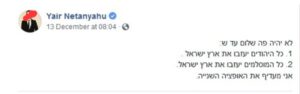
Netanyahu’s son, Yair Netanyahu, stated on Facebook in 2018: “There will not be peace in here until 1. All the Jews leave the land of Israel. 2. All the Muslims leave the land of Israel. I prefer the second”.

When rebuked for this vile arrogance, he increased in arrogance saying, “Why are people who have been calling for years to evacuate the settlers and establish a Palestinian state free of Jews shocked by this post?” When Facebook deleted his post, he shared a screenshot of the original post and rebuked them, saying: “thought police”. He was then blocked for 24 hours over his violation of Facebook’s community guidelines.


In 2006, the Zionist Prime Minister Ehud Olmert said, “Israeli lives are worth more than Palestinian ones”.

The Independent Newspaper


In 2012, the Zionist Interior Minister Eli Yishai said, “The goal of the operation is to send Gaza back to the Middle Ages. Only then will Israel be calm for 40 years”.


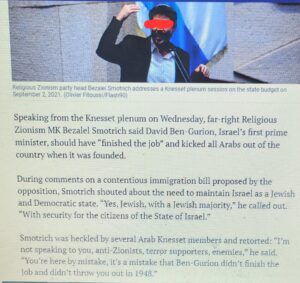
In 2021  the Zionist far-right Finance Minister Bezalel Smotrich said, “You are here by mistake because Ben Gurion didn’t finish the job and throw you out in 1948”.

The times of Israel


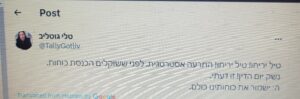
Female Zionist, Tally Gotliv – a Zionist lawyer, politician, and a member of the Knesset for the Likud party of Zionist Netanyahu- stated recently on X (twitter) regarding retaliation: “Jericho Missile! Jericho Missile! Strategic alert. Before considering the introduction of forces. Doomsday weapon! This is my opinion. May God preserve all our strength”.


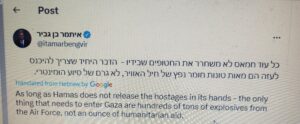
Ben Gvir Itamar- a Zionist lawyer, far-right politician, the Minister of National Security since 2022, a member of the Knesset, and leader of Otzma Yehudit – stated on X (Twitter): “As long as Hamas does not release the hostages, the only thing that needs to enter Gaza are hundreds of tons of explosives from the airforce, not an ounce of humanitarian aid”

Indeed, whoever carries out research will neither forget nor become oblivious to the fact that the conflict since 1948 stems from the Zionist movement and the consequences of its paramilitary actions in Palestine. This situation was established in part because of Zionist terrorist groups like Lehi, Haganah, and Irgun. These terrorist groups were responsible for the Nakba, the migration of the Palestinian people from their homeland, as well as sabotage, and attacks on civilian infrastructure, railways, and airfields. Furthermore, these terrorist groups and their commanders assimilated into the Zionist state when it declared independence. In addition to the Palestinian people, the British Mandate in Palestine was the target of these terrorist attacks. As one of the first significant acts of terrorism in the Middle East’s modern history, the King David Hotel bombing in Jerusalem in 1946 was a prime example. Therefore, the priority must be to educate and deradicalise Zionists and their adherents because, before their rise to power, Jews and Muslims coexisted despite the latter’s practice of a path that is considered abrogated in the Sight of Allah.

The poem, titled “The Friendship Song,” was shared by some Zionist online news outlet before being removed. Here is an excerpt from it:

Here the IDF is crossing the line

To annihilate the swastika bearers

In another year there will be nothing there

And we will return safely to our home within a year

We will annihilate them all

And then return to ploughing our fields

Recently, Zionist Arieh King, deputy mayor of Jerusalem, stated in a deleted tweet regarding some Palestinian non-combatant males detained by the Zionist army for interrogation to determine their Hamas affiliation:

There is no need to comment on his statement that the arrested non-combatant Palestinians are subhuman because we know who is behaving like spotted hyenas on a rampage and slaying nearly over 30000 Palestinians at present, including children. However, we will comment on both his statements referring to those non-combatants as ants and his statement “To protest the memory of Amalek, we will not forget.”

Indeed, even the ants during the time of Prophet Sulayman, peace be upon him and his father, knew that they would not be oppressed. Allah says:

وَحُشِرَ لِسُلَيۡمَـٰنَ جُنُودُهُ ۥ مِنَ ٱلۡجِنِّ وَٱلۡإِنسِ وَٱلطَّيۡرِ فَهُمۡ يُوزَعُونَ
حَتَّىٰٓ إِذَآ أَتَوۡاْ عَلَىٰ وَادِ ٱلنَّمۡلِ قَالَتۡ نَمۡلَةٌ۬ يَـٰٓأَيُّهَا ٱلنَّمۡلُ ٱدۡخُلُواْ مَسَـٰكِنَڪُمۡ لَا يَحۡطِمَنَّكُمۡ سُلَيۡمَـٰنُ وَجُنُودُهُ ۥ وَهُمۡ لَا يَشۡعُرُونَ
فَتَبَسَّمَ ضَاحِكً۬ا مِّن قَوۡلِهَا وَقَالَ رَبِّ أَوۡزِعۡنِىٓ أَنۡ أَشۡكُرَ نِعۡمَتَكَ ٱلَّتِىٓ أَنۡعَمۡتَ عَلَىَّ وَعَلَىٰ وَٲلِدَىَّ وَأَنۡ أَعۡمَلَ صَـٰلِحً۬ا تَرۡضَٮٰهُ وَأَدۡخِلۡنِى بِرَحۡمَتِكَ فِى عِبَادِكَ ٱلصَّـٰلِحِينَ

And there were gathered before Sulaiman (Solomon) his hosts of jinns and men, and birds, and they all were set in battle order (marching forwards). Till, when they came to the valley of the ants, one of the ants said: “O ants! Enter your dwellings, lest Sulaiman (Solomon) and his hosts crush you, while they perceive not.” So he [Sulaiman (Solomon)] smiled, amused at her speech, and said: “My Lord! Inspire and bestow upon me the power and ability that I may be grateful for Your Favours which You have bestowed on me and my parents, and that I may do righteous good deeds that will please You, and admit me by Your Mercy among Your righteous slaves.” [Surah An-Naml. Ayaat 17-19]

The ant sought an excuse for (Sulayman’s) army if they would have harmed its colony because they were unaware of their presence, and it blamed its colony if they failed to take safeguards by not entering their dwelling place. Sulaymaan [peace be upon him] smiled as a result of this because it is something that should amaze and make someone smile. [3] The ant knew Sulaymaan’s affair and that of his army, exalted Sulaymaan’s authority, and excused them if they crushed its colony because that would have occurred unintentionally. Sulaymaan heard the ant’s speech and understood it, so he smiled due to being amazed by the ant’s eloquence, advice, and fine expression. [4]

Indeed, this is only one of the Prophets’ and Messengers’ remarkable manners. They never intended to hurt anyone; rather, even those small animals (the ants) were assured that Prophet Sulayman [peace be upon him] and his subjects would not harm them intentionally- neither in speech nor deed. Compare this to the attitude of Zionists, who make a speech calling for mass murder and then launch a purposeful bombing campaign to kill thousands of noncombatant Palestinians, whilst certain that the innocent victims will include thousands of children. Compare how the ant advised its colony to enter their dwellings to avoid being unintentionally harmed by Prophet Sulaymaan’s army to how the Zionist army tells non-combatant Palestinians to relocate to this or that area for safety, then conflict begins in the same area they designated as a safe-haven. As a result, Elon Musk must remember that Zionists require more education and deradicalization than anyone else.

As for Mr. King’s statement “To protest the memory of Amalek, we will not forget”, this link contains its appropriate response. https://abuiyaad.com/a/amalekite-genocide-doctrine-gaza


Read articles by Shaikh Abu Iyaad [may Allah preserve him]:

Professor of Jewish Studies David J Wasserstein: How Islam Saved the Jews

https://abuiyaad.com/a/how-islam-saved-jews

The Just and Kind Dealings of the Prophet (ﷺ) with the Jews
https://abuiyaad.com/a/prophet-dealings-jews


[1] Translator: Shaikh Abu Iyaad. NobleQur’an

[2] An Excerpt from Tafseer as-Sadi. Slightly paraphrased

[3] An Excerpt from ‘Badaa’i At-Tafseer Al-Jaami Limaa Fassarahu Al-Imaam Ibnul Qayyim Al-Jawziyyah’ 2/279-282)

[4] An Excerpt from Tafseer As-Sadi

[7] O Faris Al-Hammadi! The time has arrived for your deceitful and absurd statements to be unveiled for all to see! [A question put to Faris “Everywhere I see Tabdee.”]

In The Name of Allah, The Most Merciful, The Bestower of Mercy.

قال ابن القيم: وعـلـيك بالتفصيل والتبيين فالإجمال والإطلاق دون بيان
قد أفسدا هذا الوجود وخبـطا الأذهان والآراء كل زمـان

Imam Ibn Al-Qayyim, may Allah have mercy upon him, said:

“It is obligated to you to provide detailed explanations and clarifications, as generalisations and unrestricted (speech) without elaboration (clarification) have corrupted the existence and confused minds and opinions throughout all times”.

Al-Allamah Salih Al-Fawzan, may Allah preserve him, stated:

There has to be a detailed explanation. The one who is not proficient in giving details should keep quiet because benefit is not acquired from his speech. And every time an error occurs, its cause is due to an absence of detailed explanation regarding truth and falsehood. There has to be detailed explanation and distinction and not mix-up. Indeed, it may be that there is something of truth and falsehood in an opponent’s statement, so all of it is neither deemed to be false nor true; rather there has to be a distinction between its truth and falsehood. All of it is neither rejected nor accepted; rather a distinction is made regarding the truth and what is correct and the falsehood and error in it. And if you are not proficient in giving details, then you should not enter into this field. [1]

13th August 2024 Faris was asked: Everywhere I see  Tabdee”. Then Faris added: “Tabdee’ meaning Calling someone a deviant Or labeling him as a deviant”. 

Firstly, [تبديع- Tabdee] in the Arabic Language does not mean “deviant” in the English language; rather, Tabdee in the English Language means to declare someone a [مبتدع (Mubtadi)- an innovator in religious matters].  He can be excused for translating Tabdee as deviant because English is not his first language. Secondly, not every [deviant – منحرف (Munharif)]  is a [Mubtadi – innovator in religious matters]; but every Mubtadi is a Munharif. Thirdly, as for Tabdee [declaring a person a Mubtadi (an innovator in religious matters)], Al-Allamah Ubaid Bin Abdillah Al-Jabiri, may Allah have mercy upon him, was asked: “The questioner says: Assalaamu alaykum Warahmatullaahi Wabarakaatuhu. We hear a statement from some of the Mashaayihk of Ahlus Sunnah, “This man is from the people of Bidah”. Is it understood that he is a Mubtadi (an innovator) or not?

Response: What I know is that this statement holds two interpretations (applications) according to Ahlus Sunnah. The first of them, which is often intended, is that he is a Mubtadi (an innovator in religion). He is aware of the truth yet remains obstinate. He rejects (truth), but not deviation; knows the Sunnah, but refuses to follow it and follows Bidah. He practices Bidah while knowing it is Bidah. The other meaning is that this man engages in Bidah, even though he is not a Mubtadi because what we know regarding the methodology of Ahlus Sunnah Wal Jamaa’ah is that they do not declare a specific person a Mubtadi until the proofs are established against him. [2]

In addition, concerning the intricate aspects of this matter about Tabdee and the various classifications of individuals along with their errors, we present an elaborate discourse by Al-Allamah Rabee Bin Hadi, may Allah protect him, as translated by Shaikh Abu Khadeejah, may Allah protect him. https://abukhadeejah.com/shaikh-rabee-establishment-of-proof-in-declaring-a-person-to-be-an-innovator/

As we delve deeper into this matter, it is essential to address the duplicity of Faris, who must once again be held accountable for his glaring double standards. He cautions against labelling people deviant, yet readily defends Dr. Muhammad Bin Hadi, who issues the judgment of Tabdee against some senior students of knowledge, [a] and similarly excuses Shaikh Sulayman Ar-Ruhayli, who stands in defence of Dr. Muhammad. He asserts that “Anybody who claims something, he has to give us a dalil”, however, has deceitful Faris inquired of Dr. Muhammad Bin Hadi regarding the proof for the Tabdee of senior students of knowledge before offering his defense of him and his ally, Shaikh Sulayman Ar-Ruhayli? This is the sad reality of a two-faced individual, a deceiver who ultimately undermines himself through the very dishonesty he attempts to conceal. Faris exposes his absurd double standards, even as he believes he is persuading others and disseminating guidance.

In the statement it is asserted that certain individuals have labeled Shaikh Abdur Razzaaq Al-Badr as a deviant, interpreting the term “Tabdee” in this manner. However, the source of this declaration is unknown, leaving us with no obligation to delve into the issue further. Without specifying the individual or group responsible for such a claim, the discourse remains unsubstantiated. Thus, if neither the inquirer nor Faris discloses the identity of those who deem Shaikh Abdur Razzaaq deviant, it parallels the unfounded conjectures of Tommy Robinson. Concerning Abdul Aziz Farhan, we find ourselves without any information regarding his circumstances, and thus we refrain from commenting on those whose situations remain unclear to us. In contrast, the duplicitous Faris is chastised for his nonsensical ramblings, charlatanism, and ludicrous opinions—all purportedly in the service of Dawah and the defense of the truth.

In conclusion, the statement that Tabdee is seen everywhere, which was inaccurately translated as deviant, is an overstatement that lacks credible support. Unless the claimant explicitly identifies the individuals labeled as deviant and provides information, it remains merely an inflated assertion, akin to the hyperboles of Nigel Farage. However, it is imperative to emphasise that clarity is essential, a principle upheld by esteemed scholars like Al-Allamah Rabee and others, who adeptly differentiate between those who guide and those who mislead. “Classifying people according to their beliefs, religions, and characteristics —particularly in the context of rendering judgments and establishing principles—is not an innovated or a new (aspect) of knowledge; rather, it is knowledge of Al-Jarh Wat Tadeel (the science of criticism and commendation within Islam); and this practice will endure within this Ummah as long as the cycle of day and night persists. Those who endeavour to extinguish the light of this discipline for the sake of their party or out of concern for their beloved ones—individuals who have been justly criticized—are, without a doubt, misguided who lead others astray. Classifying people with discernment and truth serves as a safeguard for the religion ordained by Allah. It is a combatant among the combatants facilitated by Allah through which is repelled the distortions of those two exceed the limits, the false claims of the falsifiers, and the false interpretations of the ignorant ones; the deviations of the innovators in religious matters, the schemes of the Khawaarij, and all the (deviant) sects that arise from the Ummah of As-Saadiq Al-Ameen [the Messenger Muhammad (peace and blessings of Allah be upon him)- the truthful and trustworthy one].” [3]

———————————-

[a]

To be continued…InShaAllah.


[1] An Excerpt from “at-Ta’leeqaat Al-Mukhtasar Alaa Al-Qaseedah an-Nooniyyah” 1/216

[2] Al-Haddul Faasil Bayna Mu’aamalah Ahl As-Sunnah Wa Ahl Al-Baatil 60

[3] Tasneefun Naas page 6

[6] O Faris Al-Hammadi! The time has arrived for your deceitful and absurd statements to be unveiled for all to see! [Deceitful Faris Attempts to Divert From The Core Issue Concerning Certain Individuals Who Ardently Support Dr. Muhammad at The Cost of The Recantation Demanded From Him]

In The Name of Allah, The Most Merciful, The Bestower of Mercy.

Shaikh Al-Islam Ibn Taymiyyah, may Allah have mercy on him, said:

ﻭﻟﻴﺲ ﻟﻠﻤﻌﻠﻤﻴﻦ ﺃﻥ ﻳﺤﺰﺑﻮﺍ ﺍﻟﻨﺎﺱ
ﻭﻳﻔﻌﻠﻮﺍ ﻣﺎ ﻳﻠﻘﻲ ﺑﻴﻨﻬﻢ ﺍﻟﻌﺪﺍﻭﺓ ﻭﺍﻟﺒﻐﻀﺎﺀ،
ﺑﻞ ﻳﻜﻮﻧﻮﻥ ﻣﺜﻞ ﺍﻷﺧﻮﺓ ﺍﻟﻤﺘﻌﺎﻭﻧﻴﻦ ﻋﻠﻰ
ﺍﻟﺒﺮ ﻭﺍﻟﺘﻘﻮﻱ ﻛﻤﺎ ﻗﺎﻝ ﺗﻌﺈﻟﻰ
وَتَعَاوَنُوا عَلَى الْبِرِّ وَالتَّقْوَى وَلا تَعَاوَنُوا عَلَى الإثْمِ وَالْعُدْوَانِ
وليس لأحد منهم أن يأخذ على أحد عهداً بموافقته على كل ما يريده وموالاة من يواليه ومعاداة من يعاديه،بل من فعل هذا كان من جنس جنكز خان وأمثاله الذين يجعلون من وافقهم صديقاً واليا، ومن خالفهم عدوَّا باغيا، بل عليهم وعلى أتباعهم عهد الله ورسوله بأن يطيعوا الله ورسوله ويفعلوا ما أمر الله ورسوله ويحرموا ما حرم الله ورسوله ويرعوا حقوق المعلمين كما أمر الله ورسوله، فإن كان أستاذ أحد مظلوماً نصره، وإن كان ظالماً لم يعاونه على الظلم بل يمنعه منه كما ثبت في الصحيح أنه قال:
(انصر أخاك ظالماً أو مظلوماً. قيل: يا رسول الله: أنصره مظلوماً فكيف أنصره ظالماً؟. قال تمنعه من الظلم فذلك نصرك إياه).
وإذا وقع بين معلم ومعلم أو تلميذ وتلميذ أو معلم وتلميذ خصومة ومشاجرة لم يجز لأحد أن يعين أحدهما حتى يعلم الحق، فلا يعاونه بجهل ولا بهوى، بل ينظر في الأمر، فإذا تبين له الحق أعان المحق منهما على المبطل سواء كان المحق من أصحابه أو أصحاب غيره، وسواء كان المبطل من أصحابه أو أصحاب غيره، فيكون المقصود عبادة الله وحده وطاعة رسوله واتباع الحق والقيام بالقسط
قال تعالى
يا أيها الذين آمنوا كونوا قوامين بالقسط شهداء لله ولو على أنفسكم أو الوالدين والأقربين، إن يكن غنياً أو فقيراً فالله أولى بهما، فلا تتبعوا الهوى أن تعدلوا وإن تلووا أو تعرضوا فإن الله كان بما تعملون خبيراً

It not allowed for educators to foster (illegal) partisanship among the people, nor to engage in actions that may incite enmity and hatred between them. Instead, they ought to be brothers, collaborating upon righteousness and piety, as Allah, The Exalted, says:

وَتَعَاوَنُوا عَلَى الْبِرِّ وَالتَّقْوَىٰ ۖ وَلَا تَعَاوَنُوا عَلَى الْإِثْمِ وَالْعُدْوَانِ

Help another in Al-Birr and At-Taqwa (virtue, righteousness and piety); but do not help one another in sin and transgression. [Al-Maa’idah. 2]

It is not permissible for any of them to receive a pledge from anyone to agree with him in everything he wants – having allegiance to the one he is allied to and enmity towards their adversaries. Whoever does this mirrors the behaviour of Genghis Khan and his ilk (in this affair), who take as loyal friends those who agree with them and the ones who oppose them as a rebellious enemy. Instead, it is obligated to them and their followers (i.e. the educators and students) to fulfil the covenant of Allah and His Messenger in obedience to Allah and His Messenger- doing what Allah and His Messenger have commanded, declaring unlawful what Allah and His Messenger have declared unlawful, and safeguarding the rights of the educators in a manner commanded by Allah and His Messenger.

Therefore, if one’s teacher is oppressed, he should help him; but should the teacher be the one perpetrating oppression, he should not help him in his act of oppression, as has been clearly articulated in the authentic books of hadeeth that the Prophet, peace and blessings of Allah be upon him, stated: “Help your brother, whether he is an oppressor or he is an oppressed one. People asked, “O Allah’s Messenger! It is all right to help him if he is oppressed, but how should we help him if he is an oppressor?” The Prophet said, “By preventing him from oppressing others.” [Al-Bukhaari 2444]

In the event of an argument or dispute arising between an educator and another educator, or between a student and another student, it is not permissible for anyone to help one of them until he knows the truth. Assistance should not be rendered out of ignorance or (vain) desires; rather, one examines the matter. Once the truth becomes clear, he helps the one who deserves to be helped against the one who is in error regardless of whether the one who deserves help is one’s companion or the companion of someone else, or whether the one who erred is one’s companion or the companion of someone else. Thus, the objective is only to worship Allah alone, obedience to Allah’s Messenger, adhere to truth, and establish justice. Allah, The Exalted, says:

يا أيها الذين آمنوا كونوا قوامين بالقسط شهداء لله ولو على أنفسكم أو الوالدين والأقربين، إن يكن غنياً أو فقيراً فالله أولى بهما، فلا تتبعوا الهوى أن تعدلوا وإن تلووا أو تعرضوا فإن الله كان بما تعملون خبيراً

O you who believe! Stand out firmly for justice, as witnesses to Allah; even though it be against yourselves, or your parents, or your kin, be he rich or poor, Allah is a Better Protector to both (than you). So follow not the lusts (of your hearts), lest you may avoid justice, and if you distort your witness or refuse to give it, verily, Allah is Ever Well-Acquainted with what you do. [Surah An-Nisaa. Ayah 135] [End of quote] [Majmoo Al-Fataawaa. 28/15-17] [Paraphrased]

Undoubtedly, the preceding discourse is lucid, and we beseech Allah to include us among those who steadfastly uphold justice, unyielding to fear or favouritism. The crux of the matter lies in the fact that certain individuals, such as Shaikh Sulayman Ar-Ruhayli, have chosen to openly support Dr. Muhammad Bin Hadi without any valid rationale, prompting Al-Allamah Rabee Bin Hadi Al-Mad’khali to issue a caution against him. There exists no uncertainty regarding Dr. Muhammad Bin Hadi’s situation, as he has overtly defied what is permissible and engaged in unequivocally impermissible actions by declaring Tabdee without substantiation. Similarly, there is no doubt concerning Dr. Sulayman Ar-Ruhayli’s stance, as he persistently and publicly endorses Dr. Muhammad Bin Hadi. Anyone who grasps the gravity and consequences of Dr. Muhammad’s actions will undoubtedly recognise the sound rationale behind Al-Allamah Rabee’s caution directed at those who openly endorse him. Furthermore, Shaikh Abu Iyadh has elaborated on several principles related to this issue, which can be found in the following link, commencing at the 52-minute mark: https://mixlr.com/albaseerah/showreel/narration-from-the-salaf-regarding-creed-and-methodology

Also read: Documents and Resources for Countering the Doubts of the Muṣaʿfiqah
https://www.manhaj.com/manhaj/articles/uyryh-documents-and-resources-for-countering-and-exposing-the-musafiqah.cfm

Furthermore, Shaikh Abu Iyadh presents a profound classification of individuals concerning Dr. Muhammad Bin Hadi’s Fitna. Please see the details here: https://www.manhaj.com/manhaj/assets/docs/types-of-people-mbh-fitnah.pdf

It is imperative to remain vigilant against the schemes of the duplicitous Faris, who attempts to misrepresent the situation as a conflict solely between Dr. Muhammad and Al-Allamah Rabee. [a] This portrayal is far from the truth, as we have elucidated throughout this series. The crux of the matter lies in the fact that Dr. Muhammad faced censure primarily due to his unwarranted Tabdee of those senior students of knowledge. Consequently, it is neither appropriate for Shaikh Sulayman to extend his defense of Dr. Muhammad—an action that prompted Al-Allamah Rabee to justly warn against Shaikh Sulayman for supporting an unjust figure—nor is it acceptable for the likes of the duplicitous Faris to conflate truth with falsehood in an attempt to rationalise his misleading narratives, all while promoting individuals without transparency or integrity. Thus, the only recourse left is for all parties involved to urge Dr. Muhammad to retract his erroneous tabdee and to absolve themselves from such transgressions.

In closing this article, we would like to share the exquisite advice imparted by some of the scholars of Ahlus Sunnah, including Shaikh Abdus Salam Burgess, may Allah’s mercy be upon him.

Imam Abu Bakr Ibn Al-Arabi Al-Maliki, may Allah have mercy upon him, said: Muhammad Bin Qaasim Al-Uthmaanee, may Allah have mercy upon him, told me more than once: “I arrived in Fustat one day, then I went to the gathering of Shaikh Abee Al-Fadl Al-Jawharee, may Allah have mercy upon him, and there I witnessed a statement that he uttered to the people. And that which he stated – in the first gathering when I sat with him – was that ‘The Messenger, peace and blessings of Allah be upon him, طلق – i.e. he did divorce, ظاهر – i.e. he did utter the statement to a wife, ‘You are like my mother’s back’, and آلى – i.e. he made an oath to abandon his wives for a month”.

When he (i.e. Shaikh Abee Al-Fadl Al-Jawharee) left, I followed him until I reached his house with a group of people; then he sat with us in the vestibule and acquainted them with my affair because he saw a stranger [i.e. I (Muhammad Bin Qaasim)] and did not know the person among those who came to him before. When most of them departed from him, he said to me, “I see that you are a stranger; do you have anything to say?” I said, “Yes”. He said to his companions, “Excuse him from having to speak in your presence”, so, they got up and I stayed alone with him. I said to him, “I attended your gathering today so that Allah may bless me (with some of the knowledge you possess), and I heard you say, ‘Allah’s Messenger [peace and blessings of Allah be upon him] آلى – i.e. he once made an oath to abandon his wives for a month and what you said was true; طلق – i.e. he did divorce women, and what you said was true, and you said that Allah’s Messenger, peace and blessings of Allah be upon him, ظاهر i.e. he did utter the statement to a wife, ‘You are like my mother’s back’, but this never happened and can never be correct to say that it happened because Az-Zihaar [i.e. to say to one’s wife, ‘You are like my mother’s back’ (i.e. unlawful for me to approach)] is an evil statement and false speech, and this can never be uttered by the Prophet, peace and blessings of Allah be upon him”. He hugged and kissed my forehead, and said, “I repent from this statement. May Allah reward you on my behalf as a good teacher”.

I departed from his presence, and the next day I went early to his gathering, but he was in the Central Mosque before me and was sitting on the pulpit. When I entered the Masjid and thus he saw me, he called out at the top of his voice (saying), “Welcome, my teacher. Make room for my teacher”. So, the people turned towards me and their eyes stared at me! O Abu Bakr! And you know me – meaning, he (i.e. Muhammad Bin Qaasim Al-Uthmaanee) was indicating to Ibnul Arabi about his extremely shy character because when someone greeted him by surprise, he would feel shy – due to his extreme shyness – and turned red as if his face was painted with Gulnaar (pomegranate blossom). He (i.e. Muhammad Bin Qaasim) continued, “People hastened towards me, raising their hands towards me (i.e. acknowledging me) and nudging me until I reached the pulpit, and I did not know in which part of the earth I was due to my extreme shyness (i.e. shocked), whilst the Masjid was overcrowded with people and I sweated due to shyness. Then the Shaikh turned towards the people and said to them, ‘I am your teacher and this is my teacher! Yesterday, I told you that Allah’s Messenger آلى – i.e. he once made an oath to abandon his wives for a month; طلق – i.e. he did divorce women, and ظاهر i.e. he once uttered the statement to a wife, ‘You are like my mother’s back’, and neither did a single one of you give me the correct understanding nor respond to me, but he (i.e. Muhammad Bin Qaasim) followed me to my house and said such and such to me. I repeat (i.e. right now) what took place between him and I, repent from yesterday’s statement, and return to the truth. Whoever hears it from those who were present, let him not rely on what he says, and let the one who is present convey this affair to the absent one. May Allaah reward him with good’”. Then he (i.e. Shaikh Abee Al-Fadl) started supplicating a lot and the people responded with Aameen.

Ibnul Arabi stated – after narrating this incident- “So look – may Allah have mercy upon you – at this firm adherence to the religion and an acknowledgment of the people of knowledge given by this man – whose leadership was manifest and whose worth was well known- to a stranger whom he neither knew nor where he came from! Follow his example and you’ll be led aright”. [(1)] [End of quote]

This narrative serves as a profound reminder for individuals like Dr. Muhammad, compelling them to reflect on the esteemed figures who came before us. Despite their remarkable knowledge and revered status among the populace, their profound reverence for Allah led them to humbly retract their positions in public, devoid of hesitation or fear of losing their esteemed reputation. Similarly, this should inspire individuals like the duplicitous Faris to embrace the truth rather than evade it, resorting to baseless tirades and disparaging remarks. It also demonstrates his misguided assertion that those who pursue Dr. Muhammad’s matters in a manner he disapproves are engaged in something tantamount to foolishness; rather, it is, in fact, Faris who embodies such folly by attempting to obscure the truth through his attacks. Furthermore, there exists no rationale for Shaikh Sulayman to support Dr. Muhammad. Instead, the story recounted by Abu Bakr Ibn Al-Arabi should serve as a poignant reminder for all who seek justice in this ongoing discourse.

Shaikh Abdus Salaam Burgess, may Allah have mercy upon him, said, “It is obligated to a student to recant a mistake, just as it is obligated to a teacher to return to the truth when he errs. He should not be deterred from returning to the truth upon reassessing a statement and discovering that it contradicts what is correct, as this reflects a commitment to fairness and humility. Therefore, one must adhere to what is correct, regardless of whether it is presented by someone younger or older. It is a blessing for a teacher to have a student who notifies him of his errors and guides him toward what is correct so that he does not remain in ignorance. This requires that one express gratitude to Allah, The Exalted, followed by gratitude to the individual through whom one was guided (to the truth), be it a student or another person”. [2] [End of quote]

This succinct yet impactful counsel deserves our utmost attention. Notably, the esteemed Shaikh Abdus Salaam Burgess, may Allah have mercy upon him, a cherished confidant of Dr. Muhammad Bin Hadi, held him in the highest regard, even composing a heartfelt poem in his honour. Thus, Dr. Muhammad and his loyal supporters must heed this invaluable wisdom, especially in light of the duplicitous Faris, who relentlessly seeks to exploit the shadows for his unpraiseworthy ambitions regarding this matter. There exists no justification for such endeavours, save for the pressing need to acknowledge and rectify the grave errors—specifically, the erroneous Tabdee issued by Dr. Muhammad—and to insist upon this accountability.

Imam Muhammad Ibn Saalih Al-Uthaymeen, may Allah have mercy upon him, said: It is obligated to a person to return to the truth wherever he finds it; even if it opposes his statement, he should return to (the truth) because this is nobility for him in the Sight of Allah, nobility in the eyes of the people, safer for his state of accountability and vindication, and it will not harm him. Therefore, do not think that if you abandon your statement for what is correct, this will lower your status among the people; rather, this will raise your status and people will know that you only follow the truth. As for the stubborn one- remains as he is, and rejects the truth, this is an arrogant person, and Allah’s refuge is sought. This happens to some people, even to students of knowledge, and Allah’s refuge is sought. It becomes clear to him – after discussion – regarding what is correct and that what is correct is contrary to what he said yesterday, however, he remains in his opinion. Shaytan makes him preoccupied with thinking that if returns (to what is correct), the people will denounce him and say, “This person is a yes-man who makes a different statement every day”. This (i.e. if the people were to utter this view about him) does not harm if he returns to what is correct. [(3)] [End of quote]

We remind ourselves that it does not matter who makes the truth apparent to us. Allah [The Exalted] said: [وَٱلَّذِینَ إِذَا ذُكِّرُوا۟ بِـَٔایَـٰتِ رَبِّهِمۡ لَمۡ یَخِرُّوا۟ عَلَیۡهَا صُمࣰّا وَعُمۡیَانࣰا – And those who, when they are reminded of the Signs of their Lord, fall not deaf and blind thereat]. [Surah Al-Furqan. Ayah 73]

Imam Muhammad ibn Saalih Al-Uthaymeen, may Allah have mercy upon him, commented on this Ayah: The one who gives the reminder is not made known, so it includes everyone who gives the reminder; and to show that their acceptance of the reminder is not due to the specific person who gives the reminder, because there are people who do not accept the truth except from a specific person. If it comes from another person, he does not accept it, such as what the People of the Scripture did to the Prophet [peace and blessings be upon him], and also other than them. They do not accept the truth except from a specific group or a specific person. Allah said:

[وَلَئِنْ أَتَيْتَ الَّذِينَ أُوتُوا الْكِتَابَ بِكُلِّ آيَةٍ مَا تَبِعُوا قِبْلَتَكَ – And even if you were to bring to the people of the Scripture (Jews and Christians) all the Signs, they would not follow your Qiblah (prayer direction)]. [Surah Al-Baqarah. Ayah 145]

So here (in this Ayah), Allah said: [إِذَا ذُكِّرُوا – And those who, when they are reminded].

The one who gives the reminder is not made known, which shows that they accept the truth because it is the truth- not due to who says it. They do not accept or reject reminder due to the specific person who gives the reminder, but rather they accept it because it is a reminder. This is the Faa’idah behind not mentioning the doer of the action (i.e. the one who gives the reminder). [(4)]

[a] A tweet revealing the duplicitous nature of Faris, who attempts to frame the basis of the affair as a problem between Dr. Muhammad and Al-Allamah Rabee Bin Hadi Al-Mad’khali.

To be continued…InShaAllah


[1]: Ahkaam Al-Qur’aan 1/248-249

[2] An Excerpt from ‘Awā’iq at-Talab pg. 52 Slightly paraphrased

[3]: Sharh Riyaadus Saaliheen 3/537. slightly paraphrased

[4] An Excerpt from “Tafseer Surah Al-Furqan2 shared by our Salafi brother Abdul Malik (Abu Zakariyyah Al-Congoli (may Allah preserve him)

[5] O Faris Al-Hammadi! The time has arrived for your deceitful and absurd statements to be unveiled for all to see! [Duplicitous Faris seeks to divert attention from serious issues that are as evident as the midday sun.]

In The Name of Allah, The Most Merciful, The Bestower of Mercy.

Faris Reminded About The Riba of The Tongue

Allah’s Messenger, peace and blessings of Allah be upon him] said, “Verily, the worst act of usury is to attack the honour of a Muslim without a just cause”. (1) Meaning: The greater in evil and the more strictly prohibited is to unleash your tongue against the honour of a Muslim by insulting him, acting haughtily towards him, and speaking ill of him through abusive language or slander. This becomes a stricter prohibition because honour is more valuable than wealth. “Without a just cause”. This shows there are instances in which it is allowed to refer to someone negatively by using language like “such and such is an oppressor or transgressor” or “such and such is an innovator (in religious affairs) and an open sinner” to warn others is allowed. (2)

This has been referred to as usury because the transgressor receives his honour and then goes above and beyond it as if he has added an increase that infringes on the boundaries concerning the honour of a Muslim, which is more valuable than his wealth. According to At-Teebee, may Allah have mercy upon him, “From the standpoint of emphasis, honour is included in the categories of wealth. Usury is classified into two types: that which is conventional and is described as what is added to debts, and that which is not unconventional, such as verbally disparaging someone’s honour.” Al-Qaadhee, may Allah have mercy upon him, said, ”Violating a Muslim’s honour means dealing with him more than he deserves of what is to be said about him, or more than is permitted to be said about him, which is why it is compared to usury and regarded as one of its types. Then it is considered to be worse because it contains more harm and is more serious in corruption”. (3)

Duplicitous Faris asserts that the matter concerning Dr Muhammad Bin Hadi “Must be buried” [a], claiming that any further pursuit in a manner he deems inappropriate is sheer folly and a manifestation of Shaytaan’s influence. [b] Nevertheless, it is undeniable that Dr Muhammad Bin Hadi has exceeded acceptable bounds in his remarks about those senior students of knowledge, labelling them with Tabdee. [c] In contrast, Faris conveniently overlooks this issue, offering ludicrous justifications and resorting to insults against those who seek transparency and fairness. Thus, one must ponder: who truly embodies the essence of dimwittedness in this situation—the advocates for justice and clarity, or Faris, who willfully ignores the glaring truth? Faris is the one embodying this characteristic in this situation, as Imam Ibn Al-Athir, may Allah have mercy upon him, said: “The essence of foolishness is placing something in an inappropriate place while being aware of its ugliness”. [An-Nihaayah 1/442]

Furthermore, the misstep of Dr Muhammad Bin Hadi, stemming from the unfounded Tabdee he has proclaimed against those senior students of knowledge, constitutes a grave act of Dhulm (oppression). It is indisputable that the cunning Faris is fully cognizant of the perils associated with such oppression. The Prophet, peace and blessings of Allah be upon him, said that Allah said: “Allah Almighty said: O My servants, I have forbidden injustice for Myself and I have forbidden it among you, so do not oppress one another”. [4] The Prophet, peace and blessings of Allah be upon him, said: “Beware of oppression, for indeed oppression will be darkness on the Day of Resurrection….” [5]

In light of the profound warnings against oppression found in these two Prophet reports, among numerous others we have not cited, one cannot help but ponder the motives of the duplicitous Faris. He insists that the matter concerning Dr Muhammad Bin Hadi “must be buried,” asserting that any pursuit of it, particularly in a manner he disapproves of, is sheer folly and a manifestation of Shaytaan’s influence. Yet, Dr. Muhammad has to retract his unfounded Tabdee, which undeniably constitutes oppression. Thus, who truly deserves the label of an airhead, engaging in a pursuit tainted by Shaytaan’s whispers? Is it those who rightfully demand Dr. Muhammad to renounce his oppressive stance, or is it Faris, who willfully deceives himself into believing that this matter is resolved? Imam An-Nawawi, may Allah have mercy upon him, said: “The reality of a fool is that he does what harms him while knowing its ugliness”. [Sharh Sahih Muslim 18/136]

In addition to speaking of others more than they merit, an act akin to usury and injustice as stated in the hadith cited at the beginning of this article, Dr. Muhammad has remained stubborn, even when faced with robust counterarguments. He has no proof to establish the Tabdee, yet continues to cling to his misconceptions. Thus, we must quote Al-Allamah Abdur Rahmaan Bin Yahyah Al-Mu’allimee, may Allah bestow His mercy upon him, regarding the perils of persisting upon error as follows:

To oppose desires – by way of action – for the sake of the truth is a manifest affair due to the obligation and difficulty it involves, and this can be viewed from different angles: A person sees that by acknowledging the truth, it would necessitate that he has acknowledged that he was upon falsehood because a person is nurtured upon a religion, creed, school of thought or views, which he acquired from his nurturer and teacher, considers it to be the truth and followed it for a long time. Then when it becomes clear to him that (the religion, creed, view, or school of thought) is false, it becomes difficult for him to acknowledge, just like when his forefathers, ancestors or the one he follows are upon a (particular) way and its falsity is clarified for him because he sees that their deficiencies necessitate his own deficiencies, and an acknowledgement of their misguidance or errors necessitates his own.

It may be that clinging to falsehood gave him prestige, fame and a livelihood, so it becomes difficult for him to acknowledge that (what he is upon is) falsehood and thus all those benefits (i.e. the fame, prestige, livelihood etc) would disappear. It may be that a person is upon ignorance or falsehood, then another person comes along and clarifies the proofs for him, so he sees that by acknowledging such proofs, it would necessitate that he is lacking (in understanding) and that it was that person who guided him. And due to this we find that it is not difficult for some of those attributed to knowledge to acknowledge their mistakes when it becomes manifest to them in their research and studies, but it becomes difficult for them if it was others who clarified such mistakes.

When another person clarifies the truth for him, he sees that acknowledging such truth would necessitate an acknowledgement of the clarifier’s virtue, knowledge and correctness due to that clarification, and thus that becomes great in the eyes of the people and many people follow him [i.e. the person who clarified the truth]. So you will find some of those attributed to knowledge being eager to prove the mistakes of other scholars even if that is done by way of falsehood due to envy and seeking to diminish their status amongst the people. To oppose desires for the sake of the truth -in affairs of knowledge and creed- can indeed be difficult to accomplish, therefore it requires (sincere) research and contemplation. In this regard, one needs to ask the scholars and benefit from them, adhere to the fear of Allah, and seek Allah’s Tawfeeq and guidance. [6]

In light of the treacherous obstacles that hinder an individual from embracing the unveiled truth, one must ponder why the duplicitous Faris is intent on concealing the reality that Dr Muhammad has stubbornly refused to retract his erroneous Tabdee against those senior students. However, Faris asserts that his affair “Must be buried”, suggesting that any pursuit of it, in a manner he deems inappropriate, is sheer folly and a manifestation of Shaytaan’s influence. Thus, who truly deserves the label of blockhead: those who insist that Dr Muhammad renounce his misguided Tabdee and return to the path of truth, or the duplicitous Faris himself? Indeed, Faris is the fool in this specific matter! Ar-Raghib, may Allah have mercy upon him, said, “Foolishness is an individual’s failure to arrive at the correct conclusion in most instances and placing a statement in other than its appropriate place”. [Muhaadaraat al-Adbaa /25]

In conclusion, it must be made known that in essence, the heart of the matter does not revolve around Al-Allamah Rabee or Dr. Muhammad Bin Hadi; it was fundamentally about the Tabdee that Dr. Muhammad levied against certain distinguished senior students of knowledge. This prompted a rebuke from Al-Allamah Rabee, Al-Allamah Ubaid, Shakh Abdullah Al-Bukhari, and others. The duplicitous Faris endeavours to depict this situation as a quarrel between Al-Allamah Rabee and Dr. Muhammad, advocating that “It must be buried”. Such a narrative may easily mislead the naive seeker of truth into viewing it as a trivial personal dispute. Faris needs to uphold justice and sincerity in his expressions and positions. Thus, we leave him with these significant reminders by Shaikh Al-Islam Ibn Taymiyyah, may Allah have mercy upon him:

“Allah loves speech with knowledge and justice, and to give (everything) the rights that belong to it, and to place the people in their rightful positions”. [7]

“It is well known that the mere aversion of those who disagree or the affection of those who agree does not serve as (proof) for the soundness or corruption of a statement unless it is based on guidance from Allah; rather, using it as a proof is akin to following one’s desires without guidance from Allah; for an individual’s adherence to what they desire is to accept a statement and action they love while rejecting those they hate without guidance from Allah”. [8]

“Speech about the people has to be with knowledge and justice, and not by way of ignorance and oppression”. [9]

“The one who follows the path of justice will exalt the one worthy of being exalted and he will love and ally with him; he will give the truth its due right, exalt the truth and show mercy to the creation”. [10]

———————————————————–

[a]

[b] Faris 9th August 2024 Video (1)

[c] https://www.manhaj.com/manhaj/print.cfm?uyryh

https://twitter.com/AbuIyaadSP/status/1018974451269033986/photo/1

To be continued InShaAllah


[1] Abu Daawud 4876

[2] An Excerpt from ‘Awnul Mabood Sharh Sunan Abee Daawud’ 13/152

[3] An Excerpt from ‘Mirqaatul Mafaateeh Sharh Mishkaat Al-Masaabeeh’ 8/3157

[4] Muslim 2577

[5] Muslim 2578

[6] An excerpt from ‘At-Tankeel Bimaa Fee Ta’need Al-Kawthariy Minal Baatil’ 2/180-181 with the checking of Imaam Albaanee (rahimahullaah).

[7] Majmoo Al-Fataawaa: 12/205]

[8] Majmoo Al-Fataawaa 4/189-190]

[9] Minhaajus Sunnah: 4/337]

[10] Minhaajus Sunnah: 4/544

Part 4: O Faris Al-Hammadi! The time has arrived for your deceitful and absurd statements to be unveiled for all to see! [Faris hit us and wept; preceded us and lodged a complaint]

https://twitter.com/AbuIyaadSP/status/1018974451269033986/photo/1

In The Name of Allah, The Most Merciful, The Bestower of Mercy.

Abu Ad-Darda, may Allah be pleased with him, reported that the Prophet, peace and blessings of Allah be upon him, said: “The heaviest (deed) on the scale is good manners”.

Al-Allamah Zayd Bin Hadi Al-Mad’khali, may Allah have mercy upon him, said:

This hadith serves as evidence regarding the virtue of good manners and the obligation to be good-mannered. The knowledge of the Shariah forms the foundation of manners. When Allah bestows knowledge of the Shariah upon an individual, it leads them towards exhibiting good manners. Consequently, a Muslim demonstrates good manners towards others through good dealings-assisting the vulnerable, honouring guests, greeting others with Salaam, imparting knowledge, and enjoining good and forbidding evil. All these are fruitful outcomes of good manners. An individual cannot exhibit good manners unless he is among those who adhere to the commands of Allah and refrain from acts of disobedience. This implies that his conduct must align with the obligations set forth by the Shariah. He fulfills Allah’s commands and is shy to fall short concerning that which Allah has commanded him. He avoids disobedience, prohibited actions, and evil deeds out of shyness before Allah and a desire to be merciful to himself, as such actions can lead to punishment in both this life and the hereafter. Furthermore, he applies this to all that Allah has commanded, steering clear of what Allah has prohibited and detested.

Being good-mannered includes:

Fulfilling Allah’s rights most perfectly, neither negligent nor exceeding the legislated boundaries of the Shariah. To exhibit good manners towards one’s family, first and foremost towards one’s wife, son, daughter, and others in the family, so that this fosters an environment of harmony, cooperation, and positive feelings among all family members, preventing any form of division or estrangement.

To exhibit good manners towards parents by being dutiful to them, refraining from being undutiful, showing compassion, and supplication for them, treating them with kindness, whether they are living or deceased, by making supplications for them, spending in charity on their behalf, and speaking of them positively.

To exhibit good manners towards extended family members from both the paternal and maternal sides. To exhibit good manners towards neighbours, regardless of whether they are Muslims or not. Neighbours have rights; a Muslim neighbour is entitled to the rights associated with both their faith and their status as a neighbour, while a relative who is also a neighbour holds three sets of rights: those of a Muslim, a neighbour, and a family member.

To exhibit good manners towards one’s companions by pleasantly speaking to them and fulfilling the rights of companionship. To exhibit good manners towards one’s Shuyookh—those Shuyookh of Ahlus Sunnah from whom knowledge is sought—by showing them respect, interacting with them kindly, and consistently supplicating for their well-being, as a teacher imparts significant benefits to their students. In contrast, regarding Ahlul Bidah Wad-Dalaal, even if some of them engage in study with others, their teachings, and learning yield no true benefit.

To exhibit good manners towards fellow students, whether in school settings, during specific gatherings, at designated lessons in the Masjid, or in any other location. An individual should embody good manners, which should be reflected in their speech, actions, interactions, and adherence to promises. This includes fostering love among one another as prescribed by Shariah and nurturing affection for one another for the sake of Allah. The significance of this noble act is highlighted in the hadith, “The heaviest thing on the scales is good manners.” This implies that good manners represent the most substantial deed in the realm of virtuous actions, as they pave the way for all commendable deeds while countering various forms of wrongdoing. And Allah knows best. [1]

Deceitful Faris stated about good manners:

Observation: O Faris! Concealing truth and then claiming to be forbearing is not commendable; rather, it is the patience in upholding the truth that deserves recognition. Imam Ahmad exemplified adherence to the truth while also demonstrating exemplary character. In contrast, you remain silent regarding the truth and claim that seeking clarification about Dr. Muhammad Bin Hadi is tantamount to foolishness. You have even suggested that engaging in this matter is influenced by Shaytaan, despite your conscious choice to avoid openly acknowledging that Dr. Muhammad has committed oppression and transgression by issuing a false Tabdee, which has been challenged and rebutted by several scholars. Nevertheless, he remains unyielding. Is it considered good manners to remain silent about the truth when you can speak? Have you not reflected on the trials that Imam Ahmad endured for advocating the truth? We should remind you of this account before sharing a link concerning Imam Ahmad’s patience. Muhammad Ibn Bandaar As-Sabbaak Al-Jurjaani, may Allah have mercy upon him, said: I said to Ahmad Ibn Hanbal, may Allah have mercy upon him: “It is difficult for me to say that this one is a weak (narrator) and that one is a liar”. Ahmad said, “If you remain silent and I remain silent, then when will the ignorant distinguish between the authentic and the flawed (narration)”. [2] Read below: https://abukhadeejah.com/benefits-in-the-manhaj-by-studying-the-life-and-legacy-of-the-imam-of-ahlus-sunnah-ahmad-ibn-hanbal-161ah-241ah/#:~:text=Imam%20Ahmad%20(rahimahull%C4%81h)%20was%20raised,him%20upon%20piety%20and%20virtue.

Deceitful Faris said:

Observation: O Faris! This assertion can be wielded for both truth and falsehood; thus, a discerning individual needs to scrutinise the reality of the one who employs it as evidence for their own stance. The basis of the rebuttals against you lies in your lack of decorum, your cunning rhetoric, and your deceit regarding the truth in the matter concerning Dr. Muhammad Bin Hadi. Consequently, this statement serves as a testament against you rather than in your favour. As Al-Allamah Zayd, may Allah bestow His mercy upon him, articulated, that good manners also entail promoting virtue and prohibiting evil. Yet, not only have you abstained from advocating for righteousness and denouncing wrongdoing in this instance, but you have also dismissed our quest for truth as folly and a manifestation of Shaytaan’s influence, even though Dr. Muhammad Bin Hadi transgressed against those senior students of knowledge, whom he unjustly labeled with a false Tabdee and has continued without remorse. Thus, you have become your own adversary through your engagement in sophistry and obfuscation. You have wronged us by equating our earnest pursuit of truth with foolishness and the whispers of Shaytaan, however, you seek to portray yourself as the victim. This behaviour is nothing short of a lamentable and desperate attempt to play the victim, as eloquently expressed by the poet.

ضربني وبكى
سبقني واشتكى

He hit me and wept; preceded me and lodged a complaint.

Many of us can easily recall the mischievous escapades of our younger siblings, who would stealthily damage our treasured possessions. When we would confront them, our parents—especially our mothers—would often swiftly reprimand us, unaware of the mischief instigated by the little one. This sibling rivalry, a playful yet irritating game, has no place in the noble pursuit of Dawah. Therefore, do not be among those who instigate trouble and then feign victimhood when justly confronted. Such behaviour is akin to dishonesty, particularly in the context of Dawah. While it is clear that your actions may be rightly condemned, you have sought to twist this rightful criticism into an undeserved rebuttal and rebuke. Allah says:

وَلَا تَلْبِسُوا الْحَقَّ بِالْبَاطِلِ وَتَكْتُمُوا الْحَقَّ وَأَنتُمْ تَعْلَمُونَ

And mix not truth with falsehood, nor conceal the truth while you know (the truth)].

Imaam Ibn Al-Qayyim, may Allah have mercy upon him, said: “Allah has prohibited the amalgamation of truth with falsehood, thus this leads to the obscuring of the truth. The act of blending truth with falsehood results in a situation where one may be mistaken for the other. This constitutes forgery and deception, whereby what is presented is contrary to its actual nature. Similarly, when truth is intertwined with falsehood, the perpetrator presents falsehood disguised as truth and articulates statements that possess dual interpretations—one that is accurate and another that is misleading. Consequently, the listener may be misled into believing that the speaker is conveying the accurate interpretation, while the speaker intends the corrupt meaning”. [3]

Read: Dr Muhammad Bin Hadi and the Musafiqah

https://twitter.com/AbuIyaadSP/status/1018974451269033986/photo/1

https://www.manhaj.com/manhaj/print.cfm?uyryh

In conclusion, after I shared the Rudud provided in the aforementioned links, compiled by Shaikh Abu Iyadh, may Allah protect him, Faris opted to block my Twitter account. Therefore, I have enlisted the help of a brother to share some of his tweets, ensuring that our dialogue continues until he either ceases his remarks or offers a sincere apology for deeming our pursuit of truth as foolish and a product of Shaytaan’s influence. It is indeed a paradox, as none could be more foolish and more influenced by Shaytaan than he and those who deliberately overlook the unjust Tabdee issued by Dr. Muhammad Bin Hadi, and then attempt to assign blame to the innocent.

To be continued InShaAllah


[1] An Excerpt from “at-Ta’leeqaat Al-Maleehah Alaa Al-Ahaadeeth As-Saheehah. 1/38-39

[2] Al-Kifaayah Fee Ilm Ar-Riwaayah 1/63

[3] An Excerrp from “Badaa’i At-Tafseer Al-Jaami Limaa Fassarahu Al-Imaam Ibnul Qayyim’ 1/124

Part 3: O Faris Al-Hammadi! The time has arrived for your deceitful and absurd statements to be unveiled for all to see! [A Brief Examination of Faris’s Main Assertions]

In The Name of Allah, The Most Merciful, The Bestower of Mercy.


Allah, The Most High, says:

يَـٰٓأَيُّہَا ٱلَّذِينَ ءَامَنُواْ كُونُواْ قَوَّٲمِينَ بِٱلۡقِسۡطِ شُہَدَآءَ لِلَّهِ وَلَوۡ عَلَىٰٓ أَنفُسِكُمۡ أَوِ ٱلۡوَٲلِدَيۡنِ وَٱلۡأَقۡرَبِينَۚ إِن يَكُنۡ غَنِيًّا أَوۡ فَقِيرً۬ا فَٱللَّهُ أَوۡلَىٰ بِہِمَاۖ فَلَا تَتَّبِعُواْ ٱلۡهَوَىٰٓ أَن تَعۡدِلُواْۚ وَإِن تَلۡوُ ۥۤاْ أَوۡ تُعۡرِضُواْ فَإِنَّ ٱللَّهَ كَانَ بِمَا تَعۡمَلُونَ خَبِيرً۬ا

O you who believe! Stand out firmly for justice, as witnesses to Allah; even though it be against yourselves, or your parents, or your kin, be he rich or poor, Allah is a Better Protector to both (than you). So, follow not the lusts (of your hearts), lest you may avoid justice, and if you distort your witness or refuse to give it, verily, Allah is Ever Well-Acquainted with what you do. [An-Nisaa.135]

وَإِن تَلۡوُ ۥۤاْ أَوۡ تُعۡرِضُواْ فَإِنَّ ٱللَّهَ كَانَ بِمَا تَعۡمَلُونَ خَبِيرً۬ا

And if you distort your witness or refuse to give it, verily, Allah is Ever Well-Acquainted with what you do.

Imam Ibn Al-Qayyim, may Allah have mercy upon him, said:

Allah, Glorified be He and free is He from all imperfections, mentions two reasons that will inevitably lead to the concealment of truth, then He warned against them and issued a threat: the first of them is distortion and the second is to turn away from giving truthful witness. That is because when a proof that supports the truth is manifested and the one who wants to repel it finds no way of doing so, he refrains from mentioning it and thus becomes a silent devil, and sometimes he distorts it. Distortion is of two types -distorting words and meanings. Distorting words occur when one utters a word in a context in which it does not establish the truth – either adding to the word, omitting something from it, or substituting it with something else to the extent that the listener is made to believe something, whilst something else is intended, just as the Yahood [i.e. those Yahood who disbelieved in the Prophet and hated him in Madeenah] used to distort words when giving Salaam to the Prophet [i.e. saying As-Saamu Alayka (death be upon you), instead of saying Assalaamu alaykum)]. This is one type of distortion. The second type of distortion is related to meanings – distorting the wording, giving it an interpretation that is not intended by the one who uttered it and pretending not to know its unintended meaning; or dropping other meanings intended by it. Allah, The Exalted, says: [وَإِن تَلۡوُ ۥۤاْ أَوۡ تُعۡرِضُواْ فَإِنَّ ٱللَّهَ كَانَ بِمَا تَعۡمَلُونَ خَبِيرً۬ا – and if you distort your witness or refuse to give it, verily, Allah is Ever Well-Acquainted with what you do]. [1]


Faris stated: “You know I get asked this question a lot, and I know usually, Allahu a’lam I’m tested, I’m being tested with this question. Then I say to the brothers who still indulging in such a matter that they should fear Allah and get busy with things that are beneficial to them, yeah”

Observation: In the statement above, deceitful Faris says Allah knows best, but he believes that he is being tested! Therefore, the only thing we deduce from this is that we are all tested in one of two ways in the arena of Dawah and adherence to the religion: one may be tested and challenged while advocating for the truth, or individuals may assess someone’s position on a significant matter before accepting knowledge from them. Neither scenario poses a problem for someone who is questioned, as their ultimate aim is to uphold the truth and maintain the correct position. The challenges faced in the pursuit of Dawah are well known from the stories of the Prophets and their followers. Furthermore, we all know what is mentioned in Surah Al-Asr. We ask Allah to grant us Tawfeeq and include us among those who embody the four qualities highlighted in Surah Al-Asr. Read below:

The pinnacle of human perfection is attained through four qualities

However, what stands out most prominently in Faris’s statement is the scrutiny he faces concerning his stance on a particular issue, specifically the matter of Muhammad Bin Hadi, which will soon come to light. First, it is essential to establish that the evaluation of a teacher or caller’s reliability is a well-established principle within the Manhaj of the Salaf before one seeks knowledge from them. Imam Ibn Sirin, may Allah have mercy upon him, said: “Indeed, this knowledge is religion, so carefully consider from whom you take your religion”. [2]

Imam Muhammad Ibn Salih Al-Uthaymeen, may Allah have mercy upon him, said: We add trustworthiness as an additional characteristic alongside proficiency because proficiency is a strength and it has to be accompanied by trustworthiness. Allah says:

إِنَّ خَيۡرَ مَنِ ٱسۡتَـٔۡجَرۡتَ ٱلۡقَوِىُّ ٱلۡأَمِينُ

Verily, the best of men for you to hire is the strong, the trustworthy.[Al-Qasas. 26]

It may be that a scholar is proficient and vast in knowledge, able to derive and explain subsidiary issues from fundamental principles, as well as categorise, distinguish, and place different subject matters in their appropriate place, but he is not trustworthy and might misguide you from where you do not know”. [3]

Thus, it is only fitting that the seekers of knowledge should be aware of the individuals they accompany or acquire their knowledge from. The poet said, “Do not ask about a man, but ask about his companion because every person guides himself by his companion”. [Al-Ibaanah 2/439] Translated by Spubs

Ibn Mas’ood said, “Indeed, a person walks along & accompanies the one whom he loves & who is like him”. [Al-Ibaanah 2/476] Translated by Spubs

Abu Dardaa said, “It is from the Fiqh (understanding of a person) that he (chooses) those whom he walks with, whom he enters upon (visits) & whom he sits with”. [Al-Ibaanah 2/477] Translated by Spubs

Al-A’mash said, “The Salaf did not used to ask anything more about a person after having asked three affairs: Who he walks with, who he enters upon (visits) & who he associates with amongst the people”. [al-Ibaanah 2/478] Translated by Spubs

Abdullah Ibn Mas’ud said, “Make consideration of the (regions of the) earth by the names given to them & make consideration of a person by his companion”. [al-Ibaanah 2/479] Translated by Spubs

Mu’aadh Bin Mu’aadh said to Yahyah Bin Sa’eed, O Abu Sa’eed! A person may hide his viewpoint from us, but will not be able to hide that in his son, or his friend or in one whom he sits with”. [Al-Ibaanah 2/437] Translated by Spubs

Thus, should the duplicitous Faris perceive himself as undergoing a trial of this nature, it may indeed serve a beneficial purpose, compelling him to embrace honesty in his declarations, associations, and deeds, particularly if he genuinely advocates for Salafiyyah. Nevertheless, upon expressing his sentiment of being tested, he requested that the brothers who continue to engage in such matters should fear Allah and focus on more beneficial pursuits. From this, we can draw several noteworthy observations as follows:

He implores those who engage in this matter to cultivate a profound reverence for Allah. It is indeed commendable that Faris encourages individuals to embrace this fear, and we should always heed such reminders. However, it is equally essential to explore the underlying principles that necessitate this fear of Allah. In this context, such reverence compels one to uphold the truth, denounce falsehood, champion what is right, and provide clarity in all matters. Dr. Muhammad Bin Hadi has overstepped by issuing a Tabdee against some senior Salafi students. Is there any alternative course of action available, other than ensuring that Dr. Muhammad publicly retracts his erroneous Tabdee? This would liberate him from the unjust burden of seeking to undermine the integrity of these senior students of knowledge, based solely on speculation, transgression, and impulsiveness. This is why Al-Allamah Rabee and Al-Allamah Ubaid reprimanded him because he has transgressed. The Prophet, peace and blessings of Allah be upon him, said: “Help your brother, whether he is an oppressor or he is an oppressed one”. People asked, “O Allah’s Messenger! It is all right to help him if he is oppressed, but how should we help him if he is an oppressor?” The Prophet said, “By preventing him from oppressing others.” [4]

What actions is Faris undertaking to persuade Dr. Muhammad Bin Hadi to retract the erroneous Tabdee, instead of merely invoking the phrase “Fear Allah” to evade his obligations? Furthermore, there are individuals, whether through deception or naivety, who believe that Dr. Muhammad Bin Hadi’s situation is confined to a court case. In reality, the crux of the issue lies in his issuance of a false Tabdee judgment, which he has yet to revoke. This is precisely why he faced confrontation and scrutiny from Al-Allamah Rabe Bin Hadi Al-Mad’khali. Please read further below:

https://twitter.com/AbuIyaadSP/status/1018974451269033986/photo/1

https://www.manhaj.com/manhaj/print.cfm?uyryh

Beyond the mere utterance of “Fear Allah” as a means to evade his obligations, he further asserted that one should immerse oneself in pursuits that yield more benefit. Is it truly of lesser significance to investigate the matters concerning Dr. Muhammad Bin Hadi? The turmoil he has instigated has undeniably troubled the Salafiyyoon, and should we allow this misguided Tabdee to pass unchallenged, we can anticipate the emergence of another individual who will follow suit. Subsequently, we may find yet another like Faris advising others to fear Allah and focus on what is deemed more beneficial. This is the insidious manner in which the Mu’mayyi’ah gradually stifle the essence of enjoining good and prohibiting evil under the guise of unity and the pursuit of greater benefits, rather than adhering to the clear, knowledge-based guidance provided by scholars against those who err and persist in their missteps. More than two decades ago, and even at present, certain individuals have sought to dissuade others from engaging with and scrutinising the rebuttals directed at those who remain entrenched in their errors, as articulated by Al-Allamah Rabee Bin Hadi Al-Mad’khali, may Allah protect him. The Shaikh said:

“The people extensively read books that contained deviant viewpoints, and the libraries were decaying and being filled with misguidance and Bidah. Nonetheless, they refrained from speaking in this manner (those who object when one seeks to acquaint himself with refutation to be upon clarity about groups and individuals). However, as people started to (follow) the teachings of Allah’s Book and the Sunnah based on the methodology of the Pious Predecessors and discovered books that warned them against Bidah and misguidance, they said, “Do not busy yourselves on these matters, do not neglect knowledge”. These refutations are part of acquiring knowledge. By Allah! To be acquainted with guidance (and distinguishing) it from misguidance, recognising good and (distinguishing it) from evil, are knowledge that will safeguard a person, as Hudhaifah, may Allah be pleased with him, said, ‘The people used to ask the Messenger about the good, but I used to ask him about the evil out of fear of falling into it’. The books of the proponents of Bidah and misguidance should be made known through the books that debunk them. Many young people were ruined when deprived of the likes of these books that protect them. These books offer a shield of protection for the youth”. [5]

Therefore, is it not essential for those who enquire to gain comprehension of the sound Manhaj position regarding the erroneous Tabdee proclaimed by Dr. Muhammad Bin Hadi? Have those scholars, Al-Allamah Rabee, Al-Allamah Ubaid, and Shaikh Abdullah Al-Bukhari, squandered their efforts in cautioning us about the perils of this misguided Tabdee? Al-Allamah Rabee Bin Hadi Al-Madkhali, may preserve him, said: “Numerous Fitan have transpired, including the fitna of the Khawaarij, the Rawaafid, and killing. Instances of deviation and misguidance have occurred, often linked to conflicts and trials concerning politics, creed, methodology, and similar matters… Therefore, during every trial, they (the scholars of Ahlus Sunnah) must openly proclaim the truth and clarify it for the people. They should distinguish – for them – between guidance and misguidance, truth and falsehood, how the people will be safeguarded from these trials, the path through which they will be saved from entering into trials and other affairs (through which) Allah guides this (victorious) group when (they) face every trial”. [6]

Then Faris stated: “This happened years ago….”

How intriguing it is that a grave error committed long ago seems to fade in importance, even while the individual responsible continues to uphold it! The controversies surrounding figures like Al-Halabi, Al-Maghrawi, Al-Maribi, Al-Hajuri, and Falih Al-Harbi may have occurred in the distant past, yet they remain subjects of scrutiny due to their unwavering adherence to their misjudgements. Similarly, those who erred centuries ago and did not retract their statements continue to face criticism, with scholars cautioning against their writings and fallacies. So, what of the individual whose erroneous stance on false Tabdee persists, with supporters still rallying to his side, while he remains unrepentant? Yet, Faris dismissively claims, “This happened years ago…” Umar Ibn Al-Khattab, may Allah be pleased with him, said: “People were (sometimes) judged by the revealing of a Divine revelation during the lifetime of Allah’s Messenger but now there is no longer any more (new revelation). Now we judge you by the deeds you practice publicly, so we will trust and favour the one who does good deeds in front of us, and we will not call him to account about what he is really doing in secret, because Allah will judge him for that; but we will not trust or believe the one who presents to us an evil deed even if he claims that his intentions were good”. [7]

Imam Abdul-Azeez Bin Baaz, may Allah have mercy upon him, said: “Whoever manifests good, it will be accepted from him and a good suspicion is held about him. And if he manifests evil, it will be held against him and an evil suspicion is held about him”. [8]

Indeed, the challenges faced by others far surpass those endured by the deceitful Faris! Consider the esteemed Al-Allamah Rabee and Al-Allamah Ubaid, under whose guidance and other senior scholars Dr. Muhammad Bin Hadi flourished in his quest for knowledge. Yet, when Dr. Muhammad remained stubborn in his misguided Tabdee, they admonished him. Furthermore, what of the senior teachers at Spubs, who have been acquainted with Dr. Muhammad for an extensive period? Despite their long-standing relationship, they took it upon themselves to elucidate his situation when he continued to cling to his errors. Read below:

https://abukhadeejah.com/muhammad-hadi-allegations-and-response-of-the-major-scholars/

This is because the essence lies in the absence of unwavering loyalty to any individual; instead, the Muslim’s loyalty is solely to the truth, as articulated by Al-Allamah Zayd Bin Hadi Al-Mad’khali, may Allah’s mercy be upon him:

“There is no (unrestricted or unconditional) allegiance except to Allah’s Messenger, peace and blessings of Allah be upon him, because he is infallible and never speaks out of his desires. As for unrestricted allegiance to personalities whether they are correct or mistaken, then indeed this is not permissible for the seeker of knowledge. On the other hand, he should look to such and such Shaikhs as to which of them is upon uprightness and is following the Manhaj of the Salaf. This is the one whom we place our hands on his hands- not out of blameworthy blind following, but rather, because he is upon the truth. So we agree with him upon truth and follow a singular path in obedience to the statement of Allaah [The Mighty and Majestic]: [وَأَنَّ هَٰذَا صِرَاطِي مُسْتَقِيمًا فَاتَّبِعُوهُ ۖ وَلَا تَتَّبِعُوا السُّبُلَ فَتَفَرَّقَ بِكُمْ عَن سَبِيلِهِ – And verily, this is my Straight Path, so follow it, and follow not (other) paths, for they will separate you away from His Path] [6:153]
As for the one who selects Shaikhs, leaders, and guides, whilst agreeing with them- in what is correct and wrong- to the extent that they do not leave their Manhaj whether they are correct or wrong, then these are the people who bring evil upon themselves and others. And if they do not repent, then they are most worthy of being blamed. So the affair-and all praise belongs to Allah- is clear and it is not permissible for a person to be in confusion regarding this affair. We are with those who follow the straight path – a singular path that Allah, The Mighty and Majestic, has commanded us to follow and the messenger called us to. And those you follow the wrong path or are mistaken in many of their affairs, or some of their affairs, we leave him [i.e. we leave his mistakes or abandon him when he deserves to be boycotted]. None is followed in everything except the Messenger of Allah. As for the people, they can be correct or mistaken. Indeed, we do not follow them and we do not follow their footsteps solely because they are Shaikhs, callers to Islam, leaders or guides; rather you should be with the people of the Salafi Manhaj-those who follow the correct Manhaj and correct understanding”. [9]

Al-Allamah Rabee Bin Hadi Al-Mad’khali, may Allah preserve him, stated: “Concerning the individual who possesses the evidence, it is incumbent to accept their speech based on adherence to Allah’s Legislation and Proofs, rather than the personality of that individual”. [10]

The Shaikh also said, “The seeker of truth is not diverted from the truth, fairness, and justice due to admiration of the big personalities and being amazed by them, for indeed the truth is more worthy to be followed. It is not permissible to drop the proofs for the sake of this or that great man. The principle of the Muslim – the unbiased one, the seeker of truth – is always: [قُلْ هَاتُوا بُرْهَانَكُمْ إِن كُنتُمْ صَادِقِينَ -Say, bring forth your proofs if you are truthful]. [Surah An-Nahl. Verse 64] [11]

In addition, there should be no flattery, as emphasised by Imam Ash-Shawkaanee: “We often see a man who holds a belief that aligns with truth and correctness. However, when he speaks to someone who disagrees with him- one who is inclined towards something of the innovated matters in the religion, and especially if that person holds a position of leadership or worldly wealth, not to mention a king, he agrees with him, strengthens, supports and aids him against others. The least in such circumstances is that he would hide what he believes is the truth and show contempt – in the presence of a person from whom it is neither possible to receive harm nor benefit – towards what has become clear to him is the right thing, so, what about someone from whom harm and benefit are possible? This behavior is essentially prioritising worldly things and the life of this world over the religion and the afterlife. If he observed and reflected upon what has happened to him, he would have realised that his inclination toward the (vain) desires of a man, two men, three or more individuals – among those he compliments within that gathering, conceals the truth to be in agreement with them and to gain affection, acquire their possessions, and avoid being isolated by them -is a deficiency in upholding the truth and tantamount to exalting falsehood. If it were not for the fact that these individuals hold a higher position in his eyes than the Lord, he would not have been inclined to their (vain) desires and abandoned what he knows to be what Allah wants and demands from His servants”. [12]

In conclusion, duplicitous Faris said: “This fitnah about Shaykh Muhammad bin Hadi and wallaahi this is not a subject or a topic that should be discussed publicly and especially among people or laymen or young students of knowledge. Discussing this and making you know walaa and baraa because of this matter, this is foolishness and this is from the shaytaan and this will divide the Muslims wAllahu ta’aala A’lam, get busy with what benefits you that’s better and this is not something that is beneficial and valuable.”

Observation: To begin with, is Faris feigning ignorance to the alarming extent of the Fitna surrounding Dr. Muhammad Bin Hadi and the reprehensible conduct of his fervent followers, Al-Musafiqah? Does he genuinely believe that his actions should not be scrutinised and discussed in the public sphere, although his false Tabdee unfolded before all eyes? Shaikh Al-Islam Ibn Taymiyyah, may Allah have mercy upon him, said: If a man commits evil openly, denouncing him openly is not tantamount to backbiting him. It is obligatory to chastise him openly with what would prevent him from (the evil), such as boycotting and other than that”. [13]

Imam Abdul Azeez Bin Baaz, may Allah have mercy upon him, was asked: When should advice be given in private or openly?

Response: The one giving advice does what is best. If he sees that it is more beneficial in secret, he advises secretly; if he sees that it is more beneficial to do so openly, he does so. However, if the sin is committed secretly, the advice can only be given secretly. If he knows about his brother that he sins in secret, he advises him in secret and does not expose him. But if the sin is committed openly- seen by the people, for example, a person starts drinking alcohol in a gathering, then one must denounce it openly; or if a person started calling (others) to drink alcohol or to fornicate, whilst one is present, he should say, “O my brother! This is not permissible”. [14]

Subsequently, Faris invoked “The Layman Card,” which has echoed for almost thirty years, often uttered by those who seek refuge behind it to evade accountability when confronted with the necessity of honesty. Ironically, it is these same laymen who, in the absence of clarity, become pawns in the hands of the very deceivers who insist they should remain uninvolved. Al-Allaamah Rabee Bin Haadi Al-Madkhali, may Allah preserve him, was asked, “What do you say about an individual who advises people not to listen to refutations, when asked why he took this stance, he answered, ‘The person who asked me about this was a common person, and he is unable to recite the Quran properly’. What is your comment on this? May Allah bless you”.

Response: If he is a layman, he must be taught the Islamic creed and warned against ahlul bidah. Because the majority of ordinary people have become supporters of the people of bidah these days, it is necessary to warn them. Say to him, “So and so is on such and such bidah, and you will be harmed if you listen to him.” This is done so that they will not read (his books), listen to his audio tapes, and will be cautious of his statements. This layman needs someone to caution him and remind him of the principle, “This knowledge is religion so look at whom you take your religion from”. During these times, the common people are targeted by the people of bidah, who will tell you, “Do not let them read the books of refutations.” No. No. This will expose them (the people) to destruction. [15]

Then Faris expressed that the matter concerning Dr. Muhammad is being transformed into a divisive issue of Walaa and Baraa, deeming such behavior as folly and a ploy of Shaytaan. He cautioned that this could lead to a rift among Muslims, urging instead a focus on pursuits that yield what is more beneficial, for such endeavours are better and more valuable!

Observation: Faris’s approach once again reminds us that it is indeed the case that when an individual consciously chooses to evade their responsibilities from the very beginning, they often resort to uttering something either malevolent or nonsensical to mask their wrongdoing. There is no doubt that this situation must be examined through the lens of love and hatred for the sake of Allah, as we detest injustice and transgression. We harbour disdain for the unfounded Tabdee made by Dr. Muhammad Bin Hadi, and we abhor his stubbornness and unwillingness to retract this falsehood. The Prophet, peace and blessings of Allah be upon him, stated: “Whoever loves for the sake of Allah, hates for the sake of Allah, gives for the sake of Allah, and withholds for the sake of Allah has perfected the faith”. [16] We ask Allah to include us among those who hate what He hates and loves what He loves Ameen.

In this context, what Faris considers to be from Shaytaan is absolutely not the case in the twinkling of an eye, rather, whoever assesses the situation honestly will discern – by the Tawfeeq of Allah – precisely between the influences of Shaytaan and the genuine emotions of love and hate. It is undoubtedly an act of Shaytaan to obscure the truth or to condone the misdeeds of Dr. Muhammad Bin Hadi, regardless of an individual’s awareness. Conversely, to reject the transgressions and obstinacy exhibited by Dr. Muhammad Bin Hadi is a manifestation of justifiable disdain. From this vantage point, Faris’s attempts to articulate his objections reveal a profound folly, as he naively seeks to label a sound pursuit and stance as misguided. Were this issue trivial, esteemed scholars and diligent senior students would not have taken the time to elucidate the matter and offer guidance on the appropriate stance to adopt.

Then Faris said that engaging in the matter in a manner he finds objectionable will lead to a rift among Muslims. To illuminate this point, we can refer to a hadith that underscores the root of the discord: it stems from Dr. Muhammad’s overstepping and his unwavering commitment to the erroneous practice of false Tabdee, thus he became the one prolonging the dispute because he refuses to abandon this sin. The Prophet, peace and blessings of Allah be upon him, said: “There are not two people who love each other for the sake of Allaah, and then they split from each other, except that it is due to a sin of one of them”.  Al-Allamah Zayd Bin Haadi Al-Mad’khali, may Allaah have mercy upon him, said: This hadith shows that to love one another- the religious and worldly benefits it contains – is legislated in the Shariah. Regarding the religious benefits of this love, (it brings about) cooperation upon righteousness and piety. As for its worldly benefits, it (results in attaining those) necessities of life that are sought after. Those who love one another are attached and remain upon that until one of them commits a sin that leads to the destruction of this legislated love- the love that was established for the sake of Allah and the sake of Islamic brotherhood. Therefore, it is a good thing that the person abandons the sin he committed, which was the cause of separation between them so that brotherhood for the sake of Allaah is restored as it was before, and so that both the religious and worldly benefits of that brotherly love can continue. The basis of the sin committed by one of them may have occurred without any external influence (i.e. it was solely the person’s fault), or it may have occurred due to tale-bearing and instigated by some of the devils amongst mankind- those who hasten to cause corruption in the earth. Loving one another for the sake of Allaah [The Mighty and Majestic] carries a reward that has been mentioned in the Shari’ah texts. Abu Hurairah [may Allaah be pleased with him] reported that the Prophet [peace and blessings of Allaah be upon him] said, “Allaah will give shade to seven on the day when there will be no shade but His”’…and amongst those people are “Two people who love each other only for the sake of Allaah and they meet and part in Allaah’s cause only”. [17]

It is this very clarity that deceitful Faris attempts to elude, resorting instead to feeble justifications to uphold his absurdities. He mistakenly believes he possesses the right to voice an opinion; however, what is truly incumbent on him is to either convey the truth or maintain silence, thereby avoiding the embarrassment of exposing his own deceitful and superficial comprehension. His misguided attempts to obscure the distinctions between virtue and vice, integrity, and falsehood, only serve to highlight his folly.

To be continued InShaAllah

This series is presented by a member of the Masjid Committee, Abdullah Jallow, yet it reflects the unified position of the entire committee against this duplicitous individual. Abdullah’s name is cited to ensure accountability for the content being shared.


[1] An Excerpt from ‘Badaa’i At-Tafseer Al-Jaami Limaa Fassarahu Al-Imaam Ibn Al-Qayyim. Vol 1. Page 300-303

[2] Muqaddimah Sahih Muslim 26

[3] An Excerpt from Sharh Hilyati Taalibal Ilm. page 79

[4] Sahih Al-Bukhari 2444

[5] An Excerpt from “Juhoodul Allaamah Rabee Al-Madkhali Fee Naqdi Shubuhaatil Hizbiyyeen. page 80-81

[6] An Excerpt from ‘Adh-Dharee’ah Ilaa Bayaan Maqaasid Kitaab Ash-Sharee’ah. 1/200-202

[7] Saheeh Bukhaari; Vol 3; Hadith Number:2641]
[8] An Excerpt from Al-Hulalul Ibreeziyyah Min At-Taleeqaat Al-Baaziyyah Alaa Saheeh Al-Bukhaariy page:397 Vol 2 footnote 1

[9] العقد المنضد الجديد في الإجابة على مسائل في الفقه والمناهج والتوحيد -(page:144) ]

[10] Majmoo 9/40) 3rd paragraph]

[11] All-Mulakh-khasul Jameel Fee Bayaani Manhaji Ash-Shaikh Rabee Fid-Da’wati Wal-Jarhi Wat-Ta’deel. Page 87

[12] An Excerpt from Adabud Talab Wa Muntahaa Al-Adab. Pages 93-95

[13] Majmoo Al-Fataawaa 28/217

[14] Majallah Al-Islaah. (Number 17/241). Date: 23/6/1993

[15] Fataawa Fadeelah Ash-Shaykh Rabee’ Al-Madkhalee (1/273)]

[16] Sunan Abī Dāwūd 4681

[17] Awnul Ahadis Samad Sharhu Al-Adab Al-Mufrad 1/445-446