The truth remains the truth even if the one who utters it is lowly (insignificant)

بسم الله الرحمن الرحيم
In The Name of Allah, The Most Merciful, The Bestower of Mercy.
Imam Ash-Shanqeetee, may Allah have mercy upon him, said:
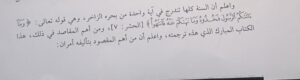
And know that from the Sunnah’s vast (sciences and sources of knowledge), all of it is embodied within a single verse, namely (Allah’s) statement:
وَمَآ ءَاتَىٰكُمُ ٱلرَّسُولُ فَخُذُوهُ وَمَا نَهَىٰكُمْ عَنْهُ فَٱنتَهُوا۟
And whatever the Messenger gives you, take it; and whatever he forbids you from, abstain from it. [Al-Hashr: 7]
Among the most important objectives in this regard is this blessed book which is an explanation of it. And know that among the most important objectives behind its authorship are two matters:
One of them is the explanation of the Qur’an by the Qur’an due to the consensus of the scholars that the noblest and loftiest types of Tafseer is the explanation of Allah’s Book by Allah’s Book (i.e. explanation of a verse of the Qur’an by another verse of the Qur’an), since no one is more knowledgeable about the meaning of Allah’s speech than Allah (Himself). And indeed, we have committed ourselves not to explain the Qur’an except through the seven types of Qur’an recitation, regardless of whether there is another type of recitation in the clear verse itself, or another verse other than it. We do not rely on explanation based on the “Shadh recitations” (a), though we may mention a “Shadh recitation” as supporting evidence to clarify the seven types of recitations. The recitations of Abu Jafar, Yaqub, and Khalaf are not considered Shadh in our view nor by the Muhaqqiqeen (b) among the people who possess knowledge of the (different) types of recitations.
With regards to the second objective, the Imam stated that he will clarify the Fiqh rulings from the verses, their evidences from the Sunnah, and the statements of the scholars therein. Then he stated: We will establish as stronger proof that which appears to us to be the stronger proof based on the evidence, without partisanship toward any particular school of jurisprudence or (based) on the statement of any specific person (scholar). Indeed, we will examine the statement itself and not the one who made it, for every person’s statement may be accepted or rejected, except the speech of the Messenger, peace and blessings of Allah be upon him. And it is well known that the truth (remains) truth even if the one who utters it is lowly (insignificant etc). Have you not seen that despite the fact that the Queen of Sabah and her people were prostrating to the sun instead of prostrating to Allah, however, when she uttered a statement of truth, Allah affirmed that she has spoken the truth. Her disbelief did not prevent it from being affirmed for her as the truth, which is her statement, as Allah stated that she said:
إِنَّ ٱلْمُلُوكَ إِذَا دَخَلُوا۟ قَرْيَةً أَفْسَدُوهَا وَجَعَلُوٓا۟ أَعِزَّةَ أَهْلِهَآ أَذِلَّةً
Verily! Kings, when they enter a town (country), they despoil it, and make the most honourable amongst its people low.
Then Allah stated in confirmation of the truth of the truth she stated, saying:
وَكَذَٰلِكَ يَفْعَلُونَ
And thus they do. [1]
Footnote a: Ibn al-Jazari, may Allah have mercy upon him, stated regarding the determinant of an authentic (valid) Qur’anic recitation: Every recitation that conforms to Arabic grammar, even in one possible aspect; conforms to one of the Uthmani manuscripts, and has an authentic chain of transmission, is considered one of the authentic recitations. It is not permissible to reject nor lawfully deny it, rather, its is one of the seven aḥruf in which the Qur’an was revealed. It is incumbent upon the people to accept it, whether it is transmitted from the seven Imams, the ten, or from other than them among the Imams who are recognised. When one of these three pillars is absent, the recitation is described as weak, shādh, or false, whether it is reported from the Seven or from someone greater than them. This is the correct position according to the Imams – among the pious predecessors and thiose who came after them- who are recognised as the ones with the precise knowledge and expertise in this field. [2]
Footnote b: The Muhaqqiqeen are those scholars who are firmly grounded in knowledge and blessed with the ability to precisely and thoroughly investigate issues to reach the correct position.
Your feedback is welcomed if you have any suggestions to improve this paraphrase. May Allah bless you all.
[1] An Excerpt from Adwa al-Bayan 1/6-7. paraphrased
[2]An-Nashr 1/9

Donate
Related Posts
Follow Us
Share
Related Posts
Donate to the Dawah in Manchester

Join the Umrah Trip