Impeccable Scholarly Impartiality Even Toward the Worst of Ahlul Bidah!

بسم الله الرحمن الرحيم
The Story
The Khawarij captured Abdullah, the son of Khabbab bin Al-Aratt, a noble companion of the Messenger. They questioned him, asking, “Who are you?” He answered, “I am Abdullah bin Khabbab.” They said, “Tell us a Hadith you heard from your father, who transmitted it from the Messenger, peace and blessings of Allah be upon him.” He said, “I heard my father say, ‘Allah’s Messenger, peace and blessings of Allah be upon him, said: “There will be a Fitnah where those who remain seated would be better than the one walking, and the one walking would be better than those who hurry. Thus, if someone must either kill or be killed, let him be killed and not be the killer.” They asked, “What do you think of Abu Bakr and Umar?” Abdullah spoke highly of them. They then asked, “What is your opinion on At-Ta’hkim (when Ali and Mu’awiyah turned to some companions to judge their dispute based on the Quran and Sunnah)?” He responded, “I believe Ali has superior knowledge of the Book of Allah, is more cautious with the religion, and possesses greater wisdom than you!” Afterward, they took him to a river and slaughtered him, and they also killed his pregnant wife, stabbing her belly.
In his explanation of Kitaab Ash-Shaaree’ah by Imam Al-Aajuree, may Allah have mercy upon him, al-Allamah Rabee Bin Hadi Al-Mad’khali, may Allah have mercy upon him, did not quote the full story, but he referred to the reference (number 75), stating that there is an unknown narrator in the chain; thus, he holds that the narration is neither authentic nor hasan. Then he said:
[نحن ما عندنا تحامل – we do not have bias, prejudice, partiality, or favoritism]. We do not authenticate a narration unless the trustworthiness and precision of the narrator have been firmly established. The Shaikh also briefly touched on the conditions for the authentication of a hadith up until he said:
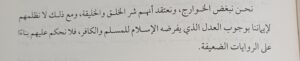
“We hate the Kharijites and believe that they are the worst of the people and the creation. Despite this, we do not oppress them due to our belief in the obligation of justice that Islam obligates toward both Muslims and non-Muslims. Therefore, we do not pass judgment on them based on weak narrations”
Refer to “Adh-Dhari’ah ilaa Bayaan Maqaasid kitaab Ash-Sharee’ah 1/188-189. 1st Edition 1434H [2013] Publisher. Dar Mirath

Donate
Related Posts
Follow Us
Share
Related Posts
Donate to the Dawah in Manchester

Join the Umrah Trip