[5] Be Vigilant Against Subtle Repackaged Shubuhaat in Some WhatsApp Groups

بسم الله الرحمن الرحيم
In The Name of Allah, The Most Merciful, The Bestower of Mercy.
Response to the one who says, “Only a scholar should refute a scholar” or “He hasn’t reached the station of the one he is correcting his mistake, so better he keeps quiet”.
Al-Allamah Rabee Bin Hadi Al-Mad’khali, may Allah have mercy upon him, was asked:
“What is the correctness (or validity) of the statement made by some (people): A scholar cannot be refuted except by (another) scholar?”
Response: If silence is employed in the face of his misguidance and there is no scholar to clarify the truth, while this one- who is of a much lesser status (or considered much inferior in knowledge) – possesses evidence and proof, it is incumbent upon him to present what he has. The point is that a scholar and a student of knowledge should only speak based on knowledge and should not engage in any matter without knowledge.
وَلَا تَقْفُ مَا لَيْسَ لَكَ بِهِ عِلْمٌ ۚ إِنَّ السَّمْعَ وَالْبَصَرَ وَالْفُؤَادَ كُلُّ أُولَٰئِكَ كَانَ عَنْهُ مَسْئُولًا
And do not pursue that of which you have no knowledge. Verily! The hearing, and the sight, and the heart, of each of those you will be questioned (by Allah). [Al-Israa 36]
Speaking based on ignorance in any speech, even if made by a scholar, is rejected and not accepted. It is unlawful and may even lead to a level greater than disbelief in Allah, The Mighty and Majestic, as Allah, The Blessed and Exalted, said:
قُلْ إِنَّمَا حَرَّمَ رَبِّىَ ٱلْفَوَٰحِشَ مَا ظَهَرَ مِنْهَا وَمَا بَطَنَ وَٱلْإِثْمَ وَٱلْبَغْىَ بِغَيْرِ ٱلْحَقِّ وَأَن تُشْرِكُوا۟ بِٱللَّهِ مَا لَمْ يُنَزِّلْ بِهِۦ سُلْطَٰنًا وَأَن تَقُولُوا۟ عَلَى ٱللَّهِ مَا لَا تَعْلَمُونَ
Say (O Muhammad): “(But) the things that my Lord has indeed forbidden are Al-Fawahish (great evil sins, every kind of unlawful sexual intercourse, etc.) whether committed openly or secretly, sins (of all kinds), unrighteous oppression, joining partners (in worship) with Allah for which He has given no authority, and saying things about Allah of which you have no knowledge.” [Al-A’raf 33]
Imam Ibn al-Qayyim stated in his explanation of this verse: Indeed, Allah, Blessed and Exalted, mentioned in stages starting from the lesser to the greater in these matters. The gravest of sins and major sins is to speak about Allah without knowledge, as this encompasses Shirk, disbelief, bidah, and various sins. The root of all calamity lies in speaking about Allah without knowledge, speaking in the name of Allah and His religion without knowledge.
If there is a student of knowledge, meaning, he has knowledge of a matter, proof and evidence, and the scholars have not spoken, he should speak the truth. (Paraphrased) (1)
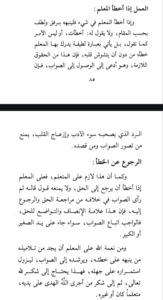
The Arabic text below is a statement of Shaikh Abdus Salam Burjess, may Allah have mercy upon him, in Awa’iq at-Talab pages 85-86.
The Shaikh said that when a teacher errs regarding something, the student should deal with him gently according to the circumstances and should not say to him, “You have made an error” or “The matter is not as you say”, rather, he should use kind expressions through which the teacher realises his mistake without unsettling his heart, for this is from the rights that are owed to the teacher…. refutation that is accompanied with bad manners and distressing the person’s heart prevents understanding of what is right…
And just as this is obligated to a student of knowledge when dealing with the teacher, it is also incumbent upon the teacher to return to the truth when he errs. He is not to be prevented from returning to the truth after reviewing a statement he made and finds that it is in opposition to what is correct, for indeed that is a sign of equity and humbling oneself to the truth. Therefore, it is obligatory that one follows what is correct, whether it was conveyed by a younger or older person.
And it is a blessing upon a teacher that he has amongst his students one who notifies him of his mistake and leads him to what is correct, so that he does not persist upon that ignorance. This requires that one shows gratitude to Allah, The Most High, and then being thankful to the person through whom one was guided, whether it was a student or other than him. (Paraphrased)
(1)https://youtu.be/KxPnClf4q-g?si=CxJv9NJY_RFFNQEl

Donate
Related Posts
Follow Us
Share
Related Posts
Donate to the Dawah in Manchester

Join the Umrah Trip