Three Matters That Give Sin Its True Weight: A Call to Reflection for Our Era

بسم الله الرحمن الرحيم
In The Name of Allāh, The Most Merciful, The Bestower of Mercy.
Imam Ibn Al-Qayyim, may Allāh have mercy upon him, stated regarding ascribing the due magnitude to an offence (or crime):
If one treats it lightly, he will not be regretful about it. The extent to which he considers it a grave thing determines the level of his regret for perpetrating it. For example, the one who considers the loss of a copper coin insignificant will not regret losing it, but if he knows that it was actually a gold dinar, his regret will intensify, and the loss becomes greater in his sight. Considering an offence (or crime) as a grave thing (based on proof) arises from three matters: Exaltation of a command, exalting the One Who gave the command and belief in the recompense.
[I] Exaltation of the Command: Occurs through recognising that the prohibition of the offense is from Allah, The Most High, and that Allah has clarified it in His Book or through the words of His Prophet, peace and blessings of Allah be upon him. Thus, one knows that this prohibition is of great magnitude, its danger is grave, and it is not permissible for a sane person to take it lightly.
[II] Exaltation of the One Who gave the Command occurs through drawing one’s attention very close to Allāh’s Greatness, The Most High; and that He is Al Jabbar – The Exalted and Almighty Compeller. The One to Whose Might everything in the creation submits. The Exalted One Who rectifies the affairs of His creation for them, and Who restores the weak and the broken-hearted], able to avenge the wrongdoers, and that had He willed to hold people accountable for their sins, He would not leave a single creature upon the earth.
And that He, Glorified be He, free from all imperfections, is Al Malik – The King. The sole, absolute and true sovereign King. Complete and Perfect in His Kingship. The One Who there is no kingship above His Kingship, nor anywhere near it. Everything being incomparable to Him, and beneath Him. The sovereign Owner of everything, Who does whatever He wills with regards to the creation, with nothing to prevent or hinder Him, Whose commands are completely effective within His dominion. The King of all kings.
Al Adheem – The Tremendous One, or The Magnificent. The One Tremendous in Greatness, and The Only One deservingly held in awe and venerated by the creation for His Greatness in every sense], Al Quddoos – The Pure and Perfect. The Pure and Exalted One. High above every impurity. The One Whom the noble angels venerate. The One free of any opposites, rivals, consorts, and children. Having Perfection as His attribute. The One declared free of all deficiencies and imperfections. And free of having anyone with the like of His Perfection, or anyone close to it];
Ar Rabb – The Lord and Nurturer. The Lord and Master Who has none like Him in His Lordship. The One Who nurtures and rectifies the affairs of the creation by the favors which He showers upon them. The sovereign Owner Who alone creates and commands. The One Who controls the affairs and grants blessings. The One Who nurtures. The Creator. The Provider. The One Who aids. And The One Who guides];
Al-Karim [The Bountiful, The Generous One. Abundant in good. The One Who causes and makes easy every good. And Who bestows generously. The One so generous that He even bestows favors upon those who reject His favors, and use them as a means to disobey Him], and the Bestower of blessings and favours.
Therefore, neither is it befitting (permissible) for a servant (of His) to disobey Him nor use His blessings in acts of opposition against Him. Due to this, it is said: “Do not look at the smallness of the sin, but rather look at the greatness of the One you have disobeyed”. Whenever a person’s exaltation of his Lord and being shy in His presence increases, he restrains himself from disobeying Him. [Footnote a]
[III] Belief in the Recompense: Belief in the recompense is that the person is certain of what Allah has ordained as recompense for sins in this world and the Hereafter, as if he can see it with his naked eyes. Thus, he knows that its recompense is the Fire, and that the heat of the fire cannot be endured, and that a single immersion in it would make one forget every pleasure and comfort of this worldly life, and there is no good in a pleasure whose final ending is the Fire. [Footnote B]
He knows that from the recompense for disobedience is being deprived of nearness to Allah, The Most High, and what a grave punishment that is. Among its recompense is hardship for the sinner’s affairs, distress in his life, the hardness of his heart, a sense of inner isolation, and being afflicted with humiliation, as Ibn Abbas, may Allāh be pleased with him, said:
“Indeed, a good deed has a light in the heart, radiance on the face, strength to the body, increase in provision, and love (Allah places in) the hearts of creation (for the doer of good). And indeed, a bad deed brings darkness to the face, darkness in the heart, weakness in the body (to carry out good deeds etc), a cause of decrease in provision, and hatred (placed in the) hearts of creation (towards the sinful one).” [Footnote C] [1]
In the light of what has been transmitted above, consider the grave crime of Tabdee without proof. Imam Muhammad Ibn Salih Al-Uthaymin, may Allah have mercy upon him, was asked:
السائل : جزاك الله خيرا يقول السائل : لا يحكم على معين بكفر أو فسق إلا بعد إقامة الحجة والسؤال : هل التبديع مثل التكفير والتفسيق أي يحتاج لإقامة الحجة ؟
الشيخ : نعم نعم كل عيب يوصف به الإنسان فإنه يحتاج إلى ثبوت ما يقتضيه هذا العيب يعني ما يوجب هذا العيب أما أن نصف كل واحد بأنه مبتدع كل واحد بأنه ضال بدون دليل هذا لا يجوز نعم
Questioner: May Allah reward you with good. The questioner asks: “The judgement of Kufr (disbelief) is not issued against a specific individual, nor Fisq (declaring someone sinful), except after establishing proof. Is Tabdīʿ (declaring someone an innovator in the religion) like Takfīr and Tafsīq, in that it also requires establishing the proof?”
The Shaikh: Yes, yes. Every fault (blameworthy trait) with which a person is described requires verification of what justifies attributing that fault to him—meaning what necessitates that fault. As for describing (labeling) everyone an innovator in the religion, (or) misguided, without evidence, this is not permissible. [2] [Paraphrased]
In a rebuke against those who seek to compare Shaikh al-Islam Ibn Taymiyyah and Sayyid Qutb, Shaikh al-Islam Ibn Taymiyyah and al-Mawdudi, or Shaikh al-Islam Ibn Taymiyyah and Hasan al-Bannah, Shaikh Abdus Salam Burjess, may Allah have mercy upon him, said:
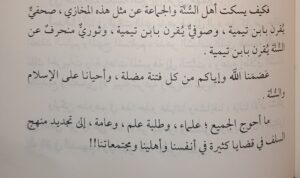
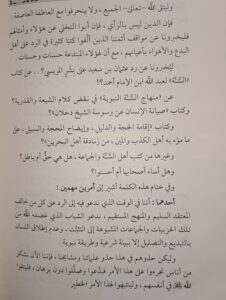
Thus, how can Ahlus Sunnah Wa Jama’ah remain silent about the likes of such disgraceful (things)? A journalist being compared to Ibn Taymiyyah, a Sufi compared to Ibn Taymiyyah, and a deviant revolutionary who deviated from the Sunnah being compared to Ibn Taymiyyah! May Allah protect us and you from every misleading trial, and grant us life upon Islam and the Sunnah. How much in need is everyone – scholars, students of knowledge, and the common people – of reviving the methodology of the (pious) predecessors in many matters within ourselves, our families, and our societies!
And let everyone fear Allah -The Most High – and not be deviated along with volatile emotions, fior indeed, the religion is not based on opinion. If they refuse to disassociate themselves from these people and their ilk, then let them inform us about the stances of our scholars who authored many books in refutation – by name – against the people of Bidah and (vain) desires, even though those Mubtadi’ah had many good deeds.
Let them inform us about the refutations by Uthman Ibn Sa‘id against Bishr al-Mareesee; about “Kitab As-Sunnah” by Abdullah Ibn Imam, “Minhaj as-Sunnah an-Nabawiyyah Fee Naqd Kalam ash-Shi‘ah Wal-Qadariyyah”, and the book “Siyanat al-Insan an Waswasat ash-Shaykh Dahlan, and the book “Iqamah al-Hujjah Wa ad-Dalil, wa Idah al-Mahajjah wa as-Sabil ala Ma Mawwaha Bihi Ahl al-Kadhib Wal-Mayn, min Zanadiqah Ahl al-Bahrayn, and other books of Ahlus Sunnah Wal-Jama‘ah — are they truth or falsehood? Did their authors do wrong, or did they do well?
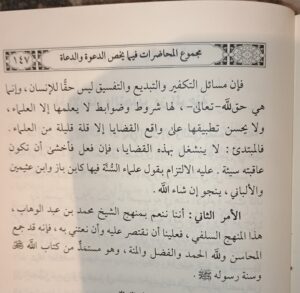
And in concluding this statement, I point to two important matters:
The first is that indeed we are within a time wherein we call to refutation against everyone who opposes the sound creed and the upright methodology. We call upon the youth whom Allah has safeguarded from those illegal partisanships and dubious groups to establish verification, and not to unleash their tongues by declaring people Mubtad’ah and misguided, except based on the clear Shariah proofs and the prophetic path. Let their footsteps in this matter be based on the footsteps of our scholars and our Mashayikh, for indeed, at present, we complain regarding a people who have become bold enough to engage in this matter, thus, declaring others Mubtadi’ah and misguided without proof. Therefore, let them fear Allah in their souls and be mindful of this dangerous matter. For indeed, the Msaa’il of Takfeer, (declaring others disbelievers), Tabdee (declaring others Mubtadi’ah) and Tafseeq (declaring others sinners) are not the right of a person, rather, they are the right of Allah – The Most High. It has Shurut and Dawabit that none truly knows except the scholars, and none is proficient in applying it on the real situations (circumstances) except a few among the scholars. The beginner does not preoccupy himself with these issues; if he does, it is feared that its outcome will be evil. It is incumbent upon him to adhere to the statements of the scholars of Sunnah in this regard, such as Ibn Baz, Ibn ‘Uthaymin, and al-Albani, and InShaAllah, they will be safe.
The second matter: Indeed, we are blessed with the methodology of Shaikh Muhammad ibn ‘Abd al-Wahhab – this Salafi methodology. Therefore, it is incumbent upon us to limit ourselves to it and give it close attention, for indeed, it – all praise, grace and blessings belong to Allah – gathers virtues derived from Allah’s Book and the Sunnah of His Messenger. [3]
Also read:
Painful Memories About Some of Those Who Set Ablaze the Flames of Transgression and False Tabdi
Read a brief biography of the Shaikh, may Allah have mercy upon him:
https://salafidawahmanchester.com/2025/11/30/3-brief-biographies-of-some-prominent-contemporary-scholars-shaikh-abdus-
NB: Translation of the meanings of the Names of Allah Al-Jabbar and the other names in this article was quoted from The Names and Attributes of Allah by Shaikh Abu Talhah – Dawud Burbank [may Allah have mercy upon him and his wife]
Footnote A: Read here: https://salafidawahmanchester.com/2026/02/08/root-causes-of-the-unimaginable-depravity-of-some-of-the-modern-worlds-influential-figures/
Footnote B: Anas ibn Malik reported: The Messenger of Allah, peace and blessings be upon him, said, “The most privileged people in the world among the people of Hellfire will come on the Day of Resurrection to be dipped in Hellfire, then it will be said: O son of Adam, did you see any good? Did you get any blessings? He will say: No, by Allah, my Lord! Then, the most miserable people in the world among the people of Paradise will come on the Day of Resurrection to be dipped in Paradise, then it will be said: O son of Adam, did you see any hardship? Did you have any distress? He will say: No, by Allah, my Lord! I did not once see hardship or distress.” [Muslim 2807]
Footnote C: https://salafidawahmanchester.com/2019/12/04/the-relationship-between-sinning-and-ones-circumstances/
[1] Excerpts from Madarij As-Salikin 1/202 and 1/423
[2] https://alathar.net/home/esound/index.php?op=codevi&coid=117138
[3] An Excerpt from Majmūʿ Muʾallafāt wa Taḥqīqāt Faḍīlat ash-Shaykh ad-Duktūr ʿAbd as-Salām Ibn Burjess. 3/145-147. Paraphrased

Donate
Related Posts
Follow Us
Share
Related Posts
Donate to the Dawah in Manchester

Join the Umrah Trip