The Good Suspicion and Excuse Received After Mistakes Do Not Make Mistakes Other Than What They Are, Nor Eradicate The Rights of Others

بسم الله الرحمن الرحيم
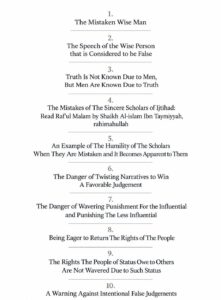
The Mistaken Wise Man
Yazid Bin Ameerah, who was one of the companions of Mu’adh Bin Jabal said: Whenever he (Mu’adh) sat in a meeting to give admonition, he would say: “Allah is a just arbiter; those who doubt would perish”. One day Mu’adh Bin Jabal said: In the times after you, there would be trials in which riches would be abundant. During these trials the Quran would be easy so much so that every believer, hypocrite, man, woman, young, grown up, slave and free man will learn it. Then a man might say: “What happened with the people that they do not follow me while I read the Quran? They are not going to follow me until I introduce a Bidah for them other than it”. So beware of that which is innovated (in religion), for whatever is innovated is misguidance. I warn you of the deviation of a wise person from right guidance, for sometimes Satan utters a statement of misguidance through the tongue of a wise person and sometimes a hypocrites may speak a word of truth. I said to Mu’adh: “I am at a loss to understand may Allah have mercy on you that a wise man sometimes may utter a statement of misguidance and a hypocrite may utter a statement of truth”. He said, “Certainly, avoid the speech that emanates from a wise person that is known to be false and about which it is said, “What is this?!” And it does not warrant that you abandon him, for it is possible that he may withdraw (from these things that are well known to be false). Adhere to the truth when you hear it, for truth has light.
The Speech of the Wise Person that is Considered to be False
It is the ambiguous speech that makes one say: “What does he intend by this statement?!” He is known for good and beautiful speech, but he may err and slip, or shaytan misleads him to utter bad understanding. Shaytan may misguide a person until he utters misguidance and a false statement despite the fact that he is known for good, beautiful and fine speech. [1]
Truth Is Not Known Due to Men, But Men Are Known Due to Truth
Al-Allamah Salih Al-Fawzan, may Allah preserve him, was asked: “What is the meaning of the principle, ‘The truth is not known by way of men, rather men are known by way of the truth?'”
Answer: Its meaning is that we do not merely blindly follow anyone, for it may be that one is blindly followed based on error. It may be that the Mujtahid is mistaken and the one who makes [a statement or holds an opinion] is mistaken, so we do not take [his statement, opinion etc] and say, “This is the statement of such as such; this is truth, because such and such is good, he is a scholar; such and such is Taqiy [i.e. one who fears Allaah]”. We do not say this because he is not infallible and he can make a mistake; so we know men by way of the truth – those who know; those who take [or adhere to] the proofs and indeed they are known to be scholars.
As for those who do not give concern [or importance] to the proofs, they are not scholars; they are not people of [sound] understanding and they are not people of knowledge, so their statement is never taken straight away. It is imperative that the proof is presented, so if the proof is established as witness to [what he says or holds etc], then it is the truth; but if he opposes the proof, then indeed [his statement or opinion] is rejected; however if he is a Mujtahid and he is mistaken, he is rewarded [once] due to his Ijtihaad; but if he deliberately holds on to error, he has sinned. [Paraphrased. Refer to video here: https://video.link/w/9famb ]
The Mistakes of The Sincere Scholars of Ijtihad
Read Raf’ul Malam by Shaikh Al-islam Ibn Taymiyyah, rahimahullah
An Example of The Humility of The Scholars When They Are Mistaken and It Becomes Apparent to Them
An Incident at Fustat: When Status Meets Truth, Humility as the Scholar’s Test and Shield
A breathtaking clarification that followed a slip of the tongue- Al-Allamah Rabee
Some of the Motivations for Clinging to Falsehood When the Truth Is Clarified By Another Person
The Danger of Twisting Narratives to Win A favorable Judgement
Umm Salamah, may Allah be pleased with her, reported that Allah’s Messenger, peace and blessings of Allah be upon him, said, “Indeed, I am only a human being and you people come to me with your disputes. And it may be that one of you can present his case more eloquently than the other and I consider him truthful, and judge in his favour. So if I ever judge and give the right of a brother to his brother, then it is a piece of hellfire and let him not take it”.
Some Benefits Derived From This Hadith
The Ummah [i.e. the scholars and judges] have been commissioned to judge based on what is apparent, but the (mere) judgement of a judge cannot prohibit the lawful and allow the unlawful [i.e. because it cannot be taken if proven erroneous].
This Hadith contains a refutation against those who say that the Messengers possess knowledge of the unseen. This hadith also shows that speech can be seen to be true based on what is apparent, but it is truly falsehood with regards to what is hidden within it.
This hadith shows that the one who receives a judgement in his favour is more aware than every other person as to whether he is entitled to it or whether he is a falsifier. So, he takes it if he is entitled to it or leaves it if he is a falsifier because, in reality, a judgement cannot change an affair from what it was in origin [i.e. the original truth in the affair before its distortion or concealment].
This hadith shows the sinfulness of the one who argues based on falsehood until he receives what he wants publicly, whilst he is upon falsehood.
In this Hadith is proof that a scholar can make a mistake and it is a refutation against those who say that every Mujtahid is correct. This hadith shows us that the Mujtahid is forgiven (when he makes a mistake). [2]
The Danger of Wavering Punishment For The Influential and Punishing The Less Influential
Aa’isha, may Allah be pleased with her, reported that the Quraish had been anxious about the Makhzumi woman who had committed theft, and said, “Who will speak to Allah’s Messenger, peace and blessings of Allah be upon him, about her?” They said, “Who dare it, but Usamah, the loved one of Allah’s Messenger?” So Usamah spoke to him. Thereupon Allah’s Messenger said, “Do you intercede regarding one of the punishments prescribed by Allah?” He then stood up and addressed (people) saying, “O people! Those who have gone before you were destroyed, because if any one of high status committed theft amongst them, they spared him; and if anyone of low status committed theft, they inflicted the prescribed punishment upon him. By Allah, if Fatima, daughter of Muhammad, were to steal, I would have her hand cut of”. [3]
“Do you intercede regarding one of the punishments prescribed by Allah?” Meaning, it is not permissible to intercede regarding the divine prescribed punishments.
“Those who have gone before you were destroyed because if any one of high status committed theft amongst them, they spared him; and if anyone of low status committed theft, they inflicted the prescribed punishment upon him”.
Meaning, destroyed through punishment due to their sins. They were destroyed due to this matter because they said, “This is a person of high status and it is not possible to cut his hand”. When a person of high status amongst them stole, they let him off, (but) when a person of low status stole, they established the punishment on him, thus the implementation of Allah’s prescribed punishments was carried out based on their desires. In this hadith is proof to show that the nations before us committed theft, and that there was much theft in their midst including the wealthy, the poor, the one of high status and the one of low status.
The Messenger then made an oath – even though he is the righteous and truthful one without making an oath – that “By Allah, if Fatima, daughter of Muhammad, were to steal, I would have her hand cut of”.
O Allah! Send Your Salutations and blessings upon him (i.e. the prophet). This is how justice should be and the manner in which Allah’s rulings are to be applied, and not through desires. He made an oath that if Fatimah – who was of a higher status than that Makhzumi woman, both in nobility and lineage, because she is the leader of the women of paradise, the daughter of Muhammad – stole, he would cut her hand. [4]
Imaam An-Nawawi, may Allah have mercy upon him, stated that Imam Muslim, may Allah have mercy upon him, mentioned narrations in the chapter regarding the forbiddance of interceding in the divine ordained punishments and that this was the cause of the destruction of the Children of Israel. The scholars unanimously agreed that – due to these narrations – interceding in the divine ordained punishments – after the affair has reached the leader – is prohibited. As for before it reaches the leader, most scholars have permitted intercession if the one being interceded for is not an evil person and harmful to the people. As for the sins (or acts of disobedience) for which there are no prescribed punishments, then intercession regarding them is permissible whether the affair has reached the leader or not. Intercession in these affairs is desirable if the one being interceded for is not a harmful person and so on. [5]
Being Eager to Return The Rights of The People
The Prophet, peace and blessings of Allah be upon him, said: “Whoever has wronged his brother, should ask for his pardon (before his death), as (in the Hereafter) there will be neither a Dinar nor a Dirham. (He should secure pardon in this life) before some of his good deeds are taken and paid to his brother, or, if he has done no good deeds, some of the bad deeds of his brother are taken to be loaded on him (in the Hereafter). [Al-Bukhari 6534]
The Rights The People of Status Owe to Others Are Not Wavered Due to Such Status
Ahlus Sunnah Do Not Speak Ill of The Scholars of Ahlus Sunnah- By Shaikh Ali Al-Hudhaifi
Be Warned Against False Judgements, Especially In Affairs of Creed
The Prophet [peace and blessings of Allah be upon him] said, “The judges are three: one will go to Paradise and two to Hell. A man who knows the truth and judges with it will enter paradise; a man who knows the truth but judges with the opposite of it will enter the fire, and a man who judges for the people based on ignorance will enter the fire”. [Reported by Imam Abu Dawud 3573]
Shaikh Al-Islam Ibn Taymiyyah, may Allah have mercy upon him, said, “And when it is the case that the one who judges between the people in [affairs] of wealth, blood [i.e. murder cases, physical violence etc] and honour will enter the hell fire if he is not a just scholar, then how about the one who passes judgements – without knowledge and justice – on creeds, religions, the fundamentals of belief, divine knowledge and the general fundamental principles related to different subject matters”. [6]
[1] Sharh Kitab Sunnah Min Sunan Abee Dawud from pages 111-118 by Al Allamah Abdul Muhsin Al-Abbad, may Allah preserve him. May Allah bless our Ustadh and colleage Harun Banton for sharing the Sharh of this Athar from which we extracted these few points.
[2] Source: Saheeh Al-Bukhari -Kitaab Al-Ahkaam (Book of Judgements): Chapter 29: Hadeeth Number: 7181 with Fath al-Bari
[3] Saheeh Muslim. 1688a
[4] An Excerpt from Sharh Riyaadus Saaliheen 6/525-530 By Imam Muhammad Ibn Saalih Al-Uthaymeen (may Allah have mercy upon him)
[5] An Excerpt from ‘Sharh Saheeh Muslim’. 11/155
[6] Al-Jawaab as-Sahih 1/26

Donate
Related Posts
Follow Us
Share
Related Posts
Donate to the Dawah in Manchester

Join the Umrah Trip