Spot the Difference: Behaviour of the Scholars of Cautious Piety When Their Errors Became Known to The Public

بسم الله الرحمن الرحيم
Al-Allamah Abdur Rahman Al-Mu’allimee, may Allah have mercy upon him, said:
To oppose desires – by way of action – for the sake of the truth is a manifest affair due to the obligation and difficulty it involves, and this can be viewed from different angles as follows:
A person sees that by acknowledging the truth, it would necessitate that he has acknowledged that he was upon falsehood, because a person is nurtured upon a religion, creed, school of thought or views, which he acquired from his nurturer and teacher, considers it to be the truth and followed it for a long time. Then when it becomes clear to him that (the religion, creed, view, or school of thought) is false, it becomes difficult for him to acknowledge, just like when his forefathers, ancestors or the one he follows are upon a (particular) way and its falsity is clarified for him, because he sees that their deficiencies necessitate his own deficiencies, and an acknowledgement of their misguidance or errors necessitates his own.
It may be that clinging to falsehood gives him prestige, fame and a livelihood, so it becomes difficult for him to acknowledge that (what he is upon is) falsehood, thus all those benefits (i.e. the fame, prestige, livelihood etc) would disappear.
It may be that a person is upon ignorance or falsehood, then another person comes along and clarifies the proofs for him, so he sees that by acknowledging such proofs, it would necessitate that he is lacking (in understanding) and that it was that person who guided him. And due to this we find that it is not difficult for some of those attributed to knowledge to acknowledge their mistakes when it becomes manifests to them in their researches and studies, but it becomes difficult for them if it was others who clarified such mistakes.
When another person clarifies the truth for him, he sees that by acknowledging such truth it would necessitate an acknowledgement of the clarifier’s virtue, knowledge and correctness due to that clarification, thus that becomes great in the eyes of the people and many people follow him [i.e. the person who clarified the truth].
So you will find some of those attributed to knowledge being eager to prove the mistakes of other scholars even if that is done by way of falsehood due to envy and seeking to diminish their status amongst the people.
To oppose desires for the sake of the truth -in affairs of knowledge and creed- can indeed be difficult to accomplish, therefore it requires (sincere) research and contemplation. And in this regard, one is in need of asking the scholars and benefiting from them, adhering to fear of Allah, seeking the Tawfeeq of Allah and guidance. (1)
After contemplating on the above statement by Al-Allamah Al-Mu’allimee, may Allah have mercy upon him, then examine the articles in this link that gives two examples of the behaviour of the scholars of cautious piety when they made mistakes in public.
Exemplary and Beautiful Relationships of Respect and Responsibility Between Teachers and StudentsA breathtaking clarification that followed a slip of the tongue- Al-Allamah Rabee
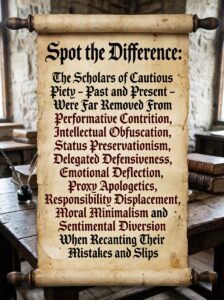
Finally, spot the difference. There is an important distinction between a person who makes a mistake, acknowledges it and corrects himself, and a person who makes a public mistake but resists the responsibility of publicly correcting it. Making a public mistake but refusing to issue a public correction, only for those who mention it to be attacked, does not resolve the matter. Relying on those who utter vague speech in the guise of knowledge to preserve the honour of so and so personality does not repair public misinformation. The matter is simple: the correction should be proportionate to the publicity and impact of the mistake as we have learnt from the above clarifications of scholars who made mistakes and were people of integrity and cautious piety.
Furthermore, seeking to change the subject through the vague and emotional speech of others instead of addressing the evidence, and discussing credentials, achievements and the past, does not make the issue go away while the person who made the mistake remains quiet without clarification. He has not answered the actual, justified criticism. An argument must be addressed on its merits. Strategic silence cannot dupe sensible people, especially when silence is repeatedly employed while supporters are left to defend an unresolved public error. This is nothing but avoiding accountability. The question then becomes: why is so much energy devoted to defending the individual’s reputation, but so little effort devoted to resolving the actual mistake?
Allowing supporters to attack those demanding clarification is particularly concerning. Rather than addressing the evidence, supporters attack the character, intentions, intelligence or qualifications of those raising the issue. Invoking the honour of the people of knowledge in relation to correcting an error contains truth; however, this principle must not be manipulated. Respecting the carriers of knowledge does not mean vehemently defending someone while the person who made the mistake refuses to make a recantation. We have not witnessed this from the senior scholars of piety.
And Allah knows best
[1]: An excerpt from at-Tankeel Bimaa Fee Ta’need Al-Kawthariy Minal Baatil’ 2/180-181 with the checking of Imaam Albaanee, may Allah have mercy upon him.

Donate
Related Posts
Follow Us
Share
Related Posts
Donate to the Dawah in Manchester

Join the Umrah Trip