[2] Spot the Difference: Behaviour of the Scholars of Cautious Piety When Their Errors Became Known to The Public

بسم الله الرحمن الرحيم
Despite Abū Bakr ibn al-Anbārī’s (strong) memorisation, he, may Allah have mercy upon him, was a Zahid and a humble person. Abu al-Ḥasan ad-Daraqutni, may Allah have mercy upon him, reported that he attended one of his gatherings on a Friday during which he was dictating. He misread a name that he cited in the chain of transmission of a ḥadīth: it was Ḥibbana, but he either said Ḥayyanu, Ḥayyana, or Habbanu. Abu al-Ḥasan said:
“I considered it too grave that an error should be transmitted from someone like him due to his virtue and lofty status. I was in awe of him and hesitant to notify him. Then when the dictation ended, I went to the one who was taking the dictation, mentioned the mistake to him, informed him of the correct word, and then left. Then I attended his gathering the following Friday, so, Abu Bakr said to the one taking the dictation:
‘Make it known to those present in the gathering that we misread such-and-such a name when we dictated the ḥadith on such-and-such an occasion last Friday, and that a young man notified me regarding the correct name, which is such-and-such. And inform that young man that we referred back to the original source and found it as he said'”. [Tarikh Baghdad 4/301] [End of quote]
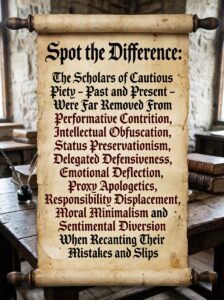
Finally, spot the difference. There is an important distinction between a person who makes a mistake, acknowledges it and corrects himself, and a person who makes a public mistake but resists the responsibility of publicly correcting it. Making a public mistake but refusing to issue a public correction, only for those who mention it to be attacked, does not resolve the matter. Relying on those who utter vague speech in the guise of knowledge to preserve the honour of so and so personality does not repair public misinformation. The matter is simple: the correction should be proportionate to the publicity and impact of the mistake as we have learnt from the above clarifications of scholars who made mistakes and were people of integrity and cautious piety.
Furthermore, seeking to change the subject through the vague and emotional speech of others instead of addressing the evidence, and discussing credentials, achievements and the past, does not make the issue go away while the person who made the mistake remains quiet without clarification. He has not answered the actual, justified criticism. An argument must be addressed on its merits. Strategic silence cannot dupe sensible people, especially when silence is repeatedly employed while supporters are left to defend an unresolved public error. This is nothing but avoiding accountability. The question then becomes: why is so much energy devoted to defending the individual’s reputation, but so little effort devoted to resolving the actual mistake?
Allowing supporters to attack those demanding clarification is particularly concerning. Rather than addressing the evidence, supporters attack the character, intentions, intelligence or qualifications of those raising the issue. Invoking the honour of the people of knowledge in relation to correcting an error contains truth; however, this principle must not be manipulated. Respecting the carriers of knowledge does not mean vehemently defending someone while the person who made the mistake refuses to make a recantation. We have not witnessed this from the senior scholars of piety.
And Allah knows best

Donate
Related Posts
Follow Us
Share
Related Posts
Donate to the Dawah in Manchester

Join the Umrah Trip