Author: Abdullah Jallow

A verse recalled by honest people when handling the subtle and obvious “Common Cause Alliances”

In The Name of Allah, The Most Merciful, The Bestower of Mercy.

Allah [The Exalted] says:

يَـٰٓأَيُّہَا ٱلَّذِينَ ءَامَنُواْ كُونُواْ قَوَّٲمِينَ بِٱلۡقِسۡطِ شُہَدَآءَ لِلَّهِ وَلَوۡ عَلَىٰٓ أَنفُسِكُمۡ أَوِ ٱلۡوَٲلِدَيۡنِ وَٱلۡأَقۡرَبِينَ‌ۚ إِن يَكُنۡ غَنِيًّا أَوۡ فَقِيرً۬ا فَٱللَّهُ أَوۡلَىٰ بِہِمَا‌ۖ فَلَا تَتَّبِعُواْ ٱلۡهَوَىٰٓ أَن تَعۡدِلُواْ‌ۚ وَإِن تَلۡوُ ۥۤاْ أَوۡ تُعۡرِضُواْ فَإِنَّ ٱللَّهَ كَانَ بِمَا تَعۡمَلُونَ خَبِيرً۬ا

O you who believe! Stand out firmly for justice, as witnesses to Allah; even though it be against yourselves, or your parents, or your kin, be he rich or poor, Allah is a Better Protector to both (than you). So follow not the lusts (of your hearts), lest you may avoid justice, and if you distort your witness or refuse to give it, verily, Allah is Ever Well-Acquainted with what you do. [Surah An-Nisaa. Ayah 135]

Imam Ibn Al-Qayyim [may Allah have mercy upon him] stated:

One must stand firmly for justice, whether it be in favour or against oneself, one’s parents, one’s close relatives, or one’s dearest friend among the people. If one’s affection towards oneself, parents, and relatives hinders them from standing up for the truth, particularly if the truth aligns with someone they despise and consider an adversary because of them, then only those whose devotion to Allah and His Messenger surpasses all other affections would uphold justice in such circumstances. Furthermore, an individual must uphold justice when dealing with their adversaries and those who deny them their rights. It is unacceptable for animosity towards one’s enemies to result in unjust actions towards them, just as it is unacceptable for self-love, love for one’s parents, and love for relatives to cause one to abandon the pursuit of justice. Therefore, one’s animosity towards someone should not lead them to falsehood, and their love for oneself and their loved ones should not cause one to compromise on the establishment of truth, as one of the righteous predecessors stated, “A just person is someone whose anger does not lead them astray from the path of truth, and whose contentment does not divert them from it.” [1]

Shaikh Al-Islam Ibn Taymiyyah [may Allah have mercy upon him] stated:

The objective is not to transgress against anyone – not the adversary or anyone else; not to disregard their rights or label them with specific descriptions which apply to both them and others. Instead, the objective is to speak based on the virtues of sound knowledge, justice, and religion, just as Allah [The Most High] says:

 يَا أَيُّهَا الَّذِينَ آمَنُوا كُونُوا قَوَّامِينَ لِلَّهِ شُهَدَاءَ بِالْقِسْطِ ۖ وَلَا يَجْرِمَنَّكُمْ شَنَآنُ قَوْمٍ عَلَىٰ أَلَّا تَعْدِلُوا ۚ اعْدِلُوا هُوَ أَقْرَبُ لِلتَّقْوَىٰ

O you who believe! Stand out firmly for Allah and be just witnesses and let not the enmity and hatred of others make you avoid justice. Be just: that is nearer to piety. [5:8] [2]

Indeed, many years ago, we came across individuals who displayed no inclination toward pursuing the truth. Instead, they opted to align themselves with a particular individual solely out of disdain for others. Their primary objective was to exploit a given circumstance to address their grievances, all the while failing to comprehend that the situation extended beyond the mere identification of true friendship based on their definition. Nevertheless, it would have been prudent for them to acknowledge that a bond forged on convenience or flattery, stemming from a shared cause or a misguided perception of oppression, does not embody genuine loyalty. The individuals in question failed to acknowledge the fundamental truth that the matter at hand extended far beyond mere companionship during moments of adversity. Instead, it revolved around the invaluable presence of those who offered sincere counsel and illuminate the correct course of action to enhance one’s circumstances. Over time, it became abundantly clear that a connection built upon convenience or a fleeting coalition forged upon groundless allegations against others, devoid of introspection or candour, is nothing but a bond that ultimately exposes its people when confronted with trials and tribulations.

Naive companions relished the smooth ride at first, however, when the path grew slightly challenging, their true nature began to reveal itself. Indeed, some of them, to safeguard their interests, went to the extent of unveiling the plots of their previous accomplices. Likewise, it was customary for certain individuals to incessantly forge alliances against a shared adversary, all in an attempt to veil their transgressions or shift blame onto others. However, this deplorable conduct merely served to amplify their sycophantic tendencies and their relentless pursuit of garnering sympathisers, all in a desperate bid to emerge victorious in any argument, regardless of the consequences. As for our elder teachers at Salafipublications, they are known for establishing justice, all by the Tawfeeq of Allah, in accordance with the robust principles of Salafiyyah. We ask Allah to safeguard us and them from every calamity in our religious and worldly affairs. We ask Allah: [يَا حَيُّ يَا قَيُّومُ بِرَحْمَتِكَ أَسْتَغيثُ أَصْلِحْ لِي شَأْنِيَ كُلَّهُ وَلاَ تَكِلْنِي إِلَى نَفْسِي طَرْفَةَ عَيْنٍ – O Ever Living! O The Self Subsisting, Upon Whom Everything Depends! By Your mercy I seek assistance; rectify for me all of my affairs and do not leave me to myself, even for the blink of an eye]. [Silsilah As-Saheehah Number 227]


[1] An Excerpt from ‘Badaa’i At-Tafseer Al-Jaami Limaa Fassarahu Al-Imaam Ibn Al-Qayyim. 1/300-303

[2] An Excerpt from “Ar-Radd Alal Ikhnaa’ee”. page 110

A Concise Educational Dialogue on the Educator and Several Effective Pedagogical Approaches – By Imam Abdul Aziz Bin Baz

All praise is due to Allah alone and may peace and blessings be upon the one (Muhammad) after whom there is no Prophet. To proceed:

Knowledge constitutes a fundamental element of human existence

Knowledge is undoubtedly the bedrock upon which the essence of human life is built. Among all forms of knowledge, the most important and deserving of attention is the knowledge of the Islamic Shariah because it allows us to understand the purpose behind which Allah created us and sent the Messengers. Through this knowledge, we gain knowledge and awareness of Allah and worship Him accordingly, as He says:

وَمَا خَلَقْتُ الْجِنَّ وَالْإِنْسَ إِلَّا لِيَعْبُدُونِ

And I did not create the jinn and mankind except to worship Me. [Adh-Dhariyat 56]

Allah -Glorified be He and free is He from all imperfections- says:

وَلَقَدْ بَعَثْنَا فِي كُلِّ أُمَّةٍ رَسُولًا أَنِ اُعْبُدُوا اللَّهَ وَاجْتَنِبُوا الطَّاغُوتَ

Indeed, We have sent a Messenger to every nation, saying, “Worship Allaah alone and keep away from all false deities]. [Al-Nahl 36]

From these two verses, one can understand the wisdom behind the creation of Jinn and humans, as well as the reason for sending Messengers. A nation lacking a sound faith or religion is considered ignorant, no matter how advanced and developed it may be, as Allah says:

أَمْ تَحْسَبُ أَنَّ أَكْثَرَهُمْ يَسْمَعُونَ أَوْ يَعْقِلُونَ إِنْ هُمْ إِلَّا كَالْأَنْعَامِ بَلْ هُمْ أَضَلُّ سَبِيلً

Or do you think that most of them hear or understand? They are only like cattle; nay, they are even farther astray from the Path. (i.e. even worse than cattle). [Al-Furqan 44]

A life of excellence is a life led by people who possess both knowledge and faith in Islam, as Allah says:

يَا أَيُّهَا الَّذِينَ آمَنُوا اسْتَجِيبُوا لِلَّهِ وَلِلرَّسُولِ إِذَا دَعَاكُمْ لِمَا يُحْيِيكُمْ

O you who believe! Answer Allah (by obeying Him) and (His) Messenger when he calls you to that which will give you life. [Al-Anfaal. 24]

Allah [The Exalted] says:

مَنْ عَمِلَ صَالِحًا مِنْ ذَكَرٍ أَوْ أُنْثَى وَهُوَ مُؤْمِنٌ فَلَنُحْيِيَنَّهُ حَيَاةً طَيِّبَةً وَلَنَجْزِيَنَّهُمْ أَجْرَهُمْ بِأَحْسَنِ مَا كَانُوا يَعْمَلُونَ

Whoever works righteousness, whether male or female, while he (or she) is a true believer (of Islamic Monotheism) verily, to him We will give a good life (in this world with respect, contentment, and lawful provision), and We shall pay them certainly a reward in proportion to the best of what they used to do (i.e. Paradise in the Hereafter). [Al-Nahl. 97]


The Importance of a skilled and upright teacher

Beneficial knowledge can only be acquired through a teacher, and no one can be a teacher unless they are well-versed in the subject they are teaching, as one cannot give what they do not possess. The scholars are the heirs of the prophets, making the teacher’s task one of the most challenging tasks that require embodying the most perfect Islamic qualities as much as possible, such as beneficial knowledge, noble manners, consistent good deeds, patience, resilience, and the ability to guide students towards righteousness and a pure Islamic upbringing. The success of a teacher in this endeavour hinges on their attainment of impeccable Islamic traits. Our master and leader, Muhammad Bin Abdullah Al-Haashimee – peace and blessings of Allah be upon him – serves as a role model and leader for all. He exemplified the highest virtues and faced numerous challenges while guiding and teaching people. However, he remained patient and resilient, enduring every hardship and difficulty to spread his religion and bring his Ummah out of darkness into light. May Allah reward him with the best and most perfect reward for his efforts. Through him, a righteous generation was nurtured – a generation that is widely regarded as the best throughout human history. This is attributed to his exceptional nurturing and guidance of his companions, as well as his unwavering commitment to the path of truth after Allah granted them success and guided them.


Responsibilities of a Teacher and Interaction with Students

One of the most important responsibilities for a teacher, regardless of time or place, is to emulate the path of the first and foremost teacher, Muhammad, peace and blessings of Allah be upon him, strive to understand and implement his teachings in oneself and the students to the best of one’s ability. This requires a great deal of effort. The Ummah is in dire need of righteous teachers who acquire knowledge from the Quran, the Sunnah of the Prophet, and the path of the pious predecessors, instilling in their students values such as honesty, trustworthiness, sincerity, and a deep respect for Allah’s commands and prohibitions, compete in virtuous deeds and to avoid all forms of vice, particularly in the present era, where many voices are promoting moral decay and only a few advocate for true rectification. Based on the preceding information, it is known that being a teacher is not only one of the most challenging tasks but also one of the most honourable professions. It is a job that holds immense benefits and value, especially when the teacher possesses sincerity, and good intentions, and puts in effort. That is because one will be rewarded just like the person who benefits from their knowledge. The Prophet stated, “The best among you is the one who learns and teaches the Qur’an.” He said, “By Allah, that Allah guides a man through you is better for you than red camels”.

There is no doubt that the teacher is the religious nurturer of the student. Therefore, the teacher needs to possess virtuous morals and good character, serving as a positive example for the students to follow. Additionally, the teacher should adhere to the obligations outlined in the Shariah, avoiding what is prohibited, being mindful of time, joking a little, being open-minded (within the confines of the Shariah), friendly, kind-hearted, clemant, pleasant, independent, capable, broad in knowledge, and possess extensive knowledge of the Arabic language to fulfill their duty to the utmost extent.


An Overview of Knowledge Acquisition and the Teacher’s Role in the Process

Undoubtedly, individuals who are dedicated to comprehensively studying the human self and exploring the underlying factors that facilitate the acquisition of knowledge will yield fruitful outcomes in uncovering the intricacies of the self that are not readily apparent. This includes delving into the emotions and perceptions intertwined with the self, as well as gauging its receptiveness towards assimilating new information. Through this examination and investigation, valuable insights can be derived, contributing to the fundamental principles upon which the field of education is built. For any educator to impart knowledge to their students, they must possess a comprehensive understanding of the subject matter, a wide range of teaching methodologies, effective communication skills, and the ability to direct students’ focus toward the core concepts of the lesson while avoiding confusion and ensuring comprehension. To facilitate the students’ comprehension of the subjects being taught, the teacher should employ persuasive techniques, various presentation methods, comparisons, and visual aids. Emphasis should be placed on the essential aspects that serve as the fundamental principles for each lesson, while gradually introducing additional details that are relevant to the main topic. It is crucial to recognize that the foundation of any subject is of utmost importance, as all subsidiary matters stem from these fundamental principles. The educator must integrate the topics and make them more relatable to the students, fostering their interest in the lesson, encouraging active listening, and elucidating the significance and objectives of the subject matter. It is essential to consider the individual comprehension levels of each student by using language that resonates with them, as students have diverse learning styles. Furthermore, the teacher should promote open discussions and be patient with the mistakes that may arise during these discussions, as they are a natural part of the learning process. The educator ought to motivate them to conduct thorough research aimed at uncovering the truth, all the while considering the social context, diverse individual traits, customs, and environment, as these factors significantly influence the students’ psyche, subsequently affecting their comprehension, conduct, and performance. It is widely acknowledged that a perceptive and mindful teacher who factors in these elements exerts a more profound influence on students compared to their counterparts. The educator’s role can be likened to that of a medical practitioner, as one of the responsibilities of the educator is to understand the inclinations of the students and their cognitive abilities. With this information in mind, the educator assesses the fundamental standards that stem from this perspective to effectively cater to their diverse learning styles and levels of comprehension. These factors are key contributors to the educator’s effectiveness in fulfilling their duties.


Striking a balance between Shariah expertise and practical worldly sciences.

The utmost crucial obligation, without any exemptions, is to focus on the authentic Islamic creed derived from the Qur’an, the Sunnah, and the guidance of the pious predecessors. Subsequently, emphasis should be placed on other aspects of Shariah, followed by indispensable sciences that humanity cannot do without. However, it is imperative that these sciences do not distract from the knowledge for which they were created, and that they are utilised for the betterment of society without hindering beneficial knowledge (i.e. the Shariah). Allah, in His infinite grace and profound wisdom, has bestowed guidance upon those who have been guided to acquire beneficial knowledge. They have not only learned this knowledge but also imparted it to others, benefiting both the people and the nation. As a result, they have achieved success and are highly regarded by the people, earning a good reputation, increased rewards, and a good end. On the other hand, those who deviated from the right path were deprived of success. Consequently, their knowledge became a calamity for them and their students. They lost their way in the mazes of disbelief, atheism, and heresy, leading others astray. Consequently, they incurred the same sins as those they misguided. This is a manifestation of Allah’s flawless Justice and Wisdom, as well as His punishment for those who veered off the path of truth and succumbed to their wicked desires. They shall be humiliated and forsaken, deviating further from the truth, as Allah says:

فَلَمَّا زَاغُوا أَزَاغَ اللَّهُ قُلُوبَهُمْ

So, when they deviated (by choice), Allaah deviated their hearts. [Al-Saff. 5]

Allah says:
وَنُقَلِّبُ أَفْئِدَتَهُمْ وَأَبْصَارَهُمْ كَمَا لَمْ يُؤْمِنُوا بِهِ أَوَّلَ مَرَّةٍ وَنَذَرُهُمْ فِي طُغْيَانِهِمْ يَعْمَهُونَ

And We shall turn their hearts and their eyes away (from guidance), as they refused to believe therein for the first time, and We shall leave them in their trespass to wander blindly]. [Al-An’aam. 110]

Numerous verses express the same message as the aforementioned verses. We beseech Allah to bestow His blessings upon us and all Muslims, granting us beneficial knowledge and righteous actions. May He shower us with kindness, provide us with a deep understanding of the religion, and help us remain steadfast upon it. May He rectify the rulers and leaders of the Muslim Ummah, and may the truth prevail through them. Indeed, Allah is capable of all things. May Allah’s peace and blessings be upon His servant and Messenger Muhammad, as well as the companions of the Messenger and those who follow their guidance until the Day of Judgment. [1]


The appropriate methodology for imparting the sciences and the advantages derived from it

It is important to note that the effective teaching of sciences to students is achieved through a gradual and incremental approach. Initially, the teacher imparts knowledge to the student by introducing the basic principles in each chapter. The learner is then familiarised with these fundamental principles through a general explanation, allowing the teacher to assess the student’s intellectual capacity and readiness to grasp the upcoming material. This process enables the student to establish a foundation for further learning, even if it is initially incomplete or weak. Ultimately, this method facilitates the student’s understanding and familiarity with the subject matter and its complexities. The teacher subsequently revisits the topic with the student for a second time, delivering instruction at a more advanced level compared to the initial instruction. This entails providing the learner with a comprehensive explanation and clarification that differs from the initial general explanation and clarification. The teacher also enlightens the learner about varying viewpoints and perspectives within the subject matter, extending this discussion until the conclusion of the topic. As a result, the learner becomes aware of their potential and capabilities in the field of study. Finally, the teacher brings back the learner once they have built a strong foundation – and at this point, they clarify all the aspects that are vague, crucial, or intricate and unlock all the secrets in the subject for the learner to establish a firm grasp on it. This exemplifies the approach of beneficial teaching, and it is demonstrated through repetition – three times. Undoubtedly, some learners may reach their maximum potential in fewer than these three stages depending on their natural aptitude and what is facilitated for them.


Common Errors Made by Teachers

Many teachers in our current era lack knowledge of effective teaching methods. As a result, they introduce topics at the beginning of the learning process that hinder the learner’s understanding and motivation. This approach forces the learner to focus on unraveling these obstacles instead of grasping the core concepts. These teachers mistakenly believe that this is the correct way to teach and impose the requirement for learners to comprehend and familiarise themselves with these complex issues. However, this approach only confuses the learner by presenting advanced concepts at the beginning, which should be introduced in the later stages of learning. In reality, the ability to acquire knowledge and develop understanding should be nurtured gradually over time. Initially, the learner is only able to grasp a few specific details, as their understanding gradually improves through the use of general concepts and specific examples. As they encounter more challenging aspects of the subject matter, these concepts are reinforced and repeated, allowing the learner to progress gradually. This transition from a slower learning process to a higher level of understanding is crucial. However, if the learner is presented with complex details right from the start, it hinders their comprehension and prevents them from adequately preparing for the subject matter. Consequently, the learner may feel overwhelmed, perceive knowledge acquisition as difficult, become unmotivated, and ultimately give up on learning. This negative outcome can be attributed to ineffective teaching methods. Hence, it is inappropriate for the teacher to surpass the comprehension presented in the book being examined by the student, irrespective of whether they are just starting or nearing the end of the topic. The teacher must refrain from blending the content of the book with unrelated matters until the students have familiarised themselves with its introductory and concluding aspects; comprehend the objective of the book and have absorbed its content, which they can then utilise when delving into other books to be explored under the guidance of the teacher. This is because once an individual comprehends a specific topic, they are equipped to comprehend other aspects within the same subject, actively seek to enhance their knowledge and understanding, and aspire to progress until they reach the most advanced level of knowledge. However, if the matters are presented in a perplexing manner, the learner will struggle to comprehend and consequently become disengaged, cease critical thinking, lose motivation to acquire knowledge, and ultimately forsake the pursuit of knowledge and learning. And Allah guides those whom He wishes to guide.

Also, the teacher needs to avoid keeping the learner focused on a single subject for an extended period with breaks in between, as this can lead to forgetfulness and disrupt the continuity between different topics within the subject. This can make it challenging for the learner to fully understand the subject due to the lack of connection. When the learner consistently reviews and repeats the material, ensuring that both the initial and final details are retained in their memory, forgetfulness is minimised, making it easier to comprehend the subject matter. Regular practice and repetition are key to acquiring knowledge and achieving proficiency. Another effective method of teaching is to avoid presenting the learner with a combination of two subject matters simultaneously. This is because dividing one’s attention between two subjects can hinder the learner’s ability to gain proficiency in either of them. Consequently, the learner may find both subjects unclear and challenging, leading to a failure in comprehending and mastering both. However, if the learner’s mind is focused solely on studying one subject matter without any distractions, it may increase their chances of accomplishing it. Ultimately, it is Allah who guides individuals towards the correct path. [2]


[1] Majmoo Fataawaa Wa Maqaalaat Ash-Shaikh Ibn Baaz 2/316-317
[2] Muqaddimah Ibn Khaldoon, page 604-605. Publisher: Maktabah Al-Qur’an 2006

[13] The Ascent and Decline of The Ottoman Empire: [Clash between Bayazid I and Timur, and its repercussions on the Ottoman Empire]

In The Name of Allah, The Most Merciful, The Bestower of Mercy.

Timur was a member of the noble families in Transoxiana. In 1369 CE, he assumed the position of ruler of Khurasan, with Samarkand as its headquarters. Through his formidable armies, he was able to expand his influence and dominate a significant portion of the Islamic world. His vast forces stretched across Asia, from Dehli to Damascus, and from the Aral Sea to the Persian Gulf. His conquests included Persia, Armenia, the upper Euphrates, the Tigris, and the regions spanning from the Caspian Sea to the Black Sea. In Russia, he held control over the territories between the Volga, Don, and Dnieper rivers. Renowned for his bravery, military brilliance, and political acumen, Timur was known to meticulously gather information, employ spies, and carefully deliberate before issuing his orders. Such was his standing that his soldiers unwaveringly followed his commands, regardless of their nature.

Various factors and reasons led to the conflict between him and Bayezid. The rulers of Iraq, whose land was taken by Timur, sought refuge with Bayezid, while some rulers of Asia Minor sought protection from Timur. This led to both sides being incited to wage war against each other by the refugees. Additionally, the Christians supported Timur in his efforts to eliminate Bayezid. The exchange of fiery messages between the two parties further escalated tensions, with Timur indirectly insulting Bayezid in one of his letters by mentioning his family’s origins. Both leaders had ambitions to expand their respective states. His armies advanced and took control of Sivas, destroying the garrison led by Prince Ertugrul Bin Bayezid. Later, the two armies clashed near Ankara in the year 804 AH / 1402 CE. Bayezid’s forces, consisting of 120,000 soldiers, confronted their opponent. On July 20, 1402 AD (84 AH), Timur led a massive army into battle, resulting in a triumph for the Turco Mongols. Bayezid was captured and remained in captivity until his death the following year. Bayezid’s hasty decision led to his defeat. He should have considered the location where he set up camp with his army. His forces consisted of only 120,000 fighters, whereas his adversary commanded an army of at least 800,000 soldiers. The scorching summer weather exacerbated the situation, causing many of his troops to perish from thirst due to a lack of water. As soon as the two armies clashed in Ankara, the Tatar soldiers, who were part of Bayezid’s army, along with the soldiers from the recently conquered Asian emirates, promptly deserted and joined Timur’s forces.

The Christian nations in the Western world celebrated Timur’s triumph, amazed by the demise of Bayezid and the collapse of his empire. The monarchs of England, France, Castile, and the Emperor of Constantinople extended their congratulations to Timur for his remarkable victory. Europe believed that they had finally been liberated from the perpetual threat posed by the Ottomans, which had long instilled fear and posed a danger to them. Following his victory over Bayezid, Timur captured Iznik, Bursa, and various other cities and fortresses. He then proceeded to demolish the walls of Izmir, liberating it from the control of the Knights of Rhodes (also known as the Knights of St. John). He aimed to justify his actions in the eyes of the Islamic public, who accused him of severely damaging Islam by eliminating the Ottoman Empire. By engaging in battles against the Knights of St. John, he sought to portray the conflicts in Anatolia as a Jihad.

He restored the rulers of Asia Minor to their previous positions, reclaimed the emirates that Bayezid had taken over and granted them independence, and instigated conflicts among the sons of Bayezid who were disputing over leadership. The outbreak of a civil war within the Ottoman Empire posed a significant internal threat. This conflict arose between the sons of Bayezid, all of whom sought to claim rulership. The war endured for a decade, spanning from 806AH (1403 CE) to 816AH (1413 CE). Bayezid’s five sons actively engaged in the fighting, with Mustafa losing his life on the battlefield. Musa, on the other hand, was captured alongside his father, while the remaining three sons successfully evaded capture and escaped. Regarding Sulayman, the eldest among them, he journeyed to Adrianople and proclaimed himself as a sultan in that region. Eesaa, on the other hand, traveled to Brusa and made it known to the people that he was his father’s rightful heir. Meanwhile, Muhammad, the youngest of the siblings, retreated to Amasya accompanied by a group of soldiers. A conflict ensued between these three brothers, who were vying for control over the fragmented state, while their adversaries eagerly awaited their downfall from all directions. Timur then set Prince Musa free to fuel the flames of rebellion and escalate the conflict, urging them to engage in battle against each other. Subsequently, a year later, Timur led his army away after setting fire to both the lush and arid vegetation, leaving the nation in a state of utter ruin, devastation, and disorder. Despite facing internal conflicts, the Ottomans endured the hardships until “Muhammad I” took control as the sole ruler in 1413 CE, successfully reclaiming the territories that had been lost by the state.

An Excerpt from Ad-Dawlah Al-Uthmaaniyyah Awaamil An-Nuhood wa Asbaab As-Suqoot 6/73-83

An Illustration of The Excellent Conduct of The Sahaabah During Disputes and Their Sincere Efforts to Maintain Harmony Without Hiding the Truth or Downplaying Mistakes

In The Name of Allah, The Most Merciful, The Bestower of Mercy.

Rabee’ah Al-Aslami [may Allah be pleased with him] narrated: I used to serve Allah’s Messenger [peace and blessings of Allah be upon him], so he gave me a piece of land and gave Abu Bakr [may Allah be pleased with him] a piece of land. Then, the worldly life came and we argued over a bunch of palm trees, so Abu Bakr said, ‘It is in my piece of land’ and I said, ‘It is in my piece of land’. There was an exchange of words between Abu Bakr and myself, so Abu Bakr said something to me that I disliked, and he regretted that. He said to me, ‘O Rabee’ah! Say in return to me what I said to you so that it becomes retribution’. I said, ‘I will not do so!’ Abu Bakr said, ‘Say it, or I will call Allah’s Messenger on you!’ I said, ‘I will not do so’. So Abu Bakr abandoned the piece of land and went to the Prophet and I followed him. The people from (the tribe of) Aslam came and said, ‘May Allah have mercy on Abu Bakr! Why would he call Allah’s Messenger on you when he has said to you what he has said?’ I said, ‘Do you know who that is? That is Abu Bakr -the Truthful (as-Siddeeq). He is the one who was in the Cave with the Prophet, and he is the elder of the Muslims! So beware that he turns around and sees you helping me against him and it makes him angry, then Allah’s Messenger comes along and becomes angry because of Abu Bakr’s anger, and then Allah becomes angry due to their anger, and thus Rabee’ah is destroyed!’ So, they said, ‘So what do you want us to do?’ I said, ‘Go back to where you came from’. Abu Bakr went to Allah’s Messenger and I followed him by myself and continued until he reached and informed him of our conversation as it happened. So he (the Prophet) raised his head to me and said, ‘O Rabee’ah! What is going on between you and as-Siddeeq?’ I said, ‘O Allah’s Messenger! This happened and that happened, so he said something to me that I disliked, and he told me to say the same thing back to him so that it would be a retribution’. Allah’s Messenger said, ‘Do not return his comment to him, rather say, may Allah forgive you O Abu Bakr! May Allah forgive you O Abu Bakr!’ Then Abu Bakr turned his face and began to cry”.

Al-Allamah Zayd Bin Hadi Al-Mad’khali [may Allah have mercy upon him] commented below: The hadith contains a remarkable story that provides us with an exhortation and a lesson. It demonstrates the pure hearts of the companions towards each other, showing that even in times of disagreement over worldly matters, they did not boycott one another, nor harboured grudges or hatred, instead, they offered sincere advice. This narrative highlights that the Sahaabah were people of fair play and justice, and they feared falling into disobedience and evil deeds. And if punishment was legislated for an evil deed, they preferred that it is received in this life rather than in the hereafter. This story illustrates the excellence of AbuBakr, his esteemed position among the Sahaabah, in the view of the Prophet, and also in the sight of Allah, as the Prophet held him in great regard and elevated him to his deserved status, just as Allah says in the Qur’an:

إِذۡ هُمَا فِى ٱلۡغَارِ إِذۡ يَقُولُ لِصَـٰحِبِهِۦ لَا تَحۡزَنۡ إِنَّ ٱللَّهَ مَعَنَا‌ۖ

The second of two, when they were in the cave, he [Muhammad] said to his companion [Abu Bakr], “Be not sad (or afraid), surely Allah is with us”. [Surah At-Tawbah. Ayah 40]

Abu Bakr was the Prophet’s fellow in the cave. He holds the highest level of virtue among the Ummah after the Prophet, as agreed upon by Ahlus Sunnah Wal Jamaa’ah past and present. Indeed, the Prophet said to some of his other companions regarding Abu Bakr: “Would you not leave my companion for me” – meaning AbuBakr [i.e. don’t bother him, etc][Bukhari 3661]

This narrative highlights the importance of forgiveness and pardoning those who have wronged you, when you can do so and due to a (lawful or overriding) benefit because being forgiving and pardoning others will only bring you honour and a loftier status in the sight of Allah.

This narrative also demonstrates that the companions of the Prophet were not infallible. They made unintentional mistakes, but they were people whom Allah favoured with the privilege of being in the company of the Prophet. They did not persist in their mistakes, as can be seen in this story. Disagreements did arise among them, but they humbled themselves to the truth. They did not reject the truth with falsehood or engage in oppression. Instead, they promptly sought the guidance of Allah’s Messenger to resolve (the disagreements). The Messenger resolved those issues, and all of them were content with the judgment and submitted wholeheartedly.

This narrative highlights the importance of making supplications for others, especially those who have wronged you. Therefore, you supplicate for them that (Allah) rectifies their affairs and forgives them because you have an angel who responds, saying, “Ameen, and may Allah grant you the same”. One should be eager about this practice! The story shows that fulfilling the rights of others in this life is better than delaying it until the Day of Judgment, where no one will forgive another, even if they are close relatives. Additionally, it showcases the wisdom of Rabee’ah Al-Aslami, who advised his companions not to support or argue against Abu Bakr, recognising his esteemed status in the sight of Allah and the Messenger.

What do we derive as a benefit from this story: We must forgive and maintain love for each other when we have disagreements about worldly matters. A person should be eager to give others their rights and also seek forgiveness from those they have argued with. [1] [End of quote]


Do Not Conceal Facts During a Dispute

Allah [The Exalted] says:

وَإِن تَلۡوُ ۥۤاْ أَوۡ تُعۡرِضُواْ فَإِنَّ ٱللَّهَ كَانَ بِمَا تَعۡمَلُونَ خَبِيرً۬ا

And if you distort your witness or refuse to give it, verily, Allah is Ever Well-Acquainted with what you do.

Imam Ibn Al-Qayyim [may Allah have mercy upon him] said: Allah [Glorified be He and free is He from all imperfections] mentions two reasons that will inevitably lead to concealment of truth then He warned against them and issued a threat: the first of them is distortion and the second is to turn away from giving truthful witness. That is because when a proof that supports the truth is manifested and the one who wants to repel it finds no way of doing so, he refrains from mentioning it and thus becomes a silent devil, and sometimes he distorts it. Distortion is of two types -distorting words and meanings. Distorting words occur when one utters a word in a context in which it does not establish the truth – either adding to the word, omitting something from it, or substituting it with something else to the extent that the listener is made to believe something, while something else is intended, just as the Yahood [i.e. those Yahood in Madinah who disbelieved in the Prophet and hated] used to distort words when giving Salaam to the Prophet [i.e. saying As-Saamu Alayka (death be upon you), instead of saying Assalaamu alaykum)]. This is one type of distortion. The second type of distortion is related to meanings – distorting the wording, giving it an interpretation that is not intended by the one who uttered it and pretending not to know its unintended meaning; or dropping other meanings intended by it. Allah [The Exalted] says: [وَإِن تَلۡوُ ۥۤاْ أَوۡ تُعۡرِضُواْ فَإِنَّ ٱللَّهَ كَانَ بِمَا تَعۡمَلُونَ خَبِيرً۬ا – and if you distort your witness or refuse to give it, verily, Allah is Ever Well-Acquainted with what you do].

When it is the case that a witness is required to bear witness based on what the affair should be [i.e. the wholesome truth], therefore neither should he hide nor change it. Turning away from the testimony is tantamount to concealment and distortion is tantamount to alteration and substitution. [2]


Do Not Seek to Establish Something Based On a False Analogy

Allah [The Most High] says that the brothers of Prophet Yusuf [peace be upon him] said about him and his brother Bin Yameen: [إِن يَسْرِقْ فَقَدْ سَرَقَ أَخٌ لَّهُۥ مِن قَبْلُ َ – “If he steals, there was a brother of his [Yusuf (Joseph)] who did steal before (him)]. [Surah Yusuf. Ayah 77]

Imam Ibn Al-Qayyim [may Allah have mercy upon him] stated: Allah informs us about Yusuf’s brothers that when they found the (golden) bowl in their brother’s (Bin Yamin) bag, they said: “If he steals, there was a brother of his (Yusuf) who did steal before (him).” Therefore, they did not draw a (sound) comparison (regarding this affair) between the basis of the affair and its shared characteristics based on a (sound) reason nor its evidence; rather they attached one to the other without comprehensive evidence other than the mere similarity between Bin Yamin and Yusuf (as blood brothers); so, they said, “This is analogy regarding the similarity between him and his brother in many ways, and that this one (Bin Yamin) has committed theft just as that one (Yusuf) committed theft (in the past). This (analogy of theirs) is a void comparison between similarities (in the reality of this specific affair) and an analogy based on a mere comparison between (two) images that is devoid of a shared cause (or reason) that would necessitate that the two are the same. It is a corrupt analogy. The similarity due to being blood brothers is not a shared cause (or reason) for being similar with regards to committing theft. There is no evidence of similarity in this, so the comparison is one devoid of a (sound or real) shared reason (or cause) and its evidence. [3]


Beware of Burdensome Speech

The Messenger [peace and blessing of Allah be upon him] said: “Indeed, Allah hates the eloquent one among men who moves his tongue round (within his teeth), as cattle do”. Al-Allaamah Abdul Muhsin Al-Abbaad [may Allah preserve him] said: “The person intended in this hadeeth is the one who speaks eloquently while using obscure or ambiguous language, immerses himself in speech, and burdens himself. He burdens himself in speech and thus utters something blameworthy. However, if this [eloquence] is not done by way of burdening oneself in speech, such as the one Allah has granted eloquence and he utilises it in his speech to clarify the truth, then this is not blameworthy. Allaah hates the person who speaks eloquently and utters that which is blameworthy due to deliberately utilising obscure, ambiguous, and burdensome speech. This person is likened to a cow that moves its tongue round [among its teeth] when eating. It is said that a cow is not like other animals because other animals use their teeth but a cow uses its tongue. This hadeeth forbids the likes of this action [i.e. eloquent burdensome speech] and the one who does so is hated by Allah. [4]


Do Not Be Quarrelsome

The Prophet [peace and blessings of Allah be upon him] said, “The most hated of men in the sight of Allah is the one who is most quarrelsome”. Al-Allaamah Zayd Bin Haadi al-Mad’khali [may Allah have mercy upon him] said: “A warning against (blameworthy) argumentation, falling into wicked behaviour and its evil, especially if the argumentation is based on falsehood. As for when it is based on truth, there is nothing wrong with that for the one who has a right to do so; but he should be just in his argument so that he does not enter into oppression or error, and Allah knows best. The hadeeth is related to a warning against lying during argumentation, falsehood, and adorned speech within it until one changes falsehood into truth and truth into falsehood; not bothered about making an oath, lying, or giving false witness. All this occurs from an extremely quarrelsome person, who goes into excess in the affair and does not feel shy in the presence of Allah- neither fears punishment in this life nor the next life. When it is the case that the extremely quarrelsome person is blameworthy, then indeed the person who has good conduct – if entitled to something – during an argument and other affairs will not utter except truth, and will not seek after anything except the truth- neither lies nor deceives the Shariah judge. This is one of the characteristics of the people of Imaan – those whom Allah praised in the Qur’an and the Prophet [peace and blessings of Allah be upon him] praised them in the pure Sunnah. [5]


Do Not Misuse Eloquence

Imam Al-Bukhari [may Allah have mercy upon him] said: Chapter: Chapter: [Whoever is given the right of his brother through a judicial decision]: Umm Salamah [may Allah be pleased with her] reported that Allah’s Messenger [peace and blessings of Allah be upon him] said, “Indeed, I am only a human being and you people (i.e. disputants) come to me with your disputes. And it may be that one of you can present his case more eloquently than the other and I consider him truthful, and judge in his favour. So if I ever judge and give the right of a brother to his brother, then it is a piece of hellfire and let him not take it”.

Some Benefits Derived From This Hadeeth: The Ummah (i.e. the Shariah Judges) judge based on what is apparent; however, the judgment of a judge cannot prohibit the lawful and allow the unlawful (i.e. when proven erroneous). This Hadeeth contains a refutation against those who say that the Messengers possess knowledge of the unseen. This hadeeth also shows that speech can be seen to be true based on what is apparent, but it is truly falsehood concerning what is hidden within it. This hadeeth shows that the one who receives a judgment in his favour is more aware than every other person as to whether he is entitled to it or whether he is a falsifier. So, he takes it if entitled or leaves it if he is a falsifier because, in reality, a judgment cannot change an affair from what it was in origin (i.e. the original truth in the affair before its distortion or concealment]. This hadeeth shows the sinfulness of the one who argues based on falsehood until he receives what he wants publicly, whilst he is upon falsehood. This hadeeth is proof to show that a scholar can make a mistake and it is a refutation against those who say that every Mujtahid is correct. This hadeeth shows that the Mujtahid is forgiven (when he makes a mistake). [6] [End of quote]

We ask Allah to bless us with fear of Him, good behaviour, and truthfulness during disagreements. It is crucial to be cautious of downplaying bad behaviour out of a desire to be not seen as mistaken. By minimising the seriousness of bad behaviour, one aims to manipulate others into believing their distorted version of events. This behaviour is not only driven by a guilty conscience but rather by a desire to deceive and control the observers. Avoid adopting the strategies employed by those who attempt to convince others that their actions are not as dreadful or detrimental as they may appear. Similarly, be cautious of tactical manipulators who may confess to a fraction of their wrongdoing, just enough to create the illusion of accepting responsibility. However, it is important to note that admitting to a few minor points does not equate to fully acknowledging their actions. These tactics are merely a part of the game of managing impressions. Changing their ways becomes exceedingly challenging for these individuals as they downplay the gravity of their actions. It has been observed many times that individuals who consistently downplay the significance of matters are unlikely to tackle the problems they need to fix and take responsibility for. Trivializing is just one of the tactics they use to hinder the progress of sincere discussions and rectification. Therefore, it is important not to be influenced by excuses and attempts to minimise the importance of an individual’s obligation to fulfil on behalf of others, regardless of any appeals for unity or exaggerated statements.

Since 1995, we have met two categories of individuals. The First Group: Individuals who have consistently upheld integrity, provided valuable advice, stood firmly against Ahlul Bidah, promoted unity, avoided causes of disunity, and earned the trust of the people through their unwavering commitment by the Tawfeeq of Allah. This is Salafipublications and others known to us. The Second Group: People who slowly disclosed their aspirations for leadership, placed their importance above all else, and later proclaimed themselves as advocates for unity, but it became evident to anyone with even a small amount of common sense that every person seeking leadership immediately undermines themselves by downplaying significant matters while claiming to promote unity. This is because the desire for leadership itself is one of the main causes of division, and trivializing important issues during this pursuit has always been a tactic used to divert attention from one’s misdeeds. And Allah is the one whose Aid is sought!

We ask Allah: [اللهم كما حَسَّنْت خَلْقِي فَحَسِّنْ خُلُقِي – O Allah! Just as You made my external form beautiful, make my character beautiful as well].


[1] An Excerpt from “At-taleeqaat Al-maleehah Alaa Silsilah Al-Ahaadeeth As-Saheehah”. Pages 1/42-44

[2] An Excerpt from ‘Badaa’i At-Tafseer Al-Jaami Limaa Fassarahu Al-Imaam Ibn Al-Qayyim. Vol 1. Page 300-303

[3] I’laam Al-Muwaqqi’een 1/198. paraphrased:
قوله تعالى : إِن يَسْرِقُ فَقَدْ سَرَفَ أَخٌ لَهُ مِن قَبْلُ
[يوسف: ٧٧]
أخبر عن إخوة يوسف أنهم قالوا لما وجدوا الصواع في رحل أخيهم : إن يَسْرِقُ فَقَدْ سَرَفَ أَخٌ لَهُ مِن قَبْلُ . فلم يجمعوا بين الأصل والفرع بعلة ولا دليلها، وإنما ألحقوا أحدهما بالآخر من غير دليل جامع سوى مجرد الشبه الجامع بينه وبين يوسف، فقالوا : هذا مقيس على أخيه، بينهما شبه من وجوه عديدة، وذاك قد سرق فكذلك هذا ، وهذا هو الجمع بالشبه الفارغ، والقياس بالصورة المجردة عن العلة المقتضية للتساوي، وهو قياس فاسد والتساوي في قرابة الأخوة ليس
بعلة للتساوي في السرقة، ولو كانت حقاً، ولا دليل على التساوي فيها، فيكون الجمع لنوع شبه خال عن العلة ودليلها.
إعلام الموقعين (۱۹۸/۱)

[4] Explanation of Sunan Abu Dawud. Audio number 569

[5] An Excerpt from ‘At-taleeqaatul Maleehah Alaa Silsilatil Ahaadeeth As-Saheehah. 1/26

[6] Sahih Al-Bukhaari. Kitaab Al-Ahkaam (Book of Judgements): Chapter 29. Hadeeth Number 7181 with Fathul Baari]

[12] The Ascent and Decline of The Ottoman Empire [Bayazid I]

Some Instances of Beautiful Interactions Between Our Pious Predecessors and Their Seniors

The Name of Allah, The Most Merciful, The Bestower of Mercy.

Sahl Bin Abu Hathma and Rafi’ Bin Khadij reported that Abdullah Bin Sahl Bin Zaid and Muhayyisa Bin Mas’ud Bin Zaid went out and as they reached Khaibar they were separated. Then Muhayyisa found Abdullah Bin Sahl having been killed. He buried him, and then came to Allah’s Messenger [peace and blessings of Allah be upon him]. They were Huwayyisa Bin Mas’ud and ‘Abdur Rahman Bin Sahl, and he (the latter one) was the youngest of the people (those three who had come to seek an interview with the Prophet) began to talk before his Companions (had spoken). Thereupon Allah’s Messenger [peace and blessings of Allah be upon him] said, “The eldest one (eldest in regard to age should speak)”. So, he kept quiet, and his companions (Muhayyisa and Huwayyisa) began to speak, and he (Abdur-Rahmaan) spoke along with them and they narrated to Allah’s Messenger the murder of Abdullah Bin Sahl. Thereupon he said to them, “Are you prepared to take fifty oaths so that you may be entitled (to blood-wit) of your companion (or your man who has murdered)?” They said, “How can we take an oath on a matter which we have not witnessed?” He (the Prophet) said, “Then the Jews will exonerate themselves by fifty oaths”. They said, “How can we accept the oaths of people who are unbelievers?” When Allah’s Messenger saw that, he himself paid his blood-wit. [Sahih Muslim 1669]

After three ahaadeeth were quoted – including the above one regarding the murder of Abdullah Bin Sahl, Imam Abdul Azeez Bin Baaz [may Allah have mercy upon him] stated, “These three ahaadeeth are the same as those before them, in clarification of giving precedence to people of virtue, knowledge, and those of old age over those younger than them, giving concern to the affair by placing them in their deserved position in which Allah has placed them, as has preceded in the statement of the Prophet [peace and blessings of Allah be upon him], “The one who is well grounded in Allah’s Book and is distinguished among them in recitation should act as Imam for the people, and if they are equally versed in reciting it, then the one who has most knowledge regarding Sunnah; if they are equal regarding the Sunnah, then the earliest one to emigrate; If they emigrated at the same time, then the oldest one in age. No man must lead another in prayer in latter’s house or where (the latter) has authority, or sit in his place of honour in his house, except that he gives you permission or with his permission”. (1) [Paraphrased]

Imam Muhammad Ibn Saalih Al-Uthaymeen [may Allah have mercy upon him] said, “The apparent context of the hadith is that the three came to Allah’s Messenger [peace and blessings of Allah be upon him] to relate the news, so Muhayyisa wanted to speak because he was the one who had the story and knew about it, and Abdur Rahman Bin Sahl did not speak because he was not present, or because he was the youngest of the people, or because the intent was to mention the case without making a claim; otherwise who would have had more right to speak? It would have been Abdur Rahman Bin Sahl, Abdullah’s brother because he is his heir. Muhayyisa and Huwayyisa are cousins ​​of the murdered, but why did Muhayyisa want to speak even though he was lesser than a brother in relationship? That is because he had the story and knew about it. And why did Abdur Rahmaan not speak? It was either because of his young age or because he was sufficed with the statement of Muhayyisa due to him being the witness of the incident or because the intent was to mention the case and not the claim, otherwise if the intent was the claim, then Abdur Rahmaan Bin Sahl would have been the most entitled to speak, then Huwayyisa and then Muhayyisa”. (2)[Paraphrased]

Idris Bin Abdul Karim said: “Salamah Bin Aasim said to me: “I want to hear Kitaab Al-Adad from khalaf”. I said, “Khalaf?” He said: “Let him come”. When Khalaf entered, he tried to make Salamah sit in the teacher’s place, but he refused, and said: “I will not sit except in front of you”. Then he said, “This is the right of learning”. Khalaf  said to him: “Ahmad Ibn Hanbal came to me to listen to the narrations of Abu Awanah, so I tried make him sit and transmit, but he refused and said: “I will not sit except in front of you. We are commanded to be humble in the presence of the one from whom we learn”. (3)

Al-Marwazi [may Allah have mercy upon him] said, “Abu Abdillah [Imam Ahmad – may Allah have mercy upon him] used to be from those who honoured his fellow Muslim brothers the most and those who were older than him. One time, Abu Hammam [may Allah have mercy upon him] came to him on a donkey, so he held the stirrup of the riding beast for him. I witnessed him doing the same for the eldest Shaikhs”. (4)

Mu’adh Ibn Sa’eed [may Allah have mercy upon him] said: “We were with Ataa Bin Abee Rabah [may Allah have mercy upon him], while a man narrated a hadith, thus another man contradicted his narration. Ataa said: “SubhanAllaah! What type of manners are these? Verily, I hear a narration from a man while I know better than him (regarding it), yet I portray myself to him that I am not better than him in anything”. (5)

Muhammad Ibn Raafi said: I was with Ahmad (Imam Ahmad) and Ishaq in the company of Abdur Razzaaq when the day of Eidul Fitr arrived, so we went out with Abdur Razzaaq to the Musalla and with us were many people. When we returned, Abdur Razzaaq invited us to lunch, then he said to Ahmad and Ishaq, “Today I saw something strange from both of you. You did not say the Takbir”. Ahmad and Ishaq said, “O father of Abu Bakr! We were waiting for you to say the Takbir so that we could say the Takbir, but when we saw that you did not say the Takbir, we refrained”. Abdur Razzaaq said, “I was waiting for both of you to say the Takbir so that I could say the Takbir”. (6)

Ibn Abbas stood up next to Zaid Bin Thabit [may Allah be pleased with both of them] and held the stirrup of his riding beast. Zaid said to him, “Step aside, O cousin of Allah’s Messenger [peace and blessings of Allah be upon him]”. Ibn Abbas said to him, “This is what we do for our scholars and elders”. (7)

Salamah Bin Kuhail [may Allah have mercy upon him] said: “Ash-Shabi and Ibrahim An-Nakha’i [may Allah have mercy upon upon both of them] never sat together except that Ibrahim remained silent, and both of them were Taabi’een”. (8)

Abdullah Bin Ahmad [may Allah have mercy upon him] said: I heard my father [Imam Ahmad – may Allah have mercy upon him] being asked: “Why did you not hear a lot (of hadith) from Ibrahim Bin Sa’d [may Allah have mercy upon him] and indeed he did stay next to you in the house of Amarah?” He said: “We attended his gathering once and he narrated to us. When the second session was held, he saw youth putting themselves forward (or speaking) before the elders, so he became angry and said, ‘By Allah! I will not narrate for a year’. He died and did not narrate (thereafter)”. (9)


[1]:https://binbaz.org.sa/audios/2335/128-%D9%85%D9%86-%D8%AD%D8%AF%D9%8A%D8%AB-%D8%A7%D9%86%D8%B7%D9%84%D9%82-%D8%B9%D8%A8%D8%AF-%D8%A7%D9%84%D9%84%D9%87-%D8%A8%D9%86-%D8%B3%D9%87%D9%84-%D9%88%D9%85%D8%AD%D9%8A%D8%B5%D8%A9-%D8%A8%D9%86-%D9%85%D8%B3%D8%B9%D9%88%D8%AF-%D8%A7%D9%84%D9%89-%D8%AE%D9%8A%D8%A8%D8%B1-%D9%88%D9%87%D9%8A-%D9%8A%D9%88%D9%85%D9%89%D8%B0-%D8%B5%D9%84%D8%AD-%D9%81%D8%AA%D9%81%D8%B1%D9%82%D8%A7 ]

[2]:https://alathar.net/home/esound/index.php?op=codevi&coid=33690 ]

(3) Al-Jaami Li-Akhlaaq Ar-Raawi Wa Aadaab As-Saami 1/198

(4) Al-Aadaab Ash-Shar’iyyah 1/416

(5) Al-Jaami Li-Akhlaaq Ar-Raawi Wa Aadaab As-Saami 1/200

(6) Siyar A’laam An-Nubula a 9/566

(7) Al-Muntadhim Fee Taareekh Al-Muluk Wal Umam 5/215

(8)Taareekh Dimashq 25/367

(9) Siyar A’laam An-Nubula 11/317

The Ruling On Visiting and Exploring Ancient Ruins of The Destroyed Nations

In The Name of Allah, The Most Merciful, The Bestower of Mercy.

Al-Allamah Rabee Bin Hadi Al-Mad’khali [may Allah preserve him] stated:

The focus on artefacts by Archaeologists in this era was not present during the era of the Prophet’s companions and the pious predecessors. Instead, Muslims began to imitate the Europeans and Americans, who aimed to revive pre-Islamic nationalistic traits like Pharaonism, Babylonianism, and Phoenicianism in the Muslim lands. They were largely successful in achieving these objectives, leading to the emergence of pre-Islamic national pride and the glorification of these nationalistic identities in Muslim societies.

Imam Al-Bukhaaree said: “Abdullah Bin Muhammad Al-Ju’fee narrated to us that Abdur Razzaaq narrated to them from Az-Zuhree who narrated from Salim, who narrated from Ibn Umar who said that when the Prophet [peace and blessings of Allah be upon him] passed by Al-Hijr, he said, ‘Do not enter the dwelling places of those people who were unjust to themselves unless you enter in a weeping state lest the same calamity similar to theirs should befall you’. Then he covered his head and increased his speed till he crossed the valley. Yahyah Bin Bukayr narrated to us who said that Malik narrated to us from Abdullah Bin Deenaar who reported from Ibn Umar who said that Allah’s Messenger [peace and blessings of Allah be upon him] said to his companions who were at Al-Hijr, “Do not enter upon these people who are being punished, except in a weeping state, lest the same calamity similar to theirs should befall you”. [Sahih Al-Bukhaari. Numbers 4419 and 4420]

The two Prophetic reports illustrate the peril of entering into the places of those who have earned Allah’s wrath and were consequently annihilated for their disbelief and rejection of the prophets and their message. The Prophet prohibited entry into such places, except for those who fear Allah and dread His punishment. In cases of dire necessity, he may enter these locations while weeping. It is feared that one who enters the dwellings of those who have been punished may suffer the same punishment. It is legislated for those who approach these dwellings to quickly pass by while covering their faces, following the example of Allah’s Messenger. Do Muslims, including archaeologists and those who encourage them, comprehend what is embodied in this guidance from the Prophet, who speaks not from his own desires? Additionally, Allah’s Messenger advised those passing through the valleys of Muhassar to hasten, as it was the location where Allah destroyed the people of the Elephant.

So, do those who dig up the artefacts of Ad, Thamud, the Ashaab Al-Ukh’dud, the Pharaohs, and the Babylonians, follow the teachings of Allah’s Messenger or blindly follow the enemies of Allah who establish partnerships to explore the artefacts of the destroyed nations to entice them (towards) the pride of the pre-Islamic era of ignorance? I and others have read numerous boasting by Muslims or those who ascribe to Islam, such as the statement of one of them, (as follows), “O Misree (i.e. Egyptian)! Be proud of the builders of your glory when people were sleeping”. He boasts about the Pharaonic artefacts such as the pyramids and other than them.

An Excerpt from “Baraa’ah As-Sahaabah Al-Akhyaar Min At-Tabarruk Bil Amaakin Wal-Aathaar”. Pages 11-14

[11] The Ascent and Decline of The Ottoman Empire- [Sultan Murad I]

In The Name of Allah, The Most Merciful, The Bestower of Mercy.

Murad demonstrated bravery, diligence, generosity, and piety. He had a strong affinity for organization, ensuring fairness in his dealings with his subjects and soldiers. He was enthusiastic about military campaigns and the construction of mosques, schools, and shelters. Surrounding himself with a team of skilled leaders, experienced individuals, and soldiers, he established a council for advice and guidance. Murad successfully expanded his kingdom in both Asia Minor and Europe simultaneously. In Europe, the Ottoman forces launched attacks on territories under Byzantine rule, eventually capturing the strategically significant city of Edirne in 763 AH / 1360 CE. Recognizing its importance, Murad declared Edirne as the new capital of the Ottoman Empire in 768 AH / 1466 CE, marking the shift of the empire’s capital to Europe and establishing Edirne as the Islamic capital. His aim in making this strategic move was to capitalize on the military strength of Edirne’s fortifications and its proximity to the Jihaad operations. He aimed to incorporate the European territories they had conquered during their Jihad and establish a firm presence there. Murad centralized the government functions in this city, including governance principles, various administrative departments, army divisions, legal experts, and religious scholars. He set up courts, public schools, and military academies to train the Janissaries. Edirne flourished as a political, military, administrative, cultural, and religious centre until the Ottomans seized Constantinople in 857 AH / 1453 AD, making it the new capital of their empire. [a]

He initiated Jihad, summoning people to the path of Allah and conquering territories in Europe. His military campaign aimed to conquer Macedonia, and his triumphs held great significance, resulting in the formation of a European Balkan crusader alliance (opposing him) that gained approval from the Fifth Pope of Europe. This alliance included the Serbs, Bulgarians, Hungarians, and the inhabitants of the Wallachia region. The member states of the Crusader alliance managed to assemble an army of sixty thousand soldiers, who were confronted by the Ottoman commander Lala Şahin with a force smaller than that of the allied forces. They clashed near the Maritza River, specifically at (Chermen), where a terrifying battle unfolded. The allied army suffered defeat and the two Serbian princes fled, only to meet their demise in the Maritza River. However, the King of Hungary miraculously escaped death. Meanwhile, Sultan Murad was engaged in battle in Asia Minor, where he successfully conquered several cities. Upon his return to his Sultanate, he diligently organized the territories he had acquired, displaying the qualities of a wise leader. One of the significant outcomes of the Ottoman victory at the Maritza River was the conquest of Thrace and Macedonia. Additionally, the Ottomans expanded their reach into southern Bulgaria and eastern Serbia. The cities and territories of the Byzantine Empire, Bulgaria, and Serbia fell into their possession, akin to the falling of autumn leaves. When the Ottoman Empire’s expansion intensified, neighbouring countries, especially the weaker ones, grew fearful. In response, the Republic of (Ragoza) took the initiative and dispatched envoys to Sultan Murad to establish a friendly and commercial treaty. As part of this agreement, they committed to paying an annual tribute of 500 gold ducats. This treaty marked the first of its kind between the Ottoman Empire and Christian nations. The Ottoman Empire had already made inroads into the Balkans through its commanders, which incited the Serbs. They attempted multiple times to exploit the Sultan’s absence from Europe by launching attacks on Ottoman forces in the Balkans and surrounding areas. However, their efforts failed to yield significant victories against the Ottomans.

Subsequently, the Serbs, Bosnians, and Bulgarians allied and assembled a formidable European crusader army to confront the Sultan, who had brought his troops after mustering a large force for the Kosovo region in the Balkans. An incident worth noting was when Sultan Murad’s minister, who happened to have a copy of the Qur’an in his possession, accidentally opened it, leading the Sultan to come across this Ayah: “O Prophet (Muhammad )! Urge the believers to fight. If there are twenty steadfast persons amongst you, they will overcome two hundred, and if there be a hundred steadfast persons they will overcome a thousand of those who disbelieve because they (the disbelievers) are people who do not understand”. [Surah Al-Anfal. Verse 65]

The hopeful anticipation of victory was shared by both him and the Muslims fighting alongside him. The battle ensued fiercely between the two sides, culminating in a resounding and definitive triumph for the Muslims. Following the victory, Sultan Murad surveyed the battlefield, offering prayers for the fallen and tending to the wounded. During the inspection, a Serb soldier feigned death and attempted to attack the Sultan with a poisoned dagger, but was swiftly apprehended by the guards. Despite the betrayal, the Sultan chose to show mercy and allowed the soldier to approach him, only to be met with a treacherous attack. Sultan Murad’s final words were filled with gratitude towards Allah, the One who knows all that is hidden and answers the prayers of the needy. He acknowledged that there is no deity worthy of worship except Allah and expressed his gratitude towards Him. As his life was coming to an end, he witnessed the triumph of the soldiers of Islam. He entrusted his son Yazeed with the responsibility of leading and urged him to treat prisoners with kindness, not to harm or rob them. With these parting words, he bid farewell and entrusted the protection of their mighty victorious army to the mercy of Allah, who safeguards their state from all evil. This remarkable sultan was martyred on the 15th of Sha’ban 791 AH at the age of 65.

He was fully aware that his battle was in the name of Allah and that success only came from Allah. This is why he prayed fervently, continuously beseeching God, showing humility and reliance on Him. One of his sincere prayers exemplifies his deep understanding of his Creator and commitment to serving Him. He supplicated, “O Allah! The Most Merciful, Lord of the heavens and the earth, O Answerer of prayers, do not let me be disgraced. O Most Merciful, O Bestower of Mercy, answer the prayer of Your humble servant. Send rain from the sky and scatter the clouds of darkness so that we may face our enemy. We are nothing other than Your sinful servants. You are indeed The Bestower of all blessings and favours, while we are Your humble dependents. I am Your humble servant, one of lowly status in Your presence. You are the All-Knowing, The Knower of all that is unseen, the secrets, and everything hidden in the hearts. I have no personal goals or interests for myself, nor am I motivated by a desire for material gain. My only desire is Your Pleasure! O Allah! O All-Knowing One! O The One Whose Knowledge encompasses all places and things! I offer you, my soul, so grant me what I hope for. Do not let the Muslims be abandoned in the face of the enemy! O Allah! O The Most Merciful of all who show mercy! Do not let me be the cause of their downfall, but make them victorious! O Lord! I sacrifice my soul for You. I have longed and always wished to be a martyr, so O my Lord, do not let me witness their suffering! O my Lord! Grant me the opportunity to be martyred for Your sake and Your pleasure”.

In a different report, it is stated that he said: “O my deity! Indeed, I swear by Your Might and Exaltedness that I do not seek this temporary worldly life through my Jihad, but rather I seek Your Pleasure and nothing else but Your Pleasure. O my deity! Indeed, I swear by Your Might and Exaltedness that I am striving in Your path, so increase me in nobility through death upon Your path. O my deity! O my Protector! Accept my supplication and my submission. By Your Mercy, send down rain upon us, dispel the storms around us, and give us ample light that dispels the darkness around us, so that we can see the positions of our enemy, and so that we may fight him in the path of promoting the mighty religion you have ordained. O my deity! O my Protector! You alone possess all dominion and strength, and it is within your discretion to bestow it upon whomever you choose among your servants. I, as your humble and incapable servant, acknowledge that you are aware of my secrets and public proclamations. I solemnly swear by your immense power and exalted status that my pursuit of Jihad is not driven by a desire for the fleeting pleasures of this worldly life, but solely for your pleasure. O my divine being! O my protector! You have honoured me by guiding me towards Jihad in your path, so I ask you to further elevate my status through martyrdom in your cause”.

Sultan Murad, with his wisdom and expertise, guided the Ottoman society for thirty years, surpassing any other contemporary leader in his ability to govern the people. The Byzantine historian Halko Nadilas praised him for his numerous accomplishments. He emerged victorious from 37 battles, whether in Anatolia or the Balkans, displaying his military prowess. Additionally, he was known for his benevolent treatment of his subjects, regardless of their diverse races and religions. According to the French historian Crenard, Murad was not only a prominent figure within the Ottoman family but also surpassed all European rulers of his time. Inheriting a sizable principality of 95,000 square kilometers from his father, he expanded it significantly during his reign. After his death, his son Bayazid took over the Ottoman principality, which had grown to an impressive 500,000 square kilometers over approximately 29 years. [An Excerpt from Ad-Dawlah Al-Uthmaaniyyah Awaamil An-Nuhood wa Asbaab As-Suqoot 6/59-65]

[a] The Hadeeth about the capture of Constantinople: The fall of the Byzantine capital Constantinople, under the rule of Sultan Muhammad Al-Fatih, does not fulfill the requirements of the conquest mentioned in the authentic narrations. Al-Allaamah Hamood at-Tuwayjiree explained, “I must clarify that Constantinople was indeed conquered in the year 857 AH by Sultan Muhammad Al-Fatih, the Uthmaanee Turkman ruler. Constantinople remained under the control of the Uthmaaniyyeen until the end of the fourteenth century after the Hijrah. However, this conquest is not the one referred to in the Prophetic reports mentioned earlier in this discussion. The true conquest will only take place after a major battle and shortly before the appearance of the Dajjaal, as stated in various Prophetic reports in this chapter, and will also be mentioned in the two Prophetic reports transmitted by Mu’aadh and Abdullah Ibn Bishr. The conquest of Constantinople and Rome will take place alongside the utterances of Tasbeeh [SubhaaAllah], Tahleel [Laa ilaaha ilal lah], and Takbeer [Allahu Akbar]. However, it will not involve a large number of people or extensive weaponry, as mentioned in multiple hadiths in this chapter. The conquest will be achieved by the Arabs, not the Turks, as confirmed by the Prophet’s statement transmitted by Amr Bin Awf: “The strong and dedicated youth of the Arabian Peninsula, who fearlessly strive in the path of Allah despite criticism, will emerge and eventually achieve the conquest of Constantinople and Rome through the recitation of Tasbeeh and Takbeer”. In the hadith narrated by Abu Hurairah in Sahih Muslim, he mentioned, “Subsequently, an army from Medina will emerge towards them, being the finest among the people of the world at that moment.” [An Excerpt from It’haaf Al-Jamaa’ah Bimaa Jaa’a Fil Fitan Wal-Malaahim Wa Ashraat As-Saa’ah. Vol 1. pages 403-404]

Salafi Shaikh Fawzaan on Jihad in our times and the guidelines of Jihad according to Islam

Zionist Utilisation of Psychological Projection Against a Muslim Ruler

In The Name of Allah, The Most Merciful, The Bestower of Mercy.

Allah [The Exalted] says:

وَيْلٌ لِّلْمُطَفِّفِينَ
الَّذِينَ إِذَا اكْتَالُوا عَلَى النَّاسِ يَسْتَوْفُونَ
وَإِذَا كَالُوهُمْ أَو وَّزَنُوهُمْ يُخْسِرُونَ

Woe to Al-Mutaffifin [those who give less in measure and weight (decrease the rights of others)], those who, when they have to receive by measure from men, demand full measure, and when they have to give by measure or weight to men, give less than due. [al-Mutaffifeen Ayaat 1-3]

Imam As-Sadi said: This noble verse demonstrates that it is not only the right of a person to receive what they are entitled to from others, but they also have to give others what they are entitled to. This includes matters related to wealth and mutual dealings; rather, proofs and statements are included in the generality of this verse, as it is common for individuals engaged in argumentation and discussion to strive to establish their proofs. Therefore, it is incumbent upon a person to acknowledge and examine the evidence presented by others, just as they would scrutinize their proof. In this regard, a person’s justice is evident as opposed to bigotry, humility in contrast to arrogance, and their display of common sense rather than foolish behaviour. [And Excerpt from Tafsir As-Sadi]

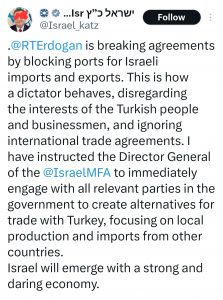
Hence, if an individual alleges to be a victim of injustice and publicly declares it, whether directly or indirectly, it is imperative to conduct a thorough investigation into the matter. This is crucial since certain individuals in contemporary times, particularly the Zionists led by Netanyahu, often resort to portraying themselves as victims and appealing to emotions, despite their well-documented mistreatment of Palestinians and refusal to heed the calls of Muslim nations to halt their atrocities. Most recently, the Zionist Foreign Minister, Mr. Katz, accused President Recep Tayyip of behaving like a “dictator”. This situation brings to mind the proverbial saying:

ضربني وبكى
سبقني واشتكى

“He hit me and cried….and complained before me”.

Therefore, what led Mr. Katz to accuse President Recep Tayyip of dictatorship? The underlying cause for this accusation stems from Turkey’s recent decision to halt all trade with the Zionists. Consequently, Mr. Zionist Katz expressed his viewpoint on the matter, saying:

Firstly, read here about boycotting:

https://abuiyaad.com/a/albani-boycotting-goods-oppressors
https://abuiyaad.com/a/luhaydan-boycott-mockery-prophet
https://abuiyaad.com/a/trade-relations-peace-war

Secondly, the Zionists persist in spreading falsehoods to suppress dissent, sometimes resorting to blatantly false claims, while other times opting for more subtle tactics like trying to conflate anti-Zionism with antisemitism. Those who expose their wrongdoing are labelled as Nazis or brainwashed anti-semites, all while claiming to act in the name of Jewish security. This narrative is reinforced by the fear-mongering of certain political and community figures, even though Netanyahu and his associates offer no protection to Palestinians whatsoever.

Since the onset of the genocide, a staggering number of 34,200 have been murdered, among them 14,500 children and 10,000 women. The devastating aftermath persists, with over 10,000 individuals remaining buried beneath the ruins. Furthermore, the discovery of mass graves at hospitals in both the northern and southern regions of Gaza has added to the already harrowing situation. The unparalleled cruelty exhibited by Netanyahu and his accomplices, the Zionists, is truly unfathomable. The destruction is extensive, with two-thirds of residential properties, as well as vital infrastructure such as roads, hospitals, schools, universities, factories, shops, graveyards, libraries, and masjids, reduced to ruins. In her report for the UN Human Rights Council, UN special rapporteur on the occupied Palestinian territories Francesca Albanese wrote: “[There are] reasonable grounds to believe that the threshold indicating the commission of the following acts of genocide against Palestinians in Gaza has been met: killing members of the group; causing serious bodily or mental harm to groups’ members; and deliberately inflicting on the group conditions of life calculated to bring about its physical destruction in whole or in part”. [End of quote]

Hence, the question arises: who truly merits the title of dictator? It is widely acknowledged that Mr. Katz and his counterpart Netanyahu are the ruthless dictators. However, we condemn the killing of every non-combatant whether they are Muslim or non-Muslim. Read below:

https://abuiyaad.com/a/amalekite-genocide-doctrine-gaza

Question: “Why this blatant contradiction?!” Answer: “No comment”.

In The Name of Allah, The Most Merciful, The Bestower of Mercy.

Allah [The Most High] says:

يَـٰٓأَيُّہَا ٱلَّذِينَ ءَامَنُواْ كُونُواْ قَوَّٲمِينَ بِٱلۡقِسۡطِ شُہَدَآءَ لِلَّهِ وَلَوۡ عَلَىٰٓ أَنفُسِكُمۡ أَوِ ٱلۡوَٲلِدَيۡنِ وَٱلۡأَقۡرَبِينَ‌ۚ إِن يَكُنۡ غَنِيًّا أَوۡ فَقِيرً۬ا فَٱللَّهُ أَوۡلَىٰ بِہِمَا‌ۖ فَلَا تَتَّبِعُواْ ٱلۡهَوَىٰٓ أَن تَعۡدِلُواْ‌ۚ وَإِن تَلۡوُ ۥۤاْ أَوۡ تُعۡرِضُواْ فَإِنَّ ٱللَّهَ كَانَ بِمَا تَعۡمَلُونَ خَبِيرً۬ا

O you who believe! Stand out firmly for justice, as witnesses to Allah; even though it be against yourselves, or your parents, or your kin, be he rich or poor, Allah is a Better Protector to both (than you). So follow not the lusts (of your hearts), lest you may avoid justice, and if you distort your witness or refuse to give it, verily, Allah is Ever Well-Acquainted with what you do. [Surah An-Nisaa. Ayah 135]


Recent statement:

Mr. Starmer stated: Let me be clear about what I was saying and what I wasn’t saying; I was saying Israel has the right to self-defense, and when I said that right, it was the right to self-defense; I was not saying that Israel had the right to cut off water, fuel, food supplies or medicine.


Previous Statement:

The Interviewer said to Mr Starmer: I think you would understand, I have to start with events that we are seeing, the Israel and Hamas conflict. Overnight Leo Varadkar, the Irish Prime minister had said that Israel has to be careful because if they are not proportionate, they will risk losing global support. So, what is the proportionate response in your view?

Mr Starmer responded: I think I have to say that the responsibility lies with Hamas. This is cold-blooded murder of men, women, even children. It is terrorism and Israel has the right to defend herself, and there is an ongoing situation with hostages, and Israel has the right to do everything that it can to get those hostages back, safe and sound. Therefore, I am very clear, Israel does have that right to defend herself and Hamas bears responsibility.

The Interviewer said: A siege is appropriate? Cutting off power, cutting off water?

Mr Starmer responded: I think Israel does have that right, it is an ongoing situation. Obviously, everything must be done within international law, but I don’t want to step away from the core principles that Israel has the right to defend herself and Hamas has responsibility for these terrorist acts….. [End of quote]

So, you can judge for yourselves whether the recent and previous statements are a contradiction or whether they can be reconciled.


Finally, examine the consistency of this Muslim ruler – Saudi Prince Turki Al-Faisal who stated – on October 18, 2023 – about the present Israel Government and the Hamas:

All militarily occupied people have a right to resist their occupation, even militarily. I do not support the military option in Palestine. I prefer the other option: civil insurrection and disobedience. It brought down the British Empire in India and the Soviet Empire in Eastern Europe. Israel has overwhelming military superiority and we see in front of our eyes, the devastation and oblivion it is bringing to the people of Gaza.

I categorically condemn Hamas’ targeting of civilian targets of any age or gender, as it is accused of. Such targeting belies Hamas’s claims to an Islamic identity. There is an Islamic injunction against the killing of innocent children, women, and elders. The injunction is also against the desecration of places of worship.

I also condemn Hamas’ gifting the higher moral ground to an Israeli government that is universally shunned, even by half of the Israeli public as fascist, miscreant, and abhorrent. I condemn Hamas for giving this awful government the excuse to ethnically cleanse Gaza of its citizens and bombing them to oblivion.

I condemn Hamas further undermining the Palestinian Authority as Israel has been doing. I condemn Hamas for sabotaging the attempt of Saudi Arabia to reach a peaceful resolution to the plight of the Palestinian people.

But equally, I condemn Israel’s indiscriminate bombing of Palestinian civilians in Gaza and the attempt to forcibly drive them into Sinai. I condemn Israeli targeted killing and the indiscriminate Arrest of Palestinian children, women, and men in the West Bank. Two wrongs don’t make a right.

I’ve been hearing a repeated phrase in American media: unprovoked attack. What more provocation is required to make it provoked than what Israel has done to the Palestinian people for three-quarters of a century? I refer you to the article in the Middle East Monitor of February 17 2014 under the title: Israeli army veterans admit role in massacre of Palestinians in 1948. Read it and weep as I did. Just this year, from May to July, over 450 Palestinians were killed, including 67 children. This bloodletting must stop. I condemn Israel’s stealing of Palestinian lands. I condemn Israeli colonists for rampaging through houses of worship in the Al-Aqsa Mosque in Jerusalem. I condemn Israel for destroying Palestinian homes and olive orchids. I condemn Israel for incarcerating Palestinian women, children, and men in concentration camps without reason to due process. I condemn Israel’s targeted killings and assassinations of Palestinians.

I condemn Western politicians for shedding tears when Israelis are killed by Palestinians but refuse to even express sorrow when Israelis kill Palestinians. There are no heroes in this complicit. Only victims.