Author: Abdullah Jallow

Ahlus Sunnah Do Not Speak Ill of The Scholars of Ahlus Sunnah- By Shaikh Ali Al-Hudhaifi

Shaikh Ali Hudaifi, may Allāh preserve him, stated:

All praise and thanks be to Allah, Lord of the entire existence. And I testify that there is no deity worthy of worship except Allah alone, with no partner, the Protector of the righteous; and I testify that our Prophet Muhammad is His servant and Messenger—peace and blessings of Allah be upon him. To proceed:

Indeed, Ahlus Sunnah do not speak ill of the scholars of Ahlus Sunnah Wal Jama‘ah due to their lofty status, elevated ranks, numerous and unquestionable virtues transmitted in the Qur’an, the Sunnah, and the narrations of the Salaf, and due to their great and tremendous efforts in spreading knowledge, calling to the path of Allah, and defence of the religion. This is the great foundation that does not change in the sight of Ahlus Sunnah.

As for myself, I love the scholars of Ahlus Sunnah. I defend them, spread their virtues, their knowledge, urge (people) towards their books and fatwas, and adherence to their path, whether they are from the early scholars, the middle generations, or the later ones. Among these later scholars are: His Eminence Shaikh Abdul Azeez Ibn Baz, Shaikh al-Albani, Shaikh Ibn Uthaymin, our Shaikh Rabee al-Madkhali, Shaikh Ṣaliḥ al-Fawzan, our Shaykh Muqbil al-Wadiʿi, Shaikh Ṣaliḥ al-Luḥaydan, Shaikh Abdul Azeez Aal Ash-Shaikh, Shaikh Ubayd al-Jabiri, and others from the scholars of Ahlus Sunnah, may Allah have mercy upon all of them, forgive them, and elevate their ranks.

For many years, I have defended Ahlul Hadith in general, and I—through lecture and writings—have defended the scholars of Tawhid. I have defended a group of scholars—both in lectures and writing—among them Shaikh al-Islam Ibn Taymiyyah; and among them Al-Hafidh An-Nawawi- rebutting those who make Tabdee of him. And I have defended the reviver, Shaikh Muhammad ibn Abdil Wahhab, and other than them.

And I have defended contemporary scholars- Shaikh Ibn Baz, may Allah have mercy upon him, Shaikh al-Albani, may Allah have mercy upon him, Shaikh al-Jami, may Allah have mercy upon him, our Shaikh, Shaikh Rabee, may Allah have mercy upon him, our Shaikh Muqbil al-Wadi‘i, may Allah have mercy upon him, our Shaikh Ubaid al-Jabiri, may Allah have mercy upon him, and our Shaikh al-Wassabi, may Allah have mercy upon him. I defended them and others among the scholars, and some of them I defended many times. I have followed this methodology for more than thirty years, all praise and thanks is due to Allah, and I ask Him, the Most High, to grant me steadfastness upon Tawheed, the Sunnah, and the methodology of the pious predecessors until I meet Him.

When the opponents of Ahlus al-Sunnah speak ill against the scholars of Ahlus Sunnah, indeed, they speak ill against them for various reasons: either they speak ill against them due to the characteristic of theirs as carriers of the Salafi methodology—carrying, clarifying, supporting, and spreading it—or because, indeed, they have inherited hatred for the scholars of Ahlus Sunnah from other haters, so they make gestures about them (in mockery and belittlement) and back-biting them (with slander in their absence), or speaking ill against them because, in their view, the scholars hold no value, or for other such reasons.

As for the one who engages one of the scholars in discussion because he has made a mistake in an issue of knowledge, or seeks from the scholar to clarify some of his statements, or seeks from him to treat him fairly in some matter, and what is similar, it is not permissible to say that he is speaking ill against the scholars of Ahlus Sunnah, for indeed he making a request based on truth.

And indeed, there occurred differing between some scholars of Ahlul Hadith, and from the proofs regarding this is the subject of al-Aqran (contemporaries), which is a matter that is well-known and much publicised, and no one applied to the other person arguing against him the narrations that censure speaking ill against Ahlul Hadith. There occurred some differing among some contemporary scholars. Shaikh al-Albani responded to (or refuted) Shaikh Ibn Baz on the issue of placing the hands back on the chest after rising from Ruku, and he said—if I recall correctly—“A Bidah of the Arabian peninsula”. [Footnote a] Shaikh al-Albani strongly responded (or refuted) the Council of Senior Scholars during the Gulf crisis. Shaikh Abdul Azeez Ibn Baz said about his Shaikh- Shaikh Muhammad Ibn Ibrahim Aala Ash-Shaykh- “He is a scholar, not a prophet”. Shaikh An-Najmi responded (or refuted) Shaikh al-Abbad on the subject of the book “Rifqan Ahlus Sunnah”. Shaikh Muqbil al-Wadi‘i responded (or refuted) Shaikh al-Albani on the issue of elections and other than that. Shaikh al-Albani responded (or refuted) Shaikh at-Tuwayjiri on several issues. Shaikh al-Jami responded (or refuted) Shaikh al-Albani during the Second Gulf Crisis regarding the issue of seeking help from unbelievers. Shaikh al-Fawzan responded (or refuted) Shaikh al-Albani and has statements on that. The examples are many, and none considered—in the likes of these matters—as speaking ill against the scholars. May Allah have mercy upon all the scholars of Ahlus Sunnah, forgive them, and elevate their ranks.

A scholar may make a mistake in relation to a right owed to a layperson in matters such as buying, selling, leasing, loans, guarantees, or similar transactions, thus, the layperson may hate him and speak about him. Is this layperson described as hating the scholars or that he is speaking ill against the scholars solely because he wants his rightful due? We have seen some of the Mashayikh who possess knowledge, commendations, and certifications in Qur’an and Hadith, yet they make mistakes in relation to the rights of some of the laypeople. So the laypeople speak about them and demand their rights. When he (i.e. the layperson) is given his rightful due, he remains silent. No one says that these laypeople are those who speak ill against scholars of Ahlus Sunnah. In brief: Indeed, if a man is seeking (requesting something) from a Shaikh based on truth—seeking the cessation of an injustice which he is able to stop, or to clarify matters, especially when people are asking him for an explanation (clarification), it is not permissible to consider someone who is requesting based on truth as one who is speaking ill against the scholars. 

Finally, I say: Indeed, I do not speak ill against any of the Mashayikh of Ahlus Sunnah, as portrayed by some people, and those who fabricate (lies) against me that I indeed speak ill against the scholars of Ahlus Sunnah, circulate this false accusation, or disseminates it about me, or he knows me and does not verify it, then I do not pardon him, and he is my opponent on the Day of Judgment in Allah’s presence. And I remind him of the hadith of the Prophet, peace and blessings of Allāh be upon him: “Whoever says about a believer what is not in him, Allah will make him drink from the foul discharge of the people of Hell”.

And I advise all the brothers to read the book: “The Methodology of Ahl al-Sunnah Wal Jama‘ah in Criticising Narrators, Books, and Groups” by our Shaikh, Shaykh Rabee ibn Hadi, may Allah have mercy on him, forgive him, and elevate his rank. It is an upright and great book.

وصلى الله وسلم وبارك على عبده ورسوله

Ali al-Hudhaifi al-‘Adani
24 / Shawwal / 1447 AH

Arabic Text On This Link:

Shaikh_Ali_Hudhaifi

Paraphrased

Footnote a: https://youtu.be/ZYw4_msM3co?si=ZcOAfK5uCpkMOmDW

[4] Justice For All

In The Name of Allah, The Most Merciful, The Bestower of Mercy.

Aa’isha, may Allah be pleased with her, narrated:

There was a black slave girl belonging to an Arab tribe and they freed her but she remained with them. The slave girl said:

“Once one of their girls (of that tribe) came out wearing a red leather scarf decorated with precious stones. It fell from her or she placed it somewhere. A kite (i.e. a medium to alarge long-winged bird of prey) passed by that place, saw it lying there and mistaking it for a piece of meat, flew away with it. Those people searched for it but they did not find it. So they accused me of stealing it and started searching me and even searched my private parts.”

The slave girl further said: “By Allah! While I was standing (in that state) with those people, the same kite passed by them and dropped the red scarf and it fell amongst them. I told them, ‘This is what you accused me of and I was innocent and now this is it.”

Aisha added, “That slave girl came to Allah’s Messenger, peace and blessings of Allah be upon him, and submitted in Islam. She had a tent or a small room with a low roof in the Masjid. Whenever she visted me, she had a conversation with me and whenever she sat with me, she would recite the following, ‘The day of the scarf (band) was one of the wonders of our Lord, verily He rescued me from the disbelievers’ town’ Aisha added, ‘Once I asked her, what is the matter with you? Whenever you sit with me, you always recite these poetic verses.’ So she told me the whole story'”. [al-Bukhari 439]

Al-Hafidh Ibn Hajr, may Allah have mercy upon him, stated:

In the hadith is that it is permissible to stay overnight and sleep in the Masjid for those Muslims – whether a man or woman – who do not have a place to live if that would not lead to trouble.

The permissibility of placing a covering in the Masjid by way of a tent and the like.

To leave the land where a person is put to trial in the hope of relocating to a better place for oneself just as what happened to this woman.

The virtue of migrating from the land of disbelief.

Allah’s response to the supplication of an oppressed person even if he (or she) is a disbeliever because the context of this hadith shows that she became a Muslim after arriving in Medinah. Allah knows best. [1]

Imam Abdul Azeez Bin Baz, may Allah have mercy upon him, stated:

This oppressed woman was aided by Allah, for indeed Allah aids a person (even) an unbeliever.

Exit the Masjid if menses begin in the Masjid or stay out of necessity. 

There is no harm in erecting a tent for a woman who is in need until a safe place is found.

There’s no harm in sleeping in the Masjid if that would not lead to harm. [2]


[1] Fath Al-Bari Sharh Sahih Al-Bukhari 1/692. Publisher: Dar As-Salam. 1st Edition 1421AH (Year 2000)]

[2] Al-Hulal Al-Ibreeziyyah Min at-Ta’leeqaat Al-Baaziyyah Ala Sahih Al-Bukhari 1/141-142

[1] Exalt Allah and His Shariah First and Foremost

In The Name of Allah, The Most Merciful, The Bestower of Mercy.

Al-Allamah Rabee Bin Hadi Al-Mad’khali, may Allah have mercy upon him, said:

Many people humble themselves to one another more than they humble themselves to Allah – The Most High, The Most Great. It is neither permissible for a person to be a slave except to Allah, (i.e. not to be subservient to anyone in a manner that only Allah deserves) nor humble himself except to the Greatness of Allah. Allah [Glorified be He and free is He from all imperfections] said:

هُوَ ٱللَّهُ ٱلَّذِى لَآ إِلَـٰهَ إِلَّا هُوَ‌ۖ عَـٰلِمُ ٱلۡغَيۡبِ وَٱلشَّهَـٰدَةِ‌ۖ هُوَ ٱلرَّحۡمَـٰنُ ٱلرَّحِيمُ
هُوَ ٱللَّهُ ٱلَّذِى لَآ إِلَـٰهَ إِلَّا هُوَ ٱلۡمَلِكُ ٱلۡقُدُّوسُ ٱلسَّلَـٰمُ ٱلۡمُؤۡمِنُ ٱلۡمُهَيۡمِنُ ٱلۡعَزِيزُ ٱلۡجَبَّارُ ٱلۡمُتَڪَبِّرُ‌ۚ سُبۡحَـٰنَ ٱللَّهِ عَمَّا يُشۡرِڪُونَ
هُوَ ٱللَّهُ ٱلۡخَـٰلِقُ ٱلۡبَارِئُ ٱلۡمُصَوِّرُ‌ۖ لَهُ ٱلۡأَسۡمَآءُ ٱلۡحُسۡنَىٰ‌ۚ يُسَبِّحُ لَهُ ۥ مَا فِى ٱلسَّمَـٰوَٲتِ وَٱلۡأَرۡضِ‌ۖ وَهُوَ ٱلۡعَزِيزُ ٱلۡحَكِيمُ

He is Allah besides Whom none has the right to be worshipped but He; the King, the Holy, the One Free from all defects, the Giver of security, the Watcher over His creatures, the All-Mighty, the Compeller, the Supreme. Glory be to Allaah! [High is He] above all that they associate as partners with Him. He is Allaah, the Creator, the Inventor of all things, the Bestower of forms. To Him belong the Best Names. All that is in the heavens and the earth glorify Him. And He is the All-Mighty, the All-Wise. [Surah Al-Hashar’ Ayaat 23-24]

Examine those Ayaat in the last part of Surah Al-Hashar! The statement:

هُوَ ٱللَّهُ ٱلَّذِى لَآ إِلَـٰهَ إِلَّا هُوَ

He is Allah besides Whom none has the right to be worshipped but He)]: This necessitates Tawheed Al-Uluhiyyah [The Oneness as the only one Who has the right to be worshipped].

The statement:
هُوَ ٱللَّهُ ٱلَّذِى لَآ إِلَـٰهَ إِلَّا هُوَ‌ۖ عَـٰلِمُ ٱلۡغَيۡبِ وَٱلشَّهَـٰدَةِ‌ۖ هُوَ ٱلرَّحۡمَـٰنُ ٱلرَّحِيمُ

He is Allah, besides Whom none has the right to be worshipped but He, the All-Knower of the unseen and the seen (open). He is the Most Beneficent, the Most Merciful]: This necessitates Tawheed Al-Asmaa Was Sifaat [The Oneness of Allah in His Names and Attributes.

The statement:
هُوَ ٱللَّهُ ٱلۡخَـٰلِقُ ٱلۡبَارِئُ ٱلۡمُصَوِّرُ‌ۖ

He is Allah, the Creator, the Inventor of all things, the Bestower of forms]. This necessitates Tawheed Ar-Roboobiyyah [The Oneness of Allah in His Lordship].These few Ayaat in the last part of Surah Al-Hashr necessitate all the categories of Tawheed [Pure Islamic Monotheism]. [1]

Imam Ash-Shawkaanee [may Allaah have mercy upon him] said:

The love for high status and wealth often leads to the abandonment of fairness, which in turn distances individuals from the truth. This abandonment further results in the concealment of truth and the failure to clarify what Allah has obligated. The two aforementioned matters are a greater enemy to an individual than a pair of hunting wolves, [Footnote a] as stated by Allah’s Messenger [peace and blessings of Allah be upon him] because it was the reason that led the people of the scripture to distort Allah’s Books and hide the clear evidences and guidance that were revealed to them, such as what happened to the Jewish Rabbis (i.e. those who deviated after the advents of their Prophets). Allah, in His Mighty Book, and the Messenger, through authentic narrations, have both informed us about this.

The Imam also stated:

We often see a man who holds a belief that aligns with truth and correctness. However, when he speaks to someone who disagrees with him- one who is inclined towards something of the innovated matters in the religion, and especially if that person holds a position of leadership or worldly wealth, not to mention a king, he agrees with him, strengthens, supports and aids him against others.

The least in such circumstances is that he would hide what he believes is the truth and show contempt – in the presence of a person from whom it is neither possible to receive harm nor benefit – towards what has become clear to him is the right thing, so, what about someone from whom harm and benefit are possible? This behavior is essentially prioritizing worldly things and the life of this world over the religion and the afterlife. If he observed and reflected upon what has happened to him, he would have realised that his inclination toward the (vain) desires of a man, two men, three or more individuals – among those he compliments within that gathering, conceals the truth to be in agreement with them and to gain affection, acquire their possessions, and avoid being isolated by them -is a deficiency in upholding the truth and tantamount to exalting falsehood. If it were not for the fact that these individuals hold a higher position in his eyes than the Lord, he would not have been inclined to their (vain) desires and abandoned what he knows to be what Allah wants and demands from His servants. [2]

Footnote a: Allah’s Messenger [peace and blessings of Allah be upon him] said, “Two hungry wolves let loose among sheep are not more harmful than a person’s craving after wealth and status is to his Religion”. [3]

Imam Muhamad Ibn Saalih Al-Uthaymeen [may Allah have mercy upon him] said, “Two hungry wolves let loose on a flock -then what will remain from the flock?! Even when a single wolf stops eating because its stomach is full, it still kills the rest of the flock; then what about two hungry wolves let loose on a flock!! Not a single will remain. Likewise, a person who craves wealth or status will corrupt the religion and because of this, it is obligated to a person that his intention is far removed from this- far removed from craving wealth and status in the religion. We ask Allah to aid us to accomplish this”. [4]

We ask Allah:

اللَّهُمَّ إِنِّي أَسْأَلُكَ حُبَّكَ وَحُبَّ مَنْ يُحِبُّكَ وَالْعَمَلَ الَّذِي يُبَلِّغُنِي حُبَّكَ

O Allah, I ask you for your love and the love of those who love you and the deeds that will bring me your love.


[1] An Excerpt from Majmu Wa Rasaail Wa Fataawa 1/22

[2] An Excerpt from Adabud Talab Wa Muntahaa Al-Adab. Pages 93-95. Slightly paraphrased]

[3] Reported by Tirmidhee no.2376. Declared Authentic by Imaam Albaani (rahimahullaah) Saheeh Sunan At-Tirmidhee Vol 2 page 553

[4] At-taleeq Alaa Siyaasah Shar’iyyah. pages 454-455

[3] Justice For All

In The Name of Allah, The Most Merciful, The Bestower of Mercy.

Narrated Al-Miswar bin Makhrama and Marwan: (whose narrations attest to each other) Allah’s Messenger, peace and blessings of Allah be upon him, set out at the time of Al-Hudaibiya (treaty), and when they proceeded for a distance, he said, “Khalid bin Al-Walid leading the cavalry of Quraish constituting the front of the army, is at a place called Al-Ghamim, so take the way on the right.” By Allah, Khalid did not perceive the arrival of the Muslims till the dust arising from the march of the Muslim army reached him, and then he turned back hurriedly to inform Quraish. The Prophet went on advancing till he reached the Thaniya (i.e. a mountainous way) through which one would go to them (i.e. people of Quraish). The she-camel of the Prophet sat down. The people tried their best to cause the she-camel to get up but in vain, so they said, “Al-Qaswa’ (i.e. the she-camel’s name) has become stubborn! Al-Qaswa’ has become stubborn!” The Prophet said, “Al-Qaswa’ has not become stubborn, for stubbornness is not her habit, but she was stopped by Him Who stopped the elephant.”

Imam Muhammad Ibn Salih Al-Uthaymin, may Allah have mercy upon him, stated:

إن البهائم تمدح على مكارم الأخلاق، فإن ناقة النبي عليه الصلاة والسلام في غزوة الحديبية لما بركت وخلأت أبت أن تستمر في السير إلى مكة صاح الناس وقالوا خلأت القصواء خلأت القصواء يعني حرنت ووقفت فقال النبي عليه الصلاة والسلام: ( والله ما خلأت وما ذاك لها بخلق  دافع عنها ( وما ذاك لها بخلق ولكن حبسها حابس الفيل

Animals are praised for their good manners because when the Prophet’s She-camel – during the Battle of Al-Hudaybiyah- refused to continue walking to Makkah, the people shouted “Al-Qaswa has become stubborn! Al-Qaswa has become stubborn!” The Prophet, peace and blessings of Allah be upon him, said, “By Allah! She has not become stubborn because stubbornness is not her character”. He defended her (saying), “But she was stopped by Him (i.e. Allah) Who stopped the elephant (i.e. the elephant amongst Abraha’s army that came to destroy the Kabah)”.

https://www.alathar.net/home/esound/index.php?op=codevi&coid=31665

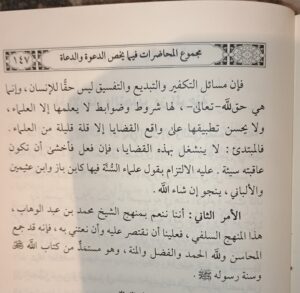
A Brief Caution by Shaikh Abdus Salam Burjess on Takfeer, Tabdee, and Tafseeq

In The Name of Allah, The Most Merciful, The Bestower of Mercy.

In a rebuke against those who seek to compare Shaikh al-Islam Ibn Taymiyyah and Sayyid Qutb, Shaikh al-Islam Ibn Taymiyyah and al-Mawdudi, or Shaikh al-Islam Ibn Taymiyyah and Hasan al-Bannah, Shaikh Abdus Salam Burjess, may Allah have mercy upon him, said:

Thus, how can Ahlus Sunnah Wa Jama’ah remain silent about the likes of such disgraceful (things)? A journalist being compared to Ibn Taymiyyah, a Sufi compared to Ibn Taymiyyah, and a deviant revolutionary who deviated from the Sunnah being compared to Ibn Taymiyyah! May Allah protect us and you from every misleading trial, and grant us life upon Islam and the Sunnah. How much in need is everyone – scholars, students of knowledge, and the common people – of reviving the methodology of the (pious) predecessors in many matters within ourselves, our families, and our societies!

And let everyone fear Allah -The Most High – and not be deviated along with volatile emotions, fior indeed, the religion is not based on opinion. If they refuse to disassociate themselves from these people and their ilk, then let them inform us about the stances of our scholars who authored many books in refutation – by name – against the people of Bidah and (vain) desires, even though those Mubtadi’ah had many good deeds.

Let them inform us about the refutations by Uthman Ibn Sa‘id against Bishr al-Mareesee; about “Kitab As-Sunnah” by Abdullah Ibn Imam, “Minhaj as-Sunnah an-Nabawiyyah Fee Naqd Kalam ash-Shi‘ah Wal-Qadariyyah”, and the book “Siyanat al-Insan an Waswasat ash-Shaykh Dahlan, and the book “Iqamah al-Hujjah Wa ad-Dalil, wa Idah al-Mahajjah wa as-Sabil ala Ma Mawwaha Bihi Ahl al-Kadhib Wal-Mayn, min Zanadiqah Ahl al-Bahrayn, and other books of Ahlus Sunnah Wal-Jama‘ah — are they truth or falsehood? Did their authors do wrong, or did they do well?

And in concluding this statement, I point to two important matters:

The first is that indeed we are within a time wherein we call to refutation against everyone who opposes the sound creed and the upright methodology. We call upon the youth whom Allah has safeguarded from those illegal partisanships and dubious groups to establish verification, and not to unleash their tongues by declaring people Mubtad’ah and misguided, except based on the clear Shariah proofs and the prophetic path. Let their footsteps in this matter be based on the footsteps of our scholars and our Mashayikh, for indeed, at present, we complain regarding a people who have become bold enough to engage in this matter, thus, declaring others Mubtadi’ah and misguided without proof. Therefore, let them fear Allah in their souls and be mindful of this dangerous matter. For indeed, the Msaa’il of Takfeer, (declaring others disbelievers), Tabdee (declaring others Mubtadi’ah) and Tafseeq (declaring others sinners) are not the right of a person, rather, they are the right of Allah – The Most High. It has Shurut and Dawabit that none truly knows except the scholars, and none is proficient in applying it on the real situations (circumstances) except a few among the scholars. The beginner does not preoccupy himself with these issues; if he does, it is feared that its outcome will be evil. It is incumbent upon him to adhere to the statements of the scholars of Sunnah in this regard, such as Ibn Baz, Ibn ‘Uthaymin, and al-Albani, and InShaAllah, they will be safe.

The second matter: Indeed, we are blessed with the methodology of Shaikh Muhammad ibn ‘Abd al-Wahhab – this Salafi methodology. Therefore, it is incumbent upon us to limit ourselves to it and give it close attention, for indeed, it – all praise, grace and blessings belong to Allah – gathers virtues derived from Allah’s Book and the Sunnah of His Messenger.

Source: Majmūʿ Muʾallafāt wa Taḥqīqāt Faḍīlat ash-Shaykh ad-Duktūr ʿAbd as-Salām Ibn Burjess. 3/145-147. Paraphrased

Also read:

Painful Memories About Some of Those Who Set Ablaze the Flames of Transgression and False Tabdi

Read a brief biography of the Shaikh, may Allah have mercy upon him:

[3] Brief Biographies of Some Prominent Contemporary Scholars – Shaikh Abdus Salaam Burgis

Story of a Brother Wrongfully Deprived: From Pain of Disappointment and Oppression to Happiness

In The Name of Allah, The Most Merciful, The Bestower of Mercy.

The brother narrates:

In 1994, I finished a course in NVQ Level 3 Business Administration. Then I started looking for a job to earn enough money, because even though I was born in the UK, I had got married back home and needed £1000 within 9 weeks to pay for the air fare for both my wife and child to join me in the UK. So, I was hoping that securing a job with my new qualification would at least raise some of the money.

I then went to the Jobcentre and eagerly applied for a job. A very kind white lady was very eager to help me with an interview with the employer on the phone. She rang the employer and passed the phone over to me. The employer sounded impressed when I mentioned that I had just finished an NVQ Level 3 in Business Admin. After taking some details, he told me to hand over the phone to the white lady. Then, within very few seconds, I saw an angry expression on her face, and she said to me, “Don’t go for this job, I will find you another one”. I was very surprised as well as disappointed. So, I left, and an appointment was made for another job search.

Later on that day, while I was out, my uncle received a phone call from the same white lady from the Jobcentre, informing him that the employer I had spoken to asked her whether I was coloured, to which she replied yes, so he said, “I don’t prefer to employ coloured people”. She also told my uncle that the conversation was recorded, and she is begging me to sue the employer for discrimination. When my uncle related this message and begged me constantly to pursue the matter, I reminded him that I only have 9 weeks to raise this money, and these matters take many months. I will leave it and look for something else. I was very disappointed and felt oppressed, but did not give up. So I went out every morning and afternoon looking for a job until I found one at a bakery, but the wages were extremely low and the heat started affecting my asthma.

Then one day, after finishing work at the bakery, I went past a takeaway and said to myself, let me find out whether they have a vacancy. I went in, and straight away the owner said yes, we have a vacancy, and the hours are 2.30 pm to 1 am in the morning, and the wage was more than enough to gather the air fare within 7 wks. I could not believe it. When he asked me when can I start, I said the next day. I started and worked and raised the money, sent the money back home, and my wife joined me within a week after sending the money. After my wife came over, I worked for a few more weeks. I carried on working at the takeaway to earn more income, as my wife was now in the UK.  Then I found a job at a school as a teaching assistant for foreign children who had just moved to the UK. I stayed there until I found another teaching job at a Muslim independent primary school that paid higher wages. My children enrolled in the school, and I finally had a stable job as well as enhanced my career prospects. From then until now, I am still in education.

When I look back, one interesting thing is that the job I was deprived of at first was only £120 a week, and the job I got at the takeaway was nearly nearly 3 times the amount. I ponder upon the sadness when I could not secure the first job, and it was something I hated, but later on until today I know that it was something good. [end of story]

This story reminds us of the Ayah:

وَعَسَىٰٓ أَن تَكۡرَهُواْ شَيۡـًٔ۬ا وَهُوَ خَيۡرٌ۬ لَّڪُمۡ‌ۖ وَعَسَىٰٓ أَن تُحِبُّواْ شَيۡـًٔ۬ا وَهُوَ شَرٌّ۬ لَّكُمۡ‌ۗ وَٱللَّهُ يَعۡلَمُ وَأَنتُمۡ لَا تَعۡلَمُونَ
And it may be that you dislike a thing which is good for you and that you like a thing which is bad for you. Allah knows but you do not know.” [AI-Baqarah. Verse 216]
Imam Ibn Al-Qayyim, may Allah have mercy upon him, said:
There is for the servant (of Allah) -in this verse – a number of insightful guidelines, underlying benefits and welfare, because indeed if he knows that Al-Makrooh (what is disliked) can bring forth Al-Mahboob (i.e. what is beloved), and vice versa, then neither would he feel safe from the harm that might occur from something that makes him happy nor would he lose hope whilst expecting a final source of happiness from a situation of harm. That is because he does not have (infinite or perfect) knowledge of the Awaaqib (i.e. the final outcomes), but Allaah knows that which he does not know.
The servant (of Allah) should hand over his affair to the One (Allah) who knows – (perfectly without anything hidden from Him)- the end result of affairs. He should be pleased with what Allah chooses and decrees for him because of the good end result he hopes for. Neither should he make suggestions to his Lord nor put forward his choice over that of his Lord, nor does he ask for something about which he has no knowledge, because it maybe that what will bring about harm and destruction on him is found in what he asks, whilst he does not know. Therefore, he does not choose anything over what his Lord chooses; rather he asks his Lord to choose the best for him and make him pleased with what has been chosen for him, because there is nothing more beneficial for him than this.
When he hands over his affair to his Lord and is pleased with what has been chosen for him, his Lord facilitates him with strength, determination and patience in that which has been chosen for him; repel the afflictions he would have encountered due to the choice he makes and show him some of the good end results of the choice his Lord made for him, which could not have been attained through the choice he makes for himself. If he is pleased with Allah’s choice, then what has been decreed will come to him, whilst he is deserving of commendation and graceful in it; otherwise, what has been decreed will come to him while he is blameworthy and ungraceful, because he is left with the choice he made for himself.
Al-Fawaa’id. page 204


The friend who, whenever you complain, says: “Let this reflection bear fruit”

In The Name of Allah, The Most Merciful, The Bestower of Mercy.

Shaikh Al-Islam Ibn Taymiyyah, may Allah have mercy upon him, said:

One must know that neither is it conceivable to the intellect (i.e. sound intellect) nor (plausible) in the religion to seek the pleasure of the creation [i.e. mankind and Jinn] due to two affairs: First, Imam Ash-Shafi’ee, may Allah have mercy upon him, said: The people are an unattainable goal”. Therefore, it is obligated on you to (pursue) that which would rectify your affairs and adhere to it; abandon its opposite and do not concern (yourself) with it. Second, indeed, we have been commanded to (seek) the pleasure of Allah and His Messenger, as Allah, The Most High, said:

وَٱللَّهُ وَرَسُولُهُۥٓ أَحَقُّ أَن يُرْضُوهُ إِن كَانُوا۟ مُؤْمِنِينَ

But it is more fitting that they should please Allah and His Messenger (Muhammad), if they are believers.[at-Tawbah. 62]

It is obligated to us to fear Allah and not fear anyone except Allah, as Allah, The Most High, said:

فَلَا تَخَافُوهُمْ وَخَافُونِ إِن كُنتُم مُّؤْمِنِينَ

So fear them not, but fear Me, if you are (true) believers. [Aal Imran. 175]

Allah said:

فَلَا تَخْشَوُا۟ ٱلنَّاسَ وَٱخْشَوْنِ

Therefore fear not men but fear Me. [Al-Ma’idah. 44]

Allah said:

فَإِيَّٰىَ فَٱرْهَبُونِ

Then, fear Me (Allah) much [and Me (Alone), i.e. be away from all kinds of sins and evil deeds that Allah has forbidden and do all that Allah has ordained and worship none but Allah. [An-Nahl. 51]

Allah said:

وَإِيَّٰىَ فَٱتَّقُونِ

And fear Me and Me Alone. [Al-Baqarah. 41]

It is obligated to us to fear Allah – fear Allah concerning the (rights) of the people- neither harm them with our hearts (i.e. blameworthy hatred, malice etc) nor with our limbs (i.e. physical harm); fulfil their rights with our hearts and limbs (i.e. wish them good, love for them what we love for ourselves, physically do what will benefit them etc), but do not fear them and leave what Allah and His Messenger commanded. The one who adheres to this path will (reach) the (praiseworthy) outcomes, just as Aa’isha, may Allah be pleased with her, wrote to Mu’aawiyah, may Allah be pleased with him and his father, and said, “To proceed: Indeed, whoever seeks the pleasure of the people at the expense of Allah’s displeasure will (earn) Allah’s displeasure and Allah will cause the people to be displeased with him. And the praise of the people will become blame against him. And whoever seeks Allah’s Pleasure at the expense of people’s displeasure, will (earn) Allah’s Pleasure and Allah will cause the people to be pleased with him”.

Therefore, a person’s concern and intention should be nothing else but to (seek) the Pleasure of Allah and to avoid Allah’s displeasure, and there is no power or might except with Allah. [1]

Imam Muhammad Bin Salih Al-Uthaymin, may Allah have mercy upon him, said: If all the people were pleased with you and Allah is not pleased with you, then indeed it will not benefit you except the Pleasure of Allah, The Mighty and Majestic, for indeed if Allah is pleased with you, He will make people become pleased with you and make their hearts incline towards you, as it has been reported in a hadeeth, “Indeed, when Allah loves a servant, He calls Jibreel and says, ‘Verily, I love this person so you should love him’. Then Jibreel loves him and makes an announcement in the heavens, saying, ‘Indeed, Allah loves this person and you should love him’, so the inhabitants of the heavens love him. Then he is granted the (pleasure and acceptance) of the (people) in the earth”, just as Allah said:

إِنَّ ٱلَّذِينَ ءَامَنُوا۟ وَعَمِلُوا۟ ٱلصَّٰلِحَٰتِ سَيَجْعَلُ لَهُمُ ٱلرَّحْمَٰنُ وُدًّا

Verily, those who believe [in the Oneness of Allah and in His Messenger (Muhammad)] and work deeds of righteousness, the Most Beneficent (Allah) will bestow love for them (in the hearts of the believers). [Maryam. 96]

However, if a person seeks after the pleasure of the people at the expense of Allah’s displeasure, the affair will be the opposite. Allah will be angry with him and will make the people become angry with him. This is why when Mu’aawiyah became the Khaleefah, Aa’isha, may Allah be pleased with her, wrote to him, saying, “I heard the Prophet, peace and blessings of Allah be upon him, say, ‘Whoever seeks the pleasure of Allah at the expense of the displeasure of the people, Allah will suffice him against the people. Whoever seeks the pleasure of people at the expense of Allah’s displeasure, Allah will leave his affair to the people'”. [2]

Allah, The Most High, said:

 وَتَعَاوَنُوا۟ عَلَى ٱلْبِرِّ وَٱلتَّقْوَىٰ وَلَا تَعَاوَنُوا۟ عَلَى ٱلْإِثْمِ وَٱلْعُدْوَٰنِ

Imam Ibn Al-Qayyim, may Allah have mercy upon him, said:

This Ayah contains all the Masaalih [beneficial matters] for the servants (of Allah) in their Dunyah and matters related to the Hereafter- be it between themselves or between them and their Lord, for indeed every servant (of Allah) finds himself within two circumstances and obligations – either to fulfil the obligations owed to Allah or the obligations owed to Allah’s creation. As for the obligations owed to the creation, they include (righteous) association, companionship, aiding one another upon what Allah loves and obedience to Allah, and this is the objective behind one’s search for happiness and success in the afterlife. There can be no happiness in the afterlife except through Bir [virtue] and Taqwaa [piety], for it is basis of all matters of the religion.

As for Taqwa, its reality is to act in obedience to Allah based on Iman in Allah and hoping for Allah’s Reward; fulfil what Allah has commanded based on having Iman in that which Allah has commanded and affirming the reward Allah has promised; abandoning what Allah has forbidden based on one’s belief that what Allah has forbidden is forbidden and fearing Allah’s punishment, as Talq Bin Habib, may Allah have mercy upon him, said:

“When Fitna occurs, extinguish it with Taqwa”. Rhe people asked, “What is Taqwa?” He said, “You act in obedience to Allah upon a light from Allah (i.e. Iman, sincerity, guidance) and hoping for reward from Allah. And you abandon disobedience to Allah upon a light from Allah and fearing the punishment of Allah”.

This is the best of that which has been stated regarding Taqwa, for indeed there has to be an aim and a goal behind every deed. A deed cannot be considered an act of obedience to Allah and an act that gets one close to Allah until it is based on Iman, thus, that which leads to the performance of the deed is solely due to Iman – neither customs nor desires; neither seeking praise nor status and other than it; rather it should be solely based on Iman and the aim behind it should be to attain Allah’s reward and seeking after Allah’s Pleasure. [3]

Abu Umamah, may Allah be pleased with him, reported: Allah’s Messenger, peace and blessings of Allah be upon him, said, “Whoever loves for the sake of Allah, hates for the sake of Allah, gives for the sake of Allah, and withholds for the sake of Allah has perfected the Iman”. [Sunan Abi Dawud 4681]

Mu’adh bin Jabal, may Allah be pleased with him, narrated: One morning, Allah’s Messenger, peace and blessings of Allah be upon him, was prevented from coming to us for morning prayer until we were just about to look for the eye of the sun (meaning sunrise). Then he came out quickly and the Iqama was called for him to (lead) the prayer. Allah’s Messenger performed the prayer, and he performed his prayer in a relatively quick manner. When he said the Salam, he called aloud with his voice saying to us: ‘Stay in your rows as you are.’ Then he turned coming near to us, then he said: ‘I am going to narrate to you what kept me from you this morning: I got up during the night, I performed Wudu and prayed as much as I was able to, and I dozed off during my prayer, and fell deep asleep. Then I saw my Lord, Blessed and Most High, in the best of appearances. He said: ‘O Muhammad!’ I said: ‘My Lord here I am my Lord!’ He said: ‘What is it that the most exalted group busy themselves with?’ I said: ‘I do not know Lord.’ And He said it three times.” He said: “So I saw Him place His Palm between my shoulders, and I sensed the coolness of His Fingertips between my breast. Then everything was disclosed to me, and I became aware. So He said: ‘O Muhammad!’ I said: ‘Here I am my Lord!’ He said: ‘What is it that the most exalted group busy themselves with?’ I said: ‘In the acts that atone.’ He said: ‘And what are they?’ I said: ‘The footsteps to the congregation, the gatherings in the Masajid after the prayer, the correct performance of ablution during difficulties.’ He said: ‘Then what else?’ I said: ‘Feeding others, being lenient in speech, and prayer during the night while the people are sleeping.’ He said: ‘Ask.’ I said:

اللَّهُمَّ إِنِّي أَسْأَلُكَ فِعْلَ الْخَيْرَاتِ وَتَرْكَ الْمُنْكَرَاتِ وَحُبَّ الْمَسَاكِينِ وَأَنْ تَغْفِرَ لِي وَتَرْحَمَنِي وَإِذَا أَرَدْتَ فِتْنَةَ قَوْمٍ فَتَوَفَّنِي غَيْرَ مَفْتُونٍ أَسْأَلُكَ حُبَّكَ وَحُبَّ مَنْ يُحِبُّكَ وَحُبَّ عَمَلٍ يُقَرِّبُ إِلَى حُبِّكَ

O Allah! I ask of you the doing of the good deeds, avoiding the evil deeds, loving the Masakin, and that You forgive me, and have mercy upon me. And when You have willed trial among the people, then cause me to die without being put to trial. And I ask You for Your love, the love of whomever You love, and the love of the deeds that bring one nearer to Your love.'” Allah’s Messenger said: “Indeed it is true, so study it and learn it.” [Sahih at-Tirmidhi 3235]

 “O Allah! I ask of you the doing of the good deeds, avoiding the evil deeds”.

There is no need for further explanation regarding the performance of good deeds, other than the fact that they are actions that please Allah, and the doer is praised for them, receiving great rewards. Similarly, the reward for abstaining from wrongdoing is also significant, provided that the intention behind refraining is to seek Allah’s pleasure.

“And loving the Masakin”.

The word Miskin in this sentence “The term refers to the humble individual, neither arrogant nor haughty, someone who is gentle, approachable, and easy to deal with; neither boastful nor evil. [4]

“And when You have willed trial among the people, then cause me to die without being put to trial”.

The essence of the supplication is to ensure the person’s safety from worldly trials throughout their life. If Allah decrees a trial for His servants, He may take them before it occurs. This is one of the most significant supplications, as a believer who lives free from trials and is taken by Allah before they arise is saved from all evil. The Prophet instructed his companions to seek refuge in Allah from both apparent and hidden trials. In another narration, he advised them to avoid both manifest and concealed immoralities and trials. Thus, praying for death out of fear of religious trials is permissible, as it has been done by the companions and righteous individuals after them.

“And I ask You for Your love, the love of whomever You love, and the love of the deeds that bring one nearer to Your love”.

This supplication encompasses all that is good. The chosen actions of Allah’s servants arise from love and intention. If the love of Allah is firmly established in a person’s heart, it will lead to actions of the limbs that align with what Allah loves and approves. Thus, one will cherish all actions and words that Allah loves, resulting in the performance of all good deeds and the avoidance of all wrongdoings, as well as loving those whom Allah loves among His creation. [5]


[1]An Excerpt from Majmu Al-Fatawa 3/233

[2]An Excerpt from Sharh Riyad As-Saalihin 1/163

[3]An Excerpt from Bada’i at-Tafseer Al-Jaami Limaa Fassarahu Al-Imam Ibn Al-Qayyim Al-Jawziyyah 1/307-311. Publisher: Dar Ibn Al-Jawziyyah 2nd Ed, 1431AH.

[4] An Excerpt from “Al-Istidhkar. 8/ 171” by Al-Allamah Ibn Abdul Barr, may Allah have mercy upon him.


[5] An Excerpt from “Ikhtiyar Al-Awwal” 118-125 by Imam Ibn Rajab, may Allah have mercy upon him.

[2] Justice For All

In The Name of Allah, The Most Merciful, The Bestower of Mercy.

Aa’isha, may Allah be pleased with her, reported that the Quraish had been anxious about the Makhzumi woman who had committed theft, and said, “Who will speak to Allah’s Messenger, peace and blessings of Allah be upon him, about her?” They said, “Who dare it, but Usamah, the loved one of Allah’s Messenger?” So Usamah spoke to him. Thereupon Allah’s Messenger said, “Do you intercede regarding one of the punishments prescribed by Allah?” He then stood up and addressed (people) saying, “O people! Those who have gone before you were destroyed, because if any one of high status committed theft amongst them, they spared him; and if anyone of low status committed theft, they inflicted the prescribed punishment upon him. By Allah, if Fatima, daughter of Muhammad, were to steal, I would have her hand cut of”. [1]

“Do you intercede regarding one of the punishments prescribed by Allah?” Meaning, it is not permissible to intercede regarding the divine prescribed punishments.

“Those who have gone before you were destroyed because if any one of high status committed theft amongst them, they spared him; and if anyone of low status committed theft, they inflicted the prescribed punishment upon him”.

Meaning, destroyed through punishment due to their sins. They were destroyed due to this matter because they said, “This is a person of high status and it is not possible to cut his hand”. When a person of high status amongst them stole, they let him off, (but) when a person of low status stole, they established the punishment on him, thus the implementation of Allah’s prescribed punishments was carried out based on their desires. In this hadith is proof to show that the nations before us committed theft, and that there was much theft in their midst including the wealthy, the poor, the one of high status and the one of low status.

The Messenger then made an oath – even though he is the righteous and truthful one without making an oath – that “By Allah, if Fatima, daughter of Muhammad, were to steal, I would have her hand cut of”.

O Allah! Send Your Salutations and blessings upon him (i.e. the prophet). This is how justice should be and the manner in which Allah’s rulings are to be applied, and not through desires. He made an oath that if Fatimah – who was of a higher status than that Makhzumi woman, both in nobility and lineage, because she is the leader of the women of paradise, the daughter of Muhammad – stole, he would cut her hand. [2]

Imaam An-Nawawi, may Allah have mercy upon him, stated that Imam Muslim, may Allah have mercy upon him, mentioned narrations in the chapter regarding the forbiddance of interceding in the divine ordained punishments and that this was the cause of the destruction of the Children of Israel. The scholars unanimously agreed that – due to these narrations – interceding in the divine ordained punishments – after the affair has reached the leader – is prohibited. As for before it reaches the leader, most scholars have permitted intercession if the one being interceded for is not an evil person and harmful to the people. As for the sins (or acts of disobedience) for which there are no prescribed punishments, then intercession regarding them is permissible whether the affair has reached the leader or not. Intercession in these affairs is desirable if the one being interceded for is not a harmful person and so on. [3]


[1] Saheeh Muslim. 1688a

[2] An Excerpt from Sharh Riyaadus Saaliheen 6/525-530 By Imam Muhammad Ibn Saalih Al-Uthaymeen (may Allah have mercy upon him)

[3] An Excerpt from ‘Sharh Saheeh Muslim’. 11/155


[1] Justice for All

In The Name of Allah, The Most Merciful, The Bestower of Mercy.

Allah, The Most High, said:

يَـٰٓأَيُّہَا ٱلَّذِينَ ءَامَنُواْ كُونُواْ قَوَّٲمِينَ بِٱلۡقِسۡطِ شُہَدَآءَ لِلَّهِ وَلَوۡ عَلَىٰٓ أَنفُسِكُمۡ أَوِ ٱلۡوَٲلِدَيۡنِ وَٱلۡأَقۡرَبِينَ‌ۚ إِن يَكُنۡ غَنِيًّا أَوۡ فَقِيرً۬ا فَٱللَّهُ أَوۡلَىٰ بِہِمَا‌ۖ فَلَا تَتَّبِعُواْ ٱلۡهَوَىٰٓ أَن تَعۡدِلُواْ‌ۚ وَإِن تَلۡوُ ۥۤاْ أَوۡ تُعۡرِضُواْ فَإِنَّ ٱللَّهَ كَانَ بِمَا تَعۡمَلُونَ خَبِيرً۬ا

O you who believe! Stand out firmly for justice, as witnesses to Allah; even though it be against yourselves, or your parents, or your kin, be he rich or poor, Allah is a Better Protector to both (than you). So follow not the lusts (of your hearts), lest you may avoid justice, and if you distort your witness or refuse to give it, verily, Allah is Ever Well-Acquainted with what you do. [An-Nisaa. 135]

Imam Ibn Al-Qayyim, may Allah have mercy upon him, said:

Allah, Glorified be He and free is He from all imperfections, commanded His servants to stand out firmly for justice on behalf of everyone – be it an enemy or an ally, and the matter that is most worthy of being established with justice are the statements and methodology related to the commands of Allah as well as everything that Allah has (revealed in the Qur’an and the authentic Sunnah). Therefore, to establish these affairs based on desires and disobedience is contrary to Allah’s command and a negation (i.e. either intentionally or unintentionally) of that which Allah’s Messenger, peace and blessings of Allah be upon him, was sent with.

The establishment of justice is the responsibility of those entrusted with the task of conveying Islam after the death of the Messenger, and this task cannot become a reality unless one establishes it based on pure justice and sincerity to Allah- (sincerity) based on Allah’s Book, to Allah’s Messenger (by adhering to his guidance), and sincere dealings and advice when dealing with Allah’s servants. These people are the true inheritors (i.e. inheritors of the knowledge left behind by the Prophets), but not that one who merely makes his companions, sect, and path the determinant of truth and the distinction between (truth and falsehood) by showing enmity to the one who opposes him and allies with the one who agrees with him, merely based on being opposed or agreed with [i.e. without sound proofs based on the Book and the authentic Sunnah], because where is that command to stand out firmly for justice on behalf of everyone, even though standing out firmly for justice is the greatest command and obligation!

Then Allah, The Most High, said:

 شُہَدَآءَ لِلَّهِ

As witnesses to Allah.

A witness presents information about something; so if he presents credible information, he is a just witness and his (statement) is accepted; but if he gives false information, he is a false witness. Allah, The Most High, commands us to stand out firmly as just witnesses for His sake, therefore it has to be carried out for the Sake of Allah and not for other than Allah. In [Surah Al-Ma’idah Ayah 8, Allah said]:

كُونُواْ قَوَّٲمِينَ لِلَّهِ شُہَدَآءَ بِٱلۡقِسۡطِ‌ۖ

Stand out firmly for Allah and be just witnesses.

This Ayah establishes four affairs: stand out firmly for justice and do so for the sake of Allah; witness to justice and do so for the Sake of Allah.

Then Allah said:

وَلَوۡ عَلَىٰٓ أَنفُسِكُمۡ أَوِ ٱلۡوَٲلِدَيۡنِ وَٱلۡأَقۡرَبِينَ‌ۚ

Even though it be against yourselves, or your parents, or your kin.

Allah, Glorified be He and free is He from all imperfections, commands us to stand out firmly for justice and testify, even if it were someone who is the most beloved person to us. A person should stand out firmly for justice (for or against) himself, his two parents, his close relatives, and his best friend among the people. If a person’s love for himself, his parents, and his relatives prevents him from standing out firmly for the truth against them, especially if the truth is with someone he hates and regards as an enemy due to them, then none would stand out firmly for justice in such circumstances except one whose love for Allah and His Messenger is more than their love for everyone else. Also, a person has to establish justice when dealing with his enemies and that one who deprives him of his rights because it is not permissible that hatred for his enemies leads him to be unjust towards them, just as it is not permissible that love of himself, his parents and relatives makes him abandon standing firmly for justice against them. Therefore, hatred harboured against someone should not lead him to falsehood, and love (of himself, parents, and relatives) should not make him fall short in establishing truth, just as one of the pious predecessors said, “The just person is that one who when angry, his anger does not lead him to falsehood, and when he is pleased it does not remove him from the truth”. The two Ayaat of the Qur’an [i.e. Surah An-Nisaa 135 and Surah Al-Maa’idah 8] convey two rulings and they are: standing out firmly for justice and making a truthful testimony on behalf of one’s allies and enemies.

Then Allah said:

إِن يَكُنۡ غَنِيًّا أَوۡ فَقِيرً۬ا فَٱللَّهُ أَوۡلَىٰ بِہِمَا‌ۖ

Be he rich or poor, Allah is a Better Protector to both (than you).

Meaning, Allah is the Lord of both of them and their Protector, and they are both His servants. It may be that you become fearful of standing firmly for justice by testifying against a rich person or a poor person – either fearing that the rich person might lose his wealth or because the poor person has nothing, so your heart becomes lackadaisical about standing out firmly for the truth. Therefore, it should be said to them, “Allah is a better Protector of both the rich and poor person. Allah knows the affair of the rich person more than you and He is more Merciful to the poor than you, therefore, do not refrain from standing out firmly for the truth and from giving testimony (for or against) the rich or the poor.

Then Allah said:

فَلَا تَتَّبِعُواْ ٱلۡهَوَىٰٓ أَن تَعۡدِلُواْ‌ۚ

So follow not the lusts (of your hearts), lest you may avoid justice.

Meaning, Allah forbids (His slaves) from following desires, which will lead them to abandon justice.

Then Allah said:

وَإِن تَلۡوُ ۥۤاْ أَوۡ تُعۡرِضُواْ فَإِنَّ ٱللَّهَ كَانَ بِمَا تَعۡمَلُونَ خَبِيرً۬ا

And if you distort your witness or refuse to give it, verily, Allah is Ever Well-Acquainted with what you do.

Meaning, Allah, Glorified be He and free is He from all imperfections, mentions two reasons that will inevitably lead to concealment of truth then He warned against them and issued a threat: the first of them is distortion and the second is to turn away from giving truthful witness. That is because when a proof that supports the truth is manifested and the one who wants to repel it finds no way of doing so, he refrains from mentioning it and thus becomes a silent devil, and sometimes he distorts it. Distortion is of two types -distorting words and meanings. Distorting words occur when one utters a word in a context in which it does not establish the truth – either adding to the word, omitting something from it, or substituting it with something else to the extent that the listener is made to believe something, whilst something else is intended, just as the Yahud [i.e. those Yahud who disbelieved in the Prophet and hated him in Madinah] used to distort words when giving Salam to the Prophet [i.e. saying As-Saamu Alayka (death be upon you), instead of saying Assalaamu alaykum)]. This is one type of distortion. The second type of distortion is related to meanings – distorting the wording, giving it an interpretation that is not intended by the one who uttered it and pretending not to know its unintended meaning; or dropping other meanings intended by it.

When it is the case that a witness is required to bear witness based on what the matter should be [i.e. the complete truth], therefore neither should he hide nor change it. Turning away from the testimony is tantamount to concealment and distortion is tantamount to alteration and substitution. Therefore, contemplate this Ayah and the treasures of knowledge it contains. The faith of a person cannot be complete, except through accepting the texts of the Shariah and calling the people to them – neither turning away from them at times nor distorting them at other times.

An Excerpt from ‘Bada’i at-Tafseer Al-Jaami Limaa Fassarahu Al-Imaam Ibn Al-Qayyim. 1/300-303


Chapter: Whoever is given the right of his brother

In The Name of Allah, The Most Merciful, The Bestower of Mercy.

Imam Al-Bukhari, may Allah have mercy upon him, said: Chapter: Whoever is given the right of his brother through a judicial decision

Umm Salamah, may Allah be pleased with her, reported that Allah’s Messenger, peace and blessings of Allah be upon him, said:

“Indeed, I am only a human being and you people (i.e. disputants) come to me with your disputes. And it may be that one of you can present his case more eloquently than the other and I consider him truthful, and judge in his favour. So if I ever judge and give the right of a brother to his brother, then it is a piece of hellfire and let him not take it”.

Some Benefits Derived From This Hadith

The Ummah (i.e. the qualified judges) judge based on what is apparent, however, the judgement of a judge cannot prohibit the lawful and allow the unlawful (i.e. when proven erroneous).

This Hadith contains a refutation against those who say that the Messengers possess knowledge of the unseen.

This hadith also shows that speech can be seen to be true based on what is apparent, but it is truly falsehood with regard to what is hidden within it.

This hadith shows that the one who receives a judgement in his favour is more aware than every other person as to whether he is entitled to it or whether he is a falsifier. So, he takes if entitled or leaves it if he a falsifier because -in reality- a judgement cannot change a matter from what it was in origin (i.e. the original truth in the affair before its distortion or concealment).

This hadith shows the sinfulness of the one who argues based on falsehood until he receives what he wants publicly, whilst he is upon falsehood.

This hadith is proof to show that a scholar can make a mistake and it is a refutation against those who say that every Mujtahid is correct.

This hadith shows that the Mujtahid is forgiven (when he makes a mistake).


Source: An Excerpt From Sahih Al-Bukhari. Kitab Al-Ahkaam (Book of Judgements): Chapter 29. Hadith Number 7181 with Fath Al-Bari