Author: Abdullah Jallow

Journey to three Masajid

In The Name of Allah, The Most Merciful, The Bestower of Mercy.

Abu Hurairah, Allah be pleased with him, reported it directly from Allah’s Messenger (ﷺ) that he said:

Do not undertake a journey to visit any Mosque, but three: this Mosque of mine, the Mosque of al-Haram and the Mosque of Aqsa (Bait al-Maqdis). [Muslim 1397]

Brief comments by Imam Abdul Aziz Bin Baz, rahimahullah.

4_6001591298597854751

Source: Transmitted by Shaikh Fawwaz Al-Mad’khali at his Telegram Channel.


[7] Exalt Allah and His Shariah First and Foremost

In The Name of Allah, The Most Merciful, The Bestower of Mercy.

Allah, The Almighty, said:

فَأَمَّا عَادٌ فَٱسْتَكْبَرُوا۟ فِى ٱلْأَرْضِ بِغَيْرِ ٱلْحَقِّ وَقَالُوا۟ مَنْ أَشَدُّ مِنَّا قُوَّةً أَوَلَمْ يَرَوْا۟ أَنَّ ٱللَّهَ ٱلَّذِى خَلَقَهُمْ هُوَ أَشَدُّ مِنْهُمْ قُوَّةً وَكَانُوا۟ بِـَٔايَٰتِنَا يَجْحَدُونَ

As for ‘Ad, they were arrogant in the land without right, and they said: “Who is mightier than us in strength?” See they not that Allah, Who created them was mightier in strength than them. And they used to deny Our Ayat (proofs, evidences, verses, lessons, revelations, etc.)! [Fussilat 15]

Imam As-Sadi, may Allah have mercy upon him, said:

This is a detailed account of the story of the two nations, Aad and Thamud. As for Aad, they were arrogant in the earth, together with their disbelief in Allah, their denial of His signs, and their rejection of His messengers. They subdued those – the servants of Allah – around them, oppressed them and were self-amazed with their strength.

[وَقَالُوا۟ مَنْ أَشَدُّ مِنَّا قُوَّةً – They said: “Who is mightier than us in strength?”] In response, Allah reminded them of a fundamental truth known to all:

أَوَلَمْ يَرَوْا أَنَّ اللَّهَ الَّذِي خَلَقَهُمْ هُوَ أَشَدُّ مِنْهُمْ قُوَّةً

See they not that Allah, Who created them was mightier in strength than them.

If Allah did not create them, they would not have existed. Had they contemplated their situation in a correct manner, they would not have been deceived by their own power, thus, Allah punished them in a manner befitting the strength in which they had placed their misguided trust. [1]

Imam Al-Baghawi, may Allah have mercy upon him, said:

The statement of the Almighty:

فَأَمَّا عَادٌ فَٱسْتَكْبَرُوا۟ فِى ٱلْأَرْضِ بِغَيْرِ ٱلْحَقِّ وَقَالُوا۟ مَنْ أَشَدُّ مِنَّا قُوَّةً

As for Aad, they were arrogant in the land without right, and they said: “Who is mightier than us in strength?”

This was in response to Prophet Hud, peace be upon him, who warned them of impending punishment. They arrogantly claimed that their strength could protect them from such retribution, boasting of their tall and powerful physiques. In response, Allah said to them:

أَوَلَمْ يَرَوْا۟ أَنَّ ٱللَّهَ ٱلَّذِى خَلَقَهُمْ هُوَ أَشَدُّ مِنْهُمْ قُوَّةً وَكَانُوا۟ بِـَٔايَٰتِنَا يَجْحَدُونَ

See they not that Allah, Who created them was mightier in strength than them. And they used to deny Our Ayat (proofs, evidences, verses, lessons, revelations, etc.)] [2]

Imam Ibn Kathir, may Allah have mercy upon him, said:

Allah, The Exalted, said:

فَأَمَّا عَادٌ فَٱسْتَكْبَرُوا۟ فِى ٱلْأَرْضِ بِغَيْرِ ٱلْحَقِّ

As for Aad, they were arrogant in the land without right.

Meaning, rebellious, insolent and disobedient.

[وَقَالُوا۟ مَنْ أَشَدُّ مِنَّا قُوَّةً – They said: “Who is mightier than us in strength?] Meaning, believing that their physical strength and capabilities would protect them from Allah’s punishment.

أَوَلَمْ يَرَوْا۟ أَنَّ ٱللَّهَ ٱلَّذِى خَلَقَهُمْ هُوَ أَشَدُّ مِنْهُمْ قُوَّةً

See they not that Allah, Who created them was mightier in strength than them.

Meaning, they did not reflect on the fact that Allah, who created them, is indeed stronger than they are! Did they not contemplate the One against whom they openly declared their enmity? For indeed, He (Allah) is Al-Adheem (Footnote a) who created all things and endowed them with the strength to exist, and His punishment is indeed severe. [3]

Imam Al-Qurtubi, may Allah have mercy upon him, said:

The statement of Allah, The Exalted:

فَأَمَّا عَادٌ فَٱسْتَكْبَرُوا۟ فِى ٱلْأَرْضِ

As for Aad, they were arrogant in the land] – without right – towards the servants of Allah, (towards) Prophet Hud, peace be upon him, and those who believed in him.

[وَقَالُوا۟ مَنْ أَشَدُّ مِنَّا قُوَّةً – They said: “Who is mightier than us in strength?

They were deceived by their physical stature when faced with the threat of punishment, saying: “We are able to avert the punishment from ourselves by virtue of our strength”. This was due to their tall and mighty physiques. It has already been stated in the explanation of Surah Al-A’raf” (based on a report) by Ibn Abbas, may Allah be pleased with him and his father, that the tallest among them was one hundred cubits, while the shortest was sixty cubits. In response, Allah said to them:

أَوَلَمْ يَرَوْا۟ أَنَّ ٱللَّهَ ٱلَّذِى خَلَقَهُمْ هُوَ أَشَدُّ مِنْهُمْ قُوَّةً

“See they not that Allah, Who created them was mightier in strength than them” and in ability, rather, the ability of a person is contingent upon Allah’s power, and indeed, Allah is the most capable. [4]

فَأَرْسَلْنَا عَلَيْهِمْ رِيحًا صَرْصَرًا فِىٓ أَيَّامٍ نَّحِسَاتٍ لِّنُذِيقَهُمْ عَذَابَ ٱلْخِزْىِ فِى ٱلْحَيَوٰةِ ٱلدُّنْيَا وَلَعَذَابُ ٱلْءَاخِرَةِ أَخْزَىٰ وَهُمْ لَا يُنصَرُونَ

So We sent upon them furious wind in days of evil omen (for them) that We might give them a taste of disgracing torment in this present worldly life, but surely the torment of the Hereafter will be more disgracing, and they will never be helped. [Fussilat 16]

Abu Musa, may Allah be pleased with him, said, Allah’s Messenger, peace and blessings of Allah be upon him, said: “Verily, Allah will give respite to the oppressor until when He seizes him and he cannot escape”. Then he [i.e. the Messenger] recited the verse:

وَكَذَٲلِكَ أَخۡذُ رَبِّكَ إِذَآ أَخَذَ ٱلۡقُرَىٰ وَهِىَ ظَـٰلِمَةٌ‌ۚ إِنَّ أَخۡذَهُ ۥۤ أَلِيمٌ۬ شَدِيدٌ

Such is the Seizure of your Lord when He seizes the (population of) towns while they are doing wrong. Verily, His Seizure is painful, and severe]. [Hud. 102]

Al-Allamah Zaid Bin Hadi Al-Mad’khali, may Allah have mercy upon him, said:

There is a warning against oppression in this lofty hadith- oppression against oneself through different levels and types of sins. The one whom Allah has given wealth, good health, safety and stability while he persists upon sin, this is Allah’s plan in stages against this sinner because he deserves it;

 وَلَا يَظۡلِمُ رَبُّكَ أَحَدً۬ا

And your Lord treats no one with injustice. [Al-Kahf. 49]

There’s a warning – in this hadith – against oppressing others because the one who oppresses others is called an oppressor and the one who oppresses himself through sins is called an oppressor. Therefore, the one who oppresses himself and the one who oppresses others are (exposed) to great danger in this life, in the grave and in the afterlife. If Allah gives him respite and does not hasten punishment against him, then indeed Allah reserves for him the punishment he deserves due to the statement of Allah:

وَكَذَٲلِكَ أَخۡذُ رَبِّكَ إِذَآ أَخَذَ ٱلۡقُرَىٰ وَهِىَ ظَـٰلِمَةٌ‌ۚ إِنَّ أَخۡذَهُ ۥۤ أَلِيمٌ۬ شَدِيدٌ

Such is the Seizure of your Lord when He seizes the (population of) towns while they are doing wrong. Verily, His Seizure is painful, and severe].

This is how the hadith is in agreement with the noble verse, that if Allah gives respite to an oppressor, it is not that Allah has neglected his affair. If Allah delays punishment against him in the worldly life, Allah multiplies it for him in the hereafter, thus, he is recompensed based on what he did and the evil deeds he committed. Allah is the possessor of (perfect) wisdom, because He recompenses a doer based on his deed- good recompense for good deeds and evil recompense for evil deeds. [5]

Imam Ibn Al-Qayyim, may Allah have mercy upon him, said:

Everyone with a bit of (sound) intellect knows that the corruption of the world and its ruin occurs due to giving precedence to opinion over the divine revelation and (vain) desires over sound intellect. These two corrupt motives are not entrenched in a heart except that its destruction becomes inevitable nor in a nation except that its affairs are completely corrupted. [6]


[1] Tafsir As-Sadi

[2] Tafsir Al-Baghawi

[3] Tafsir Ibn kathir

[4] Tafsir Al-Qurtubi

[5] at-Taleeqaat Al-Maleehah Alaa Silsilah Al-Ahaith As-Saheehah. 1/100

[6] I’laam Al-Muwaqqi’een 1/67-69

[6] Exalt Allah and His Shariah First and Foremost

In The Name of Allah, The Most Merciful, The Bestower of Mercy.

Allah, The Most High, said:

أَلَمْ تَرَ إِلَى الَّذِي حَاجَّ إِبْرَاهِيمَ فِي رَبِّهِ أَنْ آتَاهُ اللَّهُ الْمُلْكَ إِذْ قَالَ إِبْرَاهِيمُ رَبِّيَ الَّذِي يُحْيِي وَيُمِيتُ قَالَ أَنَا أُحْيِي وَأُمِيتُ ۖ قَالَ إِبْرَاهِيمُ فَإِنَّ اللَّهَ يَأْتِي بِالشَّمْسِ مِنَ الْمَشْرِقِ فَأْتِ بِهَا مِنَ الْمَغْرِبِ فَبُهِتَ الَّذِي كَفَرَ ۗ وَاللَّهُ لَا يَهْدِي الْقَوْمَ الظَّالِمِينَ

Have you not seen (contemplated with your heart) him who disputed with Ibrahim (Abraham) about his Lord (Allah), because Allah had given him the kingdom? When Ibrahim (Abraham) said (to him): “My Lord (Allah) is He Who gives life and causes death.” He said, “I give life and cause death.” Ibrahim (Abraham) said, “Verily! Allah causes the sun to rise from the east; then cause it you to rise from the west.” So the disbeliever was utterly defeated. And Allah guides not the people, who are Zalimun (wrong-doers, etc.). [Al-Baqarah. 258]

Imam Al-Baghawi, may Allah have mercy upon him, said:

There is a difference of opinion among (the Mufassiroon) regarding the timing of this debate. Muqatil, may Allah have mercy on him, stated that after Ibrahim, peace be upon him, broke the idols, Namrud imprisoned him and later brought him out to be burned. Namrud asked, “Who is the Lord you urge us to worship?” Ibrahim, peace be upon him, replied, “My Lord is the one who gives life and causes death.” Others say that this (occurred) after Ibrahim was thrown into the fire, during a time of drought when people sought food from Namrud. If someone approached him for food, he would inquire, “Who is your Lord?” If the person responded, “You are my Lord,” he would then offer to sell them food. [1]

أَلَمۡ تَرَ إِلَى ٱلَّذِى حَآجَّ إِبۡرَٲهِـۧمَ فِى رَبِّهِۦۤ

“Have you seen (contemplated with your heart and eyes) him who disputed with Ibrahim (Abraham) about his Lord (Allah)”……Meaning, his insolence, ignorant attitude and obstinacy, and arguing about that which there is no doubt! Nothing led him to this behaviour except because” Allah had given him the kingdom”, thus, he transgressed and rebelled, and considered himself as one in control of those under his authority, which led him to argue with Prophet Ibrahim about Allah’s Lordship and claimed that he can do the same thing as Allah does.

Prophet Ibrahim said to him, “My Lord is He Who gives life and death” – Meaning, “Allah alone is in absolute control of everything”. Then Ibrahim mentioned two specific things – life and death. This is because they the greatest things in Allah’s absolute control. Life is the beginning of the worldly life and death is the beginning of what is to occur in the afterlife.

Then the one (the king) who sought to ague against Ibrahim said, “I give life and cause death”, but he never said, “I am the One Who gives life and death, because could not claim that he is not in need of anyone to interfere in the matter; instead, he only claimed that he could do what Allah does by killing someone and sparing someone’s life. Prophet Ibrahim saw the fallacy in his argument and utterence of speech that is not even worthy of being a Shubhah (i.e. an ambiguity portrayed as wholesome truth) let alone a proof, so he said to him, “Verily! Allah causes the sun to rise from the east”.

Ibrahim mentioned something that can be clearly seen and affirmed by everyone including this disbeliever. “Then cause it you to rise from the West”. This compelled him to bring proof if he is truthful in his claim.

When Ibrahim uttered this to him, about which he neither had the ability to present an ambiguity to make Ibrahim’s proof look confusing nor could he find something to disparage it, he was utterly defeated – lost for an answer, his proof cut off and his ambiguous statement toppled. [2]

He Who brings life and death (Allah) has absolute control over the existence and creates everything in it, including absolute control of its celestial bodies and their movements. The sun rises everyday from the east, thus, if you were god, as you claim, who gives life and cause death, make the sun rise from the west. [3]

This is the situation of an obstinate falsifier who wants to confront truth and overcome it, because he will be defeated and subdued. This is why Allah said:

وَٱللَّهُ لَا يَہۡدِى ٱلۡقَوۡمَ ٱلظَّـٰلِمِينَ

And Allah guides not the people, who are Zalimun (wrong-doers, etc.)]; instead He abandons them to their disbelief and misguidance. [4]


[1] An Excerpt from Tafseer As-Sadi.

[2] Tafseer Ibn Katheer

[3] An Excerpt from Tafseer As-Sadi

[4] An Excerpt from ‘Taysir As-Sadi

Value of the Dawah in Sight of Al-Allamah Muqbil

In The Name of Allah, The Most Merciful, The Bestower of Mercy.

Al-Allamah Muqbil Bin Hadi Al-Wadi’ee, may Allah have mercy upon him, said:

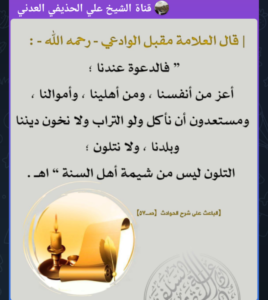
The Dawah is more precious to us than our own ourselves, (or lives) and our families. We are prepared to eat sand rather than betray our religion and our country; wa lā natalawwan – we do not waiver stances and principles according to personal interests and desires; at-talawun is not from Ahlus Sunnah’s moral character. [(1)]

The Advice of The Predecessors

Abdullah Ibn Mas’ud, may Allah be pleased with him, said:

Whoever wants to follow a path, let him follow the path of one who has passed away, for indeed the living are not safe from trial, and those (who have passed away) are the Companions of Muhammad, peace and blessings of Allah be upon him. They were the most virtuous of this Ummah, the purest in heart, the most profound in knowledge and the least sophisticated. Allah chose them to accompany His Prophet and establish His religion, so recognise their status and follow in their footsteps and adhere – as much as you can – to their manners and conduct, for they were upon upright guidance”. [(2)]

Imam Al-Hasan al-Basri, may Allah have mercy on him, said:

I swear by the One (Allah) besides whom there is no deity worthy of worship but Him! The Sunnah is between the extremes of those who are excessive and those who are neglectful. Therefore, be patient upon it (the Sunnah) – may Allah have mercy on you- for the people of the Sunnah were the fewest among the people in the past, and they remained the fewest among those who remained. Neither did they go along with the excessive ones in their excesses nor with the proponents of Bidah in their Bidah, while remaining steadfast in their adherence to the Sunnah until they met their Lord. Thus, if Allah wills, let it be the same for you. [(3)]


(1) al-bāʿith ʿalā sharḥ al-ḥawādith page 57. Source: Posted in Shaikh Ali Hudhaifi’s Telegram Channel

(2) Jami Bayan Al-Ilm Wa Fad’lihi 2/947

(3) Ighatha Al-Lahfan 1/70

[1] When the Victim Is Misjudged and the Selfless Is Abandoned

In The Name of Allah, The Most Merciful, The Bestower of Mercy.

The Messenger, peace and blessings of Allah be upon him, said: “If one of you is afflicted with a calamity, then let him reflect upon his calamity through me (i.e. my death), for indeed it is the greatest of calamities”. [1]

Imam Al-Qurtubi, may Allah have mercy upon him, reported in his Tafsir that Imam Ibn Abdil Barr, may Allah have mercy upon him, said:

“Indeed, he (the Messenger) spoke the truth because the calamity that results from his death is greater than every calamity that will afflict a Muslim after him until the day of judgement. The revelation stopped and Prophethood ceased (forever)”. [2]

Reflect Upon The Harm Received By The Messengers

Al-Allamah Abdur Rahman Bin Yahyah Al-Mu’allimee, may Allah have mercy upon him, said:

Allah tested Prophet Ayyoub, peace be upon him, and Prophet Yaqub, peace be upon him, during the time he lost his two sons, (Yusuf and Binyamin), peace be upon them, along with the profound sorrow that afflicted his heart. Allah says:

وَتَوَلَّىٰ عَنۡہُمۡ وَقَالَ يَـٰٓأَسَفَىٰ عَلَىٰ يُوسُفَ وَٱبۡيَضَّتۡ عَيۡنَاهُ مِنَ ٱلۡحُزۡنِ فَهُوَ كَظِيمٌ۬

And he turned away from them and said: “Alas, my grief for Yusuf (Joseph)!” And he lost his sight because of the sorrow that he was suppressing]. [Yusuf. 84]

Allah tested Muhammad, peace and blessings of Allah be upon him, during the initial years of his prophethood, commanding him to call his people to renounce the Shirk and the erroneous beliefs inherited from their ancestors. He communicated this message both privately and publicly, tirelessly day and night. He engaged with them in their social settings, assemblies, and communities, persistently advocating for nearly 13 years, despite enduring significant persecution, a stark contrast to the 40 years of his life before this period during which he faced no harm.

He hailed from a distinguished and esteemed tribe, belonging to a household that was both noble and revered. He grew up with refined manners, earning him the admiration and respect of the people, however, he remained remarkably humble despite his elevated status. The individual possessing these attributes endured significant suffering and encountered profound difficulties. This suffering was exacerbated by ridicule; this one spat in his face, another tried to place his feet on his neck while he was in prostration to his Lord, and yet another placed camel intestines on his back when he prostrated to his Lord. Another seized the collar of his garment in an attempt to strangle him. His uncle, Abu Lahab, relentlessly pursued him, cautioning others by declaring, “He is a liar” and “He is insane.”

The ignorant were stirred up against him, and they hurled stones at him until blood streamed from his feet. Others chose to ostracise him and his close relatives for an extended period, hoping they would perish from starvation. Some individuals subjected his followers to various forms of torment, including forcing them to lie on the scorching sand during the peak heat of the day without access to water. One follower was burned with fire, and the only thing that could extinguish the flames was the fat from his back. A woman among them faced severe torture, but when it became evident that she would not abandon her faith in Islam, she was stabbed in her private area and ultimately killed.

The suffering they endured stemmed solely from the Messenger’s efforts to lead them away from the darkness of Shirk and into the light of Islam. He intended to remove them from corruption and guide them towards righteous behaviour, to steer them away from the wrath of Allah and direct them towards the means of achieving His Pleasure. He sought to divert them from the path of eternal punishment and guide them towards everlasting happiness. Despite the clarity of these truths, they remained oblivious, fixated instead on the fact that he was urging them toward something contrary to their desires.

Furthermore, Allah tested the Prophet peace and blessings of Allah be upon him, through the loss of his parents during his early childhood, followed by the passing of his grandfather, the demise of his uncle who provided him with protection, and the death of his wife who offered him solace. The calamities continued unabated, despite his status as the leader of the children of Adam and his position as the most beloved individual to Allah.

Contemplate these matters to understand, through genuine knowledge, that the competitive strife in which we participate, driven by our desire to attain the pleasures of this world, pales in comparison to the pursuit of Allah’s Pleasure and the everlasting joy of paradise. In contrast, the suffering and challenges of worldly existence that we seek to avoid are insignificant when weighed against Allah’s discontent, His wrath, and the eternal torment of hellfire. Anas Bin Malik, may Allah be pleased with him, reported that Allah’s Messenger, peace and blessings of Allah be upon him, said, “A person amongst the inhabitants of Hell – who lived the most enjoyable life amongst the people of the world – would be dipped in fire only once on the Day of Resurrection and then it would be said to him, ‘O son of Adam! Did you find any comfort, did you happen to get any material blessing?’ He would say, ‘By Allah! No, my Lord’. Then a person amongst the people of the world would be brought – who lived the most miserable life (in the world) – from amongst the inhabitants of Paradise and he would be dipped once in Paradise, and it would be said to him, ‘O son of Adam! Did you face any hardship? Or had any distress fallen to your lot?’ He would say, ‘By Allah! No, O my Lord, never did I face any hardship or experience any distress’”. [Sahih Muslim. 2807] [3]

Prophet Ayyoub and His Wife During Times of Severe Hardship

Ayyub, peace be upon him, remained in his state of affliction [i.e. illness] for eighteen years, and he was shunned by both those close to him [i.e. relatives] and those who were not close to him [strangers], except two among his brothers who used to come to him in the morning and evening. One day, one of them said to his companion, “By Allah! Do you know that Ayyub must have committed a sin which none amongst the creation has ever committed? His companion said to him, ‘Why is that?’ He said, ‘It has been eighteen years, Allah has not shown him mercy and granted him relief from [what has afflicted him]’”. So, when they went to Ayyub  in the evening, the man could not restrain himself and thus transmitted – to Ayyub – the statement that was made by his companion. So, Ayyub said, “I don’t know what you two are talking about, other than the fact that Allaah knows that I used to go pass two men who were arguing, and they mentioned Allah, because in one’s dispute one swears by Allaah saying ‘By Allaah! By Allah!’ So, I would return to my house and offer expiation on their behalf, because I hated that Allaah is mentioned, except in that which is true”.

Whenever he went out to answer the call of nature, and after finishing, his wife would hold his hand until he returns to his house. One day, he took a long time, and Allaah had revealed to him to strike the ground with his foot:

ٱرۡكُضۡ بِرِجۡلِكَ‌ۖ هَـٰذَا مُغۡتَسَلُۢ بَارِدٌ۬ وَشَرَابٌ۬

(Allah said to him): “Strike the ground with your foot: This is a spring of water to wash in, cool and a (refreshing) drink.] [Sad 42]

She thought that he took a long time [to return] and turned to look for him, and thus Allah had taken away the afflictions he was suffering from, and he was more good looking than he was in the past. So, when she saw him, she said, “May Allah bless you, have you seen that Prophet of Allaah who is put to trial and test [by Allah]? By Allaah! I have not seen anyone who resembles him more than you if he were healthy [or in a state of wellbeing]”. So, he [Ayyub] said, “It is me indeed”. And he had two threshing floors – one for wheat and one for barley. Allah sent two clouds, and when one of them reached the threshing floor of the wheat, it rained gold until it was full, and the other reached the threshing floor of barley until it was full with silver. [Silsilah As-Saheehah. 17]

Shuraih Al-Qaadhiy, may Allah have mercy upon him, said:

Indeed, when afflicted by a calamity, I praise Allah four times: I praise Allah for not making the calamity greater than what it is. I praise Allah for granting me patience. I praise Allah for the reward I hope for in that calamity and I praise Allah for not placing that calamity in the affairs of my religion. [4]

We ask Allah:

اللَّهُمَّ بِعِلْمِكَ الْغَيْبَ وَقُدْرَتِكَ عَلَى الْخَلْقِ أَحْيِنِي مَا عَلِمْتَ الْحَيَاةَ خَيْراً لِي وَتَوَفَّنِي إِذَا عَلِمْتَ الْوَفَاةَ خَيْراً لِي، اللَّهُمَّ إِنِّي أَسْأَلُكَ خَشْيَتَكَ فِي الْغَيْبِ وَالشَّهَادَةِ، وَأَسْأَلُكَ كَلِمَةَ الْحَقِّ فِي الرِّضَا وَالْغَضَبِ، وَأَسْأَلُكَ الْقَصْدَ فِي الْغِنَى وَالْفَقْرِ، وَأَسْأَلُكَ نَعِيماً لَا يَنْفَذُ، وَأَسْأَلُكَ قُرَّةَ عَيْنٍ لَا تَنْقَطِعُ، وَأَسْأَلُكَ الرِّضِا بَعْدَ الْقَضَاءِ، وَأَسْأَلُكَ بَرْدَ الْعَيْشِ بَعْدَ الْمَوْتِ، وَأَسْأَلُكَ لَذَّةَ النَّظَرِ إِلَى وَجْهِكَ وَالشَّوْقَ إِلَى لِقَائِكَ فِي غَيْرِ ضَرَّاءَ مُضِرَّةٍ وَلَا فِتْنَةٍ مُضِلَّةٍ، اللَّهُمَّ زَيِّنَّا بِزِينَةِ الْإِيمَانِ
وَاجْعَلْنَا هُدَاةً مُهْتَدِينَ

O Allah! By Your Knowledge of the unseen and by Your Power over creation, let me live if life is good for me, and let me die if death is good for me; O Allah! I ask You to grant me (the blessing of having) fear of You in private and public, and I ask You (to make me utter) a statement of truth in times of contentment and anger, and I ask You for moderation when in a state of wealth and poverty, and I ask you for blessings that never ceases, and I ask You for the coolness of my eye that never ends, and I ask You (to make me pleased) after (Your) decree; and I ask You for a life of (ease, comfort, tranquillity, etc) after death; I ask You for the delight of looking at Your Face (i.e. in the Hereafter) and yearning to meet You without any harm and misleading trials (coming upon me). O Allah! Adorn us with the adornment of Iman, and make us (from those who are) guided and guiding (others). [5]

اللَّهُمَّ أَصْلِحْ لِي دِينِي الَّذِي هُوَ عِصْمَةُ أَمْرِي

وَأَصْلِحْ لِي دُنْيَايَ الَّتِي فِيهَا مَعَاشِي

وَأَصْلِحْ لِي آخِرَتِي الَّتِي فِيهَا مَعَادِي

وَاجْعَلِ الْحَيَاةَ زِيَادَةً لِي فِي كُلِّ خَيْرٍ

وَاجْعَلِ الْمَوْتَ رَاحَةً لِي مِنْ كُلِّ شَرٍّ

O Allah! Rectify my religion for me, which is the safeguard of my affairs; rectify my worldly [affairs], wherein is my livelihood; and rectify my Afterlife to which is my return; and make life for me [as a means of] increase in every good and make death for me as a rest from every evil. [Saheeh Muslim Number: 2720] [6]

اللَّهُمَّ إِنِّي أَعُوذُ بِكَ مِنَ الْهَمِّ وَالْحَزَنِ، وَالْعَجْزِ وَالْكَسَلِ، وَالْبُخْلِ وَالْجُبْنِ ، وَضَلَعِ الدَّيْنِ، وَغَلَبَةِ الرِّجَالِ

O Allaah! I seek refuge with You against distress and grief, helplessness and laziness, miserliness and cowardice, being heavily in debt and being overcome by men. [Saheeh Al-Bukhaari. Number 2893] [7]

 https://salafidawahmanchester.com/2024/09/30/souls-cannot-be-purified-until-they-are-put-to-the-test-by-imam-ibn-al-qayyim-qayyim/

Also read: It may be that you dislike a thing which is good for you

It may be that you dislike a thing which is good for you- [A number of insightful guidelines in this Ayah]


[1] Sahih Al-Jaami As-Sagheer. Number 347

[2] Al-Jami Li-Ahkam Al-Qur’an. Tafsir Surah Al

[3]An Excerpt from “Aathaar Ash-Shaikh Al-Allamah Abdur Rahman Bin Yahyah Al-Mu’allimee”. 11/311-313

[4] Shu’ab Al-Eemaan 9507

[5]https://salafidawahmanchester.com/2021/01/01/o-allaah-let-me-live-if-life-is-good-for-me-and-let-me-die-if-death-is-good-for-me/

[6]https://salafidawahmanchester.com/2019/03/12/shuraih-al-qaadhiys-thankfulness-when-afflicted-with-a-calamity/

[7]https://salafidawahmanchester.com/2020/03/24/grief-distress-helplessness-laziness-miserliness-cowardice-being-heavily-in-debt-and-being-overcome-by-men-the-prophet-used-to-seek-allaahs-refuge-from-these-eight-affairs/

Dhu al-Qi’dah, Dhu al-Hijjah, and Muharram

In The Name of Allah, The Most Merciful, The Bestower of Mercy.

Al-Allamah Ibn Uthaymeen, may Allah have mercy upon him, said:

These three months (meaning Dhu al-Qi’dah, Dhu al-Hijjah, and Muharram) were made sacred because people set out during them for the House of Allah, the Mighty and Majestic.

Dhu al-Qi’dah and Muharram for traveling to the Bayt (Kabah), and Dhu al-Hijjah for performing the rites of Hajj.

For this reason, they were made sacred months in which fighting was forbidden, and attention given to avoid wronging (oppressing or committing injustice against oneself). Due to this, He (Allah) said:

 فَلَا تَظْلِمُوا۟ فِيهِنَّ أَنفُسَكُمْ

So wrong not yourselves therein. [at-Tawbah 36] [Footnote a]

Source: Shared by Shaikh Fawwaz Al-Mad’khali in his Telegram Channel.


[Footnote a]: The three types of Dhulm

Placing Things Where They Don’t Belong: The Reality of Dhulm

[7] Justice For All

In The Name of Allah, The Most Merciful, The Bestower of Mercy.

Abu Hurairah, may Allah be pleased with him, reported: The Messenger of Allah, peace and blessings of Allah be upon him, said: “Do you know who is bankrupt?” They said, “The one without money or goods is bankrupt.” The Prophet said: “Verily, the bankrupt person of my Ummah are those who come on the Day of Resurrection with prayers, fasting, and charity, but also with insults, slander, consuming wealth, shedding blood, and beating others. The oppressed will each be given from his good deeds. If his good deeds run out before justice is fulfilled, then their sins will be cast upon him and he will be thrown into the Hellfire”.

Muslim 2581

[5] Exalt Allah and His Shariah First and Foremost

In The Name of Allah, The Most Merciful, The Bestower of Mercy.

الله اكبر

Allah is the Greatest:

Imam Ibn Al-Qayyim, may Allah have mercy upon him, said:

When one says this, they have testified to Allah’s Majesty.

سُبْحَانَكَ اللَّهُمَّ وَبِحَمْدِكَ. تَبَارَكَ اسْمُكَ وَتَعَالَى جَدُّكَ. وَلاَ إِلهَ غَيْرُكَ

I declare You free from all imperfections O Allāh, and all praise is for You. Blessed is Your Name, great and exalted is Your kingdom. And there is none worthy of worship besides You [1]

When one says this, they have testified with the heart that the Lord is free from every fault, removed from every shortcoming and worthy of praise with every perfect praise. This necessitates that Allah is described with every Attribute of perfection and free from every deficiency – blessed be His Name. Neither is His Name mentioned in a small matter except that it becomes big nor in something good except that it increases and becomes blessed; neither mentioned in a state of affliction except that it ceases nor mentioned against a Shaytan except that the Shaytan is repelled, turned away and defeated. The perfection of a name is from the perfection of the one named with it; therefore when it is the fact that nothing can cause harm in the heavens or the earth with (a mention) of His Name, then the affair of the owner of the name is loftier and more exalted.

وَتَعَالَى جَدُّكَ

Great and exalted is Your kingdom.

Meaning: Exalted is His Greatness and above everything that is considered great. His affair is exalted above every affair and every authority (kingdom) is completely under His absolute authority, and exalted is He above having a partner in His kingdom, Lordship, deity ship, His actions and Attributes, just as (He informed us) that the believers amongst the Jinn said:

وَأَنَّهُ ۥ تَعَـٰلَىٰ جَدُّ رَبِّنَا مَا ٱتَّخَذَ صَـٰحِبَةً۬ وَلَا وَلَدً۬ا

And exalted be the Majesty of our Lord, He has taken neither a wife, nor a son (or offspring or children)]. [Al-Jinn. 3]

أَعُوذُ بِاللَّهِ مِنَ الشَّيْطَانِ الرَّجِيمِ

I seek refuge in Allah from the accursed devil.

When the person says this, they have turned to Allah’s all encompassing power against the enemy (shaytaan) who wants to sever, and separate them from the Lord and distance them from earning the love, pleasure and assistance of the Lord, and leave them in the worst situation.

When he says:

 الْحَمْدُ لِلَّهِ رَبِّ الْعَالَمِينَ

“All the praises and thanks be to Allah Lord of the entire existence”, he pauses a little to wait for the response of his Lord with the statement “My servant has praised Me”.

When he says:

الرَّحْمَنِ الرَّحِيمِ

“The Most Merciful, The Bestower of (special) to the believers”, he waits for the response “My servant has exalted Me”.

When he says:

مَالِكِ يَوْمِ الدِّينِ

“The Only Owner (and the Only Ruling Judge) of the Day of Recompense (i.e. the Day of Resurrection)”, he waits for the response, “My servant has glorified Me”.

What a pleasure for his heart, pleasure of his eyes and happiness of his soul due to the statement of his Lord, “My servant” three times. By Allah, had there not been the smudge of desires on the hearts and the murkiness of the souls, they would have sparkle with joy and happiness due to the statement of their Lord, their Originator and object of worship (when He says):

“My servant has praised Me”, “My servant has exalted Me” and “My servant has glorified Me”.

Then his heart would have had room to draw close attention to these three Names, namely “Allah”, “Ar-Rabb” and “Ar-Rahman”, which are the basis of all the beautiful (and perfect Names). [2]

The complete hadith mentioned above is as follows:

Abu Hurairah, may Allah be pleased with him, reported that the Prophet, peace and blessings of Allah be upon him, said:

“Allah [Almighty] said, “I have divided prayer between Myself and My servant into two halves, and My servant shall have what he has asked for. When the servant says, ‘All praises and thanks be to Allaah, Lord of the entire existence’, Allah says, ‘My servant has praised Me. When he says, ‘The Most Merciful, The Bestower of (special) Mercy to the believers’, Allah says, ‘ My servant has exalted Me’. When he says, ‘The Only Owner (and the Only Ruling Judge) of the Day of Recompense (i.e. the Day of Resurrection)’, Allah says, ‘My servant has glorified’. When he says, ‘You alone we worship, You alone we ask for help’, Allah says, ‘This is between Me and My servant, and My servant will have what he has asked for’. When he says, ‘Guide us to the straight path, the path of those whom you have favored, neither the path of who earned Your anger nor those who went astray”, Allah says, ‘This is for My servant, and My servant will have what he has asked for'”. [3]

Regarding the statement: “I have divided prayer between Myself and My servant into two halves”, its meaning is: three and half verses in Surah Al-Fatihah are for the Lord and they are the first part of the Surah. And three and half verses are for the servant and they are the last verses. The first part is about praising Allah and the last part are supplications for the servant”.[4]


[1] Supplication translated by Shaikh Abu Khadeejah [may Allaah preserve him]. See here: https://www.abukhadeejah.com/prophets-prayer-beginners-illustrations/

[2] An Excerpt from Kitaab As-Salaah. Page 345-346.

[3] Ṣaḥeeh Muslim 395

[4] Sharh Ad-Durus Al-Muhimmah. page 16-17. By Shaikh Abdur Razzaaq Al-Badr – may Allah preserve him.

[1] Admonitions Shared By Brothers and Sisters

In The Name of Allah, The Most Merciful, The Bestower of Mercy.

A beloved Salafi brother from Saudi, may Allah protect him and his family, sent me this hadith few minutes ago

حَدَّثَنَا عُبَيْدُ اللَّهِ بْنُ سَعْدِ بْنِ إِبْرَاهِيمَ، حَدَّثَنَا يَعْقُوبُ، حَدَّثَنَا أَبِي، عَنْ صَالِحِ بْنِ كَيْسَانَ، عَنِ الأَعْرَجِ، عَنْ أَبِي هُرَيْرَةَ، عَنِ النَّبِيِّ صلى الله عليه وسلم قَالَ ‏ “‏ اخْتَصَمَتِ الْجَنَّةُ وَالنَّارُ إِلَى رَبِّهِمَا فَقَالَتِ الْجَنَّةُ يَا رَبِّ مَا لَهَا لاَ يَدْخُلُهَا إِلاَّ ضُعَفَاءُ النَّاسِ وَسَقَطُهُمْ‏.‏ وَقَالَتِ النَّارُ ـ يَعْنِي ـ أُوثِرْتُ بِالْمُتَكَبِّرِينَ‏.‏ فَقَالَ اللَّهُ تَعَالَى لِلْجَنَّةِ أَنْتِ رَحْمَتِي‏.‏ وَقَالَ لِلنَّارِ أَنْتِ عَذَابِي أُصِيبُ بِكِ مَنْ أَشَاءُ، وَلِكُلِّ وَاحِدَةٍ مِنْكُمَا مِلْؤُهَا ـ قَالَ ـ فَأَمَّا الْجَنَّةُ فَإِنَّ اللَّهَ لاَ يَظْلِمُ مِنْ خَلْقِهِ أَحَدًا، وَإِنَّهُ يُنْشِئُ لِلنَّارِ مَنْ يَشَاءُ فَيُلْقَوْنَ فِيهَا فَتَقُولُ هَلْ مِنْ مَزِيدٍ‏.‏ ثَلاَثًا، حَتَّى يَضَعَ فِيهَا قَدَمَهُ فَتَمْتَلِئُ وَيُرَدُّ بَعْضُهَا إِلَى بَعْضٍ وَتَقُولُ قَطْ قَطْ قَطْ ‏”‏‏.‏

The Prophet, peace and blessings of Allah be upon him, said: “Paradise and Hell (Fire) quarrelled in the presence of their Lord. Paradise said, ‘O Lord! What is wrong with me that only the poor and humble people enter me ?’ Hell (Fire) said, I have been favored with the arrogant people.’ So Allah said to Paradise, ‘You are My Mercy,’ and said to Hell, ‘You are My Punishment which I inflict upon whom I wish, and I shall fill both of you.'” The Prophet added, “As for Paradise, (it will be filled with good people) because Allah does not wrong any of His created things, and He creates for Hell (Fire) whomever He will, and they will be thrown into it, and it will say thrice, ‘Is there any more, till Allah (will put) His Foot over it and it will become full and its sides will come close to each other and it will say, ‘Qat! Qat! Qat! (Enough! Enough! Enough!).

Al-Bukhari 7449

[4] Exalt Allah and His Shariah First and Foremost

In The Name of Allah, The Most Merciful, The Bestower of Mercy.

When hearts exalt Allah, the souls would exalt Allah’s Shariah. Allah’s sanctities are exalted, and the state of affairs of the people is set right:

ذَٰلِكَ وَمَن يُعَظِّمْ شَعَٰٓئِرَ ٱللَّهِ فَإِنَّهَا مِن تَقْوَى ٱلْقُلُوبِ

Thus, what has been mentioned in the previous verses [Surah Hajj (27, 28, 29, 30, 31)] is an obligation that mankind owes to Allah. And whosoever honours the Symbols of Allah, then it is truly from the piety of the heart. [Al-Hajj 32]

Exalting Allah, Glorified and Exalted is He, is a branch of knowledge and awareness of Allah, Glorified and Most High. The greater knowledge a servant (of Allah) has regarding Allah, the greater the exaltation, veneration, and fear of Allah, and the greater his fulfilment of that fear.

When the heart exalts its Lord, it submits to Him, yields to His judgment, fulfils His command, and humbles itself before Him, Glorified and Exalted is He. And the source of all types of deviation, diverse falsehoods, and misguidance among people is weakness of one’s exaltation of Allah or its absence in the hearts. [Paraphrased]

https://www.al-badr.net/muqolat/2634