“The end of history” claim shattered

In The Name of Allah, The Most Merciful, The Bestower of Mercy.

Allah, The Most High, said:

وَإِن تُطِعْ أَكْثَرَ مَن فِى ٱلْأَرْضِ يُضِلُّوكَ عَن سَبِيلِ ٱللَّهِ إِن يَتَّبِعُونَ إِلَّا ٱلظَّنَّ وَإِنْ هُمْ إِلَّا يَخْرُصُونَ

And if you obey most of those on earth, they will mislead you far away from Allah’s Path. They follow nothing but conjectures, and they do nothing but lie. [Al-An’am 116]

Allah, The Mighty and Majestic, said:

إِن يَتَّبِعُونَ إِلَّا ٱلظَّنَّ وَمَا تَهْوَى ٱلْأَنفُسُ وَلَقَدْ جَآءَهُم مِّن رَّبِّهِمُ ٱلْهُدَىٰٓ

They follow but presumption and what their souls desire, though there has certainly come to them guidance from their Lord. [An-Najm 23]

Allah, The Most High, said:

إِن يَتَّبِعُونَ إِلَّا ٱلظَّنَّ وَإِنَّ ٱلظَّنَّ لَا يُغْنِى مِنَ ٱلْحَقِّ شَيْـًٔا

They follow but presumption. And verily, presumption does not avail anything against the truth. [An-Najm 28]

Allah, The Exalted, said:

وَمَا يَتَّبِعُ أَكْثَرُهُمْ إِلَّا ظَنًّا إِنَّ ٱلظَّنَّ لَا يُغْنِى مِنَ ٱلْحَقِّ شَيْـًٔا إِنَّ ٱللَّهَ عَلِيمٌۢ بِمَا يَفْعَلُونَ

And most of them follow nothing but conjecture. Certainly, conjecture can be of no avail against the truth. Surely, Allah is All-Aware of what they do.[Yunus 36]

Through His immense mercy, Allah rescued us from the ideologies propagated by philosophers, including those regarded as political or social scientists, which we pursued during our higher education before being guided to the authentic Sunnah. A notable political philosopher whose ideas significantly influenced our misguided perceptions of global events was Francis Fukuyama. In 1989, he claimed that the Western democratic and capitalist model had achieved a definitive triumph, suggesting that while various events would continue to unfold, the ideological struggle had concluded with the ascendance of a particular contemporary liberal political and economic model as the singular and superior choice for humanity’s future. This notion, which can be characterised as one of Mr. Fukuyama’s misconceptions, was encountered during our academic journey in the mid to late 1990s. At that time, it shaped our worldview and fueled our aspirations to engage in politics. However, Allah guided us to the Sunnah and distanced us from speculations of these people. Therefore, it is essential for those who take pride in their children pursuing studies in social or political sciences to exercise extreme caution, as the vast majority of those in authority within these fields reject the infallible guidance provided by the Prophets and Messengers of Allah, establishing principles that lead humanity away from the path ordained by the Creator. Allah, the Most High, stated:

فَلَمَّا جَاءَتْهُمْ رُسُلُهُم بِالْبَيِّنَاتِ فَرِحُوا بِمَا عِندَهُم مِّنَ الْعِلْمِ وَحَاقَ بِهِم مَّا كَانُوا بِهِ يَسْتَهْزِئُونَ

Then when their Messengers came to them with clear proofs, they were glad (and proud) with that which they had of the knowledge (of worldly things): And that at which they used to mock, surrounded them (i.e. the punishment). [Ghafir 83]

إِنَّ الَّذِينَ يُجَادِلُونَ فِي آيَاتِ اللَّهِ بِغَيْرِ سُلْطَانٍ أَتَاهُمْ ۙ إِن فِي صُدُورِهِمْ إِلَّا كِبْرٌ مَّا هُم بِبَالِغِيهِ ۚ فَاسْتَعِذْ بِاللَّهِ ۖ إِنَّهُ هُوَ السَّمِيعُ الْبَصِيرُ

Verily, those who dispute about the Signs of Allah, without any authority having come to them, there is nothing else in their breasts except pride [to accept you (Muhammad) as a Messenger of Allah and to obey you]. They will never have it (i.e. Prophethood which Allah has bestowed upon you). So seek refuge in Allah (O Muhammad from the arrogant ones). Verily, it is He Who is the All-Hearer, the All-Seer. [Ghafir 56]

قَدۡ مَڪَرَ ٱلَّذِينَ مِن قَبۡلِهِمۡ فَأَتَى ٱللَّهُ بُنۡيَـٰنَهُم مِّنَ ٱلۡقَوَاعِدِ فَخَرَّ عَلَيۡہِمُ ٱلسَّقۡفُ مِن فَوۡقِهِمۡ وَأَتَٮٰهُمُ ٱلۡعَذَابُ مِنۡ حَيۡثُ لَا يَشۡعُرُونَ

ثُمَّ يَوۡمَ ٱلۡقِيَـٰمَةِ يُخۡزِيهِمۡ وَيَقُولُ أَيۡنَ شُرَڪَآءِىَ ٱلَّذِينَ كُنتُمۡ تُشَـٰٓقُّونَ فِيہِمۡ‌ۚ قَالَ ٱلَّذِينَ أُوتُواْ ٱلۡعِلۡمَ إِنَّ ٱلۡخِزۡىَ ٱلۡيَوۡمَ وَٱلسُّوٓءَ عَلَى ٱلۡڪَـٰفِرِينَ

Those before them indeed plotted, but Allah struck at the foundation of their building, and then the roof fell down upon them, from above them, and the torment overtook them from directions they did not perceive. Then, on the Day of Resurrection, He will disgrace them and will say: “Where are My (so called) ‘partners’ concerning whom you used to disagree and dispute (with the believers, by defying and disobeying Allah)?” Those who have been given the knowledge (about the Torment of Allah for the disbelievers) will say: “Verily! Disgrace this Day and misery are upon the disbelievers. [An-Nahl. 26-27]

They plotted against their Messengers, employed various tricks in order to reject that which the messengers brought and established gigantic safeguards for their plots.

فَأَتَى ٱللَّهُ بُنۡيَـٰنَهُم مِّنَ ٱلۡقَوَاعِدِ

But Allah struck at the foundation of their building]– Meaning, an affair came to them from its basis and foundation.

فَخَرَّ عَلَيۡہِمُ ٱلسَّقۡفُ مِن فَوۡقِهِمۡ

And then the roof fell down upon them, from above them.

Meaning, so what they built became a punishment for them.

وَأَتَٮٰهُمُ ٱلۡعَذَابُ مِنۡ حَيۡثُ لَا يَشۡعُرُونَ

And the torment overtook them from directions they did not perceive.

Meaning, because they thought that such a building will benefit and protect them from punishment, but their punishment occurred from that which they built and established. This is one the best of parables regarding how Allah nullifies the plots of his enemies, for indeed they pondered and reflected on that which the Messengers brought when they belied them, concocted principles and rules based on falsehood, referred back to them to reject that which the Messengers came with, employed tricks to bring about discomfort to the Messengers, and to inflict harm on them and their followers, but their plot became a source of evil against them, so their plan became their destruction, because their plot was evil as Allah said:

وَلَا يَحِيقُ الْمَكْرُ السَّيِّئُ إِلَّا بِأَهْلِهِ

But the evil plot encompasses only him who makes it]. [Fatir. 43]

This is in this worldly life and the punishment in the afterlife would be more disgraceful, and due to this Allah said: [ثُمَّ يَوۡمَ ٱلۡقِيَـٰمَةِ يُخۡزِيهِمۡ – Then, on the Day of Resurrection, He will disgrace them]. [1]

The claim that the world has unanimously embraced a particular contemporary liberal political and economic model as the singular and superior choice for humanity’s future is a rejection of the undeniable truths found within the sacred texts of the final divine revelation. These texts speak of the return of the methodology of the Prophets, peace and blessings be upon them, alongside the rulership of Prophet Isa, peace be upon him.

In that era, justice will once again reign supreme, guided by the principles of the Qur’an and the authentic Sunnah. The Prophet, peace and blessings of Allah be upon him, said:

“Prophethood will remain amongst you for as long as Allah wills it to be. Then Allah will raise it when He wills to raise it. Then there will be the khilaafah upon the Prophetic methodology. And it will last for as long as Allaah wills it to last. Then Allaah will raise it when He wills to raise it. Then there will be biting kingship, and it will remain for as long as Allaah wills it to remain. Then Allaah will raise it when He wills to raise it. Then there will be tyrannical (forceful) kingship and it will remain for as long as Allaah wills it to remain. Then He will raise it when He wills to raise it. Then there will be a khilafah upon the Prophetic methodology”. Then he (the Prophet) was silent.  [Footnote a]

Abu Hurairah, may Allah be pleased with him, reported that Allah’s Messenger, peace and blessings of Allah be upon him, said:

“By Him in Whose hand is my life, the son of Mary, peace be upon him, will soon descend among you as a just judge. He will break crosses, kill swine and abolish Jizya and the wealth will pour forth to such an extent that no one will accept it”. [Sahih Muslim 155]

We must express our profound gratitude to Allah for guiding us away from the conjectures of the philosophers. Indeed, The political power across the globe rests firmly and solely within the divine will of Allah, as confirmed by the infallible revelation.

Allah’s Messenger and what has been revealed to him are the authorities one must study in order to understand the subject of trials and tribulations before the end of time. As a result, one cannot return to the following matters: the narrations of the people of the Scripture, opinions and dreams, weak and false narrations, analogy, and political, economic, or socialist analysis. That is because the narrations about the trials and tribulations, the signs of the Hour, and the strife that will occur are from the (affairs) of the Religion, and the Religion is Tawqeefee (i.e. its source can only be established from the divine texts of the Qur’an and the authentic Sunnah). So, whatever is reported from the Prophet with authentic chains of transmission about (upcoming events) is necessary for a Muslim to believe, whether it appeals to the intellect or not, and this is the reality of one’s testimony that Muhammad is Allah’s Messenger.

Allah, The Most High, said:

وَمَا يَنْطِقُ عَنِ الْهَوَىٰ

إِنْ هُوَ إِلَّا وَحْيٌ يُوحَىٰ

Nor does he (Muhammad) speak of (his own) desire. It is only an Inspiration that is inspired. [An-Najm. 3]

Allah, The Most High, said:

وَمَا آتَاكُمُ الرَّسُولُ فَخُذُوهُ وَمَا نَهَاكُمْ عَنْهُ فَانْتَهُو

And whatsoever the Messenger (Muhammad) gives you, take it, and whatsoever he forbids you, abstain (from it)].[Al-Hashr. 7]

Umar, may Allah be pleased with him, reported:

One day while we were sitting with Allah’s Messenger, peace and blessings of Allah be upon him, there appeared before us a man whose clothes were exceedingly white and whose hair was exceedingly black; no signs of journeying were to be seen on him and none of us knew him. He walked up and sat down by the prophet. Resting his knees against his and placing the palms of his hands on his thighs, he said: “O Muhammad, tell me about Islam”. The messenger of Allah said: “Islam is to testify that none has the right to be worshipped but Allah and Muhammad is the messenger of Allah, to perform the prayers, to pay the zakat, to fast in Ramadan, and to make the pilgrimage to the House if you are able to do so.” He said: “You have spoken rightly’’ And we were amazed at him asking him and saying that he had spoken rightly. He said: “Then tell me about Iman.” He said: ”It is to believe in Allah, His angels, His books, His messengers, and the Last Day, and to believe in divine destiny, both the good and the evil thereof.” He said: “You have spoken rightly”. He said: “Then tell me about Ihsan.” He said: “It is to worship Allah as though you are seeing Him, and while you see Him not yet truly He sees you”. He said: “Then tell me about the Hour”. He said: “The one questioned about it knows no better than the questioner.” He said: “Then tell me about its signs.” He said: “That the slave-girl will give birth to her mistress and that you will see the barefooted, naked, destitute herdsman competing in constructing lofty buildings.” Then he took himself off and I stayed for a time. Then he said: “O Umar, do you know who the questioner was?” I said: “Allah and His messenger know best”. He said: “He was Gibreel (Gabriel), who came to you to teach you your religion”. [Reported by Muslim. Kitaab al-Iman. Chapter: Iman, Islam and Ihsan. Hadeeth Number: 8]

The testimony in this hadith is the statement of the Prophet, “He was Gibreel, who came to you to teach you your religion”. Therefore, the principle in the preceding hadeeth is that the Prophet asked a question concerning the Hour and its circumstances, and he established that it is something contained in religion. The trials and tribulations, circumstances, and strife associated with the (portents) of the Hour are from the religion, and it is not for anybody to speak about it based on their own (opinions, views, analysis, interpretations, etc.). [2]

Abu Hurairah, may Allah be pleased with him,  reported that Allah’s Messenger, peace and blessings of Allah be upon him, said:

“The Hour will not be established till two big groups fight each other whereupon there will be a great number of casualties on both sides and they will be following one and the same path, till about thirty Dajjals (liars) appear and each one of them will claim that he is Allah’s Messenger, till religious knowledge is taken away (by the death of Religious scholars), earthquakes will increase in number; time will pass quickly, afflictions will appear, Al-Harj, (i.e., killing) will increase, till wealth will be in abundance – so abundant that a wealthy person will worry lest nobody should accept his Zakat, and whenever he will present it to someone, that person (to whom it will be offered) will say, ‘I am not in need of it, till the people compete with one another in constructing high buildings, till a man when passing by a grave of someone will say, ‘Would that I were in his place’ and till the sun rises from the West. So when the sun will rise and the people will see it (rising from the West) they will all believe (accept Islam) but that will be the time when: (as Allah said):

لاَ يَنْفَعُ نَفْسًا إِيمَانُهَا لَمْ تَكُنْ آمَنَتْ مِنْ قَبْلُ، أَوْ كَسَبَتْ فِي إِيمَانِهَا خَيْرًا

No good will it do to a person to believe then, if he believed not before, nor earned good (by performing deeds of righteousness) through his Faith]. And the Hour will be established while two men spreading a garment in front of them but they will not be able to sell it, nor fold it up, and Hour will be established when a man has milked his she-camel and has taken away the milk but he will not be able to drink it, and Hour will be established before a man repairing a tank (for his livestock) is able to water (his animals) in it, and Hour will be established when a person has raised a morsel (of food) to his mouth but will not be able to eat it.” [Saheeh Al-Bukhaari. Hadeeth Number 7121]

Abu Zaid -Amr Bin Akhtab, may Allah be pleased with him, reported: Allah’s Messenger, peace and blessings of Allah be upon him, led us in the dawn prayer and then mounted the pulpit and addressed us until it was (time for the) noon prayer. He then came down the pulpit and observed prayer and then again mounted the pulpit and again addressed us until it was time for the ‘Asr prayer. He then again came down and observed the prayer and again mounted the pulpit and addressed us until the sun was set and he informed (us about) everything (pertaining to turmoil) that lay hidden in the past and what lies in (the womb) of) the future and the most learned amongst us is one who remembers them well. [ Saheeh Muslim 2892]

Imam Muslim said: Chapter: The Conquest Of Constantinople, The Emergence Of The Dajjal And The Descent Of ‘Isa Bin Maryam [peace be upon him]: Abu Hurairah [may Allah be pleased with him] reported that Allah’s Messenger [peace and blessings of Allah be upon him] said: The Last Hour would not come until the Romans would land at al-A’maq or in Dabiq. An army consisting of the best (soldiers) of the people of the earth at that time will come from Medina (to counteract them). When they will arrange themselves in ranks, the Romans would say: Do not stand between us and those (Muslims) who took prisoners from amongst us. Let us fight with them; and the Muslims would say: Nay, by Allah, we would never get aside from you and from our brethren that you may fight them. They will then fight and a third (part) of the army would run away, whom Allah will never forgive. A third (part of the army) which would be constituted of excellent martyrs in Allah’s eye, would be killed and the third who would never be put to trial would win and they would be conquerors of Constantinople. And as they would be busy distributing the spoils of war (amongst themselves) after hanging their swords by the olive trees, Satan would cry: The Dajjal has taken your place among your family. They would then come out, but it would be of no avail. And when they would come to Syria, he would come out while they would be still preparing themselves for battle drawing up the ranks. Certainly, the time of prayer shall come, and then Jesus (peace be upon him) son of Mary would descend and would lead them. When the enemy of Allah would see him, it would (disappear) just as the salt dissolves itself in water, and if he (Jesus) were not to confront them at all, even then it would dissolve completely, but Allah would kill them by his hand and he would show them their blood on his lance (the lance of Jesus Christ). [Saheeh Muslim. 2897]

Abu Hurairah, may Allah be pleased with him, narrated that Allah’s Messenger, peace and blessings of Allah be upon him, said:

“By Allah in Whose Hands my soul is, son of Mary (Jesus) will shortly descend amongst you people (Muslims) as a just ruler and will break the Cross and kill the pig and abolish the Jizya (a tax taken from the non-Muslims, who are in the protection, of the Muslim government). Then there will be an abundance of money and nobody will accept charitable gifts”. [Sahih Al-Bukhari 2222]

Abu Hurairah, may Allah be pleased with him, narrated that Allah’s Messenger, peace and blessings of Allah be upon him, said:

“What would you do when the son of Mary would descend amongst you and would lead you as one amongst you? Ibn Abi Dhi’b on the authority of Abu Huraira narrated: Your leader amongst you. Ibn Abi Dhi’b said: Do you know what the words:” He would lead as one amongst you” mean? I said: Explain these to me. He said: He would lead you according to the Book of your: Lord (hallowed be He and most exalted) and the Sunnah of your Messenger”. [Saheeh Muslim 155]

Hudhaifah, may Allah be pleased with him, reported that Allah’s Messenger, peace and blessings of Allah be upon him, stood before us one day and he did not leave anything unsaid (that he had to say) at that very spot which would happen (in the shape of turmoil) up to the Last Hour. Those who had to remember them preserved them in their minds and those who could not remember them forgot them. My friends knew them and there are certain things that slip out of my mind, but I recapitulate them when anyone makes a mention of them just as a person is lost from one’s mind but is recalled to him upon seeing his face. [Saheeh Muslim 2891]

Abu Hurairah, may Allah be pleased with him, reported that Allah’s Messenger, peace and blessings of Allah be upon him, said:

The Last Hour would not come before the Euphrates uncovers a mountain of gold, for which people would fight. Ninety-nine out of each one hundred would die but every man amongst them would say that perhaps he would be the one who would be saved (and thus possess this gold). [Saheeh Muslim 2894]

The Beast:

Allah said:

وَإِذَا وَقَعَ ٱلۡقَوۡلُ عَلَيۡہِمۡ أَخۡرَجۡنَا لَهُمۡ دَآبَّةً۬ مِّنَ ٱلۡأَرۡضِ تُكَلِّمُهُمۡ أَنَّ ٱلنَّاسَ كَانُواْ بِـَٔايَـٰتِنَا لَا يُوقِنُونَ

And when the Word (of torment) is fulfilled against them, We shall bring out from the earth a beast to them, which will speak to them because mankind believed not with certainty in Our Ayat (Verses of the Qur’an and Prophet Muhammad).

Imam As-Sadi [may Allah have mercy upon him] commented: Meaning, when the time comes for the warning, which Allah has decided; [أَخۡرَجۡنَا لَهُمۡ دَآبَّةً۬ مِّنَ ٱلۡأَرۡضِ – We shall bring out from the earth a beast to them] or one of the earth’s beasts, rather than the heavens. This beast [تُكَلِّمُهُمۡ – will speak to them]; Meaning, it would speak to the people about how they did not believe with certainty in Our (i.e. Allah’s) signs due to a lack of knowledge and certainty in Allah’s signs. So Allah will make this beast appear as one of His amazing signs to manifest to the people what they doubted. This beast is the well-known beast that will appear at the end of time, and it will be one of the (major) signs indicating the approach of the Day of Judgement, as mentioned in many Prophetic narrations. [3]

Abu Umamah, may Allah be pleased with him, narrated that the Prophet, peace and blessings of Allah be upon him, said:

The beast will emerge and strike the people on their noses, then their numbers will increase among you until a man will buy a camel and they will say, ‘Who did you buy it from?’ and he will say, ‘I bought it from one of those with a mark on their noses”. [Reported by Imam Ahmad 22362 and declared authentic by Imaam Al Albaanee in As-Sisilah As-Saheehah. Number 322]

Anas, may Allah be pleased with him, reported that Allah’s Messenger, peace and blessings of Allah be upon him, said:

“The Hour will not occur until ‘Allah, Allah’ is not said on earth”. [Saheeh Muslim 148]

Abu Hurairah [may Allah be pleased with him] said that Allah’s Messenger [peace and blessings of Allah be upon him] said, “When three things appear, faith will not benefit one who has not previously believed or has derived no good from his faith: the rising of the sun in its place of setting, the Dajjal, and the beast of the earth”. [Saheeh Muslim. Number 158]

Shaikh Al-Islaam Ibn Taymiyyah [may Allah have mercy upon him] as follows:

In the Qur’an and authentic Prophetic reports, there are numerous reports regarding that which will take place in the worldly life and the Hereafter, and the events that occurred perfectly after the Prophet [peace and blessings of Allah be upon him] spoke about them many years prior to their occurrence, such as his statement: ‘The Hour will not be established until you fight with the Turks; people with small eyes, red faces, and flat noses. Their faces will look like shields coated with leather. The Hour will not be established till you fight with people whose shoes are made of hair. [Saheeh Al-Bukhaari. Number 2928]

 Those amongst the Muslims – who saw and fought those Turks when their king Genghis Khan appeared, his children and grandchildren, such as Hulagu Khan and other than him amongst the disbelieving kings- could not describe them better than how the Prophet [peace and blessings of Allah be upon him] described them [i.e. even though he did not meet them]. He stated this 600 years prior to its occurrence. (4)

In addition to the misguided political theorists, the practitioners of dark arts, including devil-worshipping magicians, soothsayers, and psychics, also partake in this speculation. Al-Allamah Rabee Bin Hadi Al-Mad’khali, may Allah preserve him, stated:

Among the liars – whose affair has been unveiled by Islam in the Qur’an and the Sunnah – are the soothsayers, fortune tellers and magicians. They are from the most evil liars. Allah said:

هَلۡ أُنَبِّئُكُمۡ عَلَىٰ مَن تَنَزَّلُ ٱلشَّيَـٰطِينُ

تَنَزَّلُ عَلَىٰ كُلِّ أَفَّاكٍ أَثِيمٍ۬

يُلۡقُونَ ٱلسَّمۡعَ وَأَڪۡثَرُهُمۡ كَـٰذِبُونَ

وَٱلشُّعَرَآءُ يَتَّبِعُهُمُ ٱلۡغَاوُ ۥنَ

أَلَمۡ تَرَ أَنَّهُمۡ فِى ڪُلِّ وَادٍ۬ يَهِيمُونَ

وَأَنَّہُمۡ يَقُولُونَ مَا لَا يَفۡعَلُونَ

إِلَّا ٱلَّذِينَ ءَامَنُواْ وَعَمِلُواْ ٱلصَّـٰلِحَـٰتِ وَذَكَرُواْ ٱللَّهَ كَثِيرً۬ا وَٱنتَصَرُواْ مِنۢ بَعۡدِ مَا ظُلِمُواْ‌ۗ وَسَيَعۡلَمُ ٱلَّذِينَ ظَلَمُوٓاْ أَىَّ مُنقَلَبٍ۬ يَنقَلِبُونَ

Shall I inform you (O people!) upon whom the Shayatin (devils) descend? They descend on every lying (one who tells lies), sinful person. Who gives ear (to the devils and they pour what they may have heard of the unseen from the angels), and most of them are liars. As for the poets, the erring follow them; see you not that they speak about every subject (praising others right or wrong) in their poetry? And that they say what they do not do. Except those who believe (in the Oneness of Allah Islamic Monotheism), and do righteous deeds, and remember Allah much, and reply back (in poetry) to the unjust poetry (which the pagan poets utter against the Muslims). And those who do wrong will come to know by what overturning they will be overturned. [Ash-Shu’araa. 221-222]

Allah made it known that the devils descend on these types of liars, even the poets amongst them; except those who believe, perform righteous deeds and reply back (in poetry) to the unjust poetry (which the pagan poets utter against the Muslims).

 The Messenger said, “Whoever goes to a fortune teller or soothsayer and believes in what he says has disbelieved in what has been revealed to Muhammad”. [Sahih al-Jami. Number 5015]

It has been reported in an authentic narrations that the devils eavesdrop in the [first] heavens and then inform the magician or the soothsayer, then they add a hundred lies to it; so the ignorant wrong doer believes them whilst being aware of the recompense for the one who believes them. If this is the ruling against the one who believes them, then how about the one who is immersed in the sludge of soothsaying, magic and fortune telling? Therefore, the Muslims should also be cautious of these evil category of people and from their most distinct characteristics is lying. Allah and Messenger testified that indeed they are liars and made known their attachment to the devils. [5]

The Khawaariq – [Phenomena Attributed to Something Outside The Norm]

Shaikh Al-Islam Ibn Taymiyyah [may Allah have mercy upon him] said:

The Khawaariq by way of which the devils misguide the children of Adam – such as when the devils take the image of a person who is absent or has passed away and what is similar to this – has misguided many of those who ascribe themselves to the Muslims or to the people of the Scripture. They establish this on two affairs: Firstly, that whoever from whom these khawaariq occurs is a Wali, and according to the term of the Christians he is a Qadees A’dheem – a great saint! Secondly, that the one from whom these khawaariq occurs is therefore infallible, everything he narrates is truth and everything he commands is justice”. However, it can definitely be the case that neither did a phenomena outside the norm – whether unrelated or related to sound knowledge and piety – occur from such a person nor a phenomena outside the normal related to deeds of the devils; rather the person merely carried out the tricks of the liars and wicked sinners. The tricks of the liars and wicked sinners are numerous indeed, so one thinks that they are amazing events outside the norm, however neither is that the case nor is it something similar to the tricks of the monks. Some people have written books regarding the tricks of the monks, such as the trick reported about one of them changing water into oil- that when the oil is in the interior of the lighthouse, the water gradually reduces and thus the oil floats [or pops up] on the water, so those who are present think that the water has changed into oil. The likes of this affair are numerous from the tricks of those Christians, because all that those Christians possess – those who altered the religion of the Messiah [peace and blessings of Allaah be upon him] – of activities that are attributed to something out of the norm are either from the devils or they are tricks, and there’s nothing in them related to the miracles of the righteous people.

Similarly, the deviated people – those who seek to alter the religion of Muhammad – adopt a religion that is not legislated by Allah and His Messenger, then they make it a path of worship and give it precedence over the path that is legislated by Allah and His Messenger. For example, they give precedence to listening to sounds from the tambourines and the shrill flutes over listening to the book of Allah, so one of them goes into a state of ecstasy and a satanic trance through which he becomes muddled up with shaytaan until he speaks in a language he does not know. Then when he returns to his senses – just as when a jinn speaks through the tongue of the one who is possessed and after informing the people of that which is in his heart and soul, which is from the Shaytaan, and the shaytaan leaves him -, he cannot repeat what he said at first.

The heretics alter the religion of the Messengers – either the religion of the Messiah or seek to alter the religion of Muhammad, and amongst the likes of such people are the proponents of hearsay, misguidance, the disbelievers, the polytheists, apostates and other than them, such as the likes of Musaylimah the liar, Al-Aswad Al-Unzee, Al-Haarith Ad-Dimashqee, Baabaa Roomee and other than them amongst those who engaged in activities that are considered to be outside the norm [i.e. so called miracles] but [in reality] are related to the deeds of the devils.

As for the tricksters, they are numerous and they are not Awliyaa of Allah. Their so called amazing activities that are outside the norm- if not related to the satanic deeds of the soothsayers and the magicians – a just tricks. They deliberately lie and deceive unlike those connected to the devils, because amongst them is he who deceives, so one thinks that what he does is from the miracles of the righteous people, just as amongst them is one who knows that what he does is from the devils, but he does so in order to achieve his goals.

The intent behind this discussion is that many of the activities that are considered to be outside of the norm [i.e. so called miracles] are either satanic deeds or tricks, so one thinks that they are the true miracles of the righteous people, for indeed that which whose cause is based on Shirk and wicked deeds can only be from the devils, such as when a person associates partners with Allah by invoking the stars, or invokes a person- whether such a person is dead or absent, or he makes an oath through unknown words and statements whose meanings are not known, or he knows that they are names of devils, or seeks aid through lewd conduct and oppression, then such deeds – considered to be outside of the norm that emanates from this – are from the devils.

The righteous people have miracles such as the miracles of the pious people of this Ummah [may Allah have mercy upon them], the miracles of the disciples of the Messiah [may the peace and blessings of Allah be upon the Messiah, and may Allah have mercy upon the disciples] and other than them amongst those who were upon the correct and unaltered religion of the Messiah. However, the occurrence of miracles at the hands of the righteous people does not necessitate that they are infallible like the Prophets [peace and blessings of Allah be upon them]; rather it maybe that a righteous man- a Wali – has miracles, but despite this he mixes up by error and makes a mistake in that which he thinks or what he is made to hear or see, or what he sees, or what he understands from the revealed Scripture. And because of this, the statements of those other than the Prophets [peace and blessings of Allah be upon them] can either be accepted or rejected [i.e. based on evidence], but as for the Prophets [peace and blessings of Allah be upon them], it is obligated on a person to affirm truthfully everything they have related regarding the affairs of the unseen and obey them in everything they command. And due to this, Allah [The Exalted] obligated on a person to believe in everything the Prophets [peace and blessings of Allah be upon them] brought and did not obligate on a person to believe in everything that comes from others. Allah [The Exalted] said:

قُولُوٓاْ ءَامَنَّا بِٱللَّهِ وَمَآ أُنزِلَ إِلَيۡنَا وَمَآ أُنزِلَ إِلَىٰٓ إِبۡرَٲهِـۧمَ وَإِسۡمَـٰعِيلَ وَإِسۡحَـٰقَ وَيَعۡقُوبَ وَٱلۡأَسۡبَاطِ وَمَآ أُوتِىَ مُوسَىٰ وَعِيسَىٰ وَمَآ أُوتِىَ ٱلنَّبِيُّونَ مِن رَّبِّهِمۡ لَا نُفَرِّقُ بَيۡنَ أَحَدٍ۬ مِّنۡهُمۡ وَنَحۡنُ لَهُ ۥ مُسۡلِمُونَ

Say (O Muslims), “We believe in Allah and that which has been sent down to us and that which has been sent down to Ibrahim (Abraham), Isma’il (Ishmael), Ishaque (Isaac), Ya’qub (Jacob), and to Al-Asbat [the twelve sons of Ya’qub (Jacob)], and that which has been given to Musa (Moses) and ‘Iesa (Jesus), and that which has been given to the Prophets from their Lord. We make no distinction between any of them, and to Him we have submitted (in Islam).” [Al-Baqarah. 136]

 Allah [The Exalted] said:

لَّيۡسَ ٱلۡبِرَّ أَن تُوَلُّواْ وُجُوهَكُمۡ قِبَلَ ٱلۡمَشۡرِقِ وَٱلۡمَغۡرِبِ وَلَـٰكِنَّ ٱلۡبِرَّ مَنۡ ءَامَنَ بِٱللَّهِ وَٱلۡيَوۡمِ ٱلۡأَخِرِ وَٱلۡمَلَـٰٓٮِٕڪَةِ وَٱلۡكِتَـٰبِ وَٱلنَّبِيِّـۧنَ

 It is not Al-Birr (piety, righteousness, and each and every act of obedience to Allah, etc.) that you turn your faces towards east and (or) west (in prayers); but Al-Birr is (the quality of) the one who believes in Allah, the Last Day, the Angels, the Book, the Prophets. [Al-Baqarah. 177]

And because of this the Muslims are all in agreement that the one who disbelieved in a single Prophet whose Prophethood is well known, then he is a disbeliever- an apostate. There is no distinction between one Prophet from the other- by believing in some and disbelieving in others. Allah said:

إِنَّ ٱلَّذِينَ يَكۡفُرُونَ بِٱللَّهِ وَرُسُلِهِۦ وَيُرِيدُونَ أَن يُفَرِّقُواْ بَيۡنَ ٱللَّهِ وَرُسُلِهِۦ وَيَقُولُونَ نُؤۡمِنُ بِبَعۡضٍ۬ وَنَڪۡفُرُ بِبَعۡضٍ۬ وَيُرِيدُونَ أَن يَتَّخِذُواْ بَيۡنَ ذَٲلِكَ سَبِيلاً

أُوْلَـٰٓٮِٕكَ هُمُ ٱلۡكَـٰفِرُونَ حَقًّ۬ا‌ۚ وَأَعۡتَدۡنَا لِلۡكَـٰفِرِينَ عَذَابً۬ا مُّهِينً۬ا

Verily, those who disbelieve in Allah and His Messengers and wish to make distinction between Allah and His Messengers (by believing in Allah and disbelieving in His Messengers) saying, “We believe in some but reject others,” and wish to adopt a way in between. They are in truth disbelievers. And We have prepared for the disbelievers a humiliating torment. [An-Nisaa.  150-151] [6]

NB: This brief dialogue we engage in does not, in any manner, endorse violence, terrorism, or the violation of the rights for those who may not subscribe to the infallible sacred teachings of the Qur’an and the authentic reports of the seal of the Prophets, Muhammad, peace and blessings of Allah be upon him.

While we hold an unwavering belief in the inevitability of all the events mentioned in the Islamic Shariah, and acknowledge that the victorious group and the saved sect will endure until the end of time, despite the prevailing corruption – in any era – in the world, we also affirm that the noble Prophet Eesa, peace be upon him, will return to establish perfect justice on earth, guided by Allah’s final revelation.

However, it is important, without any ambiguity, that one adheres to the principles of justice in their interactions with others. Thus, one must explore the insightful writings of Shaikh Abu Iyaad, may Allah safeguard him.

http://www.shariah.ws/articles/nmsdfkp-islam-and-the-muslims-are-free-and-innocent-of-the-kharijite-extremists.cfm

http://www.shariah.ws/articles/szsumlh-the-foundation-of-muslim-relations-with-non-muslims-who-do-not-show-aggression-and-hostility.cfm

http://www.shariah.ws/articles/duviqgl-shaykh-salih-al-fawzan-the-islamic-shariah-provides-security–for-muslims-and-non-muslims-and-those-who-violate-it-are-kh257rijites-who-are-to-be-fought-and-severely-punished.cfm

We ask Allah:

اللَّهُمَّ أَصْلِحْ لِي دِينِي الَّذِي هُوَ عِصْمَةُ أَمْرِي

وَأَصْلِحْ لِي دُنْيَايَ الَّتِي فِيهَا مَعَاشِي

وَأَصْلِحْ لِي آخِرَتِي الَّتِي فِيهَا مَعَادِي

وَاجْعَلِ الْحَيَاةَ زِيَادَةً لِي فِي كُلِّ خَيْرٍ

وَاجْعَلِ الْمَوْتَ رَاحَةً لِي مِنْ كُلِّ شَرٍّ

O Allah! Rectify my religion for me, which is the safeguard of my affairs; rectify my worldly [affairs], wherein is my livelihood; and rectify my Afterlife to which is my return; and make life for me [as a means of] increase in every good and make death for me as a rest from every evil. [7]

Footnote a:

https://www.aqidah.com/creed/articles/kyvik-the-khilaafah-lasted-for-30-years-then-there-was-kingship.cfm


[1] An Excerpt from Tafseer as-Sadi

[2] An Excerpt from Mawqiful Muslim Minal Fitan. 15-16

[3]An Excerpt from Tafseer as-Sadi

[4] An Excerpt from Al-Jawaabus Saheeh Liman Baddala Deen Al-Maseeh. 2/65-67

[5]https://rabee.net/audio/%D8%AE%D8%B7%D9%88%D8%B1%D8%A9-%D8%A7%D9%84%D9%83%D8%B0%D8%A8-%D9%88%D8%A2%D8%AB%D8%A7%D8%B1%D9%87-%D8%A7%D9%84%D8%B3%D9%8A%D8%A6%D8%A9-%D9%88%D9%85%D9%88%D9%82%D9%81-%D8%A7%D9%84%D8%A5%D8%B3%D9%84/

[6] An Excerpt from Al-Jawaabus Saheeh Liman Baddala Deen Al-Maseeh. 1/284-287

[7] Saheeh Muslim Number: 2720


One of The Hidden Battles of a Teacher

In The Name of Allah, The Most Merciful, The Bestower of Mercy.

Imam Ibn Al-Jawzi, may Allah have mercy upon him, said:

Some of them (the pursuers of the religious sciences) rejoice due to abundance of followers and Iblees deceives him that this joy is because of the large number of students of knowledge, but what is intended is the large number of companions and being constantly mentioned, and from that is being amazed by their statements and knowledge. This deception is revealed when some of them (followers) abandon him for someone else who is more knowledgeable than him, thus, this becomes difficult for him. This is not the characteristic of the sincere one in teaching because the likeness of the sincere (teacher) is like physicians who treat the sick for the sake of Allah. If some of the patients are cured by a physician amongst them, the other rejoices. We mentioned earlier the narration of Ibn Abi Laylah, may Allah have mercy upon him– and we repeat it again with another chain of transmission – who said:

“I have met a hundred and twenty companions of the Messenger, peace and blessings of Allah be upon him, amongst the Ansar and not a single man amongst them was asked about a hadith, except he wished that his brother would suffice him in (answering)”.

[An Excerpt from Talbees Iblees 159-160]

Restrain your tongue, stay indoors and weep

In The Name of Allah, The Most Merciful, The Bestower of Mercy.

Uqbah Ibn Aamir, may Allah be pleased with him] said: I said: “O Messenger of Allah! What is salvation?” He said, “Restrain your tongue, keep to your house and weep over your sin”.

Imam Al-Albani, may Allah have mercy upon him, said:

“Restrain your tongue”.

Meaning, do not speak, except based on that which benefits and concerns you, as the Prophet, peace and blessings of Allaah be upon him, said:

“Whoever believes in Allah and the Last Day, then let him say what is good or remain silent”.

“Keep to your house”.

Some people may think that this necessitates keeping away from the people completely; rather this is an advice of the Prophet, peace and blessings of Allah be upon him, that one stays in his house when Fitan becomes rife, so a person realises that there is no benefit in intermingling with the people; rather it becomes obligated to  him to save himself by staying indoors.

However, this is not permissible in every era and place, because Islam is established based on the foundation “Arise and warn (i.e. call to Tawheed and warn” against shirk)” [Al-Mud-dath-thir. 2], and this necessitates that one intermingles with the people to give them dawah.

And this why the Messenger, peace and blessings of Allah be upon him, said:

“The believer who mixes with people and patiently bears their harm is better than the one who does not mix with people and does not patiently bear their harm”.

But if intermingling with the people will result in harming the Aqeedah, manners and religion of the Muslim, he should adhere to this noble advice of the Prophet that one stays in his house.

“And weep over your sins”.

This is a constant obligation, whether a Muslim lives in isolation from the people (i.e. when the need arises) or intermingles with them. One should take himself to account and contemplates on what he did during day and night, so that he remembers his Lord and hopes that he will be included amongst those seven people (i.e. those who will be provided with shade on the day of judgement when there will be no shade), and amongst them is “the one who remembers Allah when he is alone, and his eyes fill up with tears”.[Al-Bukhari. 620]

https://safeshare.tv/x/zoThA-C4aDw

A Supplication for Well-Being and Comprehensive Protection, Morning and Evening

In The Name of Allah, The Most Merciful, The Bestower of Mercy.

اللَّهُمَّ إِنِّي أَسْأَلُكَ العافِيَـةَ فـي الدُّنيا والآخِرَةِ، اللَّهُمَّ إِنِّي أَسْأَلُكَ العَفْوَ والعافِيَـةَ فـي دِيني ودُنْـيايَ وأَهْلِي ومالِي، اللَّهُمَّ اسْتُـرْ عَوْراتِي، وآمِنْ رَوْعاتِي،
اللَّهُمَّ احْفَظْنِـي مِنْ بَـيْنِ يَدَيَّ، ومِنْ خَلْفِي، وعَنْ يَمِيـنِـي، وعَنْ شِمالِي، ومِنْ فَوْقِي، وأَعُوذُ بِعَظَمَـتِكَ أَنْ أُغْتالَ مِنْ تَحْتِـي

O Allah! I ask You for well-being in this Dunya and the Aakhirah. O Allāh, I ask You for pardon and well-being in my religion, my worldly affairs, my family and my wealth. O Allaah! Conceal my [faults, shortcomings etc] and safeguard me against everything that will bring me fear and sorrow. O Allah! Protect me from in front, from behind me, from my right and my left, and from above. And I seek refuge with Your Magnificence from being swallowed up from beneath me.

This great supplication begins with one asking Allaah for [العافِيَـةَ -wellbeing] in the Dunya and Aakhira. Nothing can be equal to wellbeing, for whoever is granted well-being then indeed he has received his complete share of good. Seeking [العَفْوَ -pardon] necessitates that one is forgiven his sins and they are wiped away.

As for [العافِيَـةَ – Well-being], it is safety Allah bestows on a servant of His- protects him against every punishment and trial, by averting evil from him, protecting him against calamities and ailments [sicknesses], evil affairs and sins. So, the Messenger, peace and blessings of Allah be upon him, asked for wellbeing in the Dunyaa and Aakhirah, as well as wellbeing in his religion, worldly affairs, his family and wealth.

Well-being in one’s religion is protection against everything that will bring dishonour (or disgrace) to one’s religion or deprive him of it.

Well-being in the Dunyaa is to seek protection against everything that will harm the person in his worldly affairs, such as calamities or trials, severe poverty and ailments.

Well-being in the Aakhirah is to seek protection against the extreme hardships in the Aakhirah and its various punishments. Well-being in one’s family is that they are protected from trials, calamities and tests; wellbeing in one’s wealth is that it is protected from drowning, burning, theft etc…

[اللَّهُمَّ اسْتُـرْ عَوْراتِي – O Allah! Conceal my faults, shortcomings etc]

[ وآمِنْ رَوْعاتِي – safeguard me against every affair that will frighten me and bring sorrow upon me].

اللَّهُمَّ احْفَظْنِـي مِنْ بَـيْنِ يَدَيَّ، ومِنْ خَلْفِي، وعَنْ يَمِيـنِـي، وعَنْ شِمالِي، ومِنْ فَوْقِي، وأَعُوذُ بِعَظَمَـتِكَ أَنْ أُغْتالَ مِنْ تَحْتِـي

O Allah! Protect me from in front, from behind me, from my right and my left, and from above. And I seek refuge with Your Magnificence from being swallowed up from beneath me] – Meaning: Asking Allaah to protect you against destructive things and evils which a person is exposed to from the six directions, for indeed evil can approach from the front, behind, the right, the left, above or below, and he does not know which direction calamity will suddenly come upon him.

An Excerpt from Fiqh Al-Ad’iyah Wal Af’kar 3/32-33- By Shaikh Abdur Razzaq Al-Badr, may Allah preserve him.

Five Comprehensive Supplications of Guidance and Rectification

In The Name of Allah, The Most Merciful, The Bestower of Mercy.

Five Comprehensive Supplications of Guidance and Rectification_PDF

Supplication 1 – After Tashahud and Before Tasleem 

اللَّهُمَّ بِعِلْمِكَ الْغَيْبَ وَقُدْرَتِكَ عَلَى الْخَلْقِ أَحْيِنِي مَا عَلِمْتَ الْحَيَاةَ خَيْراً لِي وَتَوَفَّنِي إِذَا عَلِمْتَ الْوَفَاةَ خَيْراً لِي، اللَّهُمَّ إِنِّي أَسْأَلُكَ خَشْيَتَكَ فِي الْغَيْبِ وَالشَّهَادَةِ، وَأَسْأَلُكَ كَلِمَةَ الْحَقِّ فِي الرِّضَا وَالْغَضَبِ، وَأَسْأَلُكَ الْقَصْدَ فِي الْغِنَى وَالْفَقْرِ، وَأَسْأَلُكَ نَعِيماً لَا يَنْفَذُ، وَأَسْأَلُكَ قُرَّةَ عَيْنٍ لَا تَنْقَطِعُ، وَأَسْأَلُكَ الرِّضِا بَعْدَ الْقَضَاءِ، وَأَسْأَلُكَ بَرْدَ الْعَيْشِ بَعْدَ الْمَوْتِ، وَأَسْأَلُكَ لَذَّةَ النَّظَرِ إِلَى وَجْهِكَ وَالشَّوْقَ إِلَى لِقَائِكَ فِي غَيْرِ ضَرَّاءَ مُضِرَّةٍ وَلَا فِتْنَةٍ مُضِلَّةٍ، اللَّهُمَّ زَيِّنَّا بِزِينَةِ الْإِيمَانِ

وَاجْعَلْنَا هُدَاةً مُهْتَدِينَ

O Allah! By Your Knowledge of the unseen and by Your Power over creation, let me live if life is good for me, and let me die if death is good for me; O Allah! I ask You to grant me (the blessing of having) fear of You in private and public, and I ask You (to make me utter) a statement of truth in times of contentment and anger, and I ask You for moderation when in a state of wealth and poverty, and I ask you for blessings that never ceases, and I ask You for the coolness of my eye that never ends, and I ask You (to make me pleased) after (Your) decree; and I ask You for a life of (ease, comfort, tranquillity, etc) after death; I ask You for the delight of looking at Your Face (i.e. in the Hereafter) and yearning to meet You without any harm and misleading trials (coming upon me). O Allah! Adorn us with the adornment of Iman, and make us (from those who are) guided and guiding (others). [1]


اللَّهُمَّ بِعِلْمِكَ الْغَيْبَ وَقُدْرَتِكَ عَلَى الْخَلْقِ أَحْيِنِي مَا عَلِمْتَ الْحَيَاةَ خَيْراً لِي وَتَوَفَّنِي إِذَا عَلِمْتَ الْوَفَاةَ خَيْراً لِي

 “O Allah! By Your Knowledge of the unseen and by Your Power over creation, let me live if life is good for me, and let me die if death is good for me”.

This requires surrendering and submitting all of one’s affairs to the Lord, asking Allah for the best outcome in every situation, and seeking that through His All-Encompassing knowledge because Allah has complete knowledge of both hidden and visible matters, and He has absolute power over everything. No one can change His judgment or prevent His decree. It is well known that a servant of Allah cannot predict the outcome of their affairs or their final destination. They are also unable to achieve good or avoid harm except with the help and ease granted by Allah. Therefore, a servant of Allah is always in need of Allah, regardless of where he may be. This is why one says in this supplication:


أَحْيِنِي مَا عَلِمْتَ الْحَيَاةَ خَيْراً لِي وَتَوَفَّنِي إِذَا عَلِمْتَ الْوَفَاةَ خَيْراً لِي

Let me live if life is good for me, and let me die if You know that death is good for me.

This is why the Sunnah forbids wishing for death when faced with hardships, as one does not fully understand the repercussions. The Prophet, peace and blessings of Allah be upon him, said, “Let none of you wish for death. If he is righteous, he might increase his good deeds. If he is sinful, he might repent”. [Al-Bukhari]


اللَّهُمَّ إِنِّي أَسْأَلُكَ خَشْيَتَكَ فِي الْغَيْبِ وَالشَّهَادَةِ

O Allah! I ask You to grant me (the blessing of having) fear of You in private and public.

Meaning: To fear You in private and public- when I am with the people and when they are absent because while some fear Allah in public and when seen, the true measure of devotion lies in fearing Allah when not seen by the people. Allah praised those who fear Him in the unseen, saying:

 الَّذِينَ يَخْشَوْنَ رَبَّهُمْ بِالْغَيْبِ وَهُمْ مِنْ السَّاعَةِ مُشْفِقُونَ

Those who fear their Lord without seeing Him, while they are afraid of the Hour. [Al-Anbiya. 49]

Allah, The Most High, said: 

 مَنْ خَشِيَ الرَّحْمَنَ بِالْغَيْبِ وَجَاءَ بِقَلْبٍ مُنِيبٍ

 Who feared the Most Beneficent (Allah) in the Ghaib (unseen): (i.e. in this worldly life before seeing and meeting Him), and brought a heart turned in repentance (to Him – and absolutely free from each and every kind of polytheism). [Qaf. 33]


وَأَسْأَلُكَ كَلِمَةَ الْحَقِّ فِي الرِّضَا وَالْغَضَبِ

And I ask you (to make me utter) a statement of truth in times of contentment and anger

Meaning: Empower me to speak the truth during moments of contentment and anger. Speaking the truth during moments of anger is a virtuous and powerful act, as anger often leads a person to utter the opposite of truth and other than justice. Indeed, Allah commends those of His servants who forgive when angered and their anger never drives them towards transgression and aggression. 

Allah, The Most High, said:

  وَإِذَا مَا غَضِبُوا هُمْ يَغْفِرُونَ 

And when they are angry, they forgive. [Ash-Shuraa. 37]

If someone speaks only the truth when they’re angry, it shows that they have a strong faith and are in control of their soul (by the permission of Allah). In a hadith, the Prophet, peace and blessings of Allah be upon him, said: 

“The strong one (i.e. the one who is more worthy to be described as a strong person) is not the one who (overcomes the people in) wrestling, rather the strong person is the one who restrains himself when angry”.


وَأَسْأَلُكَ الْقَصْدَ فِي الْغِنَى وَالْفَقْرِ

 And I ask You for moderation when in a state of wealth and poverty.

 Meaning: Being moderate whether I’m poor or wealthy, following the balanced path set by the Shariah; neither stingy when I’m poor and fear running out of what I have; nor being extravagant and burdening myself with things I can’t handle, as Allah, The Most High, said:

  وَلاَ تَجْعَلْ يَدَكَ مَغْلُولَةً إِلَى عُنُقِكَ وَلاَ تَبْسُطْهَا كُلَّ الْبَسْطِ فَتَقْعُدَ مَلُومًا مَحْسُورًا

 And let not your hand be tied (like a miser) to your neck, nor stretch it forth to its utmost reach (like a spendthrift), so that you become blameworthy and in severe poverty. [Al-Israa. 29]

 And that if one is wealthy, his wealth does not lead him to extravagance, thus, he exceeds the limits. Allah, The Most High, said:

 وَالَّذِينَ إِذَا أَنفَقُوا لَمْ يُسْرِفُوا وَلَمْ يَقْتُرُوا وَكَانَ بَيْنَ ذَلِكَ قَوَامًا

And those, who, when they spend, are neither extravagant nor niggardly, but hold a medium (way) between those (extremes). [Al-Furqan. 67]


وَأَسْأَلُكَ نَعِيماً لَا يَنْفَذُ

And I ask you for blessings that never cease.

Meaning: The blessing that never ceases is the blessing of the Hereafter, as Allah, The Most High, said:


مَا عِنْدَكُمْ يَنفَدُ وَمَا عِنْدَ اللَّهِ بَاقٍ

 Whatever is with you, will be exhausted, and whatever with Allah will remain. [An-Nahl. 96]

 Allah said:

  إِنَّ هَذَا لَرِزْقُنَا مَا لَهُ مِنْ نَفَادٍ

 (It will be said to them)! Verily, this is Our Provision which will never finish. [Sad. 54]


وَأَسْأَلُكَ قُرَّةَ عَيْنٍ لَا تَنْقَطِعُ

 And I ask You for the coolness of my eye that will never end. 

Meaning: Some blessings come to an end, while others do not. The coolness of one’s eyes in worldly things is only temporary and will eventually fade away. Moreover, this is tainted with fear and anxiety due to the hardships and pain we experience. As a result, believers do not find greater pleasure in anything of this world except in their love for Allah, their remembrance of Him, and their obedience to Him, as the Messenger said, “The coolness [pleasure or delight] of my eyes is in prayer”. Therefore, whoever finds the pleasure of his eyes in this (i.e. their love for Allah and obedience to Him), they have something that will never cease to exist in this world, in the grave, and the Hereafter.


وَأَسْأَلُكَ الرِّضِا بَعْدَ الْقَضَاءِ 

And I ask You (to make me pleased) after (Your) decree.

 Meaning: Asking Allah to grant you contentment after His decree has been fulfilled, as it would genuinely demonstrate your satisfaction with Allah’s decree.


وَأَسْأَلُكَ بَرْدَ الْعَيْشِ بَعْدَ الْمَوْتِ

And I ask You for a life of (ease, comfort, tranquillity etc) after death.

Meaning: This demonstrates that the true essence of a perfect life, filled with goodness and comfort, can only be experienced after death. Life before death is marred by pain and suffering. If the only pain we had to endure in this life was death itself, that would have been enough. But the reality is that life is filled with countless pains, sorrows, illnesses, the frailty of old age, and the heartache of being separated from loved ones.


وَأَسْأَلُكَ لَذَّةَ النَّظَرِ إِلَى وَجْهِكَ وَالشَّوْقَ إِلَى لِقَائِكَ فِي غَيْرِ ضَرَّاءَ مُضِرَّةٍ وَلَا فِتْنَةٍ مُضِلَّةٍ

And I ask You for the delight of looking at Your Face (i.e. in the Hereafter) and yearning to meet You without any harm and misleading trials (coming upon me). 

This part of the supplication brings together the best aspects of both this life and the Hereafter – the desire to meet Allah and see His Noble face in the Hereafter [May He be free from any imperfections, equals, similarities, or partners]. And since the fulfilment of this desire depends on being protected from harm in this life and being tested in one’s religious affairs, one expresses the following sentiment: 

فِي غَيْرِ ضَرَّاءَ مُضِرَّةٍ وَلَا فِتْنَةٍ مُضِلَّةٍ 

without any harm and misleading trials (coming upon me).

The meeting between the believer and his lord on the day of judgment has been mentioned in many texts in the Qur’an and Sunnah. Only those who have deviated from the right path would deny it. It is the ultimate happiness for the people of Jannah and brings them the greatest joy. The Prophet [peace and blessings of Allah be upon him] said: When the people of Paradise would enter Paradise, Allah, The Blessed and Most High, would ask: 

“Do you want me to give you anything more?” They would say, “Have You not brightened our faces? Have You not made us enter Paradise and saved us from Fire?” He would lift the veil, and of things given to them, nothing would be dearer to them than looking at their Lord”. [Sahih Muslim 181]


اللَّهُمَّ زَيِّنَّا بِزِينَةِ الْإِيمَانِ وِاجْعَلْنَا هُدَاةً مُهْتَدِينَ

 O Allah! Adorn us with the adornment of Iman and make us (from those who are) guided and guiding (others).

Meaning: Beautification with Imaan involves adornment of the heart with authentic creed and noble deeds of the heart. It also entails adorning the tongue with remembrance of Allah and recitation of the Qur’an, as well as enjoining good and forbidding evil; adorning the limbs with righteous deeds that bring one closer to Allah.


 وَاجْعَلْنَا هُدَاةً مُهْتَدِينَ

And make us (from those who are) guided and guiding (others).

Meaning: To be guided and guide others. This is the greatest status when one is acquainted with the truth, lives by it, and teaches others. We pray to Allah to lead us towards this path and allow us to be among those who are guided and guiding others. [2] 


 Supplication 2 – A General Supplication

 اللَّهُمَّ أَصْلِحْ لِي دِينِي الَّذِي هُوَ عِصْمَةُ أَمْرِي

 وَأَصْلِحْ لِي دُنْيَايَ الَّتِي فِيهَا مَعَاشِي

 وَأَصْلِحْ لِي آخِرَتِي الَّتِي فِيهَا مَعَادِي

 وَاجْعَلِ الْحَيَاةَ زِيَادَةً لِي فِي كُلِّ خَيْرٍ

 وَاجْعَلِ الْمَوْتَ رَاحَةً لِي مِنْ كُلِّ شَرٍّ

O Allah! Rectify my religion for me, which is the safeguard of my affairs; rectify my worldly [affairs], wherein is my livelihood; and rectify my Afterlife to which is my return; and make life for me [as a means of] increase in every good and make death for me as a rest from every evil. [Sahih Muslim 2720]

 This is also one of the comprehensive supplications of the Prophet, peace and blessings of Allāh be upon him. Indeed, it gathers things which a person asks for the rectification of their religious affairs, worldly affairs and affairs related to the Afterlife. It begins with one’s religious affairs because when one’s religion is rectified, the other affairs will also be rectified.


اللَّهُمَّ أَصْلِحْ لِي دِينِي الَّذِي هُوَ عِصْمَةُ أَمْرِي

 O Allah! Rectify my religion for me, which is the safeguard of my affairs.


اللَّهُمَّ أَصْلِحْ لِي دِينِي 

O Allah! Rectify my religion for me. 

Meaning:  Asking Allaah for the rectification of one’s religion- to be blessed with the ability and guidance to fulfil its obligations, etiquettes and requirements in a perfect and complete manner; blessed with the guidance and ability to adhere to the Qur’aan and the authentic Sunnah based on the path of the Salafus Saaleh – the Sahaabah, the Taabi’een and the righteous Imaams- in affairs related to sound creed, worship, Dawah [i.e. the sound method of calling to the path of Allaah] and good social behaviour in general.

[الَّذِي هُوَ عِصْمَةُ أَمْرِي– which is the safeguard of my affairs]

Meaning: The affair through which all my affairs will be protected, just as Allah stated: [وَٱعۡتَصِمُواْ بِحَبۡلِ ٱللَّهِ جَمِيعً۬ا وَلَا تَفَرَّقُواْ‌ۚ – And hold fast, all of you together, to the Rope of Allah (i.e. this Qur’an), and be not divided among yourselves]. [Aal Imran. 103]

This demonstrates the fact that adherence to the religion based on the sound methodology is a means to safety for the person against the misleading trials, deviation in creed and deeds. And not adhering to the religion is the reason behind ruining one’s affairs, as Allah said:

وَلَا تُطِعۡ مَنۡ أَغۡفَلۡنَا قَلۡبَهُ ۥ عَن ذِكۡرِنَا وَٱتَّبَعَ هَوَٮٰهُ وَكَانَ أَمۡرُهُ ۥ فُرُطً۬ا 

And obey not him whose heart We have made heedless of Our Remembrance, one who follows his own lusts and whose affair (deeds) has been lost. [Al-Kahf. 28] 


 وَأَصْلِحْ لِي دُنْيَايَ الَّتِي فِيهَا مَعَاشِي

 And rectify my worldly (affairs), wherein is my livelihood.


[وَأَصْلِحْ لِي دُنْيَايَ – And rectify my worldly (affairs)]. 

Meaning: Asking Allaah to rectify one’s worldly affairs- to be granted sufficiency in what one needs and through permissible means, as well as making it a means that aids one to obey Allah. 


[الَّتِي فِيهَا مَعَاشِي– wherein is my livelihood].

Meaning: In my livelihood and my life. This shows that people have a specified livelihood and a determined provision, and they will receive all of it before they die.


وَأَصْلِحْ لِي آخِرَتِي الَّتِي فِيهَا مَعَادِي

And rectify my Afterlife to which is my return.

[وَأَصْلِحْ لِي آخِرَتِي – And rectify my Afterlife]- Meaning: Asking Allah to make one’s affairs upright in the afterlife – to receive Allah’s Kindness, guidance and ability to obey Him; granted a righteous departure from this life and success through eternal bliss in paradise. 

[الَّتِي فِيهَا مَعَادِي – to which is my return] – Meaning: My place of return and my return to Allah.

Allāh said:

لِيَجۡزِىَ ٱلَّذِينَ أَسَـٰٓـُٔواْ بِمَا عَمِلُواْ وَيَجۡزِىَ ٱلَّذِينَ أَحۡسَنُواْ بِٱلۡحُسۡنَى 

So that He (Allah) may requite those who do evil with that which they have done (i.e. punish them in Hell), and reward those who do good, with what is best (i.e. Paradise). [An-Najm. 31]


وَاجْعَلِ الْحَيَاةَ زِيَادَةً لِي فِي كُلِّ خَيْرٍ

And make life for me (as a means of) increase in every good.


[وَاجْعَلِ الْحَيَاةَ زِيَادَةً لِي فِي كُلِّ خَيْرٍ– And make life for me (as a means of) increase in every good]. 

Meaning: Make the duration of lifespan an opportunity and a means of attaining good in speech and deeds. This shows that the duration of a person’s lifespan is a motive for increasing in righteous and good deeds.


 وَاجْعَلِ الْمَوْتَ رَاحَةً لِي مِنْ كُلِّ شَرٍّ

 And make death for me as a rest from every evil.

Meaning: Make death and my departure from this worldly life a means of rest; and not trials, tests and calamities through sinning and heedlessness.

This shows that the believer is upon complete ease and submission in desiring to meet his Lord, [desiring] to receive Allaah’s great reward and external bliss. We ask Allah for His Bounty. [3]


 Supplication 3- General Supplication

Mu’adh bin Jabal, may Allah be pleased with him, narrated: One morning, Allah’s Messenger, peace and blessings of Allah be upon him, was prevented from coming to us for morning prayer until we were just about to look for the eye of the sun (meaning sunrise). Then he came out quickly and the Iqama was called for him to (lead) the prayer. Allah’s Messenger performed the prayer, and he performed his prayer in a relatively quick manner. When he said the Salam, he called aloud with his voice saying to us: ‘Stay in your rows as you are.’ Then he turned coming near to us, then he said: ‘I am going to narrate to you what kept me from you this morning: I got up during the night, I performed Wudu and prayed as much as I was able to, and I dozed off during my prayer, and fell deep asleep. Then I saw my Lord, Blessed and Most High, in the best of appearances. He said: ‘O Muhammad!’ I said: ‘My Lord here I am my Lord!’ He said: ‘What is it that the most exalted group busy themselves with?’ I said: ‘I do not know Lord.’ And He said it three times.” He said: “So I saw Him place His Palm between my shoulders, and I sensed the coolness of His Fingertips between my breast. Then everything was disclosed to me, and I became aware. So He said: ‘O Muhammad!’ I said: ‘Here I am my Lord!’ He said: ‘What is it that the most exalted group busy themselves with?’ I said: ‘In the acts that atone.’ He said: ‘And what are they?’ I said: ‘The footsteps to the congregation, the gatherings in the Masajid after the prayer, the correct performance of ablution during difficulties.’ He said: ‘Then what else?’ I said: ‘Feeding others, being lenient in speech, and prayer during the night while the people are sleeping.’ He said: ‘Ask.’ I said:

اللَّهُمَّ إِنِّي أَسْأَلُكَ فِعْلَ الْخَيْرَاتِ وَتَرْكَ الْمُنْكَرَاتِ وَحُبَّ الْمَسَاكِينِ وَأَنْ تَغْفِرَ لِي وَتَرْحَمَنِي وَإِذَا أَرَدْتَ فِتْنَةَ قَوْمٍ فَتَوَفَّنِي غَيْرَ مَفْتُونٍ أَسْأَلُكَ حُبَّكَ وَحُبَّ مَنْ يُحِبُّكَ وَحُبَّ عَمَلٍ يُقَرِّبُ إِلَى حُبِّكَ

O Allah! I ask of you the doing of the good deeds, avoiding the evil deeds, loving the Masakin, and that You forgive me, and have mercy upon me. And when You have willed trial among the people, then cause me to die without being put to trial. And I ask You for Your love, the love of whomever You love, and the love of the deeds that bring one nearer to Your love.'” Allah’s Messenger said: “Indeed it is true, so study it and learn it.” [Sahih at-Tirmidhi 3235]


“O Allah! I ask of you the doing of the good deeds, avoiding the evil deeds”.

There is no need for further explanation regarding the performance of good deeds, other than the fact that they are actions that please Allah, and the doer is praised for them, receiving great rewards. Similarly, the reward for abstaining from wrongdoing is also significant, provided that the intention behind refraining is to seek Allah’s pleasure.

“And loving the Masakin”.

 The word Miskin in this sentence “The term refers to the humble individual, neither arrogant nor haughty, someone who is gentle, approachable, and easy to deal with; neither boastful nor evil. [4] 

 “And when You have willed trial among the people, then cause me to die without being put to trial”.

The essence of the supplication is to ensure the person’s safety from worldly trials throughout their life. If Allah decrees a trial for His servants, He may take them before it occurs. This is one of the most significant supplications, as a believer who lives free from trials and is taken by Allah before they arise is saved from all evil. The Prophet instructed his companions to seek refuge in Allah from both apparent and hidden trials. In another narration, he advised them to avoid both manifest and concealed immoralities and trials. Thus, praying for death out of fear of religious trials is permissible, as it has been done by the companions and righteous individuals after them. 

“And I ask You for Your love, the love of whomever You love, and the love of the deeds that bring one nearer to Your love”.

This supplication encompasses all that is good. The chosen actions of Allah’s servants arise from love and intention. If the love of Allah is firmly established in a person’s heart, it will lead to actions of the limbs that align with what Allah loves and approves. Thus, one will cherish all actions and words that Allah loves, resulting in the performance of all good deeds and the avoidance of all wrongdoings, as well as loving those whom Allah loves among His creation. [5] 


Supplication 4- During The Night Prayer, After The Takbir And Before Recitation 

 اللّهُـمَّ رَبَّ جِـبْرائيل ، وَميكـائيل ، وَإِسْـرافيل، فاطِـرَ السَّمواتِ وَالأَرْض ، عالـِمَ الغَيْـبِ وَالشَّهـادَةِ أَنْـتَ تَحْـكمُ بَيْـنَ عِبـادِكَ فيـما كانوا فيهِ يَخْتَلِفـون. اهدِنـي لِمـا اخْتُـلِفَ فيـهِ مِنَ الْحَـقِّ بِإِذْنِك ، إِنَّـكَ تَهْـدي مَنْ تَشـاءُ إِلى صِراطٍ مُسْتَقـيم

O Allah! Lord of Jibraa’eel, Meekaa’eel, and Israafeel, Creator of the heavens and the Earth, The Knower of the seen and the unseen. You judge between Your slaves regarding which they differ. Guide me to the truth regarding that in which there is differing, by Your Will. Verily, You guide whomever you will to the straight path. [Sahih Muslim 770]

The scholars say that these creations [i.e. Jibraa’eel, Meekaa’eel, Israafeel, the heavens, and the earth] have been specifically mentioned, even though Allah is the Creator of all the creation, just as has been established in the Qur’an and authentic Sunnah with regards to the specific mention of every created thing that has a great and mighty status as one of Allah’s creation, such as the statement, “Lord of the Heavens and the Earth”, “Lord of the Supreme Throne”, “Lord of the Angels and Jibreel”, “The Lord of the two Easts (places of sunrise during early summer and early winter) and the Lord of the two Wests (places of sunset during early summer and early winter)”, “The Lord of Humankind”, “The King of Humankind”, “The Only True God of Humankind”, “The Lord of all Created Things”, “The Lord of the Prophets”, “The Creator of the Heavens and the Earth”, “The Originator of the Heavens and the Earth” etc.  All these things and what is similar to them show Allah’s Greatness, All-encompassing Power, and absolute Sovereignty. [6] 

In this supplication, one employs the means of seeking Allah’s (love, aid, pleasure, assistance, etc) through belief and affirmation that He is the Lord – in general and specific – of these three Angels, who have been given a means of giving life. Jibra’eel is given the responsibility to convey the revelation (to the Prophets) by way of which the hearts and souls are given that type of life that necessitates the presence of sound belief in the heart that leads to all righteous deeds. Meekaa’eel is given the responsibility to bring the rain by way of which the earth, the vegetation, and animals are given life, and Israafeel is given the responsibility to blow the trumpet by way of which the creation is resurrected after their death. 

Also employing the means of seeking Allah’s (love, aid, assistance, pleasure, etc) through belief and affirmation that Allah alone is the Originator of the heavens and earth, meaning, He is their Creator and the one who brought them into existence prior to their non-existence, and that He is the knower of the unseen and the seen- meaning, the hidden and apparent, and because He alone is the One Who judges between the servants in that which they differ, so that He guides you to the truth in that which they differ. As for guidance, it is knowledge of the truth together with having the intent to follow the truth and preferring it over other things. The guided person acts upon the truth and desires it, and it is the Greatest blessing of Allah bestowed on the servants. We ask Allah to guide us all to the straight path and grant us every good. [7]


Supplication Number 5

Abu Bakr, may Allah be pleased with him, narrated: I said to Allah’s Messenger, peace and blessings of Allah be upon him, “O Allah’s Messenger! Teach me a supplication to say in my prayers”, he said, say:

 اللَّهُمَّ إِنِّي ظَلَمْتُ نَفْسِي ظُلْمًا كَثِيرًا وَلَا يَغْفِرُ الذُّنُوبَ إِلَّا أَنْتَ فَاغْفِرْ لِي مَغْفِرَةً مِنْ عِنْدِكَ وَارْحَمْنِي إِنَّكَ أَنْتَ الْغَفُورُ الرَّحِيمُ

 O Allah! I have wronged myself with many wrongs and none forgives except You, so forgive me and have mercy upon me. Verily, you alone are the Forgiving, the Merciful.

 Imam Ibn Al-Qayyim, may Allah have mercy upon him, said: Supplication is three types: 

The first type is to invoke Allah by His Names and Attributes, and this is one of the explanations of Allah’s statement:

   وَلِلَّهِ ٱلۡأَسۡمَآءُ ٱلۡحُسۡنَىٰ فَٱدۡعُوهُ بِہَا

 And (all) the Most Beautiful [perfect] Names belong to Allah, so supplicate to Him by them. [Al-A’raaf. 180]

The second type is that you invoke Allah for your need and due to your poverty, saying: “I am Your poor slave, the needy one, the one to be pitied, the one seeking help and refuge” etc.

The third type is that you ask for your needs while not using the aforementioned two types of invocations. The first invocation is more perfect and the second is more perfect than the third. Therefore, if an invocation gathers all three types, then it will be most perfect and this is what the invocations of the Prophet usually consisted of. 

And in this invocation which Siddeeq Al-Ummah [i.e. AbuBakr] was taught, the three types of invocations are mentioned. In the beginning of the supplication:

اللَّهُمَّ إِنِّي ظَلَمْتُ نَفْسِي ظُلْمًا كَثِيرًا 

O Allah! I have wronged myself with many wrongs.

 This clarifies the situation of the one asking. 

 Then one says: 

وَلَا يَغْفِرُ الذُّنُوبَ إِلَّا أَنْتَ 

And none forgives except You.

This is about the affair of the one being asked.


Then one says: 

فَاغْفِرْ لِي 

So forgive me.

Here one mentions his need, and then ends the innovation with two Names from Allah’s Names that necessitates and fitting what is being requested. [8]

Ibn Battal, may Allah have mercy upon him, said: In this supplication is the fact that it is obligated to a servant of Allah to be mindful of his Lord in all circumstances, even if he is one of those who strives the most in worship, because despite the position of Abu Bakr in the religion, he was not exempted from having the need for seeking the forgiveness of his Lord. [9]

Ibn Daqeeq Al-Eid, may Allah have mercy upon him, said:  This hadith passes judgement with regards to making this supplication in Salah without specifying where it should be performed. However, perhaps the best place where it is most worthy are two- either in Sujud or after Tashahud, because they are the two places we have been commanded to make du’aa.  The Prophet,  peace and blessings of Allah be upon him, said: “And while in prostration, then make effort in supplication”. [Muslim 479] And regarding Tashahud [i.e. after Tashahud and before Tasleem], he said: “Then select the invocation you like best and supplicate with it”. [Al-Bukhari 835] Perhaps the best place would be after Tashahud due to the importance given to the affair. [10]

Ibn Mulqin, may Allah have mercy upon him, said: “This hadith establishes proof regarding the fact that it is legislated to seek knowledge from the scholars, especially in relation to the supplications of the prayer”. [11] 


[1] As-Sahihah Number 1301

[2] An “Excerpt from “Fiqh Al-Adiyah Wal Adkaar. 3/165-169 – By Shaikh Abdur Razzaq Al-Badr, may Allah preserve him

[3] An Excerpt from Fiqhul Ad’iyah Wal Ad’kaar. 4/493-494

[4] An Excerpt from “Al-Istidhkar. 8/ 171” by Al-Allamah Ibn Abdul Barr, may Allah have mercy upon him.

[5] An Excerpt from “Ikhtiyar Al-Awwal” 118-125 by Imam Ibn Rajab, may Allah have mercy upon him.

[6] Sharh Saheeh Muslim 5/50

[7] An Excerpt from Fiqh Al-Ad’iyah Wal Ad’kaar 3/139-140

[8] Jalaa Al-Ifhaam. 201

[9] Sharh Sahih Al-Bukhari. By Ibn Battaal 10/93

[10] Ihkam Al-Ahkaam. 1/314-315

[11] Al- I’lam Sharh Umdah Al-Ahkam 3/511


The Measure of Truth Is Not the One Who Utters It

In the Name of Allah, the Most Merciful, the Bestower of Mercy.

Allah, the Most High, said:

وَٱلَّذِينَ إِذَا ذُكِّرُوا۟ بِـَٔايَٰتِ رَبِّهِمْ لَمْ يَخِرُّوا۟ عَلَيْهَا صُمًّا وَعُمْيَانًا

And those who, when they are reminded of the Signs of their Lord, fall not deaf and blind thereat. [Al-Furqan 73]

Imam Muḥammad Ibn Salih Al-Uthaymin, may Allah have mercy upon him, commented:

ولم يبين من المذكِّر ليشمل كل مذكِّر؛ وليبين أن قبولهم للتذكير ليس من أجل شخص مذكِّر؛ لأن من الناس من لا يقبل الحق إلا من شخص معين، إذا جاءه من شخص آخر لم يقبله، مثل ما فعل أهل الكتاب بالنبي عليه الصلاة والسلام، وغيرهم أيضًا، لا يقبلون الحق إلا من طائفة معينة أو شخص معين

He (Allah) did not make known (specifically) the one giving the reminder, therefore, it includes every person who gives a reminder. This is because among the people there is one who does not accept the truth except from a specific person; if it reaches him from another person, he does not accept it, such as how the people of the Scripture behaved towards the Prophet, peace and blessings be upon him, and other than them, who do not accept the truth except from a specific party or person.

وَلَئِنْ أَتَيْتَ الَّذِينَ أُوتُوا الْكِتَابَ بِكُلِّ آيَةٍ مَا تَبِعُوا قِبْلَتَكَ

And even if you were to bring to the people of the Scripture all the Signs, they would not follow your Qiblah (prayer direction). [Al-Baqarah 145]

فهنا قال: ﴿إِذَا ذُكِّرُوا﴾ ولم يبين المذكر إشارة إلى أنهم إنما يقبلون الحق؛ لأنه حق، لا من أجل من قال به، نعم، فهم لا يقبلون التذكير لأجل شخص مذكِّر أو يردونه من أجل شخص مذكِّر، وإنما يقبلونه؛ لأنه تذكير، وهذا هو الفائدة في حذف الفاعل


إِذَا ذُكِّرُوا

“When they are reminded”.

Here (in this phrase), He (Allah) did not make known (specifically) the one who gives the reminder, as a demonstration that they (the ones receiving the reminder) accept the truth (solely) because it is the truth, not because of who utters it. They neither accept nor reject a reminder (merely) due to the person who gives the reminder; rather, they accept it because it is a reminder. This is the benefit of omitting- (from the verse) – the doer (i.e. the one giving the reminder). [2]

The Imam, may Allah have mercy upon him, also stated:

يعني إذا نسوا شيئاً من طاعة الله ثم ذكّرهم أحد بذلك قبلوا وسمعوا وأبصروا
فلم يخروا عليها صماً وعميانا.
وإنما تلقونها بالقبول والراحة ويقومون بما يجب عليهم.
إن بعض الناس والعياذ بالله إذا ذكر بآيات الله استنكف واستكبر.
وقال: من أنت حتى تأمرني؟ من أنت حتى تنهاني؟ أنا أكبر منك. أنا أعلم منك
وهذا محرم
الواجب إذا ذكرك أحدٌ بطاعة الله أن تتذكر، وأن لا تخر على ذلك أصم أعمى

Meaning:

When they forget something pertaining to obedience to Allah, then someone reminds them, they accept it, listen, and hearken to clear insight (give thought, observe, etc.), not falling on deaf ears and blind thereat. Rather, they receive (welcome) it with acceptance and repose and fulfil what is obligated to them.

Indeed, some people – and Allāh’s Refuge is sought – when they are reminded of Allah’s verses, they become dismissive (disdainful, etc.) and arrogant, and say:

“Who are you to command me? Who are you to forbid me (from this or that)? I am older than you. I am more knowledgeable (or I know more) than you”.

This (behaviour) is forbidden. When someone reminds you of obedience to Allah, the obligation is that you take heed; (it should) not fall on deaf ears and be blind thereat. [2]

Allāh’s Messenger, peace and blessings of Allah be upon him, said:

The best of the people are those living in my generation, then those who will follow the latter and then those who come after them. Then there will come after them people who will be treacherous and will not be trustworthy, they will bear witness without being asked to do so, [a] and they will vow, but will never fulfil their vows, and fatness will appear among them. [b]

Al-Allamah Rabee Bin Hadi Al-Mad’khali, may Allah have mercy upon him, said:

They give false testimony, act treacherously and deceitfully. They behave in a very sinful manner and follow evil desires, except those whom Allah safeguards amongst the Taa’ifatul Mansoorah [i.e. the victorious (aided) group of Muslims upon the straight path] – those whom Allah’s Messenger, peace and blessings of Allah be upon him, praised. Therefore, it is obligated to us to acquire knowledge for the sake of Allah, The Mighty and Majestic, and act upon it. Ignorance is a deadly disease and knowledge is a weapon that will destroy you if you do not act upon it, and Allah’s refuge is sought. [An Excerpt from “Marhaban Yaa Taalibal Ilm” pages 268-270] [end of quote]

——————————————-

[a]: Regarding the statement, “They will bear witness without being asked to do so”. This can mean that they bear witness before being asked, or they bear witness based on falsehood, or they give witness without being from those who are worthy of it. [Sharh Saheeh Muslim 12/17]

However, there is another Hadith in which the Prophet, peace and blessings of Allah be upon him, stated: “Should I not inform you about the best of witnesses, they are those who bear witness before being asked”. The scholars say that what is intended by this hadith is that for example someone has a witness to give on behalf of another person based on truth, but the person does not know about it, so he informs the person about it; or for example, a person has already passed away and another person knows what the deceased person has left behind as inheritance, so he bears witness to that and makes it known. [Fat-hul Baari 5/260] [end of quote]

[b] And regarding the statement, “And fatness will appear among them”. Meaning: These people give importance to the means of fattening themselves – food, drink and over-abundance. So, their only concern is their bodies and fattening themselves. As for being fat without choice, then one cannot be blamed for that, just as a person cannot be blamed for being tall, short, black or white…[Majmu Al-Fataawaa 10/1056 -By Imam Muhammad Ibn Salih Al-Uthaymeen, may Allah have mercy upon him]

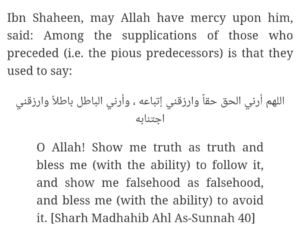
We ask Allah, the Most High, as Ibn Shaheen stated that among the supplications of those who came before (i.e. the pious predecessors) was that they said:

اللَّهُمَّ أَرِنِي الْحَقَّ حَقًّا وَارْزُقْنِي اتِّبَاعَهُ، وَأَرِنِي الْبَاطِلَ بَاطِلًا وَارْزُقْنِي اجْتِنَابَهُ

O Allah! Show me the truth as truth (or as it is in reality) and bestow on me (the ability) to follow it; show me falsehood as falsehood (or as it is in reality) and bestow on me (the ability) to avoid it. [3]


[1] An Excerpt from Tafseer Surah Al-Furqan. (Paraphrased). May Allah bless my Salafi brother, colleague, and friend, Abu Zakariyyah (Abdul Malik Al-Congoli Al-Ifreeqee) for sharing the Arabic text of this reminder.

[2](Paraphrased): https://www.alathar.net/home/esound/index.php?op=codevi&coid=166809

[3] Sharh Madhahib Ahl As-Sunnah page 40.

Knowledge Across Generations: Guidance, Responsibility and Harmony

In The Name of Allah, The Most Merciful, The Bestower of Mercy.

“Indeed, among the portens of the hour (i.e. the signs of the day of Judgement) is that knowledge will be sought from the Asaghir”.

The people (scholars) have given different interpretations of “As-Sighar” in this context (as) mentioned by Ibn Abd al-Barr in Al-Jami [1/157] and Al-Shatibi in Al-I’tisam [2/93].

Ibn Qutaybah – may Allah the Most High have mercy upon him – held that As-Sighar are the young (youth). He stated based on the narration by Ibn Mas’ud, may Allah be pleased with him, “the people will not cease to be upon good as long as their scholars are Mashayikh (i.e. elders) and not young people”, that it means:

Youthful gratification, youthful intensity, haste and folly would have ceased from the elder, and he possesses Tajribah and Khibrah [experience, proficiency and the know-how with regards to matters].

Neither doubt influences him through his knowledge nor is he overcome by (vain) desires, neither inclined -through his knowledge-towards excess eagerness for something nor (easily) enticed by Shaytan in the manner a young man is enticed. Thus, age is accompanied with composure, dignity and awe. The Shaikh (is mostly) safe from these matters which may influence the young person. If they influence him (i.e. a young person) and he gives a verdict, he ruins himself and others”.

Then the Shaikh [Abdus Salam Burjess – may Allah have mercy mercy upon him] stated that this ruling is not absolute with regards to the young ones, for indeed there were a group of the Sahabah and the Tabi’in who taught and gave verdicts in their young age, while the elders were present. However, the likes of these people are hard to find amongst those who came after them. If they are found and known for being upright- upon a sound (path), possess knowledge and their firmness is manifested, while there are no elders to be found, then knowledge of the Shariah is acquired from them, if they are free from Fitnah!

Therefore, the intent is not that the knowledge possessed by the young person is boycotted, while the elders are present; rather the intent is that the people are placed in their rightful positions. [1] [End of quote]

Nu’aym, may Allah have mercy upon him, said: It was said to Ibn Al-Mubarak, may Allah have mercy upon him, “Who are the Asaghir?” He said:

“Those who speak based on their views. As for the young one who narrates from the elder, he is not one who narrates based on his views”. [2]

Ibn al-Mubarak also said: “Al-Asaghir are Ahlul Bidah”. [3]

Imam Al-Bukhari, may Allah have mercy upon him, said:

A man will not become well facilitated until he takes knowledge from one above him, one similar to him and one below him. [4]

Imam Abdullah Ibn al-Mubarak, may Allah have mercy upon him, said:

A man will not be from the (students or scholars) of Hadith until he writes from someone similar to him, someone above him and someone below him. [5]

Imam Sufyan Ibn Uyaynah, may Allah have mercy upon him, said:

A man will not be from the (students or scholars) of Hadith until he takes from someone above him, someone below him and someone similar to him.” [6]

Al-Allamah Rabee Bin Hadi Al-Mad’khalee, may Allah have mercy upon him, said:

Musa, peace be upon him, was spoken to directly by Allah and the Tawrat was revealed to him, which contained Hudaa [i.e. that which guides a person to Iman, truth and protects one from misguidance] and Nur [i.e. a guiding light in the midst of the darkness of ignorance, confusion, doubts, beliefs and deeds that appear to be truth but are falsehood in reality and evil desires], but when he knew that another person possessed knowledge of that which he did not possess, [Allah informed us that he (Musa) said]:

لَا أَبْرَحُ حَتَّىٰ أَبْلُغَ مَجْمَعَ الْبَحْرَيْنِ أَوْ أَمْضِيَ حُقُبًا

I will not give up (travelling) until I reach the junction of the two seas or (until) I spend years and years in travelling]. [Al-Kahf. Verse 60]

He went on foot – neither had a car nor a riding beast, nor a horse; (rather) he travelled on foot”. [7]


An Example of Harmony Between Teacher and Student

Al-Allamah Muhammad Ibn Abdil Wahhab Al-Bannah -may Allah have mercy upon him, was considered one of Shaikh Rabee’s Shuyukh. Anyone who knew Shaikh Al-Bannah will know that he used to hold Shaikh Rabee in high esteem. On one occasion when he visited him at his house, Shaikh Al-Bannah said to him, “Take a seat and do not stand, for even though I am your Shaikh, you are my teacher”.

He was asked whether Shaikh Rabee is considered one of the senior scholars, so he said: “Who among the scholars of this era and before it truly knows the numerous callers to Islam like him?! He is known for evidence and proof and does not speak against anyone except with evidence. For this reason, I say that Rabee Hadi is like Yahyah Ibn Ma’een in this era. I say that indeed Rabee is the Yahya Ibn Ma’een of this era. May Allah reward him (with good), preserve him, and safeguard his intellect and memory. The most knowledgeable regarding the (situation) of men – with proof and evidence- is Rabee Hadi. May Allah keep him firm and alive, so that he refutes those who misrepresent Salafiyyah and wage war against it. We ask Allah to reveal their state of affairs, expose them, and protect us from their evil”. [8]

Allah Raises Some People of Knowledge Above Others

Allah, The Most High, said:

فَبَدَأَ بِأَوْعِيَتِهِمْ قَبْلَ وِعَآءِ أَخِيهِ ثُمَّ ٱسْتَخْرَجَهَا مِن وِعَآءِ أَخِيهِ كَذَٰلِكَ كِدْنَا لِيُوسُفَ مَا كَانَ لِيَأْخُذَ أَخَاهُ فِى دِينِ ٱلْمَلِكِ إِلَّآ أَن يَشَآءَ ٱللَّهُ نَرْفَعُ دَرَجَٰتٍ مَّن نَّشَآءُ وَفَوْقَ كُلِّ ذِى عِلْمٍ عَلِيمٌ

So he [Yusuf] began (the search) in their bags before the bag of his brother. Then he brought it out of his brother’s bag. Thus did We plan for Yusuf. He could not take his brother by the law of the king (as a slave), except that Allah willed it. (So Allah made the brothers to bind themselves with their way of “punishment, i.e. enslaving of a thief.”) We raise to degrees whom We please, but over all those endowed with knowledge is the All-Knowing (Allah). [12:76]

نَرْفَعُ دَرَجَٰتٍ مَّن نَّشَآءُ

We raise to degrees whom We please], as Allah said (i.e. in another Ayah):

يَرْفَعِ اللَّهُ الَّذِينَ آمَنُوا مِنْكُمْ وَالَّذِينَ أُوتُوا الْعِلْمَ دَرَجَاتٍ ۚ وَاللَّهُ بِمَا تَعْمَلُونَ خَبِيرٌ –

Allah will exalt in degree those of you who believe, and those who have been granted knowledge. And Allah is Well-Acquainted with what you do]. [Al-Mujadilah 11]

وَفَوْقَ كُلِّ ذِى عِلْمٍ عَلِيمٌ

But over all those endowed with knowledge is the All-Knowing (Allah).

Al-Hasan al-Basri, may Allah have mercy upon him, said:

There is not a scholar except that above him is (another) scholar until the all knowledge goes back to Allah, The Mighty and Majestic, (i.e. Allah as the absolute Owner and Bestower of all knowledge).

Abdur Razzaq, may Allah have mercy upon him, reported from Sufyan ath-Thawri, may Allah have mercy upon him, from Abdul A’laa ath-Tha’labi, may Allah have mercy upon him, from Sa’eed Ibn Jubayr, may Allah have mercy upon him, who said:

We were with Ibn Abbas, may Allah be pleased with him and his father, when he delivered an amazing speech. Then a man was amazed and said: “All praise and thanks be to Allah, above every possessor of knowledge is One All-Knowing”. Ibn Abbas said: “What an evil (or terrible) thing you have uttered! Allah is the All-Knowing, and He is above every knowledgeable one”. [9]

نَرْفَعُ دَرَجَاتٍ مَنْ نَشَاءُ

We raise to degrees whom We please.

Meaning, through beneficial knowledge and acquaintance with the paths that lead to their intended goals, just as We raised Yusuf’s, peace be upon him, in ranks.

Basheer al-Hujaymee, may Allah have mercy upon him, said: One day, I heard al-Ḥasan al-Baṣri, may Allah have mercy upon him, recite this verse:

وَفَوْقَ كُلِّ ذِى عِلْمٍ عَلِيمٌ

But over all those endowed with knowledge is the All-Knowing (Allah).

Then he paused and said: “By Allah! There is not a single scholar on the face of the earth who has reached the evening except that above him is one who is more knowledgeable until (all) knowledge goes back to the One who taught it (i.e. Allah)”. [10]

“We raise in degrees whom We will”.

Imam as-Sadi, may Allah have mercy upon him, said:

(Meaning), through beneficial knowledge and acquaintance with the paths that lead to the intended goals, just as We raised the ranks of Yusuf. [وَفَوْقَ كُلِّ ذِي عِلْمٍ عَلِيمٌ – but over all those endowed with knowledge is the All-Knowing (Allah)]- Meaning, for every scholar, there is one above him who is more knowledgeable until (all) knowledge goes back to Allah the Knower of the unseen and the seen. [11]

Imam Muhamad Ibn Salih Al-Uthaymin, may Allah have mercy upon him, said:

know that regardless how much knowledge you have attained, indeed, there is always someone more knowledgeable than you. ” but over all those endowed with knowledge is the All-Knowing (Allah)”, until all knowledge goes back to Allah, the Might and Majestic (as the absolute Owner and Bestower of all knowledge). Do not think that you are the most knowledgeable of people, for (even) if you possess abundant knowledge, there is one who is more knowledgeable than you. Contemplate Musa, peace be upon him, when he said: “I do not know anyone among the people of the earth who is more knowledgeable than I”. What happened? He was told that indeed in a such and such place there is one who is more knowledgeable than you, meaning al-Khiḍr, peace be upon him. Then took place that which Allah Allah, The Most High, related to us in Surah al-Kahf. [12]


[1]An Excerpt from “Awaa’iq at-Talab” pages 29 onwards. Paraphrased

[2]Az-Zuhd 1/21

[3]Sharh Usul Al-I’tiqad Ahl As-Sunnah Wal Jama’ah 1/95

[4]Quoted by Shaikh Abdullah Al-Bukhari, may Allah preseeve him, in Sharh Umdah Al-Ahkam. Lesson 1

[5]Tarikh Baghdad by Al-Khateeb Al-Baghdaadee 5/68, may Allah have mercy upon him.

[6]Al-Jami Li-Akhlaaq Ar-Raawee 2/218

[7] Marhaban Yaa Taalibal Ilm. 245-248.

[8]https://rabee.net/%D8%A7%D9%84%D8%AB%D9%86%D8%A7%D8%A1-%D8%A7%D9%84%D8%A8%D8%AF%D9%8A%D8%B9-%D9%85%D9%86-%D8%A7%D9%84%D8%B9%D9%84%D9%85%D8%A7%D8%A1-%D8%B9%D9%84%D9%89-%D8%A7%D9%84%D8%B4%D9%8A%D8%AE-%D8%B1%D8%A8%D9%8A/

[9]An Excerpt from Tafseer Ibn Kathir

[10]An Excerpt from Mawsu’ah at-Tafseer al-Ma’thur 11/708

[11]An Excerpt from Tafseer as-Sadi

[12]https://alathar.net/home/esound/index.php?op=codevi&coid=39439


A Brief Reflection From Al-Ahzab 39 and Al Ma’idah 54

In The Name of Allah, The Most Merciful, The Bestower of Mercy.

Allah, The Exalted, said:

الَّذِينَ يُبَلِّغُونَ رِسَالاتِ اللَّهِ وَيَخْشَوْنَهُ وَلا يَخْشَوْنَ أَحَداً إِلاَّ اللَّهَ وَكَفَى بِاللَّهِ حَسِيباً

Those who convey the Message of Allah and fear Him, and fear none save Allah. And Sufficient is Allah as a Reckoner. [Al-Ahzab. 39]

“Those who convey the Message of Allah” – Meaning, they propagate Allah’s Ayaat (verses, signs lessons, commands, and prohibitions), His proofs, and evidences to His servants. They call them to Allah’s path, they fear Allah alone without ascribing partners to Him, and they fear none except Allah. [1] “And Sufficient is Allah as a Reckoner”- Meaning: Preserve (and record) the deeds of His creation and will recompense them. [2]


In Surah Al-Ma’idah Ayah 54, Allah said about the true believers:

يُجَٰهِدُونَ فِى سَبِيلِ ٱللَّهِ وَلَا يَخَافُونَ لَوْمَةَ لَآئِمٍ ذَٰلِكَ فَضْلُ ٱللَّهِ يُؤْتِيهِ مَن يَشَآءُ وَٱللَّهُ وَٰسِعٌ عَلِيمٌ

They strive in the Way of Allah, and are never afraid of the blame of the blamers.

Meaning, they strive in the path of Allah with their wealth, lives, statements and actions. They do not fear the blame of the blamer, rather, they give precedence to their Lord’s Pleasure and the fear of His blame over the blame of the people. [NB: Must read “Footnote a” about Jihad in our era] This shows the strength of their resolve and determination, as the one whose heart is weak is weak in his resolve, which falters in the face of the blame of the blamers, and his strength diminishes when criticised by the critics. [3]

Imam Ibn Al-Qayyim, may Allah have mercy upon him, said:

There are three people in relation to this matter: The first person is one hindered from what Allah loves due to fear of blame. The second manifests their love for what Allah loves, regardless of the blame of the blamers. The third conceals his deed that may attract blame to fulfil what is beloved to Allah. So, the first person is excessively negligent, the third person is a weak believer, and the second person is in the best position, and he is a strong believer. A strong believer is more virtuous and beloved to Allah than a weak believer. The highest type of love for Allah and His Messenger is found in striving in the path of Allah despite the numerous blamers since many souls dislike being in this situation. [4]

Al-Allamah Abdur Rahman Bin Yahyah Al-Mu’allimee, may Allah have mercy upon him, said:

When the Christians initially exaggerated the status of Isa, peace be upon him, the extremists began to accuse anyone who rebuked them of harboring animosity towards Isa and diminishing his status. Thus this became the greatest means for the proliferation of extremism, as those who adhered to the truth saw that rebuking the extremists would lead to accusations of a more detestable nature, such as hating and belittling Isa, as well as being hated by the majority and subjected to harm. This held them back from rebuking the extremists, allowing shaytan to operate without restraint. The circumstances surrounding the extremists among the Rawafid, grave worshippers, and advocates of blind adherence in the religion bear a striking resemblance to this scenario. [5]

Al-Allamah Ibn Aqeel, may Allah have mercy upon him, said:

If the truthful ones were to keep silent and the falsifiers speak, the creation would relinquish what they have witnessed (of truth) and reject what they have not witnessed. So when the devout ones desire to revive the Sunnah, the people would reject it and think that it is Bidah. [6]

Jihad in our times: https://abukhadeejah.com/salafi-shaikh-fawzaan-on-jihaad-in-our-times-and-the-guidelines-of-jihaad-according-to-islam/
—————————————–


[1] An Excerpt from Tafsir As-Sadi

[2] An Excerpt from Tafsir Al-Baghawi

[3] An Excerpt from “Tafsir as-Sadi”

[4] An Eccerpt from Badaa’i at-Tafsir Al-Jaami Limaa Fassarahu Al-Imaam Ibn Al-Qayyim 1/324

[5]at-Tankil Bimaa Fee Ta’neeb Al-Kawtharee Minal Abaateel. 1/80

[6] Shifaa As-Sudur Fee Ziyaarah Al- Mashahid Wal-Qubur. page 148


Some Timeless and Precise Principles, Robust Admonitions: By Imam Ibn al-Qayyim, al-Allamah Muqbil bin Hadi, al-Allamah Rabee, and Shaikh Abdus Salam Burjess

In The Name of Allah, The Most Merciful, The Bestower of Mercy.

Imam Ibn Al-Qayyim, may Allah have mercy upon him, said:

فمن هداه اللهُ سُبحانَه إلى الأخذِ بالحقِّ حيثُ كان، ومع مَن كان، ولو كان مع من يُبغِضُه ويُعاديه، وردِّ الباطِلِ مع من كان، ولو كان مع مَن يحِبُّه ويُواليه؛ فهو ممَّن هُدِيَ لِما اختُلِفَ فيه من الحَقِّ

(الصواعق المرسلة)) (2/516

Whoever Allah—Glorified be He, free from all imperfections—guides to embrace (accept, uphold, etc) the truth, no matter where it comes from and with whomever it maybe, even if it is with someone he hates and (shows) enmity, and he rejects falsehood, no matter with whomever it may be, even if it is with someone he loves and allies with,  he is from those who have been guided to the truth regarding matters on which (people) differ. [1]

Al-Allamah Muqbil Bin Hadi Al-Wadi’ee, may Allah have mercy upon him, said:

What I advise the brothers is that they are eager for the texts of the Qur’an and Sunnah. (As for) an issue about which there is no proof, there is no harm that we return to the statements of the Imams and utilise it as support. [2]

He said:

“Call to the Book and the Sunnah. Do not call to personalities, for indeed personalities are not safe from Fitna”. [3]

He said:

“All the Muslims – Arabs, non-Arabs, white and black, it is incumbent to be one Jama’ah. [4]

He said:

“O Ahlus Sunnah! The society is under your care and it is your responsibility to rebut every Rafidi and falsifier. [5]

He said:

“The Dawah will not be properly grounded (or established) except through al-jarḥ wa al-ta’deel”. [6]

He said:

“If Allah shows you the truth, do not be bothered even if opposed, and be gentle with other scholars. As for the one whose conduct is conspicuously (blameworthy) every day, his condition must be clarified”. [7]

Some Timeless Robust Principles And Admonitions By Al-Allamah Rabee, may Allah have mercy upon him

Al-Allamah Rabee Bin Hadi Al-Mad’khali, may Allah have mercy upon him, said:

The seeker of truth is not diverted from the truth, fairness and justice due to admiration of the big personalities and being amazed by them, for indeed the truth is more worthy to be followed. It is not permissible to drop the proofs for the sake of this or that great man. The principle [rule] of the Muslim – the unbiased one, the seeker of truth – is always:

قُلْ هَاتُوا بُرْهَانَكُمْ إِن كُنتُمْ صَادِقِينَ

Say, bring forth your proofs if you are truthful. [An-Nahl. 64] [8]

He said:

It is incumbent upon the people of truth to have patience and deepen their commitment to this religion of truth. In times when frivolous desires are prevalent, it is essential to enhance one’s understanding of the truth and to remain steadfast in following it, as the Messenger, peace and blessings of Allah be upon him, said: “The one who lives long amongst you will see a lot of differences, so upon you is that you follow my Sunnah and the Sunnah of the rightly guided khulafa. Bite onto it with your molar teeth (i.e. hold onto it firmly) and beware of newly invented matters (in the religion), for every newly invented matter (in the religion) is innovation in religion and every innovation in religion is misguidance’” [8.1]

The Arabic text below is a statement of Shaikh Abdus Salam Burjess, may Allah have mercy upon him, in Awa’iq at-Talab pages 85-86.

The Shaikh said that when a teacher errs regarding something, the student should deal with him gently according to the circumstances and should not say to him, “You have made an error” or “The matter is not as you say”, rather, he should use kind expressions through which the teacher realises his mistake without unsettling his heart, for this is from the rights that are owed to the teacher…. refutation that is accompanied with bad manners and distressing the person’s heart prevents understanding of what is right…

And just as this is obligated to a student of knowledge when dealing with the teacher, it is also incumbent upon the teacher to return to the truth when he errs. He is not to be prevented from returning to the truth after reviewing a statement he made and finds that it is in opposition to what is correct, for indeed that is a sign of equity and humbling oneself to the truth. Therefore, it is obligatory that one follows what is correct, whether it was conveyed by a younger or older person.

And it is a blessing upon a teacher that he has amongst his students one who notifies him of his mistake and leads him to what is correct, so that he does not persist upon that ignorance. This requires that one shows gratitude to Allah, The Most High, and then being thankful to the person through whom one was guided, whether it was a student or other than him.  (Paraphrased)

https://x.com/i/status/2010036458296619316

Reflections on some statements of Al-Allamah Rabee Bin Hadi Al-Mad’khali [77 of 80]

Shaikh Abdus Salaam Burgess, may Allah have mercy upon him, said:


[1] s-Sawaa’iq Al-Mursalah 2/516 Paraphrased

[2]Al-Basha’ir Fis Samaa Al-Mubashir” page 13 with introduction by Shaikh Muhammad Ibn Abdil Wahhab Al-Wassaabee, rahimahullah

[3] Basha’ir page 12

[4] Basha’ir Page 14

[5] Basha’ir Page 14

[6] Basha’ir Page 17

[7] Al-Basha’ir 25

[8] Al-Mulakh-khas Al-Jameel Fee Bayaan Manhaj Ash-Shaikh Rabee Fid-Da’wati Wal-Jarhi Wat-Ta’deel. Page 87

[8.1] Majmu 14/294

The Path to Honour: Contemplating Revelation and Following the Prophetic Example

In The Name of Allah, The Most Merciful, The Bestower of Mercy.

Studying the Prophet’s biography and reading it strengthens believer’s certainty, steadfastness and perseverance upon the religion ordained by Allah. It makes the believer’s heart honourable due to Islam, Islamic monotheism, the knowledge and awareness of Allah in his heart, his belief in Muhammad, peace and blessings of Allah be upon him, and what Allah revealed to His Messengers. Allah said:

وَلِلَّهِ الْعِزَّةُ وَلِرَسُولِهِ وَلِلْمُؤْمِنِينَ

But honour, power and glory belong to Allah, His Messenger (Muhammad), and to the believers]. [Al-Munaafiqun.  8]

These are from the many benefits that every believer benefits from by studying the biography of The Chosen One (المصطفى). [1]

Indeed, one of the greatest blessings (bestowed) on a believer – leading to guidance and righteous deeds – is that Allah, The Mighty and Majestic, facilitates for him the path to seeking knowledge, grants him an ardent zeal and eagerness for knowledge. Seeking knowledge is something one never feels that he has acquired enough, rather whenever a path to knowledge is made available, he pursues it.

Allah protects the student of knowledge, guides and aids him, therefore it is incumbent upon a student of knowledge to exalt turning to Allah (in submission, obedience etc) and that what he learns should be a proof for him and not against him, and that Allah increases him in knowledge, facilitates him with the path to good and guidance.

“Whoever follows a path in search of knowledge Allah will make easy for a him a path to paradise”.

One of the noblest aspects of knowledge – a matter that occupies a mighty station- is to pay close attention to the characteristics of the Prophet, his specific qualities and deeds through by which Allah distinguished him from everyone amongst humankind, his manners, etiquettes and biography. This is because he is the greatest Imam and the perfect example. Indeed, Allah, The Mighty and Majestic, commanded us to follow his example, made him an Imam and example for us. Allah, The Mighty and Majestic, said:

لَّقَدۡ كَانَ لَكُمۡ فِى رَسُولِ ٱللَّهِ أُسۡوَةٌ حَسَنَةٌ۬ لِّمَن كَانَ يَرۡجُواْ ٱللَّهَ وَٱلۡيَوۡمَ ٱلۡأَخِرَ وَذَكَرَ ٱللَّهَ كَثِيرً۬ا

Indeed in the Messenger of Allah (Muhammad) you have a good example to follow for him who hopes in (the Meeting with) Allah and the Last Day and remembers Allah much. [Al-Ahzab 21]

This noble verse – as the people of knowledge have stated – is a basis to established the fact that the Prophe, peace and blessings of Allah be upon him, is to be emulated; (but) emulating him cannot be fulfilled except through acquainting oneself with his characteristics, his qualities in general, his specific qualities and deeds through which Allah distinguished him from everyone amongst humankind, and (acquaintance with) his manners and etiquettes. The one who is unacquainted with the Prophet’s characteristics and manners will not be able to emulate him, and this is why the scholars have written beneficial books regarding his characteristics and qualities.

The manners and qualities of the Prophet are a means of calling inviting to this mighty religion. Indeed, many people- during his era and thereafter – have been guided through their acquaintance with his manners and qualities. One used to come to him while harbouring the most intense hatred towards him, but after meeting him and (observing) his great etiquettes, noble manners, lofty dealings and benevolence, the person would depart while loving him more than everyone else on the face of the earth. Therefore, his characteristics are a means to calling to this religion- an intrument for the one inviting the people in the path of Allah.

Speaking about his qualities, emulating him and calling others to emulate him strengthens the religion of Islam, because he was the one whom Allah appointed to convey and explain the religion to humankind. Allah chose him and he is the best of all the slaves of Allah- the greatest in his servitude to Allah. Calling the people to emulate his qualities is a means to calling people to believe in the religion ordained by Allah and a means to strengthening the belief of the one who has already believed in his Messenger-ship. This is why turning away from his Seerah has been the cause of people’s inclination towards the path of losers amongst men and women [i.e. those upon a path other than the path of Allah].

As for the biographies of the Imams of Guidance- the greatest of them being the Messenger, they are (also) a means of rectifying the person and safety from corruption and evil. On the other hand, the biography of the losers is a path that will lead to evil, ruin and corruption. Allah, The Mighty and Majestic, said:

قَدۡ كَانَتۡ ءَايَـٰتِى تُتۡلَىٰ عَلَيۡكُمۡ فَكُنتُمۡ عَلَىٰٓ أَعۡقَـٰبِكُمۡ تَنكِصُونَ
مُسۡتَكۡبِرِينَ بِهِۦ سَـٰمِرً۬ا تَهۡجُرُونَ
أَفَلَمْ يَدَّبَّرُوا الْقَوْلَ أَمْ جَاءَهُم مَّا لَمْ يَأْتِ آبَاءَهُمُ الْأَوَّلِينَ
أَمْ لَمْ يَعْرِفُوا رَسُولَهُمْ فَهُمْ لَهُ مُنكِرُونَ

Indeed, My Verses used to be recited to you, but you used to turn back on your heels [denying them, and with hatred to listen to them]. In pride [they Quraish pagans and polytheists of Makkah used to feel proud that they are the dwellers of Makkah sanctuary Haram], talking evil about it [the Qur’an] by night. Have they not pondered over the Word [of Allaah, i.e. what is sent down to the Prophet], or has there come to them what had not come to their fathers of old? Or is it that they did not recognize their Messenger [Muhammad] so they deny him? [i.e. this is a rebuke against them because all of them – young and old – knew his lineage, truthfulness and trustworthiness, yet they turned away from his message]. [Al-Muminun. 66-69]

This shows that contemplating the Qur’an, acquainting oneself with the Messenger’s guidance and biography is a path leading to safety, and a safeguard against turning back on one’s heels. On the contrary, abandoning the Seerah of the Prophet and inclining towards the Seerah of the losers will lead to ruin.

The people became corrupted – in this era – after being put to trial through movies and films, but had they turned to the biographies of the Prophets and the noble companions of the Prophet Muhammad, they would have found guidance and a path leading to steadfastness. [2]


[1] An Excerpt from “Silsila al-Muhādarāt al-ilmiyyah 4/506-507 By Shaikh Salih Aala Ash-Shaikh – may Allah preserve him.

[2]An Excerpt from: “Sharh Al-Mukhtasar Fee Sifatus An-Nabi Wa Akhlaqihi. Audio Lesson 1 By Shaikh Abdur Razaaq Al-Badr – may Allah preserve him.