The remembrance of Allah is the life of the hearts; there is no life for them except through it. Al-Bukhari reports in his Saheeh from Abu Musa Al-Ash’ari (may Allah be pleased with him), that the Prophet ﷺ said:
“The example of the one who remembers his Lord and the one who does not remember his Lord is like that of the living and the dead.”
The hearts find no reassurance, no tranquility, no true delight, and no real happiness except through the remembrance of Allah, the Almighty and Majestic.
Those who believe (in the Oneness of Allah – Islamic Monotheism), and whose hearts find rest in the remembrance of Allah, Verily, in the remembrance of Allah do hearts find rest. (Ar-Ra’d 13:28)
Question: What is the ruling regarding responding to one that sneezes during the Friday sermon (khutbah)?
Watch the full video for the Shaykh's answer!
Links 🔗 from Video – salafidawahmanchester.com/Online – Online Quran Lessons Salafischool.co.uk/online – Online Full Day Classes – TuitionClub.org/Online
Question: Is it correct that reciting Surah Ad-Dukhaan 3 times before sleep protects one from the evil plots of the people?
Watch the full video for the Shaykh's answer!
Links 🔗 from Video – salafidawahmanchester.com/Online – Online Quran Lessons Salafischool.co.uk/online – Online Full Day Classes – TuitionClub.org/Online
Question: When should the supplication of Istikhara be performed?
Watch the full video for the Shaykh's answer!
Links 🔗 from Video – salafidawahmanchester.com/Online – Online Quran Lessons Salafischool.co.uk/online – Online Full Day Classes – TuitionClub.org/Online
Question: If the time of the morning adhkaar is missed, should they be said after dhuhr?
Watch the full video for the Shaykh's answer!
Links 🔗 from Video – salafidawahmanchester.com/Online – Online Quran Lessons Salafischool.co.uk/online – Online Full Day Classes – TuitionClub.org/Online
Alee ibn Abee Talhah (rahimahullah) reported that Ibn Abbas (Allah be pleased with them both) stated regarding Allah The Most High’s statement
اذكروا الله ذكرا كثيرا
Remember Allah with much remembrance. (Al-Ahzaab:41)
Verily, Allah did not obligate an obligation upon his servants except that he legislated a fixed limit for it (1), and then excused its performers when they are in a situation when they are excused (2), except in the case of dhikr (remembrance of Allah) for indeed Allah did not legislate a limit for it and nor is a person excused for abandoning it, except when compelled. Allah said,
فَٱذۡڪُرُواْ ٱللَّهَ قِيَـٰمً۬ا وَقُعُودً۬ا وَعَلَىٰ جُنُوبِڪُمۡ
remember Allah standing, sitting down, and (lying down) on your sides (An-Nisaa:103)
night and day, at land or sea, whilst travelling or resident, when wealthy and in times of poverty, in sickness and in health, in private and public and in all circumstances, He, The Mighty and Majestic said,
و سبحوه بكرة و أصيلا
And glorify His Praises morning and afternoon [the early morning (Fajr) and ‘Asr prayers]. (Al-Ahzaab:42)
so if you were to do that (in the manner mentioned by ibn Abbas (Allah be pleased with them both)) then Allah will send His Blessings upon you, and the Angels will supplicate for you.
Tafsir Al-Qur’aan Al-‘Adheem ibn Katheer vol.11 pgs.182-183
(1) e.g. obligatory prayers are a fixed number (five) with set number of raka’aat, obligatory fasts of Ramadhan are one month every calendar year.
(2) e.g. a traveller, sick person does not have to fast obligatory fasts, the woman on her menses does not pray or fast etc
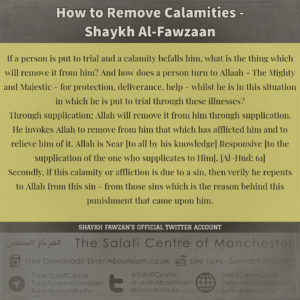
If a person is put to trial and a calamity befalls him, what is the thing which will remove it from him? And how does a person turn to Allaah – The Mighty and Majestic – for protection, deliverance, help – whilst he is in this situation in which he is put to trial through these illnesses?
Through supplication; Allah will remove it from him through supplication. He invokes Allah to remove from him that which has afflicted him and to relieve him of it. Allah is Near [to all by his knowledge] Responsive [to the supplication of the one who supplicates to Him]. [Al-Hūd:61]
Secondly, if this calamity or affliction is due to a sin, then verily he repents to Allāh from this sin – from those sins which is the reason behind this punishment that came upon him.
What do you say about the one who says its not a must for him to supplicate for the (Muslim) ruler?
(You say this) because you do not love the ruler, and this is a proof of hypocrisy. The ruler of the Muslims is loved, this is the way of the believers, that they love the Muslim rulers and make dua for their success and their guidance and for them to be aided (by Allah), because their guidance is guidance for the Muslims. And if they are guided, Allah benefits the Muslims by them.
Supplicating for them is from Sincere advice, and the Religion is sincere advice to Allah, his messenger, the rulers of the muslims and the general people. (1)
And the salaf used to supplicate for the Muslim rulers upon the minbar, supplicating for their success and rectification and their guidance because this is rectification of the Muslims and a benefit for the Muslims. (2)
And this (statement) is not possible except from he who has a soul of the khawaarij, a soul of hypocrisy.
And Allah’s refuge is sought.
From the lecture:
أسباب محبة الله
————–
(1) The famous hadith of Tameem Ad-Daarimi (May Allah be pleased with him) as reported in Saheeh Muslim
(2) It is reported that Al-Fudayl bin Ayyad [Allah have mercy on him] said, ‘If I had one supplication that was going to be answered I would make it for the ruler (imam), for the wellbeing and righteousness of the imam means wellbeing for the land and its people.’
Al-Dhahabi, Siyar A’lam Al-Nubala` in his biography of Al-Fudayl b. Ayyad.
We ask Allah The Lord of the Tremendous Throne to rectify the affairs of our Muslim rulers, to make them from the righteous and to benefit Islaam and the Muslims by way of them. آمين