Tag: tawheed

[1] The Three Monotheistic Religions! [Brief Observations On This Statement Uttered By Writers Who Are Ignorant About Islaam And Misguided Modernists Speaking In The Name of Islaam]

In The Name of Allaah, The Most Merciful, The Bestower of Mercy.


Firstly: We repeat once again the fact that rebutting false beliefs, ideas and views does not necessitate bad behaviour, rather Muslims are commanded to behave well towards others. Must read: https://www.abukhadeejah.com/living-with-non-muslims-in-the-west-with-fine-conduct/    https://salafidawahmanchester.com/2017/05/stance-proactive-order-protect-muslims-non-muslim-neighbours-inhuman-ideologies-devilish-acts-jihaadist-terrorists-sympathisers/

Allaah [The Most High] said:

قُلۡ يَـٰٓأَهۡلَ ٱلۡكِتَـٰبِ تَعَالَوۡاْ إِلَىٰ ڪَلِمَةٍ۬ سَوَآءِۭ بَيۡنَنَا وَبَيۡنَكُمۡ أَلَّا نَعۡبُدَ إِلَّا ٱللَّهَ وَلَا نُشۡرِكَ بِهِۦ شَيۡـًٔ۬ا وَلَا يَتَّخِذَ بَعۡضُنَا بَعۡضًا أَرۡبَابً۬ا مِّن دُونِ ٱللَّهِ‌ۚ فَإِن تَوَلَّوۡاْ فَقُولُواْ ٱشۡهَدُواْ بِأَنَّا مُسۡلِمُونَ

Say (O Muhammad): “O people of the Scripture (Jews and Christians): Come to a word that is just between us and you, that we worship none but Allah, and that we associate no partners with Him, and that none of us shall take others as lords besides Allah. Then, if they turn away, say: “Bear witness that we are Muslims.” [Surah Aal Imraan. Aayah 64]

Meaning: say to the people of the scripture – the Jews and Christians, [تَعَالَوۡاْ إِلَىٰ ڪَلِمَةٍ۬ سَوَآءِۭ بَيۡنَنَا وَبَيۡنَكُمۡ – Come to a word that is just between us and you]- Meaning: Come let us unite upon the statement which all the Prophets and Messengers agreed upon and none opposes it, except the obstinate and misguided. This statement is not specific to anyone of us, rather it is something that you and us should establish between us, so this is justice and fairness in debate. Then Allaah explains this and said: [أَلَّا نَعۡبُدَ إِلَّا ٱللَّهَ وَلَا نُشۡرِكَ بِهِۦ شَيۡـًٔ۬ا  –  that we worship none but Allah, and that we associate no partners with Him]- Meaning: We should single out Allaah in worship, devoting all love, fear and hope to Him alone, and we should not associate anyone as partner with Allaah in worship- neither a Prophet, an Angel, a Righteous Person, an Idol, a Deified image, a living or non-living thing, [وَلَا يَتَّخِذَ بَعۡضُنَا بَعۡضًا أَرۡبَابً۬ا مِّن دُونِ ٱللَّهِ‌ۚ  – and that none of us shall take others as lords besides Allaah]; rather all obedience is to be devoted to Allah and His Messengers. [فَإِن تَوَلَّوۡاْ فَقُولُواْ ٱشۡهَدُواْ بِأَنَّا مُسۡلِمُونَ – Then, if they turn away, say: “Bear witness that we are Muslims]. [Ref 1]


The Christians wrote to Shaikhul Islaam Ibn Taymiyyah [rahimahullaah] and claimed that Islaam considers all religions to be equal and that this has been mentioned in Suratul Baqarah as follows: [إِنَّ ٱلَّذِينَ ءَامَنُواْ وَٱلَّذِينَ هَادُواْ وَٱلنَّصَـٰرَىٰ وَٱلصَّـٰبِـِٔينَ مَنۡ ءَامَنَ بِٱللَّهِ وَٱلۡيَوۡمِ ٱلۡأَخِرِ وَعَمِلَ صَـٰلِحً۬ا فَلَهُمۡ أَجۡرُهُمۡ عِندَ رَبِّهِمۡ وَلَا خَوۡفٌ عَلَيۡہِمۡ وَلَا هُمۡ يَحۡزَنُونَ – Verily! Those who believe and those who are Jews and Christians, and Sabians, whoever believes in Allaah and the Last Day and do righteous good deeds shall have their reward with their Lord, on them shall be no fear, nor shall they grieve]. [Surah Al-Baqarah. Aayah 62]

So, Shaikhul Islaam [rahimahullaah] replied to them saying: So, [according to them], this statement makes all the people equal- the Yahood, the Muslims and other than them. The response to this firstly is that there is no proof for you in this ayah regarding that which you seek.  Indeed, (the ayah) places you (Christians), the Jews and the Sabians on the same level.  You (Christians) are in agreement with the Muslims that the Jews became disbelievers after belying the Messiah and the Sabians became disbelievers after belying the Messenger sent to them.  Therefore, if it were the case that this ayah exalts  the Religion you are upon after the advent of Muhammad [sallal-laahu-alayhi-wasallam], then in it will also be praise for the Religion of the Jews, and both the Muslims and yourselves consider this to be falsehood.  So, if the Jews have not been praised in this Ayah after the abrogation and replacement of [their religion], then there will be no praise in it for the Christians after abrogation and replacement of [their religion]. Rather the meaning of the ayah is that those who believe in Muhammad [sallal-laahu-alayhi-wasallam], and those Jews who followed Moosaa-  those who were upon his path before its abrogation and replacement; and the Christians who followed the Messiah- those who followed his path before its abrogation and replacement]; and the Sabians- the Sabian Monotheists, such as those amongst the Arabs and other than them who were upon the Religion of Ibraaheem, Ismaa’eel and Ishaaq before its abrogation and replacement, because the Arabs are from the children of Ismaa-eel and other than him from amongst those who were neighbours of the Baitul Ateeq (the ka’bah), which was built by Ibraaheem and Ismaa-eel), and they used to be Monotheists upon the religion of Ibraaheem up until one of the heads of the (Khuzaa-a clan) Amr Bin Luhai altered the religion of Ibraaheem with polytheism  and prohibited that which Allaah did not prohibit.  That is why the Prophet [sallal-laahu-alayhi wasallam] said: “’I saw Amr Bin luhai dragging his guts in the hell fire for he was the first one who set out across the small sea and changed the religion of Ibraaheem”.   Likewise, there were those of the Children of Ishaaq who were upon the religion of Ibraaheem before the advent of Moosaa [alayhis-salaam] and they used to be from  the favoured, praised ones.  Therefore the above mentioned and others like them are those who have been praised.  Allaah said: [إِنَّ ٱلَّذِينَ ءَامَنُواْ وَٱلَّذِينَ هَادُواْ وَٱلنَّصَـٰرَىٰ وَٱلصَّـٰبِـِٔينَ مَنۡ ءَامَنَ بِٱللَّهِ وَٱلۡيَوۡمِ ٱلۡأَخِرِ وَعَمِلَ صَـٰلِحً۬ا فَلَهُمۡ أَجۡرُهُمۡ عِندَ رَبِّهِمۡ وَلَا خَوۡفٌ عَلَيۡہِمۡ وَلَا هُمۡ يَحۡزَنُونَ – Verily! Those who believe and those who are Jews and Christians, and Sabians, whoever believes in Allaah and the Last Day and do righteous good deeds shall have their reward with their Lord, on them shall be no fear, nor shall they grieve]. [Surah Al-Baqarah Aayah 62]

Therefore, the People of the Scripture who (came) after the abrogation and replacement of (these Religions) are neither from those who believed in Allaah and the Last day nor from those who worked righteous good deeds.  Those people of the Scripture [who came after the advent of Muhammad] disbelieved because they either substituted the religion of the Messiah or belied him or belied Muhammad [sallal-laahu-alayhi-wasallam] in various affairs.  The Aayaat of the Qur’aan (about this affair) are clear and many, have been transmitted in abundance and are known by necessity in the Religion of Muhammad [sallal-laahu-alayhi-wasallam]. However, these Christians approach the Qur’aan in the same way they approached the Torah and the Injeel. They make undue claims on the Muhkamaat [i.e. the texts] which do not carry except a single meaning, whilst clinging onto the Mutashaabih [i.e. the texts which must be referred back to the Muhkamaat for explanation], even though in them is there is that which is in opposition to what they desire. [Ref 2]

Finally: Refuting false ideas and claims does not negate living in harmony and peace with our non-Muslims, so must read the following articles:

Living With Non-Muslims In The West With Fine Conduct

https://www.abukhadeejah.com/living-with-non-muslims-in-the-west-with-fine-conduct/

http://www.abukhadeejah.com/wp-content/uploads/2014/12/Living-with-Non-Muslims.pdf

Being Proactive to Protect Our Non-Muslim Neighbours

https://salafidawahmanchester.com/2017/05/stance-proactive-order-protect-muslims-non-muslim-neighbours-inhuman-ideologies-devilish-acts-jihaadist-terrorists-sympathisers/


Ref 1: An Excerpt from Tafseer As-Sadi, slightly paraphrased

Ref 2: An Excerpt from Al-Jawaabus Saheeh Liman Baddala Deenul Maseeh. Vol 2. Pages 51-52. Publisher ‘Daarul Hadeeth’ edition 1426AH – 2005. slightly paraphrased

They Attributed to Allaah That Which They Considered to Be Deficiency When Attributed to Them!

In The Name of Allaah, The Most Merciful, The Bestower of Mercy.

Imaam Muhammad Bin Abdul Wahhaab [rahimahullaah] said in Masaa’ilil Al-Jaahiliyyah: They [i.e. people of the era of pre-Islamic ignorance] attributed deficiencies to Allaah [Glorified be He and free is He from all imperfections], such as (attributing) a child (to Him), being in need and tiredness, while (they) freed their monks from some of these Deficiencies.

Shaikh Saaleh al Fawzaan [may Allaah preserve him] explained the above, saying:

Deficiency is opposite to Perfection and attributing deficiencies to Allaah [Glorified be He and free is He from all imperfections] is a violation of His Lordship, and that is the (case) when a son is attributed to Him, because the father is in need of a son and is like him. The Jews [i.e. a sect amongst them] said that Ezra [alayhis-salaam] is Allaah’s son; the Christians said that the Messiah [alayhis-salaam] is Allaah’s son and the Pagan Arabs said that the Angels are Allaah’s daughters, while, the Christians declare their monks free from having wives and sons because [attributing this to their Monks] would be diminution of their rights. So these [Christians] do not declare Allaah free from that which they free their Monks.

Likewise, the Arabs hated having daughters, while they attributed that to Allaah.  So they attributed to Allaah what they hated for themselves and considered to be a disgrace and deficiency.  Allaah said: [وَيَجْعَلُونَ لِلَّهِ الْبَنَاتِ سُبْحَانَهُ ۙ وَلَهُم مَّا يَشْتَهُونَ – And they assign daughters unto Allaah! Glorified (and Exalted) is He above all that they associate with Him! And unto themselves what they desire’’. 16:57]

[وَيَجْعَلُونَ لِلَّهِ مَا يَكْرَهُونَ  – They assign to Allaah that which they dislike (for themselves). 16:62]

A Muslim Scholar went on a mission to one of the kings of Rome, so when he entered upon [the King] he said to him, “How is (your) wife and the children?’’ Those who were present became angry, for how can [this Muslim Scholar] describe their leader as having a wife and children?  So [the Muslim Scholar] said to them, “You (people) free your leader from having a wife and a son, while you attribute that to Allaah [The Mighty and Majestic] and you do not declare Him free from that?  So he silenced them and debated with them on that [basis]. [Source: An Excerpt from Sharh Masaa’ilil-Jaahiliyyah’ pages 150-151. slightly paraphrased]

The First Command In The Qur’aan

In The Name of Allaah, The Most Merciful, The Bestower of Mercy.

يَـٰٓأَيُّہَا ٱلنَّاسُ ٱعۡبُدُواْ رَبَّكُمُ ٱلَّذِى خَلَقَكُمۡ وَٱلَّذِينَ مِن قَبۡلِكُمۡ لَعَلَّكُمۡ تَتَّقُونَ

ٱلَّذِى جَعَلَ لَكُمُ ٱلۡأَرۡضَ فِرَشً۬ا وَٱلسَّمَآءَ بِنَآءً۬ وَأَنزَلَ مِنَ ٱلسَّمَآءِ مَآءً۬ فَأَخۡرَجَ بِهِۦ مِنَ ٱلثَّمَرَٲتِ رِزۡقً۬ا لَّكُمۡ‌ۖ فَلَا تَجۡعَلُواْ لِلَّهِ أَندَادً۬ا وَأَنتُمۡ تَعۡلَمُونَ

O mankind! Worship your Lord (Allah), Who created you and those who were before you so that you may become Al-Muttaqun (the pious) – Who has made the earth a resting place for you, and the sky as a canopy, and sent down water (rain) from the sky and brought forth therewith fruits as a provision for you. Then do not set up rivals unto Allah (in worship) while you know (that He Alone has the right to be worshipped). [Surah Al-Baqarah’ Aayaat 21-22]

The statement ‘There is no deity worthy of worship except Allaah’ necessitates ‘negation’ and ‘affirmation’. Negating every other thing worshipped besides Allaah because they are not worthy of worship, and affirming that Allaah alone is the true deity worthy of worship. The religion of Tawheed is founded upon these two foundations, just as Allaah stated that Ibraaheem [alayhis salaam] said to his people:

وَإِذۡ قَالَ إِبۡرَٲهِيمُ لِأَبِيهِ وَقَوۡمِهِۦۤ إِنَّنِى بَرَآءٌ۬ مِّمَّا تَعۡبُدُونَ

إِلَّا ٱلَّذِى فَطَرَنِى فَإِنَّهُ ۥ سَيَہۡدِينِ

And (remember) when Ibrahim (Abraham) said to his father and his people: “Verily, I am innocent of what you worship; Except Him (i.e. I worship none but Allah Alone) Who did create me, and verily, He will guide me.” [Surah Az-Zukhruf’ Aayaat 26-27]

This was the path of every Messenger sent by Allaah [to the people]. Allaah [The Most High] said:

وَلَقَدۡ بَعَثۡنَا فِى ڪُلِّ أُمَّةٍ۬ رَّسُولاً أَنِ ٱعۡبُدُواْ ٱللَّهَ وَٱجۡتَنِبُواْ ٱلطَّـٰغُوتَ‌ۖ

And verily, We have sent among every Ummah (community, nation) a Messenger (proclaiming): “Worship Allah (Alone), and avoid (or keep away from) Taghut (all false deities, etc. i.e. do not worship Taghut besides Allah).” [Surah An-Nahl’ Aayah 36]

Allaah [The Most High] said:

فَمَن يَكۡفُرۡ بِٱلطَّـٰغُوتِ وَيُؤۡمِنۢ بِٱللَّهِ فَقَدِ ٱسۡتَمۡسَكَ بِٱلۡعُرۡوَةِ ٱلۡوُثۡقَىٰ لَا ٱنفِصَامَ لَهَا‌ۗ

Whoever disbelieves in Taghut and believes in Allah, then he has grasped the most trustworthy handhold that will never break. [Surah Al-Baqarah’ Aayah 256]

Whoever says that ‘There is no deity worthy of worship except Allaah’ has indeed declared his freedom from every other thing worshipped besides Allaah and obligated on himself [or herself] to worship Allaah [alone]. This is a covenant obligated by a person on himself [or herself]. [Allaah (The Most High) said]:

فَمَن نَّكَثَ فَإِنَّمَا يَنكُثُ عَلَىٰ نَفۡسِهِۦ‌ۖ وَمَنۡ أَوۡفَىٰ بِمَا عَـٰهَدَ عَلَيۡهُ ٱللَّهَ فَسَيُؤۡتِيهِ أَجۡرًا عَظِيمً۬ا

Then whosoever breaks his pledge, breaks only to his own harm, and whosoever fulfills what he has covenanted with Allah, He will bestow on him a great reward. [Surah Al-Fath’ Aayah 10]

Laa Ilaaha Ilal laah – There is no deity worthy of worship except Allaah – is a declaration of Tawheed Al-Ibaadah [i.e. to single Allaah out in worship]. Therefore, whoever says this statement, knows its meaning, acts upon what it necessitates by negating shirk and affirming that Allaah alone is the true deity worthy of worship and believes in that, then he [or she] is a true Muslim.

And whoever says this statement and acts upon what it necessitates – outwardly; but does not believe in it -in his heart, then he [or she] is a hypocrite. And whoever says this statement, but acts in opposition to it by committing shirk [Ref 7]-negating what it necessitates, he is a disbeliever, even if he repeats this statement many times. [Ref 8] [NB: Reader must refer to footnotes 7 and 8 at the end of this article regarding types of Shirk and Al-Udhr Bil-Jahl (the excuse of ignorance)].

This is the state of the grave worshippers of today – those who say this statement, but neither do they understand its meaning nor does it have any effect on their acts of worship; so, you see one of them saying, “There is no deity worthy of worship except Allaah”, but then he also says, “O Abdul Qaadir [i.e. Abdul Qaadir Jaylaani]! Grant me aid and assistance. O Badawi! O such and such.” He appeals to the dead people and seeks their help when faced with afflictions. [Ref 9]

Indeed, the polytheists of the earlier era had a better understanding of  Laa ilaaha ilal laah than these people [i.e. the grave worshippers of our era], because when the Messenger [sallal laahu alayhi wasallam] said to them, “Say (i.e. testify) that ”There is no deity worthy of worship except Allaah”, they knew that he was commanding them to abandon idol worship and to worship Allaah alone; so, this why -as Allaah informed us- they said: [أَجَعَلَ ٱلۡأَلِهَةَ إِلَـٰهً۬ا وَٲحِدًا‌ۖ إِنَّ هَـٰذَا لَشَىۡءٌ عُجَابٌ۬  – Has he (i.e. Muhammad) made the aliha (gods) (all) into One Ilah (God – Allah). Verily, this is a curious thing!” [Surah Saad’ Aayah 5]

And [Allaah informed us that the] people of Hud said: أَجِئۡتَنَا لِنَعۡبُدَ ٱللَّهَ وَحۡدَهُ ۥ وَنَذَرَ مَا ڪَانَ يَعۡبُدُ ءَابَآؤُنَا‌ۖ- You have come to us that we should worship Allah Alone and forsake that which our fathers used to worship. [Surah Al- A’raaf’ Aayah 70]

And [Allaah informed us that the people of Saaleh] said: [أَتَنۡهَٮٰنَآ أَن نَّعۡبُدَ مَا يَعۡبُدُ ءَابَآؤُنَا – Do you (now) forbid us the worship of what our fathers have worshipped? [Surah Hud’ Aayah 62]

And [Allaah informed us that] the people of Nuh said:

وَقَالُواْ لَا تَذَرُنَّ ءَالِهَتَكُمۡ وَلَا تَذَرُنَّ وَدًّ۬ا وَلَا سُوَاعً۬ا وَلَا يَغُوثَ وَيَعُوقَ وَنَسۡرً۬ا

“And they have said: ‘You shall not leave your gods, nor shall you leave Wadd, nor Suwa’, nor Yaghuth, nor Ya’uq, nor Nasr (names of the idols). [Surah Nuh’ Aayah 23]

So, this is how the disbelievers of old understood Laa ilaaha illal laah – that it necessitates the abandonment of idol worship and that Allaah alone is to be worshipped. And because of this, they refused to utter it because it can’t be in harmony with worshipping laat, uzzaa and manaat. The grave worshippers of today do not realise this contradiction, so they say Laa ilaaha illal laah whist worshipping the dead. [Source: An Excerpt from ‘Muhaadaraat Fil Aqeedah Wad-Da’wah’ by Shaikh Saaleh Al-Fawzaan (hafidhahullaah) 1/7-17]


Ref 1: Tafseer ibn katheer 1/251.

Ref 2: Ighaathatul Lahfaan 2/201

Ref 3: Surah Nuh Ayah 23

Ref 4: Bukhaari 6/4920

Refs 5 & 6: see article for further detail: http://www.salafipublications.com/sps/sp.cfm?subsecID=MNJ07&articleID=MNJ070003&articlePages=1

Ref 7: Types of shirk: http://www.abukhadeejah.com/ahmad-an-najmees-kitaab-at-tawheed-chapter-3-fear-of-falling-into-shirk/

Ref 8: Takfeer [i.e. declaring a specific individual to be outside the fold of Islaam is carried out by the scholars based on clear principles. See links about Takfeer and excuse of ignorance by Shaikh Saaleh Al-Fawzaan]:

http://www.salafipublications.com/sps/sp.cfm?subsecID=MNJ09&articleID=MNJ090004&articlePages=1

http://www.manhaj.com/manhaj/articles/obkwf-takfir-and-the-excuse-of-ignorance-shaykh-saalih-al-fawzaan.cfm

http://www.manhaj.com/manhaj/articles/dkhtd-takfir-and-the-excuse-of-ignorance-shaykh-saalih-al-fawzaan-2.cfm

http://www.manhaj.com/manhaj/articles/gzrsz-takfir-and-the-excuse-of-ignorance-shaykh-saalih-al-fawzaan-3—takfir-of-the-raafidah.cfm

http://www.manhaj.com/manhaj/articles/illhh-takfir-and-the-excuse-of-ignorance-shaykh-saalih-al-fawzaan-4—takfir-of-the-raafidah.cfm

http://www.manhaj.com/manhaj/articles/uufmf-takfir-and-the-excuse-of-ignorance-shaykh-saalih-al-fawzaan-5.cfm

http://www.takfiris.com/takfir/articles/mlryz-summary-of-the-principles-concerning-takfir-of-a-specific-individual.cfm

Ref9:http://www.abukhadeejah.com/rescue-and-deliverance-from-other-than-allaah-and-to-supplicate-to-other-than-him-is-from-shirk-shaikh-ahmad-an-najmees-kitaab-at-tawheed-chapter-13/

Tremendous Glad Tidings for the Muwahhid – Day 10 – Shaykh Fawzan

It is narrated that Mu’adh bin Jabal (May Allah be pleased with him) said: I was riding behind the Prophet ﷺ on a donkey and he said to me “O Mu’adh, do you know what is the right of Allah on his slaves and what is the right of the slaves upon Allah?”

I responded: “Allah and His Messenger know best.” He continued, “The Right of Allah upon His slaves is to… ”


Benefit in Reciting the Specific Suwar in Witr – Shaykh Saalih al-Fawzan

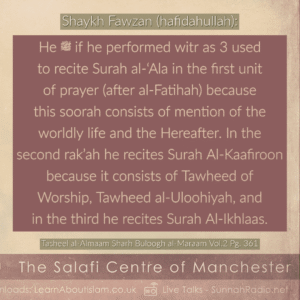
He ﷺ if he performed witr as 3 used to recite Surah al-‘Ala in the first unit of prayer (after al-Fatihah) because this soorah consists of mention of the worldly life and the Hereafter. In the second rak’ah he recites Surah Al-Kaafiroon because it consists of Tawheed of Worship, Tawheed al-Uloohiyah, and in the third he recites Surah Al-Ikhlaas.


Shaykh Fawzan’s Tasheel al-Almaam Sharh Buloogh al-Maraam Vol.2 Pg. 361

The Bondage of Sins In This Dunyaa And Aakhirah, And The Virtue of Tawheed and Repentance

In The Name of Allaah, The Most Merciful, The Bestower of Mercy.

Disobedience is the cause of being in shaytaan’s captivity and a prisoner of lowly desires. A disobedient person is always in the captivity of his devil, the prison of his lusts and leadership of his desires. He is a captive and a shackled prisoner. There is neither a captive whose state of affairs is more evil than that of a captive whose captor is his worst enemy, nor is there a prison more restricted than the prison of desires, and shackles that are more restrictive than the shackles of lust; so how can a heart that is a captive and a shackled prisoner follow the path to Allaah and the home of the afterlife? How can he follow a single path when the heart is shackled and stricken with harm from every angle as a result of the [severity] of its shackles? The likeness of the heart is that of a bird; it distances from harm whenever it flies high and surrounded by harm whenever it lands. It is reported in a hadeeth: ‘’Shaytaan is a wolf to a human being.’’

And just as an unprotected sheep in the midst of wolves is quickly destroyed, likewise if there is no protection from Allaah for the slave, it is inevitable that his wolf will prey on him. He is protected by Allaah through Taqwaah. Taqwaah is a shield and shelter from Allaah between the person and his wolf; just as it is a shield against punishment in this life and the afterlife. Whenever the sheep is closer to its shepherd, it is safer from the wolf and whenever it is distanced from the shepherd, it comes closer to being destroyed. So the sheep is more protected when it is closer to the shepherd, for the wolf only takes away the [sheep, cattle]  that are distanced and far away from the shepherd.

The basis of this affair is that whenever the heart is distanced from Allaah, then harm upon it is quicker, and whenever it is comes closer to Allaah, it is distanced from harm. Being distanced from Allaah is of various levels and some are more severe than others. Being distanced from [Allaah] through disobedience is greater than being distanced from [Allaah] through thoughtlessness; being distanced from [Allaah] through bidah is greater than being distanced from [Allaah] through disobedience, and being distanced from [Allaah] through hypocrisy and shirk is greater than all of that. [Ref 1]

Sin and disobedience is something common in all the nations. It is something that has not cease to exist in the world amongst the Children of Aadam regardless of their different social classes- the common people, the ignorant ones, [the zuhhaad – those who choose to abstain from some of the lawful pleasures of the worldly life which one can do without], those desirous of it [i.e. the pleasures], the leaders and those under their rule.  This affair of [sin and disobedience] is not something specific to this Ummah of Muhammad [sallal laahu alayhi wasallam], such that [the Ummah] and its Prophet are [singled out] with rebuked as a result of that. Sin and disobedience does not negate belief in the Messengers, because it is possible for them to exist alongside belief in the Messengers. And although disobedience diminishes the perfection and completeness of belief in the Messengers, however it does not negate it.

Sins are wiped away through sincere repentance.  Allaah forgives the slave when he repents, even if his sins fill the heavens and are of a great number.  Allaah said: [قُلۡ يَـٰعِبَادِىَ ٱلَّذِينَ أَسۡرَفُواْ عَلَىٰٓ أَنفُسِهِمۡ لَا تَقۡنَطُواْ مِن رَّحۡمَةِ ٱللَّهِ‌ۚ إِنَّ ٱللَّهَ يَغۡفِرُ ٱلذُّنُوبَ جَمِيعًا‌ۚ إِنَّهُ ۥ هُوَ ٱلۡغَفُورُ ٱلرَّحِيمُ  – Say: O Ibaadee [My slaves] who have transgressed against themselves [by committing evil deeds and sins]! Despair not of the Mercy of Allaah, verily Allaah forgives all sins. Truly, He is Oft-Forgiving, Most Merciful. [39:53]

This is the right of the one who repents because repentance wipes away the sin after it [was committed]. Therefore, the one who repents from a sin is like one without that sin.  Tawheed wipes away sins, as [mentioned] in the Hadeeth Al-Qudsiy: ‘’O Son of Adam! If you were to meet Me with enough sins to fill the earth, whilst not associating anything with Me [in worship], I shall meet you with its equivalent in forgiveness.’’  Therefore, strong Tawheed wipes away the sins of the Muslims; but if punished for their sins, they will be removed from the fire as a result of their belief in Tawheed. As for the people of shirk and the disbelievers, their good deeds are nullified as result of the disbelief and shirk they are upon.  They will neither meet their Lord with good deeds in order to obtain safety nor will they be forgiven any of their sins. Allaah [Glorified be He] said: [إِنَّ ٱللَّهَ لَا يَغۡفِرُ أَن يُشۡرَكَ بِهِۦ وَيَغۡفِرُ مَا دُونَ ذَٲلِكَ لِمَن يَشَآءُ‌ۚ  – Verily, Allaah does not forgive (a person) the sin of associating partners with Him in worship (i.e. if one dies in that state without repentance),  but He (Allaah) forgives (sins that are) lesser than that (i.e. lesser than shirk) to whom He pleases]. [4:48]

Allaah [The Most High] said: [ وَقَدِمۡنَآ إِلَىٰ مَا عَمِلُواْ مِنۡ عَمَلٍ۬ فَجَعَلۡنَـٰهُ هَبَآءً۬ مَّنثُورًا – And We shall turn to whatever deeds they did, and We shall make such deeds as scattered floating particles of dust]. [25:23] [Ref 2]


[Ref 1: An Excerpt from ‘Ad-Daa’u Wad-Dawaa’u. page 119-120. slightly paraphrased]

[Ref 2: Source: An Excerpt from ‘Hidaayatul Hayaaraa Fee Ajwibatil Yahood Wan-Nasaaraa. Page 123-124. Slightly paraphrased]

Only Those Who Are Patient Shall Receive Their Rewards In Full, Without Hisaab [Without Limit, Calculation and Estimation]

In The Name of Allaah, The Most Merciful, The Bestower of Mercy.

Question: The questioner asks: What is the status of patience and what is the reward for those who exercise patience?

Answer: Patience has a great status in the sight of Allah (The Most High). The Eemaan of a slave (i.e. a male or female Muslim) cannot be perfect without patience.  Patience is from the best of deeds and its reward has no limits. When it is the case that one good deed is written as ten good deeds and can multiply until it reaches seven hundred or more, then indeed the reward for exercising patience has no limits,  for indeed Allaah ( Glorified and Exalted be He) said:

إِنَّمَا يُوَفَّى الصَّابِرُونَ أَجْرَهُم بِغَيْرِ حِسَابٍ

Only those who are patient shall receive their rewards in full, without Hisaab (without limit, calculation and estimation) [a] [39:10]

Patience is of three types:

[1] The first type patience is when a person exercises patience (whilst striving) to obey Allaah: A Muslim is commanded to exercise patience (whilst striving) to obey Allaah (The Most High), especially the when fulfilling obligations. And the first of those obligations is the prayer, for it is obligatory to establish it at its fixed time together with all its conditions and obligatory acts. [b] Therefore, patience is required in seeking to fulfill the five daily prayers. When a sleeping person hears the Adhaan of Fajr, he strives against his soul and wakes up, and then he performs Wudhu and goes to the Masjid. This is patience whilst seeking to obey Allaah. One also exercises patience in striving to treat his (or her) parents kindly, dealing with them in a beautiful manner and patiently bearing whatever occurs from that. Allaah (The Most High):

وَقَضَىٰ رَبُّكَ أَلَّا تَعْبُدُوا إِلَّا إِيَّاهُ وَبِالْوَالِدَيْنِ إِحْسَانًا ۚ إِمَّا يَبْلُغَنَّ عِندَكَ الْكِبَرَ أَحَدُهُمَا أَوْ كِلَاهُمَا فَلَا تَقُل لَّهُمَا أُفٍّ وَلَا تَنْهَرْهُمَا وَقُل لَّهُمَا قَوْلًا كَرِيمًا

And your Lord has decreed that you worship none but Him. And that you be dutiful to your parents. If one of them or both of them attain old age in your life, say not to them a word of disrespect, nor shout at them but address them in terms of honour. [17:23]

وَاخْفِضْ لَهُمَا جَنَاحَ الذُّلِّ مِنَ الرَّحْمَةِ وَقُل رَّبِّ ارْحَمْهُمَا كَمَا رَبَّيَانِي صَغِيرًا

And lower unto them the wing of submission and humility through mercy, and say: “My Lord! Bestow on them Your Mercy as they did bring me up when I was small.”[17:24]

رَّبُّكُمْ أَعْلَمُ بِمَا فِي نُفُوسِكُمْ ۚ إِن تَكُونُوا صَالِحِينَ فَإِنَّهُ كَانَ لِلْأَوَّابِينَ غَفُورًا

Your Lord knows best what is in your inner-selves. If you are righteous, then, verily, He is Ever Most Forgiving to those who turn unto Him again and again in obedience, and in repentance. [17:25]

A person should also exercise patience in seeking to nurture his (or her) children and teaching them good manners and behaviour.

[2] The second type of patience is when a person exercises patience in seeking to restrain him (or herself) from disobeying Allaah: A person excises this patience in order to prevent him or (herself) from sins and (evil) desires. And among those sins a person should keep away from is that he refrains from violating the honour of the people.

[3] The third type of patience is when a person exercise patience when encountered with Allaah’s decree, which maybe something painful (i.e. a calamity): That is because that which afflicts a person, such as the death of a son (or daughter) or being afflicted with a sickness on a person’s the body, or his (or her) sanity, or what may afflict a relative of his (or hers), it is obligated on a person to exercise patience when these affairs are encountered and should hope for Allaah’s reward for being patient. He should know that all these affairs are from Allaah.  Allah (the most high) said:

مَا أَصَابَ مِن مُّصِيبَةٍ إِلَّا بِإِذْنِ اللَّهِ ۗ وَمَن يُؤْمِن بِاللَّهِ يَهْدِ قَلْبَهُ ۚ

No calamity befalls, but with the Leave [i.e. decision and Qadar (Divine Preordainments)] of Allah, and whosoever believes in Allah, He guides his heart. [64:11]

Alqamah (radiyallaahu-anhu) said: This (ayah) is about a person who is afflicted with a calamity and he knows that it is from Allaah.  So he becomes pleased with what Allaah has decreed and submit to Allaah’s judgement, and he (or she) says: ‘’this is Allaah’s decree. I believe in Allaah and we are pleased with Allaah’s decree.” So Allaah fills his heart with Eemaan and tranquillity, and he (or she) receives a great reward (i.e. due to his patience).

We ask Allaah to include us and you amongst those who exercise patience.

[Source: Fadaa’il Al- A’maal’ pages 11-14’ by Shaikh Muhammad Bin Abdillaah As-Subayyil (rahimahullaah). Abridged and slightly paraphrased]


[a] Tayseerul Kareem Ar-Rahmaan Fee Tafseeri Kalaam Al-Mannaan’ by Imaam Sadi (rahimahullaah)

[b]Conditions, pillars and obligations of the prayer, see  link:

http://www.salafitalk.net/st/viewmessages.cfm?Forum=10&Topic=8984

Dhaat Anwaat – [A Brief Warning Against Grave Worship In The Ummah]- By Shaikh Saaleh Aala Ash-Shaikh

In The Name of Allaah, The Most Merciful The Bestower of Mercy.

Tawaaf [Circumambulation] around a grave, stroking them [with one’s hands] and seeking blessings from them are acts of shirk. Circumambulation is an act of worship and it has not been legislated in any [other place] besides the Ka’bah and likewise walking between Safaa and Marwa is [only legislated at Safaa and Marwa].

Stroking [graves], seeking blessings from them and hoping to be benefited –in this life and the next- by way of such acts is [tantamount to] deification. It is similar to what the pre-Islamic idolaters used to do with their gods. Whoever hopes [for reward, blessings etc] through [these acts of worship at the] graves, then indeed he has exalted that which Allaah has not legislated to be exalted.

The proof to show that these practices are acts of Shirk is the hadeeth of Abee Waaqid Al-Laythee [radiyallaahu-anhu] who said: “We went out with the Messenger of Allaah [sallal-laahu-alayhi-wasallam] to the [military] campaign to Hunayn, while we were new converts from disbelief to [Islaam]. The idol worshippers had a lote tree in [whose vicinity] they used to stay and hang their weapons, and it [i.e. this lote-tree] was called Dhaat Anwaat. So when we went pass a tree, we said, ‘O Messenger of Allaah! Set up a Dhat Anwat for us just as they have a Dhaat Anwaat’. So the Messenger of Allaah [sallal-laahu-alahi-wasallam] said, ‘Allaah is the Greatest! This is a path that has proceeded [from the people of the past]. By Allaah in whose Hand my soul is! You have stated just as the children of Israa’eel stated to Moosaa [alayhis-salaam], ‘O Moosaa! Make for us an ilaahan (a god) as they have aalihah (gods)’. He (Moosaa) said: ‘Verily, you are a people who know not (the Majesty and Greatness of Allah and what is obligatory upon you, i.e. to worship none but Allah Alone, the One and the Only God of all that exists)’”. [Reported by Ahmad and Tirmidhee and it is a sound hadeeth.]

Those [new Muslims] wanted to perform that act of worship in that particular place and (also) to seek blessings; so the Messenger of Allaah [sallal-laahu-alayhi-wasallam] referred to what they sought after as worship of another deity besides Allaah. That [act they sought after] is a means to Shirk, but after the Messenger of Allaah [sallal-laahu-alayhi-wasallam] clarified the affair for them, they turned in repentance and obedience to [Allaah and His Messenger]. Seeking blessings from graves, circumambulation round them and stroking them is more severe [acts of shirk and sin] than what those [new Muslims] sought after.

[Source: An Excerpt from ‘Al-Min’dhaar Fee Bayaani Katheer Minal Akhtaa Ash-Shaa’i’ah page: 11’. slightly paraphrased]


The State of The Believing Servant at The Time of Departure From This World

In The Name of Allaah, The Most Merciful, The Bestower of Mercy.

The following is the wording of Imaam Ahmad [rahimahullaah] with authentic additions compiled and authenticated by Imaam Al-Albaani [rahimahullaah] in ‘Ahkaamul-Janaa`iz (pp.198-202).

Al Baraa Ibn Aazib [radiyallaahu-anhu] said: “We went out with the Prophet [sallal laahu alayhi wasallam] to a funeral of a man from the Ansaar; so we came to the grave and he [sallal laahu alayhi wasallam] had a stick, with which he was prodding the earth. He began looking towards the sky, and looking towards the earth, and raising his gaze and lowering it three times, and then he said: ‘Seek Allaah’s refuge from the Punishment of the Grave!’ …two or three times, and then he [sall Allaahu alaiyhi wa sallam said: ‘O Allaah, I seek your refuge from the Punishment of the Grave’. …three times; and then he [sallal laahu alayhi wasallam] said: ‘The believing servant, when he is departing from this world and going on to the Hereafter, some angels from the heaven descend upon him with white faces as if their faces were the sun. With them, there are shrouds from the shrouds of Paradise and perfume for embalming from the perfume of Paradise, until they sit at a distance away from him that can be reached by the sight.

And then the Angel of Death comes, until he sits by his head and he says, ‘O Pure soul! (and in one narration – at rest), come out to forgiveness from Allaah and His Pleasure!’ So it comes out flowing just like a drop of fluid flows out of a vessel. So he takes it – and in one narration – when his soul comes out, then every angel between the Heavens and the Earth makes supplication for it and every angel in the Heaven and the Gates of the (lowest) Heaven are opened for him. And there are no inhabitants (i.e. angels) present at any gate except that they make supplication to Allaah that his soul be taken up towards their direction.

So when he (the Angel of Death) takes it, he does not leave it in his hand even for the blink of an eye until he takes it and places it in that shroud and in that perfume – and that related to the statement of Allaah [The Exalted] ‘Our Messengers take his soul in Death, and they do not fall short in their duty.’ And a smell comes from him like the smell of the purest musk found on the face of the earth. Then they ascend with it (the believing soul) and they do not pass by any (group of angels) except that they say, ‘What is this pure soul?’ So they say, ‘It is so and so, the son of so and so’. …mentioning him by the finest names which he used to be called in this world, until they take him to the lowest heaven and they request that it be opened for him, so it is opened for him. And then the closest ones from every heaven accompany him to the next heaven until he reaches the seventh heaven – and Allaah [The Mighty and Majestic] says, ‘Write down the record of My servant in Illiyyeen (the highest heaven)!’ And what will explain to you what is Illiyyoon? (in it will be) the written down record. Witnessed by those drawn close.’ So he [sallal laahu alaiyhi wa sallam] said, ‘Then his record will be written down in Illiyyeen’; then it will be said, ‘Return him to the earth, for I have promised them that- from it I created you, and to it I shall return you, then I shall take you out from it again’. So he will be returned to the earth and his soul will be returned to his body, and he will hear the striking of the feet of his companions when they depart from him going away (from his grave). Then two stern angels will come to him, and they will be very abrupt with him, they will make him sit up and they will say to him, ‘Who is your Lord?’ So he will say, ‘My Lord is Allaah’. They will say to him, ‘What is your religion?’ So he will say, ‘My religion is Islaam’. So they will say to him, ‘What was this man who was sent amongst you?’ He will say, ‘He is Allaah’s Messenger [sal Allaahu alaiyhi wa sallam]’. So they will say to him, ‘How did you know?’ So he will say, ‘I read the Book of Allaah, and I believed in it, and I affirmed it’.

This will be the last trial the believer will face. So that is about what Allaah, the Mighty and Majestic said: ‘Allaah will make those who are believers firm, with the firm statement [i.e. the shahaadah] in the life of this world.’ Then a caller will call from the heavens: ‘My Servant has spoken the Truth, so give him a bed from Paradise, and give him clothing from Paradise and open for him a door towards Paradise.’ So its gentle breeze and fragrance will come to him, and his grave will be expanded for him as far as the eye can see. And then there will come to him (in one narration there will be shown to him) a man with a handsome face, with fine clothing, with a beautiful scent, and he will say, ‘Receive good news of that which is pleasing for you! Receive good news of pleasure from Allaah and of gardens containing everlasting delight! This is your day which you were promised’. So he will reply to him, ‘And you, – may Allaah give you good tidings – who are you? Your face is the face of one who comes with good’; so he will say, ‘I am your righteous deeds. For by Allaah, I have not known you except to be quick upon obedience to Allaah, slow to disobey Him, so may Allaah reward you with good’. And then a gate will be opened for him from Paradise and a gate from the Fire, and he will say, ‘This would have been your place had you been disobedient to Allaah, but Allaah has exchanged this for you instead of it’. And when he sees what is in Paradise, he will say, ‘O My Lord, hasten the establishment of the Hour so that I can return to my family and what is for me!’ So it will be said to him, ‘Be calm’.

And he [sall Allaahu alaiyhi wa sallam] said: And as for the kaafir (disbelieving servant) (and in one narration – the faajir, the wicked one), when he is departing from this world and going on to the Hereafter, then angels descend upon him from the Heaven – angels who are severe and stern with dark faces, having sack- cloths from the Fire. So they will sit at a distance from him that the sight can reach, and then the Angel of Death will come until he sits by his head and says, ‘O foul and filthy soul! Come out to the Wrath of Allaah and His Anger!’ So it (his soul) will scatter throughout his body. So he will drag it out, just as a pronged roasting- fork with many prongs is pulled through wet wool. The veins and tendons will be torn along with it. And he will be cursed by every angel between the Heaven and the Earth and by every angel in the Heaven. The gates of the Heaven will be locked. There will not be any inhabitants of any gate except that they make supplication to Allaah that his soul should not ascend towards their direction. So he will take it (the soul) and when he takes it, he will not leave it in his hand even for the blink of an eye until he places it in that sack cloth. And there will come out from him a smell like the worst stench of the foulest corpse rotting upon the earth. So they will take it up, and they will not pass by any group of angels except that they say, ‘What is this foul soul?’ So they will say, ‘So and so, the son of so and so’. …mentioning the worst names which he used to be called in this world, until they reach the lowest heaven, and request is made for him that it be opened but it will not be opened for him. Then he [sall Allaahu alaiyhi wa sallam] recited: ‘The gates of the Heaven will not be opened for them (the disbelievers) nor will they enter Paradise until a camel passes through the eye of a needle.’ So he [sall Allaahu alaiyhi wa sallam] said: ‘So Allaah [The Mighty and Majestic] will say: ‘Write his record in sijjeen (the lowest earth)!’ Then it will be said: ‘Return My Servant to the Earth because I have promised them that from it I created you, and to it I shall return you and from it I will bring you out another time’.  So his soul will be thrown down from the Heaven until it lands in his body. Then he [sall Allaahu alaiyhi wa sallam] recited: ‘And whoever commits shirk along with Allaah, then it is as if he had fallen down from the Heaven and been snatched by birds – or the wind had carried him and thrown him in a far-off place.’ So his soul will be returned to his body and he will hear the footsteps of his companions when they are departing from him, and two angels will come to him who are stern. And they will be stern with him, and they will make him sit up and they will say to him, ‘Who is your Lord?’ So he will say: ‘Haah, haah… I don’t know’. So they will say to him, ‘What is your religion?’ So he will say: ‘Haah, haah… I don’t know’. So they will say: ‘So what do you say about this man who was sent amongst you?’ So he will not be able to mention his name. So it is said: ‘Muhammad’. So he will say, ‘Haah, haah…I do not know. I heard the people saying this’. It will be said: ‘You do not know and you did not recite (or learn)’. So then a caller from the Heavens will call: ‘He has lied, so give him bedding from the Fire, and open for him a door to the Fire’. So its heat and scorching wind will come upon him, and his grave will be constricted upon him until his ribs cross over. Then there will appear to him a man with an evil looking face with foul clothing, smelling of an evil stench and he will say, ‘Receive news which will upset you. This is your day which you were promised’. So he will say: ‘And may Allaah give you news of evil! Who are you? For your face is the one who comes with evil’. So he will say: ‘I am your foul deeds. I have not known you except being slow upon obedience to Allaah, quick to disobey Allaah, so may Allaah reward you with evil’….to the end of the hadeeth

O Allaah! Grant us Your Mercy In This Dunyaa and Aakhirah, And Protect us From Evil In This Dunyaa And Aakhirah Aameen