When Respect for Elders and Mercy Towards Youth Is Mentioned, None Is Exempted

بسم الله الرحمن الرحيم
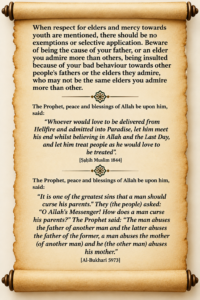
Abdullah Bin Amr, may Allah be pleased with him, reported that Allah’s Messenger, peace and blessings of Allah be upon him, said, “Whoever would love to be delivered from Hellfire and admitted into Paradise, let him meet his end whilst believing in Allah and the Last Day, and let him treat people as he would love to be treated”. [1]
Imam An-Nawawi, may Allah have mercy upon him, said:
This is from the Jawami al-Kalim of the Prophet [i.e. precise speech with a comprehensive meaning] and his amazing wisdom. It is obligatory to pay close attention to this important principle and that a person must not deal with the people except in a way he loves to be dealt with. [2]
Al-Allamah Zayd Bin Hadi Al-Madkhali, may Allah have mercy upon him, said:
A Muslim is to give consideration to his Muslim brothers in the same way he would give consideration to himself- wishing for them the good he wishes for himself and hates that evil should touch them just as he hates that for himself. The one who loves that the people should approach him with good related to the worldly affairs and affairs related to the Afterlife, then it is obligated on him to do the same for them, so that the statement of the Prophet, “You cannot (truly) believe until you wish for your brother what you wish for yourself” becomes a reality in his personality; and also the statement of the Prophet, “The believer in relation to another believer is like a structure, each part strengthening the other”. And also the statement of the Prophet, “The Muslim is the brother of another Muslim”. Whoever is able to have these characteristics, then indeed he has established Iman (in this affair), good manners and good dealings. [3]
Imam Ibn Al-Qayyim, may Allah have mercy upon him, said:
And from the signs of well-being and success is that whenever the slave is increased in his knowledge, he increases in humility and mercy; and whenever he is increased in action, he increases in his fear and caution; and whenever his age is increased, he decreases in eagerness; and whenever he is increased in wealth, he increases in his generosity and spending; and whenever his status and honour is increased, he increases in coming close to the people, in fulfilling their needs and being humble in (their presence). And the signs of wretchedness are: Whenever he is increased in knowledge, he increases in pride and haughtiness; and whenever he is increased in actions, he increases in his boasting, mockery of the people and having a good opinion of himself; and whenever he is increased in his status and honour, he increases in pride and haughtiness. These affairs of [well-being and wretchedness] are a trial and a test from Allah by way of which He puts His slaves to trial. He brings about well-being and wretchedness to a people by way of these affairs. [4]
Ibn Abbas stood up next to Zaid Bin Thabit [may Allah be pleased with both of them] and held the stirrup of his riding beast. Zaid said to him, “Step aside, O cousin of Allah’s Messenger [peace and blessings of Allah be upon him]”. Ibn Abbas said to him, “This is what we do for our scholars and elders”. [Al-Muntadhim Fee Taareekh Al-Muluk Wal Umam 5/215]
Salamah Bin Kuhail [may Allah have mercy upon him] said: “Ash-Shabi and Ibrahim An-Nakha’i [may Allah have mercy upon upon both of them] never sat together except that Ibrahim remained silent, and both of them were Taabi’een”. [Taareekh Dimashq 25/367]
Al-Marwazi [may Allah have mercy upon him] said, “Abu Abdillah [Imam Ahmad – may Allah have mercy upon him] used to be from those who honoured his fellow Muslim brothers the most and those who were older than him. One time, Abu Hammam [may Allah have mercy upon him] came to him on a donkey, so he held the stirrup of the riding beast for him. I witnessed him doing the same for the eldest Shaikhs”. [Al-Aadaab Ash-Shar’iyyah 1/416]
Idris Bin Abdul Karim said: “Salamah Bin Aasim said to me: “I want to hear Kitaab Al-Adad from khalaf”. I said, “Khalaf?” He said: “Let him come”. When Khalaf entered, he tried to make Salamah sit in the teacher’s place, but he refused, and said: “I will not sit except in front of you”. Then he said, “This is the right of learning”. Khalaf said to him: “Ahmad Ibn Hanbal came to me to listen to the narrations of Abu Awanah, so I tried make him sit and transmit, but he refused and said: “I will not sit except in front of you. We are commanded to be humble in the presence of the one from whom we learn”. [Al-Jaami Li-Akhlaaq Ar-Raawi Wa Aadaab As-Saami 1/198]
Muhammad Ibn Raafi said: I was with Ahmad (Imam Ahmad) and Ishaq in the company of Abdur Razzaaq when the day of Eidul Fitr arrived, so we went out with Abdur Razzaaq to the Musalla and with us were many people. When we returned, Abdur Razzaaq invited us to lunch, then he said to Ahmad and Ishaq, “Today I saw something strange from both of you. You did not say the Takbir”. Ahmad and Ishaq said, “O father of Abu Bakr! We were waiting for you to say the Takbir so that we could say the Takbir, but when we saw that you did not say the Takbir, we refrained”. Abdur Razzaaq said, “I was waiting for both of you to say the Takbir so that I could say the Takbir”. [Siyar A’laam An-Nubula a 9/566]
Abdullah Bin Ahmad [may Allah have mercy upon him] said: I heard my father [Imam Ahmad – may Allah have mercy upon him] being asked: “Why did you not hear a lot (of hadith) from Ibrahim Bin Sa’d [may Allah have mercy upon him] and indeed he did stay next to you in the house of Amarah?” He said: “We attended his gathering once and he narrated to us. When the second session was held, he saw youth putting themselves forward (or speaking) before the elders, so he became angry and said, ‘By Allah! I will not narrate for a year’. He died and did not narrate (thereafter)”. [Siyar A’laam An-Nubula 11/317]
Imam As-Sadi, may Allah have mercy upon him, stated about the Mu’allimeen (teachers):
They are the intermediary between the Messenger, peace and blessings of Allah be upon him, and his Ummah with regards to propagation of the religion and clarification of the Shariah. Had it not been for these ones, the people would have been like cattle. They nurture the souls and hearts of the slaves upon the beneficial sciences and sound knowledge. They are the ones who guide the Ummah in the fundamental and subsidiary affairs of their religion, and return them to the rulings related to the duties obligated to them and in their dealings, just as they return them to the affairs pertaining to worship. Through them the Book and the Sunnah are established, and through them is made clear truth from falsehood, guidance as opposed to misguidance, Halal as opposed to Haram, good as opposed to evil, and rectification as opposed to corruption. They are of varying ranks, in accordance with what they establish of knowledge, teaching and benefit- great or small. They have great rights (owed to them) by the ummah and are possessors of a lofty status. Therefore, the people must have love and respect for them. They must recognise their excellence and virtue, and thank them greatly. They are to supplicate for them in private and public, and seek nearness to Allah by having love for them and praising them. They are to proclaim their excellence; guard the hearts (from harbouring evil against them) and the tongues (from) insulting them, for this would tarnish their excellence. [5]
Al-Allamah Rabee Bin Hadi Al-Madkhali, may Allah preserve him, said:
We have been commanded to learn, thus, it is obligated to us to learn, act and call to the religion based on the path that Allah has ordained and clarified for us- the path that the Messenger clarified for us and applied, and was applied by his companions after him. They spread Islam in the entire world – in different nations. This knowledge and goodness was spread mostly through (praiseworthy) manners – through patience, forbearance, firm fulfilment of obligations and responsibilities, truthfulness, honourable behaviour, nobility, noble mindedness, fulfilling promises and what is similar to that. These manners became manifest to the people, thus the hearts, ears and eyes of the nations accepted this guidance, which the companions of Muhammad carried”. [6]
The Shaikh also stated:
Abdullah Ibn Al-Mubarak, may Allah have mercy upon him, said, “Whoever belittles the scholars will ruin his religion; whoever belittles the rulers will ruin his worldly affairs and whoever belittles his brothers will ruin his sense of honour”. O my brothers! Let us behave in a good manner, especially the students of knowledge. O my brothers! At present the connection between a student and his teacher is limited to the classroom. He listens to the lesson and after it finishes, he leaves in a hurry. It is as if he does not know anything about the teacher- neither in a house nor in any other place. They say, “The scholars run away from the students!” It is obligated to the students to behave well towards the scholars and to come to their houses. Do they want the scholars to run behind the students?! The Salaf did not know this behaviour. When we became deprived of good manners, we expect the scholars to be our followers. Many people want the scholars to be their followers – giving directions to the scholars like they would give directions to a senile old person. A particular scholar can meet thousands of people and benefit them, but as for going to the house of every person and knocking at his door, this is neither legislated by Allah nor is it obligated to the scholars.
Good manners is a necessity in the path of seeking knowledge, and (when dealing with) scholars and elders. It was said to king Abdul Azeez, may have mercy upon him, “How do you view the people?” He said, “The people in my view are three types: a man who is older than me, so he is placed in my father’s position; a man who is in my age group, so he is placed in my brother’s position, and a man who is younger than me, so he is like my son”. Therefore, a Muslim behaves towards his brothers in this manner- he places the people in these different categories. The student of knowledge should respect the elders, honour his contemporaries and show mercy to those below his age. The one who is old in age is like his father, the one in his age group is like his brother and the one below him in age is like his son. [7]
Emulating Scholars Can Only Be In What Is Good
Imam Abdul Aziz Bin Baz, may Allah have mercy upon him, was asked: The question: Our brother also says: There are personalities- role models for everyone, however, they shave their beards. What is your view on this matter?
The answer is: If a scholar disobeys his Lord, he is not considered a role model in that which he disobeys his Lord. The Jews (i.e. those among them who deviated) were scholars, but despite this, they disobeyed the Messenger, peace and blessings of Allah be upon him and did not respond to the truth, thus, Allah rebuked and became angry with them. Therefore, whoever among the scholars who resemble them will share in Allah’s wrath in accordance with his act of disobedience. And the one who resembles the Christians by performing acts of worship based on ignorance and turning away from the religion, he has a share of misguidance and resemblance to the Christians. This is why Sufyan ibn Uyaynah, may Allah have mercy upon him, or Ath-Thawri stated: “Whoever among our scholars is corrupt, he has a resembles to the Jews, and whoever among our devout worshippers is corrupt, he resembles the Christians (i.e. those Jews and Christians who deviated from the path of their prophets).”
Therefore, it is incumbent upon the Muslim to be cautious of resembling all two groups. If he finds a scholar committing a sin, he should not emulate him in that sin; rather, he advises him and supplicates to Allah for his guidance, and avoids following his example in that. The true role model is the Messenger, peace and blessings of Allah be upon him – the scholar who should be followed and not the sinful (disobedient) scholar. If he commits an act of disobedience by shaving his beard, wearing his garments below his ankles, or regarding other matters, then layperson should not emulate him in that, instead, he should take emulate the scholars have been blessed with guidance – those who fear Allah and follow the Messenger, peace and blessings of Allah be upon him. Following a role model in reality is by following the Messenger, because he is the basis, the Imam, peace and blessings be upon him. The scholars who follow him do so because he is the best example, the one (chosen and specified as a foundation for) emulation.
If you follow the good scholars in growing the beard and in all that Allah has legislated, then indeed, you are, in this regard, emulating the Messenger, peace and blessings of Allah be upon him, whom the scholars follow in truth, following him with regards to that which he prescribed for them. [8]
Make Sure You Behave Well Towards Everyone’s Father, Lest You Become The Reason For Your Father to Be Insulted
Allah’s Messenger, peace and blessings of Allah be upon him, said: “It is one of the greatest sins that a man should curse his parents.” They (the people) asked: “O Allah’s Messenger! How does a man curse his parents?” The Prophet said: “‘The man abuses the father of another man and the latter abuses the father of the former, a man abuses the mother (of another man) and he (the other man) abuses his mother.” [Al-Bukhari 5973]
[1] Ṣaḥih Muslim 1844]
[2] Sharh Sahih Muslim 12/196
[3] at-Ta’leeqaat Al-Maleehah Alaa Silsilati Al-Ahaadeeth As-Saheehah. 2/29-33
[4] Al-Fawaa’d. page: 228
[5] An Excerpt from Nurul Basaa-ir Wal Albaab Fee Ahkaamil Ibaadaat Wal-Mu’aamalaat Wal Huqooq Wal Aadaab, page: 57-58]
[6] An Excerpt from Marhaban Yaa Taalibal Ilm. page 86
[7] Marhaban Yaa Taalibal Ilm’ pages 123-124
[8] https://binbaz.org.sa/fatwas/6077/%D9%88%D9%82%D9%88%D8%B9-%D8%A8%D8%B9%D8%B6-%D8%A7%D9%84%D9%82%D8%AF%D9%88%D8%A7%D8%AA-%D9%81%D9%8A-%D8%A7%D9%84%D9%85%D9%86%D9%83%D8%B1%D8%A7%D8%AA

Donate
Related Posts
Follow Us
Share
Related Posts
Donate to the Dawah in Manchester

Join the Umrah Trip