Justice When Issuing Rulings – By Al Allamah Ubaid Bin Abdillah Al-Jabiri

بسم الله الرحمن الرحيم
In The Name of Allah, The Most Merciful, The Bestower of Mercy.
The Shaikh, may Allah have mercy upon him, said:

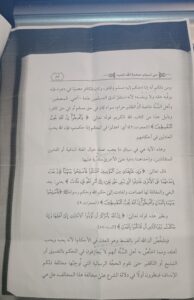
Justice is to place something in its (rightful) place and it is synonymous with wisdom. Its meaning is that a person is just in his rulings (judgments) towards both those who are close (in relationship) and those who are distant (in relationship).
And from this is that if a ruling (judgement) is sought from him between a Muslim and a Kafir, while the Kafir is correct in his claim, then indeed, he fulfils his right and does not deprive him of it. Indeed, this is because it is established among Muslims – as a general rule – meaning, the just people- and Ahlus Sunnah in particular – that injustice is forbidden, whether with regards to the right of a Muslim or a Kafir. The proof for this from Allah’s Book is His saying:
وَأَقْسِطُوٓا۟ إِنَّ ٱللَّهَ يُحِبُّ ٱلْمُقْسِطِينَ
And act justly (between them). Verily, Allāh loves those who are just. [Al-Hujurat 9]
Meaning: be just in passing a ruling (judgment) when you judge, for indeed, Allah loves those who are just in their rulings (judgements).
This verse is in the context of what is incumbent to do regarding a rebellious group, or two groups fighting each other and one of them commits aggression against the other. He [i.e. Allah – The Most High] said:
وَإِن طَآئِفَتَانِ مِنَ ٱلْمُؤْمِنِينَ ٱقْتَتَلُوا۟ فَأَصْلِحُوا۟ بَيْنَهُمَا فَإِنۢ بَغَتْ إِحْدَىٰهُمَا عَلَى ٱلْأُخْرَىٰ فَقَٰتِلُوا۟ ٱلَّتِى تَبْغِى حَتَّىٰ تَفِىٓءَ إِلَىٰٓ أَمْرِ ٱللَّهِ فَإِن فَآءَتْ
If two parties among the believers should fight (each other), then make settlement between them (through the Book of Allāh). But if one of them revolts against the other (and refuses compliance with the judgement of Allāh’s Book), then fight you (all) against the one that revolts until it complies with the command of Allāh. Then if it complies (by returning to truth)…” [a] Meaning: after transgression and fighting, it complies and submits to the judgment of Allah and the judgment of His Messenger, then:
فَأَصْلِحُوا۟ بَيْنَهُمَا بِٱلْعَدْلِ وَأَقْسِطُوٓا۟ إِنَّ ٱللَّهَ يُحِبُّ ٱلْمُقْسِطِينَ
Then make reconciliation between them (by making the transgressing party abide by) justice and act justly (between them). Verily, Allāh loves those who are just.
And what is similar to this is His – The Most High – statement:
إِنَّ ٱللَّهَ يَأْمُرُكُمْ أَن تُؤَدُّوا۟ ٱلْأَمَٰنَٰتِ إِلَىٰٓ أَهْلِهَا وَإِذَا حَكَمْتُم بَيْنَ ٱلنَّاسِ أَن تَحْكُمُوا۟ بِٱلْعَدْلِ
Indeed, Allah commands you to render trusts to whom they are due, and when you judge between people to judge with justice [An-Nisa 4:58]
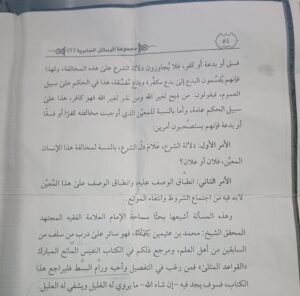
So, the conclusion is that indeed Allah commanded (the establishment of) equity, which is justice in rulings (judgments), because He loves it and loves its people. Among that which Ahlus Sunnah is distinguished with is that they do not act impulsively in passing rulings of Tafseeq, Tabdee or Takfeer until the divine proof is established that necessitates the opposition (committed) by that person, so they first examine [دلالة الشرع – the sound divine textual proofs to see how it applies to the nature] of the opposition of the one in opposition: is it Fisq, bidah or kufr? They do not go beyond what the Shariah textual proof demonstrates concerning that opposition. Due to this reason, they classify Bidah into Mukaffirah and Mufassiqah. This is a general ruling, so they say: “Whoever sacrifices to other than Allah or vows to other than Allah is a disbeliever”. This is from the angle of a general ruling. As for with regards to a specific individual whose opposition appears to entail Kufr, Fisq or Bidah, then indeed, they take into account two matters:
The first matter: [دلالة الشرع – the sound divine textual proofs] – [علام دل الشرع – what the Shariah proofs demonstrates] with regards to the opposition committed by this specific person, so-and-so?
The second matter: the application of the description to him. [وانطباق الوصف على هذا المعين لا بد فيه من اجتماع الشروط وانتفاء الموانع – application of the description/ruling to this specific individual requires the fulfilment of the conditions and the factors that prevents the ruling must be justifiably absent].
Then the Shaikh, may Allah have mercy upon him, stated that this has been discussed thoroughly by Imam Muhammad Ibn Salih al-Uthaymeen, may Allah have mercy on him, in Al-Qawa’id Al-Muthla, and whoever desires its detail, he will find in it, InShaAllah, that which will suffice him.
[An Excerpt from Majmu Al-Rasa’il Al-Jaabiriyyah 2/82-84. paraphrased]
[a] https://www.thenoblequran.com/q/#/search/49_9

Donate
Related Posts
Follow Us
Share
Related Posts
Donate to the Dawah in Manchester

Join the Umrah Trip