[2] An Urgent Need to Examine Our Behaviour

بسم الله الرحمن الرحيم
Aa’isha, may Allah be pleased with her, reported that Allah’s Messenger, peace and blessings of Allah be upon him, did something and allowed his people to do it, but some people refrained from doing it. When the Prophet learned of that, he delivered a sermon, and after having praised Allah, he said, “What is wrong with such people who refrain from doing a thing that I do? By Allah, I know Allah better than they, and I am more afraid of Him than they.” [Al-Bukhari 6101]
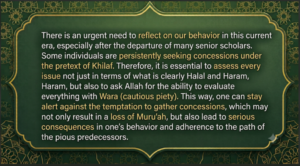
Ibn Abbas, may Allah be pleased with him and his father, reported that Allah’s Messenger, peace and blessings of Allah be upon him, said: “Verily, Allah loves for you to take His concessions, just as He loves you to fulfill the things He has obligated.” [Sahih Ibn Hibban 354]
Be Warned – Unjustified Pursuit of Concessions and The Odd Matters In The Name of Khilaf
Ibrahim Ibn Abee Ablah (died 152AH – may Allah have mercy upon him) said, “He who carries the odd affairs of knowledge carries a lot of evil”. [1]
Abdur Rahmaan Bin Mahdi (died 198AH – may Allah have mercy upon him) said, “The one who pursues the odd affairs of knowledge cannot be an Imam in knowledge”. [2]
Imam ash-Shaatibee, may Allah have mercy upon him, stated regarding the attitude of unjustified pursuit of concessions, “This arises from following one’s desires. Desire leads to a ‘too easy going attitude’ and the pursuit of concessions for oneself and others. So, you see him (i.e. such person) adopting that for himself or passing that judgment for his relative or friend, which he would not do for another person, due to the desire of that relative and friend”. [3]
He, may Allah have mercy upon him, said, “If a Mukallaf [i.e. the sane one who has reached the age in which the obligations of the Shariah are obligated to him or her] seeks after concessions in the Madhabs in every affair that is difficult for him and every statement that agrees with his desires, then he will remove himself from the firm handhold of piety and persist upon the pursuit of desires”. [4]
He, may Allah have mercy upon him, also stated regarding the attitude of the unjustified pursuit of concessions: “This arises from following one’s desires. Desire leads to a too easy going attitude and the pursuit of concessions for oneself and others. So, you see him adopting that for himself or passing that judgment for his relative or friend, which he would not do for another person due to the desire of that relative and friend”. [5]
He, may Allah have mercy upon him, also said: “If a Mukallaf [i.e. the sane one who has reached the age when the obligations of the Shariah are obligated on him or her] seeks after concessions in the Madhabs in every affair that is difficult for him and every statement that agrees with his desires, then he will remove himself from the firm handhold of piety and persist upon the pursuit of desires”. [6]
“f desires enter (a person), it leads to following the ambiguous matters out of being eager to prevail and become victorious through establishing excuses in issues related to difference of opinion (or differing); but rather it leads to splitting, disharmony, enmity, and hatred due to the different desires and lack of (sound) agreement; however, the Shariah came to curtail (vain) desires completely. If some of the premises of the evidence were not established except through desires, it would not result except in following desires and that is contrary to the Shariah, and opposing the Shariah is not fr of the Shariah at all. Therefore, following desires concerning what one may regard to be adherence to the Shariah is tantamount to misguidance.”. [7]
Imam Abdul Aziz Bin Baz, may Allāh have mercy upon him, said:
It is obligated to you to adhere to evidence and not (seek) concessions. Some of the pious predecessors said: “Whoever pursues concessions may fall into Zandaqah (hypocrisy or disbelief). Every Mad’hab contains some errors- some mistakes from some of its followers or from the Imam to whom it is attributed, who may have erred in some narrations or some hadiths were hidden from him. Therefore, a student of knowledge should not chase after concessions. If there is a difference of opinion on an issue and it is not one about which there is consensus, there are treatises among the people of knowledge, and the student of knowledge should (diligently) search for evidence and examine the more compelling statement or the one supported by stronger evidence, then he takes that which is established based on evidence and he does not chase after concessions. [8]
Imam Muhammad Ibn Salih Al-Uthaymin, may Allāh have mercy upon him, said:
The facilitation of ease is what aligns with the essence of the religion. From this, we know that when two scholars differ in their opinions and it is not clear which view carries greater weight, neither in terms of evidence nor derivation of proofs, and both are reputable scholars in their knowledge and trustworthiness and the evidence is not clear as well as the derivation of proofs, yet they hold differing views—one being more stringent than the other—whom should we follow? The response: We should follow the easier option and it is said (we follow) the more stringent one, as it is deemed more cautious. However, this statement requires further examination, as the most cautious approach would be what aligns more with the Shariah and the easier option would be what aligns more with the Shariah. [9]
He, may Allah have mercy upon him, also said:
The jurists -may Allāh have mercy upon them, defined Muru’ah [manliness, sense of honour, honourable behaviour] in the Book of Testimonies, stating: “Doing what beautifies and adorns (a person’s character), while avoiding what may tarnish one’s character or reputation. This definition is general. Anything that beautifies and adorns you in the eyes of the people, and serves as a reason for praise for you, is considered Muru’ah, even if it does not fall under acts of worship. And everything opposite of this is contrary to Muru’ah. [10]
Al-Allamah Salih Al-Fawzaan, may Allah preserve him, was asked about those who follow the legislated Islamic concessions?
He replied: The religion is an Amaanah- an amaanah between the slave and his Lord. It’s obligatory that he fulfils it (the religious duties) as Allah and his messenger have commanded. Whoever performs the obligations, refrains from the prohibited affairs, (does) that which he is able from the Mustahabbaat (recommended deeds) and abandons the Makroohaat (disliked actions), this is the Amaanah between the slave and his lord. The concessions are only allowed when there is a need and necessity (to utilise) them. Utilise them in accordance with necessity- with a need for the concession. Just like the sick person combines between two prayers, performs Tayyamum if he cannot use water for purification and doesn’t fast in Ramadhaan (i.e. when travelling etc), and a traveler shortens the prayers. This is a religious concession used at the time of its requirement. As for using concessions in other than their correct place (i.e. situation), then this is not permissible. Allah did not permit that for him (in such situation). Indeed He (Allaah) only placed the concessions at specified times and situations, and they are not used in other than these (times and situations). Therefore, it is obligated to the Muslim that he fears Allah and that he establishes that which Allah has obligated to him. [11]
Imam Ibn Al-Qayyim, may Allah have mercy upon him, said:
The loftiest ambition in pursuit of knowledge is to acquire knowledge from the Qur’an and the Sunnah- to be granted understanding by Allah [i.e. blessed to acquire sound knowledge and act upon it] and through the Sunnah of the Messenger, and acquaint oneself with the boundaries of the revelation [i.e. neither going into excess nor being lackadaisical]. And the most baseless ambition of the students of knowledge is to confine their ambitions in following the bizarre affairs and that which has neither occurred nor has it been revealed, or acquainting (oneself) with the differences of opinion and pursuing the statements of the scholars, whilst having no ambition to acquaint oneself with what is correct among those statements. Little is there to benefit from the knowledge of these people”. [12]
Imam Muhammad Ibn Salih Al-Uthaymin, may Allāh have mercy upon him, said:
We have decided to explain the book “Hilya Talib Al-Ilm” after consultations and suggestions from our students at the central Masjid. This is because if a student of knowledge lacks virtuous character, then there is no benefit in his pursuit of knowledge; instead it is obligated to a person that whenever he acquires knowledge of something related to virtuous deeds or acts of worship, he (strives) to implement it. If he does not do so, then he and the ignorant person will be the same; rather, the ignorant person may be in a better position because he deliberately abandons it unlike the ignorant person. This is because the ignorant person may act if he knows unlike the one who knows yet does not follow. Therefore, I urge both myself and you to embody virtuous manners, patience, perseverance, forgiveness, and kindness to the best of our abilities. This is besides the great advice – fear of Allāh – about which Allāh says:
وَلَقَدْ وَصَّيْنَا ٱلَّذِينَ أُوتُوا۟ ٱلْكِتَٰبَ مِن قَبْلِكُمْ وَإِيَّاكُمْ أَنِ ٱتَّقُوا۟ ٱللَّهَ
And verily, We have recommended to the people of the Scripture before you, and to you (O Muslims) that you (all) fear Allah, and keep your duty to Him. [An-Nisa 131] [13]
Al-Allaamah Abdur-Rahmaan Bin Yahyah Al-Mu’allimee, ay Allah have mercy upon him] said, “And know that some of the sincere ones fall into error by the will of Allah as a trial for others, as to whether they will follow the truth and abandon his speech, or be deceived by his virtuousness and lofty (status)? He (i.e. this sincere scholar) is excused; rather he is rewarded for striving to reach the correct verdict and his intention to reach good, and he is not degraded. However, the one who follows him (out of being) deceived by his great (status) without turning towards the real evidences in Allah’s Book (i.e. the Qur’an) and the Sunnah of His Messenger (peace and blessings of Allah be upon him), he is not excused; rather he is upon a great danger”. [14]
Imam Ash-Shawkaanee [may Allaah have mercy upon him] said: The statement “there is no Inkaar (sternly manifesting one’s disapproval) in the issues of Khilaaf (differing)” has indeed become the greatest means to blocking the path to enjoining good and forbidding evil”. [15]
Imam Muhammad Ibn Abdul Wahhaab [may Allah have mercy upon him] said: If the utterer of the statement “there should be no Inkaar (i.e. sternly manifesting one’s disapproval) in issues of Khilaaf (i.e. differing)” intends the issues of khilaaf, this statement is false according to the consensus of the scholars. The Messenger’s companions and those who succeeded them did not cease showing disapproval of error regardless of who he (i.e. the person who made the mistake) was, even if he was the most knowledgeable and pious amongst the people. When it is the fact that Allah sent Muhammad [peace and blessings of Allah be upon him] with guidance and the true religion, commanded us to follow him and abandon that which opposes him, then part of the perfection of this affair is that whoever – amongst those scholars who err- opposes his path (i.e. in any affair), then such scholar is notified of his error and the error is rejected. However, if the utterer of the statement that “there is no Inkaar in issues of khilaaf” intends the issues of Ijtihaad about which there is no one view (opinion or stance) that stands out to be the one with more weight (or there is room to allow different views within the proofs), then his statement is correct. [16]
Some people are under the illusion that what is intended by this statement “there is a no Inkaar in issues of khilaaf” is that it is not permissible to show stern disapproval regarding any affair in which difference of opinion is held; so based on this (illusion of theirs), it becomes impermissible to disapprove of a Munkar (an evil) unless there is complete agreement in doing so. This is a wrong understanding that would necessitate a cessation of enjoining good and forbidding evil. What is correct regarding this statement “there is no Inkaar in issues of Khilaaf” is that there should neither be harshness in disapproval nor reprimand with regards to those issues about which there is no manifest proof to be taken as the final (affair). The basis upon which this is founded is that the issues of khilaaf are of two types: The type is those issues about which there is proof necessitating that it be taken as the final (decision); so here the proof must be taken and the other statement (opinion) in opposition is discarded. And whoever follows the statement (opinion) that is established to be in opposition to the proofs, then he is shown disapproval (i.e. clearly stated to him that what he holds is wrong without going into excess). The second type is those issues about which the proof has not been manifested to be taken as the final (decision). It is an affair in which the evidence is either at contention or the views are at variance. This is an issue of ijtihad, and there is neither disapproval nor reprimand against the one in opposition; rather advice is given for acquaintance with the statement (opinion) that carries more weight. This second type is what is intended by the statement “there is no Inkaar in issues of khilaaf”, which some people have understood in an unrestrictive manner. [17]
Imam Ibn Al-Qayyim, may Allah have mercy upon him, said:
“There is no excuse in the presence of Allah on the day of judgment for the one that the (authentic) Prophetic reports and narrations reached in a subject matter of the religion that are not opposed by any other texts – (i.e. texts that deal with the it based the Aam, Khaas, Mutlaq and Muqayyid, or dealt with based on the Muhkam and Mutashaabih etc), or its ruling – if he turns away from them”. [18]
We ask Allah:
اللّهُـمَّ رَبَّ جِـبْرائيل ، وَميكـائيل ، وَإِسْـرافيل، فاطِـرَ السَّمواتِ وَالأَرْض ، عالـِمَ الغَيْـبِ وَالشَّهـادَةِ أَنْـتَ تَحْـكمُ بَيْـنَ عِبـادِكَ فيـما كانوا فيهِ يَخْتَلِفـون. اهدِنـي لِمـا اخْتُـلِفَ فيـهِ مِنَ الْحَـقِّ بِإِذْنِك ، إِنَّـكَ تَهْـدي مَنْ تَشـاءُ إِلى صِراطٍ مُسْتَقـيم
O Allah! Lord of Jibraa’eel, Meekaa’eel, and Israafeel, Creator of the heavens and the Earth, The Knower of the seen and the unseen. You judge between Your slaves regarding in that which they differ. Guide me to the truth regarding that in which there is differing, by Your Will. Verily, You guide whomever you will to the straight path. [Saheeh Muslim 770]
The scholars say that these creations [i.e. Jibraa’eel, Meekaa’eel, Israafeel, the heavens, and the earth] have been specifically mentioned, even though Allah is the Creator of all the creation, just as has been established in the Qur’an and authentic Sunnah with regards to the specific mention of every created thing that has a great and mighty status as one of Allah’s creation, such as the statement, “Lord of the Heavens and the Earth”, “Lord of the Supreme Throne”, “Lord of the Angels and Jibreel”, “The Lord of the two Easts (places of sunrise during early summer and early winter) and the Lord of the two Wests (places of sunset during early summer and early winter)”, “The Lord of Humankind”, “The King of Humankind”, “The Only True God of Humankind”, “The Lord of all Created Things”, “The Lord of the Prophets”, “The Creator of the Heavens and the Earth”, “The Originator of the Heavens and the Earth” etc. All these things and what is similar to them show Allah’s Greatness, All-encompassing Power, and absolute Sovereignty. [19]
In this supplication, one employs the means of seeking Allah’s (love, aid, pleasure, assistance, etc) through belief and affirmation that He is the Lord – in general and specific – of these three Angels, who have been given a means of giving life. Jibra’eel is given the responsibility to convey the revelation (to the Prophets) by way of which the hearts and souls are given that type of life that necessitates the presence of sound belief in the heart that leads to all righteous deeds. Meekaa’eel is given the responsibility to bring the rain by way of which the earth, the vegetation, and animals are given life, and Israafeel is given the responsibility to blow the trumpet by way of which the creation is resurrected after their death. Also employing the means of seeking Allah’s (love, aid, assistance, pleasure, etc) through belief and affirmation that Allah alone is the Originator of the heavens and earth, meaning, He is their Creator and the one who brought them into existence prior to their non-existence, and that He is the knower of the unseen and the seen- meaning, the hidden and apparent, and because He alone is the One Who judges between the servants in that which they differ, so that He guides you to the truth in that which they differ. As for guidance, it is knowledge of the truth together with having the intent to follow the truth and preferring it over other things. The guided person acts upon the truth and desires it, and it is the Greatest blessing of Allah bestowed on the servants. We ask Allah to guide us all to the straight path and grant us every good. [20]
[1] Siyar A’laam An-Nubula 6/324
[2] At-Tamheed 1/64 by Ibn Abdil Barr
[3] Al-Muwaafaqaat. 5/84
[4]Al-Muwaafaqaat. 3/123
[5] Al-Muwaafaqaat. 5/84
[6] Al-Muwaafaqaat. 3/123
[7] Al-Muwaafaqaat 5/221
[8] Paraphrased:
عليك أن تأخذ بالدليل، لا بالرخص، قال بعض السلف: من تتبع الرخص؛ تزندق، كل مذهب يكون فيه بعض الأغلاط، بعض الأخطاء من بعض أتباعه، أو من الإمام الذي هو منسوب إليه أنه غلط في بعض الروايات، وأنه خفي عليه بعض الأحاديث، فطالب العلم لا يتتبع الرخص.
وإذا كان في المسألة خلاف، ما هي بمسألة إجماع، فهناك رسائل بين أهل العلم، فطالب العلم يتحرى الدليل، وينظر في أقرب القولين، أو الأقوى للدليل، فيأخذ بما قام عليه
الدليل، لا بتتبع الرخص
https://binbaz.org.sa/fatwas/2138/%D8%AD%D9%83%D9%85-%D8%AA%D8%AA%D8%A8%D8%B9-%D8%B1%D8%AE%D8%B5-%D8%A7%D9%84%D9%81%D9%82%D9%87%D8%A7%D8%A1
[9] Paraphrased:
التيسير هو الموافق لروحِ الدِّينِ، مِن هُنَا نَعْلَمُ أَنَّهُ إِذَا اخْتَلَفَ عَالِمِانَ فِي رَأْي ولم يتبين لنا الأَرْجَحُ من قوليها لا من حَيْثُ الدَّلِيلِ، وَلا مِن حَيْثُ الاسْتِدْلَالُ وكُلُّهُمْ عُلَماءُ ثَقَاتِ فِي عِلْمِهِمْ وَأَمَانَتِهِمْ، وَالْأَدلَّةُ لِيسَتْ وَاضِحَةً، وَالاسْتِدْلَالُ كَذَلِكَ، لكن اخْتَلَفَ رَأَيْهَا، أَحَدُهُمَا أَشَدُّ مِن الثَّانِي، فَمَنْ نَتَّبِعُ؟
الجواب: تَتَّبِعُ الأَيْسَرَ ، وقيل : الأَشَدَّ؛ لَأَنَّهُ أَحْوَطُ؛ وهذا القَوْلُ فِيهِ نَظَرُ؛ لأن
الأَحْوَطَ مَا كَانَ أَوْفَقَ لِلشَّرْعِ، وَالأَيْسَرُ هُوَ الأَوْفَقُ لِلشَّرْعِ
Sharh Hilya Talib Al-Ilm page 202. 1st Edition 1434AH Rabi’ ul Awwal
[10] Paraphrased:
والمَرُوءَةُ حَدَّهَا الفقهاء . – رحمهم الله – في
كتاب الشهادات، فقالوا هي: فِعْلُ ما يُجَمِّلُهُ ويُزَيِّنُهُ، وَاجْتِنَابُ مَا يُدَنَّسُهُ وَيُشِيةٌ
وهذه عبارة عَامَّةٌ ، كُلُّ شَيْءٍ يُجَمِّلُكَ عِنْدَ النَّاسِ، وَيُزَيِّنُكَ وَيَكُونُ سَبَبًا للثَّنَاءِ عَلَيْكَ
فهو مَرُوعَةٌ، وإن لم يكن مِنَ العِبادات، وكلُّ شيء عَكْسُ ذلك فهو خلاف المروءة
Sharh Hilya Talib Al-Ilm page 7. 1st Edition 1434AH Rabi’ ul Awwal. page 50
[11] Translated by Abu Aa’isha Amjad Khan. http://www.alfawzan.af.org.sa/node/13751
[12] An Excerpt from Al-Fawaa’id. Page 99
[13] Paraphrased:
فقد قَرَّرْنَا شَرْحَ كتاب «حِلْيَةُ طَالِبِ الْعِلْمِ»، بعد مُشَاوَرَةٍ واقتراح الطلبة لدينا في الجامع؛ وذلك لأنَّ طالب العلم إذا لم يَتَحَلَّ بالأخلاقِ الفَاضِلَةِ فَإِن طَلَبَهُ لِلْعِلْمِ لا فائدة فيه، لكن يَجِبُ على الإنسان كُلَّمَا عَلِمَ شَيْئًا مِن الْفَضَائِلِ أو العِبَادَاتِ أن يقوم به، فإذا لم يفعل فهو والجاهل سواءٌ، بَلِ الْجَاهِلُ أَحْسَنُ حَالًا منه، لأنَّه تَرَكَ الفَضْلَ عن عَمْدٍ بخلاف الجاهل، ولأنَّ الجاهل رُبَّمَا يَنْتَفِعُ إِذا عَلِمَ،
بخلاف من عَلِمَ ولم يَنتَفِعُ .
فلهذا أحثُّ نفسي وإِيَّاكُمْ على التَّحَلي بالأخلاقِ الفَاضِلَةِ، وَالصَّبْرِ والمُصَابَرَةِ، والعفو والإحسان، بقدر المستطاع، هذا بقطع النظر عن الوصية الكبرى، وهي الوَصِيَّةُ بتقوى الله – عز وجل، التي قال الله – تعالى – فيها
وَلَقَدْ وَصَّيْنَا ٱلَّذِينَ أُوتُوا۟ ٱلْكِتَٰبَ مِن قَبْلِكُمْ وَإِيَّاكُمْ أَنِ ٱتَّقُوا۟ ٱللَّهَ
Sharh Hilya Talib Al-Ilm page 7. 1st Edition 1434AH Rabi’ ul Awwal
[14] Raf’ul Ish-tibaah. page 152
[15] An Excerpt from “As-Sayl Al-Jarraar”. 4/588
[16] An Excerpt from “Ad-Durar As-Saniyyah” 4/8
[17] An Excerpt from “Ibaaraat Moohimah”. page 25
[18] An Excerpt from “I’laam Al-Muwaqqi’een” 3/300-301
[19] Sharh Saheeh Muslim 5/50
[20] An Excerpt from Fiqh Al-Ad’iyah Wal Ad’kaar 3/139-140

Donate
Related Posts
Follow Us
Share
Related Posts
Donate to the Dawah in Manchester

Join the Umrah Trip