A Profound Caution Against Becoming Mercenaries for a Narrative In Private or Public

بسم الله الرحمن الرحيم
Abu Hurairah, may Allah be pleased with him, said:
“One of you looks at the speck in his brother’s eye while forgetting the stump in his own eye.” [a]
Al-Allamah Zayd Bin Hadi Al-Madkhalee, may Allah have mercy upon him, said:
This narration shows that it is obligated to (a person) to pre-occupy himself with his own faults before looking at that of others. It is severe heedlessness that a Muslim is heedless of his faults and delays rectification of himself, yet he criticises others and even though his faults are more and greater than that of others. Therefore, what is obligated to a Muslim and a Muslimah is to strive to prevent oneself from violating Allah’s commands and prohibition. Also, one should strive to call others to the (path of) Allah, so that they are distanced from sins, as sins are a heavy burden on a person in this life and the next, and make them incline towards obedience to Allah that would make their scales of good deeds heavy, earn a person paradise and the pleasure of Allah, and saves him from the anger of Allah and His painful punishment. However, it must be borne in mind that warning against ahlul bidah – those who call to their bidah through speech and books – is not tantamount to seeking after the faults of others, for indeed to warn against ahlul bidah is an established Sunnah- obligated by the Qur’an and the Sunnah. This is because to abandon the mention of a Mubtadi in order to warn against him is tantamount to abandonment of enjoining good and forbidding evil”. Therefore, we must make a distinction in order to know what is commanded and what is prohibited, and the difference between warning and seeking after the faults of others. [1]
Shaikh al-Islām Ibn Taymiyyah, may Allah have mercy upon him, said:
“Many of these groups show partisanship against others. They see the speck in their brother’s eye, yet do not see the tree stump obstructing their own eye. They mention the contradictions in the statements of others and their opposition to the textual evidence and sound reasoning, while they themselves have statements on that same subject that are of the same nature as those statements, or weaker than them, or stronger than them. And Allah, the Most High, commands knowledge and justice, and dispraises ignorance and oppression.” [2]
Al-Ḥāfiẓ Ibn Rajab, may Allah have mercy upon him, said:
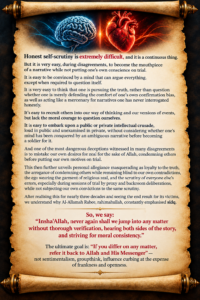
When people’s differences in the issues of the religion became many, and their divisions became many, mutual hatred and cursing also became widespread as a result. Each person thinks that he was indeed hating for the sake of Allah.
In reality, a person may have a valid excuse for doing so, or he may have no valid excuse, but may be following his own desires and falling short in his efforts to investigate the reasons for which he hates someone. For indeed, much of this occurs merely because someone opposes a person whom he follows, believing that this person speaks nothing but the truth. Yet this belief may be either correct or mistaken.
It may be that what drives a person to incline towards someone is merely personal desire, familiarity, affection, or habit. All of this discredits the claim that such hatred is for the sake of Allah.
Therefore, it is incumbent upon a Muslim to be sincere with himself and to exercise the utmost caution in this matter. And whatever is unclear to him, he should refrain from involving himself in it, out of fear that he may fall into the forbidden hatred that he has been prohibited from engaging in. [3]
We ask Allah:
اللَّهُمَّ رَبَّ جِبْرِيلَ وَمِيكَائِيلَ وَإِسْرَافِيلَ فَاطِرَ السَّمَوَاتِ وَالأَرْضِ عَالِمَ الْغَيْبِ وَالشَّهَادَةِ أَنْتَ تَحْكُمُ بَيْنَ عِبَادِكَ فِيمَا كَانُوا فِيهِ يَخْتَلِفُونَ اللَّهُمَّ اهْدِنِي لِمَا اخْتُلِفَ فِيهِ مِنَ الْحَقِّ إِنَّكَ تَهْدِي مَنْ تَشَاءُ إِلَى صِرَاطٍ مُسْتَقِيمٍ
[a] Imam Albaani (rahimahullaah) stated (in As-Saheehah 1/74-75) about this Hadith: ‘Saheeh Mawqoofan’.
[1] Awn Al- Ahad As-Samad Sharh Al-Adab Al-Mufrad’ 2 /205
[2] Darʾ Taʿāruḍ al-ʿAql wa al-Naql, 4/98
[3] Jāmiʿ al-ʿUlūm wa al-Ḥikam, 2/267

Donate
Related Posts
Follow Us
Share
Related Posts
Donate to the Dawah in Manchester

Join the Umrah Trip