The antisemitism virus – Brief Dialogue with Dr. Raheli Baratz
In The Name of Allah, The Most Merciful, The Bestower of Mercy.
Allah, The Most High, said:
يَـٰٓأَيُّہَا ٱلَّذِينَ ءَامَنُواْ كُونُواْ قَوَّٲمِينَ بِٱلۡقِسۡطِ شُہَدَآءَ لِلَّهِ وَلَوۡ عَلَىٰٓ أَنفُسِكُمۡ أَوِ ٱلۡوَٲلِدَيۡنِ وَٱلۡأَقۡرَبِينَۚ إِن يَكُنۡ غَنِيًّا أَوۡ فَقِيرً۬ا فَٱللَّهُ أَوۡلَىٰ بِہِمَاۖ فَلَا تَتَّبِعُواْ ٱلۡهَوَىٰٓ أَن تَعۡدِلُواْۚ وَإِن تَلۡوُ ۥۤاْ أَوۡ تُعۡرِضُواْ فَإِنَّ ٱللَّهَ كَانَ بِمَا تَعۡمَلُونَ خَبِيرً۬ا
O you who believe! Stand out firmly for justice, as witnesses to Allah; even though it be against yourselves, or your parents, or your kin, be he rich or poor, Allah is a Better Protector to both (than you). So follow not the lusts (of your hearts), lest you may avoid justice, and if you distort your witness or refuse to give it, verily, Allah is Ever Well-Acquainted with what you do. [An-Nisaa. 135]
The purpose of this brief article is not to challenge the right of race to exist within humanity, nor to endorse the oppression of any person. Rather, it aims to provide a quick analysis that highlights aspects the article’s author may have overlooked in their argument, as well as some potential exaggerations in their perspective. It’s important to understand that not all individuals who identify as Jewish agree with or support the actions of Netanyahu’s government, which has been guilty of committing violence and oppression against Palestinians—actions that many have labeled as genocidal in the past three years.
Furthermore, we are not implying that the author endorses such actions, as we have not found any statements from that indicate this. Also, we condemn the actions of any group or individual identifying as Muslim—whether in Palestine, the UK, or elsewhere—that inflicts harm on non-combatants or fellow citizens, regardless of their religious beliefs. We also firmly oppose vigilantism and anti-Semitism in any form, a stance we will emphasise throughout this article, InShaaAllah.
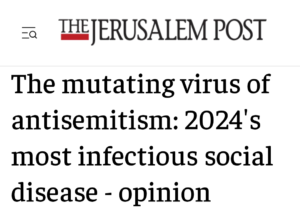
In the above article, Dr. Raheli Baratz titled: “The mutating virus of antisemitism: 2024’s most infectious social diseased”, the author stated:
“It seems that the epidemic of antisemitism has become a real global threat in recent years”. [End of quote]
Response: It is not our expertise to explore the complexities and theory of viral mutations; that responsibility lies with the truthful scientists, both from Muslim backgrounds and others, who engaged in meaningful dialogue and diverse perspectives without succumbing to the fearmongering that was frequently witnessed during the lockdowns. When it comes to the metaphorical rise of antisemitism mentioned by the writer, we acknowledge that, irrespective of our opinions on the extent of its prevalence, it is undeniably a form of racism that Islam condemns. However, it is crucial to emphasise that the violence and oppression linked to Zionism over the last 70 years deserves more condemnation.
Dr. Raheli stated: “While it didn’t start following the October 7 massacre, these events served as a powerful catalyst that brought hatred out of the shadows”. [End of quote]
Response: The tragic loss of innocent lives, including unarmed civilians and non-combatants, is an act that can never be justified, whether it occurred on October 7 or at any other time. However, it is also incumbent to acknowledge the deep-seated animosity towards Palestinians that has persisted for over seven decades, alongside the alarming rhetoric of hatred employed by some people who associate with Zionism. Refer to “Footnote a” for the remarks made by Yair Netanyahu, Ehud Olmert, Eli Yishai, Bezalel Smotrich, Tally Gotliv, Itamar Ben Gvir, and Arieh King. Additionally, you will find the content of “The Friendship Song.”
Dr. Raheli stated: “The tragic murder of Rabbi Zvi Kogan, a 28-year-old Chabad-Lubavitch emissary in Dubai, by Islamic terrorists in early 2024 further demonstrates this escalating crisis. His death, which shocked both the Jewish community and people of goodwill worldwide, illustrates how even in places of apparent progress and interfaith cooperation like the UAE, antisemitic violence can emerge with devastating consequences”. [End of quote]
Response: The murder of any innocent individual, whether they are a Rabbi, a Muslim, a Christian, a Hindu, a Sikh, or an atheist, is unequivocally condemned. However, what about the horrific acts of murdering infants and non-combatants, as well as the starvation of mothers and their children during the blockage in Gaza?! These actions are far more heinous than the tragic murder of a 28-year-old Jewish man, which, while a grave crime, pales in comparison to the suffering inflicted by Zionists over the past 70 years. For a deeper understanding of the atrocities committed by Zionists even prior to the recent violence, please refer to Footnote b at the end of this article. As for when discussing what some people refer to as interfaith cooperation, it is essential to clarify its meaning from an Islamic perspective. This concept does not imply that Muslims should abandon their identity or engage in practices that contradict Islamic law. Instead, it should be framed as peaceful coexistence, where the principles of Shariah compel Muslims to safeguard the lives and dignity of non-Muslims. We reiterate that antisemitism is condemned by the Creator, as are the acts of starving and bombing innocent children. Just as antisemitic violence can lead to catastrophic outcomes, the actions of Zionists have resulted in even more devastating consequences for the lives and dignity of Palestinians, all while the world observed the genocide and the inflammatory rhetoric from certain Zionist leaders. For further details, please refer to Footnote d.
Dr. Raheli stated: “The infection rate has reached unprecedented levels, with reports showing a staggering 400% increase in antisemitic incidents over the past year. This exponential growth rate surpasses any previous outbreak in recent history, marking what epidemiologists would call a “super-spreader event” in social terms. The velocity and scale of this surge mirror the behavior of highly infectious diseases, demanding immediate global intervention”. [End of quote]
Response: We must once again assert that antisemitism and its repercussions have no place in any society. However, it is crucial to recognise that the incidents of antisemitism observed by the writer pale in comparison to the staggering loss of thousands of Palestinian lives when the conflict was at its peak, alongside countless others buried under rubble, children starved due to interference with food supplies by settlers etc. While antisemitism is undeniably a grave injustice, the scale of brutality inflicted by Zionists today is unparalleled and demands more urgent global intervention. Furthermore, I believe the writer has overstated the current prevalence of antisemitism, suggesting it surpasses all previous instances, when in fact, the suffering endured by Bani Israel at the hands of Fir’awn was far more severe. There is no need for such exaggeration; instead, we should engage in a fair discussion of these issues without inflating the reality of antisemitism, which has not even approached the magnitude of Zionist brutality experienced over the past 70 years.
Dr. Raheli stated: “The similarity between antisemitism and COVID-19 is striking. Just as we saw colorful maps describing the spread of the epidemic at its peak – green, yellow, orange, and red – we can now imagine the spread of antisemitism. If, in the past, many areas were “green” and relatively clean of this hatred, today, more and more areas are turning orange and red”. [End of quote]
Response: Antisemitism, akin to a profound affliction of the heart, finds its parallel in Zionism; both are manifestations of deeply flawed beliefs and ideologies that inflict far greater harm than mere physical maladies.
Dr. Raheli stated: “On social networks, hatred spreads like a virus. Antisemitic posts travel from device to device in seconds, echoing across the network without real supervision and strengthening ignorance and incitement. What is the cause? The root of the problem lies in ignorance. When people don’t understand Jewish history, the lessons of the Holocaust, or the heavy price of blind hatred, they easily fall for antisemitic rhetoric. Therefore, education is the most effective cure for dealing with the antisemitism epidemic”. [End of quote]
Response: We denounce anti-Semitism wherever it is perpetrated. However, we must also address the blatant genocidal rhetoric and actions of Netanyahu’s government, which are as evident as the midday sun. These provocations have incited some ignorant soldiers to perpetrate atrocious acts. It is undeniable that all forms of racism arise from ignorance, which positions Netanyahu and his far-right associates as some of the most ignorant individuals, given their openly genocidal statements and the actions that follow.
Dr. Raheli stated: “In the US, where campuses have become conflict-ridden arenas, there is an urgent need to implement comprehensive educational programs. Holocaust studies, which are currently mandatory in half of US states, must become a requirement, not just as a historical gesture but as a tool to prevent future infections of ignorance and hatred”.
Response: Firstly, refer to “Footnote e” for a concise overview of America’s historical relationship with Zionism. Furthermore, while any initiatives aimed at combating antisemitism are commendable, the most pressing need is to implement programs that focus on deradicalising Zionists. This is essential to address the sense of superiority that has contributed to recent genocidal actions, as well as the ongoing violence that has persisted for over 70 years.
Dr. Raheli stated: “Legislation is another crucial tool. In Germany, for example, there are clear penalties against inciting calls such as “from the river to the sea,” which deter potential hate spreaders. Other countries need to learn from this example. When there is a real price for spreading hatred – whether legal punishment or social sanctions – people will think twice before choosing it”. [End of quote]
Response: Certainly, the principles that apply to others equally extend to Zionists in every nation and aspect of life, ensuring they respect the rights of all individuals. In my opinion, if the writer is aware that some individuals who support Zionism also utilise this slogan, it would reflect a level of hypocrisy and an unhealthy sense of entitlement to criticise others for using it while defending its use among their own allies. However, if the writer is simply unaware of those who share similar sentiments and align with Zionists, she bears no fault. Regarding this slogan, there are indeed those, particularly among certain evangelists, who advocate for the concept of a Greater Israel. “The National Christian Company” that was purchased by the Zionist priest Jerry Falwell and its name changed to “Daily Freedom Broadcasting” operates (or operated) from Leechburg, Virginia, and offers religious programming 24 hours a day. Its owner, Jerry Folwell, a close friend of former US President George H.W. Bush, frequently asserts through his station that “the re-establishment of Israel among fundamentalist Christians is a fulfillment of biblical prophecies, and every American must make every effort to ensure full support for Israel.” He also states that the Torah’s Book of Genesis declares that Israel’s borders will extend from the Euphrates to the Nile and that the promised territory will include Iraq, Syria, Turkey, Saudi Arabia, and Egypt, Sudan, Lebanon, Jordan, and Kuwait”. [Refer to Footnote f] While both Zionists and antisemites propagate hatred, it is undeniable that the Zionists have perpetrated a greater number of atrocities against the Palestinian people over the past seven decades.
Dr. Raheli stated: “Furthermore, there is an urgent need for cooperation between countries. The antisemitism epidemic crosses borders and cannot be treated separately in each country. Information sharing between countries about incitement networks, joint global campaigns to raise awareness, and encouraging international agreements to protect Jewish communities are critical steps. Democratic countries need to unite around shared core values and work together to eradicate hatred. Just as international cooperation works to fight terrorism and cross-border crime, we can also stop the spread of antisemitism and ensure a safer and more equal society for all. The public needs to understand that antisemitism is not just a problem of the Jewish community. It’s a symptom of a broader disease – the collapse of democratic and liberal values. Throughout history, hatred of Jews has been the first stage in broader social disintegration”. [End of quote]
Response: This is indeed a positive idea, but there is a more pressing need for all countries to work together to stop the much larger atrocities and serious crimes committed by Zionists against Palestinians. We also need to raise awareness about protecting Palestinians in their own land. All good people should oppose racism and antisemitism, but we must also challenge and eliminate Zionist arrogance, impunity, and the terrorism committed by some soldiers to ensure that Palestinians are safe and treated justly. The public should recognise that antisemitism is not only a Jewish issue; it reflects a wider problem. Similarly, Zionist arrogance, terrorism, and brutality are not just Palestinian issues; they indicate a larger failure of compassion, kindness, fairness, and the values found in the infallible final revelation- the Qur’an and the authentic Sunnah.
Regarding the writer’s point that hatred of Jews has historically been the first sign of social breakdown, while the writer does not explicitly say that all Jews are innocent, this statement could be misinterpreted by extreme Zionists to claim moral superiority, despite their actions suggesting otherwise. No nation or group is without wrongdoing by its leaders or certain factions throughout history, which can lead to retaliation that harms the innocent. This is not to deny that Jews have faced injustices at times, but no nation can claim to be free from injustice during its rise and fall or ensure that all its citizens and lands are free from it.
Dr. Raheli stated: “Like COVID-19, the way to stop the epidemic is through combined action – education, regulation, international cooperation, and public awareness. The murder of Rabbi Kogan underscores the urgent need for these interventions. Only if all establishment factors and government ministries cooperate can we break the chain of transmission and stop the antisemitism epidemic before it too becomes the norm”. [End of quote]
Response: The views of Dr. Raheli regarding Covid-19 and its mutations, shaped by her scientific perspective, are not the focus of this article of ours. Instead, we emphasise that both antisemitism and Zionism represent deep-seated ailments of the heart and soul. Furthermore, only the final divine revelation – the Qur’an and authentic Sunnah – can provide the healing needed for these ailments. The tragic murder of Rabbi Kogan calls for immediate action, but the urgency surrounding Zionist brutality and genocide demands even greater attention and intervention. It is imperative for all governments to unite in confronting these two issues and putting an end to them. However, it is important to note that Zionist violence has been a persistent reality for the past 70 years. Mere human ideas will not suffice to resolve these conflicts; we must seek a return to the final revelation.
Shaikh Al-Islam Ibn Taymiyyah, may Allah have mercy upon him, said:
Even though there is something in the paths of analogical reasoning and reflection that will lead to knowledge, however sometimes it cannot give detail explanation in a dispute between the people of the earth due to the minute details and ambiguities (in the dispute), and at other times due to the fact the people differ when prioritising necessities. Due to this, Allah [The Most High] commanded [us] to return to the revelation in times of dispute. Allah [The Most High] said:
كَانَ ٱلنَّاسُ أُمَّةً۬ وَٲحِدَةً۬ فَبَعَثَ ٱللَّهُ ٱلنَّبِيِّـۧنَ مُبَشِّرِينَ وَمُنذِرِينَ وَأَنزَلَ مَعَهُمُ ٱلۡكِتَـٰبَ بِٱلۡحَقِّ لِيَحۡكُمَ بَيۡنَ ٱلنَّاسِ فِيمَا ٱخۡتَلَفُواْ فِيهِۚ
Mankind were one community (i.e. upon Tawheed and Allaah’s Sharee’ah) and Allah sent Prophets with glad tidings and warnings, and with them He sent the Scripture in truth to judge between people in matters wherein they differed. [Al-Baqarah. 213]
Therefore, Allah designated the revealed Books [i.e. the Qur’an being the final of them] as the judge between the people in matters wherein they differ”. [Dar Ta’aarud Al-Aql Wan-Naql:. 9/17-18]
Imam Ibn Al-Qayyim, may Allah have mercy upon him, said:
Everyone with a bit of (sound) intellect knows that the corruption of the world and its ruin occurs due to giving precedence to opinion over the divine revelation and (evil) desires over sound intellect. These two corrupt motives are not entrenched in a heart except that its destruction becomes inevitable nor in a nation except that its affairs are completely corrupted”. [A’laam Al-Muwaqqi’een 1/67-69]
And Allah knows best
Read: Muslims and Antisemitism by Shaikh Abu Iyaad- may Allah preserve him: https://abuiyaad.com/sn/muslims-antisemitism
Footnote a:
Must take a look at what is happening in their own backyard first
Footnote b:
https://salafidawahmanchester.com/2024/11/26/we-have-a-mandate-from-the-almighty-that-we-are-an-eternal-nation/
Footnote c:
http://www.shariah.ws/articles/duviqgl-shaykh-salih-al-fawzan-the-islamic-shariah-provides-security–for-muslims-and-non-muslims-and-those-who-violate-it-are-kh257rijites-who-are-to-be-fought-and-severely-punished.cfm
http://www.shariah.ws/articles/szsumlh-the-foundation-of-muslim-relations-with-non-muslims-who-do-not-show-aggression-and-hostility.cfm
http://www.shariah.ws/articles/nmsdfkp-islam-and-the-muslims-are-free-and-innocent-of-the-kharijite-extremists.cfm
Footnote d:
https://abuiyaad.com/a/slaughtering-children-holy-war/print
https://abuiyaad.com/a/amalekite-genocide-doctrine-gaza
https://www.abuiyaad.com/a/pharoah-slaughtering-babies
Footnote e:
The Development of Christian Zionism in America Since the Puritan Settlement
Footnote f: