Early Attempts to Corrupt Sound Creed Under the Pretence of So Called Scholarly Refinement and Objectivity

In The Name of Allah, The Most Merciful, The Bestower of Mercy.

Shaikh Shamsuddeen Al-Afghaanee As-Salafi, may Allah have mercy upon him, said:

The books of Greek Philosophy, which encompassed notions of grave and idol worship, were translated into Arabic, thus, many who identified with Islam, such as Al-Farabi, (a) Ibn Sina Al-Hanafi, (b) and Nasir at-Tusi, an advocate of disbelief and shirk, (c) and others among who played tricks Islam, akin to how Paul manipulated the tenets of Christianity, busied themselves with these books.

They were influenced by the ideas of the Greek philosophers, particularly the veneration of graves, transforming them into proponents of such practices. The practices of these people were rife amidst the ranks of the proponents of theological rhetoric among the Hanafi Maturidiyyah (d) and the Ash’ariyyah Kullabiyyah, as they immersed themselves in the writings of these philosophers, thus, influenced by the creed of grave worship. They emerged as advocates for grave worship and the creed of the Jahmiyyah at the same time, exemplified by the likes of Taftazani Al-Hanafi, a philosopher of the Maturidiyyah and a proponent of grave worship, alongside Jurjanee Al-Hanafi, who was a caller to superstition.

[a] Al-Faraabee:

He said that Philosophy is more perfect than Prophet hood. Shaikh Al-Islam Ibn Taymiyyah, may Allah have mercy upon him, said about him: “Misguided, a disbeliever”. Ibn Sina adopted his books and ideas of disbelief. [For further details concerning Al- Faraabee, See Majmoo Al-Fataawaa 2/67—86] [Dar At-Ta’aarud 1/10] [Ighaathatul Luhfaan 2/372-373].

[b] Ibn Sina:

Imam Ibnu Salah, may Allah have mercy upon him, said: “He was a devil amongst the human devils”. [See Fataawaa Ibn Salaah 1/209] [Also see: ‘Ar-Radd Alal Mantaqiyyeen’ by Shaikh Al-Islaam Ibn Taymiyyah 278-279] [Ighaatha Al-Lahfaan’ by Imam Ibn Al-Qayyim 2/373-380] [Al-Bidayah Wan-Nihaayah’ by Imam Ibn Kathir12/43]

[c] Nasir at-Tusi:

He was a magician and a minister of the Tartars. He rejected the ‘resurrection’. For further details, see: As-Sawaa-iq Al-Mursalah of Imaam Ibnul Qayyim (rahimahullaah) 2/790; 3/1077-1078]

[d] Al-Maturidiyyah:

Followers of the Jahmi Abu Mansur Al-Maturidi Al-Hanafi [Al-Maturidiyyahby Shaikh Shamsuddeen Al-Afghani 1/205—376] [1]


Revival of The Authentic Sunnah Every Hundred Years

The Prophet, peace and blessings be upon him, said, “Allah will raise for this Ummah at the end of every hundred years the one who will revive its religion for it”. [2]

“Allah will raise for this Ummah”- Meaning the Ummah Ijabah [i.e. the Muslims]. “At the end of every hundred years”- Meaning at the end of every hundred years when there is little knowledge of the Shariah and the authentic Prophetic Tradition, whilst ignorance and religious innovation is rife. “One who will revive its religion for it”- Meaning a scholar who is alive and well known. He will clarify the authentic Prophetic Tradition and distinguish it from the religious innovations. knowledge will be abundant again and its adherents will be aided, and the proponents of religious will be overcome and degraded. This reviver is non else but a scholar who has sound understanding of the religious sciences that deal with acts of worship, the underlying wisdoms of the religion and the texts that deal with beliefs of the heart. [3]

There will not cease to be a group of people upon the Truth and Sunnah’ – Sharhus-Sunnah al-Barbahārī by Shaikh Abu Khadeejah, may Allah preserve him.

https://www.salafisounds.com/there-will-not-cease-to-be-a-group-of-people-upon-the-truth-and-sunnah-sharhus-sunnah-al-barbahari-by-abu-khadeejah/https://www.salafisounds.com/there-will-not-cease-to-be-a-group-of-people-upon-the-truth-and-sunnah-sharhus-sunnah-al-barbahari-by-abu-khadeejah/


[1] An Excerpt from Juhud Ulamaa Al-Hanafiyyah Fee Ibtaal Aqaa’id Al-Quburiyyeen. 1/ 19-25

[2] Sahih Sunan Abee Daawud. Hadeeth Number 4291.

[3]An Excerpt from Awnul Mabud Sharh Sunan Abee Dawud. 11/259-260. Publisher: Daar Al-Kutub Al-Ilmiyyah. 1st Edition 1419AH (Year 1998).


Steadfast Moderation in Worship and Uprightness in Times of Lesser Enthusiasm

In The Name of Allah, The Most Merciful, The Bestower of Mercy.

Continuous Goods Deeds, Even If Little

The Prophet, peace and blessings of Allah be upon him, said:

”The Most beloved deeds to Allah are that which (a person does) continuously even if little”. [1]

Imaam Abdul Aziz Bin Baz, may Allah have mercy upon him, said:

Righteous deeds (i.e. supererogatory deeds)- even if little-performed regularly are better than performing a lot of deeds that are not regular. [2]

The hadith shows that a Muslim should limit himself to the acts of worship he is able perform (i.e. supererogatory deeds) and what is understood from this is a prohibition against imposing on himself (supererogatory deeds) which he is not able to perform. [3]

Remaining Upon Guidance Even During Times of Reduced Activity

The Prophet, peace and blessings of Allah be upon him, said:

Indeed, every deed has enthusiasm, and every enthusiasm has a time limit (or period of inactivity). Whoever’s time of enthusiasm is for my Sunnah has been guided and he is ruined if upon other than that. [4]

In another narration, the Prophet said: So, if the doer behaves in an upright manner and is moderate, then have hope for him (i.e. success). [5]

“If its doer behaves in an upright manner and is moderate”.

Al-Allamah Al-Mubaarakrufee, may Allah have mercy upon him, said:

Meaning: The doer becomes moderate (i.e. within the boundaries of the Shariah) and avoids the two extremes- excess at the time of enthusiasm and negligence at the time of inactivity. [6]

We ask Allah:

 اللهمَّ أعنِّي على ذكرِك وشكرِك وحسنِ عبادَتِك

O Allah! Help me to remember and thank you, and to worship you perfectly.


[1] Sahih Muslim Number 782

[2] Al-Hulal Al-Ibreeziyyah Min at-Taleeqaat Al-Baaziyyah Alaa Sahih Al-Bukhari. Vol 1 footnote number 2. Page 24.

[3] Bugh’yah Al-Mutatawwi Fee Salah at-Tatawwu. page198.

[4] Sahih Al-Jami 2152

[5] Sahih At-Targheem 57

[6] Tuhfah Al-Ahwadahi 7/126

The Best Place for the Heart to Attach Itself

In The Name of Allah, The Most Merciful, The Bestower of Mercy.

Salman, may Allah be pleased with him, wrote to Abu Ad-Dardaa, may Allah be pleased with him, saying, “O my brother! It is incumbent upon you to attach yourself to the Masjid and be constantly there, for indeed I heard the Prophet, peace and blessings of Allah be upon him, saying, ‘The Masjid is the house of every pious person'”.

Al-Allamah Zaid Bin Hadi Al-Mad’khali, may Allah have mercy upon him, said:

First: The hadith is proof to show that the most virtuous place on the earth are the Masajid and the best of the people are its maintainers, because they are people of Iman based on the proof:

إِنَّمَا يَعۡمُرُ مَسَـٰجِدَ ٱللَّهِ مَنۡ ءَامَنَ بِٱللَّهِ وَٱلۡيَوۡمِ ٱلۡأَخِرِ وَأَقَامَ ٱلصَّلَوٰةَ وَءَاتَى ٱلزَّڪَوٰةَ وَلَمۡ يَخۡشَ إِلَّا ٱللَّهَ‌ۖ فَعَسَىٰٓ أُوْلَـٰٓٮِٕكَ أَن يَكُونُواْ مِنَ ٱلۡمُهۡتَدِينَ

The Mosques of Allah shall be maintained only by those who believe in Allah and the Last Day; perform As-Salat, give Zakat and fear none but Allah. It is they who are expected to be on true guidance. [a-Tawbah. 18]

Second: Prayer in the Masjid is multiplied [i.e. 27 times] and none is excused for being absent from the Masajid [i.e. except one who has a legislated Islamic excuse]. Continuous presence in the Masajid and attaching one’s heart to them is a sign of one’s Iman, strength and desire for good.

at-Taleeqaat Al-Maleehah Alaa Silsilah Al-Ahaadith As-Saheehah.  1/286

Plotting to Uphold Kufr, Boasting About Military Might to Utilise for Transgression, and Outrageous Declarations

In The Name of Allah, The Most Merciful, The Bestower of Mercy.

Plotting to Uphold Kufr, Boasting About Military Might to Utilise for Transgression, and Outrageous Declarations: An Inheritance of Tyrannical Nations of Old

Allah  The Most High, said:

قَدۡ مَڪَرَ ٱلَّذِينَ مِن قَبۡلِهِمۡ فَأَتَى ٱللَّهُ بُنۡيَـٰنَهُم مِّنَ ٱلۡقَوَاعِدِ فَخَرَّ عَلَيۡہِمُ ٱلسَّقۡفُ مِن فَوۡقِهِمۡ وَأَتَٮٰهُمُ ٱلۡعَذَابُ مِنۡ حَيۡثُ لَا يَشۡعُرُونَ
ثُمَّ يَوۡمَ ٱلۡقِيَـٰمَةِ يُخۡزِيهِمۡ وَيَقُولُ أَيۡنَ شُرَڪَآءِىَ ٱلَّذِينَ كُنتُمۡ تُشَـٰٓقُّونَ فِيہِمۡ‌ۚ قَالَ ٱلَّذِينَ أُوتُواْ ٱلۡعِلۡمَ إِنَّ ٱلۡخِزۡىَ ٱلۡيَوۡمَ وَٱلسُّوٓءَ عَلَى ٱلۡڪَـٰفِرِينَ

Those before them indeed plotted, but Allah struck at the foundation of their building, and then the roof fell down upon them, from above them, and the torment overtook them from directions they did not perceive. Then, on the Day of Resurrection, He will disgrace them and will say: “Where are My (so called) ‘partners’ concerning whom you used to disagree and dispute (with the believers, by defying and disobeying Allah)?” Those who have been given the knowledge (about the Torment of Allah for the disbelievers) will say: “Verily! Disgrace this Day and misery are upon the disbelievers. [An-Nahl. 26-27]

قَدۡ مَڪَرَ ٱلَّذِينَ مِن قَبۡلِهِمۡ

Those before them indeed plotted.

The Mufassiroon say that this refers to Namrud who built a tall tower in order to climb – as he claimed – the heavens and fight its inhabitants.

فَأَتَى ٱللَّهُ بُنۡيَـٰنَهُم مِّنَ ٱلۡقَوَاعِدِ فَخَرَّ عَلَيۡہِمُ ٱلسَّقۡفُ مِن فَوۡقِهِمۡ

But Allah struck at the foundation of their building, and then the roof fell down upon them, from above them]: The Mufassiroon say: Allaah sent a wind which flung the top of the tower to the sea and the rest was destroyed.

وَأَتَٮٰهُمُ ٱلۡعَذَابُ مِنۡ حَيۡثُ لَا يَشۡعُرُونَ

And the torment overtook them from directions they did not perceive]: Meaning, from where they thought they were safe. [ثُمَّ يَوۡمَ ٱلۡقِيَـٰمَةِ يُخۡزِيهِمۡ – Then, on the Day of Resurrection, He will disgrace]: Meaning, disgraced with punishment. [1]

قَدۡ مَڪَرَ ٱلَّذِينَ مِن قَبۡلِهِمۡ

Those before them indeed plotted.

Meaning: plotted against their Messengers, used various types of tricks to reject that which the messengers brought and established gigantic safeguards (by way of arguments, views etc) on their plots.

فَأَتَى ٱللَّهُ بُنۡيَـٰنَهُم مِّنَ ٱلۡقَوَاعِدِ

But Allah struck at the foundation of their building.

Meaning, an affair came to them from its basis and foundation.

فَخَرَّ عَلَيۡہِمُ ٱلسَّقۡفُ مِن فَوۡقِهِمۡ

And then the roof fell down upon them, from above them.

Meaning, so what they built became a punishment for them.

وَأَتَٮٰهُمُ ٱلۡعَذَابُ مِنۡ حَيۡثُ لَا يَشۡعُرُونَ

And the torment overtook them from directions they did not perceive.

Meaning: Because they thought that such a building will benefit and protect them from punishment, but their punishment occurred from that which they built and established.

This is one the best of parables regarding how Allah nullifies the plots of his enemies, for indeed they reflected on that which the Messengers brought when they belied them, made up principles and rules for it based on falsehood, referred back to them to reject that which the Messengers came with, used tricks to bring discomfort to the Messengers and inflict harm on them and those who followed them, but their plot became a source of evil against them, thus, their plan became their destruction, because their plot was evil as Allah said:

وَلَا يَحِيقُ الْمَكْرُ السَّيِّئُ إِلَّا بِأَهْلِهِ

But the evil plot encompasses only him who makes it. [Fatir. 43]

This is in this worldly life and the punishment in the afterlife would be more disgraceful, and due to this Allah said: [ثُمَّ يَوۡمَ ٱلۡقِيَـٰمَةِ يُخۡزِيهِمۡ – Then, on the Day of Resurrection, He will disgrace them. [2]

Allah said:

أَلَمْ تَرَ إِلَى الَّذِي حَاجَّ إِبْرَاهِيمَ فِي رَبِّهِ أَنْ آتَاهُ اللَّهُ الْمُلْكَ إِذْ قَالَ إِبْرَاهِيمُ رَبِّيَ الَّذِي يُحْيِي وَيُمِيتُ قَالَ أَنَا أُحْيِي وَأُمِيتُ ۖ قَالَ إِبْرَاهِيمُ فَإِنَّ اللَّهَ يَأْتِي بِالشَّمْسِ مِنَ الْمَشْرِقِ فَأْتِ بِهَا مِنَ الْمَغْرِبِ فَبُهِتَ الَّذِي كَفَرَ ۗ وَاللَّهُ لَا يَهْدِي الْقَوْمَ الظَّالِمِينَ

Have you not seen (contemplated with your heart) him who disputed with Ibrahim (Abraham) about his Lord (Allah), because Allah had given him the kingdom? When Ibrahim (Abraham) said (to him): “My Lord (Allah) is He Who gives life and causes death.” He said, “I give life and cause death.” Ibrahim (Abraham) said, “Verily! Allah causes the sun to rise from the east; then cause it you to rise from the west.” So the disbeliever was utterly defeated. And Allah guides not the people, who are Zalimun (wrong-doers, etc.). [Al-Baqarah. 258]

Imam Al-Baghawi, may Allah have mercy upon him, said:

There is a difference of opinion among (the Mufassiroon) regarding the timing of this debate. Muqatil, may Allah have mercy on him, stated that after Ibrahim, peace be upon him, broke the idols, Namrud imprisoned him and later brought him out to be burned. Namrud asked, “Who is the Lord you urge us to worship?” Ibrahim, peace be upon him, replied, “My Lord is the one who gives life and causes death.” Others say that this (occurred) after Ibrahim was thrown into the fire, during a time of drought when people sought food from Namrud. If someone approached him for food, he would inquire, “Who is your Lord?” If the person responded, “You are my Lord,” he would then offer to sell them food. [3]

أَلَمۡ تَرَ إِلَى ٱلَّذِى حَآجَّ إِبۡرَٲهِـۧمَ فِى رَبِّهِۦۤ

“Have you seen (contemplated with your heart and eyes) him who disputed with Ibrahim (Abraham) about his Lord (Allah)…”

Meaning, his insolence, ignorant attitude, obstinacy, and arguing about that which there is no doubt! Nothing led him to this behaviour except because Allah had given him the kingdom, thus, he transgressed, rebelled, and considered himself as one in control of those under his authority, which led him to argue with Prophet Ibrahim, peace be upon him, about Allah’s Lordship and claimed that he can do the same thing as Allah does.

Prophet Ibrahim said to him, “My Lord is He Who gives life and death” – Meaning, “Allah alone is in absolute control of everything”. Then Ibrahim mentioned two specific things – life and death. This is because they the greatest things in Allah’s absolute control. Life is the beginning of the worldly life and death is the beginning of what is to occur in the afterlife.

Then the one (the king) who sought to ague against Ibrahim said, “I give life and cause death”, but he never said, “I am the One Who gives life and death, because could not claim that he is not in need of anyone to interfere in the matter; instead, he only claimed that he could do what Allah does by killing someone and sparing someone’s life. Prophet Ibrahim saw the fallacy in his argument and utterence of speech that is not even worthy of being a Shubhah (i.e. an ambiguity portrayed as wholesome truth) let alone a proof, so he said to him, “Verily! Allah causes the sun to rise from the east”.

Ibrahim mentioned something that can be clearly seen and affirmed by everyone including this disbeliever. “Then cause it you to rise from the West”. This compelled him to bring proof if he is truthful in his claim.

When Ibrahim uttered this to him, about which he neither had the ability to present an ambiguity to make Ibrahim’s proof look confusing nor could he find something to disparage it, he was utterly defeated – lost for an answer, his proof cut off and his ambiguous statement toppled. [4]

He Who brings life and death (Allah) has absolute control over the existence and creates everything in it, including absolute control of its celestial bodies and their movements. The sun rises everyday from the east, thus, if you were god, as you claim, who gives life and cause death, make the sun rise from the west. [5]

This is the situation of an obstinate falsifier who wants to confront truth and overcome it, because he will be defeated and subdued. This is why Allah said:

وَٱللَّهُ لَا يَہۡدِى ٱلۡقَوۡمَ ٱلظَّـٰلِمِينَ

And Allah guides not the people, who are Zalimun (wrong-doers, etc.)]; instead He abandons them to their disbelief and misguidance. [6]

Outrageous Declarations

Allah, said: [وَقَالَ فِرْعَوْنُ – Fir’aun (Pharaoh) said] – Meaning, with haughtiness and tyranny, whilst deluding his foolish people;

[ذَرُونِي أَقْتُلْ مُوسَىٰ وَلْيَدْعُ رَبَّهُ – Leave me to kill Musa (Moses), and let him call his Lord (to stop me from killing him)!]

This was his claim that had it not been for his consideration of the wishes of his people, he would have killed Musa and that (Musa’s) supplication to his Lord would not have prevented him from that. Fir’awn then mentioned what made him want to kill Musa and that he is a sincere adviser to his people, and that he wished to remove mischief from the land. Allah stated that Fir’awn said:

إِنِّي أَخَافُ أَنْ يُبَدِّلَ دِينَكُمْ أَوْ أَنْ يُظْهِرَ فِي الْأَرْضِ الْفَسَادَ

I fear that he (Musa) may change your religion, or that he may cause mischief to appear in the land!” [Ghafir 26]

This is the most amazing the affair can be! The most evil one among the creation gives advice to the people against the best among the creation. This is (nothing but) disguised falsehood and propaganda, which cannot seize except the intellects of those (people) about whom Allah stated:

فَاسْتَخَفَّ قَوْمَهُ فَأَطَاعُوهُ ۚ إِنَّهُمْ كَانُوا قَوْمًا فَاسِقِينَ

Thus he Fir’aun (Pharaoh)] befooled and misled his people, and they obeyed him. Verily, they were ever a people who were Fasiqun (rebellious, disobedient to Allah).] [Az-Zukhruf. 54] [7]

 يَـٰٓأَيُّهَا ٱلۡمَلَأُ مَا عَلِمۡتُ لَڪُم مِّنۡ إِلَـٰهٍ غَيۡرِى

O chiefs! I know not that you have an ilah (a god) other than me

Just look at what Fir’awn said! He did not say. “You do not have a god besides me”, rather he said: “I know not that you have a god other than me’’.

This is because they considered him to be a virtuous scholar and that whatever he said has to be the truth, and whatever he commands has to be followed. And after he made this statement, he then tried to prove that what he has stated is true. Allah said that Fir’awn said to Haman:

فَأَوۡقِدۡ لِى يَـٰهَـٰمَـٰنُ عَلَى ٱلطِّينِ فَٱجۡعَل لِّى صَرۡحً۬ا لَّعَلِّىٓ أَطَّلِعُ إِلَىٰٓ إِلَـٰهِ مُوسَىٰ وَإِنِّى لَأَظُنُّهُ ۥ مِنَ ٱلۡكَـٰذِبِينَ

So kindle for me (a fire), O Haman, to bake (bricks out of) clay, and set up for me a Sarhan (a lofty tower, or palace, etc.) in order that I may look at (or look for) the Ilah (God) of Musa (Moses); and verily, I think that he [Musa (Moses)] is one of the liars.

Meaning: We think that Musa is lying, but we are going to ascertain the affair and prove that he is a liar.

Look at Fir’awn’s extreme sinful boldness! He belied Musa, peace be upon him, claimed that he is a God, claimed that he is not aware of a true object of worship and asked Haman to build him a tower in order that he can see the god of Musa! These claims were nothing else but propaganda; however what is really amazing is the affair of those chiefs who considered themselves as the elders of the Kingdom, for how did they allow Fir’awn to tiffle with their intellects and deceive them? Indeed, that was due to their extremely sinful behaviour, which corrupted their religion and then their intellects. We ask Allah to keep us firm upon Iman and that our hearts do not become deviated after we have been guided. [8]

Allah said:

فَأَمَّا عَادٌ فَٱسْتَكْبَرُوا۟ فِى ٱلْأَرْضِ بِغَيْرِ ٱلْحَقِّ وَقَالُوا۟ مَنْ أَشَدُّ مِنَّا قُوَّةً أَوَلَمْ يَرَوْا۟ أَنَّ ٱللَّهَ ٱلَّذِى خَلَقَهُمْ هُوَ أَشَدُّ مِنْهُمْ قُوَّةً وَكَانُوا۟ بِـَٔايَٰتِنَا يَجْحَدُونَ

As for ‘Ad, they were arrogant in the land without right, and they said: “Who is mightier than us in strength?” See they not that Allah, Who created them was mightier in strength than them. And they used to deny Our Ayat (proofs, evidences, verses, lessons, revelations, etc.)![Fussilat 15]

Allah stated that Prophet Hud, peace be upon him, said to his people:

وَإِذَا بَطَشۡتُم بَطَشۡتُمۡ جَبَّارِينَ

And when you seize, seize you as tyrants.

Meaning, when you want to attack with a whip or sword, you attack like tyrants, completely overpowering and being savagely violent – neither compassionate nor aim to discipline (within justice as commanded by Allah), nor contemplating on the consequences. [9]

Allah gave them great strength and it was obligated to them to use this strength in obedience to Allah, but they became boastful and haughty, and they said: [مَنۡ أَشَدُّ مِنَّا قُوَّةً‌ۖ – Who is mightier than us in strength? (Fussilat. 15], and they utilised their strength in disobedience to Allah, fruitlessly and foolishly, thus, their Prophet forbade them from that. [10]

Their Prophet forbade them from that because it was done out of oppression. [11]


[1] An Excerpt from ‘Zad Al-Nasir By Imaam Ibn Al-Jawzi
[2: An Excerpt from Tafseer as-Sadi
[3] An Excerpt from Tafseer Al-Baghawi
[4] An Excerpt from Tafseer As-Sadi.
[5] Tafseer Ibn Katheer
[6] An Excerpt from Tafseer As-Sadi
[7] An Excerpt from ‘Tafseer As-Sadi
[8] An Excerpt from ‘Tafseer As-Sadi
[9] Ruh Al-Ma’aanee 11/165
[10] Tafseer As-Sadi.
[11] Zad Al-Maseer

Deliberate Harm to a Child During War…!

In The Name of Allah, The Most Merciful, The Bestower of Mercy.

Deliberate Harm to a Child During War: No Compassionate Adult Stays Silent Regardless of Child’s Country of Origin

Allah, The Most High, said:

إِذَا ٱلشَّمْسُ كُوِّرَتْ
When the sun will be coiled up (and lose its light).

وَإِذَا ٱلنُّجُومُ ٱنكَدَرَتْ
And when the stars will fall down (and scatter).

وَإِذَا ٱلْجِبَالُ سُيِّرَتْ
And when the mountains will be swept away (from their places, having being turned to dust).

وَإِذَا ٱلْعِشَارُ عُطِّلَتْ
And when the pregnant she-camels (that reach full-term) will be left idle, without care.

وَإِذَا ٱلْوُحُوشُ حُشِرَتْ

And when the wild beasts will be gathered together (for retribution to take place between them, before they are turned to dust).

وَإِذَا ٱلْبِحَارُ سُجِّرَتْ
And when the oceans will be kindled ablaze (after having merged together).

وَإِذَا ٱلنُّفُوسُ زُوِّجَتْ

And when the (various categories of) souls will be paired together (on the basis of their actions in this world) (or: when the souls are returned to their bodies).

وَإِذَا ٱلْمَوْءُۥدَةُ سُئِلَتْ
بِأَىِّ ذَنۢبٍ قُتِلَتْ
And when the female newborn (who was) buried alive will be asked. For what sin she was killed.

وَإِذَا ٱلصُّحُفُ نُشِرَتْ

And when the scrolls (of the good and bad deeds of every person as recorded by the angels) will be spread open.

وَإِذَا ٱلسَّمَآءُ كُشِطَتْ
And when the heaven will be torn out (from its place).

وَإِذَا ٱلْجَحِيمُ سُعِّرَتْ

And when the Hellfire will be kindled ablaze (its burning rage reflecting the sins of mankind and Allāh’s anger).

وَإِذَا ٱلْجَنَّةُ أُزْلِفَتْ
And when Paradise will be brought near (for the pious).

عَلِمَتْ نَفْسٌ مَّآ أَحْضَرَتْ

(When these events have taken place) then will every soul know what it has brought (of good and evil for this Day). [1]


وَإِذَا ٱلْمَوْءُۥدَةُ سُئِلَتْ
بِأَىِّ ذَنۢبٍ قُتِلَتْ

“And when the female new born (who was) buried alive will be asked. For what sin she was killed”. This pertains to the custom followed by the ignorant people of the pre-Islamic period, wherein they would bury their (infant) daughters alive solely out of the apprehension of poverty. Consequently, the innocent female child would be questioned (on the day of Judgement): [بِأَىِّ ذَنۢبٍ۬ قُتِلَتۡ- For what sin she was killed]? This is because it is widely acknowledged that she is sinless, and this verse serves as a (strong) reproach and cautionary message to those responsible for her demise. [2]

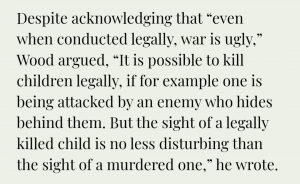
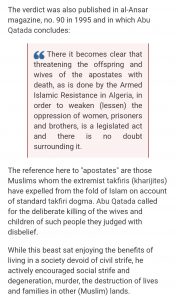
Staff writer Graeme Wood from The Atlantic attempted to justify and legitimise the act of killing children in times of war. This disturbing stance parallels the sinister tactics employed by the Khariji Abu Qatadah. Both individuals align themselves with extremist factions, with Graeme siding with Netanyahu’s faction and Abu Qatadah supporting the Kharijites.

Graeme Wood said:


Abu Qatadah 

Ibn Umar, may Allah be pleased with him and his father, narrated that a woman was found killed in one of the battles; so Allah’s Messenger, peace and blessings of Allah be upon him, forbade the killing of women and children. [Sahih Muslim 1744]

Truly, the view of these individuals to justify and legitimise such barbaric, atrocious, and dreadful act is utterly despicable. Despite their reasoning, they have made a declaration that goes against the innate human compassion for children and the instinct to safeguard them at all costs. Their rationalisations exude pure malice verging on sadism, and they cannot absolve themselves of accountability for their words. No amount of sugar-coated language or purported noble goals can excuse the abhorrent nature of their statements. The proclamations they make are utterly appalling to any parent with even a shred of compassion, leaving one in disbelief. It is truly distressing to listen to or read, causing a wave of nausea. How could anyone attempt to justify such a heinous act against the most innocent, children or infants? This wicked justification paves the way for all perpetrators in times of conflict to behave inhumanely, inflicting deadly harm and unbearable agony leading to the demise of helpless children. One can scarcely fathom the horror and multitude of wounds that a child would suffer when trapped alongside others before meeting their demise! Indeed, the noble Messenger [peace and blessings of Allah be upon him] said:

“Allah will not be merciful to those who are not merciful to people”. [Ṣahiḥ Al-Bukhari 7376]

We ask Alla

اللهم إني أسألك بأن لك الحمد لا إله إلا أنت المنان بديع السماوات والأرض يا ذا الجلال والإكرام! ياحيُّ ياقيوم

After the above supplication, we say, “May Allah guide Graeme, Abu Qatadah, and all those who utter such abhorrent and inhumane words towards the righteous path or afflict them with an ailment that renders their tongues and minds incapacitated. If both Graeme and Abu Qatadah have recanted these satanic views, then may Allah guide them, but if they continue to hold these views, may Allah deal with them as He pleases in this life and the next. Likewise, may Allah deal with those whose armies  deliberately kill Palestinian and Iranian, and all other children during war. Amin.


Some Previous Violent Groups Among Jews and Muslims

The Muta’assibah (Fanatical Partisans) among the Jews: The fanatical partisans among the Jews were a group whose thought was close to that of the Faareesiyyoon, but they were very aggressive and believed in assassinating anyone who disagreed with them. They were also called Saffaakoon [Those Eager to Commit Murder], and they committed pillage, plunder, and transgressed against everyone who accepted submission to others besides them. Hostility occurred between them and the Fareesiyyoon because the Faareesiyyoon submitted to the Romans. Some of the researchers consider them to be from the political or nationalistic sects, even though their movement started within a religious framework, but great were the crimes that they committed from one place to another”. [3]

The Azaariqah Among The Muslims: Al-Baghdaadee [429 AH- may Allah have mercy upon him] stated about their Bidah: “From them is their declaration that it is permissible to kill the women and children of their opponents, and they claimed that the children of their opponents would dwell in the fire forever”. [4]

Read:

https://abuiyaad.com/a/pharoah-slaughtering-babies


[1] Surah At-Takweer. Ayah 1-14: https://www.thenoblequran.com/q/#/verse/81/1

[2] An Excerpt from Tafsir As-Sadi

[3]Al-Faslu Fil Milal Wal-Ahwaa Wan-Nihal. 1/177-179 By Ibn Hazm. Publisher: Daar Al-Jeel 1405AH. Al-Milal Wan-Nihal 1/215-219. By Ash-Sharastaanee. Maktabah Al-Halabiy 1406AH. Maqaarinatul Ad’yaan Al-Yahoodiyyah 218-225. Maktabah An-Nahdah Al-Misriyyah

[4] Al-Farqu Baynal Firaq. page 82

Endured a Food Embargo, Yet Showed Mercy in Power: A Lesson in Contrast to “Oil-for-Food” Policies

In The Name of Allah, The Most Merciful, The Bestower of Mercy.

Allah, The Most High, informed us of some of the qualities of the Abrar – the pious, who fear Allah and avoid evil:

ويُطۡعِمُونَ ٱلطَّعَامَ عَلَىٰ حُبِّهِۦ

مِسۡكِينً۬ا وَيَتِيمً۬ا وَأَسِيرًا

And they give food, in spite of their love for it. The Miskin (poor), the orphan, and the captive – Meaning, they are in a state wherein they love wealth and food, but they give precedence to loving Allah over what their souls love, and (they) feed the people who deserve and need it the most, saying:

إِنَّمَا نُطۡعِمُكُمۡ لِوَجۡهِ ٱللَّهِ

“We feed you seeking Allah’s Countenance only. We wish for no reward, nor thanks from you” – Meaning, to seek Allah’s Reward. Mujaahid and Ibn Jubayr, may Allah have mercy upon them, said, “As for these people, they did not make this statement, but Allah knows this is what is in their hearts, so He praised them for it as an exhortation for the one who desires to do so”.

لَا نُرِيدُ مِنكُمۡ جَزَآءً۬

“We wish for no reward”. – Meaning, through actions;

وَلَا شُكُورًا

“nor thanks”. Meaning, through statement. (2)

إِنَّا نَخَافُ مِن رَّبِّنَا يَوۡمًا عَبُوسً۬ا قَمۡطَرِيرً۬ا

“Verily, We fear from our Lord a Day, hard and distressful, that will make the faces look horrible (from extreme dislike to it)”.

فَوَقَٮٰهُمُ ٱللَّهُ شَرَّ ذَٲلِكَ ٱلۡيَوۡمِ وَلَقَّٮٰهُمۡ نَضۡرَةً۬ وَسُرُورً۬ا

So Allah saved them from the evil of that Day, and gave them Nadratan (a light of beauty) and joy]. [Al-Insan. 8-11]


The Quraish Attempted to Starve The Prophet and His Close Relatives

Abu Hurairah, may Allah be pleased with him, reported: On the Day of Nahr at Mina, the Prophet, peace and blessings of Allah be upon him, said, “Tomorrow we shall stay at Khaif Bani Kinana where the pagans had taken the oath of disbelief.” He meant (by that place) Al-Muhassab where the Quraish tribe and Banu Kinaanah concluded a contract against Banu Haashim and Banu Abdul-Muttalib or Banu Al-Muttalib that they would not intermarry with them or deal with them in business until they handed over the Prophet to them. (3)

Usamah Bin Zayd, may Allah be pleased with him, said: I asked the Prophet, peace and blessings of Allah be upon him, during his Hajj,” O Allah’s Messenger! Where will you stay tomorrow?” He said, “Has Aqeel left any house for us?” He then added, “Tomorrow we will stay at Khaif Bani Kinana, i.e. Al-Muhassab, where Quraish (polytheists) took an oath of disbelief that Banu Kinana allied with Quraish against Banu Hashim on the terms that they would not deal with the members of the tribe or give them shelter.” (4)

The incident mentioned in the above narrations took place when the Makkan polytheists had a meeting at a place called the Valley of Al-Muhassab, where they established an alliance against Banu Hashim and Banu Al-Muttalib. They agreed not to have any business transactions with them, no marriage ties, no visits, and no verbal communication with the Prophet, peace and blessings of Allah be upon him, and those who aided him. So, Abu Talib – the Prophet’s uncle who stood by him at the time – decided to move to a valley in the eastern suburbs of Makkah, then Banu Hashim and Banu Al-Muttalib also moved and they were all confined to a narrow passage. They remained in that situation for three years- from the 7th year of the Prophet’s Prophethood until the 10th year. It was a very repressive embargo that brought extreme hardship, and in addition to this, the vile polytheists bought everything that reached Makkah in order that nothing reached Banu Al-Mutallib and Banu Hashim. The situation became so bad that they had to eat the leaves of trees and animal skins, and children constantly cried due to hunger.

They had nothing besides very little provision that was sometimes delivered secretly by some people in Makkah who sympathised with them. During the sacred months when fighting was not permitted, they used to go and buy provisions, but the prices of goods were inflated so that they would not be able to afford them. However, this great hardship never stopped the Prophet, peace and blessings of Allah be upon him, from calling to the truth, rather he used to go to the Kabah and call people to Islam. By the grace of Allah, the agreement between the polytheists ended in the 10th year of the Prophet’s Prophethood, because some of them could no longer bear to see their relatives in that situation. (5)

The Quraish implored the Prophet to refrain from interfering with their food supplies, even though they had previously engaged in the same wrongdoing when they were in a position of power

Abu Hurairah, may Allah be pleased with him, reported: “The Prophet, peace and blessings of Allah be upon him, sent a troop of fighters towards Najd and they brought a man from the tribe of Banu Haneefah who was called Thumamah bin Uthaal. He was then tied to one of the pillars of the Masjid. The Prophet went to him and said, “What have you got, O Thumama?” He replied, “I have got a good thought, O Muhammad! If you should kill me, you would kill a person who has already killed somebody, and if you should set me free, you would do a favor to one who is grateful, and if you want property, then ask me whatever wealth you want.” So, he was left till the next day when again the Prophet said to him, “What have you got, O Thumama?” He said, “What I have already told you”. The Prophet left him till the day after, and said to him again, “What have you got, O Thumama?” He said, “I have got what I told you. So the Prophet said, “Set him free”.

Then Thumamah) went to a garden of date palm trees near the Masjid, took a bath, entered the Masjid, and then said, “I testify that none has the right to be worshipped except Allah, and also testify that Muhammad is His Messenger! By Allah, O Muhammad! There was no face on the surface of the earth more disliked by me than yours, but now your face has become the most beloved face to me. By Allah, there was no religion more disliked by me than yours, but now it is the most beloved religion to me. By Allah, there was no town more disliked by me than your town, but now it is the most beloved town to me. Your troops arrested me (at the time) when I was intending to perform the Umra. And now what do you think?” The Prophet gave him good tidings of good in this world and the next, and ordered him to perform the Umra. So when he came to Makkah, someone said to him, “You have become a Sabian?” He replied, “No! By Allah, I have submitted to Islam with Muhammad, Allah’s Messenger. No, by Allah! Not a single grain of wheat will come to you from Yamamah unless the Prophet gives his permission.” (6)

The Prophet asked Thumamah, “What have you got O Thumamah?” He replied that he has good thoughts about the Prophet- Meaning, “You O Muhammad never oppress anyone, rather you are from those who pardon and do good”. So after he was set free, he entered Makkah to perform Umrah and then pronounced the Talbilya and he was the first to enter Makkah in that manner, so Quraish grabbed him and said, “You have the audacity to do this to us”, and they wanted to kill him; then a person amongst the Quraish said, “Leave him because you are in need of food from Yamaamah (i.e. from his land)”, so they released him. Then he said to them, “By Allah! Not a single grain of wheat will come to you from Yamamah unless the Prophet gives his permission.” Ibn Hisham said, “Then Thumamah returned to Yamamah and prevented the Quraish from bringing any food to Makkah, so the Quraish wrote to the Prophet saying, “Indeed, you command people to keep good the ties of kinship”, so the Prophet wrote to Thumamah to allow them to transport their food”.(7)

[1] Tafsir as-Sadi

[2] Zadul Maseer Fee Ilm at-Tafsir by Imam Ibn Al-Jawzi

[3] Al-Bukhari. 1590

[4] Al-Bukhari. 3058

[5] Zadul Ma’ad 3/31 and Seerah Ibn Hisham 1/350

[6] Al-Bukhari. 4372

[7] Fath Al-Bari Sharh Sahih Al-Bukhari 8/110-111 and Al-Hulalul Ibreeziyyah Min at-Taleeqaat al-Baaziyyah Alaa Sahih Al-Bukhari 3/319

The Beautiful Generosity of The Pious Predecessors During Armed Conflict

The Middle Path and Sunniyyah: A Brief Note to Alan Rosenbaum at The Jerusalem Post

In The Name of Allah, The Most Merciful, The Bestower of Mercy.

Allah said:

يَٰٓأَهْلَ ٱلْكِتَٰبِ قَدْ جَآءَكُمْ رَسُولُنَا يُبَيِّنُ لَكُمْ كَثِيرًا مِّمَّا كُنتُمْ تُخْفُونَ مِنَ ٱلْكِتَٰبِ وَيَعْفُوا۟ عَن كَثِيرٍ قَدْ جَآءَكُم مِّنَ ٱللَّهِ نُورٌ وَكِتَٰبٌ مُّبِينٌ
يَهْدِى بِهِ ٱللَّهُ مَنِ ٱتَّبَعَ رِضْوَٰنَهُۥ سُبُلَ ٱلسَّلَٰمِ وَيُخْرِجُهُم مِّنَ ٱلظُّلُمَٰتِ إِلَى ٱلنُّورِ بِإِذْنِهِۦ وَيَهْدِيهِمْ إِلَىٰ صِرَٰطٍ مُّسْتَقِيمٍ

O people of the Scripture! Now has come to you Our Messenger (Muhammad) explaining to you much of that which you used to hide from the Scripture and passing over (i.e. leaving out without explaining) much. Indeed, there has come to you from Allah a light (Prophet Muhammad) and a plain Book (this Quran). Wherewith Allah guides all those who seek His Good Pleasure to ways of peace, and He brings them out of darkness by His Will unto light and guides them to a Straight Way (Islamic Monotheism). [Al-Ma’idah 15-16]

In this article, our focus is not on politics, as that falls under the purview and expertise of Muslim rulers and the counsel they obtain from righteous scholars. Rather, our response is prompted by the the word moderation and the term Sunni in an article of Alan Rosenbaum at Jerusalem Post. These terms have been misused and misinterpreted by both non-Muslims and uninformed Muslims. Therefore, it is essential to elucidate these concepts to differentiate truth from falsehood, clarity from ambiguity, and detail from generalisation.

Al-Wasatiyyah – The Middle Path

It is well-known regarding some of the people that ٱلۡوُسۡطَ is only what occupies the middle position between two things, and they do not take note of the meaning of this term in the Magnificent Qur’an and the Prophetic Sunnah.

[ٱلۡوُسۡطَ]  in the Shariah is something that is superior to other things. Allah said:

حَـٰفِظُواْ عَلَى ٱلصَّلَوَٲتِ وَٱلصَّلَوٰةِ ٱلۡوُسۡطَىٰ

Guard strictly (five obligatory) As-Salawaat (the prayers) especially the Salatul Wustaa (the Asr prayer)]. [Al-Baqarah. 238]

[ٱلۡوُسۡطَىٰ]- Meaning, the best, most excellent.

Allah said:

مِنۡ أَوۡسَطِ مَا تُطۡعِمُونَ أَهۡلِيكُمۡ

(On the scale) of the average of that which you feed your own families. [Al-Ma’idah. 89]

 [مِنۡ أَوۡسَطِ ] – Meaning, the best and most just.

Allah said:

وَكَذَٲلِكَ جَعَلۡنَـٰكُمۡ أُمَّةً۬ وَسَطً۬ا

Thus We have made you  أُمَّةً۬ وَسَطً۬ا- Meaning, the best and most upright Ummah.

The intent behind this is to understand that [الوسطية] in the religion is what is best and the justice of the religion – to follow the command of Allah and refrain from His prohibitions. As for the explanation of [الوسطية] in the religion with a meaning other than this, it is (something) ready to crumble and a (is like) a mirage which a thirsty one considers water [i.e. an illusion]. [1]

Thus, we notify Alan that both moderation and extremism are evaluated through the lens of divine revelation, as understood and practiced by the companions of the Prophet, peace and blessings of Allah be upon him. Allah said:

يَٰٓأَيُّهَا ٱلَّذِينَ ءَامَنُوٓا۟ أَطِيعُوا۟ ٱللَّهَ وَأَطِيعُوا۟ ٱلرَّسُولَ وَأُو۟لِى ٱلْأَمْرِ مِنكُمْ فَإِن تَنَٰزَعْتُمْ فِى شَىْءٍ فَرُدُّوهُ إِلَى ٱللَّهِ وَٱلرَّسُولِ إِن كُنتُمْ تُؤْمِنُونَ بِٱللَّهِ وَٱلْيَوْمِ ٱلْءَاخِرِ ذَٰلِكَ خَيْرٌ وَأَحْسَنُ تَأْوِيلًا

O you who have believed, obey Allāh and obey the Messenger and those in authority over you. And if you disagree among yourselves over anything then refer it back to Allāh and the Messenger if you truly believe in Allāh and the Last Day. That is better (conduct) and (leads to) the most excellent outcome.

Allah said:

وَمَن يُشَاقِقِ ٱلرَّسُولَ مِنۢ بَعْدِ مَا تَبَيَّنَ لَهُ ٱلْهُدَىٰ وَيَتَّبِعْ غَيْرَ سَبِيلِ ٱلْمُؤْمِنِينَ نُوَلِّهِۦ مَا تَوَلَّىٰ وَنُصْلِهِۦ جَهَنَّمَ وَسَآءَتْ مَصِيرًا

And whoever contradicts and opposes the Messenger (Muhammad) after the right path has been shown clearly to him, and follows other than the believers’ way (i.e. the companions). We shall keep him in the path he has chosen, and burn him in Hell – what an evil destination. [An-Nisaa 115]

Allah said:
فَلْيَحْذَرِ ٱلَّذِينَ يُخَالِفُونَ عَنْ أَمْرِهِۦٓ أَن تُصِيبَهُمْ فِتْنَةٌ أَوْ يُصِيبَهُمْ عَذَابٌ أَلِيمٌ

And let those who oppose the Messenger’s (Muhammad) commandment (i.e. his Sunnah legal ways, orders, acts of worship, statements, etc.) (among the sects) beware, lest some Fitnah (disbelief, trials, afflictions, earthquakes, killing, overpowered by a tyrant, etc.) befall them or a painful torment be inflicted on them. [An-Nur 63]

Allah said:

يَا أَيُّهَا الَّذِينَ آمَنُوا اسْتَجِيبُوا لِلَّهِ وَلِلرَّسُولِ إِذَا دَعَاكُمْ لِمَا يُحْيِيكُمْ ۖ وَاعْلَمُوا أَنَّ اللَّهَ يَحُولُ بَيْنَ الْمَرْءِ وَقَلْبِهِ وَأَنَّهُ إِلَيْهِ تُحْشَرُونَ

O you who believe! Answer Allah and (His) Messenger when he calls you to that which will give you life, and know that Allah comes in between a person and his heart. And verily to Him you shall (all) be gathered. [8:24]

Imam Ibn Al-Qayyim, may Allah have mercy upon him, said:

This Ayah comprises some affairs and one of them is that a beneficial life is only attained through obedience to Allah and His Messenger, therefore, whoever does not submit to this call (of Allah and His Messenger) will have no life (upright guidance), even though he has a life similar to that of the most despicable animals (eats, drinks and fulfils desires whilst devoid of the sound faith that enables a person to distinguish between guidance and misguidance). A real and good life is the life of that one who answers the call of Allah and His Messenger- outwardly and inwardly. They are those who are alive (with sound faith in this life), and even if they have passed away (their righteous example remains). As for others besides them, they are dead (with hearts devoid of sound faith), even if their bodies are alive. This is why the one with the most perfect life amongst the people is the one with the most perfect response to the call of the Messenger because there is life (upright guidance) in everything he calls to. Therefore, whoever missed a portion of it will miss a portion of life and there is life in accordance with his response to his call.

[لِمَا يُحْيِيكُمْ -To that which will give you life.]

Mujahid said: Meaning, “the truth”. Qatadah, said, “Meaning, this Qur’an in which is life (upright guidance), safety and protection in the life of this world and the hereafter. As-Sa’dee, said, “Meaning, Islam. They were given life (upright guidance) by way of it after being dead (completely misguided) through disbelief.

وَاعْلَمُوا أَنَّ اللَّهَ يَحُولُ بَيْنَ الْمَرْءِ وَقَلْبِهِ وَأَنَّهُ إِلَيْهِ تُحْشَرُونَ

And know that Allah comes in between a person and his heart. And verily to Him you shall (all) be gathered. [2]

Allah, The Most High, said:

وَٱلسَّـٰبِقُونَ ٱلۡأَوَّلُونَ مِنَ ٱلۡمُهَـٰجِرِينَ وَٱلۡأَنصَارِ وَٱلَّذِينَ ٱتَّبَعُوهُم بِـإِحۡسَـٰنٍ۬ رَّضِىَ ٱللَّهُ عَنۡہُمۡ وَرَضُواْ عَنۡهُ

And the first to embrace Islam of the Muhajirun (those who migrated from Makkah to Al-Madinah) and the Ansar (the citizens of Al-Madinah who helped and gave aid to the Muhajirun) and also those who followed them exactly (in Faith). Allah is well-pleased with them as they are well-pleased with Him]. [9:100]

Allah said:

إِنَّ ٱلَّذِينَ ءَامَنُواْ وَهَاجَرُواْ وَجَـٰهَدُواْ بِأَمۡوَٲلِهِمۡ وَأَنفُسِہِمۡ فِى سَبِيلِ ٱللَّهِ وَٱلَّذِينَ ءَاوَواْ وَّنَصَرُوٓاْ أُوْلَـٰٓٮِٕكَ بَعۡضُہُمۡ أَوۡلِيَآءُ بَعۡضٍ۬‌ۚ

Verily, those who believed, and emigrated and strove hard and fought with their property and their lives in the Cause of Allah as well as those who gave (them) asylum and help, – these are (all) allies to one another [8:72] until Allah stated:

وَٱلَّذِينَ ءَامَنُواْ مِنۢ بَعۡدُ وَهَاجَرُواْ وَجَـٰهَدُواْ مَعَكُمۡ فَأُوْلَـٰٓٮِٕكَ مِنكُمۡ‌ۚ

And those who believed afterwards, and emigrated and strove hard along with you, (in the Cause of Allah) they are of you]. [8:75]

Allah said:

لِلۡفُقَرَآءِ ٱلۡمُهَـٰجِرِينَ ٱلَّذِينَ أُخۡرِجُواْ مِن دِيَـٰرِهِمۡ وَأَمۡوَٲلِهِمۡ يَبۡتَغُونَ فَضۡلاً۬ مِّنَ ٱللَّهِ وَرِضۡوَٲنً۬ا وَيَنصُرُونَ ٱللَّهَ وَرَسُولَهُ ۥۤ‌ۚ أُوْلَـٰٓٮِٕكَ هُمُ ٱلصَّـٰدِقُونَ
وَٱلَّذِينَ تَبَوَّءُو ٱلدَّارَ وَٱلۡإِيمَـٰنَ مِن قَبۡلِهِمۡ يُحِبُّونَ مَنۡ هَاجَرَ إِلَيۡہِمۡ

(And there is also a share in this booty) for the poor emigrants, who were expelled from their homes and their property, seeking Bounties from Allah and to please Him. And helping Allah (i.e. helping His religion) and His Messenger (Muhammad). Such are indeed the truthful (to what they say); And those who, before them, had homes (in Al-Madinah) and had adopted the Faith, love those who emigrate to them.” [59:8-9]- up until His, The Most High, statement:

وَٱلَّذِينَ جَآءُو مِنۢ بَعۡدِهِمۡ يَقُولُونَ رَبَّنَا ٱغۡفِرۡ لَنَا وَلِإِخۡوَٲنِنَا ٱلَّذِينَ سَبَقُونَا بِٱلۡإِيمَـٰنِ

And those who came after them say: “Our Lord! Forgive us and our brethren who have preceded us in Faith”. 59:10

The Prophet, peace and blessings of Allah be upon him, said:

“This ummah will split into seventy-three sects; all of them will enter the fire except one”. They said, “Which is that (saved sects) O Messenger of Allaah?” He replied, “Those who are upon that which I and my companions are upon today”. The Prophet said, “Adhere to my Sunnah and the Sunnah of the rightly guided Khulafaa after me”. https://salafidawahmanchester.com/2024/12/28/all-in-the-fire-except-one/

Therefore, the basis for evaluating moderation and extremism are rooted in the Qur’an and Sunnah, as understood and practiced by those who witnessed sending down of the revelation and its application. Any belief or methodology that diverges from this foundational understanding—be it labeled as extremism, moderation, or progress—can only be seen as a form of misguidance. It is important to inform Alan Rosenbraum that this matter is exclusively evaluated according to the aforementioned principle. The statements of individuals can be accepted or dismissed, with the exception of that of the Messenger, as has been articulated by Islamic scholars over the centuries. The assessment of moderation or extremism is not determined by personal desires or human ideologies; instead, it is based on the principle previously outlined, neither ambiguity, sophistry, nor philosophy.

Sunniyyah

It is important to know that an individual’s affiliation with Suniyyah must be grounded in unequivocal evidence. Imam Barbahaaree [329AH], may Allah have mercy upon him said:

It is not permitted for a man to say, “So and so is a person of the sunnah” until he knows that he combines the characteristics of the Sunnah, so it is not said of him, “a person of the Sunnah” until he combines all the Sunnah.

Al-Allamah Salih Al-Fawzan, may Allah preserve him, commented on the above statement as follows:

Do not give recommended to a person and a praise of him, except based on knowledge, lest the people become deceived by your praise of him, while he is not what (you have stated about him).  So, when his real affair and path is clear to you, his knowledge and steadfastness, you can give him recommendation. As for giving out praise and recommendation while not knowing of anything about him, this is a dangerous recommendation through which the people will be deceived by this person. Had only those who give commendations to the people stopped at that (i.e. put it in its proper place), they would not give recommendation, except for one who fulfils the conditions of (receiving) recommendation because recommendation is a witness, thus, if the recommendation is not correct it will be a false witness. And regarding the statement of Imaam Al-Barbahaaree: “until he knows that he combines the characteristics of the Sunnah”. The characteristics of the Sunnah are to be in creed, knowledge and adherence to the (path) of the pious predecessors. But if there is not in him except a single characteristic of the (sunnah), he is not judged to be from Ahlus Sunnah on the basis of a single characteristic or one thing, then what about the one who does not have anything from that? [3]

Al-Al-Allaamah Rabee Bin Hadi Al-Madkhali, may Allah preserve him, was asked: The questioner says: We request a comment from you on this statement: “Indeed both Sunnah and Bidah may be gathered in a man, thus, if the Sunnah is predominant in him, he is a Sunni Salafi. And if bidah is predominant in him, he is an innovator, a misguided one”. Benefit us (i.e. with a comment) and may Allah reward you.

Response: This (statement) is from the [مغالطات-i.e. those misleading statements or matters that are brought forth for the purpose of deception or sophistry].

There is no doubt that the one in whom Bidah is predominant is an innovator in religious matters, but it is not a condition, for example, that he has thirty (matters) of bidah with him and twenty (matters) of Sunnah, because he may have one bidah with him, thus declared an innovator in religious matters. Rather the verdict of disbelief may be passed against him. (footnote a) Because if he adheres to all the Sunnah, but then he says, “Indeed, the Qur’an is created”, do we say that the Sunnah is predominant in this (person)? The Salaf (pious predecessors) declared (people) disbelievers due this because the Qur’an is the Speech of Allah and not created. The Salaf held a consensus regarding this. If he says, “I am a Sunni and the Qur’an is created”, we say: ”You are an innovator in religion, a misguided one, rather this innovation of yours is tantamount to disbelief.  Either you recant or else you are a disbeliever.”  We clarify the truth for him and unless he recants, otherwise he is a disbeliever. He rejects the Ruyah (i.e. he rejects the fact that the believers will see Allah on the day of judgement) and says: “I am a Sunni in everything except in this, for I do not believe that Allah will be seen in the Afterlife.” This one (i.e. the person who says this) has belied the Qur’an and the Sunnah.

This principle (i.e. that a person is a Sunni Salafi or an innovator depending whether the Sunnah or Bidah is predominant in him) is false; and how many with a single bidah – among the major bidah- were declared innovators by the Salaf?! Jad Ibn Dirham had two innovations- negation of the attributes of Allah and the statement (i.e. the belief) that the Qur’an is created, while he used to pray, observe fasting and worshipped Allah. And how many of Ahlul bidah and the devout worshippers have numerous (practices) of Sunnah, but alongside this he is an innovator!

Therefore, it is obligated to the Sunni to be solely dedicated to the truth and that his religion (Creed, Methodology and acts of worship) are pure and not stained by anything from the (matters) of bidah. However, if he falls into a Bidah khafiyyah, while he is desirous of the truth and seeking after it, then if the people were to inform him about it he would recant. Thus, we do not pass the judgement of Tabdee against this person. If he had passed away we ask Allah to forgive him and we do not pass the verdict of Tabdee against him. If he is alive, we advice him, and unless he accepts (the truth), we pass the verdict of Tabdee against him. [4]

The Shaikh also stated:

All the sects of Ahlul Bidah gather truth and falsehood, deny the truth that is with the other sect of Bidah and believe in that which they possess of falsehood. Shaikh Al-Islam Ibn Taymiyyah, may Allah have mercy upon him, said: Allah says:

وَإِذَا قِيلَ لَهُمۡ ءَامِنُواْ بِمَآ أَنزَلَ ٱللَّهُ قَالُواْ نُؤۡمِنُ بِمَآ أُنزِلَ عَلَيۡنَا وَيَكۡفُرُونَ بِمَا وَرَآءَهُ ۥ وَهُوَ ٱلۡحَقُّ مُصَدِّقً۬ا لِّمَا مَعَهُمۡ

And when it is said to them, “Believe in what Allah has sent down,” they say, “We believe in what was sent down to us.” And they disbelieve in that which came after it, while it is the truth confirming what is with them]. [Al-Baqarah 91]

The Shaikh also stated:

As for the one who falls into an innovation, he is of categories: the first category: Ahlul-Bid’ah, such as the Rawāfid, the Khawārij, the Jahmiyyah, the Qadariyyah, the Mu’tazilah, the Grave-worshipping Sūfīs, the Murji’ah, and whoever is connected to them [in our times] such as al-Ikhwān, at-Tablīgh and those similar to them. For these innovations the Salaf did not make it a condition that the proof be established due to the fact that the ruling upon them is [in accordance to] the innovation. So regarding the Rāfidī, it is said about him, “Innovator (mubtadi’)”. As for the Khārijī, it is said about him, “Innovator”, and so on, regardless of whether the proof is established upon him or not. [5]

Concerning the interactions between Muslim nations and non-Muslim nations, including peace treaties, war, and bilateral relations, these matters are managed by the leaders. It is not within our authority to dictate the actions of Muslim rulers, as this responsibility lies with them and the senior scholars of the Ummah. The rulers are tasked with determining diplomatic relations that serve the interests of the Muslim community and the senior scholars are there to give them sincere advice.

The Life of the Muhammad in Madinah: Treaties, Conquests and his Death (Islam 1.11)

Are Treaties With The Jews, the State of ‘Israel’ and other Non-Muslims Permitted? Is it Allegiance? Is it Apostasy?

Footnote a: Those Who Ought To Pronounce Takfir and Establish the Hadd Punishment:

https://www.salafipublications.com/sps/sp.cfm?subsecID=MNJ09&articleID=MNJ090004&articlePages=1


[1] An Excerpt from Al Haqeeqah Ash-Shar’iyyah Fee Tafsir Al-Qur’aa Al-Adheem Was-Sunnah An-Nabawiyyah. 186

[2] An Excerpt from Al-Fawaa’id. pages 140-144.

[3] It’haf Al-Qaaree Bittaliqaat Alaa Sharh As-Sunnah Lil Imaam Al-Barbahaaree. 2/275-276

[4] Source:  Bahjah Al-Qaaree Bi-Fawaa’id Manhajiyyah Wa Durus Tarbawiyyah Min Kitab Al-i’tisam Bi Al-Kitab Was-Sunnah Min Sahih Al-Bukhari. Question number 13. Pages 92-93

[5]https://abukhadeejah.com/shaikh-rabee-establishment-of-proof-in-declaring-a-person-to-be-an-innovator/

Some Guidelines for Polite Entry Into Your Home and Others’ Homes

In The Name of Allah, The Most Merciful, The Bestower of Mercy.

Knock Three Times When Visiting Someone 

Abu Sa’eed al-Khudri reported: “While I was in one of the gatherings of the Ansar, Abu Musa came as if he was scared, and said, ‘I asked permission to enter upon Umar three times and he did not give me permission, so I returned. (When Umar came to know about it) he said to Abu Musa, ‘Why did you not enter?’ Abu Musa said, ‘I asked permission to enter three times and was not given permission, so I went back, for the Messenger of Allah, peace and blessings of Allah be upon him, said, ‘When one of you asks for permission to enter three times and is not given it, he should go back’. He (Umar) said, ‘By Allah, you will bring witnesses for it’. (Abu Musa went to a gathering of the Ansaar) and said: ‘Is there any of you who heard it from the Prophet?’ Ubayy ibn Ka’b said, ‘By Allah, only the youngest of the people will go with you’. I was the youngest of the people and I went with him and informed Umar that the Prophet had said that. [Al-Bukhari 6245]

Imaam Abdul Azeez Bin Baaz, may Allah have mercy upon him, said: This [i.e. Umar asking for a witness] was for the purpose of verification because it is (related) to Ibaadaat (acts of worship). [1]

Mention Your Name When Asked, “Who is It?”

Narrated Jabir Bin Abdillah: I came to the Prophet, peace and blessings of Allah be upon him, in order to consult him regarding my father’s debt. When I knocked at the door, he asked, “Who is that?” I replied: “Me. He said: “Me”, “Me”. He repeated it as if he disliked it. [2]

Do Not Sneak In Your Houses

Al-Allamah Salih Al-Fawzan, may Allah preserve him, said:

One of the etiquettes of entry into a house, even your own house in which your family lives, is that you walk while making some noise in order to notify them of your presence or entry. You should not enter in secret or unnoticed because that is tantamount to behaving badly towards them. [3]


[1] Al-Hulal Al-Ibreeziyyah Min at-Taliqat Al-Baaziyyah Alaa Sahih Al-Bukhari 4/185

[2]: Summarised Sahih Al-Bukhari (Publisher: Darussalaam) Hadeeth Number 2063; page: 968-969

[3] Source: It’haf at-Tullab Bi-Sharh Mandhumah Al-Aadaab’ page 145

Core Psychopathic Traits of Extreme Corrupters On The Earth

In The Name of Allah, The Most Merciful, The Bestower of Mercy.

Arrogant hypocrites, argue without truth, lying, wilfully reject guidance, and destroys while believing themselves to be right etc 

Allah, The Most High, said:

وَإِذَا قِيلَ لَهُمْ لَا تُفْسِدُوا۟ فِى ٱلْأَرْضِ قَالُوٓا۟ إِنَّمَا نَحْنُ مُصْلِحُونَ
أَلَآ إِنَّهُمْ هُمُ ٱلْمُفْسِدُونَ وَلَٰكِن لَّا يَشْعُرُونَ

And when it is said to them, “Do not cause corruption on the earth (through your disbelief, sin, treachery, and sedition against those who believe),” they say, “Indeed, we are but reformers (who rectify and make peace).” Indeed, they are the ones who are the mischief-makers (in reality), but they perceive this not (due to their ignorance, disbelief, and arrogance). [1]

Imam Ibn Al-Qayyim, may Allah have mercy upon him, said:

First, they are declared as liars in their claim.

Secondly, a notification that they are corrupt.

Thirdly, attributed to the root of corruption with the confirmation of their true nature as corrupt individuals.

Finally, declared as very ignorant, signifying their complete lack of self-awareness regarding their corrupt behaviour. [2]

Allah said:

وَمِنَ ٱلنَّاسِ مَن يُعۡجِبُكَ قَوۡلُهُ ۥ فِى ٱلۡحَيَوٰةِ ٱلدُّنۡيَا وَيُشۡهِدُ ٱللَّهَ عَلَىٰ مَا فِى قَلۡبِهِۦ وَهُوَ أَلَدُّ ٱلۡخِصَامِ
وَإِذَا تَوَلَّىٰ سَعَىٰ فِى ٱلۡأَرۡضِ لِيُفۡسِدَ فِيهَا وَيُهۡلِكَ ٱلۡحَرۡثَ وَٱلنَّسۡلَ‌ۗ وَٱللَّهُ لَا يُحِبُّ ٱلۡفَسَادَ
وَإِذَا قِيلَ لَهُ ٱتَّقِ ٱللَّهَ أَخَذَتۡهُ ٱلۡعِزَّةُ بِٱلۡإِثۡمِ‌ۚ فَحَسۡبُهُ ۥ جَهَنَّمُ‌ۚ وَلَبِئۡسَ ٱلۡمِهَادُ

And of mankind there is he whose speech may please you (O Muhammad), in this worldly life, and he calls Allah to witness as to that which is in his heart, yet he is the most quarrelsome of the opponents. And when he turns away, his effort in the land is to make mischief therein and to destroy the crops and the cattle, and Allah likes not mischief. And when it is said to him, “Fear Allah”, he is led by arrogance to (more) crime. So enough for him is Hell, and worst indeed is that place to rest! [Al-Baqarah. 204-206]

وَمِنَ ٱلنَّاسِ مَن يُعۡجِبُكَ قَوۡلُهُ ۥ فِى ٱلۡحَيَوٰةِ ٱلدُّنۡيَا

And of mankind there is he whose speech may please you in this worldly life.

Meaning, the one who hears his speech is pleased when he speaks and he thinks that he has uttered beneficial speech.

He emphasises what he says:

وَيُشۡهِدُ ٱللَّهَ عَلَىٰ مَا فِى قَلۡبِهِ

And he calls Allah to witness as to that which is in his heart.

Meaning, he states that Allaah knows that what is in his heart agrees with what he says, even though he is lying regarding what he says because his speech contradicts his deeds. His speech would have agreed with his deeds had he being truthful, because this the case regarding the believers- those who are not hypocrites. And due to this Allaah said:

وَهُوَ أَلَدُّ ٱلۡخِصَامِ

Yet he is the most quarrelsome of the opponents.

Meaning, when you disagree with him, you’ll find him to be the most quarrelsome, bigoted and difficult person to deal with, as well as the ugly characteristics that results from this behaviour, which are the opposite of the manners of the believers- those who make ease their way, submit to the truth and pardon people.

وَإِذَا تَوَلَّىٰ سَعَىٰ فِى ٱلۡأَرۡضِ لِيُفۡسِدَ فِيهَا وَيُهۡلِكَ ٱلۡحَرۡثَ وَٱلنَّسۡلَ‌ۗ وَٱللَّهُ لَا يُحِبُّ ٱلۡفَسَادَ

And when he turns away, his effort in the land is to make mischief therein and to destroy the crops and the cattle, and Allah likes not mischief.

Meaning, when this person – the one whose speech amazes you – is not in your presence, he strives to commit sins which is tantamount to corruption in the earth, so cattle and crops are destroyed as a result of that corruption. The blessings in the vegetations, fruits and livestock decrease and become little due to evil deeds.

وَٱللَّهُ لَا يُحِبُّ ٱلۡفَسَادَ

And Allah likes not mischief.

Meaning, when it is the case that Allah does not like corruption, then He has an intense hatred for the person who sows corruption in the earth, even if such a person utters a good speech merely on the tongue (i.e. says one thing and does something else).

This verse contains proof regarding the fact that the statements uttered by individuals is not a proof regarding their truthfulness or whether they are upon falsehood, neither that they are righteous nor wicked until deeds ascertain them. And it is obligatory to examine the condition of those who bear witness, the one who is in the right and the falsifier amongst the people based on the righteousness of their deeds – examine the clear indications and their behaviour, and not to be deceived by how they portray themselves and the praise they give themselves. Then Allah mentioned that when this person – the one who causes corruption in the earth through acts of disobedience to Allah – is commanded to fear Allah, he becomes arrogant and haughty:

 أَخَذَتۡهُ ٱلۡعِزَّةُ بِٱلۡإِثۡمِ‌ۚ

He is led by arrogance to (more) crime.

Thus, he combines between disobedience to Allah and being arrogant towards the sincere advisers. [3]


[1] https://www.thenoblequran.com/q/#/verse/2/11 https://www.thenoblequran.com/q/#/verse/2/12

[2] Bada’i at-Tafseer 1/97

[3] An Excerpt from Tafsir As-Sadi

Gentleness In The Households Is a Sign of Goodness

In The Name of Allah, The Most Merciful, The Bestower of Mercy.

Aa’isha, may Allah be pleased with her, narrated that Allah’s Messenger, peace and blessings of Allah be upon him, said to her: “O Aa’isha! Be gentle, for indeed when Allah wishes good for a household, He guides them to gentleness”.

Al-Allamah Zaid Bin Hadi Al-Mad’khali, may Allah have mercy upon him, said:

This hadith contains proof regarding the fact that it is obligatory to give sincere advice and the first people one should give sincere advice is the members of the household- the wives, sons, daughters and others. Also, this hadith contains proof regarding the virtue of gentleness in all matters, for indeed gentleness is not found in any matter except that it beautifies it, and it is not removed from anything except that it ruins it. On the other hand, the opposite of gentleness is warn against and it is the harshness that is applied in other than its rightful place, because its end result will be alienation and disharmony. [1]

Imam Muhammad Ibn Salih Al-Uthaymin, may Allah have mercy upon him, said: If a person says:

“What will make a man love his wife and vice versa?”

We say: Allah has clarified this in His statement:

وَعَاشِرُوهُنَّ بِالْمَعْرُوفِ

And live with them honourably. [An-Nisaa. 19]

If every person lives with his wife honourably and vice versa, then love, a strong bond and a happy married life will be established.

[Fataawaa Noor Alad-Darb 6/29. Abridged]

[1]at-Ta’liqat Al-Malihah Alaa Silsilah Al-Ahadith As-Sahihah. 1/277.