Tremendous Glad Tidings for the Muwahhid – Day 10 – Shaykh Fawzan

It is narrated that Mu’adh bin Jabal (May Allah be pleased with him) said: I was riding behind the Prophet ﷺ on a donkey and he said to me “O Mu’adh, do you know what is the right of Allah on his slaves and what is the right of the slaves upon Allah?”

I responded: “Allah and His Messenger know best.” He continued, “The Right of Allah upon His slaves is to… ”


How to Be From the People of Jannah – Ramadhaan Reminder Day 8 – Shaykh Fawzaan

This video is being updated and will be available at 3pm UK time on 3rd May 2002

Umar stayed at his house for three days then he said to him: ‘Nothing had actually occurred between me and my father from what I mentioned to you but it was that the I heard that the Prophet ﷺ said that a man would appear upon us who will be from the people of paradise so I wanted to accompany you and see what you were doing of righteous deeds.

Yet I didn’t see you perform many righteous deeds? So the man responded to Umar and said to him that ‘I do not do more deeds than what you have already seen me doing except

Watch video below:

Ramadhaan Reminders Day 3 – “Your Actions Will Not be Accepted Unless…” Shaykh Fawzaan

DAILY VIDEO 🎥 Day 3 “Your Actions Will Not be Accepted Unless…” Shaykh Fawzaan

“Every action from the religious actions must fulfill two conditions in order for Allah, Glorified and Exalted be He, to accept it.”

Daily Ramadhaan Reminders – Taken from the live lecture done daily by Shaykh Fawzaan on Youtube. See video for the full Reminder by the Shaykh, explaining the conditions required.

Current Trials and Calamities and How to Gain Relief from Them – Shaykh Fawzaan

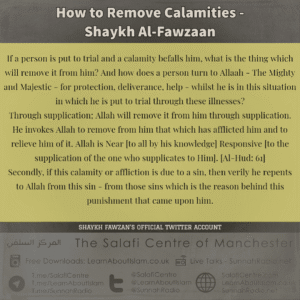
If a person is put to trial and a calamity befalls him, what is the thing which will remove it from him? And how does a person turn to Allaah – The Mighty and Majestic – for protection, deliverance, help – whilst he is in this situation in which he is put to trial through these illnesses?

How to Remove Calamities – Shaykh Al-Fawzaan

If a person is put to trial and a calamity befalls him, what is the thing which will remove it from him? And how does a person turn to Allaah – The Mighty and Majestic – for protection, deliverance, help – whilst he is in this situation in which he is put to trial through these illnesses?

Through supplication; Allah will remove it from him through supplication. He invokes Allah to remove from him that which has afflicted him and to relieve him of it. Allah is Near [to all by his knowledge] Responsive [to the supplication of the one who supplicates to Him]. [Al-Hūd:61]

Secondly, if this calamity or affliction is due to a sin, then verily he repents to Allāh from this sin – from those sins which is the reason behind this punishment that came upon him.


Shaykh Fawzan’s Official Twitter Account

The Bondage of Sins In This Dunyaa And Aakhirah, And The Virtue of Tawheed and Repentance

In The Name of Allaah, The Most Merciful, The Bestower of Mercy.

Disobedience is the cause of being in shaytaan’s captivity and a prisoner of lowly desires. A disobedient person is always in the captivity of his devil, the prison of his lusts and leadership of his desires. He is a captive and a shackled prisoner. There is neither a captive whose state of affairs is more evil than that of a captive whose captor is his worst enemy, nor is there a prison more restricted than the prison of desires, and shackles that are more restrictive than the shackles of lust; so how can a heart that is a captive and a shackled prisoner follow the path to Allaah and the home of the afterlife? How can he follow a single path when the heart is shackled and stricken with harm from every angle as a result of the [severity] of its shackles? The likeness of the heart is that of a bird; it distances from harm whenever it flies high and surrounded by harm whenever it lands. It is reported in a hadeeth: ‘’Shaytaan is a wolf to a human being.’’

And just as an unprotected sheep in the midst of wolves is quickly destroyed, likewise if there is no protection from Allaah for the slave, it is inevitable that his wolf will prey on him. He is protected by Allaah through Taqwaah. Taqwaah is a shield and shelter from Allaah between the person and his wolf; just as it is a shield against punishment in this life and the afterlife. Whenever the sheep is closer to its shepherd, it is safer from the wolf and whenever it is distanced from the shepherd, it comes closer to being destroyed. So the sheep is more protected when it is closer to the shepherd, for the wolf only takes away the [sheep, cattle]  that are distanced and far away from the shepherd.

The basis of this affair is that whenever the heart is distanced from Allaah, then harm upon it is quicker, and whenever it is comes closer to Allaah, it is distanced from harm. Being distanced from Allaah is of various levels and some are more severe than others. Being distanced from [Allaah] through disobedience is greater than being distanced from [Allaah] through thoughtlessness; being distanced from [Allaah] through bidah is greater than being distanced from [Allaah] through disobedience, and being distanced from [Allaah] through hypocrisy and shirk is greater than all of that. [Ref 1]

Sin and disobedience is something common in all the nations. It is something that has not cease to exist in the world amongst the Children of Aadam regardless of their different social classes- the common people, the ignorant ones, [the zuhhaad – those who choose to abstain from some of the lawful pleasures of the worldly life which one can do without], those desirous of it [i.e. the pleasures], the leaders and those under their rule.  This affair of [sin and disobedience] is not something specific to this Ummah of Muhammad [sallal laahu alayhi wasallam], such that [the Ummah] and its Prophet are [singled out] with rebuked as a result of that. Sin and disobedience does not negate belief in the Messengers, because it is possible for them to exist alongside belief in the Messengers. And although disobedience diminishes the perfection and completeness of belief in the Messengers, however it does not negate it.

Sins are wiped away through sincere repentance.  Allaah forgives the slave when he repents, even if his sins fill the heavens and are of a great number.  Allaah said: [قُلۡ يَـٰعِبَادِىَ ٱلَّذِينَ أَسۡرَفُواْ عَلَىٰٓ أَنفُسِهِمۡ لَا تَقۡنَطُواْ مِن رَّحۡمَةِ ٱللَّهِ‌ۚ إِنَّ ٱللَّهَ يَغۡفِرُ ٱلذُّنُوبَ جَمِيعًا‌ۚ إِنَّهُ ۥ هُوَ ٱلۡغَفُورُ ٱلرَّحِيمُ  – Say: O Ibaadee [My slaves] who have transgressed against themselves [by committing evil deeds and sins]! Despair not of the Mercy of Allaah, verily Allaah forgives all sins. Truly, He is Oft-Forgiving, Most Merciful. [39:53]

This is the right of the one who repents because repentance wipes away the sin after it [was committed]. Therefore, the one who repents from a sin is like one without that sin.  Tawheed wipes away sins, as [mentioned] in the Hadeeth Al-Qudsiy: ‘’O Son of Adam! If you were to meet Me with enough sins to fill the earth, whilst not associating anything with Me [in worship], I shall meet you with its equivalent in forgiveness.’’  Therefore, strong Tawheed wipes away the sins of the Muslims; but if punished for their sins, they will be removed from the fire as a result of their belief in Tawheed. As for the people of shirk and the disbelievers, their good deeds are nullified as result of the disbelief and shirk they are upon.  They will neither meet their Lord with good deeds in order to obtain safety nor will they be forgiven any of their sins. Allaah [Glorified be He] said: [إِنَّ ٱللَّهَ لَا يَغۡفِرُ أَن يُشۡرَكَ بِهِۦ وَيَغۡفِرُ مَا دُونَ ذَٲلِكَ لِمَن يَشَآءُ‌ۚ  – Verily, Allaah does not forgive (a person) the sin of associating partners with Him in worship (i.e. if one dies in that state without repentance),  but He (Allaah) forgives (sins that are) lesser than that (i.e. lesser than shirk) to whom He pleases]. [4:48]

Allaah [The Most High] said: [ وَقَدِمۡنَآ إِلَىٰ مَا عَمِلُواْ مِنۡ عَمَلٍ۬ فَجَعَلۡنَـٰهُ هَبَآءً۬ مَّنثُورًا – And We shall turn to whatever deeds they did, and We shall make such deeds as scattered floating particles of dust]. [25:23] [Ref 2]


[Ref 1: An Excerpt from ‘Ad-Daa’u Wad-Dawaa’u. page 119-120. slightly paraphrased]

[Ref 2: Source: An Excerpt from ‘Hidaayatul Hayaaraa Fee Ajwibatil Yahood Wan-Nasaaraa. Page 123-124. Slightly paraphrased]

Only Those Who Are Patient Shall Receive Their Rewards In Full, Without Hisaab [Without Limit, Calculation and Estimation]

In The Name of Allaah, The Most Merciful, The Bestower of Mercy.

Question: The questioner asks: What is the status of patience and what is the reward for those who exercise patience?

Answer: Patience has a great status in the sight of Allah (The Most High). The Eemaan of a slave (i.e. a male or female Muslim) cannot be perfect without patience.  Patience is from the best of deeds and its reward has no limits. When it is the case that one good deed is written as ten good deeds and can multiply until it reaches seven hundred or more, then indeed the reward for exercising patience has no limits,  for indeed Allaah ( Glorified and Exalted be He) said:

إِنَّمَا يُوَفَّى الصَّابِرُونَ أَجْرَهُم بِغَيْرِ حِسَابٍ

Only those who are patient shall receive their rewards in full, without Hisaab (without limit, calculation and estimation) [a] [39:10]

Patience is of three types:

[1] The first type patience is when a person exercises patience (whilst striving) to obey Allaah: A Muslim is commanded to exercise patience (whilst striving) to obey Allaah (The Most High), especially the when fulfilling obligations. And the first of those obligations is the prayer, for it is obligatory to establish it at its fixed time together with all its conditions and obligatory acts. [b] Therefore, patience is required in seeking to fulfill the five daily prayers. When a sleeping person hears the Adhaan of Fajr, he strives against his soul and wakes up, and then he performs Wudhu and goes to the Masjid. This is patience whilst seeking to obey Allaah. One also exercises patience in striving to treat his (or her) parents kindly, dealing with them in a beautiful manner and patiently bearing whatever occurs from that. Allaah (The Most High):

وَقَضَىٰ رَبُّكَ أَلَّا تَعْبُدُوا إِلَّا إِيَّاهُ وَبِالْوَالِدَيْنِ إِحْسَانًا ۚ إِمَّا يَبْلُغَنَّ عِندَكَ الْكِبَرَ أَحَدُهُمَا أَوْ كِلَاهُمَا فَلَا تَقُل لَّهُمَا أُفٍّ وَلَا تَنْهَرْهُمَا وَقُل لَّهُمَا قَوْلًا كَرِيمًا

And your Lord has decreed that you worship none but Him. And that you be dutiful to your parents. If one of them or both of them attain old age in your life, say not to them a word of disrespect, nor shout at them but address them in terms of honour. [17:23]

وَاخْفِضْ لَهُمَا جَنَاحَ الذُّلِّ مِنَ الرَّحْمَةِ وَقُل رَّبِّ ارْحَمْهُمَا كَمَا رَبَّيَانِي صَغِيرًا

And lower unto them the wing of submission and humility through mercy, and say: “My Lord! Bestow on them Your Mercy as they did bring me up when I was small.”[17:24]

رَّبُّكُمْ أَعْلَمُ بِمَا فِي نُفُوسِكُمْ ۚ إِن تَكُونُوا صَالِحِينَ فَإِنَّهُ كَانَ لِلْأَوَّابِينَ غَفُورًا

Your Lord knows best what is in your inner-selves. If you are righteous, then, verily, He is Ever Most Forgiving to those who turn unto Him again and again in obedience, and in repentance. [17:25]

A person should also exercise patience in seeking to nurture his (or her) children and teaching them good manners and behaviour.

[2] The second type of patience is when a person exercises patience in seeking to restrain him (or herself) from disobeying Allaah: A person excises this patience in order to prevent him or (herself) from sins and (evil) desires. And among those sins a person should keep away from is that he refrains from violating the honour of the people.

[3] The third type of patience is when a person exercise patience when encountered with Allaah’s decree, which maybe something painful (i.e. a calamity): That is because that which afflicts a person, such as the death of a son (or daughter) or being afflicted with a sickness on a person’s the body, or his (or her) sanity, or what may afflict a relative of his (or hers), it is obligated on a person to exercise patience when these affairs are encountered and should hope for Allaah’s reward for being patient. He should know that all these affairs are from Allaah.  Allah (the most high) said:

مَا أَصَابَ مِن مُّصِيبَةٍ إِلَّا بِإِذْنِ اللَّهِ ۗ وَمَن يُؤْمِن بِاللَّهِ يَهْدِ قَلْبَهُ ۚ

No calamity befalls, but with the Leave [i.e. decision and Qadar (Divine Preordainments)] of Allah, and whosoever believes in Allah, He guides his heart. [64:11]

Alqamah (radiyallaahu-anhu) said: This (ayah) is about a person who is afflicted with a calamity and he knows that it is from Allaah.  So he becomes pleased with what Allaah has decreed and submit to Allaah’s judgement, and he (or she) says: ‘’this is Allaah’s decree. I believe in Allaah and we are pleased with Allaah’s decree.” So Allaah fills his heart with Eemaan and tranquillity, and he (or she) receives a great reward (i.e. due to his patience).

We ask Allaah to include us and you amongst those who exercise patience.

[Source: Fadaa’il Al- A’maal’ pages 11-14’ by Shaikh Muhammad Bin Abdillaah As-Subayyil (rahimahullaah). Abridged and slightly paraphrased]


[a] Tayseerul Kareem Ar-Rahmaan Fee Tafseeri Kalaam Al-Mannaan’ by Imaam Sadi (rahimahullaah)

[b]Conditions, pillars and obligations of the prayer, see  link:

http://www.salafitalk.net/st/viewmessages.cfm?Forum=10&Topic=8984