In The Name of Allah, The Most Merciful, The Bestower of Mercy.
A Team of Wild Guessers at it again
They said, “We have killed the Messiah, son of Maryam, Allah’s Messenger”
https://salafidawahmanchester.com/2024/12/25/they-said-we-have-killed-the-messiah-son-of-maryam-allahs-messenger-part-1/
In The Name of Allah, The Most Merciful, The Bestower of Mercy.
On the contents page of the Shaikh’s book “Hujjiyyah Khabar al-Aahaad Fil Aqaa’id Wal-Ahkaam,” specifically on pages 162-163, a translation of the Shaikh’s summary in Arabic was provided by an individual as follows:
In this research, I endeavored to clarify the following:
The condition of the people at the time of the commissioning of the Prophet and the ignorance and misguidance that they were in at that time.
The Messenger’s conveying everything that was revealed to him, the Companions also conveying and applying this Message, upholding it in the best way, and how numerous nations were guided at their hands.
I mentioned how the rancorous amongst the Jews, Christians and atheists confronted this Message and its adherents with plots, including lying against Allah’s Messenger and discrediting the Guidance and Knowledge which he came with. I further mentioned how the Imams of Hadeeth and others countered these plots and exposed their proponents as well as how some sects deviated and how the paragons of the Sunnah rebutted these deviations.
I explained in this research paper the status of the Sunnah of Allah’s Messenger as laid out in the Qur’an and the Sunnah, and the status it held with the noble Companions and those who trod their path, from the best of the Muslim Ummah.
I clarified the misguidance and doubts of the People of Desires and the doubts of the otheists surrounding the Sunnah in the past and in the present, along with the proofs and evidences that refute them.
I mentioned the doubts of some groups surrounding non-concurrent (Aahaad) narrations constituting knowledge and their claim that these narrations, including the reports contained within the two Saheehs (Al-Bukhari and Muslim), amount only to speculation (dhann).
All this I mentioned with full clarification and detail in five sections.
I ask Allah to benefit me and all the Muslims with this humble effort, indeed my Lord answers the prayers.
In The Name of Allah, The Most Merciful, The Bestower of Mercy.
At present, this (phenomenon) is prevalent, particularly within the political movements, as some have witnessed, while others say: “I do not know of a politician who does not lie”. Some say, “Politics is hypocrisy”. Many politicians – within the political groups – exhibit hypocrisy of action. [Footnote a] From the signs of this hypocrisy is allegiance to the proponents of innovation in the religion and the establishment of dangerous methodologies to counter the methodology of Ahlus Sunnah to destroy it, such as the methodology of Muwaazanaat, [Footnote b] the methodology of “Broad, inclusive framework” that embraces all the Ummah, [Footnote c] among other principles designed to wage war against Ahlus Sunnah and defend the proponents of Bidah and misguidance. [Footnote d] [1]
In The Name of Allah, The Most Merciful, The Bestower of Mercy.
Two Compelling Admonitions [By Al-Allamah Rabee Bin Hadi Al-Madf’khali, may Allah preserve him], On The Tremendous and Fruitful Outcomes of Truthfulness and The Detrimental Outcomes of Lying
And (remember) when Ibrahim (Abraham) said: My Lord, make this city (Makkah) a place of security and provide its people with fruits, such of them as believe in Allah and the Last Day]. [Al-Baqara. 126]
Al-Allamah Salih Al-Fawzan, may Allaah protect him, said:
He (Ibrahim – peace be upon him) prioritized security in his supplication over the pursuit of sustenance because security is an essential requirement. Without security, individuals cannot truly enjoy sustenance, as fear undermines the ability to attain it. This is precisely what adversaries aim for—those who seek to destabilise Muslim societies. They wish to create division among Muslims and weaken their unity behind their leaders. This is what they desire – in the guise of promoting beneficial outcomes, rectification, and the alleviation of oppression. They do not desire good advice for the Muslims.
This is all false pretenses, as the absence of rulership would lead to widespread chaos, the proliferation of corruption, and the failure of the promised benefits. Corruption would become rampant, and rectification would be unattainable. Consequently, it is imperative for Muslims to unite under a leadership structure. Even if such leadership exhibits flaws and negligence, the populace should practice patience, as this patience serves to avert greater harm and adversity. Shaikh Al-Islam Ibn Taymiyyah, may Allah have mercy upon him, said: “It is not known of a group that has ever risen against their Muslim ruler without their circumstances deteriorating further after his removal.” This observation is evident in contemporary times. What is the situation of the countries where the rulers and heads of state have been removed? There has not ceased to be fear, anxiety, chaos, and bloodshed etc. [1]
This underscores the significance of safety as a fundamental necessity for individuals. Otherwise, Ibrahim, peace be upon him, would not have persistently sought Allah’s assistance in establishing it in this land. Consider the regions where a system that ensures safety has deteriorated. In such places, the populace struggles to manage their daily affairs; schools and markets remain closed, and individuals are confined to their homes. Those who have the means often seek to escape to safer locations. When inquiring with one of them, it becomes evident that they feel unable to coexist with their community and family in an environment devoid of safety.
Security can only be effectively established through two key principles: the implementation of Allah’s Laws and obedience to the rulers. The Messenger, peace and blessings of Allah be upon him, elucidated this essential matter for Muslims in their lives. Irbad Sariyah, may Allah be pleased with him, reported that the Messenger of Allah, peace and blessings of Allah be upon him, delivered an admonition after the morning prayer—an admonition that instilled fear in our hearts and brought tears to our eyes. A man then asked, ‘Is this a farewell sermon, and what counsel do you offer us?’ He replied, ‘I enjoin on you to fear Allah and to listen and obey, even if an Abyssinian slave is appointed as your ruler. Indeed, those among you who live long enough will witness many differences. Therefore, be cautious of newly introduced matters in the religion, for they lead to misguidance. Whoever among you observes such occurrences is obliged to adhere to my Sunnah and the Sunnah of the rightly guided caliphs, holding firmly to it with your molar teeth.'” [Ahmad 3/126]
This hadith lays the foundations for security within Islam, which consists of two primary components. The first is fear of Allah (The Most High), understood in its fullest and most comprehensive sense. The second component is the adherence to the rulers in matters that are just and beneficial. The fear of Allah fosters a Muslim’s relationship with Allah, their neighbours, and the surrounding environment. Conversely, the absence of Allah’s Shariah leads to chaos and moral decay. Indeed, Allah (The Mighty and Majestic) has issued a warning to those who forsake His Shariah and disobey His Messenger. Allah said:
And Allah puts forward the example of a township (Makkah), that dwelt secure and well content; its provision coming to it in abundance from every place, but it (its people) denied the Favours of Allah (with ungratefulness). So Allah made it taste the extreme of hunger (famine) and fear, because of that (evil, i.e. denying Prophet Muhammad) which they (its people) used to do. [Al-Nahl. 112]
Listening to and obeying the rulers in a (positive manner) ensures that an individual’s affairs within society remain orderly. This act of compliance is intrinsically linked to fear of Allah. Al-Hasan Al-Basri, may Allah have mercy upon him, said: “Indeed, Al-Hajjaaj is a manifestation of Allah’s punishment; therefore, do not attempt to counteract Allah’s punishment with your own hands. Instead, it is essential to submit and exhibit humility, as Allah, the Most High, has stated:
[وَلَقَدْ أَخَذْنَاهُم بِالْعَذَابِ فَمَا اسْتَكَانُوا لِرَبِّهِمْ وَمَا يَتَضَرَّعُونَ – And Indeed We seized them with punishment, but they humbled not themselves to their Lord, nor did they invoke (Allaah) with submission to Him]. [Al-Muminun. 76]
You see a person who possesses a true understanding of security and his awareness is increased through fear of Allah, thus, he is eager to obey the rulers. However, when there is a lapse in their piety, their sense of security may diminish. Once fear of Allah is established, they they will attain the promise that Allah has mentioned (as follows):
Allah has promised those among you who believe, and do righteous good deeds, that He will certainly grant them succession to (the present rulers) in the earth, as He granted it to those before them, and that He will grant them the authority to practise their religion, that which He has chosen for them (i.e. Islam). And He will surely give them in exchange a safe security after their fear (provided) they (believers) worship Me and do not associate anything (in worship) with Me. But whoever disbelieved after this, they are the Fasiqun (rebellious, disobedient to Allah). [Al-Nur 55]
The lack of obedience to the ruler and prioritizing personal interests over that of the ruler is among the most significant factors leading to the corruption of both the land and its inhabitants, as well as a deviation from the path of righteousness and guidance. Al Hasan Al Basri, may Allah have mercy upon him, stated, “By Allah! The establishment of religion is only possible through rulers—despite their potential for tyranny and oppression—because they rectify numerous matters through their governance that outweigh the corruption they may cause.” Imam Ibn Rajab, may Allah have mercy upon him, stated, “The worldly life holds significant benefits when rulers are followed. Through this obedience, the essential matters concerning the sustenance of the populace are established, enabling them to utilize these means as support in demonstrating their faith and fulfilling their obligations to their Lord.” Read: http://www.abukhadeejah.com/the-tyranny-of-the-rulers-a-reason-for-rebellion/
Disregarding the authority of rulers and prioritizing oneself through conflict or other means equates to defying Allah and His Messenger, as well as opposing the principles upheld by Ahlus Sunnah Wal Jamaa’ah, the righteous predecessors. The maintenance of security fosters unity and cooperation among Muslims. Allah, the Mighty and Majestic, stated:
The believers are nothing else than brothers (in Islamic religion). So, make reconciliation between your brothers, and fear Allah, that you may receive mercy. [Al-Hujurat. 10]
The believers, men and women, are Auliya’ (helpers, supporters, friends, protectors) of one another, they enjoin (on the people) Al-Ma’ruf, and forbid (people) from Al-Munkar; they perform As-Salat and give the Zakat, and obey Allah and His Messenger. Allah will have His Mercy on them. Surely Allah is All-Mighty, All-Wise. [at-Tawbah 71]
Iman is neither a matter of wishful thinking or superficial assertions; it is a conviction that resides in the heart, evidenced by one’s actions. A true believer cannot be considered as such until he desires for his Muslim brother what he desires for himself and interacts with others in a manner he wishes to be treated. It is universally acknowledged that security is a fundamental aspiration for all; thus, it is incumbent upon a Muslim to actively seek the security of others in order to attain security and safety for himself. Furthermore, maintaining security within a community requires the fulfillment of trusts, while creating an atmosphere of insecurity equates to betrayal. Allah, the Most High, has stated:
O you who believe! Betray not Allah and His Messenger, nor betray knowingly your Amanat (things entrusted to you, and all the duties which Allah has ordained for you). And know that your possessions and your children are but a trial and that surely with Allah is a mighty reward. O you who believe! If you obey and fear Allah, He will grant you Furqan a criterion [(to judge between right and wrong), or (Makhraj, i.e. making a way for you to get out from every difficulty)], and will expiate for you your sins, and forgive you, and Allah is the Owner of the Great Bounty. [Al-Anfal. 27-29]
Shaikh Al-Islam Ibn Taymiyyah, may Allah have mercy upon him, said, “They [i.e. Ahlus Sunnah] know that Allah sent Muhammad, peace and blessings of Allah be upon him, for the benefit of the creation in this life and the next, and Allah commands rectification and not corruption”. (2)
Closing the Door of Rebellion Against the Ruler – Shaikh Abu Iyaad Amjad Rafiq
[1] Excerpt From a Juma’ah Khutbah: Khutbah Number 1: dated 1432-03-15: http://www.alfawzan.af.org.sa/node/13208 paraphrased
If anyone killed a person not in retaliation of murder, or (and) to spread mischief in the land – it would be as if he killed all mankind, and if anyone saved a life, it would be as if he saved the life of all mankind. [Surah Al-Maa’idah. Ayah 32]
Imam As-Sadi [may Allah have mercy upon him] said: This means that the killer has no justification to kill, and one should not kill another person unless he has a justified reason (i.e. based on the law of the land) to do so. If a person is bold enough to kill someone who does not deserve to be killed, this implies that he does make a distinction between the one he killed and other than him; rather he would commit this act whenever his evil calls him to that. Therefore, his bold attitude that led him to kill is as if he had killed all humankind. On the other hand, if a person saves a life and does not kill – whilst his soul calls him to do so – due to fear of Allah, this is as if he has saved the lives of all humankind because the fear of Allah he possesses stops him killing one who does not deserve to be killed. [1]
The conduct of the Zionist army, led by Netanyahu, starkly contrasts with the high moral standards referenced in the verse concerning the preservation of life. Instead, they seek justifications for the killing of their own in accordance with the Hannibal Doctrine. Regardless of their acceptance, the principles of the “Dahiya doctrine” and the “Hannibal code,” which they have attempted to obscure, have been scrutinised once again. The “Dahiya philosophy” emerged during the 2006 conflict between the Zionists and Lebanon, with Dahiya denoting the southern suburbs of Beirut that were subjected to bombardment by Zionist aircraft. This strategy is predicated on the belief that a disproportionate application of force can inflict significant and enduring damage on every village from which attacks are launched against Zionists, irrespective of the impact on civilians. The intent behind such a response is to impose severe damage and punishment, necessitating lengthy and costly reconstruction efforts. Consequently, this excessive use of force, cloaked as deterrence, aims to achieve widespread destruction rather than making genuine and sincere effort to avoid civilian casualties. Ibn Abbas, may Allah be pleased with him and his father] said, “Do not kill women, children, old men, or anyone who approaches you for peace and refrains from fighting, because if you do so then you have transgressed without a doubt”. [2] Read the article by Shaikh Abu Iyaad [may Allah preserve him: https://abuiyaad.com/a/justice-war-abu-bakr-advice
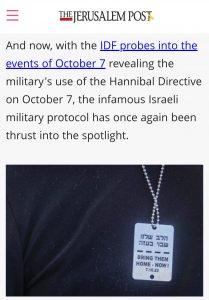
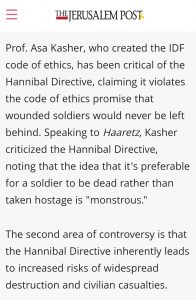
The “Hannibal code” refers to the principle that all possible actions should be taken to avert the abduction and detention of a soldier, even if such actions may endanger the lives of the abductees, potentially leading to the death of either the soldier or civilians in order to prevent them from being captured by opponents. Over a year ago, when it was reported that Zionist soldiers were implicated in the deaths of certain citizens during the October 7 attack by Hamas, many individuals categorically rejected this assertion, attributing sole responsibility for the day’s events to Hamas, even though Hamas were also involved in the assault on some non-combatants and unarmed civilians. However, recently, the matter is being portrayed differently, highlighting the controversial Zionist military’s use of the Hannibal code. Read the newspaper excerpts at the end of this article regarding this matter.
Indeed, the tyrannical Zionists remind us of some of the tyrannical disbelievers of old! Allah said:
The people Aad belied the Messengers. When their brother Hud said to them: “Will you not fear Allah and obey Him? Verily! I am a trustworthy Messenger to you. So fear Allah, keep your duty to Him and obey me. No reward do I ask of you for it (my Message of Islamic Monotheism), my reward is only from the Lord of the ‘Alamin (mankind, jinns, and all that exists). Do you build high palaces on every high place, while you do not live in them? And do you get for yourselves palaces (fine buildings) as if you will live therein forever? And when you seize, seize you as tyrants? So fear Allah, keep your duty to Him and obey me. And keep your duty to Him, fear Him Who has aided you with all (good things) that you know. He has aided you with cattle and children. And gardens and springs. Verily, I fear for you the torment of a Great Day”. They said: “It is the same to us whether you preach or be not of those who preach. This is no other than the false tales and religion of the ancients, and we are not going to be punished”. So they belied him, and We destroyed them. Verily! In this is indeed a sign, yet most of them are not believers. And verily! Your Lord, He is indeed the All-Mighty, the Most Merciful. [Surah Ash-Shu’araa. Ayaat 123-140]
Regarding the statement: [وَإِذَا بَطَشۡتُم بَطَشۡتُمۡ جَبَّارِينَ – And when you seize, you seize as tyrants] – Meaning, when you want to attack with a whip or sword, you attack like tyrants, completely overpowering and being savagely violent – neither compassionate nor aim to discipline (within justice as commanded by Allah), nor contemplating on the consequences. [3] Allah gave them great strength and it was obligated on them to use this strength in obedience to Allaah, but they became boastful and haughty, and they said: [مَنۡ أَشَدُّ مِنَّا قُوَّةًۖ – Who is mightier than us in strength? (Surah Fussilat. Verse 15]; and they utilized their strength in disobedience to Allaah, fruitlessly and foolishly, so their Prophet forbade them from that. [4] Their Prophet forbade them from that because it was done out of oppression. [5]
Did you (O Muhammad) not see (thought) how your Lord dealt with ‘Ad (people)? Who were very tall like lofty pillars, the like of which were not created in the land? And (with) Thamud (people), who cut (hewed) out rocks in the valley (to make dwellings)? And (with) Fir’aun (Pharaoh), who had Al-Awtaad? Who did transgress beyond bounds in the lands (in the disobedience of Allah). And made therein much mischief. So your Lord poured on them different kinds of severe torment. Verily, your Lord is Ever Watchful (over them). [Surah Al-Fajr. Ayaat 6-14]
[أَلَمۡ تَرَ -Did you (O Muhammad) not see]- Meaning, with your heart and insight, how those tyrannical nations were dealt with- the (people of) Iram, the well-known tribe in Yemen. [ذَاتِ ٱلۡعِمَاد -Who were very tall like lofty pillars]- Meaning, they had great strength and were insolent and proud. [ٱلَّتِى لَمۡ يُخۡلَقۡ مِثۡلُهَا -The like of which were not created]- Meaning, none was similar to Aad in strength; [فِى ٱلۡبِلَـٰدِ – In the land]-Meaning, in all the lands (due to what they possessed of power and strength), just as Allah [The Most High] says that their Prophet Hud (peace be upon him)said to them: [وَٱذۡڪُرُوٓاْ إِذۡ جَعَلَكُمۡ خُلَفَآءَ مِنۢ بَعۡدِ قَوۡمِ نُوحٍ۬ وَزَادَكُمۡ فِى ٱلۡخَلۡقِ بَصۜۡطَةً۬ۖ فَٱذۡڪُرُوٓاْ ءَالَآءَ ٱللَّهِ لَعَلَّكُمۡ تُفۡلِحُونَ -And remember that He made you successors after the people of Nuh (Noah), and increased you amply in stature. So remember the graces (bestowed upon you) from Allah, so that you may be successful] [Al-A’raaf: Ayah 70]
[وَثَمُودَ ٱلَّذِينَ جَابُواْ ٱلصَّخۡرَ بِٱلۡوَاد – And (with) Thamud (people), who cut (hewed) out rocks in the valley (to make dwellings)]; Meaning: Valley towns, which they hewed out of solid rocks with their strength and took them as dwelling places.
[وَفِرۡعَوۡنَ ذِى ٱلۡأَوۡتَاد – And (with) Fir’aun (Pharaoh), who had the stakes]; Meaning: He had hosts that established his authority, like how stakes firmly hold something (on the ground). [ٱلَّذِينَ طَغَوۡاْ فِى ٱلۡبِلَـٰدِ – Who did transgress beyond bounds in the lands (in the disobedience of Allah)]; Meaning: Aad, Thamud, Fir’awn and those who followed them because they transgressed in Allah’s earth and harmed the slaves of Allah in their religious and worldly affairs. And because of this Allah (The Most High) said: [فَأَكۡثَرُواْ فِيہَا ٱلۡفَسَاد – And made therein much mischief]; Meaning: Disbelief (in Allah and His Messengers); spreading all types of disobedience (in the land); hastening to wage war against the Messengers and hindering mankind from the path of Allah.
So when they reached that state of haughtiness deserving of destruction, Allah sent them His punishment -different kinds of severe torment. [إِنَّ رَبَّكَ لَبِٱلۡمِرۡصَادِ – Verily, your Lord is Ever Watchful]; Meaning: Ever watchful over the one who disobeys Him. Allah gives him respite for a little while and then seizes him with a mighty and powerful punishment. [6]
Also, other groups behaved in this manner, such as the Muta’assibah (Fanatical Partisans) among the Jews and the Azaariqah among the Khawaarij. “The fanatical partisans among the Jews were a group whose thought was close to that of the Faareesiyyoon, but they were very aggressive and believed in assassinating anyone who disagreed with them. They were also called Saffaakoon [Those Eager to Commit Murder], and they committed pillage, plunder, and transgressed against everyone who accepted submission to others besides them. Hostility occurred between them and the Fareesiyyoon because the Faareesiyyoon submitted to the Romans. Some of the researchers consider them to be from the political or nationalistic sects, even though their movement started within a religious framework, but great were the crimes that they committed from one place to another”. [7] As for the Azaariqah among the Khawaarij, Al-Baghdaadee [429 AH- may Allah have mercy upon him] stated about their Bidah: “From them is their declaration that it is permissible to kill the women and children of their opponents, and they claimed that the children of their opponents would dwell in the fire forever”. [8]
Regarding the use of white phosphorus, the Zionist military cannot deny the fact that it has used it in the past as stated in the Jerusalem Post as follows:
However, as for the recent claims during the recent conflict that Netanyahu’s army of Zionists are using it again, this is still being investigated, so we’ll wait for the reliable and unbiased investigators and experts – among Muslims and non-Muslims – to produce a final report. We neither negate nor affirm until the affair is finalised, but what remains a fact is that the Zionists did use white phosphorous in the past.
Finally, every oppressor who uses these barbaric methods reminds us of what has been stated in Surah Al-Burooj. Allah said:
Cursed were the People of the Ditch, (the large ditch with) the fire, given fuel (in abundance). While they were sat over it (watching those whom they punished by burning). [9]
Imam As-Sadi [may Allah have mercy upon him] said: This is the greatest type of tyranny and heart-heartedness because they combined disbelief in Allah’s Ayaat and wilful opposition to them, waging war against its adherents and torturing them with this torment, which the extremely heart-breaking, whilst they are present and throwing them into it. And the fact is that they did not take revenge on the believers except due to a characteristic for which they are praised, and by way of which they attain happiness (in this life and the next), which is that they believed in Allah. [10]
Imam Muhammad Ibn Saalih Al-Uthaymeen [may Allah have mercy upon him] said, “They saw the fire burning these people while sitting and joking as if nothing was happening, and Allah’s protection is sought (against this behaviour). This is tyranny that a person sees a human being burnt with fire while he reclines on his couch and is distracted by the conversation and does not care”. [11]
[1] Tafseer As-Sadi.
[2] Tafseer at-Ṭabaree 2/190
[3] Roohul Ma’aanee by Imam Vol 11. page 165. By Imaam al-Aloosee (may Allah have mercy upon him)]
[4] Tafseer As-Sadi. slightly paraphrased
[5] Zaadul Maseer Fee Ilmit Tafseer by Imaam Ibnul Jawzi (may Allah have mercy upon him)
[6] Tafseer As-Sadi. slightly paraphrased
[7]Al-Faslu Fil Milal Wal-Ahwaa Wan-Nihal. 1/177-179 By Ibn Hazm. Publisher: Daar Al-Jeel 1405AH. Al-Milal Wan-Nihal 1/215-219. By Ash-Sharastaanee. Maktabah Al-Halabiy 1406AH. Maqaarinatul Ad’yaan Al-Yahoodiyyah 218-225. Maktabah An-Nahdah Al-Misriyyah
In The Name of Allah, The Most Merciful, The Bestower of Mercy.
Hudhaifah, may Allah be pleased with him, reported that the Messenger of Allah, peace and blessings of Allah be upon him, said: “Trials will be presented to the hearts of people like a reed mat woven stick by stick and any heart afflicted by them will have a black mark put into it, but any heart that rejects them will have a white mark put into it. Thus there will be two kinds of hearts: one is pure like a white gemstone and it will not be harmed by any tribulation as long as the heavens and earth endure, and the other is black and dusty like a worn-out vessel, neither recognizing good nor rejecting evil, but rather immersed in its desires.” [Sahih Muslim 144]
We seek refuge with Allah from the trials and desires that cause the hearts to become like a worn out vessel, corrupts them, places them in blindness and darkness; neither recognising good nor rejecting evil, instead immersed in their (evil) desires.
In The Name of Allah, The Most Merciful, The Bestower of Mercy.
A Precise Definition of Hizbiyyah Constantly Fought By The Salafiyyoon In The West – By The Tawfeeq of Allah – Under The Guidance of The Senior Scholars, Such as Al-Allamah Rabee, Al-Allamah Ubaid and Others, During The Various Fitan and Applied to This Day, Including The Fitna of The Qutubiyyah, Sururiyyah, Salman, Safar, Abdur Rahman Abdul Khaliq, Al-Maribi, Al-Maghrawi, Al-Halabi, Al-Hajuri and Others Who Came After Them
Al-Allamah Rabee Bin Haadi Al-Mad’khali, may Allah preserve him, stated:
Bigoted partisanship for a particular idea that opposes the Book of Allah and the Sunnah of the Messenger; allegiance and enmity based upon it, this is Tahazzub (illegal partisanship). This is Tahazzub even if it is not (under an) organisation. To formulate deviated ideas and gather the people on it, this is a hizb, regardless of whether it is (under an) organisation or not. [1]
A Matter Fully Understood For Nearly Three Decades In The West – By The Tawfeeq of Allah – Under The Guidance of Senior Scholars, Such as Al- Allaamah Rabee, Al-Allamah Ubaid and Others Whenever The Proponents of Illegal Partisanship Sought to Obscure It, Including The Likes of Adnan Ar’ur, Ali Halabi, Al-Maribi and Others Who Came After Them
Al-Madkhalee, may Allah preserve him, stated:
After speaking about those – amongst the different factions of the Jahmiyah, the Khawaarij, the Rawafid and the Qadariyyah, and the reason behind such Takfeer – who excommunicate (Muslims) based on falsehood , Shaikh Al-Islam Ibn Taymiyyah [may Allah have mercy upon him] stated, “On the opposite side of these people who make Takfeer based on falsehood, there are a people who do not know the creed of Ahlus Sunnah Wal-Jamaa’ah as it should be; or they know some of it and are ignorant of some. And perhaps what they know of it, they do not clarify for the people, rather they conceal it. They do they forbid innovations in religious affairs- neither censure the proponents of innovation in religious affairs nor chastise them; rather they may censure speech regarding the Sunnah and the fundamental principles of the religion – completely – and not differentiate between what the true adherents to the Prophetic tradition say and what proponents of religious innovations and schism say; or they would affirm all their differing paths in a manner similar to how the scholars would affirm the different opinions related to affairs of Ijtihaad in which difference of opinion is justified (or allowed). This path has overwhelmed many of the Murji’ah, some of the jurists, those pursuing the path of asceticism and the philosophers, just as it has overwhelmed – first and foremost – many amongst the people of desires and rhetoric. Both these paths are perverted, outside the Kitaab [i.e. The Qur’aan] and the Prophetic tradition”. [2]
After quoting the statement of Shaikh Al-Islam, Al-Allamah Rabee stated, “I say, may Allaah have mercy on Ibn Tamiyyah. Indeed, he clarified the situation of the people of his era and those before them, then what if he saw the situation of many amongst the Al-Jamaa’aat Al-Hizbiyyah Wal-Bid’iyyah [The Groups of Illegal Partisanship and Innovations in religious affairs] who ascribe themselves to true adherents to the Prophetic tradition and take cover behind him- in particular – to promote their falsehoods. What if he saw them whilst they have definitely gathered between the paths of the two groups- the khawaarij and those who follow their way in pronouncing Takfeer in the subject matter of Al-Haakimiyyah and the way of the Mur’jiah in the manner they approach the affair of people who are upon the major and numerous innovations in religious affairs, and equating innovation in religion to those affairs of the religion in which Ijtihaad is justified, whose people are rewarded alongside a refutation against their mistakes. In the view of these people, the leaders of Misguidance and innovation in religion are just like the Imams of Guidance and Sunnah. [3]
Finally, Shaikh Al-Islam Ibn Taymiyah stated: Rather what is obligatory is to clarify that which Allah sent His Messengers with and (revealed) in His Books – propagate that which the Messengers brought from Allah and fulfill the covenant which Allah took from the scholars. Therefore, it is obligatory to know that which the Messengers brought, believe in it, propagate it, call to it, striving with it, weigh up all that which the people embark upon – (statements, actions, religious fundamentals and subsidiary issues pertaining to the apparent actions of the Limbs and affairs related to actions of the heart)- under the Book of Allah and the Sunnah of His Messenger; neither following desires (through) customs, a school of law, a religious order, a leader or a predecessor; neither following conjecture through a weak hadith nor corrupt analogy, regardless whether it is an analogy that offers some degree of certainty or not; nor blindly following someone whom it is not obligated to follow his statement and deed, because indeed Allaah -in His Book – censured those who follow conjecture and that which their souls desire, whilst they abandon that which came to them from their Lord of Guidance. [4]
A Path Understood and Followed By The Salafiyyoon – By The Tawfeeq of Allah – in The West For Nearly Three Decades Under The Guidance of The Senior Scholars, Such as Al-Allamah Rabee, Al-Allamah Ubaid and Others, Whenever Individuals Committed Wrong and Wanted Special Treatment or to Escape With Their Wrong doings, Such as Suhaib Hasan, and Others
Shaikh Al-Islam Ibn Taymiyyah, may Allah have mercy upon him, said:
ﻭﻟﻴﺲ ﻟﻠﻤﻌﻠﻤﻴﻦ ﺃﻥ ﻳﺤﺰﺑﻮﺍ ﺍﻟﻨﺎﺱ
ﻭﻳﻔﻌﻠﻮﺍ ﻣﺎ ﻳﻠﻘﻲ ﺑﻴﻨﻬﻢ ﺍﻟﻌﺪﺍﻭﺓ ﻭﺍﻟﺒﻐﻀﺎﺀ،
ﺑﻞ ﻳﻜﻮﻧﻮﻥ ﻣﺜﻞ ﺍﻷﺧﻮﺓ ﺍﻟﻤﺘﻌﺎﻭﻧﻴﻦ ﻋﻠﻰ
ﺍﻟﺒﺮ ﻭﺍﻟﺘﻘﻮﻱ ﻛﻤﺎ ﻗﺎﻝ ﺗﻌﺈﻟﻰ
وَتَعَاوَنُوا عَلَى الْبِرِّ وَالتَّقْوَى وَلا تَعَاوَنُوا عَلَى الإثْمِ وَالْعُدْوَانِ
وليس لأحد منهم أن يأخذ على أحد عهداً بموافقته على كل ما يريده وموالاة من يواليه ومعاداة من يعاديه،بل من فعل هذا كان من جنس جنكز خان وأمثاله الذين يجعلون من وافقهم صديقاً واليا، ومن خالفهم عدوَّا باغيا، بل عليهم وعلى أتباعهم عهد الله ورسوله بأن يطيعوا الله ورسوله ويفعلوا ما أمر الله ورسوله ويحرموا ما حرم الله ورسوله ويرعوا حقوق المعلمين كما أمر الله ورسوله، فإن كان أستاذ أحد مظلوماً نصره، وإن كان ظالماً لم يعاونه على الظلم بل يمنعه منه كما ثبت في الصحيح أنه قال:
(انصر أخاك ظالماً أو مظلوماً. قيل: يا رسول الله: أنصره مظلوماً فكيف أنصره ظالماً؟. قال تمنعه من الظلم فذلك نصرك إياه).
وإذا وقع بين معلم ومعلم أو تلميذ وتلميذ أو معلم وتلميذ خصومة ومشاجرة لم يجز لأحد أن يعين أحدهما حتى يعلم الحق، فلا يعاونه بجهل ولا بهوى، بل ينظر في الأمر، فإذا تبين له الحق أعان المحق منهما على المبطل سواء كان المحق من أصحابه أو أصحاب غيره، وسواء كان المبطل من أصحابه أو أصحاب غيره، فيكون المقصود عبادة الله وحده وطاعة رسوله واتباع الحق والقيام بالقسط
قال تعالى
يا أيها الذين آمنوا كونوا قوامين بالقسط شهداء لله ولو على أنفسكم أو الوالدين والأقربين، إن يكن غنياً أو فقيراً فالله أولى بهما، فلا تتبعوا الهوى أن تعدلوا وإن تلووا أو تعرضوا فإن الله كان بما تعملون خبيراً
It not allowed for the teachers to initiate (illegal) partisanship between the people and do that which would cause enmity and hatred between them; but rather they should be brothers who cooperate upon righteousness and piety, as Allah [The Exalted] said: [وَتَعَاوَنُوا عَلَى الْبِرِّ وَالتَّقْوَىٰ ۖ وَلَا تَعَاوَنُوا عَلَى الْإِثْمِ وَالْعُدْوَانِ – Help you one another in Al-Birr and At-Taqwa [virtue, righteousness and piety]; but do not help one another in sin and transgression]. [Al-Ma’idah. 2]
It is not allowed for anyone of them to receive a pledge from anyone to be in agreement with him in everything he wants – having allegiance to the one he is allied to and enmity against the one he harbours enmity, and whoever does this is similar to Genghis Khan and his ilk (in this affair), who take as their loyal friends the one in agreement with them and the one who oppose them as a rebellious enemy; rather it is obligated on them and their followers (i.e. the teachers) to fulfil the covenant of Allah and His Messenger by obeying Allah and His Messenger, doing that which Allah and His Messenger have commanded, declare unlawful that which Allah and His Messenger have declared unlawful, and preserve the rights of the teachers in the manner commanded by Allah and His Messenger. So, if one’s teacher is oppressed, he should help him; but if the teacher is the oppressor, he should not aid him in his act of oppression; rather he forbids him from it, as it has been established in the authentic books of hadeeth that the Prophet [peace and blessings of Allah be upon him] said, “Help your brother, whether he is an oppressor or he is an oppressed one. People asked, “O Allah’s Messenger! It is all right to help him if he is oppressed, but how should we help him if he is an oppressor?” The Prophet said, “By preventing him from oppressing others.” [Sahih Al-Bukhaari 2444]
If an argument and dispute occurs between a teacher and another teacher, or between a student and another student, it is not permissible for anyone to help one of them until he knows the truth – neither to aid him based on ignorance nor desires; rather he he examines the affair, so if the truth becomes clear to him, he helps the one who deserves to be helped (due to him being upon the truth) against the one upon error – regardless whether the one who deserves to be helped is one of his companions or the companion of someone else, or whether the one upon error is one of his companions or the companion of someone else. Therefore, the aim is only to worship Allah alone, obedience to Allah’s Messenger, adherence to truth and establishment of justice. Allah [The Exalted] says:
يا أيها الذين آمنوا كونوا قوامين بالقسط شهداء لله ولو على أنفسكم أو الوالدين والأقربين، إن يكن غنياً أو فقيراً فالله أولى بهما، فلا تتبعوا الهوى أن تعدلوا وإن تلووا أو تعرضوا فإن الله كان بما تعملون خبيراً
O you who believe! Stand out firmly for justice, as witnesses to Allah; even though it be against yourselves, or your parents, or your kin, be he rich or poor, Allah is a Better Protector to both (than you). So follow not the lusts (of your hearts), lest you may avoid justice, and if you distort your witness or refuse to give it, verily, Allah is Ever Well-Acquainted with what you do. [An-Nisaa. 135] [5] [End of quotes]
May Allah keep us safe and protect us from every evil. May Allah bless the elder brothers at Salafipublications whom Allah – by His great Mercy – enabled to clarify numerous issues of Manhaj in the mid 90s at the website Salafipublications.com, under the guidance of the senior scholars in the East, such as Al-Allamah Rabee and others. May Allah bless and protect all the students in the East and the West Amin.
Read:
Part 3: To Abandon Innovations, Hizbiyyah (Partisanship), Differing, Sectarianism, and Establishing the Call to Unity: Imām Ahmad bin Hanbal’s Usūl As-Sunnah (The Foundations of the Sunnah) with the explanation of Shaikh An-Najmi. – Abu Khadeejah أبو خديجة
“Why do the Salafīs say that it’s impermissible to blindly follow the Great Imāms such as Abu Hanīfah, Mālik, Ash-Shāfi’ī and Ahmad Ibn Hanbal, yet they blindly follow the scholars such as Ibn Bāz, Ibn Uthaymīn, Al-Albānī, etc?” Question 4 in the Manhaj. – Abu Khadeejah أبو خديجة
https://abukhadeejah.com/taqleed-blind-following-four-imams-salafis/
Cling To The Sunnah And Avoid Taqleed – Tele-link with Abu Khadeejah ‘Abdul-Wāhid – Salafi Sounds
https://www.salafisounds.com/cling-to-the-sunnah-and-avoid-taqleed-tele-link-with-abu-khadeejah-abdul-wahid/
[1]An Excerpt from ‘Kash As-Sitaar page 19-20’. Quoted from question number 8]
[2]Majmoo Al-Fataawaa 12/467-468]
[3] Al-Mukhtaaraat Al-Bahiyyah Min Kutub Shaikh Al-Islaam Ibn Taymiyyah. Pages 62-63]
In The Name of Allah, The Most Merciful, The Bestower of Mercy.
It is important to note that some overexcited youth may study the books of the Predecessors, but not proficient in applying what is sound from the narrations, thus, they apply them in other than their appropriate place. Therefore, it is essential to consult scholars on how to implement them because if one embarks upon applying some things incorrectly, he may harm himself, harm Islam and the Muslims.
This issue occured in the past, as some overexcited youth among the new and old Haddadiyyah focused on narrations (of the predecessors), while not memorising (and understanding) the Quran. They focused on the narrations of the predecessors, while among the narrations of predecessors, there are those that are authentic and those that are unauthentic.
When they (predecessors) hold a consensus on a matter, it is obligatory to accept it; however, in cases of disagreement, their statements must be referred back to the Quran and the Sunnah of the Prophet. If a particular statement is not reliably attributed to so and so, it should not be accepted, and if it is reliably attributed to him, (but) contradicts (what is sound), it should be rejected. This is how these matters should be. They require Fiqh (sound understanding). The Haddadiyyah used to memorise the narrations of the predecessors, and Ahlus Sunnah were the first people they wage a war against, attacking them through their hysterical reading (of those narrations), turned against the scholars and sought to topple them one after the other until targeting (Shaikh Al-Islam) Ibn Taymiyyah. This trend has resurfaced through attacks against scholars and attempting to topple them while clinging to various narrations, some of which are authentic and others not, without grasping their intended meanings (or goals).
In The Name of Allah, The Most Merciful, The Bestower of Mercy.
Shaikh Shamsuddeen Al-Afghaanee As-Salafi, may Allah have mercy upon him, said:
The books of Greek Philosophy, which encompassed notions of grave and idol worship, were translated into Arabic, thus, many who identified with Islam, such as Al-Farabi, (a) Ibn Sina Al-Hanafi, (b) and Nasir at-Tusi, an advocate of disbelief and shirk, (c) and others among who played tricks Islam, akin to how Paul manipulated the tenets of Christianity, busied themselves with these books. They were influenced by the ideas of the Greek philosophers, particularly the veneration of graves, transforming them into proponents of such practices. The practices of these people were rife amidst the ranks of the proponents of theological rhetoric among the Hanafi Maturidiyyah (d) and the Ash’ariyyah Kullabiyyah, as they immersed themselves in the writings of these philosophers, thus, influenced by the creed of grave worship. They emerged as advocates for grave worship and the creed of the Jahmiyyah at the same time, exemplified by the likes of Taftazani Al-Hanafi, a philosopher of the Maturidiyyah and a proponent of grave worship, alongside Jurjanee Al-Hanafi, who was a caller to superstition.
[a] Al-Faraabee said that Philosophy is more perfect than Prophet hood. Shaikh Al-Islam Ibn Taymiyyah, may Allah have mercy upon him, said about him: “Misguided, a disbeliever”. Ibn Sina adopted his books and ideas of disbelief. [For further details concerning Al- Faraabee, See Majmoo Al-Fataawaa 2/67—86] [Dar At-Ta’aarud 1/10] [Ighaathatul Luhfaan 2/372-373].
[b] Ibn Sina: Imam Ibnu Salah, may Allah have mercy upon him, said: “He was a devil amongst the human devils”. [See Fataawaa Ibn Salaah 1/209] [Also see: ‘Ar-Radd Alal Mantaqiyyeen’ by Shaikh Al-Islaam Ibn Taymiyyah 278-279] [Ighaatha Al-Lahfaan’ by Imam Ibn Al-Qayyim 2/373-380] [Al-Bidayah Wan-Nihaayah’ by Imam Ibn Kathir12/43]
[c] Nasir at-Tusi: He was a magician and a minister of the Tartars. He rejected the ‘resurrection’. For further details, see: As-Sawaa-iq Al-Mursalah of Imaam Ibnul Qayyim (rahimahullaah) 2/790; 3/1077-1078]
[d] Al-Maturidiyyah: Followers of the Jahmi Abu Mansur Al-Maturidi Al-Hanafi [Al-Maturidiyyahby Shaikh Shamsuddeen Al-Afghani 1/205—376] [1]
Revival of The Authentic Sunnah Every Hundred Years
The Prophet, peace and blessings be upon him, said, “Allah will raise for this Ummah at the end of every hundred years the one who will revive its religion for it”. [2]
“Allah will raise for this Ummah”- Meaning the Ummah Ijabah [i.e. the Muslims]. “At the end of every hundred years”- Meaning at the end of every hundred years when there is little knowledge of the Shariah and the authentic Prophetic Tradition, whilst ignorance and religious innovation is rife. “One who will revive its religion for it”- Meaning a scholar who is alive and well known. He will clarify the authentic Prophetic Tradition and distinguish it from the religious innovations. knowledge will be abundant again and its adherents will be aided, and the proponents of religious will be overcome and degraded. This reviver is non else but a scholar who has sound understanding of the religious sciences that deal with acts of worship, the underlying wisdoms of the religion and the texts that deal with beliefs of the heart. [3]
Imam Ibn Kathir, may Allah have mercy upon him, said, “A group amongst the scholars- including Ahmad Bin Hanbal – stated that Umar Bin Abdul Azeez was alive at the end of the first hundred years and he is more worthy and entitled to be entered into this category of people due to his leadership and striving to establish truth”. [4]
There will not cease to be a group of people upon the Truth and Sunnah’ – Sharhus-Sunnah al-Barbahārī by Shaikh Abu Khadeejah, may Allah preserve him.