Some Key Factors for Security and Peaceful Coexistence

In The Name of Allah, The Most Merciful, The Bestower of Mercy.

Anas, may Allah be pleased with him, reported that the Prophet, peace and blessings of Allah be upon him, said:

“Whoever possesses the following three qualities will have the (delight) of faith: The one whom Allah and His Messenger become dearer to him than anything else; the one who loves a person and he loves him only for the sake of Allah, and the one who hates to revert to disbelief as he hates to be thrown into the fire”. [Al-Bukhari 16]

Allah’s Messenger, peace and blessings of Allah be upon him, said:

“There are not two people who love each other for the sake of Allah, and then they split from each other, except that it is due to a sin of one of them”.

Al-Allaamah Zaid Bin Haadi Al-Mad’khali, may Allah have mercy upon him, commented as follows:

This Hadith shows that to love one another, the religious and worldly benefits it contains is legislated in the Shariah. Regarding the religious benefits of this love, (it brings about) cooperation upon righteousness and piety. As for its worldly benefits, it (leads to the attainment of) necessities of life that are sought after. Those who love one another are attached to each other and remain upon that until one of them commits a sin that leads to the destruction of this legislated love- the love that was established for the sake of Allah and for the sake of Islamic brotherhood. Therefore, it is a good thing that the person abandons the sin he committed, which was the cause of separation between them, so that brotherhood for the sake of Allah is restored as it was before, and so that both the religious and worldly benefits of that brotherly love can continue. The basis of the sin committed by one of them may have occurred without any external influence, or it may have occurred due to tale-carrying and instigated by some of the devils amongst mankind- those who hasten to caused corruption in the earth.

Loving one another for the sake of Allah carries reward that has been mentioned in the Shariah texts. Abu Hurairah, may Allah be pleased with him, reported that the Prophet, peace and blessings of Allah be upon him, said, “Allaah will give shade to seven on the day when there will be no shade but His”…and amongst those people are: “Two people who love each other only for the sake of Allah and they meet and part in Allah’s cause only”. [Awnul Ahadis Samad Sharhu Al-Adab Al-Mufrad 1/445-446]

Abdullah Bin Amr, may Allah be pleased with him, reported that Allah’s Messenger, peace and blessings of Allah be upon him, said:

“Whoever would love to be delivered from Hellfire and admitted into Paradise, let him meet his end whilst believing in Allah and the Last Day, and let him treat people as he would love to be treated”. [(1)]

Imam An-Nawawi, may Allah have mercy upon him, said: This is from the Jawami al-Kalim of the Prophet [i.e. precise speech with a comprehensive meaning] and his amazing wisdom. It is obligatory to pay close attention to this important principle and that a person must not deal with the people except in a way he loves to be dealt with. [(2)]

Al-Allamah Zayd Bin Hadi Al-Madkhali, may Allah have mercy upon him, said: A Muslim is to give consideration to his Muslim brothers in the same way he would give consideration to himself- wishing for them the good he wishes for himself and hates that evil should touch them just as he hates that for himself. The one who loves that the people should approach him with good related to the worldly affairs and affairs related to the Afterlife, then it is obligated on him to do the same for them, so that the statement of the Prophet, “You cannot (truly) believe until you wish for your brother what you wish for yourself” becomes a reality in his personality; and also the statement of the Prophet, “The believer in relation to another believer is like a structure, each part strengthening the other”. And also the statement of the Prophet, “The Muslim is the brother of another Muslim”. Whoever is able to have these characteristics, then indeed he has established Iman (in this affair), good manners and good dealings. [(3)]

Imam Ibn Al-Qayyim, may Allah have mercy upon him, said:

And from the signs of well-being and success is that whenever the slave is increased in his knowledge, he increases in humility and mercy; and whenever he is increased in action, he increases in his fear and caution; and whenever his age is increased, he decreases in eagerness; and whenever he is increased in wealth, he increases in his generosity and spending; and whenever his status and honour is increased, he increases in coming close to the people, in fulfilling their needs and being humble in (their presence). And the signs of wretchedness are: Whenever he is increased in knowledge, he increases in pride and haughtiness; and whenever he is increased in actions, he increases in his boasting, mockery of the people and having a good opinion of himself; and whenever he is increased in his status and honour, he increases in pride and haughtiness. These affairs of [well-being and wretchedness] are a trial and a test from Allah by way of which He puts His slaves to trial. He brings about well-being and wretchedness to a people by way of these affairs. [(4)]

Imam Muhammad Al-Amin Ash-Shanqeetee, may Allah have mercy upon him, said:

Contemplate what the great leader [Muhammad (peace blessings of Allah be upon him)] has been commanded and how he should deal with his society. Allah, The Most High, said:

فَبِمَا رَحْمَةٍ مِّنَ ٱللَّهِ لِنتَ لَهُمْ وَلَوْ كُنتَ فَظًّا غَلِيظَ ٱلْقَلْبِ لَٱنفَضُّوا۟ مِنْ حَوْلِكَ فَٱعْفُ عَنْهُمْ وَٱسْتَغْفِرْ لَهُمْ وَشَاوِرْهُمْ فِى ٱلْأَمْرِ

And by the Mercy of Allah, you dealt with them gently. And had you been severe and harsh-hearted, they would have broken away from about you; so pass over (their faults), and ask (Allah’s) Forgiveness for them; and consult them in the affairs. [Aal Imran. 159]

Contemplate what a person has been commanded and how he should deal with his leader. Allah [The Most High] said:

يَٰٓأَيُّهَا ٱلَّذِينَ ءَامَنُوٓا۟ أَطِيعُوا۟ ٱللَّهَ وَأَطِيعُوا۟ ٱلرَّسُولَ وَأُو۟لِى ٱلْأَمْرِ مِنكُمْ

O you who believe! Obey Allah and obey the Messenger (Muhammad), and those of you (Muslims) who are in authority]. [An-Nisaa.59] [Footnote a]

Contemplate what a person has been commanded to do (in order to safeguard close members) of his society, such as his children and wife. Allah [The Most High] said:

يَٰٓأَيُّهَا ٱلَّذِينَ ءَامَنُوا۟ قُوٓا۟ أَنفُسَكُمْ وَأَهْلِيكُمْ نَارًا وَقُودُهَا ٱلنَّاسُ وَٱلْحِجَارَةُ عَلَيْهَا مَلَٰٓئِكَةٌ غِلَاظٌ شِدَادٌ لَّا يَعْصُونَ ٱللَّهَ مَآ أَمَرَهُمْ وَيَفْعَلُونَ مَا يُؤْمَرُونَ

O you who believe! Ward off from yourselves and your families a Fire (Hell) whose fuel is men and stones, over which are (appointed) angels stern (and) severe, who disobey not, (from executing) the Commands they receive from Allah, but do that which they are commanded. [at-Tahreem. 6]

Contemplate how (the Qur’an) has informed the person about cautiousness and resoluteness when dealing his (close) social group in particular- that if he comes across what is not befitting, he is commanded to pardon and forgive. Firstly, the Qur’an commands him to be cautious and resolute, and secondly, it commands him to pardon and forgive. Allah [The Most High] said:

يَٰٓأَيُّهَا ٱلَّذِينَ ءَامَنُوٓا۟ إِنَّ مِنْ أَزْوَٰجِكُمْ وَأَوْلَٰدِكُمْ عَدُوًّا لَّكُمْ فَٱحْذَرُوهُمْ وَإِن تَعْفُوا۟ وَتَصْفَحُوا۟ وَتَغْفِرُوا۟ فَإِنَّ ٱللَّهَ غَفُورٌ رَّحِيمٌ

O you who believe! Verily, among your wives and your children there are enemies for you (i.e. may stop you from the obedience of Allah), therefore beware of them! But if you pardon (them) and overlook, and forgive (their faults), then verily, Allah is Oft-Forgiving, Most Merciful. [at-Taghabun. 14]

Contemplate how individuals in society have been commanded to deal with one another in general. Allah (The Most High) said:

إِنَّ ٱللَّهَ يَأْمُرُ بِٱلْعَدْلِ وَٱلْإِحْسَٰنِ وَإِيتَآئِ ذِى ٱلْقُرْبَىٰ وَيَنْهَىٰ عَنِ ٱلْفَحْشَآءِ وَٱلْمُنكَرِ وَٱلْبَغْىِ يَعِظُكُمْ لَعَلَّكُمْ تَذَكَّرُونَ

Verily, Allah enjoins Al-Adl (i.e. justice and worshipping none but Allah Alone – Islamic Monotheism) and Al-Ihsan [i.e. to be patient in performing your duties to Allah, totally for Allah’s sake and in accordance with the Sunnah (legal ways) of the Prophet in a perfect manner], and giving (help) to kith and kin (i.e. all that Allah has ordered you to give them e.g., wealth, visiting, looking after them, or any other kind of help, etc.): and forbids Al-Fahsha’ (i.e. all evil deeds, e.g. illegal sexual acts, disobedience of parents, polytheism, to tell lies, to give false witness, to kill a life without right, etc.), and Al-Munkar (i.e. all that is prohibited by Islamic law: polytheism of every kind, disbelief and every kind of evil deeds, etc.), and Al-Baghy (i.e. all kinds of oppression), He admonishes you, that you may take heed. [An-Nahl. 90]

Allah [The Most High] said:

يَٰٓأَيُّهَا ٱلَّذِينَ ءَامَنُوا۟ ٱجْتَنِبُوا۟ كَثِيرًا مِّنَ ٱلظَّنِّ إِنَّ بَعْضَ ٱلظَّنِّ إِثْمٌ وَلَا تَجَسَّسُوا۟ وَلَا يَغْتَب بَّعْضُكُم بَعْضًا

O you who believe! Avoid much suspicions, indeed some suspicions are sins. And spy not, neither backbite one another.[Al-Hujuraat. 12] [Footnote b]

Allah said:

يَٰٓأَيُّهَا ٱلَّذِينَ ءَامَنُوا۟ لَا يَسْخَرْ قَوْمٌ مِّن قَوْمٍ عَسَىٰٓ أَن يَكُونُوا۟ خَيْرًا مِّنْهُمْ وَلَا نِسَآءٌ مِّن نِّسَآءٍ عَسَىٰٓ أَن يَكُنَّ خَيْرًا مِّنْهُنَّ وَلَا تَلْمِزُوٓا۟ أَنفُسَكُمْ وَلَا تَنَابَزُوا۟ بِٱلْأَلْقَٰبِ بِئْسَ ٱلِٱسْمُ ٱلْفُسُوقُ بَعْدَ ٱلْإِيمَٰنِ وَمَن لَّمْ يَتُبْ فَأُو۟لَٰٓئِكَ هُمُ ٱلظَّٰلِمُونَ

O you who believe! Let not a group scoff at another group, it may be that the latter are better than the former; nor let (some) women scoff at other women, it may be that the latter are better than the former, nor defame one another, nor insult one another by nicknames. How bad is it, to insult one’s brother after having Faith [i.e. to call your Muslim brother (a faithful believer) as: “O sinner”, or “O wicked”, etc.]. And whosoever does not repent, then such are indeed Zalimun (wrong-doers, etc.). [Al-Hujuraat. 11]

Allah said:

وَتَعَاوَنُوا۟ عَلَى ٱلْبِرِّ وَٱلتَّقْوَىٰ وَلَا تَعَاوَنُوا۟ عَلَى ٱلْإِثْمِ وَٱلْعُدْوَٰنِ

Help you one another in Al-Birr and At-Taqwa (virtue, righteousness and piety); but do not help one another in sin and transgression. [Al-Maa’idah. 2] [Footnote c]

Allah said: [إِنَّمَا ٱلْمُؤْمِنُونَ إِخْوَةٌ – The believers are nothing else than brothers (in Islamic religion). [Al-Hujuraat. 10]

Allah said: [وَأَمْرُهُمْ شُورَىٰ بَيْنَهُمْ – And who (conduct) their affairs by mutual consultation. [Ash-Shuraa 38] [Footnote d]

When it is the case that the individuals of a society are not safe – regardless who they may be-from the hostility and enmity of others in their Jinn or human society, and it is the case that every individual is in need of a remedy for this problem whose trial affects everyone, therefore Allah [The Most High] clearly prescribed its remedy in three places in His Book. The remedy for human hostility is that (a person) should turn away from the hostile one and responds to them with what is better. Allah [The Most High] said in Surah Al-A’raf 199: [خُذِ ٱلْعَفْوَ وَأْمُرْ بِٱلْعُرْفِ وَأَعْرِضْ عَنِ ٱلْجَٰهِلِينَ – Show forgiveness, enjoin what is good, and turn away from the foolish (i.e. don’t punish them].

Allah said Surah Al-Muminun 96:

ٱدْفَعْ بِٱلَّتِى هِىَ أَحْسَنُ ٱلسَّيِّئَةَ نَحْنُ أَعْلَمُ بِمَا يَصِفُونَ

Repel evil with that which is better. We are Best-Acquainted with the things they utter].

Allah [The Most High] made it more evident that this divine remedy cuts off this satanic ailment and He also made it more (evident) that this divine (remedy) is not bestowed upon every person, except a person who has been granted in abundance and a great portion (of the happiness in the Hereafter). Allah [The Most High] said:

ٱدْفَعْ بِٱلَّتِى هِىَ أَحْسَنُ فَإِذَا ٱلَّذِى بَيْنَكَ وَبَيْنَهُۥ عَدَٰوَةٌ كَأَنَّهُۥ وَلِىٌّ حَمِيمٌ
وَمَا يُلَقَّىٰهَآ إِلَّا ٱلَّذِينَ صَبَرُوا۟ وَمَا يُلَقَّىٰهَآ إِلَّا ذُو حَظٍّ عَظِيمٍ

Repel (the evil) with one which is better (i.e. Allah ordered the faithful believers to be patient at the time of anger, and to excuse those who treat them badly), then verily! he, between whom and you there was enmity, (will become) as though he was a close friend. But none is granted it (the above quality) except those who are patient, and none is granted it except the owner of the great portion (of the happiness in the Hereafter i.e. Paradise and in this world of a high moral character)” [Fussilat. 34-35]

And there is no remedy against a devil amongst the Jinn except through seeking refuge with Allah. Allah [The Most High] said:

وَإِمَّا يَنزَغَنَّكَ مِنَ ٱلشَّيْطَٰنِ نَزْغٌ فَٱسْتَعِذْ بِٱللَّهِ إِنَّهُۥ سَمِيعٌ عَلِيمٌ

And if an evil whisper comes to you from Shaitan (Satan) then seek refuge with Allah. Verily, He is All-Hearer, All-Knower]. [Al-A’raf 200]

Allah [The Most High] said Surah Al-Muminun 97-98]:

وَقُل رَّبِّ أَعُوذُ بِكَ مِنْ هَمَزَٰتِ ٱلشَّيَٰطِينِ
وَأَعُوذُ بِكَ رَبِّ أَن يَحْضُرُونِ

And say: “My Lord! I seek refuge with You from the whisperings (suggestions) of the Shayatin (devils). “And I seek refuge with You, My Lord! lest they may attend (or come near) me.”

Allah [The Most High] said:

وَإِمَّا يَنزَغَنَّكَ مِنَ ٱلشَّيْطَٰنِ نَزْغٌ فَٱسْتَعِذْ بِٱللَّهِ إِنَّهُۥ هُوَ ٱلسَّمِيعُ ٱلْعَلِيمُ

And if an evil whisper from Shaitan (Satan) tries to turn you away (O Muhammad) (from doing good, etc.), then seek refuge in Allah. Verily, He is the All-Hearer, the All-Knower. [Fussilat, 36] [An Excerpt from ‘Al-Islam Deenun Kaamilun. Pages: 10-12]

Imam Muhammad Ibn Salih Al- Uthaimeen, may Allah have mercy upon him, on Interacting With Non-Muslims in Western Countries

The Imam said during a tele-link, on the 28th July 2000:

Likewise, I invite you to have respect for those people who have the right to be respected – those between you and whom there is an agreement (of protection) [i.e. Non-Muslims]. For the land in which you are living is such that there is an agreement between you and them. If this were not the case they would have killed or expelled you. So preserve this agreement, and do not prove treacherous to it, since treachery is a sign of the hypocrites, and it is not from the way of the believers.

And know that it is authentically reported from the Prophet that he said : “Whoever kills one who is under and agreement of protection will not smell the fragrance of Paradise.”

Do not be fooled by those sayings of the foolish people: those who say: “Those people are Non-Muslims, so their wealth is lawful for us [i.e. to misappropriate or take by way of murder and killing.]” For by Allah, this is a lie – a lie about Allah’s Religion, and a lie in Islamic societies.

So we may not say that it is lawful to be treacherous towards people whom we have an agreement with.

O my brothers! O youth! O Muslims! Be truthful in your buying and selling, and renting, and leasing, and in all mutual transactions, because truthfulness is from the characteristics of the believers, and Allah – the Most High – has commanded truthfulness – saying:

“O you who believe – fear and keep you duty to Allaah and be with the truthful”

And the Prophet encouraged truthfulness and said “Adhere to truthfulness, because truthfulness leads to righteousness, and righteousness leads to Paradise; and a person will continue to be truthful, and strive to be truthful until he will be recorded in the sight of Allah as a truthful person“. And he warned against falsehood, and said: “Beware of lying, because lying leads to wickedness, and wickedness leads to the Fire. And a person will continue lying, and striving to lie until he is written in the sight of Allaah as a liar.”

O my brother Muslims! O youth! Be true in your statements with your brothers, and with those Non-Muslims with whom you live, so that you will be inviters to the religion of Islam through your actions and in reality. How many people there are who first entered into Islam because of the behaviour and manners of the Muslims, and their truthfulness, and their being true in their dealings! [salafipublications.com]

We ask Allah:

 اللهمَّ كما حسَّنتَ خَلقي فحسِّنْ خُلُقي

O Allah! Just as you have made my physical appearance beautiful, make my manners beautiful.

———————————————-

Footnote a:

Believer’s Bahaviour Towards Muslim Rulers – [Supplicates For Them….]

Footnote b: Imam As-Sadi, may Allah have mercy upon him, said: Allah [The Most High] has forbidden much evil suspicion towards the believers because some suspicions are sins, such as the suspicion devoid of reality and factual evidence, and the suspicion accompanied by much forbidden speech and action, for indeed the settlement of evil suspicion in the heart does not restrict the one (in whose heart is that evil suspicion) only to that; rather, he does not cease until he utters and does that which is not permissible. [Tafseer As-Sadi]

Imam Muhammad Ibn Salih Al-Uthaymeen, may Allah have mercy upon him, said: Not every suspicion is a sin and there is no harm regarding the suspicion that is based on clear indications regarding the validity of a matter. As for mere assumption, it is not permissible. For example, if a man – who is known to be upright – is seen with a woman by another man, it not permissible to accuse him that the woman he is seen with is a stranger because this is the type of suspicion that is tantamount to sin. [Fataawaa Islaamiyyah 4/537]

Spying: The Prophet, peace and blessings of Allah be upon him, said, “Whoever listens to the talk of some people who do not like him (to listen) or they run away from him, then molten lead will be poured into his ears on the Day of Resurrection”. [Sahih Al-Bukhaari Number 7042].

Al-Allaamah Saleh Al-Fawzan, may Allah preserve him, said, “This is a severe threat, so one should not listen to the speech of the people if they do not want anyone to know what they are talking about”. [An Excerpt from It’haaf At-Tullaab Bi-Sharhi Mandhoomah Al-Aadaab. page 149]

Al-Allamah Zayd Bin Hadi Al-Mad’khalee, may Allah have mercy upon him, said:

It may be that two or more people gather to speak about a particular affair that concerns them, and they do not want anyone else to know about it; but then a person or more than one person becomes an obstacle by listening to their speech and [wants] to know what they are talking about, whilst they are not pleased with that. This is an act of transgression and foolishness – that a person involves himself into something that does not concern him. And from the perfection of a person’s Islam is to leave that which does not concern him. However, there is an exception to this prohibition such as when a person listens into the speech of those who are focused or (involved) in seeking to breach the state of safety and security of the Muslims”. [An Excerpt from ‘Awnul Ahadis Samad Sharh Al-Adabil Mufrad’ 3/281]

Backbiting: Abu Hurairah, may Allah be pleased with him, narrated that the Messenger of Allah, peace and blessings of Allah be upon him, said, ‘’Do you know what backbiting is?’’ They (i.e. the Sahaabah) replied Allah and his Messenger know best’’; he said said, “It is to mention your brother what he dislikes’’. Someone asked, ‘’What if what I said is true?’’ He replied, “If what you said about him is true you have backbitten him, and if it is not true you have slandered him’’. [Muslim]

When is speaking about someone behind his back not considered backbiting? It is not considered backbiting when a person makes a complaint about an oppressor to a person who has the ability to stop the oppression; when seeking help to stop an evil- by making that known to the person who has the ability to stop the evil; when seeking for a fatwa; when warning the Muslims so that they are not deceived; when mentioning a person who commits his evil openly or one who calls to bidah and when identifying someone with a physical defect, whilst not intending defamation. [Subul As-Salaam. 4/553]

Footnote c: Imam Ibn Al-Qayyim, may Allah have mercy upon him, said: This verse contains all the Masaalih (things that will bring about benefit and repel harm) for the servants of Allah in their worldly affairs and in the Hereafter – amongst themselves or reharding their relationship with their Lord. This is because every servant of Allah finds himself within two circumstances and obligations – either to fulfil the obligations owed to Allah or the obligations owed to Allah’s creation. As for the obligations owed to the creation, they include (righteous) association, companionship, aiding one another in Allah loves and obedience to Allah, and that is the goal behind one’s search for happiness and success in the afterlife. There can be no happiness in the afterlife except through Bir and Taqwaa because it is basis of all affairs of the religion. [An Excerpt from Bada’i at-Tafsir Al-Jaami Limaa Fassarahu Al-Imam Ibn Al-Qayyim Al-Jawziyyah. 1/307. Publisher: Daar Ibn Al-Jawziyyah 2nd Edition. 1431AH]

Footnote d: Consultation: Al-Hasan al-Basree [may Allah have mercy upon him] said: “By Allah! Never have a people sought advice except that they were guided to the best of what was available to them.” Then he recited [the statement of Allaah]:

[وَأَمۡرُهُمۡ شُورَىٰ بَيۡنَہُمۡ – And (the Believers) who (conduct) their affairs by mutual consultation].

Al-Allamah Zaid Bin Haadee Al-Mad’khalee [may Allah have mercy upon him] said: Allah [The Mighty and Majestic] commanded His Messenger Muhammad [peace and blessings of Allah be upon him] to consult his companions in some affairs. Allah [Glorified be He and free is He from all imperfections] said:

وَشَاوِرۡهُمۡ فِى ٱلۡأَمۡرِ‌ۖ فَإِذَا عَزَمۡتَ فَتَوَكَّلۡ عَلَى ٱللَّهِ‌ۚ

“And consult them in the affairs. Then when you have taken a decision, put your trust in Allah”.

He [i.e. the Messenger] is the example to be followed by the Ummah, therefore when it is the case that Allah commanded him to consult his companions, then there is even a greater reason that the Muslims are in need of consultation amongst themselves. When a difficulty that is related to a Muslim’s religious and worldly affairs occurs, then indeed it is fitting that he consults someone whom he considers reliable, wise, truthful and sincere. He examines [the advice] given by that person, then he makes a choice – either to take that advice or decides not to take it based on what he is satisfied with, in relation to his personal affairs.

The hadeeth places emphasis on the fact that consultation guides to the best outcomes, and due to this it is said: ”The one who consults [others] does not regret [thereafter InShaaAllaah] and the one who performs Istikhaarah will not fail [to achieve good]”. Both Istikhaarah and consultation are legislated and a lot of good is achieved by way of them, as opposed to when affairs are pursued in a rigid and haphazard manner, for indeed this might lead to regret and harm. [An Excerpt from ‘Awnul Ahadis Samad Sharh Al-Adab Al-Mufrad’ 1/285]


[1] Ṣaḥih Muslim 1844]
[2] Sharh Sahih Muslim 12/196
[3] at-Ta’leeqaat Al-Maleehah Alaa Silsilati Al-Ahaadeeth As-Saheehah. 2/29-33
[4] Al-Fawaa’d. page: 228

Verse 3 Surah Al-Insan and a reminder regarding gratitude

In The Name of Allah, The Most Merciful, The Bestower of Mercy.

Allah, The Most High, said:

إِنَّا هَدَيْنَٰهُ ٱلسَّبِيلَ إِمَّا شَاكِرًا وَإِمَّا كَفُورًا

Indeed, We have shown him (the human being) the way, whether (he chooses to be) grateful (for Our favours) or ungrateful. [NobleQuran.com by Shaikh abu Iyaad, may Allāh preserve him].

Imam As-Sadi, may Allah have mercy upon him, said:

ثم أرسل إليه الرسل، وأنزل عليه الكتب، وهداه الطريق الموصلة إلى الله ، ورغبه فيها، وأخبره بما له عند الوصول إلى الله.ثم أخبره بالطريق الموصلة إلى الهلاك، ورهبه منها، وأخبره بما له إذا سلكها، وابتلاه بذلك، فانقسم الناس إلى شاكر لنعمة الله عليه، قائم بما حمله الله من حقوقه، وإلى كفور لنعمة الله عليه، أنعم الله عليه بالنعم الدينية والدنيوية، فردها، وكفر بربه، وسلك الطريق الموصلة إلى الهلاك.ثم ذكر تعالى حال الفريقين عند الجزاء فقال:

Then He sent him messengers, revealed books to him, guided him to the path leading to Allāh’s (pleasure) and urged him toward it and informed him of what he would receive when he follows the path leading to attaining Allāh’s (pleasure). Then He informed him of the path leading to destruction, made him fear it, informed him of what would receive if he follows it, and tested him with that. Thus, people divide into one who is grateful for the favours Allah bestows upon him and fulfilling the duties Allah has obligated to him. And the (other) is one who is ungrateful for the blessings Allah bestows on him. Allah bestows upon him religious and worldly favours, yet he rejects them, disbelieves in his Lord, and follows the path leading to destruction.  [an Excerpt from Tafsir As-Sadi]


The Three Pillars of Gratitude

Allah [The Most High] says:

لِتَسْتَوُوا عَلَىٰ ظُهُورِهِ ثُمَّ تَذْكُرُوا نِعْمَةَ رَبِّكُمْ إِذَا اسْتَوَيْتُمْ عَلَيْهِ وَتَقُولُوا سُبْحَانَ الَّذِي سَخَّرَ لَنَا هَٰذَا وَمَا كُنَّا لَهُ مُقْرِنِينَ
وَإِنَّا إِلَىٰ رَبِّنَا لَمُنقَلِبُونَ

So that you may mount on their backs, and then may remember the Favour of your Lord when you mount thereon, and say: “Glory to Him Who has subjected this to us, and we could never have it (by our efforts). And verily, to Our Lord, we indeed are to return!” [Surah Az-Zukhruf. Ayaat 13-14]

Imam As-Sadi, may Allah have mercy upon him, said: The Ayah highlights the three pillars of gratitude, which encompass the acknowledgment of Allah’s blessings, openly expressing gratitude for them, and utilising these blessings to engage in acts of worship solely for the sake of Allah.

Regarding Allah’s saying: [ثُمَّ تَذْكُرُوا نِعْمَةَ رَبِّكُمْ إِذَا اسْتَوَيْتُمْ – And then may remember the favour of your Lord when you mount thereon], this specific mention is intended to draw attention to the time when a person enjoys those favours because blessings intoxicate many people, leading them to heedlessness, evil, and ungratefulness. Therefore, this situation where Allah commanded (us to remember Him) is a remedy for this destructive ailment. When a person remembers that they are surrounded by Allah’s blessings and that everything comes from Allah and not from oneself, but rather blessings are facilitated by Allah and its means are from Him, one then submits to Allah, humbles himself, thanks and praises Allah, and he is bestowed continuous blessings.

Regarding the statement of Allah: [وَإِنَّا إِلَىٰ رَبِّنَا لَمُنقَلِبُونَ – And verily, to Our Lord, we indeed are to return], this serves as an acknowledgement of recompense (in the Afterlife) and preparing for because the objective behind these favours is to assist a servant of Allah in carrying out the obligations commanded by Allah. [(1)]


Remembrance of Allah and Gratitude

Imam Ibn Al-Qayyim [may Allah have mercy upon him] said:

Allah [The Most High] said: [فَٱذۡكُرُونِىٓ أَذۡكُرۡكُمۡ وَٱشۡڪُرُواْ لِى وَلَا تَكۡفُرُونِ – Therefore, remember Me (by praying, glorifying, etc.). I will remember you, and be grateful to Me (for My countless Favours on you) and never be ungrateful to Me]. [Surah Al-Baqarah. Ayah 152]

The intent behind Dhikr is not merely to remember (Allah) with one’s tongue, rather it is remembrance with the heart and the tongue. Remembrance of Allah includes remembering Him by His Names and Attributes, His commandments, His prohibitions and His Speech. This necessitates that a person should have knowledge and awareness of Allah (I), belief in Allah, belief in Allah’s Perfect and Lofty Attributes, as well as (constantly) praising Allah with various types of praise [i.e. based on what Allah has legislated in the authentic texts of the Shariah and not by way of Bidah]; and this cannot be accomplished except through Tawheed [i.e. singling Allah out in His Lordship, Names and Attributes, and devoting all acts of worship to Allah alone]. True Remembrance of Allah necessitates all of this, as well as remembering the blessings and favours, which Allah has bestowed upon His creatures and His kindness to them.

As for Shukr [i.e. to be grateful or thankful to Allah], it is to act in obedience to Allah and seek to draw close to Him through those apparent (deeds of the limbs) and (deeds of the heart) that are beloved to Him. The religion is based on these two: remembrance of Allah, which necessitates having knowledge and awareness of Allah, and being grateful to Him, which necessitates obedience to Him through acts of worship and (refraining from disobedience). This is the purpose behind the creation of the Jinn, mankind, the heavens and the earth- the reason for which reward and punishment are determined, (the reason for which) Allah revealed the Books and sent the Messengers. It is the truth for which the heavens, the earth and what is between them were created, and what is in opposition to it is falsehood, such as the assumption held by the enemies of Allah that there is no purpose behind the creation [free is Allah from what they attribute to Him]. Allah [The Most High] says: [وَمَا خَلَقۡنَا ٱلسَّمَآءَ وَٱلۡأَرۡضَ وَمَا بَيۡنَہُمَا بَـٰطِلاً۬‌ۚ ذَٲلِكَ ظَنُّ ٱلَّذِينَ كَفَرُواْ‌ۚ – And We created not the heaven and the earth and all that is between them without purpose! That is the assumption of those who disbelieve!]

Allah [The Most High] said:

وَمَا خَلَقۡنَا ٱلسَّمَـٰوَٲتِ وَٱلۡأَرۡضَ وَمَا بَيۡنَہُمَا لَـٰعِبِينَ
مَا خَلَقۡنَـٰهُمَآ إِلَّا بِٱلۡحَقِّ

And We created not the heavens and the earth, and all that is between them, for mere play; We created them not except with truth (i.e. to examine and test those who are obedient and those who are disobedient and then reward the obedient ones and punish the disobedient ones).

Allah [The Most High] said: [وَمَا خَلَقۡنَا ٱلسَّمَـٰوَٲتِ وَٱلۡأَرۡضَ وَمَا بَيۡنَہُمَآ إِلَّا بِٱلۡحَقِّ‌ۗ وَإِنَّ ٱلسَّاعَةَ لَأَتِيَةٌ۬‌ۖ – And We created not the heavens and the earth and all that is between them except with truth, and the Hour is surely coming…]

Allah [The Most High] said: [مَا خَلَقَ ٱللَّهُ ذَٲلِكَ إِلَّا بِٱلۡحَقِّ‌ۚ – Allah did not create this but in truth]. Allah [The Most High] said: Allaah [The Most High] said: [أَيَحۡسَبُ ٱلۡإِنسَـٰنُ أَن يُتۡرَكَ سُدًى – Does man think that he will be left Suda [neglected without being punished or rewarded for the obligatory duties enjoined by his Lord (Allah) on him]?

Allah [The Most High] said: [أَفَحَسِبۡتُمۡ أَنَّمَا خَلَقۡنَـٰكُمۡ عَبَثً۬ا وَأَنَّكُمۡ إِلَيۡنَا لَا تُرۡجَعُونَ – Did you think that We had created you in play (without any purpose), and that you would not be brought back to Us?]

Allah [The Most High] said: [وَمَا خَلَقۡتُ ٱلۡجِنَّ وَٱلۡإِنسَ إِلَّا لِيَعۡبُدُونِ – And I (Allah) created not the jinns and humans except they should worship Me (Alone)]

Allah, The Most High, said:

ٱللَّهُ ٱلَّذِى خَلَقَ سَبۡعَ سَمَـٰوَٲتٍ۬ وَمِنَ ٱلۡأَرۡضِ مِثۡلَهُنَّ يَتَنَزَّلُ ٱلۡأَمۡرُ بَيۡنَہُنَّ لِتَعۡلَمُوٓاْ أَنَّ ٱللَّهَ عَلَىٰ كُلِّ شَىۡءٍ۬ قَدِيرٌ۬ وَأَنَّ ٱللَّهَ قَدۡ أَحَاطَ بِكُلِّ شَىۡءٍ عِلۡمَۢا

It is Allah Who has created seven heavens and of the earth the like thereof (i.e. seven). His Command descends between them (heavens and earth), that you may know that Allah has power over all things and that Allah surrounds (comprehends) all things in (His) Knowledge.

Allah, The Most High, said:

جَعَلَ ٱللَّهُ ٱلۡكَعۡبَةَ ٱلۡبَيۡتَ ٱلۡحَرَامَ قِيَـٰمً۬ا لِّلنَّاسِ وَٱلشَّہۡرَ ٱلۡحَرَامَ وَٱلۡهَدۡىَ وَٱلۡقَلَـٰٓٮِٕدَ‌ۚ ذَٲلِكَ لِتَعۡلَمُوٓاْ أَنَّ ٱللَّهَ يَعۡلَمُ مَا فِى ٱلسَّمَـٰوَٲتِ وَمَا فِى ٱلۡأَرۡضِ وَأَنَّ ٱللَّهَ بِكُلِّ شَىۡءٍ عَلِيمٌ

Allah has made the Ka’bah, the Sacred House, an asylum of security and Hajj and ‘Umrah (pilgrimage) for mankind, and also the Sacred Month and the animals of offerings and the garlanded (people or animals, etc. marked with the garlands on their necks made from the outer part of the stem of the Makkah trees for their security), that you may know that Allah knows all that is in the heavens and all that is in the earth, and that Allah is the All-Knower of each and everything.

Therefore, based on what has (already) been mentioned, it has been established that the purpose behind the creation and the Command is so that Allah is remembered and thanked. Allah is to be remembered and not forgotten, and He should be thanked and not shown ingratitude. Allah [Glorified be He and free is He from all imperfections] acknowledges the one who remembers Him, and He is Ready to appreciate good deeds and to recompense the one who is grateful to Him. Remembrance of Allah is the reason Allah acknowledges the one who does so. (II) Being grateful to Allah is the reason why a person is given an increase in blessings and favours. (III) Remembrance of Allah is to be carried out with the heart and tongue; gratitude is to be carried out with one’s heart- out of love for Allah and constantly turning to Him in repentance and obedience with true faith [Islamic Monotheism]. Extolling and praising Him is to be carried out with one’s tongue and being obedient to Him (by performing acts of obedience). [2] We ask Allah saying: [اللَّهُمَّ أَعِنِّي عَلَى ذِكْرِكَ، وَشُكْرِكَ، وَحُسْنِ عِبَادَتِكَ – O Allah, help me remember You, thank You, and worship You in an excellent manner]. [Saheeh Sunan Abee Dawud 1522]


Recalling Allah’s Favours or Flaunting

Allah [The Exalted] says: [وَأَمَّا بِنِعْمَةِ رَبِّكَ فَحَدِّثْ – And as for the favour of your Lord (in granting you Prophethood, the Qurʾān and all other bounties), then narrate it (to others)]. [3] Imam As-Sadi [may Allah have mercy upon him] said, “This encompasses both blessings from a religious and worldly perspective. It is expressing gratitude to Allah for these blessings and mentioning them specifically if there is a benefit in doing so. Even though one can speak generally about Allah’s blessings because doing so encourages one to be thankful and fosters a sense of love for (Allah) in the hearts of those who receive His blessings. This is because the hearts are naturally inclined towards those who treat them kindly”. [4]

Imam Ibn Al-Qayyim [may Allah have mercy upon him] said: “The difference between speaking of Allah’s blessings and being boastful about them is that the speaker regarding the blessing (i.e. the one who is not boasting) is making a mention of the Attributes of the Bestower (i.e. Allah), His perfect generosity and benevolence- praising Allah by manifesting the blessings and speaking of them, thanking Allah, and making known all that Allah has bestowed. The speaker intends to make known the Attributes of Allah, praising Allah with love and extolling Him, inspiring the soul to seek (things) from Allah alone, and hoping for (His favours), thus he has a fervent desire (to attain the Love and favours of) Allah by displaying Allah blessings, spreading them, and speaking of them. As for boasting about blessings, it is that one uses them to become arrogant towards the people and to show them that he is nobler and loftier in status than them, enslaves their hearts, and attracts them to himself so that they glorify him and be at his service”. [5]


We ask Allah:
اللَّهُمَّ أَصْلِحْ لِي دِينِي الَّذِي هُوَ عِصْمَةُ أَمْرِي
وَأَصْلِحْ لِي دُنْيَايَ الَّتِي فِيهَا مَعَاشِي
وَأَصْلِحْ لِي آخِرَتِي الَّتِي فِيهَا مَعَادِي
وَاجْعَلِ الْحَيَاةَ زِيَادَةً لِي فِي كُلِّ خَيْرٍ
وَاجْعَلِ الْمَوْتَ رَاحَةً لِي مِنْ كُلِّ شَرٍّ

O Allah! Rectify my religion for me, which is the safeguard of my affairs; rectify my worldly [affairs], wherein is my livelihood; and rectify my Afterlife to which is my return, and make life for me [as a means of] increase in every good and make death for me as a rest from every evil. [8]

———————————————-

Footnotes:

(I): Knowledge and Awareness of Allah: Shaikh Uthaymeen [may Allah have mercy upon him] said, ’ Marifatullaah” – Knowledge and awareness of Allah, the Mighty and Majestic, with the heart, with such knowledge and awareness that it makes the person accept whatever He has prescribed and laid down, and causes him to submit to that, and to judge by the Prescribed Laws (Shari’ah) which His Messenger Muhammad came with. The servant increases in knowledge and awareness of His Lord by considering the clear signs pertaining to the religion found in the book of Allah, the Mighty and Majestic, and in the Sunnah of His Messenger, and also by considering the signs which Allah has provided for us in the creation. So whenever a person examines and considers these signs he will increase in his knowledge and awareness of His creator and His God, who alone has the right to all his worship. Allah, the Mighty and Majestic, says “And on the earth, there are signs for those with certain belief, and also in your own selves. Will you not then consider?” [adh Dhaariyaat: 20-21] [Translated by Ustaadh Abu Talhah Dawud Burbank (may Allaah grant him and his wife abundant mercy…Aameen)]

(II): [فَٱذۡكُرُونِىٓ أَذۡكُرۡكُمۡ وَٱشۡڪُرُواْ لِى وَلَا تَكۡفُرُونِ – Therefore, remember Me (by praying, glorifying, etc.). I will remember you, and be grateful to Me (for My countless Favours on you) and never be ungrateful to Me]: Ibn Abbaas and Ibn Jubayr said that this Aayah means, ”Remember Me by obeying Me and I [Allaah] will remember you by granting you My Maghfirah. [Zaadul Maseer Fee Ilmit-Tafseer’by Imaam Ibnul Jawzi. Publisher: Daar Ibn Hazm. 1st Edition 1424AH (2002)]

Al-Maghfirah: It necessitates that Allaah will protect you from the evil consequences of your sins, accept [your deeds, repentance etc], grant you His pleasure and favours, show you kindness and generosity etc. [Majmoo Al-Fataawaa 14/140]

(III): [And be grateful to Me (for My countless Favours on you) and never be ungrateful to Me]: Imaam Ibnul Qayyim said, ”And being grateful to Allah is the reason behind which a person is given an increase in blessings and favours.” [ Al-Fawaa’id’ page 192-194]. Question: What are some of the evil consequences if a person persists upon disobedience, whilst he or she receives more blessings and favours from Allaah? Answer: Allah [The Most High] said:

وَالَّذِينَ كَذَّبُوا بِآيَاتِنَا سَنَسْتَدْرِجُهُم مِّنْ حَيْثُ لَا يَعْلَمُونَ
وَأُمْلِي لَهُمْ ۚ إِنَّ كَيْدِي مَتِينٌ

Those who reject Our Ayat (proofs, evidences, verses, lessons, signs, revelations, etc.), We shall gradually seize them with punishment in ways they perceive not. And I respite them; certainly My Plan is strong. [سَنَسْتَدْرِجُهُم – We shall gradually seize them with punishment] – by granting them plentiful provision and respite until they think that they will neither be taken to task for their disobedience nor punished, so they increase in disbelief and transgression, and evil upon evil. And through this their punishment is increased and multiplied, so they harm themselves in ways they perceive not. This is why Allah said: [إِنَّ كَيْدِي مَتِينٌ -certainly My Plan is strong]. [7]


[1] An Excerpt from “Fataawa As-Sa’diyyah” page. 61

[2] An Excerpt from ‘Al-Fawaa’id’ page 192-194. slightly paraphrased

[3] https://www.thenoblequran.com/q/#/sura/93/11

[4] Tafseer Sadi.

[5] Ar-Rooh 312

[6] Saheeh Muslim Number: 2720]: https://salafidawahmanchester.com/2020/12/29/o-allaah-rectify-my-religion-for-me-which-the-safeguard-of-my-affairs-a-tremendous-supplication/

[7] An Excerpt from Tafseer As-Sadi

Gentle Reminder to a Daily Sabah Journalist on a Subtle Point of Ramadan Fasting

In The Name of Allah, The Most Merciful, The Bestower of Mercy.

The Messenger, peace and blessings of Allah be upon him, said:

The scholars are the inheritors (of the knowledge) left behind the prophets. Verily, the prophets neither pass on Deenaar nor Dirham, but rather they  pass on knowledge, so whoever acquires it has taken a great share”. [Sunan Ibn majah 223]

Indeed, it is imperative for any of us- journalists or others – discussing any matter of the religion to return to the explanations and clarifications of the scholars – past and present. It is of utmost importance that we either provide comprehensive explanations from the upright scholars or exercise patience until we can do so. In this regard, our brief discussion in this article is about the statement of Turkish journalist about fasting as follows: “Its religious significance aside, fasting has become one of the most encouraged methods of replenishing health, with recent clinical studies citing countless physical and mental benefits, ranging from weight loss and mental clarity to reversing disease. While this historical month of fasting is certainly not new and in fact spans back thousands of years, there are many among us who have just recently boarded the fasting train and thus we may choose to embark on this annual tradition ourselves this year, whether it be as a spiritual practice or a healthy interlude”. [end of quote]

Although this statement is uplifting and we do not doubt the writer’s good intentions, it does lack clarity in this specific section, as follows: “there are many among us who have just recently boarded the fasting train and thus we may choose to embark on this annual tradition ourselves this year, whether it be as a spiritual practice or a healthy interlude”. Therefore, it is important to provide further clarification regarding this statement to differentiate the great virtue of fasting as an act of worship from fasting as a method to enhance one’s health specifically in the month of Ramadan. And before sharing some prophetic texts and the insights of scholars, let’s begin with a statement from Shaikh Al-Islam Ibn Taymiyyah, may Allah have mercy on him, about the advantages of elaborating when discussing something positive, along with additional clarifications from Imam Muhammad Ibn Salih Al-Uthaymin, may Allah have mercy on him. Shaikh Al-Islam said:

 “There is no good thing except that the Messenger, peace and blessings of Allah be upon him, has clarified it and urged a person to it, and there is no evil except that he has warned the Ummah against it”. 

Imam Muhammad Ibn Saalih Al-Uthaymeen said: “This is correct because good is something one seeks to do, so he clarified it specifically and urged a person to do it. Regarding evil, we say, “There is no evil except that he warned against it” because there are certain evils that have been explicitly clarified and warned against, while others have been addressed in a general manner. For instance, acts like fornication and murder, along with other similar deeds are manifest evils. Innovation in religious matters is a manifest evil, however, did he mention every bidah specifically by their descriptions in texts or mentioned in general? Instead, they are generally mentioned and warned against. The distinction between (evil) and good deeds is that good is something one seeks to do and, therefore, requires specific clarification. On the other hand, evil deeds are to be abandoned, thus they may be mentioned in detail and sometimes in general”. [An Excerpt from ‘Ad-Du’ratu Al-Uthaymeeniyyah Bi-Sharhi Fath Rabb Al-Bariyyah Bi-Talkhees Al-Hamawiyyah. Page 34]


 Some Virtues of Fasting and Important Matters Related to It 

Abu Huraira, may Allah be pleased with him, reported that Allah’s Messenger, peace and blessings of Allah be upon him, said: “Whoever fasts the month of Ramadan due to Iman and seeking reward, his previous sins will be forgiven. Whoever stands in prayer during the Night of Decree due to faith and seeking reward, his previous sins will be forgiven”. [Al-Bukhaaree 1901 and Muslim 760]

Imam Abdul Azeez Bin Baz, may Allah have mercy upon him, stated about this hadith: “The reason behind this is the belief that Allah has ordained it and the desire for reward, as opposed to those who fast based on blind following. [1] “This is because fasting is a means of drawing closer to Allah, and having the intention is a prerequisite for its validity.” [2]

 The intention, or Niyyah, is what distinguishes between different acts of worship. It distinguishes prayer from fasting, obligatory prayer from optional prayer, and so on. [3] Moreover, it is also what differentiates acts of worship from customary deeds. For instance, taking a bath can be done for hygiene or comfort purposes, unrelated to worship, or it can be performed as a ritual purification. [4]

“His previous sins will be forgiven”, Imam An-Nawawi, may Allah have mercy upon him, said, “It is well known – regarding what the jurists hold – that this specifically applies to the minor sins and not the major”. [5]

Imam Abdul Azeez Bin Baaz, may Allah have mercy upon him, said, “This forgiveness is attained on condition that one abandons the major sins”. [6]

The Imam also stated a principle related to the unrestricted narrations in which a mention is made regarding the expiation of sins that they are restricted by the texts regarding the abandonment of major sins – either restricted by the statement of Allah: 

 إِنْ تَجْتَنِبُوا كَبَائِرَ مَا تُنْهَوْنَ عَنْهُ نُكَفِّرْ عَنْكُمْ سَيِّئَاتِكُمْ

“If you avoid the great sins which you are forbidden to do, We shall remit from you your (small) sins” or by the statement of the Messenger, peace and blessings of Allah be upon him, “The five prayers, Friday to Friday, and Ramadan to Ramadan will expiate the sins committed between them, as long as major sins are avoided”. [a]

Al-Allamah Abdul Muhsin Al-Abbad, may Allah preserve him, stated:

 The benefits of fasting are immense as it serves as a form of protection. According to the hadeeth reported by Imam Bukhaari and Imam Muslim, “Fasting is a shield.” [b] Fasting acts as a shield against the hellfire in the afterlife and guards against disobedience to Allah and His Messenger. By weakening a person’s desires, fasting helps to control their whims and prevents them from engaging in sinful acts that may result from excessive indulgence beyond the limits set by Allah and His Messenger. The Prophet [peace and blessings of Allah be upon him] mentioned that “Paradise is surrounded by hardships and the hellfire is surrounded by all kinds of desires and passions.” [c]

The path to paradise necessitates the exercise of patience in refraining from disobedience, while the path to hellfire is encompassed by forbidden desires. By distancing oneself from these forbidden desires, one will find safety. However, engaging in such forbidden desires will lead to falling into what Allah has prohibited. Although this forbidden enjoyment may provide temporary pleasure, its consequences will bring sorrow, remorse, and humiliation in both this life and the hereafter. According to a hadith narrated by Abdullah Ibn Mas’ud [may Allah be pleased with him], the Prophet [peace and blessings of Allah be upon him] advised the youth, saying, “O young people! Those among you who are capable of marriage should marry, and those who are unable to marry are encouraged to observe fasting as it will decrease their sexual desires.” [d]

Henceforth, the Prophet explicitly stated that if an individual is capable of entering into marriage, they should promptly pursue it to maintain their chastity and provide the opportunity for another individual (i.e. spouse) to also uphold their chastity. However, if one is unable to do so, they should dedicate themselves to the Prophetic solution that the Honorable Messenger advised, which is fasting. This practice serves as a safeguard and shield against succumbing to acts of disobedience. To summarize, this is a noble guidance bestowed by the Honorable Messenger to the younger generation, emphasising that they should marry if possible; but if not, they should exercise self-restraint through fasting.

 The fasting of wealthy individuals serves as a reminder of hunger, prompting them to contemplate the blessings bestowed upon them by Allah. They are made aware of their Muslim brothers and sisters who experience hunger even without fasting. This awareness motivates them to show kindness to the less fortunate, providing for the destitute and needy. [7]

Hence, the journalist ought to have emphasised the precise difference between fasting as a fulfillment of a pillar of Islam and fasting for health reasons in the month of Ramadan in particular, for indeed the two are completely different. And Allah knows best.


[1] Al-Hulal Al-Ibreeziyah Min at-Ta’leeqaat al-Baaziyyah alaa Saheeh al-Bukhari. 2/130. Footnote 6

[2]Sharh Al-Arba’een by Shaikh Saaleh Aala Ash Shaikh. page 12. Publisher: Maktabah Al-Hadyi Al-Muhammadee. 1st Edition 1428AH (2007)]

[3] Bahjatul Quloob Al-Abraar. By Imaam As-Sadi. page 10. 1st Edition 1414AH (1994)]

[4] Sharh Saheeh Muslim Vol 6. Page 36. Publisher: Daarul Kutub Al-Ilmiyyah. 1421AH (2000)]

[5] Al-Hulalul Ibreeziyyah Min Ta’leeqaat Al-Baaziyyah Alaa Saheeh Al-Bukhaaree Vol 2. Page 120. Footnote 6. Slightly paraphrased]

[6] https://binbaz.org.sa/audios/45/1–%D9%85%D9%86-%D8%AD%D8%AF%D9%8A%D8%AB-%D8%A7%D9%84%D8%B9%D9%85%D8%B1%D8%A9-%D8%A7%D9%84%D9%89-%D8%A7%D9%84%D8%B9%D9%85%D8%B1%D8%A9-%D9%83%D9%81%D8%A7%D8%B1%D8%A9-%D9%84%D9%85%D8%A7-%D8%A8%D9%8A%D9%86%D9%87%D9%85%D8%A7

ال النبيُّ صلى الله عليه وسلم: «العمرةُ إلى العمرة كفَّارةٌ لما بينهما، والحجُّ المبرور ليس له جزاء إلا الجنة»، هذا يُبين فضل الحج والعمرة، وأن العمرة كفَّارة لما بينهما، يعني: عند اجتناب الكبائر.

قاعدة: الأحاديث المطلقة في تكفير الذنوب مُقيَّدة بترك الكبائر، إما بقوله سبحانه: {إِنْ تَجْتَنِبُوا كَبَائِرَ مَا تُنْهَوْنَ عَنْهُ نُكَفِّرْ عَنْكُمْ سَيِّئَاتِكُمْ} [النساء:31]، وفي قوله صلى الله عليه وسلم: «الصَّلوات الخمس، والجمعة إلى الجمعة، ورمضان إلى رمضان كفَّارات لما بينهنَّ إذا اجتنب الكبائر»، وفي اللفظ الآخر: «ما لم تُغْشَ الكبائر»، فالعمرة إلى العمرة كفَّارة لما بينهما عند اجتناب الكبائر.

«والحج المبرور ليس له جزاء إلا الجنة» يعني: عند اجتناب الكبائر، كما قال صلى الله عليه وسلم: «مَن حجَّ فلم يرفث ولم يفسق رجع كيوم ولدته أمه»، فالحج المبرور هو الذي ليس فيه رفثٌ ولا فسوقٌ، هذا الحج المبرور، ليس فيه ما يُبطله، وليس فيه ما ينقصه من المعاصي، هذا هو الحج المبرور الذي يُوجب الجنة


[7] An Excerpt from أثر العبادات في حياة المسلم pages: 4-20

[a] Al-Bukhari 1894 and Muslim 1151

[b] Al-Bukhari 1894

[c] Muslim 2822 and Al-Bukhari 6487

[d] Al-Bukhari 5065


Brief Dialogue with Steven Drucker – at Jerusalem Post – about the birth of Jesus and his message

In The Name of Allah, The Most Merciful, The Bestower of Mercy.

Allah, The Most High, said:

وَمَا يَتَّبِعُ أَكْثَرُهُمْ إِلَّا ظَنًّا إِنَّ ٱلظَّنَّ لَا يُغْنِى مِنَ ٱلْحَقِّ شَيْـًٔا إِنَّ ٱللَّهَ عَلِيمٌۢ بِمَا يَفْعَلُونَ

And most of them follow nothing but conjecture. Certainly, conjecture can be of no avail against the truth. Surely, Allah is All-Aware of what they do. [Yunus 36]

Allah, The Most Most High, said:

يَٰٓأَهْلَ ٱلْكِتَٰبِ قَدْ جَآءَكُمْ رَسُولُنَا يُبَيِّنُ لَكُمْ كَثِيرًا مِّمَّا كُنتُمْ تُخْفُونَ مِنَ ٱلْكِتَٰبِ وَيَعْفُوا۟ عَن كَثِيرٍ قَدْ جَآءَكُم مِّنَ ٱللَّهِ نُورٌ وَكِتَٰبٌ مُّبِينٌ

يَهْدِى بِهِ ٱللَّهُ مَنِ ٱتَّبَعَ رِضْوَٰنَهُۥ سُبُلَ ٱلسَّلَٰمِ وَيُخْرِجُهُم مِّنَ ٱلظُّلُمَٰتِ إِلَى ٱلنُّورِ بِإِذْنِهِۦ وَيَهْدِيهِمْ إِلَىٰ صِرَٰطٍ مُّسْتَقِيمٍ

O people of the Scripture! Now has come to you Our Messenger (Muhammad) explaining to you much of that which you used to hide from the Scripture and passing over (i.e. leaving out without explaining) much. Indeed, there has come to you from Allah a light (Prophet Muhammad) and a plain Book (this Quran); wherewith Allah guides all those who seek His Good Pleasure to ways of peace, and He brings them out of darkness by His Will unto light and guides them to a Straight Way (Islamic Monotheism). [Al-Ma’idah 15-16]

To Proceed:

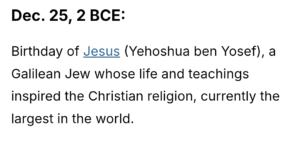
In this article, we want to notify Steven concerning what he subtly diverted from, which is that the issue at hand is not whether Jesus was a Jew, but rather the most important thing regarding this noble Prophet and Messenger, peace and blessings of Allah be upon him, is that he was sent with upright guidance. Therefore, the main issue to make clear is propagate is that before the arrival of the final noble Messenger Muhammad, peace and blessings of Allah be upon him, the noble Prophet Jesus, peace and blessings of Allah be upon him, was sent to The Children of Israel, and it was their duty to believe in and adhere to his teachings. Thus, in this brief article, we will first discuss the matter of the noble Jesus’s date of birth and his lineage, and then we will address the most important point that Steven overlooked, which is Jesus’s message and the nation who were required to follow him.

Steven said:

Response

The Date of Noble Jesus’s Date of Birth

Shaikh Abu Khadeejah, may Allah preserve him, stated in a research of his:

The exact date of the birth of the noble Prophet Isa (Jesus), peace be upon him, is not specified in the final infallible revelation, nor is it known by the people of the Scripture. Furthermore, it is not deemed essential to ascertain this information. However, it is essential to illuminate certain aspects of this topic, revealing that his birth did not occur on the 25th of December. This date, historically linked to other events later intertwined with Christian religious beliefs, thus warranting a closer examination.

“Both “Matthew” and “Luke” pinpoint the birth of Jesus Christ to the period when “Herod” was reigning as king over Judea, particularly during the final days of his rule. He passed away in 4 BC according to the Roman calendar, which indicates that the birth of Jesus occurred prior to this date. This suggests that it likely took place around the end of the fifth year or the beginning of the fourth year before Christ. The author of the third Gospel states: “In the fifteenth year of the reign of Emperor Tiberius, when Pontius Pilate was governor of Judea, Herod was tetrarch of Galilee, and his brother Philip was tetrarch of Ituraea and Trachonitis, and Lysanias was tetrarch of Abilene, during the high priesthood of Annas and Caiaphas, the word of God came to John son of Zechariah in the wilderness. He went into all the region around the Jordan, proclaiming a baptism of repentance for the forgiveness of sins. When all the people were baptised, Jesus was also baptised.” This indicates that Jesus Christ, at the age of thirty, was baptised by the Prophet John (known as John the Baptist), during the fifteenth year of Emperor Tiberius, around 26 or 27 CE. Therefore, his birth would correspond to either 6 or 4 BCE.

The author of the third Gospel also connects the birth of Jesus Christ to the census ordered by the governor of Syria, Quirinius, under the directive of Emperor Augustus. Historically, historians agree that “Quirinius” served as the governor of Syria between 6 and 12 BC, and the census he ordered in Judea took place around 6 or 7 CE, as noted by “Josephus.” However, “Tertullian” claims that the census conducted in Judea was carried out by “Sentius,” the governor of Syria, in 7 or 8 BC. This suggests that if this census is the one referenced by Luke in his Gospel, then the birth of Jesus Christ would have occurred around 6 BC. The specific birth date of Prophet Jesus, from the perspective of Christianity, is inevitably considered speculative and is lacking reliable and verified document to support it. Moreover, the celebration of Christmas on December 25 is not mentioned in the Bible, nor was it observed in early Christianity”. [1]

We shall now draw upon the Shaikh Abu Khadeejah’s research, referencing some sources that delve into the celebration of Christmas and its connection to the designation of December 25th as the birth date of the Messiah, peace and blessings of Allah be upon him. Shaikh Abu Khadeejah, may Allah preserve him, stated:

The celebration was a pagan practice introduced into the Christian faith by the Catholic Church. The Catholic Encyclopedia (1911 edition) itself states, “Christmas was not among the earliest festivals of the church. The first evidence of the feast comes from Egypt… Pagan customs around the month of January gravitated to Christmas.”

So this was centuries after Jesus (peace be upon him) was taken up into the Heavens. In the same Catholic Encyclopedia under the title ‘Natal Day’, the early Catholic father, Origen stated, “In the Scriptures, no one is recorded to have kept a feast or held a banquet on his birthday. It was only the sinners who made great rejoicings over the day in which they were born into this world.”

In the 1946 edition of the Encyclopedia Britannica, it states, “Christmas (or the Mass of Christ) was not from the earliest festivals of the church.” It is clear from these short references that the well-known festival has no basis or authority in Scripture. The 1944 edition of Encyclopedia Americana states, “Christmas: It was, according to many authorities, not celebrated in the first centuries of the Christian Church.” Elsewhere, the Encyclopedia states regarding Christmas, “A feast was established in memory of this event (i.e. the birth of Jesus) in the fourth century. In the fifth century, the Western Church ordered it to be celebrated forever on the day of the old Roman Feast of the birth of Sol, as no certain knowledge of the day of Christ’s birth existed.”

Sol was the solar deity in the Ancient Roman religion. According to at least one ancient source dating back to 354 CE, the Romans held a festival on the twenty-first of December called, “the birthday of the unconquered one” which refers to Sol, the solar deity. The winter solstice (or midwinter) marks the day with the shortest hours of daylight and the longest night of the year. The day after is the day when the sunlight hours start to extend once more, so they saw this as a great day to be celebratedJulius Caesar introduced his own calendar in the year 45 BCE and he marked the winter solstice as the twenty-fifth of December, though it is actually the twenty-first or twenty-second of the month. It is this twenty-fifth day of December that eventually found its way into the Christian Religion, and is celebrated across the world by ill-informed and unlearned Christians, as well as groups of clueless Muslims and people of many other religions.

So for the first three hundred years after Jesus (peace be upon him), the celebration had no connection to Christianity, then in the fourth century it was instituted, and in the fifth, it was ordered by the Western Church. This is similar to what some Muslims have done by introducing a celebration in memory of the birthday of the Prophet Muhammad (peace be upon him). These practices have no basis in scripture or revelation, rather they are latter-day innovations rooted in pagan festivals. [2] 


Noble Jesus’s Lineage

First, it is unequivocal that the noble Prophet Isa (Jesus), peace and blessings of Allah be upon him, hailed from Bani Israel. Ibn Al-Athir, may Allah have mercy upon him, said:

Imran Ibn Mathan, who is the grandfather of Jesus, peace be upon him, and the father of Mary, was a descendant of Sulayman, son of Dawud, peace be upon them. The family of Mathan held prominent positions as leaders and scholars among the Children of Israel. [3]

Imam Ibn Kathir, may Allah have mercy upon him, stated:

“There is no disagreement that she [meaning Maryam, peace be upon her] is from the lineage of Dawud, peace be upon him, and her father, Imran, was the one who led the prayers of the Children of Israel during his time.” [4]

Shaikh Al-Islam Ibn Taymiyyah, may Allah have mercy upon him, stated:

“There is no doubt that the people of Musa, peace be upon him, were the Children of Israel, and the Torah was revealed in their language. Likewise, the Children of Israel are the people of Christ, peace be upon him, and he spoke in their tongue. Neither of the two Messengers addressed anyone in any language other than Hebrew; neither spoke in Latin, Syriac, Greek, nor Coptic.” [5]

It is well known among the Christians that Christ spoke exclusively in Hebrew, similar to other prophets of the Israelites. Furthermore, it is noted that He was circumcised on the eighth day, in accordance with the customs of the Israelites, and that He prayed facing their designated direction, rather than towards the east, nor did he instruct others to pray in that direction. [6]

His Miraculous Birth and Message

The narrative of Isa (Jesus), peace and blessings of Allah be upon him, is well known for its precise details found in the final and infallible divine revelation, namely The Qur’an and the Sunnah. Allah, The Most High, stated:

وَٱذۡكُرۡ فِى ٱلۡكِتَـٰبِ مَرۡيَمَ إِذِ ٱنتَبَذَتۡ مِنۡ أَهۡلِهَا مَكَانً۬ا شَرۡقِيًّ۬ا (١٦) فَٱتَّخَذَتۡ مِن دُونِهِمۡ حِجَابً۬ا فَأَرۡسَلۡنَآ إِلَيۡهَا رُوحَنَا فَتَمَثَّلَ لَهَا بَشَرً۬ا سَوِيًّ۬ا (١٧) قَالَتۡ إِنِّىٓ أَعُوذُ بِٱلرَّحۡمَـٰنِ مِنكَ إِن كُنتَ تَقِيًّ۬ا (١٨) قَالَ إِنَّمَآ أَنَا۟ رَسُولُ رَبِّكِ لِأَهَبَ لَكِ غُلَـٰمً۬ا زَڪِيًّ۬ا (١٩) قَالَتۡ أَنَّىٰ يَكُونُ لِى غُلَـٰمٌ۬ وَلَمۡ يَمۡسَسۡنِى بَشَرٌ۬ وَلَمۡ أَكُ بَغِيًّ۬ا (٢٠) قَالَ كَذَٲلِكِ قَالَ رَبُّكِ هُوَ عَلَىَّ هَيِّنٌ۬‌ۖ وَلِنَجۡعَلَهُ ۥۤ ءَايَةً۬ لِّلنَّاسِ وَرَحۡمَةً۬ مِّنَّا‌ۚ وَكَانَ أَمۡرً۬ا مَّقۡضِيًّ۬ا (٢١) ۞ فَحَمَلَتۡهُ فَٱنتَبَذَتۡ بِهِۦ مَكَانً۬ا قَصِيًّ۬ا (٢٢) فَأَجَآءَهَا ٱلۡمَخَاضُ إِلَىٰ جِذۡعِ ٱلنَّخۡلَةِ قَالَتۡ يَـٰلَيۡتَنِى مِتُّ قَبۡلَ هَـٰذَا وَڪُنتُ نَسۡيً۬ا مَّنسِيًّ۬ا (٢٣) فَنَادَٮٰهَا مِن تَحۡتِہَآ أَلَّا تَحۡزَنِى قَدۡ جَعَلَ رَبُّكِ تَحۡتَكِ سَرِيًّ۬ا (٢٤) وَهُزِّىٓ إِلَيۡكِ بِجِذۡعِ ٱلنَّخۡلَةِ تُسَـٰقِطۡ عَلَيۡكِ رُطَبً۬ا جَنِيًّ۬ا (٢٥) فَكُلِى وَٱشۡرَبِى وَقَرِّى عَيۡنً۬ا‌ۖ فَإِمَّا تَرَيِنَّ مِنَ ٱلۡبَشَرِ أَحَدً۬ا فَقُولِىٓ إِنِّى نَذَرۡتُ لِلرَّحۡمَـٰنِ صَوۡمً۬ا فَلَنۡ أُڪَلِّمَ ٱلۡيَوۡمَ إِنسِيًّ۬ا (٢٦) فَأَتَتۡ بِهِۦ قَوۡمَهَا تَحۡمِلُهُ ۥ‌ۖ قَالُواْ يَـٰمَرۡيَمُ لَقَدۡ جِئۡتِ شَيۡـًٔ۬ا فَرِيًّ۬ا (٢٧) يَـٰٓأُخۡتَ هَـٰرُونَ مَا كَانَ أَبُوكِ ٱمۡرَأَ سَوۡءٍ۬ وَمَا كَانَتۡ أُمُّكِ بَغِيًّ۬ا (٢٨) فَأَشَارَتۡ إِلَيۡهِ‌ۖ قَالُواْ كَيۡفَ نُكَلِّمُ مَن كَانَ فِى ٱلۡمَهۡدِ صَبِيًّ۬ا (٢٩) قَالَ إِنِّى عَبۡدُ ٱللَّهِ ءَاتَٮٰنِىَ ٱلۡكِتَـٰبَ وَجَعَلَنِى نَبِيًّ۬ا (٣٠) وَجَعَلَنِى مُبَارَكًا أَيۡنَ مَا ڪُنتُ وَأَوۡصَـٰنِى بِٱلصَّلَوٰةِ وَٱلزَّڪَوٰةِ مَا دُمۡتُ حَيًّ۬ا (٣١) وَبَرَّۢا بِوَٲلِدَتِى وَلَمۡ يَجۡعَلۡنِى جَبَّارً۬ا شَقِيًّ۬ا (٣٢) وَٱلسَّلَـٰمُ عَلَىَّ يَوۡمَ وُلِدتُّ وَيَوۡمَ أَمُوتُ وَيَوۡمَ أُبۡعَثُ حَيًّ۬ا (٣٣) ذَٲلِكَ عِيسَى ٱبۡنُ مَرۡيَمَ‌ۚ قَوۡلَ ٱلۡحَقِّ ٱلَّذِى فِيهِ يَمۡتَرُونَ (٣٤) مَا كَانَ لِلَّهِ أَن يَتَّخِذَ مِن وَلَدٍ۬‌ۖ سُبۡحَـٰنَهُ ۥۤ‌ۚ إِذَا قَضَىٰٓ أَمۡرً۬ا فَإِنَّمَا يَقُولُ لَهُ ۥ كُن فَيَكُونُ (٣٥) وَإِنَّ ٱللَّهَ رَبِّى وَرَبُّكُمۡ فَٱعۡبُدُوهُ‌ۚ هَـٰذَا صِرَٲطٌ۬ مُّسۡتَقِيمٌ۬ (٣٦) فَٱخۡتَلَفَ ٱلۡأَحۡزَابُ مِنۢ بَيۡنِہِمۡ‌ۖ فَوَيۡلٌ۬ لِّلَّذِينَ كَفَرُواْ مِن مَّشۡہَدِ يَوۡمٍ عَظِيمٍ (٣٧) أَسۡمِعۡ بِہِمۡ وَأَبۡصِرۡ يَوۡمَ يَأۡتُونَنَا‌ۖ لَـٰكِنِ ٱلظَّـٰلِمُونَ ٱلۡيَوۡمَ فِى ضَلَـٰلٍ۬ مُّبِينٍ۬ (٣٨) وَأَنذِرۡهُمۡ يَوۡمَ ٱلۡحَسۡرَةِ إِذۡ قُضِىَ ٱلۡأَمۡرُ وَهُمۡ فِى غَفۡلَةٍ۬ وَهُمۡ لَا يُؤۡمِنُونَ (٣٩) إِنَّا نَحۡنُ نَرِثُ ٱلۡأَرۡضَ وَمَنۡ عَلَيۡہَا وَإِلَيۡنَا يُرۡجَعُونَ (٤٠)

And mention in the Book (the Qur’an, O Muhammad , the story of) Maryam (Mary), when she withdrew in seclusion from her family to a place facing east. She placed a screen (to screen herself) from them; then We sent to her Our Ruh [angel Jibrael (Gabriel)], and he appeared before her in the form of a man in all respects. She said: “Verily! I seek refuge with the Most Beneficent (Allah) from you, if you do fear Allah.” (The angel) said: “I am only a Messenger from your Lord, (to announce) to you the gift of a righteous son.” She said: “How can I have a son, when no man has touched me, nor am I unchaste?” He said: “So (it will be), your Lord said: ‘That is easy for Me (Allah): And (We wish) to appoint him as a sign to mankind and a mercy from Us (Allah), and it is a matter (already) decreed, (by Allah).’ So she conceived him, and she withdrew with him to a far place (i.e. Bethlehem valley about 4-6 miles from Jerusalem). And the pains of childbirth drove her to the trunk of a date-palm. She said: “Would that I had died before this, and had been forgotten and out of sight!” Then [the babe ‘Iesa (Jesus) or Jibrael (Gabriel)] cried unto her from below her, saying: “Grieve not! Your Lord has provided a water stream under you; and shake the trunk of date-palm towards you, it will let fall fresh ripe-dates upon you. So eat and drink and be glad, and if you see any human being, say: ‘Verily! I have vowed a fast unto the Most Beneficent (Allah) so I shall not speak to any human being this day.’”

Then she brought him (the baby) to her people, carrying him. They said: “O Mary! Indeed you have brought a thing Fariya (an unheard mighty thing). “O sister (i.e. the like) of Harun (Aaron) [not the brother of Musa (Moses), but he was another pious man at the time of Maryam (Mary)]! Your father was not a man who used to commit adultery, nor your mother was an unchaste woman.” Then she pointed to him. They said: “How can we talk to one who is a child in the cradle?” He [‘Iesa (Jesus)] said: “Verily! I am a slave of Allah, He has given me the Scripture and made me a Prophet; and He has made me blessed wheresoever I be, and has enjoined on me Salat (prayer), and Zakat, as long as I live. And dutiful to my mother, and made me not arrogant, unblest. And Salam (peace) be upon me the day I was born, and the day I die, and the day I shall be raised alive!”

Such is ‘Iesa (Jesus), son of Maryam (Mary). (it is) a statement of truth, about which they doubt (or dispute). It befits not (the Majesty of) Allah that He should beget a son [this refers to the slander of Christians against Allah, by saying that ‘Iesa (Jesus) is the son of Allah]. Glorified (and Exalted be He above all that they associate with Him). When He decrees a thing, He only says to it, “Be!” and it is. [‘Iesa (Jesus) said]: “And verily Allah is my Lord and your Lord. So worship Him (Alone). That is the Straight Path. (Allah’s Religion of Islamic Monotheism which He did ordain for all of His Prophets).” Then the sects differed [i.e. the Christians about ‘Iesa (Jesus)], so woe unto the disbelievers [those who gave false witness by saying that ‘Iesa (Jesus) is the son of Allah] from the meeting of a great Day (i.e. the Day of Resurrection, when they will be thrown in the blazing Fire). How clearly will they (polytheists and disbelievers in the Oneness of Allah) see and hear, the Day when they will appear before Us! But the Zalimun (polytheists and wrong-doers) today are in plain error. And warn them (O Muhammad ) of the Day of grief and regrets, when the case has been decided, while (now) they are in a state of carelessness, and they believe not. Verily! We will inherit the earth and whatsoever is thereon. And to Us they all shall be returned. [Maryam 16-40]

Allah said:

وَإِذۡ قَالَتِ ٱلۡمَلَـٰٓٮِٕڪَةُ يَـٰمَرۡيَمُ إِنَّ ٱللَّهَ ٱصۡطَفَٮٰكِ وَطَهَّرَكِ وَٱصۡطَفَٮٰكِ عَلَىٰ نِسَآءِ ٱلۡعَـٰلَمِينَ (٤٢) يَـٰمَرۡيَمُ ٱقۡنُتِى لِرَبِّكِ وَٱسۡجُدِى وَٱرۡكَعِى مَعَ ٱلرَّٲكِعِينَ (٤٣) ذَٲلِكَ مِنۡ أَنۢبَآءِ ٱلۡغَيۡبِ نُوحِيهِ إِلَيۡكَ‌ۚ وَمَا كُنتَ لَدَيۡهِمۡ إِذۡ يُلۡقُونَ أَقۡلَـٰمَهُمۡ أَيُّهُمۡ يَكۡفُلُ مَرۡيَمَ وَمَا ڪُنتَ لَدَيۡهِمۡ إِذۡ يَخۡتَصِمُونَ (٤٤) إِذۡ قَالَتِ ٱلۡمَلَـٰٓٮِٕكَةُ يَـٰمَرۡيَمُ إِنَّ ٱللَّهَ يُبَشِّرُكِ بِكَلِمَةٍ۬ مِّنۡهُ ٱسۡمُهُ ٱلۡمَسِيحُ عِيسَى ٱبۡنُ مَرۡيَمَ وَجِيهً۬ا فِى ٱلدُّنۡيَا وَٱلۡأَخِرَةِ وَمِنَ ٱلۡمُقَرَّبِينَ (٤٥) وَيُڪَلِّمُ ٱلنَّاسَ فِى ٱلۡمَهۡدِ وَڪَهۡلاً۬ وَمِنَ ٱلصَّـٰلِحِينَ (٤٦) قَالَتۡ رَبِّ أَنَّىٰ يَكُونُ لِى وَلَدٌ۬ وَلَمۡ يَمۡسَسۡنِى بَشَرٌ۬‌ۖ قَالَ ڪَذَٲلِكِ ٱللَّهُ يَخۡلُقُ مَا يَشَآءُ‌ۚ إِذَا قَضَىٰٓ أَمۡرً۬ا فَإِنَّمَا يَقُولُ لَهُ ۥ كُن فَيَكُونُ (٤٧) وَيُعَلِّمُهُ ٱلۡكِتَـٰبَ وَٱلۡحِڪۡمَةَ وَٱلتَّوۡرَٮٰةَ وَٱلۡإِنجِيلَ (٤٨) وَرَسُولاً إِلَىٰ بَنِىٓ إِسۡرَٲٓءِيلَ أَنِّى قَدۡ جِئۡتُكُم بِـَٔايَةٍ۬ مِّن رَّبِّڪُمۡ‌ۖ أَنِّىٓ أَخۡلُقُ لَڪُم مِّنَ ٱلطِّينِ كَهَيۡـٴَـةِِ ٱلطَّيۡرِ فَأَنفُخُ فِيهِ فَيَكُونُ طَيۡرَۢا بِإِذۡنِ ٱللَّهِ‌ۖ وَأُبۡرِئُ ٱلۡأَڪۡمَهَ وَٱلۡأَبۡرَصَ وَأُحۡىِ ٱلۡمَوۡتَىٰ بِإِذۡنِ ٱللَّهِ‌ۖ وَأُنَبِّئُكُم بِمَا تَأۡكُلُونَ وَمَا تَدَّخِرُونَ فِى بُيُوتِڪُمۡ‌ۚ إِنَّ فِى ذَٲلِكَ لَأَيَةً۬ لَّكُمۡ إِن كُنتُم مُّؤۡمِنِينَ (٤٩) وَمُصَدِّقً۬ا لِّمَا بَيۡنَ يَدَىَّ مِنَ ٱلتَّوۡرَٮٰةِ وَلِأُحِلَّ لَڪُم بَعۡضَ ٱلَّذِى حُرِّمَ عَلَيۡڪُمۡ‌ۚ وَجِئۡتُكُم بِـَٔايَةٍ۬ مِّن رَّبِّڪُمۡ فَٱتَّقُواْ ٱللَّهَ وَأَطِيعُونِ (٥٠) إِنَّ ٱللَّهَ رَبِّى وَرَبُّڪُمۡ فَٱعۡبُدُوهُ‌ۗ هَـٰذَا صِرَٲطٌ۬ مُّسۡتَقِيمٌ۬ (٥١) ۞ فَلَمَّآ أَحَسَّ عِيسَىٰ مِنۡہُمُ ٱلۡكُفۡرَ قَالَ مَنۡ أَنصَارِىٓ إِلَى ٱللَّهِ‌ۖ قَالَ ٱلۡحَوَارِيُّونَ نَحۡنُ أَنصَارُ ٱللَّهِ ءَامَنَّا بِٱللَّهِ وَٱشۡهَدۡ بِأَنَّا مُسۡلِمُونَ (٥٢) رَبَّنَآ ءَامَنَّا بِمَآ أَنزَلۡتَ وَٱتَّبَعۡنَا ٱلرَّسُولَ فَٱڪۡتُبۡنَا مَعَ ٱلشَّـٰهِدِينَ (٥٣) وَمَڪَرُواْ وَمَڪَرَ ٱللَّهُ‌ۖ وَٱللَّهُ خَيۡرُ ٱلۡمَـٰكِرِينَ (٥٤) إِذۡ قَالَ ٱللَّهُ يَـٰعِيسَىٰٓ إِنِّى مُتَوَفِّيكَ وَرَافِعُكَ إِلَىَّ وَمُطَهِّرُكَ مِنَ ٱلَّذِينَ ڪَفَرُواْ وَجَاعِلُ ٱلَّذِينَ ٱتَّبَعُوكَ فَوۡقَ ٱلَّذِينَ كَفَرُوٓاْ إِلَىٰ يَوۡمِ ٱلۡقِيَـٰمَةِ‌ۖ ثُمَّ إِلَىَّ مَرۡجِعُڪُمۡ فَأَحۡڪُمُ بَيۡنَكُمۡ فِيمَا كُنتُمۡ فِيهِ تَخۡتَلِفُونَ (٥٥) فَأَمَّا ٱلَّذِينَ كَفَرُواْ فَأُعَذِّبُهُمۡ عَذَابً۬ا شَدِيدً۬ا فِى ٱلدُّنۡيَا وَٱلۡأَخِرَةِ وَمَا لَهُم مِّن نَّـٰصِرِينَ (٥٦) وَأَمَّا ٱلَّذِينَ ءَامَنُواْ وَعَمِلُواْ ٱلصَّـٰلِحَـٰتِ فَيُوَفِّيهِمۡ أُجُورَهُمۡ‌ۗ وَٱللَّهُ لَا يُحِبُّ ٱلظَّـٰلِمِينَ (٥٧) ذَٲلِكَ نَتۡلُوهُ عَلَيۡكَ مِنَ ٱلۡأَيَـٰتِ وَٱلذِّكۡرِ ٱلۡحَكِيمِ (٥٨) إِنَّ مَثَلَ عِيسَىٰ عِندَ ٱللَّهِ كَمَثَلِ ءَادَمَ‌ۖ خَلَقَهُ ۥ مِن تُرَابٍ۬ ثُمَّ قَالَ لَهُ ۥ كُن فَيَكُونُ (٥٩) ٱلۡحَقُّ مِن رَّبِّكَ فَلَا تَكُن مِّنَ ٱلۡمُمۡتَرِينَ (٦٠)

And (remember) when the angels said: “O Maryam (Mary)! Verily, Allah has chosen you, purified you (from polytheism and disbelief), and chosen you above the women of the ‘Alamin (mankind and jinns) (of her lifetime). O Mary! Submit yourself with obedience to your Lord (Allah, by worshipping none but Him Alone) and prostrate yourself, and Irka’i (bow down etc.) along with Ar-Raki’un (those who bow down etc.).” This is a part of the news of the Ghaib (unseen, i.e. the news of the past nations of which you have no knowledge) which We inspire you with (O Muhammad ). You were not with them, when they cast lots with their pens as to which of them should be charged with the care of Maryam (Mary); nor were you with them when they disputed.

(Remember) when the angels said: “O Maryam (Mary)! Verily, Allah gives you the glad tidings of a Word [“Be!” – and he was! i.e. ‘Iesa (Jesus) the son of Maryam (Mary)] from Him, his name will be the Messiah ‘Iesa (Jesus), the son of Maryam (Mary), held in honour in this world and in the Hereafter, and will be one of those who are near to Allah. He will speak to the people in the cradle and in manhood, and he will be one of the righteous.” She said: “O my Lord! How shall I have a son when no man has touched me.” He said: “So (it will be) for Allah creates what He wills. When He has decreed something, He says to it only: “Be!” and it is. And He (Allah) will teach him [‘Iesa (Jesus)] the Book and Al-Hikmah (i.e. the Sunnah, the faultless speech of the Prophets, wisdom, etc.), (and) the Taurat (Torah) and the Injeel (Gospel). And will make him [‘Iesa (Jesus)] a Messenger to the Children of Israel (saying): “I have come to you with a sign from your Lord, that I design for you out of clay, as it were, the figure of a bird, and breathe into it, and it becomes a bird by Allah’s Leave; and I heal him who was born blind, and the leper, and I bring the dead to life by Allah’s Leave. And I inform you of what you eat, and what you store in your houses. Surely, therein is a sign for you, if you believe. And I have come confirming that which was before me of the Taurat (Torah), and to make lawful to you part of what was forbidden to you, and I have come to you with a proof from your Lord. So fear Allah and obey me. Truly! Allah is my Lord and your Lord, so worship Him (Alone). This is the Straight Path.

Then when ‘Iesa (Jesus) came to know of their disbelief, he said: “Who will be my helpers in Allah’s Cause?” Al-Hawariun (the disciples) said: “We are the helpers of Allah; we believe in Allah, and bear witness that we are Muslims (i.e. we submit to Allah).” Our Lord! We believe in what You have sent down, and we follow the Messenger [‘Iesa (Jesus)]; so write us down among those who bear witness (to the truth i.e. La ilaha ill-Allah – none has the right to be worshipped but Allah). And they (disbelievers) plotted [to kill ‘Iesa (Jesus)], and Allah planned too. And Allah is the Best of the planners.

And (remember) when Allah said: “O ‘Iesa (Jesus)! I will take you and raise you to Myself and clear you [of the forged statement that ‘Iesa (Jesus) is Allah’s son] of those who disbelieve, and I will make those who follow you (Monotheists, who worship none but Allah) superior to those who disbelieve [in the Oneness of Allah, or disbelieve in some of His Messengers, e.g. Muhammad , ‘Iesa (Jesus), Musa (Moses), etc., or in His Holy Books, e.g. the Taurat (Torah), the Injeel (Gospel), the Qur’an] till the Day of Resurrection. Then you will return to Me and I will judge between you in the matters in which you used to dispute.

As to those who disbelieve, I will punish them with a severe torment in this world and in the Hereafter, and they will have no helpers. And as for those who believe (in the Oneness of Allah) and do righteous good deeds, Allah will pay them their reward in full. And Allah does not like the Zalimun (polytheists and wrong-doers). This is what We recite to you (O Muhammad ) of the Verses and the Wise Reminder (i.e. the Qur’an). Verily, the likeness of ‘Iesa (Jesus) before Allah is the likeness of Adam. He created him from dust, then (He) said to him: “Be!” – and he was. (This is) the truth from your Lord, so be not of those who doubt. [Aal Imran 42-60]

Therefore, it appears that Steven has either forgotten or intentionally disregarded the crucial detail that Isa (Jesus), peace and blessings of Allah be upon him, was specifically sent to the Children of Israel. His teachings were rooted in the Torah, complemented by the Injeel, the new scripture bestowed upon him as a Messenger, and the Children were instructed to adhere to his guidance. Consequently, to confine Christianity solely to a group identified as Christians, while omitting the fact that his initial mission was directed towards the Children of Israel, diverts attention from the fundamental essence of the discussion.

Allah, The Exalted, said:

وَإِذْ قَالَ عِيسَى ٱبْنُ مَرْيَمَ يَٰبَنِىٓ إِسْرَٰٓءِيلَ إِنِّى رَسُولُ ٱللَّهِ إِلَيْكُم مُّصَدِّقًا لِّمَا بَيْنَ يَدَىَّ مِنَ ٱلتَّوْرَىٰةِ وَمُبَشِّرًۢا بِرَسُولٍ يَأْتِى مِنۢ بَعْدِى ٱسْمُهُۥٓ أَحْمَدُ فَلَمَّا جَآءَهُم بِٱلْبَيِّنَٰتِ قَالُوا۟ هَٰذَا سِحْرٌ مُّبِينٌ

And (remember) when Jesus, son of Mary, said: ” Children of Israel, I am the Messenger of Allāh to you, confirming what came before me of the Torah and giving good tidings of a Messenger to come after me whose name is Aḥmad”. But when he (the prophesied messenger, Muḥammad) came to them (the Jews) with clear evidences, they said: “This is plain magic”. [As-Saff. 6]

Allah said:

وَقَفَّيْنَا عَلَى آَثَارِهِمْ بِعِيسَى ابْنِ مَرْيَمَ مُصَدِّقًا لِمَا بَيْنَ يَدَيْهِ مِنَ التَّوْرَاةِ وَآَتَيْنَاهُ الْإِنْجِيلَ فِيهِ هُدًى وَنُورٌ وَمُصَدِّقًا لِمَا بَيْنَ يَدَيْهِ مِنَ التَّوْرَاةِ وَهُدًى وَمَوْعِظَةً لِلْمُتَّقِينَ

And in their footsteps, We sent ‘Iesa (Jesus), son of Maryam (Mary), confirming the Taurat (Torah) that had come before him, and We gave him the Injeel (Gospel), in which was guidance and light and confirmation of the Taurat (Torah) that had come before it, a guidance and an admonition for the pious. [Al-Ma’idah 46]

“And in their footsteps”, meaning, “We succeeded the prophets of the Children of Israel with Isa (Jesus), son of Mary, who confirmed the Torah that preceded him. Meaning, he believed in it and judge according to its teachings. “And We gave him Injeel (Gospel) in which was guidance and light”, guiding to the truth and a light illuminating the path to removing doubts and solving problems. “And confirmation of the Taurat (Torah) that had come before it”, meaning, adhering to it and not doing other than what is in it, except in a few matters about which they differed, as Allah stated that the Messiah said to tyhe Children of Israel: “And to make lawful to you part of what was forbidden to you”. This is why the most well-known statement of the scholars (of Islam) is that the Gospel abrogated certain laws of the Torah. [7]

Thus, Steven is reminded that Isa (Jesus), peace and blessings of Allah be upon him, not only upheld the teachings of the Torah but also received the Injeel, accompanied by further guidance. Nevertheless, many Jews during that time rejected his message, sought to undermine his mission, and even plotted against his life, yet Allah protected him. Prior to the arrival of Muhammad, peace and blessings of Allah be upon him, many Jews continued to disbelieve in Jesus, peace and blessings of Allah be upon him, while many of his followers had already altered the original teachings of the Injeel, introducing things that were never part of it. Then both groups turned away from Muhammad, peace and blessings of Allah be upon him, when he was sent as the final Messenger, bearing a message intended to guide them all once more.

Shaikh Al-Islam Ibn Taymiyyah, may Allah have mercy upon him, said:

When Allah, The Exalted, sent Muhammad, peace and blessings of Allah be upon him,, they disbelieved in him, thus their disbelief and misguidance occurred in two ways- substitution of the religion of the first Messenger (i.e. the Messiah) and belied the second Messenger (i.e. Muhammad), just as the Jews substituted the rulings of the Torah before the Messiah was sent and then belied him. The Christians’ denial of Muhammad’s Messengership is a well-known belief of theirs to every Muslim, which is similar to the Jews’ disbelief in the Messiah. The Christians emphasise the disbelief of the Jews greater than what the Jews deserve, because the Jews claimed that the Messiah was a magician and a liar; rather they said that he is an illegitimate child, as Allah informed us about them: [وَقَوۡلِهِمۡ عَلَىٰ مَرۡيَمَ بُہۡتَـٰنًا عَظِيمً۬ا – And their speech against Maryam (Mary)- a grave false charge (that she has committed illegal sexual intercourse]. [An-Nisaa. 156]; but the Christians claimed that the Messiah is Allah, therefore the trial between them and the Jews regarding the Messiah involved a lot of contradictions, misguidance at similar levels and confrontation, and this is why both nations rebuked one another with something more than what each of them deserved, just as Allah said:

وَقَالَتِ ٱلۡيَهُودُ لَيۡسَتِ ٱلنَّصَـٰرَىٰ عَلَىٰ شَىۡءٍ۬ وَقَالَتِ ٱلنَّصَـٰرَىٰ لَيۡسَتِ ٱلۡيَهُودُ عَلَىٰ شَىۡءٍ۬ وَهُمۡ يَتۡلُونَ ٱلۡكِتَـٰبَ‌ۗ كَذَٲلِكَ قَالَ ٱلَّذِينَ لَا يَعۡلَمُونَ مِثۡلَ قَوۡلِهِمۡ‌ۚ فَٱللَّهُ يَحۡكُمُ بَيۡنَهُمۡ يَوۡمَ ٱلۡقِيَـٰمَةِ فِيمَا كَانُواْ فِيهِ يَخۡتَلِفُونَ

The Jews said that the Christians follow nothing; and the Christians said that the Jews follow nothing; though they both recite the Scripture. Like unto their word, said (the pagans) who know not. Allah will judge between them on the Day of Resurrection about that wherein they have been differing. [Al-Baqarah. 113]

Muhammad Bin Abee Muhammad the protege of Zaid Bin Thabit reported from Ikrimah or Saeed Bin Jubayr, who reported from Ibn Abbaas that when the Christian delegation of Najraan came to Allaah’s Messenger, the Rabbis came and argued with them in the presence of the Messenger; so Rabee Bin Hurmilah said, “You are upon nothing” and thus he disbelieved in Isa and all the Injeel. Then a man from the people of Najran said to the Jews, “You are upon nothing”, and thus he willfully denied Musa’s, peace and blessings of Allah be upon him, Prophethood and disbelieved in the Torah, thus, Allah revealed: [وَقَالَتِ ٱلۡيَهُودُ لَيۡسَتِ ٱلنَّصَـٰرَىٰ عَلَىٰ شَىۡءٍ۬ وَقَالَتِ ٱلنَّصَـٰرَىٰ لَيۡسَتِ ٱلۡيَهُودُ عَلَىٰ شَىۡءٍ۬ وَهُمۡ يَتۡلُونَ ٱلۡكِتَـٰبَ‌ۗ -The Jews said that the Christians follow nothing; and the Christians said that the Jews follow nothing; though they both recite the Scripture. [Al-Baqarah. 113]

So each of them recited the affirmation of what they reject in their book- meaning, the Jews disbelieved in Isa whilst they had the Torah in which Allah established the evidence against them through Musa that they should believe in Isa and the Injeel, and Isa confirmed Musa’s Messengership and what he came with. So, each one disbelieved in what was in the possession of the other. [Ibn Abee Hatim. 1/339]

[وَقَالَتِ ٱلۡيَهُودُ لَيۡسَتِ ٱلنَّصَـٰرَىٰ عَلَىٰ شَىۡءٍ۬ – The Jews said that the Christians follow nothing]: Qatadah said regarding this verse, “Certainly, the early Christians were upon something, but they innovated and split”.

[وَقَالَتِ ٱلنَّصَـٰرَىٰ لَيۡسَتِ ٱلۡيَهُودُ عَلَىٰ شَىۡءٍ۬ – and the Christians said that the Jews follow nothing]: Qatadah said regarding this verse: “Certainly, the early Jews were upon something, but they innovated and split”. The Jews belied the religion of the Christians and said that the Christians were upon nothing; and the Christians denied everything through which the Jews were distinguished from them, even the laws of the Torah which the Messiah did not abrogate; rather he commanded them to act upon it. As for the Jews, they denied many of things through which others were distinguished from them, until they denied the truth brought by Isa.

So, even though the Christians – due to that which they innovated of exaggeration and misguidance – went into extremes in excommunicating the Jews and showed them enmity beyond what is obligated, however there is no doubt that the Jews disbelieved when they belied the Messiah, as Allah [The Exalted] said to the Messiah [peace and blessings of Allah be upon him]:

[إِنِّى مُتَوَفِّيكَ وَرَافِعُكَ إِلَىَّ وَمُطَهِّرُكَ مِنَ ٱلَّذِينَ ڪَفَرُواْ وَجَاعِلُ ٱلَّذِينَ ٱتَّبَعُوكَ فَوۡقَ ٱلَّذِينَ كَفَرُوٓاْ – I will take you and raise you to Myself and clear you [of the forged statement that ‘Isa (Jesus) is Allah’s son] of those who disbelieve, and I will make those who follow you (Monotheists, who worship none but Allah) superior to those who disbelieve [in the Oneness of Allah, or disbelieve in some of His Messengers, e.g. Muhammad, ‘Isa (Jesus), Musa (Moses), etc., or in His Holy Books, e.g. the Tawrat (Torah), the Injeel (Gospel), the Qur’an] till the Day of Resurrection. [Aal Imran. 55]

Allah, The Exalted, said:

قَالَ عِيسَى ٱبۡنُ مَرۡيَمَ لِلۡحَوَارِيِّـۧنَ مَنۡ أَنصَارِىٓ إِلَى ٱللَّهِ‌ۖ قَالَ ٱلۡحَوَارِيُّونَ نَحۡنُ أَنصَارُ ٱللَّهِ‌ۖ فَـَٔامَنَت طَّآٮِٕفَةٌ۬ مِّنۢ بَنِىٓ إِسۡرَٲٓءِيلَ وَكَفَرَت طَّآٮِٕفَةٌ۬‌ۖ فَأَيَّدۡنَا ٱلَّذِينَ ءَامَنُواْ عَلَىٰ عَدُوِّهِمۡ فَأَصۡبَحُواْ ظَـٰهِرِينَ

Isa the son of Maryam said to Al-Hawariun (the disciples): “Who are my helpers (in the Cause) of Allah?” Al-Hawarieen (the disciples) said: “We are Allah’s helpers” (i.e. we will strive in His Cause!). Then a group of the Children of Israel believed and a group disbelieved. So We gave power to those who believed against their enemies, and they became the uppermost. [As-Saff. 14]

The disbelief of the Christians – due to their denial of Muhammad’s Messengership and – is greater than the disbelief of the Jews due to their denial of the Messiah’s Messengership, because indeed the Messiah only abrogated a little from the Torah and all the laws and acts of worship ordained for him could be traced back to the Torah; however the majority of the beliefs and practices of the Christians were innovated after the departure of the Messiah. That which is found in the Jews’ denial of the Messiah by opposing Allah’s Shariah is not the same as the Christians’ denial of Muhammad, who brought an independent book from Allah, because nothing in the laws of the Qur’an was ordained based on the law of another Messenger. Allah [The Exalted] said:

[أَوَلَمۡ يَكۡفِهِمۡ أَنَّآ أَنزَلۡنَا عَلَيۡكَ ٱلۡڪِتَـٰبَ يُتۡلَىٰ عَلَيۡهِمۡ‌ۚ إِنَّ فِى ذَٲلِكَ لَرَحۡمَةً۬ وَذِڪۡرَىٰ لِقَوۡمٍ۬ يُؤۡمِنُونَ – Is it not sufficient for them that We have sent down to you the Book (the Qur’an) which is recited to them? Verily, herein is mercy and a reminder (or an admonition) for a people who believe]. [Al-Ankabut. 51]

The Qur’an is an independent book like the Torah of Musa, even though the Qur’an is greater than it. And this is why the Christian scholars made a connection between Musa and Muhammad, just as when An-Najaashee [may Allaah have mercy upon him]- the Ethiopian king of the Christians- heard the Qur’an, he said, “Indeed, this and what Musa brought came from the same source”. Also, when Waqarah bin Nawfil, may Allah have mercy upon him, – who was one of Christian Arab scholars- heard the statement of the Prophet, he said, “Indeed, the Naamoos [i.e. Jibreel] who came to you was sent to Musa. I wish that I were young till when your people expel you”. Allaah’s Messenger asked, “Will these people drive me out?” Waraqah said, “Yes, because nobody brought the like of what you have brought, but was treated with hostility. If I were to remain alive till your day (when you start calling to Islam), then I would support you strongly”. [Bukhari]

And this is why Allah mentioned the Torah and the Qur’an together in His statement:

فَلَمَّا جَآءَهُمُ ٱلۡحَقُّ مِنۡ عِندِنَا قَالُواْ لَوۡلَآ أُوتِىَ مِثۡلَ مَآ أُوتِىَ مُوسَىٰٓ‌ۚ أَوَلَمۡ يَڪۡفُرُواْ بِمَآ أُوتِىَ مُوسَىٰ مِن قَبۡلُ‌ۖ قَالُواْ سِحۡرَانِ تَظَـٰهَرَا وَقَالُوٓاْ إِنَّا بِكُلٍّ۬ كَـٰفِرُونَ
قُلۡ فَأۡتُواْ بِكِتَـٰبٍ۬ مِّنۡ عِندِ ٱللَّهِ هُوَ أَهۡدَىٰ مِنۡہُمَآ أَتَّبِعۡهُ إِن ڪُنتُمۡ صَـٰدِقِينَ

But when the truth (i.e. Muhammad with his Message) has come to them from Us, they say: “Why is he not given the like of what was given to Musa (Moses)? Did they not disbelieve in that which was given to Musa (Moses) of old? They say: “Two kinds of magic [the Tawrat (Torah) and the Qur’an] each helping the other!” And they say: “Verily! In both we are disbelievers.” Say (to them, O Muhammad): “Then bring a Book from Allah, which is a better guide than these two [the Taurat (Torah) and the Qur’an], that I may follow it, if you are truthful.” [Al-Qasas. 48-49]

Allah did not revealed books that were a better guide than the Tawraat and the Qur’an. Then Allah said:

فَإِن لَّمۡ يَسۡتَجِيبُواْ لَكَ فَٱعۡلَمۡ أَنَّمَا يَتَّبِعُونَ أَهۡوَآءَهُمۡ‌ۚ وَمَنۡ أَضَلُّ مِمَّنِ ٱتَّبَعَ هَوَٮٰهُ بِغَيۡرِ هُدً۬ى مِّنَ ٱللَّهِ‌ۚ إِنَّ ٱللَّهَ لَا يَہۡدِى ٱلۡقَوۡمَ ٱلظَّـٰلِمِينَ

But if they answer you not (i.e. do not believe in your doctrine of Islamic Monotheism, nor follow you), then know that they only follow their own lusts. And who is more astray than one who follows his own lusts, without guidance from Allah? Verily! Allah guides not the people who are Zalimun (wrong-doers, disobedient to Allah, and polytheists). [Al-Qasas. 50] [8]

Read: The Status of Jesus In Islam

https://abukhadeejah.com/wp-content/uploads/2016/06/Jesus-in-Islam-2016.pdf


[1] An Excerpt from “Ishkal Tahdid Tarikh Milad An-Nabi Isa, alayhis salam, Fee Fee ad-Diyanah An Nasraniyyah” pages 1-7

[2] https://abukhadeejah.com/the-pagan-roots-of-christmas-and-how-a-muslim-should-behave-during-this-season/

[3] Al-Kamil Fee at-Tarikh 1/252

[4] Al-Bidaya Wan Nihaya 2/52

[5] Al-Jawab As-Sahih 2/94

[6] Al-Jawab As-Sahih 3/32

[7] Tafsir Ibn Kathir.

[8] An Excerpt from Al-Jawab As-Sahih Liman Baddala Deen Al-Masih. 1/26-28

The Certainty and Steadfastness in the Heart of the Greatest Martyr Amid the Severest Trials at the End of Time

In The Name of Allah, The Most Merciful, The Bestower of Mercy.

Abu Sa’id al-Khudri, may Allah be pleased with him, reported Allah’s Messenger, peace and blessings of Allah be upon him, said:

The Dajjal would come forth and a person from amongst the believers would go towards him and the armed men of the Dajjal would meet him and they would say to him: “Where do you intend to go?” He would say: “I intend to go to this one who is coming forth”. They would say to him: “Don’t you believe in our Lord?” He would say: “There is nothing hidden (with regards to knowing) who our Lord (is)”. They would say: “Kill him”. Then some amongst them would say: “Has your master (Dajjal) not forbidden you to kill anyone without (his consent)?” So, they would take him to the Dajjal and when the believer would see him, he would say:

“O people, he is the Dajjal about whom Allah’s Messenger has informed (us)”.

The Dajjal would then order that his head be broken, saying: “Get hold of him and break his head”. He would be struck even on his back and on his stomach. Then the Dajjal would ask him: “Don’t you believe in me?” He would say:

“You are a false Masih”.

He would then order for him to be torn (into pieces) with a saw from the parting of his hair up to his legs. After that the Dajjal would walk between the two pieces. He would then say to him: “Stand”, and he would stand up straight. He would then say to him: “Don’t you believe in me?” The person would say:

“It has only added to my insight concerning you (that you are really the Dajjal)”.

He would then say: “O people, he would not behave with anyone amongst people (in such a manner) after me”. The Dajjal would try to get hold of him so that he should kill him (again). The space between his neck and collar bone would be turned into copper and he would find no means to kill him. So he would get hold of him by his hand and feet and throw him (into the air) and the people would think as if he had been thrown in the Hell-Fire whereas he would be thrown in Paradise. Thereupon Allah’s Messenger said:

“He would be the greatest amongst the people in regard to martyrdom in the sight of the Lord of the universe”.

Sahih Muslim 2938


Neighbours

In The Name of Allah, The Most Merciful, The Bestower of Mercy

Shaikh Muhammad Bin Abdillah As-Subayyil, may Allah have mercy upon him, was asked: “What are the rights of a neighbour?”

Response: The rights of a neighbour are great and many. Indeed, many ahadith have been narrated regarding the rights of a neighbour and among them is the hadith narrated by Abdullah Ibn Umar, may Allah be pleased with him and his father, that the Messenger of Allah, peace and blessings of Allah be upon him, said:

“Jibreel did not cease advising me (about the rights) of a neighbour to the extent that I thought he (i.e. the neighbour) would be my inheritor”. [Bukhari and Muslim]

Abu Hurairah narrated that the Prophet said: “By Allah, he does not believe (i.e. he is not a perfect believer); by Allah, he does not believe (i.e. he is not a perfect believer); by Allah, he does not believe (i.e. he is not a perfect believer); It was said: Who O Messenger of Allah? He said: The one whose neighbour is not safe from his evil behaviour. [Al-Bukhari]

And there are other narrations that shows the greatness of a neighbour’s rights. There are three types of neighbours: The neighbour with three rights; the neighbour with two rights and the neighbour with one.

The neighbour with three rights is the relative, who has rights as a relative, as a Muslim and the rights of a neighbour.

The neighbour with two rights is a Muslim neighbour, who has rights as a neighbour and as a Muslim.

As for neighbour with one right, he (or she) is a non-Muslim neighbour and has the rights of a neighbour. [1]

The Prophet, peace and blessings of Allah be upon him, said: ”He is not a (true) believer whose Stomach is filled while his neighbour is hungry”. [2]

Al-Allamah Zayd Bin Hadi Al-Mad’khali, may Allah have mercy upon him, said:

This Hadith (clearly demonstrates) that the one whose stomach is filled while his neighbour is hungry is not a believer of complete Iman. A person of complete Iman is the one who checks on his neighbour if the neighbour is in need of him. It is not possible for a neighbour to be enjoying himself with foods and drinks while his (other) neighbour cannot find anything and he does not give him anything. This does not reflect the manners of a believer with complete Iman. And because of this, the Prophet, peace and blessings of Allah be upon him, negated the completeness (of the Iman of the one who behaves in such a manner); rather a believer of complete Iman is the one who is generous to his neighbour as much as he is able, especially when he is in need of an essential (thing) such as food and drink. [3]

Question: A neighbour of mine and his children harm me through their speech and actions, will I be rewarded due to being patient with them?

Response: There is no doubt that you will be rewarded (In-Shaa-Allaah) due to your patience while receiving harm from your neighbour and his children. This patience of yours is from good manners and kind treatment to your neighbour. Indeed Allah, The Most High, advised His Messenger, peace and blessings of Allah be upon him, about kindness to neighbours, saying:

وَاعْبُدُوا اللَّهَ وَلَا تُشْرِكُوا بِهِ شَيْئًا ۖ وَبِالْوَالِدَيْنِ إِحْسَانًا وَبِذِي الْقُرْبَىٰ وَالْيَتَامَىٰ وَالْمَسَاكِينِ وَالْجَارِ ذِي الْقُرْبَىٰ وَالْجَارِ الْجُنُبِ وَالصَّاحِبِ بِالْجَنبِ وَابْنِ السَّبِيلِ وَمَا مَلَكَتْ أَيْمَانُكُمْ ۗ إِنَّ اللَّهَ لَا يُحِبُّ مَن كَانَ مُخْتَالًا فَخُورًا

Worship Allah and join none with Him in worship, and do good to parents, kinsfolk, orphans, Al-Masakin (the poor), the neighbour who is near of kin, the neighbour who is a stranger, the companion by your side, the wayfarer (you meet), and those (slaves) whom your right hands possess. Verily, Allah does not like such as are proud and boastful. [4:36]

The Messenger said: “Jibreel did not cease advising me (about the rights) of a neighbour to the extent that I thought he (i.e. the neighbour) would be my inheritor”. [Bukhari and Muslim]

Therefore, be steadfast in exercising patience and you’ll receive reward and a good recompense from Allah (In-Shaa-Allah). There is no doubt that your neighbour is committing evil deeds. The Messenger said:

By Allah, he does not believe (i.e. he is not a perfect believer); by Allah, he does not believe (i.e. he is not a perfect believer); by Allah, he does not believe (i.e. he is not a perfect believer); it was said: Who O Messenger of Allah? He said: The one whose neighbour is not safe from his evil behaviour. [Reported by Bukhari] [4]


[1] Fadaa’il Al A’maal pages 15-16

[2] Reported by Imam Al-Bukhari (rahimahullaah) in Adab Al-Mufrad Number 112 & declared authentic by Imaam Albaani in his checking of Adab Al-Mufrad page 50. Publisher Daar As-Siddeeq 2nd ed [1421 AH/ Year 2000]

[3] Awn Al-Ahad As-Samad Sharh Al-Adab Al-Mufrad 1/137. Publisher: Daar Al-Mirath An-Nabawiy’ 1st ed Year 1434AH/ 2013

[4] Fadaa’il Al-A’maal page 30

The Great Danger of Social Unrest: Witnessing Is Not the Same as Being Informed

In The Name of Allah, The Most Mericiful, The Bestower of Mercy.

The one who has witnessed events is not the same as the one who has been informed. After colonialism, we lived in a nation that was peaceful with strong familial ties. The first ruler, following our so-called independence from Western colonisation, was loved by many people. He was gentle and tolerant. Like every other post-colonialism country, perfection is is found in any leadership, yet there was a priceless blessing from Allah in our country: peace and security. We had no army as a nation, only a gentle police force. Then, in 1981, a group of young men, may Allah forgive them, orchestrated a coup. I was just 11 years old at the time, and I can recall the announcement made by the coup leaders on Radio Gambia. The first statement I memorized as a 11-year-old was from the spokesperson or leader of the coup, declaring: “Long live the revolution, long live the supreme council of the revolution, hello Gambians, this is no magical question unanswerable”.

The neighboring country, if you wish to refer to it that way, is actually part of the same extended families, clans, and tribes. The only reason we became two separate nations was because of the territorial divisions imposed by the British and the French. Anyone who examines the map will notice that Gambia is in reality a province of Senegal, had it not been for that colonial demarcation. The Senegalese military intervened, leading to arm struggle against rebels and other criminals, resulting in bloodshed that was entirely a very strange thing to Gambians. A week of fighting, while everyone remained indoors, felt like months due to the loss of our freedom of movement and the great sense of safety we had never experienced losing before 1981.

Once the Senegalese army established control, they remained in the country for two years to ensure stability. However, there were ongoing curfews for a long time until life returned to normal. If you had found yourself in a small room, packed with your family, too afraid to step outside, and the best meal you could have was white rice and sardines, you would have truly valued the sense of safety that existed before the coup. You would have come to understand and appreciate the importance of safety and security, even if many lived with very little. Yet, the peace, security, love, and harmony that came with poverty were invaluable compared to the promise of justice through rebellion, chaos, hostility, and violence. After being guided to the Sunnah at the age of 23, the reality of khuruj became clearer to us, as the narrations about the prohibition against khuruj reflected the truths we had experienced in the past. Indeed, the one who witnessed is not the same as the one who is informed. In this regard, the insights provided by the Scholars and their advice against Khuruj based upon the Sunnah are even more appreciated.

Scholarly Clarifications

Allah, The Most High, said:

وَإِذۡ قَالَ إِبۡرَٲهِـۧمُ رَبِّ ٱجۡعَلۡ هَـٰذَا بَلَدًا ءَامِنً۬ا وَٱرۡزُقۡ أَهۡلَهُ ۥ مِنَ ٱلثَّمَرَٲتِ مَنۡ ءَامَنَ مِنۡہُم بِٱللَّهِ وَٱلۡيَوۡمِ ٱلۡأَخِرِ‌ۖ

And (remember) when Ibrahim (Abraham) said: My Lord, make this city (Makkah) a place of security and provide its people with fruits, such of them as believe in Allah and the Last Day]. [Al-Baqara. 126]

Al-Allamah Salih Al-Fawzan, may Allaah protect him, said:

He (Ibrahim – peace be upon him) prioritized security in his supplication over the pursuit of sustenance because security is an essential requirement. Without security, individuals cannot truly enjoy sustenance, as fear undermines the ability to attain it. This is precisely what adversaries aim for—those who seek to destabilise Muslim societies. They wish to create division among Muslims and weaken their unity behind their leaders. This is what they desire – in the guise of promoting beneficial outcomes, rectification, and the alleviation of oppression. They do not desire good advice for the Muslims.

This is all false pretenses, as the absence of rulership would lead to widespread chaos, the proliferation of corruption, and the failure of the promised benefits. Corruption would become rampant, and rectification would be unattainable. Consequently, it is imperative for Muslims to unite under a leadership structure. Even if such leadership exhibits flaws and negligence, the populace should practice patience, as this patience serves to avert greater harm and adversity. Shaikh Al-Islam Ibn Taymiyyah, may Allah have mercy upon him, said: “It is not known of a group that has ever risen against their Muslim ruler without their circumstances deteriorating further after his removal.” This observation is evident in contemporary times. What is the situation of the countries where the rulers and heads of state have been removed? There has not ceased to be fear, anxiety, chaos, and bloodshed etc. [1]

This underscores the significance of safety as a fundamental necessity for individuals. Otherwise, Ibrahim, peace be upon him, would not have persistently sought Allah’s assistance in establishing it in this land. Consider the regions where a system that ensures safety has deteriorated. In such places, the populace struggles to manage their daily affairs; schools and markets remain closed, and individuals are confined to their homes. Those who have the means often seek to escape to safer locations. When inquiring with one of them, it becomes evident that they feel unable to coexist with their community and family in an environment devoid of safety.

Security can only be effectively established through two key principles: the implementation of Allah’s Laws and obedience to the rulers. The Messenger, peace and blessings of Allah be upon him, elucidated this essential matter for Muslims in their lives. Irbad Sariyah, may Allah be pleased with him, reported that the Messenger of Allah, peace and blessings of Allah be upon him, delivered an admonition after the morning prayer—an admonition that instilled fear in our hearts and brought tears to our eyes. A man then asked, ‘Is this a farewell sermon, and what counsel do you offer us?’ He replied, ‘I enjoin on you to fear Allah and to listen and obey, even if an Abyssinian slave is appointed as your ruler. Indeed, those among you who live long enough will witness many differences. Therefore, be cautious of newly introduced matters in the religion, for they lead to misguidance. Whoever among you observes such occurrences is obliged to adhere to my Sunnah and the Sunnah of the rightly guided caliphs, holding firmly to it with your molar teeth.'” [Ahmad 3/126]

This hadith lays the foundations for security within Islam, which consists of two primary components. The first is fear of Allah (The Most High), understood in its fullest and most comprehensive sense. The second component is the adherence to the rulers in matters that are just and beneficial. The fear of Allah fosters a Muslim’s relationship with Allah, their neighbours, and the surrounding environment. Conversely, the absence of Allah’s Shariah leads to chaos and moral decay. Indeed, Allah (The Mighty and Majestic) has issued a warning to those who forsake His Shariah and disobey His Messenger. Allah said:

وَضَرَبَ اللَّهُ مَثَلًا قَرْيَةً كَانَتْ آمِنَةً مُّطْمَئِنَّةً يَأْتِيهَا رِزْقُهَا رَغَدًا مِّن كُلِّ مَكَانٍ فَكَفَرَتْ بِأَنْعُمِ اللَّهِ فَأَذَاقَهَا اللَّهُ لِبَاسَ الْجُوعِ وَالْخَوْفِ بِمَا كَانُوا يَصْنَعُونَ

And Allah puts forward the example of a township (Makkah), that dwelt secure and well content; its provision coming to it in abundance from every place, but it (its people) denied the Favours of Allah (with ungratefulness). So Allah made it taste the extreme of hunger (famine) and fear, because of that (evil, i.e. denying Prophet Muhammad) which they (its people) used to do. [Al-Nahl. 112]

Listening to and obeying the rulers in a (positive manner) ensures that an individual’s affairs within society remain orderly. This act of compliance is intrinsically linked to fear of Allah. Al-Hasan Al-Basri, may Allah have mercy upon him, said: “Indeed, Al-Hajjaaj is a manifestation of Allah’s punishment; therefore, do not attempt to counteract Allah’s punishment with your own hands. Instead, it is essential to submit and exhibit humility, as Allah, the Most High, has stated:

وَلَقَدْ أَخَذْنَاهُم بِالْعَذَابِ فَمَا اسْتَكَانُوا لِرَبِّهِمْ وَمَا يَتَضَرَّعُونَ

And Indeed We seized them with punishment, but they humbled not themselves to their Lord, nor did they invoke (Allaah) with submission to Him]. [Al-Muminun. 76]

You see a person who possesses a true understanding of security and his awareness is increased through fear of Allah, thus, he is eager to obey the rulers. However, when there is a lapse in their piety, their sense of security may diminish. Once fear of Allah is established, they they will attain the promise that Allah has mentioned (as follows):

وَعَدَ اللَّهُ الَّذِينَ آمَنُوا مِنكُمْ وَعَمِلُوا الصَّالِحَاتِ لَيَسْتَخْلِفَنَّهُمْ فِي الْأَرْضِ كَمَا اسْتَخْلَفَ الَّذِينَ مِن قَبْلِهِمْ وَلَيُمَكِّنَنَّ لَهُمْ دِينَهُمُ الَّذِي ارْتَضَىٰ لَهُمْ وَلَيُبَدِّلَنَّهُم مِّن بَعْدِ خَوْفِهِمْ أَمْنًا ۚ يَعْبُدُونَنِي لَا يُشْرِكُونَ بِي شَيْئًا ۚ وَمَن كَفَرَ بَعْدَ ذَٰلِكَ فَأُولَٰئِكَ هُمُ الْفَاسِقُونَ

Allah has promised those among you who believe, and do righteous good deeds, that He will certainly grant them succession to (the present rulers) in the earth, as He granted it to those before them, and that He will grant them the authority to practise their religion, that which He has chosen for them (i.e. Islam). And He will surely give them in exchange a safe security after their fear (provided) they (believers) worship Me and do not associate anything (in worship) with Me. But whoever disbelieved after this, they are the Fasiqun (rebellious, disobedient to Allah). [Al-Nur 55]

The lack of obedience to the ruler and prioritizing personal interests over that of the ruler is among the most significant factors leading to the corruption of both the land and its inhabitants, as well as a deviation from the path of righteousness and guidance. Al Hasan Al Basri, may Allah have mercy upon him, stated, “By Allah! The establishment of religion is only possible through rulers—despite their potential for tyranny and oppression—because they rectify numerous matters through their governance that outweigh the corruption they may cause.” Imam Ibn Rajab, may Allah have mercy upon him, stated, “The worldly life holds significant benefits when rulers are followed. Through this obedience, the essential matters concerning the sustenance of the populace are established, enabling them to utilize these means as support in demonstrating their faith and fulfilling their obligations to their Lord.” Read: http://www.abukhadeejah.com/the-tyranny-of-the-rulers-a-reason-for-rebellion/

Disregarding the authority of rulers and prioritizing oneself through conflict or other means equates to defying Allah and His Messenger, as well as opposing the principles upheld by Ahlus Sunnah Wal Jamaa’ah, the righteous predecessors. The maintenance of security fosters unity and cooperation among Muslims. Allah, the Mighty and Majestic, stated:

إِنَّمَا الْمُؤْمِنُونَ إِخْوَةٌ فَأَصْلِحُوا بَيْنَ أَخَوَيْكُمْ ۚ وَاتَّقُوا اللَّهَ لَعَلَّكُمْ تُرْحَمُونَ

The believers are nothing else than brothers (in Islamic religion). So, make reconciliation between your brothers, and fear Allah, that you may receive mercy. [Al-Hujurat. 10]

Allah, The Most High, said:

وَالْمُؤْمِنُونَ وَالْمُؤْمِنَاتُ بَعْضُهُمْ أَوْلِيَاءُ بَعْضٍ ۚ يَأْمُرُونَ بِالْمَعْرُوفِ وَيَنْهَوْنَ عَنِ الْمُنكَرِ وَيُقِيمُونَ الصَّلَاةَ وَيُؤْتُونَ الزَّكَاةَ وَيُطِيعُونَ اللَّهَ وَرَسُولَهُ ۚ أُولَٰئِكَ سَيَرْحَمُهُمُ اللَّهُ ۗ إِنَّ اللَّهَ عَزِيزٌ حَكِيمٌ

The believers, men and women, are Auliya’ (helpers, supporters, friends, protectors) of one another, they enjoin (on the people) Al-Ma’ruf, and forbid (people) from Al-Munkar; they perform As-Salat and give the Zakat, and obey Allah and His Messenger. Allah will have His Mercy on them. Surely Allah is All-Mighty, All-Wise. [at-Tawbah 71]

Iman is neither a matter of wishful thinking or superficial assertions; it is a conviction that resides in the heart, evidenced by one’s actions. A true believer cannot be considered as such until he desires for his Muslim brother what he desires for himself and interacts with others in a manner he wishes to be treated. It is universally acknowledged that security is a fundamental aspiration for all; thus, it is incumbent upon a Muslim to actively seek the security of others in order to attain security and safety for himself. Furthermore, maintaining security within a community requires the fulfillment of trusts, while creating an atmosphere of insecurity equates to betrayal. Allah, the Most High, has stated:

يَا أَيُّهَا الَّذِينَ آمَنُوا لَا تَخُونُوا اللَّهَ وَالرَّسُولَ وَتَخُونُوا أَمَانَاتِكُمْ وَأَنتُمْ تَعْلَمُونَ
وَاعْلَمُوا أَنَّمَا أَمْوَالُكُمْ وَأَوْلَادُكُمْ فِتْنَةٌ وَأَنَّ اللَّهَ عِندَهُ أَجْرٌ عَظِيمٌ
يَا أَيُّهَا الَّذِينَ آمَنُوا إِن تَتَّقُوا اللَّهَ يَجْعَل لَّكُمْ فُرْقَانًا وَيُكَفِّرْ عَنكُمْ سَيِّئَاتِكُمْ وَيَغْفِرْ لَكُمْ ۗ وَاللَّهُ ذُو الْفَضْلِ الْعَظِيمِ

O you who believe! Betray not Allah and His Messenger, nor betray knowingly your Amanat (things entrusted to you, and all the duties which Allah has ordained for you). And know that your possessions and your children are but a trial and that surely with Allah is a mighty reward. O you who believe! If you obey and fear Allah, He will grant you Furqan a criterion [(to judge between right and wrong), or (Makhraj, i.e. making a way for you to get out from every difficulty)], and will expiate for you your sins, and forgive you, and Allah is the Owner of the Great Bounty. [Al-Anfal. 27-29]

Shaikh Al-Islam Ibn Taymiyyah, may Allah have mercy upon him, said, “They [i.e. Ahlus Sunnah] know that Allah sent Muhammad, peace and blessings of Allah be upon him, for the benefit of the creation in this life and the next, and Allah commands rectification and not corruption”. (2)

Believer’s Bahaviour Towards Muslim Rulers – [Supplicates For Them….]

Closing the Door of Rebellion Against the Ruler – Shaikh Abu Iyaad Amjad Rafiq
https://www.youtube.com/watch?v=XM1oHd77nKk


[1] Excerpt From a Juma’ah Khutbah: Khutbah Number 1: dated 1432-03-15: http://www.alfawzan.af.org.sa/node/13208 paraphrased

[2]An Excerpt from ‘Silsilah Ar-Rasaa’il Al-Manhajiyyah Fin-Nus’hi Wal-Irshaad Wat-Taw’iyah’. Pages 7 – 30

Reflections from some statements of Al-Allamah Rabee Bin Hadi Al-Mad’khali – [111]

In The Name of Allah, The Most Merciful, The Bestower of Mercy.

What the people of desires say about Ahlus Sunnah (is that) their preoccupation with refutations is incorrect; no, they are busy with beneficial knowledge, then they would refute the people of bidah when there is a need.

This is nobility because (refutation against ahlul bidah) is (an act of) sincerity to Allah and to His Book; (sincere advice) to the Muslim rulers and their common folk – a path they follow based on the path of the (pious) predecessors to protect the religion.

Source: An Excerpt from Juhud Al-Allamah Rabee Al-Mad’khali Fee Naqd Shubuhaat Al-Hizbiyyeen page 79


Some Scholarly Clarifications on Certain Rotten Apples Who Preceded the Blazing Bid’ee Daniel Haqiqatjou

In The Name of Allah, The Most Merciful, The Bestower of Mercy.

Shaikh Shamsuddeen Al-Afghaaniy, may Allah have mercy upon him, said:

Allah guided mankind through Muhammad, peace and blessings of Allah be upon him, and the manifest proofs given to him – guidance that surpassed the knowledge of those with great perception and could not be described by those who were well-versed in the art of description. Allah opened the hearts of the heedless, the ears of the deaf, and the eyes of the blind through this guidance. They were in a state of disharmony, harboured animosity toward one another, and adhered to perverse creeds before Allah united them under a single religion. Allah united their hearts, and as a result of this great blessing, they became true brothers in Islam. Following that, everything worshipped besides Allah, such as graves, trees, stones, and idols, ceased to exist, and all worship was established for Allah alone. [Footnote a]

People followed the true religion of Islamic monotheism and worshiped Allah alone, except for those whom Allah decreed would remain as polytheists, hypocrites, and adherents of the altered and distorted previous scriptures. The darkness of polytheism was dispelled, and the banner of Tawhid was raised in Arab and non-Arab lands. Allah’s Messenger [peace and blessings of Allah be upon him] died while Islam was established and in authority, superseding all other ways of life and creeds. The Messenger’s rightly guided khulafaa [Footnote b] continued to follow the Messenger’s path until the two powerful and great nations at the time, Rome and Persia, ended up in humiliation, degradation, and fear after they had been in security, and thus Caesar was restricted and besieged, and Chosroes was subdued and destroyed.

When the enemies of Islam realised they couldn’t destroy the religion, they planted agents within it – those who pretended to be Muslims -to sow confusion, trials, and tribulations, and spread polytheism by exaggerating the status of the pious and exalting their graves. As a result, the Ummah was exposed to temptations by Abdullah Bin Saba’s plots, who claimed that Ali Ibn Abi Talib deserved to be worshipped. The Saba’iyyah were Abdullah Bin Sabah’s followers, who were later known as the Rawafid, Ismaliyyah, Nusayriyah, and others among the Batiniyyah. They worshiped the graves and their inhabitants and erected places of worship and shrines over them. As a result of these practices, they revived the (corrupt) practices of the Jews, Christians, and idol worshippers (i.e. those among them who abandoned the correct path of their Prophets). This is how grave worshippers’ practices manifested in this Ummah, through practices initiated by the Rawafid. [Footnote c]

Furthermore, Greek philosophical texts that promoted the concepts of grave worship and idolatry were translated into the Arabic language and gained significant attention among individuals identifying with Islam, such as Al-Farabi, Ibn Sina Al-Hanafi, and Naseer At-Toosee, who advocated disbelief and polytheism, and those who sought to manipulate the teachings of Islam, akin to Paul’s manipulation of Christianity. The Greek Philosophers influenced and led them to advocate for grave worship through Greek Philosophy. The practices of these individuals were prevalent among the followers of rhetoric among the Hanafi Maturidiyyah and the Ash’ariyyah Kullabiyyah, as they immersed themselves in the works of the Philosophers. Consequently, they became proponents of grave worship and adhering to the Jahmiyyah creed. Among these individuals were Taftaazaanee Al-Hanafi, who was renowned as a philosopher of the Maturidiyyah and a follower of grave worship, and Jurjaanee Al-Hanafi, a proponent of superstitious beliefs. [Footnote d]

Another group of people arose within the Muslim community who posed an even greater threat and were more misguided than the aforementioned groups. These individuals adopted an outward appearance of piety, donning the attire of righteousness with tearful eyes, lengthy beards, towering turbans, and clutching large prayer beads. They deceitfully claimed to advocate for the teachings of the Prophet, while clandestinely engaging in despicable practices inherited from false religions. They attempted to mix blatant lies with the Qur’an and the authentic narrations to corrupt the clear proofs found in the Qur’an and the Sunnah. These deviant heretics are known as the Hululiyyah, Ittihadiyyah Grave Worshipers, such as the likes of Al-Hallaj (309AH), Ibn Al-Farid (632AH) Ibn Arabi (638AH), Ibn Sab’in (669AH), etc [Footnote e] [1]

Al-Allamah Rabee Bin Hadi Al-Mad’khali, may Allah have mercy upon him, stated:

Shaikh Al-Islam Ibn Taymiyyah, may Allah have mercy upon him, stated that the ultimate outcome for those who engage in theological rhetoric is a state of uncertainty and perplexity, while the ultimate outcome for the followers of the Sufi paths is characterised by erratic and irrational behavior along with false claims. The innovators in religious matters among the proponents of theological rhetoric have something of a resemblance to the Jews and those who innovate acts of worship in religious matters have something of a resemblance to the Christians [i.e. those Jews and Christians who deviated after the departure of their Prophets]. That is because these ones [proponents of theological rhetoric] deny the truth and are led to doubt, and those ones [those who innovate acts of worship] believe in falsehood and are led to irrational behavior. These ones are like the darkness in a vast deep sea, overwhelmed by a great wave topped by another great wave, topped by dark clouds, darkness, one above another; and those ones are like a mirage in a desert, the thirsty one thinking it’s water until he comes up to it and discovers it’s nothing. [2]

Al-Allamah Rabee Bin Hadi, may Allah have mercy upon him, stated:

Shaikh Al-Islam Ibn Taymiyyah, may Allah have mercy upon him, stated that the people in their pursuit of knowledge and religion have two innovated paths and a path legislated in the Shari’ah. The path of Islamic legislation involves examining the teachings of the Messenger, utilising them as evidence, and implementing the necessary actions. Therefore, it is imperative to possess knowledge based on the teachings of the Messenger and to act upon them, and merely possessing one of these two is insufficient. As for the two innovated paths, one of them is the path of people who engage in innovated theological discourse and this path is fraught with falsehood. Many of its adherents neglect the obligations prescribed by Allah and His Messenger, leading them to remain in a state of corruption in knowledge and action. Consequently, these individuals deviate towards false Judaism. The second path is taken by people who adopt methods to enhance their spiritual well-being, namely the followers of the Sufi paths, who introduce new forms of worship. These individuals tend to deviate towards false Christianity as they claim that by purifying one’s soul according to their prescribed methods, one will effortlessly acquire extensive knowledge of religious sciences without learning. The worship practices of many of these people are innovated, rather, they contradict the teachings of the Messenger. As a result, they continue to engage in corrupt actions and corruption due to their lack of understanding of the Messenger’s teachings because they do not know what the Messenger conveyed. Neither Allah’s Messenger nor his companions followed the path of those who introduced innovations in religion, such as the proponents of theological rhetoric, nor the path of the proponents of innovated worship and Sufiyyah. Instead, he adhered to what Allah had sent him with, which is based on the Qur’an and Sunnah. [3]

Al-Allamah Rabee Bin Hadi Al-Madkhali, may Allah have mercy upon him, stated: Ibn Al-Jawzi, may Allah have mercy upon him, said, Abu Al-Wafaa Ibn Aqeel Al-Faqee, may Allah have mercy upon him, said, our Shaikh Ab Al-Fadl Al-Hamdani, may Allah have mercy upon him, said, ”The individuals who innovate in Islam and the fabricators of Hadeeth are worse than the heretics, as the latter seeks to corrupt Islam externally, while the former aims to corrupt it internally. They (the former) are similar to the people of a country who attempt to corrupt it from within, while the heretics are similar to those who lay siege from outside, so, the ones from within open the fortress. Thus, they are more harmful to Islam than those who do not openly associate themselves with it”. [4]

Imam Ahmad, may Allah have mercy upon him, said: “There is none more harmful to the people of Islam than the Jahmiyyah. They do not desire other than to nullify the Qur’an and the (authentic) narrations of the Messenger [peace and blessings of Allah be upon him]”. [5]

Al-Hafidh Abdul Ghaniyy Al-Maqdisi, may Allah have mercy upon him, said, “(You) should know – may Allah have mercy upon you – that Islam and its people are undermined by three groups and the group that rejects the (authentic) narrations regarding the Attributes of Allah and belie its (reliable) narrators are more harmful to Islam and its people than the disbelievers”. [6]

Ibn Aqeel [may Allah have mercy upon him] said, “There is none more harmful to the Shariah than the innovators among the proponents of theological rhetoric and the ignorant Sufis”. [7]

Imam Ibn Al-Jawzi, may Allah have mercy upon him, said: “Exhortations are mostly employed when addressing the general public, particularly the common people, thus, the ignorant storytellers managed to find a way to achieve their objectives. Their innovations in the religion continued to escalate until it resulted in significant harm and they initiated evil through their deeds, statements, and goals”. [8]

Yunus Ibn Abdil A’laa, may Allah have mercy upon him, said: I heard Ash-Shafi’ee, may Allah have mercy upon him, saying, “It would be better for a man to be tempted by everything Allah has forbidden, except for the sin of associating partners with Allah in worship, rather than involving himself in theological rhetoric. This is because I have encountered certain matters from the proponents of theological rhetoric that I never expected to encounter”. [9]

Imam Malik, may Allah have mercy upon him, stated, “May Allah curse Amr Ibn Ubaid because indeed he initiated this innovation from theological rhetoric. If theological rhetoric was knowledge, the companions of the Messenger and the Taabi’een would have spoken about it just as they spoke about rulings and laws of the religion, however, it is falsehood and leads to falsehood”. [10.a]

An Example of a Misguided One Called Al-Jahiz Who Was Known to Read a Lot and Wrote Many Books, But Well-known For Jesting and Twiddling With The Religion

Ibn Qutaybah, may Allah have mercy upon him, stated about Al-Jaahiz: “You find him arguing at times for the Uthmaniyyah over the Rafidah, and sometimes for the Zaydiyyah over the Uthmaniyyah and Ahlus Sunnah, and sometimes he gave precedence to Ali,  may Allah be pleased with him, and sometimes he placed him behind others. He wrote a book in which he mentioned the arguments of the Christians against the Muslims, and when he embarked upon refuting them, he relinquished some of the proof as if he wanted to alert them to what they did not know and to cast doubt on the weak (people) among the Muslims, and you find him intending in his books to mock and twiddle. He mocked at hadith in a way that was not hidden from the scholars, while he was one of the Ummah’s greatest liars, fabricators of hadith, and the most supportive of falsehood”. [10.b]

Imam Adh-Dhahabi, may Allah have mercy upon him, said about Al-Jaahiz: “He was an insolent person, one who was very negligent in his practice of the religion and held strange views”. [10.c] “It was apparent from his traits that he used to fabricate”. [10.d] “He was from the figureheads of Bidah”. [10.e] Al-Baghdaadee, may Allah have mercy upon him, said, “Al-Jaahiz used to transmit a lot of innovated beliefs in his books”. [10.f] “Neither reliable nor trustworthy, rather, he was one of the figureheads of Bidah”. [10.g]

Al-Allamah Salih Al-Fawzan,  may Allah preserve him, stated:

It is not permissible to transmit false and fabricated narrations and then attribute them to the Messenger [peace and blessings of Allah be upon him]. That is because many amongst the people of misguidance and (vain) desires fabricate narrations, utilise them as proof, and declare them authentic when (such narrations) agree with their desires. But when the authentic narrations oppose their desires, either they belie or distort and explain them (in a manner other than what is intended by) their correct meanings. This is the state of affairs of the people of misguidance. They search for fabricated and false narrations, present them to the people, and utilise them as proof if it agrees with their desires. Also one of the characteristics of a hypocrite is that he lies when he speaks, therefore, do not speak to the people unless you are truthful (in what you say), and do not speak too much regarding the narrations in that which is no benefit out of fear of falling into lies. The Messenger [peace and blessings of Allah be upon him] said, “It is enough (to be considered as) lying that a man speaks about everything that he hears”. [Saheeh Sunan Abee Dawud. Number 4992] [11]

Al-Allamah Salih Al-Fawzan, may Allah preserve him, stated:

Ahlul Ahwaa, such as the Mutazilah, the khawarij, the Rawafid, and others, are the ones responsible for causing the wars and discord. Fitnah (turmoil) only arises from them and is a result of them. Who was responsible for the assassination of Uthman? Who was behind the murder of Ali? Who were the ones that ignited turmoil among the Muslims thereafter? It was none other than these individuals driven by their desires. Who misled Al-Mamoon and those rulers who came after him to persecute Ahlus Sunnah, and ultimately led to the beating and imprisonment of their Imam – Ahmad Bin Hanbal? It was none else other than Ahlul Ahwaa! Who initiated the imprisonment of Shaikh Al-Islaam Ibn Taymiyyah until he died in prison? It was none else other than Ahlul Ahwaa! It is our responsibility to exercise caution towards these people, as their fitnah ultimately results in the fragmentation of Muslim unity, rebellion against Muslim leaders, and splitting within the Muslim community, leading to the emergence of divergent groups and parties. This stands in stark contrast to the concept of a united Ummah. [12]

Al-Allamah Rabee Bin Haadee Al-Madkhali, may Allah have mercy upon him said:

After speaking about those who make Takfeer based on falsehood [f] amongst the different factions of the Jahmiyah [g], the Khawarij [h], the Rawafid and the Qadariyyah [i], and the reason behind such Takfeer, Shaikhul Islaam Ibn Taymiyyah, may Allah have mercy upon him, stated:

“On the opposite side of these people who make Takfeer based on falsehood, there are people who do not know the creed of Ahlus Sunnah Wal-Jama’ah as it should be, or they know some and are ignorant of some. And perhaps what they know of it, they do not clarify for the people, rather they conceal it. Neither do they forbid Bidah nor censure ahlul bidah and punish them; rather, perhaps they would censure speech related to the Sunnah and the fundamental principles of the religion – completely – and would not differentiate – in that – between what Ahlus Sunnah Wal Jama’ah say [i.e. adherents to the sound Prophetic Sunnah and sound unity] and what ahlul bidah wal furqah say [i.e. the proponents of innovation in religious affairs who split (disunite due to their opposition to the correct path)], or they would affirm all their differing Madhabs [creeds, paths] in a manner similar to how the scholars would affirm the different opinions related to affairs of Ijtihaad about which difference of opinion is justified. [j] This path has overwhelmed many of the Murji’ah, some of the jurists, those pursuing the path of asceticism and the philosophers, just as it has overwhelmed – first and foremost – many amongst the people of (vain) desires and rhetoric. Both these paths are perverted, outside the Book [i.e. The Qur’an] and the Sunnah”. [End of Quote]

After quoting the above statement of Shaikh Al-Islam Ibn Taymiyyah, Al-Allamah Rabee said, “I say, may Allah have mercy on Ibn Tamiyyah. Indeed, he clarified the situation of the people of his era and those before them, then what if he saw the situation of many amongst the Al-Jamaa’aat Al-Hizbiyyah Wal-Bid’iyyah [The Groups of Illegal Partisanship and Bidah] [k] who ascribe themselves to Ahlus Sunnah Wal-Jamaa’ah and take cover behind them – in particular – to promote their falsehoods! What if he saw them whilst they have definitely gathered between the Madhabs [creeds, paths] of the two groups- the khawaarij and those who follow their way in pronouncing Takfeer in the subject matter of Al-Haakimiyyah [l] and the way of the Mur’jiah [m] in the manner they approach the affair of people who are upon the big and numerous innovations in religious affairs, and equating innovation in religion to those affairs of the religion in which Ijtihaad is justified, whose people are rewarded alongside a refutation against their mistakes! In the view of these people, the leaders of Misguidance and Bidah are like the Imams of Guidance and Sunnah. [n] [13]

Finally, Shaikh Al-Islam Ibn Taymiyah said, “Rather what is obligatory is to clarify that which Allah sent His Messengers with and (revealed) in His Books, propagate that which the Messengers brought from Allah and fulfil the covenant which Allah took from the scholars. Therefore, it is obligatory to know that which the Messengers brought, believe in it, propagate it, call to it, striving with it, weigh up all that which the people embark upon – [statements, actions, religious fundamentals and subsidiary issues pertaining to the apparent actions of the Limbs and affairs related to actions of the heart]- under the Book of Allah and the Sunnah of His Messenger, neither following desires [through] customs, a school of law, a religious order, a leader or a predecessor, nor following conjecture through a weak hadeeth or corrupt analogy, regardless whether it is an analogy that offers some degree of certainty or not, or blindly following someone who it is not obligated to follow his statement and action because Allah -in His Book – has censured those who follow conjecture and that which their souls desire, whilst they abandon following that which came to them from their Lord of Guidance”. [14]

Allah, The Most High, said:

ٱلَّذِينَ ءَاتَيْنَٰهُمُ ٱلْكِتَٰبَ يَتْلُونَهُۥ حَقَّ تِلَاوَتِهِۦٓ أُو۟لَٰٓئِكَ يُؤْمِنُونَ بِهِۦ وَمَن يَكْفُرْ بِهِۦ فَأُو۟لَٰٓئِكَ هُمُ ٱلْخَٰسِرُونَ

Those to whom We have given the Book (the Torah and the Qurʾān), recite it as it truly should be recited (through sincere, honest implementation of its teachings, without distorting them). They are the ones who (truly) believe in it. And whoever disbelieves in it, then they are the losers.

Imām al-Ṭabarī brings the following reports: Ibn ʿAbbās and ʿIkrimah: “They follow it as it truly should be followed.” Ibn ʿAbbās: “They accept as lawful what it makes lawful, accept as unlawful what it makes unlawful, and do not distort its words from their proper places.” Mujāhid: “They act upon it as it truly should be acted upon.” Ibn Masʿūd and Qatādah: “They treat as lawful what it makes lawful and treat as unlawful what it makes unlawful. They recite it as it was revealed by Allāh. They do not distort its words from their proper places and they do not explain anything of it with other than its (true) explanation.” Al-Ḥasan: “They act upon its decisive verses (muḥkam), believe in its ambiguous verses (mutashābih), and entrust the knowledge of what is difficult for them to its knower”. [15]


Footnote a: Allah [The Exalted] says:

وَٱعْتَصِمُوا۟ بِحَبْلِ ٱللَّهِ جَمِيعًا وَلَا تَفَرَّقُوا۟ وَٱذْكُرُوا۟ نِعْمَتَ ٱللَّهِ عَلَيْكُمْ إِذْ كُنتُمْ أَعْدَآءً فَأَلَّفَ بَيْنَ قُلُوبِكُمْ فَأَصْبَحْتُم بِنِعْمَتِهِۦٓ إِخْوَٰنًا وَكُنتُمْ عَلَىٰ شَفَا حُفْرَةٍ مِّنَ ٱلنَّارِ فَأَنقَذَكُم مِّنْهَا كَذَٰلِكَ يُبَيِّنُ ٱللَّهُ لَكُمْ ءَايَٰتِهِۦ لَعَلَّكُمْ تَهْتَدُونَ

And hold fast, all of you together, to the Rope of Allah, and be not divided among yourselves, and remember Allah’s Favour on you, for you were enemies one to another but He joined your hearts together, so that, by His Grace, you became brethren (in Islamic Faith), and you were on the brink of a pit of Fire, and He saved you from it. Thus Allah makes His Ayat (proofs, evidences, verses, lessons, signs, revelations, etc.,) clear to you, that you may be guided. [Surah Al-Imran. Ayah 103]

Footnote b:

https://www.aqidah.com/creed/articles/kyvik-the-khilaafah-lasted-for-30-years-then-there-was-kingship.cfm#:~:text=The%20Prophetic%20khilaafah%20will%20last,Abu%20Dawud%20and%20al%2DHaakim

Footnote c:

http://www.shia.bs/index.cfm

The Devil’s Deception Of The Rafidah Shi’ah — Know Their Beliefs From Their Own Source References

Footnote d: Al-Faraabee: Al-Faraabee said that Philosophy is more perfect than Prophethood. Shaikhul Islaam Ibn Taymiyyah [may Allah have mercy upon him] said about him: ‘’Misguided; a disbeliever’’ Ibn Sinaa adopted his books and ideas of disbelief. [For further details concerning Al- Faraabee, See Majmoo Al-Fataawaa 2/67—86] [Dar At-Ta’aarud 1/10] [Ighaathatul Luhfaan 2/372-373] Ibn Sinaa: Imaam Ibnu Salaah (rahimahullaah) said about him: ‘’He was a devil amongst the human devils.’’ [See Fataawaa Ibn Salaah 1/209] [Also see: ‘Ar-Radd Alal Mantaqiyyeen’ of Shaikhul Islaam Ibn Taymiyyah 278-279] [‘Ighaathatul Luhfaan’ of Imaam Ibnul Qayyim 2/373-380] [Bidaayah Wan-Nihaayah’ of Imaam Ibn Katheer 12/43] Naasir At-Toosee: He was a magician and a minister of the Tartars. He rejected the ‘resurrection’. For further details, see: As-Sawaa-iq Al-Mursalah of Imaam Ibnul Qayyim (rahimahullaah) 2/790; 3/1077-1078] Followers of the Jahmi Abu Mansoor Al- Maatooreedi Al-Hanafi [For further details, see the Book of Shaikh Shamsud-deen al-Afghaanee titled: ‘Al-Maatooreediyyah’ 1/205—376]

Footnote e: Hulooliyyah and Ittihaadiyyah (i.e.Wahdatul Wujood); see link for further details:
http://www.salafitalk.net/st/viewmessages.cfm?Fo rum=8&Topic=3528

Footnote f:What is Takfeer? Read here by Shaikh Abu Khadeejah: https://abukhadeejah.com/no-muslim-leaves-islam-unless-he-does-something-that-nullifies-it/

Footnote g:Who are the Jahmiyah? https://www.aqidah.com/creed/articles/xiyvh-the-first-deniers-of-allaahs-speech-a-chain-of-evil-narrators.cfm

Footnote h:https://abukhadeejah.com/isis-in-iraq-syria-ibn-kathir-died-774-ah-if-the-khawaarij-ever-gained-strength-in-iraq-and-syria-there-would-be-mass-killing/

Footnote i: Who are the Rawafid and Qadariyyah? https://abukhadeejah.com/the-devils-deception-of-the-raafidah-shiah/ http://www.aqidah.com/creed/articles/hxnhe-the-splitting-of-the-muslim-ummah-part-3.cfm

Footnote j: What is Ijtihaad: https://www.abukhadeejah.com/tolerated-differing-and-impermissible-differing-in-islaam/ ]

Amr bin Al-Aas [may Allah be pleased with him] narrated that he heard Allah’s Messenger [peace and blessings of Allah be upon him] saying, ‘’If a Mujtahid gives a verdict according to the best of his knowledge and his verdict is correct, he will receive a double reward, and if he gives a verdict according to the best of his knowledge and his verdict is wrong, even then he will get a reward.’’ [Bukhari Number 7352]

Few Issues From This Hadeeth

[a] A Mujtahid (a scholar who strives to reach a judgement) is not deprived of reward. [b] The judgement of a non-Mujtahid is different from that of a Mujtahid. Shaikh Al-Islam Ibn Taymiyyah said that the one who speaks about the religion without knowledge and out of ignorance [is guilty of] lying and sinning. The one who intentionally speaks to oppose the truth is threatened with entry into the fire of hell, as opposed to the affair of the one who speaks based on permissible Ijtihad, for indeed he strives, fears Allah as much as he is able, desires to seek knowledge as much as he was able, speaks for the sake of Allah, knows the stronger proof and speaks based on that. This person is given two rewards if he is correct; but if he is mistaken, he receives one reward. [c] A Mujtahid can be correct or mistaken. [Arba’oona Hadeethaa Fee Usoolil Fiqh. pages 32-33]

Al-Allaamah Rabee Bin Haadee said, “We do not say that there are people of ijtihaad amongst ahlul bidah because they are followers of desires, and Allaah and His Messenger have testified to this. The misguided innovator stirs up discord and errs, and then says to you, ‘This is ijtihaad’. When Hikmatiyaar and the misguided parties [in Afghanistan] murdered Shaikh Jameel Ur-Rahmaan, they said: ‘This is ijtihaad.’ They do not fall into an affair of misguidance or a calamity except that they say, “This is ijtihaad.” This is [tantamount] to diluting Islaam, falsehood, misguidance, bidah and confounding truth with falsehood, when the mistakes of the [true and qualified scholars of ijtihaad]- for which they are rewarded- are placed at the same level with innovation, about which the Messenger [peace and blessings of Allaah be upon him] declared to be a path that will lead to the hell fire”. [Ajwibatul Allaamatush Shaikh Rabee Bin Haadee Al Madkhalee Alaa As-ilah Abee Rawaaha Al-Manhajiyyah. page 20]

Footnote k:What is Hizbiyyah – illegal partisanship:

https://salafidawahmanchester.com/2015/03/a-precise-definition-of-hizbiyyah-by-shaikh-rabee-may-allaah-preserve-him/ ]

https://salafidawahmanchester.com/2019/01/what-is-the-meaning-of-hizbiyyah-and-what-is-the-ruling-upon-it-shaykh-ubaid-al-jaabiree/

Footnote l: What is Al-Haakimiyyah?
http://www.salafipublications.com/sps/sp.cfm?secID=MNJ&subsecID=MNJ07&loadpage=displaysubsection.cfm

Footnote m: Who are the Murji’ah?
http://www.sahihalbukhari.com/sps/sp.cfm?secID=GSC&subsecID=GSC05&loadpage=displaysubsection.cfm

Footnote n: Read this article by Shaikh Abu Iyaadh: http://www.themadkhalis.com/md/series/the-false-comparison-between-hadith-giants-ibn-hajar-an-nawawi-and-20th-century-ignoramuses.cfm


[1] An Excerpt from “Juhoodu Ulamaa Al-Hanafiyyah Fee Ibtaal Aqaa-id Al-Qubooriyyeen” 1/19-25. slightly paraphrased

[2] An Excerpt from “Al-Mukhtaaraat Al-Bahiyyah Min Kutub Shaikhil Islaam Ibn Taymiyyah”. Page 281. slightly paraphrased

[3] Al-Mukhtaaraat Al-Bahiyyah Min Kutub Shaikhil Islaam Ibn Taymiyyah. 290-291. Slightly paraphrased

[4] An Excerpt from “Al-Mahajjah Al-Baydaa Fee Himaayati As-Sunnati Al-Gharraa’i Min Zallaati Alhlil Akh’taa Wa Zayghi Ahlil Ahwaa”. page 47

[5] Tabaqaat Al-Hanaabilah 1/47

[6] Al-Iqtisaad Fil I’tiqaad page 223

[7] As-Sawaa-iq Al-Mursalah Alal Jahmiyyah Wal Mu’attilah 4/1346

[8]كتاب القصاص والمذكرين- page 290

[9] Aqeedah Ash-Shaafi’ee. Page 86

[10.a] Dhammul Kalaam – by Al-Harwee 5/73

[10.b] An Excerpt from “Ta’weel Mukhtalif Al-Hadeeith”. pages 71-73

[10.c] Siyar A’laam An-Nubulaa 11/527]

[10.d] Siyar A’laam An-Nubulaa 11/528]

[10.e] Al-Meezaan Al-I’tidaal 3/247]

[10.f] Al-Farqu Baynal Firaq page 175-178]

[10.g] Al-Meezaan al-itidaal 3/247

[11] An Excerpt from ‘It’haaf At-Tullaab Bi-Sharhi Mandhoomah Al-Aadaab’ page 103

[12] https://salafidawahmanchester.com/2016/02/02/reminder-ahlul-ahwaa-i-e-the-people-of-bidah-are-the-ones-who-start-the-wars/

[13] An Excerpt from “Al-Mahajjatul Baydaa Fee Himaayatis Sunnatil Gharraa Min Zallaati Ahlil Akhtaa’i Wa Zayghi Ahlil Ahwaa” 117-118]

[14] Majmoo Al-Fataawaa 12/467-468

[15 https://www.thenoblequran.com/q/#/search/2_121 Shaikh Abu Iyaad, may Allah preserve him.

A profound realisation of those granted Tawfeeq

The Name of Allah, The Most Merciful, The Bestower of Mercy.

Imam Ibn Al-Qayyim, may Allah have mercy upon him, said:

When those granted Tawfeeq realise the (inferior) status of the worldly life and its short period of residence, they kill their (vain) desires. When they become heedful of (that state of) heedlessness, they make streneous effort to recapture that which the enemy (Iblees) snatched from them during the times of idlenesWhen the path towards (obedience) is prolonged, they understand and remember the goal (behind their efforts), thus, that which seems to be far away (i.e. the Afterlife) becomes close. Every time their lifespan is prolonged, they are reminded of the statement of Allah:

هَـٰذَا يَوۡمُكُمُ ٱلَّذِى ڪُنتُمۡ تُوعَدُونَ

This is your Day which you were promised.

An Excerpt from Al-Fawaa’id. Page 77