
[2] A Statement by Al-Allaamah Rabee and an Audio of Muhammad Abdur Razzaaq Provide a Reality Check for Obstinate Abu Makkah

In The Name of Allah, The Most Merciful, The Bestower of Mercy.

Hudhaifah [may Allah be pleased with him] reported that Allah’s Messenger [peace and blessings of Allah be upon him] said, “The Fitan will be presented to the hearts of the people like a reed mat woven stick by stick, and any heart afflicted by them will have a black mark put into it, but any heart that rejects them will have a white mark put into it. Thus there will be two kinds of hearts: one is pure like a white gemstone and it will not be harmed by any tribulation as long as the heavens and earth endure, and the other is black and dusty like a worn-out vessel, neither recognizing good nor rejecting evil, but rather immersed in its desires”. [Saheeh Muslim’ Number 144]

Abu Makkah [may Allah guide him] stated: “The questioner claims that our brother Muhammad deviated after being close to Mashayikh, however, we know and can trace who Muhammad AbdurRazzaq took ilm from”. Then Abu Makkah listed the number of scholars and people of knowledge with whom Muhammad sat, including Al-Allaamah Rabee Bin Haadi Al-Mad’khali [may Allah preserve him].

Indeed, the first thing we must remind Abu Makkah [may Allah guide him] is that which Al-Allaamah Rabee [may Allah preserve him] stated about trials and tribulations, and that none can protect us from them save Allah, regardless of how many people of knowledge a person sat with or how many students he has. Al-Allaamah Rabee [may Allah preserve him] said: “Many trials have taken place, including the trial of the khawaarij, the Rawaafid, and killing. Deviation and misguidance have occurred, as have fighting and tribulations (connected) to politics, creed, methodology, and similar affairs. Many people who were going to be destroyed were destroyed, while the one whom Allah protected was saved and (enabled to) follow the true methodology. Therefore, throughout every trial, they (the scholars of Ahlus Sunnah) must openly proclaim the truth and clarify it for the people”. (1) [End of quote]

Al-Allaamah Rabee [may Allah preserve him] also said: “Yes, a man may be upon truth, and then you might not see him again except that he has become a disbeliever or a misguided innovator (in religious affairs)! This is nothing but humiliation! He used to claim that he is upon good, a possessor of knowledge, and upon truth, but then he falls into disbelief–either Kufr Akbar or Kufr Asghar. This is ignominy, and Allah’s protection is sought! How many people have been humiliated and exposed as a result of a trial?! You learn about them, and their false claims are exposed, and their reality is clarified for you“. (2) [End of quote]

وَٱللَّهُ ٱلْمُسْتَعَانُ

Ponder the following statements again: Deviation and misguidance have occurred, as have fighting and tribulations (connected) to politics, creed, methodology, and similar affairs“. “How many people have been humiliated and exposed as a result of a trial?! You learn about them, and their false claims are exposed, and their reality is clarified for you“.

Abu Makkah [may Allah guide him] mentioned the people of knowledge with whom Muhammad Abdur Razzaaq [may Allah guide him] sat in order to belittle and inflate what he believes distinguishes Muhammad from Shaikh Abu Khadeejah [may Allah preserve him], even though Muhammad wilfully turned a blind eye to the detailed knowledge-based proofs produced by Al-Allaamah Rabee and his students against Dr Muhammad Bin Haadi and the Musaafiqah. Both him and Abu Makkah [may Allah guide them] were swept away during the Fitna of the Musaafiqah, which is a Fitna related to Manhaj (Methodology). Click on this link to learn more about the Musaafiqah and the role of Abu Makkah during this Fitna.

http://www.manhaj.com/manhaj/articles/uyryh-documents-and-resources-for-countering-and-exposing-the-musafiqah.cfm

https://salafidawahmanchester.com/wp-content/uploads/2023/07/Makkah_1.pdf
https://salafidawahmanchester.com/wp-content/uploads/2023/07/Makkah2.pdf

In addition to this matter, here is an audio with the voice of Muhammad Abdur Razzaaq [may Allah guide him], in which he transmitted the instruction he received from Al-Allaamah Rabee to keep company with the people of Sunnah, particularly those who are well-known for being firm by Allah’s Tawfeeq. Listen to the audio player below:

So, who has departed from Al-Allaamah Rabee’s sound advice?! Shaikh Abu Khadeejah or Muhammad Abdur Razzaaq?! There is nothing personal between Muhammad and us; rather, he chose to defend deception, distanced himself from the truth in this matter (i.e. the Fitna of the Musaafiqah), and chose his fellowship.

We have one last reminder for the obstinate fame-seeker (Abu Makkah) from Imam Fudayl Ibn Iyaad [may Allah have mercy upon him] who said: “There’s none who loves leadership, except that he will envy, transgress, seek after people’s fault (i.e. falsely) and hates that anyone else is mentioned with good”. (3)

However, if Abu Makkah does not desist, we remind him that Allah said:

وَلَا تُطِعۡ كُلَّ حَلَّافٍ۬ مَّهِينٍ
هَمَّازٍ۬ مَّشَّآءِۭ بِنَمِيمٍ۬
مَّنَّاعٍ۬ لِّلۡخَيۡرِ مُعۡتَدٍ أَثِيمٍ

And obey not everyone who swears much, and is considered worthless, a slanderer, going about with calumnies, a hinderer of the good, transgressor, sinful…[Al-Qalam. Ayaat 10-12]

To be continued InShaaAllah


[Ref 1: An Excerpt from ‘Adh-Dharee’ah Ilaa Bayaan Maqaasid Kitaab Ash-Sharee’ah – 1/200-202]
[Ref 2: An Excerpt from ‘Adh-Dharee’ah Ilaa Bayaan Maqaasid Kitaab Ash-Sharee’ah – 1/200-202]
[Ref 3: Reported by Ibn Abdil Barr in Al-Jaami. Number 971]

[1] Brief Rebuttal to Abu Makkah’s Recent Misleading Comparisons

In The Name of Allah, The Most Merciful, The Bestower of Mercy.

Allah [The Exalted] says:

يَـٰٓأَيُّہَا ٱلَّذِينَ ءَامَنُواْ كُونُواْ قَوَّٲمِينَ بِٱلۡقِسۡطِ شُہَدَآءَ لِلَّهِ وَلَوۡ عَلَىٰٓ أَنفُسِكُمۡ أَوِ ٱلۡوَٲلِدَيۡنِ وَٱلۡأَقۡرَبِينَ‌ۚ إِن يَكُنۡ غَنِيًّا أَوۡ فَقِيرً۬ا فَٱللَّهُ أَوۡلَىٰ بِہِمَا‌ۖ فَلَا تَتَّبِعُواْ ٱلۡهَوَىٰٓ أَن تَعۡدِلُواْ‌ۚ وَإِن تَلۡوُ ۥۤاْ أَوۡ تُعۡرِضُواْ فَإِنَّ ٱللَّهَ كَانَ بِمَا تَعۡمَلُونَ خَبِيرً۬ا

O you who believe! Stand out firmly for justice, as witnesses to Allah; even though it be against yourselves, or your parents, or your kin, be he rich or poor, Allah is a Better Protector to both (than you). So follow not the lusts (of your hearts), lest you may avoid justice, and if you distort your witness or refuse to give it, verily, Allah is Ever Well-Acquainted with what you do. [Surah An-Nisaa. Ayah 135]

Allah [The Most High] says:

يَـٰٓأَيُّہَا ٱلَّذِينَ ءَامَنُواْ كُونُواْ قَوَّٲمِينَ لِلَّهِ شُہَدَآءَ بِٱلۡقِسۡطِ‌ۖ وَلَا يَجۡرِمَنَّڪُمۡ شَنَـَٔانُ قَوۡمٍ عَلَىٰٓ أَلَّا تَعۡدِلُواْ‌ۚ ٱعۡدِلُواْ هُوَ أَقۡرَبُ لِلتَّقۡوَىٰ‌ۖ وَٱتَّقُواْ ٱللَّهَ‌ۚ إِنَّ ٱللَّهَ خَبِيرُۢ بِمَا تَعۡمَلُونَ

O you who believe! Stand out firmly for Allah and be just witnesses and let not the enmity and hatred of others make you avoid justice. Be just: that is nearer to piety, and fear Allah. Verily, Allah is Well-Acquainted with what you do. [Surah Al-Maa’idah. Ayah 8]

Previous Refutations Against Abu Makkah Suffices

Makkah_1

Makkah2


A brief rebuttal to recent misleading comparisons made in the name of defending Muhammad Abdur Razzaq [may Allah rectify his affair]

This is a brief response to Abu Makkah [may Allah guide him], a fervent admirer of Dr. Muhammad Bin Haadi, whose thirst for vengeance against Shaikh Abu Khadeejah [may Allah preserve him] is motivated solely by a strong personal desire to protect lies and twist reality. In his recent pitiful attempt to defend Muhammad Abdur Razzaaq, he demonstrated yet again his terrible comprehension of basic principles and then hastened to deliver a verdict based on that. In this brief response, we’ll demonstrate- by Allah’s Will – that he is afflicted with Al-Jahlul Murakkab because he thinks that he knows but his understanding is the polar opposite of what he believes is correct. To underscore this reality, we quote Shaikh Al-Islam Ibn Taymiyyah [ may Allah have mercy upon him], as translated by Shaikh Abu Iyaad [may Allah preserve him], “It is necessary that a person has [comprehension of and correct application of] universal principles [of jurisprudence] to which particular issues are returned so that he speaks with knowledge and justice, and thereafter, that he is acquainted with particular issues, as to how they arose [and became issues], otherwise he will remain upon lies and ignorance with respect to the particular issues and ignorance and oppression with respect to the universal principles, and great corruption will result therefrom.” Majmūʾ al-Fatāwā (19/203) https://t.me/abuiyaadsp

Abu Makkah stated: “The questioner asks Allah to keep him under the tutelage of Waheed Alam, and what a pitiful tutelage this is since Waheed Alam is almost Quranically illiterate and can barely express himself in the language the Quran was revealed in”. [End of quote]

Response: In this statement of his, Abu Makkah desperately attempted to strengthen his criticism by using one of the spider-web arguments used by those proponents of falsehood who attack upright people of Sunnah due to grammatical mistakes in the Arabic language. However, what he either misunderstands or seeks to conceal is that the Salafiyyoon are not blind to the fact that this affair is not a criterion for distinguishing between truth and falsehood.  What is there of commendation and virtue in one Muslim above another if the one who is more competent in his recitation of the Qur’an has deliberately deviated completely from sound Aqeedah or Manhaj or in some of the affairs related to sound Aqeedah and Manhaj?! Didn’t the Prophet [peace and blessings of Allah be upon him] inform us that the Khawaarij are dogs of the hellfire, even though he also said that one will belittle his recitation of the Qur’an compared to theirs?! Therefore, what virtue or advantage does Abu Makkah possess over others because of his Qur’anic recitation while he assists an oppressor (Dr. Muhammad Bin Haadi) who pronounces Tabdee without proof?! Has Allah not forbidden oppression, or has Abu Makkah not pondered those Ayaat?! What virtue or advantage does Abu Makkah have over others because of his Qur’anic recitation while defending Muhammad Abdur Razzaaq (one who co-operates with Hizbiyyoon and the Musaafiqah)?!

Second, not a single scholar or elder student who has praised Shaikh Abu Khadeejah mentions this as a cause to judge his credibility and comprehension of the Qur’an, the authentic Sunnah, and the understanding of the pious predecessors. So, do we disregard the observations of upright scholars and senior students of knowledge in favour of the opinions of a desperate hater drowned in Al-Jahlul Murakkab in this affair?! Read here: https://abukhadeejah.com/those-who-criticise-the-people-of-sunnah-due-to-mistakes-in-arabic-grammar-whilst-they-themselves-are-upon-falsehood/


Abu Makkah stated: “He (i.e. the one who asked Shaikh Abu Khadeejah the question about Muhammad Abdur-Razzaaq) then goes on to describe how akhūna Muhammad was close to ‘Mashayikh’ but yet deviated, and then asks Waheed – in a strange soothsayer-like questioning – how these things occur and if there were things to suggest that he would deviate”. [End of quote]

Response: In the above statement, Abu Makkah attempted to portray himself as an articulate speaker while failing to recognise that he made a judgement without a sound basis. Indeed, his companion was judged based on what is apparent, and no soothsayer-like questioning is asserted in this case, save by those who lack sound understanding. Therefore, pay attention to this beautiful narration: Umar Ibn Al-Khattaab [may Allah be pleased with him] said: “People were (sometimes) judged by the revealing of a Divine revelation during the lifetime of Allah’s Messenger but now there is no longer any more (new revelation). Now we judge you by the deeds you practice publicly, so we will trust and favour the one who does good deeds in front of us, and we will not call him to account about what he is really doing in secret, because Allah will judge him for that; but we will not trust or believe the one who presents to us an evil deed even if he claims that his intentions were good”. (1)

Imam Abdul Azeez Bin Baaz [may Allah have mercy upon him] said: “Whoever exhibits good, it is accepted from him and positive good suspicion is held about him. And if he exhibits evil, it will be held against him and a (justified) evil suspicion is held about him”. (2)

Abu Makkah’s companion was evaluated based on what is apparent since he supports and calls to those who defend Dr. Muhammad Bin Haadi. (refer to Appendix I)


Abu Makkah said: “Without that poor questioner’s dire state receiving any attention, and not connecting this poor man’s heart to Allah or reminding him of something that would bring his Deen benefit, Waheed immediately begins by spewing his venom towards Muhammad”. [End of quote]

Response: In the above statement, Abu Makkah attempted to portray the situation as a pointless inquiry, as though the questioner received no benefit and that Shaikh Abu Khadeejah never pointed him in the direction of what is advantageous. However, the truth is that Shaikh Abu Khadeejah did give information about the issue involving Abu Makkah’s companion which is helpful to every seeker of truth regarding this affair. There is no question that Abu Makkah desperately wants to conceal what a person seeking clarity should know.  (refer to Appendix II)


Abu Makkah said:
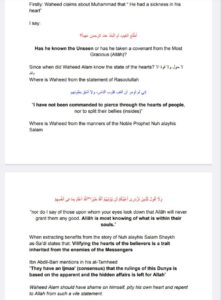
Response: In opposition to those who support sound Salafi stances against Dr. Muhammad Bin Haadi and Dr. Sulaymaan ar-Ruhayli, Abu Makkah is fiercely disputing that his colleague was not judged based on what is obvious regarding his dubious affiliations and refusal to take sound stances. Al-Allaamah Rabee Bin Haadi Al-Mad’khali [may Allah preserve him] said: “If you become aware that you reject the truth when it comes from one direction and embrace falsehood when it comes from another direction while acting as though it is the truth, then you should be aware that your heart is sick”. (3)

Is there anything else, in light of what is evident, that may have influenced Abu Makkah’s companion to side with the Musaafiqah, aside from either of the two diseases of the heart, Shubuhaat or Shahawaat?! Is there anything more to establish aside fame-seeking or ignorance from his companion’s promotion of the Musaafiqah and those who support them?!


Abu Makkah said:
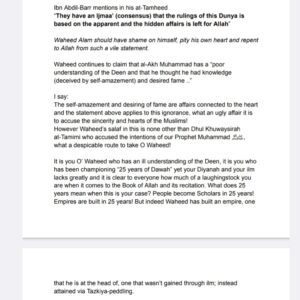
 

Response: First, Dhul Khuwaysirah was a Munaafiq who questioned the integrity of the Messenger—the one who does not speak based on his own desires but rather receives revelation from Allah. Has Abu Makkah not heard what the Prophet said during this incident “Don’t you trust me though I am the truth-worthy man of the One in the Heavens, and I receive the news of Heaven (i.e. Divine Inspiration) both in the morning and in the evening?” [Saheeh Al-Bukhari 4351]

As a result, it is impossible to draw a parallel between Dhul Khuwaysirah’s treatment of the Messenger and that of a person who judged Abu Makkah’s companion based on what is obvious. The two cases cannot be compared since Dhul Quwaysirah slandered Allah’s Messenger, whereas Abu Makkah’s companion is judged on the basis of his corrupt affiliations. Indeed, anyone with even a modicum of common sense knows that this is just another misleading analogy used by Abu Makkah in an effort to feign truth with a false comparison. (for more detail about Dhul Khuwaysirah, see Appendix III)

Second, as for Abu Makkah’s statement about “laughingstock” when Shaikh Ak recites the Quran, then, certainly, we have previously transmitted what is necessary regarding the behaviour of proponents of falsehood towards upright adherents to the Sunnah in this matter. But we’ll add one narration that we’re all familiar with. “The one who is proficient with the Qur’an will be with the noble and righteous scribes (the angels), and the one who reads it and stumbles over it, finding it difficult, will have two rewards”.

There isn’t a single one of us except that someone else outperforms us or can point out mistakes or shortcomings in our Qur’an recitation, but this isn’t a basis for distinguishing between Tawheed and Shirk, Sunnah and Bidah, sound unity and hizbiyyah, sound and corrupt Al-Walaa Wal Baraa’ah, even though Abu Makkah is grasping at straws in this matter.

Abu Makkah said, “What does 25 years mean when this is your case? People become scholars in 25 years! Empires are built in 25 years! But indeed Waheed has built an empire, one that he is the head of, one that wasn’t gained through ilm, instead attained via Tazkiyah-peddling”.

First, it is incredible that Shaikh Abu Khadeejah [may Allah protect him from the tongues of the enviers] has been endorsed by those particular senior scholars, such as Al-Allamah Ubaid Bin Abdillah Al-Jabiri [may Allah have mercy upon him], Al-Allamah Rabee Bin Haadi [may Allah preserve him], Al-Allamah Abdullah Al-Ghudiyaan [may Allah have mercy upon him] and the older students of knowledge in the UK and America, but they have been unable to reveal his Tazkiyah-peddling for the past 25 years!!! Indeed, it is definitely tantamount to foolishness if one thinks that a person who is well-known to scholars and thousands of Salafiyyoon in different places can get away with Tazkiya-peddling. O Abu Makkah! “The reality of foolishness is to place something in other than its rightful place”. [Sharh Saheeh Muslim By Imaam An-Nawawi. 18/136] O Abu Makkah! “A fool sees the impossible as possible”. [Tas’heel an-Nadr By Al-Maawardee. page 5]

And regarding this slander, we remind Abu Makkah that the Messenger [peace and blessings of Allah be upon him] said: “Verily, the worst act of usury is to attack the honour of a Muslim without a just cause”. [Abu Dawud 4876]

As for his assertion about Shaikh Abu Khadeejah not reaching the level of scholars after 25 years, this is simply another ludicrous statement of this deluded individual; rather, we can name numerous upright students of knowledge who have not been declared scholars, even though they started seeking knowledge before Shaikh Abu Khadeejah. In addition, Abu Makkah is essentially ignorant of an important affair behind the quest for knowledge. First, neither Abu Makkah nor any of us (common people) can determine the level of knowledge attained by any single scholar or senior student; rather, we return to the precise recommendations given by scholars to the students. Second, Abu Makkah and his ilk should pay attention to what is stated by al-Allaamah Saalih Aala Ash-Shaikh in this link: https://salafidawahmanchester.com/2021/08/14/not-aware-of-benefit-i-have-acquired-from-seeking-knowledge-disheartened-slow-learner-receives-tremendous-advice/

The mention of an empire built by Shaikh Abu Khadeejah gives us a clear indication that Abu Makkah cannot accept the fact that besides being abandoned due to his association with the Musaafiqah, he is also not valued in the manner that Shaikh Abu Khadeejah is valued by Al-Allaamah Rabee, Al-Allaamah Ubaid Al-Jaabiri, the senior students of knowledge in the Uk and America and the Salafiyyoon. “Die in your rage,” we tell him.

Conclusion:
Appendix 1
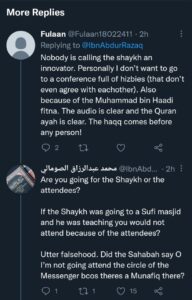
Response: This is a conversation on Twitter between Muhammad Abdur Razzaaq [may Allah open his eyes to reality] and someone else, whilst he encouraged people to attend the gathering of the Musaafiqah in the company of Dr. Sulaymaan Ar-Ruhayli. Muhammad stated, “Utter falsehood. Did the Sahaabah say ‘O I’m not going to attend the circle of the Messenger bcos there’s a Munaafiq there?'”

Amazing is the similarity between Abu Makkah and Muhammad Abdur Razzaaq! The Messenger [peace and blessings of Allah be upon him] said: “The souls are troops collected together. They come close upon what they recognize, and they differ upon what they reject”. [Al-Bukhaari 3109]

It is apparent that one of the characteristics they share is their fondness for ludicrous comparison. Indeed, the Messenger and the Sahaabah were upon clarity due to that which Allah revealed to him about the Munaafiqoon. As for Dr. Sulaymaan and the ones who invited him, all of them were upon something blameworthy because they defend Dr. Muhammad Bin Haadi, so how can a sensible person attend such a gathering to increase the numbers of Musaafiqah – those defending a person (Dr Muhammad Bin Haadi) who passed an oppressive judgement of Tabdee without proof! Read: https://abukhadeejah.com/muhammad-hadi-allegations-and-response-of-the-major-scholars/

Read and listen here: Warning against a Mistake or Behaviour Does Not Automatically Necessitate Tabdee; & a Mention of Shaikh Muhammad Bin Haadi’s & Shaikh Sulaymaan Ar-Ruhaylee’s Affair- [From 52mins onwards]: https://albaseerah.mixlr.com/recordings/1805145

Appendix II: Al-Allaamah Rabee Bin Haadi al-Mad’khali [may Allah preserve him] stated about the people of falsehood, “All the trials, splitting, and (blameworthy) differing came from the proponents of falsehood and trials. They do not keep quiet, they spread their falsehoods in their newspapers, magazines, and audio tapes, while wishing that the voice of truth should be silent. In their view, the voice of truth is what should be silent and the voice of falsehood should be raised and spread on the earth! Do they remain silent?! The proponents of falsehood do nor remain silent, neither abate nor slow down”. [Al-Ijaabaat Al-Jaliyyah Anil Qadaayaa Al-Manhajiyyah. pages 28-29]

Appendix III: Shaikh Al-Islaam Ibn Taymiyyah [may Allah have mercy upon him] said: The Qur’an has indeed stipulated that this man [i.e. Dhul Khuwaysirah] was from the hypocrites due to the statement of Allah:

وَمِنْهُمْ مَنْ يَلْمِزُكَ فِي الصَّدَقَاتِ

And of them [i.e. the Munaafiqoon] are some who accuse you (O Muhammad) in the matter of (the distribution of) the alms. [Surah at-Tawbah. Aayah 58] – Meaning they find fault with you and speak ill of you. [As-Saarim Al-Maslool. Page 228-229]

Abu Makkah’s ridiculous misrepresentations and misleading comparisons in his so-called response to Shaikh Abu Khadeejah demonstrate that he suffers from compounded ignorance and lacks basic principles in this matter of judging individuals based on what is obvious. Likewise, after it becomes apparent to the reader that Abu Makkah wanted to defend a person whose mistakes are as obvious as the midday sun, all the texts he used for that purpose were mentioned in an effort to muddle truth with untruth. The texts he utilised are truth without a doubt, but he utilised them to twist reality and beautify the affair of Muhammad Abdur Razzaaq even though reality speaks for itself. Allah [The Exalted] said:

وَلَا تَلْبِسُوا الْحَقَّ بِالْبَاطِلِ وَتَكْتُمُوا الْحَقَّ وَأَنتُمْ تَعْلَمُونَ

And mix not truth with falsehood, nor conceal the truth while you know (the truth). [Surah Al-Baqarah. Ayah 42]

Imaam Ibnul Qayyim [may Allah have mercy upon him] said, “Allaah forbade (us) from mixing truth with falsehood, thus leading to concealment of the truth. Mixing truth with false is by mixing the two until one of them is confused with the other. This is forgery and deceit by way of which what is made apparent is the opposite of what it is in reality. Likewise, when the truth is confounded with falsehood, the culprit manifests falsehood in the image of truth and speaks with a statement that carries two meanings- a correct meaning and a false meaning, so the listener is under the illusion that the speaker intends the correct meaning, whilst he intends the corrupt meaning. [An Excerpt from “Badaa’i At-Tafseer Al-Jaami Limaa Fassarahu Al-Imaam Ibnul Qayyim”. 1/124]

To be continued InShaaAllah


[Ref 1: Saheeh Bukhaari; Vol 3; Hadith Number:2641]

[Ref 2: An Excerpt from Al-Hulalul Ibreeziyyah Min At-Taleeqaat Al-Baaziyyah Alaa Saheeh Al-Bukhaariy page:397 Vol 2 footnote 1]

[Ref 3: Majmu’ Ar- Rā’iq Pgs. 485-486]


Some Affairs to Contemplate Whenever We Are Enticed Towards Blameworthy Desires!

In The Name of Allah, The Most Merciful, The Bestower of Mercy.

Imam Ibnul Jawzi [may Allah have mercy upon him] said:

Know that (blameworthy, forbidden, or unrestrained) desires entices a person towards immediate pleasures without considering the evil repercussions; entice towards short-lived pleasures, despite the fact that they are a cause of pain and harm in this life and a barrier to pleasure in the afterlife. As for sensible people, they keep away from pleasures that will lead to pain, and desires whose result will be regret. This is enough as praise regarding what sound intellect necessitates and a rebuke against desires. Know that desires can overcome a person in the different fields of study, removes one from the confines of sound reasoning and enters him (or her) into behaviour that is tantamount to madness (or folly). It might enter affairs of knowledge and thus leads a person to oppose that which sound knowledge commands, and it might enter Zuhd and thus leads one to Riyaa.

A sensible person should know that those who are addicted to lowly desires reach a state in which they no longer enjoy themselves, but at the same time, they are unable to abandon those desires, because it becomes as if it is a necessity of life. And due to this, you’ll find that alcoholics and sex addicts do not even enjoy a tenth of those desires, but they put themselves in a perilous situation that compels them to keep on returning to the act. However, if based on clear-sightedness the beautification of those lowly desires ceases, a person realises that one was exposed to some ruin that is contrary to well-being, a situation of grief instead of happiness, whilst seeking after pleasure; so, one resembles an animal that was led to a trap, but neither reached the thing that was utilised to lure it into the trap nor able to escape.

A person should ponder upon the fact that a human being was not created to fulfil desires; rather the human being was facilitated (with sound knowledge based on the divine revelation and uncorrupted perception) to reflect on the consequences of one’s actions and perform righteous deeds for the Afterlife. An animal receives pleasure through eating, drinking and sex much more than a human being, whilst living a life devoid of reflection and concern. Therefore, it is drawn towards its desires due to being ignorant of the outcomes of its actions (i.e. it does not possess the knowledge given to humans through sound reasoning and reflection guided by the divine revelation).

A person should ponder upon the consequences of desires because many people are deprived of virtue and find themselves in a state of depravity due to it. Many types of (unhealthy) food lead to illness due to an unrestrained desire (for them), and many mistakes violate one’s honour, lead to an evil mention of a person as well as the guilt of sinning due to unrestrained desires, yet one still does not give thought to anything else except their desires! The best description regarding this is that of one person in a tannery because such an individual does not really notice its smell properly until after exiting and then realises where he (or she) was.

A sensible person should imagine the dishonour that accompanies desires and the harm that results from those pleasures, for indeed one will see that- in most cases- they occur as a result of those desires and pleasures. A person should think about how (the consequences of unrestrained desires and pleasures do affect) others, then ponder and get a hint of its (unpraiseworthy) outcomes, for indeed one will see the blameworthiness of that which is known regarding them if found guilty. A person should reflect upon those pleasures because (sound) intellect (or sound perception guided by the pure divine revelation) will make one realise that they are nothing more than desires and a state of blindness.

A person should contemplate on the honour a person receives due to being given the upper hand and the humiliation found in subjugation, for indeed there is none who overcomes desires except that their honour is strengthened; and there is none who is subjugated by desires except that they will find humiliation and subjugation in one’s soul. A person should contemplate the benefits of opposing one’s desires, such as the commendation attached to it in this worldly life, the safety of the soul and safeguarding of one’s honour, as well as reward in the afterlife. (1)

We ask Allah:
يَا حَيُّ يَا قَيُّومُ بِرَحْمَتِكَ أَسْتَغيثُ أَصْلِحْ لِي شَأْنِيَ كُلَّهُ وَلاَ تَكِلْنِي إِلَى نَفْسِي طَرْفَةَ عَيْنٍ

O Ever Living! O The Self Subsisting, Upon Whom Everything Depends! By Your mercy I seek assistance; rectify for me all of my affairs and do not leave me to myself, even for the blink of an eye. [Imaam Albaani declared it Hasan in Silsilah As-Saheehah Number 227]

Do Not Cease Being Repentant To Allah And Seek Forgiveness For Your Sins- By Shaikh Abu Khadeejah

[may Allah preserve him]
https://abukhadeejah.com/do-not-cease-being-repentant-to-allaah/


[Ref 1: An Excerpt from Dhammul Hawaa. pages 36-38. Slightly paraphrased]


The People of Bidah On The Day of Aa’shooraa (Rawaafid, Nawaasib, and other Ignoramuses)

In The Name of Allah, The Most Merciful, The Bestower of Mercy.

Hishaam Bin Urwah [may Allah have mercy upon him] used to say, “Do not question the people about what they have innovated (in the religion) today because they have prepared answers for it; rather, question them about the Sunnah because they do not know it.” (1)

Ibn Aqeel [may Allah have mercy upon him] said, “If the truthful ones were to keep silent and the falsifiers speak, then the creation would have relinquished what they have witnessed (of truth) and reject what they have not witnessed. So when the devout ones desire to revive the Sunnah, the people would reject it and think that it is bidah”. (1.1)

Shaikh Al Islam Ibn Taymiyyah [may Allah have mercy upon him] was asked if there is any authentic hadeeth from the Prophet [peace and blessings of Allah be upon him] regarding what people do on the day of Aashooraa, such as applying kohl and Hena, shaking hands, taking a bath, preparing food such as barley and other grains, and manifesting happiness; if there are no authentic proofs, is this considered bidah or not? And do the deeds of the other group (i.e. the Raafidah Shiites) have a basis in the religion or not, such as mourning, showing grief, purposefully making oneself thirsty and scarring oneself, sobbing, reciting (poems), fainting as a result of that and slapping the face?

Response: All the praises and thanks be to Allah, Lord of the entire existence. There is no authentic hadeeth from the Prophet [peace and blessings of Allah be upon him] or his companions in this regard, and none of the Imams, including the four Imams (Abu Hanifah, Malik, Ahmad, and Shaafi’ee), have recommended it.  Neither the scholars who authored and collated the texts that are relied on for their authenticity nor the companions and their students reported anything authentic or weak regarding this from the Prophet, neither in the authentic books of hadith nor in the Sunan. The virtuous first three generations of Islam knew nothing about these reports; however, some of those who came after the first three virtuous generations of Islam have transmitted reports to this effect, such as “Whoever applies kohl on the day of Aashooraa will not be sore-eyed in that year.” “Whoever bathes on Aashooraa will not get sick that year.” They also transmitted reports that Adam’s repentance took place on the day of Aashooraa, the virtue of prayer on this day, and that it was the day Nuh’s ark landed on Mount Judi, the day Ya’qub was reunited with Yusuf, and the day Ibraaheem was saved from the fire, etc. They also transmitted fabricated reports and lies attributed to the Prophet saying, “Whoever gives to his family on the day of Aashooraa, Allah will give him throughout the year.” All of these reports are lies attributed to the Prophet. (2)

Then an ignorant and transgressive group arose, consisting of either disbelieving hypocrites or misguided individuals. They declared (so-called) allegiance to the Prophet’s household and observed Aashooraa as a day of mourning, misery, and wailing. They practice pre-Islamic ignorance-related deeds such as slapping the face, tearing their clothes, and calling to pre-Islamic ignorance-related slogans and disbelief. However, Allah and His Messenger instructed that when new disasters occur, (one) exercises patience, hopes for Allah’s reward, recalls one’s misdeeds, and repents, as Allah (The Most High) said:

وَبَشِّرِ الصَّابِرِينَ
الَّذِينَ إِذَا أَصَابَتْهُم مُّصِيبَةٌ قَالُوا إِنَّا لِلَّهِ وَإِنَّا إِلَيْهِ رَاجِعُونَ
أُولَٰئِكَ عَلَيْهِمْ صَلَوَاتٌ مِّن رَّبِّهِمْ وَرَحْمَةٌ ۖ وَأُولَٰئِكَ هُمُ الْمُهْتَدُونَ

But give glad tidings to As-Saabireen (the patient ones, etc.). Who, when afflicted with calamity, say: “Truly! To Allah, we belong and truly, to Him, we shall return.” They are those on whom are the Salaam (i.e. blessings, etc.) (i.e. who are blessed and will be forgiven) from their Lord, and (they are those who) receive His Mercy, and it is they who are the guided ones. [Soori Al-Baqarah: Ayaat 55-57]

And it has been reported in the Saheehayn (Bukhaari and Muslim) from the Prophet that he said, “He is not from us, he who slaps his cheeks, tears his clothes and calls to the slogans of the pre-Islamic period of ignorance” (3)

They also recite mournful poems and relate reports that are full of lies. And the truth in them merely renews their (exaggerated and mistaken way of grieving), bigoted allegiance, incitement to hatred and conflict, initiating trials between the people of Islam as a result of that, and reviling those who were first to enter Islam. Even an eloquent person cannot explain the evil of these people (i.e. the Raafidah) and their harm to the people of Islam. [Visit http://www.shia.bs/index.cfm ]

However, they (i.e. Raafidah) are opposed by another group of people who are either Nawaasib (footnote a) or ignoramuses, thus they confront corruption with corruption, lying with lies, evil with evil, and bidah with bidah. On the day of Aashooraa, they write poems conveying joy and happiness, apply kohl, dye their garments a different colour, spend extra on their families, and cook the food they do not normally cook. These people regard the day of Aashooraa as an occasion comparable to the days of celebration and happiness [i.e. the two Eids]. The Raafidah, on the other hand, observe it as a day of mourning, grief, and suffering [i.e. inflicting injuries on oneself]. In this matter, both groups are mistaken and have exited the authentic Prophetic path. Allah’s Messenger, the rightly guided Khulafaa, or any of the Muslims’ Imams, such as Maalik, Ath-Thawree, Al-Layth Bin Sa’d, Abu Haneefah, Al-Awzaa’ee, Ash-Shaafi’ee, Ahmad Bin Hanbal, and Ishaaq Bin Raahawayh, never legislated these deeds. (4)


Footnote a: Imam Muhammad Ibn Saalih Al-Uthaymeen [may Allah have mercy upon him] said: The Nawaasib are the ones who propagate hostility towards the Prophet’s family, slander and revile them, so they are the opposite of the Rawaafid (i.e. those who exaggerate the status of the Prophet’s family until they worship them). (5)

Ref 1: Quoted by Imaam Aloosee (may Allah have mercy upon him) in “Ghaayatul Amaanee Fee Ar-Radd Alaa An-Nabahaanee”. 1/367

Ref 1.1: Shifaa As-Sudoor Fee Ziyaaratil Mashaahid Wal-Quboor. Page 148

Ref 2: Majmoo al-Fataawaa 25/299-312

Ref 3: Al-Fataawaa Al-Kubraa page 1/200

Ref 4: Majmoo al-Fataawaa 25/299-312

Ref 5: Sharh Al-Aqeedah Al-Waasitiyyah 2/283

O Uncle Muhammad Al-Maliki! Sneaking into the UK and shifting alliances will not conceal your clear errors

In The Name of Allah, The Most Merciful, The Bestower of Mercy.

Allah [The Most High] said:

يَـٰٓأَيُّہَا ٱلَّذِينَ ءَامَنُواْ كُونُواْ قَوَّٲمِينَ بِٱلۡقِسۡطِ شُہَدَآءَ لِلَّهِ وَلَوۡ عَلَىٰٓ أَنفُسِكُمۡ أَوِ ٱلۡوَٲلِدَيۡنِ وَٱلۡأَقۡرَبِينَ‌ۚ إِن يَكُنۡ غَنِيًّا أَوۡ فَقِيرً۬ا فَٱللَّهُ أَوۡلَىٰ بِہِمَا‌ۖ فَلَا تَتَّبِعُواْ ٱلۡهَوَىٰٓ أَن تَعۡدِلُواْ‌ۚ وَإِن تَلۡوُ ۥۤاْ أَوۡ تُعۡرِضُواْ فَإِنَّ ٱللَّهَ كَانَ بِمَا تَعۡمَلُونَ خَبِيرً۬ا

O you who believe! Stand out firmly for justice, as witnesses to Allah; even though it be against yourselves, or your parents, or your kin, be he rich or poor, Allah is a Better Protector to both (than you). So follow not the lusts (of your hearts), lest you may avoid justice, and if you distort your witness or refuse to give it, verily, Allah is Ever Well-Acquainted with what you do. [Surah An-Nisaa. Ayah 135]

Uncle Muhammad Al-Maliki first appeared in 2012 Muhammad as a willing supporter of Masjid As-Sunnah’s Admin (Cheetham Hill- Manchester). And not only was he willing to defend these staunch followers of Al-Maribi and Al-Maghraawi, but he also embarked upon a path of slander and lies against the Salafiyyoon of Al-Markazus Salafi [Manchester]

So after the hizbiyyoon presented their complaints to Uncle Muhammad Al-Maliki, he decided to embark upon his disgraceful behaviour. And in order to hide the reality of the staunch hizbiyyoon at Masjid As-Sunnah and the unambiguous verdicts of the scholars against them, Uncle Muhammad Al-Maliki utilised Aayaat of the Qur’an and an authentic Hadeeth of the Messenger (sallal-laahu-alayhi-wasallam) against the Salafiyyoon of Al-Markazus Salafi.

The first Aayaat he utilised were in Soorah Al-Qalam as follows:
هَمَّازٍ مَّشَّاءٍ بِنَمِيمٍ
مَّنَّاعٍ لِّلْخَيْرِ مُعْتَدٍ أَثِيمٍ

A slanderer, going about with calumnies; Hinderer of the good, transgressor, sinful. [Ayaat 11-12]

Then he quoted the authentic hadeeth: The Messenger (sallal-laahu-alayhi-wasallam) said: O you who believe with your tongues, yet Iman has not entered your hearts. Do not backbite the Muslims, nor follow their faults. For he who follows others faults then Allah will declare (disclose) his faults and he whom Allah reveals his faults, then Allah disgraces him in his own house.”

These were some of the authentic texts quoted by Uncle Muhammad Al-Maliki for the purpose of sheltering and defending staunch defenders of Mubtadi’ah at Masjid As-Sunnah. So by deliberately utilizing these texts, he hoped to achieve two goals-silence those who were transmitting the clear-unambiguous verdicts of the scholars against the staunch followers of Maribi, Halabi, and Maghraawi at Masjid As-Sunnah and portray an evil image of them to the unsuspecting Muslims. So, reminded Uncle Muhammad as follows, “How is it possible that those who warned against the Mubtadi’ah and their staunch followers- with clear unambiguous evidence from the scholars- are to be regarded as slanderers and hinderers of good, whilst those who have obstinately defended those Mubtadi’ah for more ten years are protected?! One of the Salaf said: “The one who is silent about the truth is a silent devil, while the one who speaks falsehood is a speaking devil.” [Quoted in Ad-Durar as-Saniyyah. 8/75-79]

Al-Allaamah Rabee Bin Haadi Al-Madkhali (may Allaah preserve him) said: ”f you see a person upon truth and another upon falsehood, it is obligatory that you aid the truth and warn against falsehood; if not, then you are dead (i.e. a dead heart)-neither recognizing good nor rejecting evil and this is a sign of the heart’s hardness.” [Majmoo 14/271] Al-Allaamah Rabee’s Verdict Against Masjid As-Sunnah: http://safeshare.tv/w/RbhddhDFFs

Uncle Muhammad Al-Maliki’s Poem For al-Hajuri Al-Mubtadi (The Innovator In Religious Affairs)

It is well-known to the Maraakiz of Salafiyyah that Uncle Muhammad Al-Maliki was a regular guest of the UK followers of Halabi and Maribi. However, he also wrote a poem for Al-Hajoori. So has he recanted those lines of poetry? If you cannot read Arabic, then ask someone to translate the poetry for you. And after reading Uncle Muhammad’s poetry compare it with the statements and refutations against Hajoori at http://alhajuri.com/

The lines of poetry as follows:
للهِ دَرُّكَ يا حَجُـوري
أنْ كُنْتَ بِالحَقِّ جَهُورِ
تَصْبِرْ على بَغْي العَيِّي
أنْ كانَ بِالجَهْلِ جَسُورِ
والقَوْلُ إنْ لَمْ يَقْتَـرِن
بِدَلِيلِهِ فَكَمَـالبَخُــورِ
مَنْ بِالسَّفَاهَـةِ ذَمَّـكُم
قَدْ فَاهَ مِنْ غَيْرِ نُـورِ
ولَئِنْ تَزَايَـدَ ظُلْمُـهُ
قُمْتَ لَهُ مِثْلُ النُّسُـورِ
ولكَمْ صَبَرْتَ مُرَابِطاً
للرفضِ في تلكَ الثُغُورِ
تُعَرٍّضُ نَحْرَكَ للرِمَاحِ
وَتَنْصِبُ وَجْهَكَ للهَجيرِ
وَتَبْسُطُ يَدَكَ لكُلِ آتٍ
وَتَحْمِي سُّنَّةَ الهَادي البَشِيرِ
أَيُرمَى شَيْخُ دَمَّاجٍ بِظُلْمٍ
كَأَنَّ الشَّيْخُ مِنْ أَهْلِ الشُّرُورِ
وَفَضْلاً عَنْ نَصِيحٍ صِرْتَ صَاحِ
إلى أُسْلُوبِ مُوغِرَةِ الصُّدُورٍ
فَيَالَيْتَ المُعَارِضَ قَدْ أتَانَا
بِبُرْهَانٍ وَليسَ بِقَولِ زُورِ
أَمَا يَدْرِي أَنَّا جِدُّ رَهْنٌ
قَبْلَ العَرْضِ في بَطْنِ القُبوُرِ
وَيَومَ العَرْضِ إمَّا مِنْ دَلِيلٍ
وَإمَّا فَالعُقُوبَةُ بِالسَّعِيـــرِ
فَشَرُ النَّاسِ مَنْ يَتْبَعْ هَوَاهُ
وشَرُّ الشَّرِّ تَصْدِيقُ الغَرُورِ
وخَيْرُ النَّاسِ مَنْ يَنْصَحْ أَخَاهُ
ولا يَحْقَرْ بِكِبْرٍ أوْ غُرُورِ
وَيُخفِي مَا اسْتَطَاعَ لَهُ نَصِيحاً
فَإِنَّ النُّصْحَ يَفْسُدُ بِالظُهُورِ

Regarding the statement of Uncle Muhammad Al-Maliki: [للهِ دَرُّكَ يا حَجُـوري]: This statement is uttered in praise of someone for his good actions bestowed upon him by the Tawfeeq of Allaah. So when a person is considered as someone with many good actions and the people receive many benefits from him by the Tawfeeq of Allaah, it is said about him in amazement [لله دره] [للهِ دَرُّكَ], etc. Basically, Allaah has bestowed on you the Tawfeeq to perform and accomplish much good, and how excellent that is! [Lisaan Al-Arab of Ibn Mandhoor 4/279]

This was Uncle Muhammad’s view of Al-Hajuri Al-Mubtadi after he was refuted and declared a Mubtadi. Indeed, it is not surprising that Uncle held such absurd views because he took pride in associating himself with some of the followers at Masjid As-Sunnah (Cheemthamhill- Manchester). Despite Hajoori’s calamities and Bidah, Uncle Muhammad did not recant from those lines of poetry written in praise of Al-Hajuri. See Hajoori’s calamities here: http://alhajuri.com/

One of many deceptions and diversionary tactics: Uncle Muhammad deliberately sought to divert his listeners from the main subject matter [i.e. the dispute between the criticizers at Al-Markazus Salafi and Masjid As-Sunnah’s Admin was due to the three contemporary figureheads of Bidah (Al-Maribi, Al-Halabi and Al-Maghraawi)]. He claimed that we (i.e. the ones who transmitted the refutations of the scholars at Al-Markazus Salafi against Masjid As-Sunnah’s Admin) turn our faces away from a Muslim when he gives salaam, but we would say to a kaafir, “Hi John”.

First: This statement of uncle was nothing else but mixing Haqq with Baatil. He produced no evidence to support his claims; rather it is yet another emotional rhetoric aimed at defaming the Salafiyyoon at Al-Markazus Salafi and aiding the staunch followers of the Mubtadi’ah (Al-Maribi, Al-Halabi, and Al-Maghraawi).

Second: There is no doubt that a man of Sunnah will not give Salaam to a person against whom the verdict of Mubtadi is established with clear proof, even if such a Mubtadi is still within the fold of Islaam. And likewise, a man of Sunnah will not entertain those specific individuals about whom the Ulama have advised that they are to be boycotted due to the deadly Shubuhaat they spread. Shaikh Abdullaah Al-Bukhaari (may Allaah preserve him) stated: “Some of the aims behind boycotting innovators and the people of falsehood: [a] Actualization of servitude to Allaah: Boycotting is an act of worship and an affair of the Sharee-ah, which must be carried out for the sake of Allaah (The Mighty and Majestic) and in accordance with the guidance of the Messenger (sallal-laahu-alayhi-wasallam). [b] Enjoining good and forbidding evil. [c] Actualization of Walaa Wal Baraa (love and hate for the sake of Allaah). The other affairs that follow from the above aims are: Restraining the innovator and his innovation and protecting society from him. Preserving the Sharee-ah, so that what is not part of it is prevented from entering into it in the name of the Religion. [An Excerpt from At-taleeqaat As-Sareehah Alaa Risaalatee An-Naseehah Lid-Doktoor Ibraaheem Ibn Aamir Ar-Ruhayli – By Shaikh Abdullah Al-Bukhaaree. page 58]

We informed Uncle at the time that Yahyah Al-Hajoori Haddaadi Al-Mubtadi is a Muslim, so why did Al-Allaamah Rabee refuse to meet him?! Then why did Uncle unleash his tongue against the Salafiyyoon for establishing the sound Walaa Wal Baraa against those Admin members at Masjid As-Sunnah (Cheethamhill) who obstinately defend Mubtadi (Al-Halabi, Al-Maribi, and Al-Maghraawi? See here: http://www.alhajuri.com/articles/qsikmob-shaykh-of-the-hajaawirah-yahya-al-hajuri-rejected-in-makkah.cfm

Likewise, uncle did not provide any proof that we turn our faces away from other Muslims other than those whom the Ulama have advised that they are to be boycotted?! We did not entertain Mubtadi’ah and those specific individuals about whom our scholars have advised that they are to be boycotted due to the dangerous and deadly Shubuhaat they carry and propagate. As for other Muslims other than those dangerous people of falsehood and bidah, he had no proof to establish that we do turn away from them when they give us Salaam. It has been 10 years, he has not produced any proof.

As for the ruling with respect to greeting non-Muslims with other than As-Salaamu Alaykum, we asked him to explain to us what that affair has to do with shunning a Mubtadi or the obstinate people of falsehood! Likewise, he did not produce any evidence that we do turn away from the common Muslims when they give us salaam.

Likewise, he sought to divert attention from the calamities of Masjid As-Sunnah’s Admin with a very absurd question to Al-Markazus Salafi, saying, “Who says that Shaikh Wasiyullaah is a man of bidah?!” He asked us this question, but neither stated who held such a view nor cited the relevance of it to the discussion; rather it was another stratagem utilised to divert his audience from the main issues. This question was nothing else but a stratagem by way of which he sought to arouse the emotions of the common people at Masjid As-Sunnah and divert them from the very reasons Masjid As-Sunnah’s Admin was being criticized and boycotted. He did not cite a single piece of evidence to respond to the knowledge-based criticisms produced against the staunch followers and supporters of Al-Maribi (Ikhwaani Mubtadi), Al-Halabi (Murji Mubtadi), and Al-Maghraawi (Takfeeri, revolutionary, Mubtadi); rather he sought to play about with the emotions of his listeners.

These were a few issues amongst many others we discussed and reprimanded Uncle Muhammad. Therefore, what is incumbent upon Uncle Muhammad is to openly recant his errors and declare his freedom from the people of Bidah, such as the followers of Al-Maribi, Al-Maghraawi, and Al-Halabi at Masjid As-Sunnah (Cheethamhill- Manchester).
Recanting Mistakes, Repentance and Humbling Oneself- [By Ibnul Arabi, Al-Allaamah Rabee, Al-Allaamah Al-Mu’allimee and Shaikh Abdus Salaam Burgess]:

https://salafidawahmanchester.com/2022/07/16/recanting-mistakes-repentance-and-humbling-oneself-by-ibnul-arabi-al-allaamah-rabee-al-allaamah-al-muallimee-and-shaikh-abdus-salaam-burgess/

[3] Why do we need to be more cautious of the soul than an avowed enemy

In The Name of Allah, The Most Merciful, The Bestower of Mercy.


“It is obligatory for the one who hears this from Allah to be more careful or cautious about his Nafs than an enemy who wishes to murder him, take his wealth, or violate his honour. If someone asks, “Why do you obligate this precaution on me regarding the Nafs until you put it in a circumstance more dangerous than an enemy whose enmity is unquestionably very manifest?” Then it should be said to him, “The enemy who wants to harm you, take your wealth, or violate your honour, if they succeed in doing so, Allah will forgive some of your sins and elevate you. (footnote a) However, this will not be the case with the Nafs because if the Nafs dominate you through what you desire—that which you have been forbidden—then you will face ruin in this world and the next, humiliation and terrible punishment in this world and evil in the Sight of Allah”. (footnote b)


Imam al-Aajurree [may Allah have mercy upon him] said:

I’m going to give you a similitude with context that is not hidden from you. Know that the soul is like a fine foal from a horse, and the beholder is awestruck when he looks at it because of its good appearance and beauty. People with knowledge of its affairs say, “Benefit will not be obtained from it until it is properly trained and disciplined, then it will be of benefit- good enough to gallop and be of service, and thus its rider praises the outcomes of its training and discipline. But if it is not disciplined, its nice looks and beauty will be useless, and its rider will not laud its results when they are required.”

If the owner of this foal adopts the advice of individuals with knowledge about its situation, he will know that their speech is sound and will then give it to a horse trainer to train. And the trainer of horses is not considered worthy of the title unless he is proficient in the process of training as well as being patient. If he is knowledgeable about training horses and knows the best course of action, the owner will profit from it; however, if the trainer is not knowledgeable about training horses nor how to discipline a horse, he will ruin this foal, exhaust himself, and the rider will not be pleased with the results. If he is knowledgeable about horse training and how to discipline a horse but lacks the patience to endure the hardship that comes with the training, desires comfort in the situation, and is careless regarding the right course of action required of him, he will ruin and mistreat this foal, making it unfit for service and unfit to gallop, causing its appearance to be inconsistent with its true reality.

If the foal’s owner was also its trainer, he will become regretful when regret will be useless owing to his neglect. And when a service is needed, he glances at another horse whose service is sought and received and gallops when required. Then he seeks the service of his horse and requests that it gallop, but neither receives a response nor does the horse agree to gallop. All of this is due to his negligence when training the horse and his lack of patience after admitting it. So, he began to blame himself, saying, ” “Why was I negligent and why did I fall short? Indeed, my lack of patience has brought on everything I despise”. And Allaah’s Aid is sought! Consider and comprehend this similitude, may Allah have mercy on you, in order to be successful and saved. [An Excerpt from Adabun Nufoos. Page 5. Slightly paraphrased]


Footnote a: The Prophet [peace and blessings of Allah be upon him] said, “Indeed, the bankrupt one of my Ummah will come on the Day of Resurrection with prayer, fasting and Zakah (in his account), but he comes along having abused this one, slandered that one, unlawfully took the wealth of this one and shed the blood of that one, and beaten that one. So this one will be given from his good deeds, and that one will be given from his good deeds. And if his good deeds finish before the judgment is made on him, some of their sins(i.e. the ones he wronged) will be taken and cast onto him, then he will be thrown into the Fire.” [Reported by Muslim. Number: 2581]

Footnote b: Imam Abdul Azeez Bin Baaz [may Allah have mercy upon him] said: The sinners [i.e. those who die whilst committing sins lesser than shirk] are under the will of Allah- if Allah wishes, He will either punish them or forgive them straight away or He enters them into hell for some time and paradise thereafter, just as Allah said:

[إِنَّ ٱللَّهَ لَا يَغۡفِرُ أَن يُشۡرَكَ بِهِۦ وَيَغۡفِرُ مَا دُونَ ذَٲلِكَ لِمَن يَشَآءُ‌ۚ – Verily, Allah forgives not that partners should be set up with him in worship, but He forgives except that (anything else) to whom He pleases]. [Surah An-Nisaa’ Aayah 48] https://binbaz.org.sa/fatwas/28307/%D8%B4%D8%B1%D8%AD-%D8%AD%D8%AF%D9%8A%D8%AB-%D9%84%D8%A7-%D9%8A%D8%AF%D8%AE%D9%84-%D8%A7%D9%84%D8%AC%D9%86%D8%A9-%D9%86%D9%85%D8%A7%D9%85

https://abukhadeejah.com/do-not-cease-being-repentant-to-allaah/
https://abukhadeejah.com/divine-punishment-what-causes-it-and-how-to-remove-it-from-your-lives/

[2] Why do we need to be more cautious of the soul than an avowed enemy

In The Name of Allah, The Most Merciful, The Bestower of Mercy.


“It is obligatory for the one who hears this from Allah to be more careful or cautious about his Nafs than an enemy who wishes to murder him, take his wealth, or violate his honour. If someone asks, “Why do you obligate this precaution on me regarding the Nafs until you put it in a circumstance more dangerous than an enemy whose enmity is unquestionably very manifest?” Then it should be said to him, “The enemy who wants to harm you, take your wealth, or violate your honour, if they succeed in doing so, Allah will forgive some of your sins and elevate you. (footnote a) However, this will not be the case with the Nafs because if the Nafs dominate you through what you desire—that which you have been forbidden—then you will face ruin in this world and the next, humiliation and terrible punishment in this world and evil in the Sight of Allah”. (footnote b)


If someone said, “Clarify the ugly traits of the soul for me”.

It is said to him: They are traits that may have already settled in the soul and it does not love to be separated from them- numerous traits, and if a person examines his soul he might find them as well. Indeed, it is a soul that follows (evil or excess) desires and is engaged in the (evil or excess) pleasures of the worldly life. It has prolonged hope for that which is short-lived and does not show little concern for a lifespan that will inevitably come to an end. It has a fervent desire to love this worldly life, and when it loves it (through sin or excess), the heart becomes hard and turns away from an abode whose bliss will never come to an end (i.e. Paradise).

It loves traits that it knows will harm it tomorrow, laughs and rejoices, enjoys itself with that which its Lord has forbidden, and grieves morning and evening for that which was not decreed for it of those things it hopes for from the worldly life. It is a soul facilitated with ease to seek after the (good) things of the worldly life, finds enjoyment in falling short in good deeds which its Lord calls to (or commands), desires to spend wealth in obedience to Allah, but Satan threatens it with poverty, so it inclines towards that which Satan calls to.

Allah promises it forgiveness and bounty, but it neither has certainty about it nor is pleased with it. It has firm hope in the promises of the people but is reluctant when the threat of its Lord reaches it. It pleases the people at the expense of Allah’s anger and hesitates to please its Lord. Allah calls it to have patience during calamities – a means of consolation and solace, but it does not accept.

It pretends in the presence of the people that it fulfils obligations, but fulfils little of that which Allah obligates on it. It abandons disobedience after being able to do so out of being shy of the people but has little shyness whilst Allah [The Most Great] watches it.

It gives little thanks for the innumerable blessings of Allah, utilises the blessings of Allah [The Most Generous] – day and night – as an aid to disobey Him. It finds it easy to sit with idle people but finds it difficult to sit with scholars. It obeys (or follows) a deceiver but disobeys the most sincere advisers. It hastens to evil desires but delays repentance today and tomorrow.

Whoever realises these traits in his soul and other than them, he should hasten to discipline it through good behaviour in order to return it to that which is more worthy regarding fear of Allah [The Mighty and Majestic]- in private and public, having great regret, refrain from the repugnant traits which he knows for sure is with him and continue upon rectification throughout his lifespan. And Allah is the Bestower of this affair. (1)

Imam Al-Qahtaanee [may Allah have mercy upon him] said:

And You (Allah) have placed love for me within the hearts….And the affection from You is through mercy and kindness….And You have spread – amongst the people – good about me… And conceal my acts of disobedience from their eyes…And you have made my good mention amongst the people common (or widespread)…until you made them all my brothers….By Allaah, if they knew the repugnance of my secret affairs (or inner self)….The one who meets me would have refused to give me Salaams…And they would have turned away from me and loath my companionship…And I would have brought disgrace upon myself after being honored…But you conceal my faults and deficiencies…And you dealt with my sins and transgression with forbearance (i.e. gave me an opportunity to repent)…So all praise and commendations- by way of my thoughts, limbs, and tongue- is Yours…. (2)

We ask Allah:

يَا حَيُّ يَا قَيُّومُ بِرَحْمَتِكَ أَسْتَغيثُ أَصْلِحْ لِي شَأْنِيَ كُلَّهُ وَلاَ تَكِلْنِي إِلَى نَفْسِي طَرْفَةَ عَيْنٍ

O Ever Living! O The Self Subsisting, Upon Whom Everything Depends! By Your mercy I seek assistance; rectify for me all of my affairs and do not leave me to myself, even for the blink of an eye. [Imaam Albaani declared it Hasan in Silsilah As-Saheehah Number 227]

اللهم كما حَسَّنْت خَلْقِي فَحَسِّنْ خُلُقِي –

"O Allah! Just as You made my external form beautiful, make my character beautiful as well". https://salafidawahmanchester.com/wp-content/uploads/2021/07/Admonitions-of-The-Scholars-Regarding-Good-Manners.pdf

اللَّهُمَّ أَصْلِحْ لِي دِينِي الَّذِي هُوَ عِصْمَةُ أَمْرِي
وَأَصْلِحْ لِي دُنْيَايَ الَّتِي فِيهَا مَعَاشِي
وَأَصْلِحْ لِي آخِرَتِي الَّتِي فِيهَا مَعَادِي
وَاجْعَلِ الْحَيَاةَ زِيَادَةً لِي فِي كُلِّ خَيْرٍ
وَاجْعَلِ الْمَوْتَ رَاحَةً لِي مِنْ كُلِّ شَرٍّ

O Allah! Rectify my religion for me, which is the safeguard of my affairs; rectify my worldly [affairs], wherein is my livelihood; and rectify my Afterlife to which is my return; and make life for me [as a means of] increase in every good and make death for me as a rest from every evil.

اللَّهُمَّ إِنِّي أَسْأَلُكَ العافِيَـةَ فـي الدُّنيا والآخِرَةِ، اللَّهُمَّ إِنِّي أَسْأَلُكَ العَفْوَ والعافِيَـةَ فـي دِيني ودُنْـيايَ وأَهْلِي ومالِي، اللَّهُمَّ اسْتُـرْ عَوْراتِي، وآمِنْ رَوْعاتِي،
اللَّهُمَّ احْفَظْنِـي مِنْ بَـيْنِ يَدَيَّ، ومِنْ خَلْفِي، وعَنْ يَمِيـنِـي، وعَنْ شِمالِي، ومِنْ فَوْقِي، وأَعُوذُ بِعَظَمَـتِكَ أَنْ أُغْتالَ مِنْ تَحْتِـي

O Allaah! I ask You for well-being in this Dunyaa and the Aaakhirah. O Allāh, I ask You for pardon and well-being in my religion, my worldly affairs, my family and my wealth. O Allaah! Conceal my [faults, shortcomings etc] and safeguard me against everything that will bring me fear and sorrow. O Allaah! Protect me from in front, from behind me, from my right and my left, and from above. And I seek refuge with Your Magnificence from being swallowed up from beneath me.


Footnote a: The Prophet [peace and blessings of Allah be upon him] said, “Indeed, the bankrupt one of my Ummah will come on the Day of Resurrection with prayer, fasting and Zakah (in his account), but he comes along having abused this one, slandered that one, unlawfully took the wealth of this one and shed the blood of that one, and beaten that one. So this one will be given from his good deeds, and that one will be given from his good deeds. And if his good deeds finish before the judgment is made on him, some of their sins(i.e. the ones he wronged) will be taken and cast onto him, then he will be thrown into the Fire.” [Reported by Muslim. Number: 2581]

Footnote b: Imam Abdul Azeez Bin Baaz [may Allah have mercy upon him] said: The sinners [i.e. those who die whilst committing sins lesser than shirk] are under the will of Allah- if Allah wishes, He will either punish them or forgive them straight away or He enters them into hell for some time and paradise thereafter, just as Allah said:

[إِنَّ ٱللَّهَ لَا يَغۡفِرُ أَن يُشۡرَكَ بِهِۦ وَيَغۡفِرُ مَا دُونَ ذَٲلِكَ لِمَن يَشَآءُ‌ۚ – Verily, Allah forgives not that partners should be set up with him in worship, but He forgives except that (anything else) to whom He pleases]. [Surah An-Nisaa’ Aayah 48] https://binbaz.org.sa/fatwas/28307/%D8%B4%D8%B1%D8%AD-%D8%AD%D8%AF%D9%8A%D8%AB-%D9%84%D8%A7-%D9%8A%D8%AF%D8%AE%D9%84-%D8%A7%D9%84%D8%AC%D9%86%D8%A9-%D9%86%D9%85%D8%A7%D9%85

https://abukhadeejah.com/do-not-cease-being-repentant-to-allaah/
https://abukhadeejah.com/divine-punishment-what-causes-it-and-how-to-remove-it-from-your-lives/

[Ref 1: An Excerpt from Adabun Nufoos, page 4. Slightly paraphrased]
[Ref 2: Refer to first lines of Al-Qahtaanee’s Nooniyyah]


[1] Why do we need to be more cautious of the soul than an avowed enemy

In The Name of Allah, The Most Merciful, The Bestower of Mercy.

Imaam Abu Bakr Muhammad Ibn Al-Husayn Al-Aajurree [may Allah have mercy upon him] said:

All praise and thanks be to Allah by way of Whose Grace all righteous deeds are accomplished. All praise and thanks be to Allah in all circumstances and may Allah’s peace and blessings be upon the Prophet Muhammad, his family, and all his companions, and we seek Allah’s Aid and Assistance. To proceed:

May Allah grant us and you all the path towards right conduct in speech and deeds, protect us from the evils of our souls and the evil consequences of our evil deeds, and truly He is All-Hearer, Ever Near (to all things by His knowledge). Know that Allah has mentioned the soul in various sections of His Book, with notification of many matters concerning it, and that all of this implies that one should be mindful of the soul. Our Generous Protector (Allah) informed us that the soul has a tendency to gravitate toward the (evil) it desires while knowing it is forbidden. Our Generous Protector made it known and taught us that whoever prohibits the soul from pursuing the (evil) it desires, the abode of such a person will be paradise. Allah stated:

فَإِذَا جَآءَتِ ٱلطَّآمَّةُ ٱلۡكُبۡرَىٰ
يَوۡمَ يَتَذَكَّرُ ٱلۡإِنسَـٰنُ مَا سَعَىٰ
وَبُرِّزَتِ ٱلۡجَحِيمُ لِمَن يَرَىٰ
فَأَمَّا مَن طَغَىٰ
وَءَاثَرَ ٱلۡحَيَوٰةَ ٱلدُّنۡيَا
فَإِنَّ ٱلۡجَحِيمَ هِىَ ٱلۡمَأۡوَىٰ
وَأَمَّا مَنۡ خَافَ مَقَامَ رَبِّهِۦ وَنَهَى ٱلنَّفۡسَ عَنِ ٱلۡهَوَىٰ
فَإِنَّ ٱلۡجَنَّةَ هِىَ ٱلۡمَأۡوَىٰ

But when there comes the greatest catastrophe (i.e. the Day of Recompense, etc.), the Day when man shall remember what he strove for, and Hell-fire shall be made apparent in full view for (every) one who sees, then, for him who Tagha (transgressed all bounds, in disbelief, oppression and evil deeds of disobedience to Allah). And preferred the life of this world (by following his evil desires and lusts), verily, his abode will be Hell-fire; but as for him who feared standing before his Lord, and restrained himself from impure evil desires, and lusts, then verily, Paradise will be his abode. [Surah An-Naazi’aat. Ayaat 34-41]

It is obligatory for the one who hears this from Allah to be more careful or cautious about his Nafs than an enemy who wishes to murder him, take his wealth, or violate his honour. If someone asks, “Why do you obligate this precaution on me regarding the Nafs until you put it in a circumstance more dangerous than an enemy whose enmity is unquestionably very manifest?” Then it should be said to him, “The enemy who wants to harm you, take your wealth, or violate your honour, if they succeed in doing so, Allah will forgive some of your sins and elevate you. (footnote a) However, this will not be the case with the Nafs because if the Nafs dominates you through what you desire—that which you have been forbidden—then you will face ruin in this world and the next, humiliation and terrible punishment in this world and evil in the Sight of Allah”. (footnote b)

As a result, the sensible person – may Allah have mercy on him (or her)- imposes or obligates caution on the Nafs and strives against it in a more severe manner than striving against an enemy who wants to take their wealth and life – strives against the Nafs both in times of anger and happiness. This is how our prophet disciplined us in many ahadeeth, saying: “The Mujaahid is the one who strives against his Nafs in devotion to Allah – The Mighty and Majestic”.

If one asks, “By what means should I strive against my soul until I overcome it?” It is said to them, “Strive against it until it fulfils the duties imposed by Allah and stays away from what Allaah has forbidden.” If a person says, “Describe for me the traits that the soul tends to incline towards, which are not good, so that I can be cautious of them, hate them, and strive against them if I know that there is something of these traits in my soul”. Then it is said to them, “The (evil) of the soul is deserving of being hated for the sake of Allah, and whoever hates (the evil) of his soul for the sake of Allah, it is hoped that he will be saved from being hated by Allah, just as Imaam Fudayl Ibn Iyaadh said, ‘Whoever hates (the evils) of his soul for the Sake of Allah is saved from being hated by Allah'”. (1)


Footnote a: The Prophet [peace and blessings of Allah be upon him] said, “Indeed, the bankrupt one of my Ummah will come on the Day of Resurrection with prayer, fasting and Zakah (in his account), but he comes along having abused this one, slandered that one, unlawfully took the wealth of this one and shed the blood of that one, and beaten that one. So this one will be given from his good deeds, and that one will be given from his good deeds. And if his good deeds finishes before the judgment is made on him, some of their sins(i.e. the ones he wronged) will be taken and cast onto him, then he will be thrown into the Fire.” [Reported by Muslim. Number: 2581]

Footnote b: Imam Abdul Azeez Bin Baaz [may Allah have mercy upon him] said: The sinners [i.e. those who die whilst committing sins lesser than shirk] are under the will of Allah- if Allah wishes, He will either punish them or forgive them straight away or He enters them into hell for some time and paradise thereafter, just as Allah said:

[إِنَّ ٱللَّهَ لَا يَغۡفِرُ أَن يُشۡرَكَ بِهِۦ وَيَغۡفِرُ مَا دُونَ ذَٲلِكَ لِمَن يَشَآءُ‌ۚ – Verily, Allah forgives not that partners should be set up with him in worship, but He forgives except that (anything else) to whom He pleases]. [Surah An-Nisaa’ Aayah 48] https://binbaz.org.sa/fatwas/28307/%D8%B4%D8%B1%D8%AD-%D8%AD%D8%AF%D9%8A%D8%AB-%D9%84%D8%A7-%D9%8A%D8%AF%D8%AE%D9%84-%D8%A7%D9%84%D8%AC%D9%86%D8%A9-%D9%86%D9%85%D8%A7%D9%85

https://abukhadeejah.com/do-not-cease-being-repentant-to-allaah/
https://abukhadeejah.com/divine-punishment-what-causes-it-and-how-to-remove-it-from-your-lives/


[Ref 1: An Excerpt From Adabun Nufoos. Page 1-3. Slightly paraphrased]


Reflection On Tawheed When Thunder Is Heard

In The Name of Allah, The Most Merciful, The Bestower of Mercy.

Allah [The Exalted] said:

هُوَ ٱلَّذِى يُرِيڪُمُ ٱلۡبَرۡقَ خَوۡفً۬ا وَطَمَعً۬ا وَيُنشِئُ ٱلسَّحَابَ ٱلثِّقَالَ
وَيُسَبِّحُ ٱلرَّعۡدُ بِحَمۡدِهِۦ وَٱلۡمَلَـٰٓٮِٕكَةُ مِنۡ خِيفَتِهِۦ وَيُرۡسِلُ ٱلصَّوَٲعِقَ فَيُصِيبُ بِہَا مَن يَشَآءُ وَهُمۡ يُجَـٰدِلُونَ فِى ٱللَّهِ وَهُوَ شَدِيدُ ٱلۡمِحَا

It is He who shows you the lightning, as a fear and as a hope. And it is He Who brings up (or originates) the clouds, heavy (with water). And Ar-Ra’d (thunder) glorifies and praises Him, and so do the angels because of His Awe, He sends the thunderbolts, and therewith He strikes whom He wills, yet they (disbelievers) dispute about Allah. And He is Mighty in strength and Severe in punishment. [Surah Ar-Ra’d. Ayaat 12-13]

Imaam Ibnul Qayyim [may Allah have mercy upon him] said, “When Abdullah Ibn Az-Zubayr [may Allaah be pleased with him and his father] used to hear thunder, he would stop speaking and then say:

سُبْحانَ الَّذِي يُسَبِّحُ الرَّعْدُ بِحَمْدِهِ، وَالمَلائِكَةُ مِنْ خِيْفَتِهِ

Glorified be One and free is He from all imperfection, Whom the thunder glorifies and praises Him, and so do the angels because of His Awe. [Declared authentic by Imaam Al-Albaanee in Al-Kalim At-Tayyib 157]

Imam As-Sadi [may Allaah have mercy upon him] stated:

“It is He who shows you the lightning, as fear and as a hope”- Meaning, fear of the thunderbolts, destruction, and various types of harm to the crops and what is similar to them. And hoping for its good and benefits. “And it is He Who brings up (or originates) the clouds”– Meaning, heavy rain that benefits the people and the land. “And Ar-Ra’d (thunder) glorifies and praises Him”- Meaning, the sound that is heard from the clouds which makes the people terrified is under the absolute control of its Lord and glorifies and praises Him. “And so do the angels because of His Awe”- Meaning, they glorify and praise their Lord with a fear that is founded upon knowledge of the greatness of the One whom they fear (i.e. Allaah), and the complete and perfect Sovereignty and Dominion that is His.

And when it is the fact that He alone is the One Who gives rain to the servants and the clouds which is a source of their provision and that He alone is the One in absolute control of everything, and all the mighty creations – which people fear and leaves them in a state of uneasiness – are under His control, and He is the One Mighty in Power, then He alone is the One who has the right to be worshipped without partner. This is why He said in the following verse:

لَهُ ۥ دَعۡوَةُ ٱلۡحَقِّ‌ۖ وَٱلَّذِينَ يَدۡعُونَ مِن دُونِهِۦ لَا يَسۡتَجِيبُونَ لَهُم بِشَىۡءٍ إِلَّا كَبَـٰسِطِ كَفَّيۡهِ إِلَى ٱلۡمَآءِ لِيَبۡلُغَ فَاهُ وَمَا هُوَ بِبَـٰلِغِهِۦ‌ۚ وَمَا دُعَآءُ ٱلۡكَـٰفِرِينَ إِلَّا فِى ضَلَـٰلٍ۬

For Him (Alone) is the Word of Truth (i.e. none has the right to be worshipped but He). And those whom they (polytheists and disbelievers) invoke, answer them no more than one who stretches forth his hand (at the edge of a deep well) for water to reach his mouth, but it reaches him not, and the invocation of the disbelievers is nothing but an error (i.e. of no use). [Surah Ar-Ra’d. Verse 14]

Allah [The Most High] alone has the right to be worshipped. One’s acts of worship have to be carried out sincerely for the sake of Allah [The Exalted] and likewise, Allah alone has the right to be invoked when one seeks the fulfillment of a specific need. Allah alone has the right to be loved [i.e. the love that necessitates that a person devotes all acts of worship to Allah alone].

Allah alone has the right to be worshipped with Al-Kawf [Fear (1)]; Ar-Rajaa [Hope and longing (2)]; Ar-Raghbah [Fervent Desire (3)]; Ar-Rahbah [Dread (4)] and Al-Inaabah [turning to Allah in repentance (5)]. That is because Allaah alone is the possessor of all the Names and Attributes of perfection – [and free is He from all imperfections, deficiencies, weaknesses, similarities, co-equals, faults, shortcomings etc] – which makes Him the only deity worthy of worship. Any other thing taken as a deity besides Him is false.

وَٱلَّذِينَ يَدۡعُونَ مِن دُونِهِۦ لَا يَسۡتَجِيبُونَ لَهُم بِشَىۡءٍ

And those whom they (polytheists and disbelievers) invoke cannot respond to them with a thing]- Meaning: The idols and false deities that are associate as partners with Allah in worship cannot respond with a thing to those who invoke and worship them- neither can they respond to their requests in this life nor in the afterlife;

إِلَّا كَبَـٰسِطِ كَفَّيۡهِ إِلَى ٱلۡمَآءِ لِيَبۡلُغَ فَاهُ وَمَا هُوَ بِبَـٰلِغِهِۦ‌

No more than one who stretches forth his hand (at the edge of a deep well) for water to reach his mouth, but it reaches him not.

This is an excellent similitude regarding the invocation of the one who invokes other than Allah, for he is like one who stretches his hand at the edge of a deep well [to get some] water, even though it is impossible to reach it by doing so. This is the case regarding the one who invokes false deities besides Allah because he will not reach his goal. Allaah said in another Ayah:

إِنَّ ٱلَّذِينَ كَذَّبُواْ بِـَٔايَـٰتِنَا وَٱسۡتَكۡبَرُواْ عَنۡہَا لَا تُفَتَّحُ لَهُمۡ أَبۡوَٲبُ ٱلسَّمَآءِ وَلَا يَدۡخُلُونَ ٱلۡجَنَّةَ حَتَّىٰ يَلِجَ ٱلۡجَمَلُ فِى سَمِّ ٱلۡخِيَاطِ‌ۚ وَڪَذَٲلِكَ نَجۡزِى ٱلۡمُجۡرِمِينَ

Verily, those who belie Our Ayat (proofs, evidences, verses, lessons, signs, revelations, etc.) and treat them with arrogance, for them the gates of heaven will not be opened, and they will not enter Paradise until the camel goes through the eye of the needle (which is impossible). Thus do We recompense the Mujrimun (criminals, polytheists, sinners, etc.). [Surah Al-A’raaf. Verse 40]

وَمَا دُعَآءُ ٱلۡكَـٰفِرِينَ إِلَّا فِى ضَلَـٰلٍ۬

And the invocation of the disbelievers is nothing but an error (i.e. of no use)]: Meaning: They invoke false deities; therefore their invocation is tantamount to misguidance. As for Allaah, He is the True King of the entire creation and the only deity worthy of worship, therefore, to worship Him alone is the truth and it is what will definitely benefit a person in this life and the next. [Source: An Excerpt from Tayseer al-Kareem Ar-Rahman Fee Tafseer Kalaam al-Mannaan). slightly paraphrased]

————————————————-

Footnotes:

Ref 1: Al-Kawf [Fear]: Fear is to be frightened and is a result of expecting something which will bring about destruction, harm or injury, and Allaah, the one free of all imperfections and the Most High, forbade having fear of the allies of the Satan, and He commanded fear of Himself alone. Fear is of three types: (i) Natural fear, such as a person’s fear of predatory animals, fire, or drowning. This is something for which a person is not to be blamed. Allaah, the Most High, said about Moosaa, “So he entered in the morning in Pharaoh’s city in a state of fear, awaiting events.” [Soorah al-Qasas (28): 18] However if this fear is, as mentioned by the author, a cause of his leaving an obligation or doing something forbidden, then it is forbidden. Since whatever causes an obligation to be abandoned, or causes something forbidden to be done is itself forbidden (haraam). The evidence here is the Saying of Allaah, the Most High, “So do not fear them, but fear Me and beware of disobeying Me, if you are truly Believers.” [Soorah Aal-‘Imraan (3):175] Furthermore fear of Allaah, the Most High, is sometimes something praiseworthy, and is sometimes something that is not praiseworthy. It is praiseworthy when it prevents you from being disobedient to Allaah, and causes you to fulfil the obligatory duties and to avoid what is forbidden. So if this goal is reached, then the heart settles and is at peace, and is dominated by joy at the blessings of Allaah and hope for His reward. It is something that is not praiseworthy when it causes a person to despair of Allaah’s Mercy and to give up hope altogether. In such a case the person will give up and may continue in sin due to the fact that he totally gives up hope. (ii) Reverential fear, that he fears something and takes that as his religion. This is to be for Allaah, the Most High, alone. Directing such reverential fear to anyone other than Allaah, the Most High, is major shirk. (iii) Secret supernatural fear, such as fearing someone buried in a grave, or a person thought to be pious, who is far away and cannot affect him, yet still he has secret fear for him. This is also mentioned by the scholars as being a case of shirk. The evidence for hope and longing (ar-rajaa) is the Saying of Allaah the Most High: “So whoever hopes to see His Lord and be rewarded by Him, then let him make his worship correct and make it purely and sincerely for Him; and let him not make any share of it for anyone other than Him” [71] [Soorah al-Kahf (18):110]. [Source: English translation of the ‘Three fundamental principles’ by Abu Talhah (may Allaah have mercy upon him and his wife)]

Ref 2: Ar- Rajaa [Hope and longing] is that a person wishes for something that may be attained and is close, and it may be something that is far off but treated as being something close. This earnest hope which comprises humility and submission may not be directed except to Allaah, the Mighty and Majestic, and directing it to anyone other than Allaah, the Most High, is shirk. This shirk will either be lesser shirk or major shirk depending upon the state of the heart of the person in this case. The author uses as evidence the Saying of Allaah, the Most High, “So whoever hopes to see His Lord and be rewarded by Him, then let him make his worship correct and make it purely and sincerely for Him; and let him not make any share of it for anyone other than Him.” [Soorah al-Kahf (18):11O] ‘Hope’ which is praiseworthy is only that which is found in a person who acts in obedience to Allaah and hopes for reward from Him, or a person who repents from sin and hopes that his repentance is accepted. As for a person who hopes despite the fact that he does not act, then this is delusion and false hopes, and is something blameworthy. [Source: English translation of the ‘Three fundamental principles’ by Abu Talhah (may Allaah have mercy upon him and his wife)]

Ref 3: Ar-Raghbah [Fervent Desire] and Ref 4: Ar-Rahbah [Dread]: Ar-Raghbah is the love and desire to reach that which is beloved. Ar-Rahbah is fear which causes one to flee away from the cause of fear. So it is a fear that is accompanied by action. Allaah [The Most High] said: [إِنَّهُمۡ ڪَانُواْ يُسَـٰرِعُونَ فِى ٱلۡخَيۡرَٲتِ وَيَدۡعُونَنَا رَغَبً۬ا وَرَهَبً۬ا‌ۖ وَڪَانُواْ لَنَا خَـٰشِعِينَ – They used to hasten to acts of devotion and obedience to Allaah, and they used to worship Allaah upon love and desire, and upon fear, and were reverent and humble before Allaah] [21:90]

In this noble Ayah, Allaah, the Most High, describes the most loyal and sincere of His servants as worshipping Allaah, the Most High, upon raghbah and rahbah, whist being humble and submissive to Him. The du’aa (invocation) here covers both invoking Allaah through acts of worship, and supplication. So they call upon Allaah out of earnest desire for what is with Him, and hoping for His reward, whilst also fearing His punishment as a result of their sins. So the Believer should hasten to Allaah, the Most High, upon fear and earnest desire; with regard to actions of obedience his hope and earnest desire should predominate, so that he is keen to perform them and hopes that they will be accepted; and with regard to whenever he thinks of committing a sin, then fear should predominate so that he will flee away from doing it and be saved from its consequent punishment. Some scholars say that the aspect of hope should pre-dominate when a person is ill, and the aspect of fear when he is well. They say this since a person who is ill feels subdued and weakened and it may be that his appointed time is near, so that he may die, and he should do so whilst thinking good of Allaah, the Mighty and Majestic. But when healthy he is energetic and has hope of remaining for a long time, and this may lead him to be exuberant and carefree, so fear should predominate in order to be safe from that. It is also said that the earnest hope and fear should be equal so that his hope does not lead him to feel safe from Allaah, and his fear does not cause him to despair of Allaah’s mercy, since both of these are evil and cause a person’s destruction. [Source: English translation of the ‘Three fundamental principles’ by Abu Talhah (may Allaah have mercy upon him and his wife)]

Ref 4: Ar-Rahbah: [وَإِيَّـٰىَ فَٱرۡهَبُونِ – And have dread of Me]. And it is a type of Khawf (fear). Ar-Rahbah and Al-Khawf have one and the same meaning.

Ref 5: Al-Inaabah [turning to Allaah in repentance]: Allaah [The Most High] said: [وَأَنِيبُوٓاْ إِلَىٰ رَبِّكُمۡ وَأَسۡلِمُواْ لَهُ – So turn, O you people, repentantly and obediently to your Lord, and submit obediently to Him] [39:54]

Al-Inaabah is to turn to Allaah, the Most High, in obedience, and avoiding disobedience to Him, and its meaning is close to that of repentance (tawbah), except that it is more subtle in meaning, and conveys the sense of dependence upon Allaah and fleeing for refuge to Him, and it cannot be except for Allaah. What is meant by the Saying of Allaah, the Most High, “…submit obediently to Him” is: Islaam as prescribed and required of us in the Sharee’ah and that is to submit to the laws and commandments of Allaah. This is because submission to Allaah, the Most High, is of two types: (i) Submission of all the creation, which is to submit to whatever He has decreed should exist and occur in the creation about which the creation has no choice. So this is general and covers everyone in the heavens and the earth, the Believers and the unbelievers, the righteous and the wicked. No one can possibly disdain and depart from this. The evidence for it is the Saying of Allaah, the Most High, “And to Him everyone in the heavens and the earth submit, willingly or unwillingly, and to Him you will all be returned.” [Soorah Aal-‘Imraan (3):83] (ii) Submission to the laws and prescriptions of Islaam, and this is to submit in obedience. This is particular to those who are obedient to Allaah, the Messengers and those who follow them upon good. The evidences for this in the Qur’aan are many, and from them is the Aayah mentioned by the author [Soorah az-Zumar (39): 5] [Source: English translation of the ‘Three fundamental principles’ by Shaikh Abu Talhah (may Allaah have mercy upon him and his wife)]

[8] Enemies of The Qur’an Seek After The Impossible Through Their Wanton Behaviour

In The Name of Allah, The Most Merciful, The Bestower of Mercy.

A Reminder to Those Who Rely On The Protection of Militant Secularists Who Deceive and Shelter Them to Disrespect The Qur’an In The Name of Free Speech

Allah [The Exalted] said:
مَثَلُ ٱلَّذِينَ ٱتَّخَذُواْ مِن دُونِ ٱللَّهِ أَوۡلِيَآءَ كَمَثَلِ ٱلۡعَنڪَبُوتِ ٱتَّخَذَتۡ بَيۡتً۬ا‌ۖ وَإِنَّ أَوۡهَنَ ٱلۡبُيُوتِ لَبَيۡتُ ٱلۡعَنڪَبُوتِ‌ۖ لَوۡ ڪَانُواْ يَعۡلَمُونَ –

The likeness of those who take Awliya’ (protectors and helpers) other than Allah is as the likeness of a spider, who builds (for itself) a house, but verily, the frailest (weakest) of houses is the spider’s house, if they but knew]. [Surah Al-Ankabut. Verse 41]

Allah stated that they are weak and that those whom they regard as protectors and helpers are weaker than they are. In light of their frailty and their goal behind taking others as protectors and helpers other than Allah, they are similar to a spider who builds a house that is the frailest and weakest of houses. According to this parable, the polytheists become considerably weaker when they accept others as protectors and helpers besides Allah, and they do not gain (anything) from those they take as protectors and helpers besides Allah, just as Allah (stated in another verse):

وَٱتَّخَذُواْ مِن دُونِ ٱللَّهِ ءَالِهَةً۬ لِّيَكُونُواْ لَهُمۡ عِزًّ۬ا
كَلَّا‌ۚ سَيَكۡفُرُونَ بِعِبَادَتِہِمۡ وَيَكُونُونَ عَلَيۡہِمۡ ضِدًّا

And they have taken (for worship) Aaliha (gods) besides Allah, that they might give them honour, power and glory (and also protect them from Allah’s Punishment etc.). Nay, but they (the so-called gods) will deny their worship of them, and become opponents to them (on the Day of Resurrection).

And Allah [The Most High] said:
وَٱتَّخَذُواْ مِن دُونِ ٱللَّهِ ءَالِهَةً۬ لَّعَلَّهُمۡ يُنصَرُونَ
لَا يَسۡتَطِيعُونَ نَصۡرَهُمۡ وَهُمۡ لَهُمۡ جُندٌ۬ مُّحۡضَرُونَ

And they have taken besides Allah Aaliha (gods), hoping that they might be helped (by those so-called gods). They cannot help them, but they will be brought forward as a troop against those who worshipped them (at the time of Reckoning). [Surah Yaa Seen. Verses 74-75]

And after mentioning the destruction of the nations of the Mushrikoon, Allah said:
وَمَا ظَلَمۡنَـٰهُمۡ وَلَـٰكِن ظَلَمُوٓاْ أَنفُسَہُمۡ‌ۖ فَمَآ أَغۡنَتۡ عَنۡہُمۡ ءَالِهَتُہُمُ ٱلَّتِى يَدۡعُونَ مِن دُونِ ٱللَّهِ مِن شَىۡءٍ۬ لَّمَّا جَآءَ أَمۡرُ رَبِّكَ‌ۖ وَمَا زَادُوهُمۡ غَيۡرَ تَتۡبِيبٍ۬

We wronged them not, but they wronged themselves. So their Aaliha (gods), other than Allah, whom they invoked, profited them naught when there came the Command of your Lord, nor did they add aught (to their lot) but destruction. [Surah Hud. Verse 101]

These four verses in the Qur’an demonstrate that the one who seeks protectors and helpers other than Allah–through whom he wants to empower himself, act arrogantly, and prevail–will achieve nothing but the contrary, and there is much more regarding this matter throughout the Qur’an. This is one of the finest parables and clearest evidence of the falsity of Shirk and the deprivation of the one who commits Shirk, and that he will achieve the reverse of what he seeks. (1)

Allah gave this similitude about those who worship others besides Him, seeking honour, strength, and benefit by way of that, however, Allah says that the affair is the polar opposite of the goal they desire since they are similar to a spider that constructs a house to shelter itself from the heat, cold, and injury; but the spider’s house is the frailest and weakest of all dwellings. The spider is one of those weak animals, and its house is one of the weakest of homes, and building its house does little to improve its strength beyond that. The same is true for those who take protectors and helpers other than Allah; they are in need and powerless to do anything when they take protectors and helpers other than Allah to seek honour and assistance through them; as a result, they exacerbate their weakness and feebleness by relying on them in many of their affairs related to their well-being and entrusting it to them, however, the (so-called protectors and helpers) desert them, so they do not obtain anything, not even the tiniest benefit. They would not have taken them (as protectors and helps besides Allah) if they had been aware of the reality of knowledge, their situation, and that of those whom they consider to be protectors and helpers besides Allah. Rather, they would have freed themselves from them and taken Allah as their Protector and Helper- the Lord Who is able to do all things, the One Who Bestows His Special Mercy on the Believers; Who – when a servant takes Him as his Protector and an Ally, He suffices him, looks after both his religious and worldly affairs, increases him in strength upon strength in his heart [i.e. Iman], his body [i.e. grant him the ability to seek after what is beneficial] (2)


[Ref 1: An Excerpt from ‘Badaa’i At-tafseer Al-Jaami Lima Fassarahu Al-Imaam Ibnul Qayyim. Vol 2. Page299-300. Slightly paraphrased]

[Ref 2: An Excerpt from Tafseer As-Sadi. Slightly paraphrased]