Reflections on some statements of Al-Allamah Rabee Bin Hadi Al-Mad’khali [69 of 80]

In The Name of Allah, The Most Merciful, The Bestower of Mercy.

O my sons! I swear by Allah that indeed I am a sincere adviser to you. Indeed I love (good) for you and I am not pleased that anyone follows (the path that will lead) to the anger of Allah for a single moment. My brothers, I am not pleased that anyone commits an error. “None of you truly believes until he loves for his brother what he loves for himself”. By Allah, I would love that all of you (adhere) to the Book of Allah and the Sunnah of the Messenger; the methodology of the Messenger, Abu Bakr, Umar, Uthmaan, Ali, Malik, Al- Awzaa’ee, Ath Thawree, The Hammaadayn [i.e. Hammaad Ibn Zayd and Hammaad Ibn Salamah], Ahmad, Ash-Shaafi’ee and the Imaams of Islam – upon a sound creed, methodology and Walaa Wal Baraa.

[Marhaban Yaa Taalibal Ilm. page 26]

Reflections on some statements of Al-Allamah Rabee Bin Hadi Al-Mad’khali [68 of 80]

In The Name of Allah, The Most Merciful, The Bestower of Mercy.

Nowadays many do not consider bidah to be something harmful to the people who adhere to bidah. By Allah, it is a calamity upon those who have reached this state of affairs. His desires lead him to (such a state) that he does not consider bidah as something harmful to those upon bidah, even though the Messenger, peace and blessings of Allah be upon him, said, “The worst of all matters are the newly invented matters (in the religion) and every newly invented matter (in the religion) is a bidah, and every bidah is misguidance.” [Muslim 867]

“The Jews split into seventy one sects, the Christians split into seventy two sects, and this Ummah [i.e. Muslim Ummah] will split into seventy three sects, and all of them will be in the fire except one. They [i.e. the Sahaabah] said, ‘Who are they O Messenger of Allah?’ He said, “Those upon what I and my companions are upon.” [Sahih Al-Jami 5343] [Footnote a]

They [i.e. the saved sect] are the people upon truth – Ahlus Sunnah, the people who adhere to the Qur’an and Sunnah, the enemies of bidah, misguidance, disbelief, shirk and all types of misguidance. They love the truth, and they establish love and hatred based on that. [Marhaban Yaa Talib Al-Ilm page 22]

Footnote a: https://salafidawahmanchester.com/2024/12/28/all-in-the-fire-except-one/

The “Dahiya doctrine” and “Hannibal code (directive)” of the Zionist Military

In The Name of Allah, The Most Merciful, The Bestower of Mercy.

Allah [The Exalted] said:

مَنْ قَتَلَ نَفْسًا بِغَيْرِ نَفْسٍ أَوْ فَسَادٍ فِي الْأَرْضِ فَكَأَنَّمَا قَتَلَ النَّاسَ جَمِيعًا وَمَنْ أَحْيَاهَا فَكَأَنَّمَا أَحْيَا النَّاسَ جَمِيعًا

If anyone killed a person not in retaliation of murder, or (and) to spread mischief in the land – it would be as if he killed all mankind, and if anyone saved a life, it would be as if he saved the life of all mankind. [Surah Al-Maa’idah. Ayah 32]

Imam As-Sadi [may Allah have mercy upon him] said: This means that the killer has no justification to kill, and one should not kill another person unless he has a justified reason (i.e. based on the law of the land) to do so. If a person is bold enough to kill someone who does not deserve to be killed, this implies that he does make a distinction between the one he killed and other than him; rather he would commit this act whenever his evil calls him to that. Therefore, his bold attitude that led him to kill is as if he had killed all humankind. On the other hand, if a person saves a life and does not kill – whilst his soul calls him to do so – due to fear of Allah, this is as if he has saved the lives of all humankind because the fear of Allah he possesses stops him killing one who does not deserve to be killed. [1]

The conduct of the Zionist army, led by Netanyahu, starkly contrasts with the high moral standards referenced in the verse concerning the preservation of life. Instead, they seek justifications for the killing of their own in accordance with the Hannibal Doctrine. Regardless of their acceptance, the principles of the “Dahiya doctrine” and the “Hannibal code,” which they have attempted to obscure, have been scrutinised once again. The “Dahiya philosophy” emerged during the 2006 conflict between the Zionists and Lebanon, with Dahiya denoting the southern suburbs of Beirut that were subjected to bombardment by Zionist aircraft. This strategy is predicated on the belief that a disproportionate application of force can inflict significant and enduring damage on every village from which attacks are launched against Zionists, irrespective of the impact on civilians. The intent behind such a response is to impose severe damage and punishment, necessitating lengthy and costly reconstruction efforts. Consequently, this excessive use of force, cloaked as deterrence, aims to achieve widespread destruction rather than making genuine and sincere effort to avoid civilian casualties. Ibn Abbas, may Allah be pleased with him and his father] said, “Do not kill women, children, old men, or anyone who approaches you for peace and refrains from fighting, because if you do so then you have transgressed without a doubt”. [2] Read the article by Shaikh Abu Iyaad [may Allah preserve him: https://abuiyaad.com/a/justice-war-abu-bakr-advice

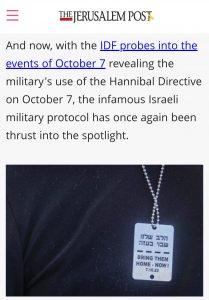
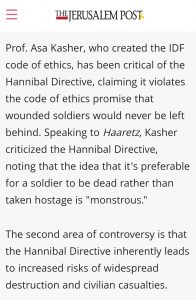
The “Hannibal code” refers to the principle that all possible actions should be taken to avert the abduction and detention of a soldier, even if such actions may endanger the lives of the abductees, potentially leading to the death of either the soldier or civilians in order to prevent them from being captured by opponents. Over a year ago, when it was reported that Zionist soldiers were implicated in the deaths of certain citizens during the October 7 attack by Hamas, many individuals categorically rejected this assertion, attributing sole responsibility for the day’s events to Hamas, even though Hamas were also involved in the assault on some non-combatants and unarmed civilians. However, recently, the matter is being portrayed differently, highlighting the controversial Zionist military’s use of the Hannibal code. Read the newspaper excerpts at the end of this article regarding this matter.

Indeed, the tyrannical Zionists remind us of some of the tyrannical disbelievers of old! Allah said:

كَذَّبَتۡ عَادٌ ٱلۡمُرۡسَلِينَ (١٢٣) إِذۡ قَالَ لَهُمۡ أَخُوهُمۡ هُودٌ أَلَا تَتَّقُونَ (١٢٤) إِنِّى لَكُمۡ رَسُولٌ أَمِينٌ۬ (١٢٥) فَٱتَّقُواْ ٱللَّهَ وَأَطِيعُونِ (١٢٦) وَمَآ أَسۡـَٔلُكُمۡ عَلَيۡهِ مِنۡ أَجۡرٍ‌ۖ إِنۡ أَجۡرِىَ إِلَّا عَلَىٰ رَبِّ ٱلۡعَـٰلَمِينَ (١٢٧) أَتَبۡنُونَ بِكُلِّ رِيعٍ ءَايَةً۬ تَعۡبَثُونَ (١٢٨) وَتَتَّخِذُونَ مَصَانِعَ لَعَلَّكُمۡ تَخۡلُدُونَ (١٢٩) وَإِذَا بَطَشۡتُم بَطَشۡتُمۡ جَبَّارِينَ (١٣٠) فَٱتَّقُواْ ٱللَّهَ وَأَطِيعُونِ (١٣١) وَٱتَّقُواْ ٱلَّذِىٓ أَمَدَّكُم بِمَا تَعۡلَمُونَ (١٣٢) أَمَدَّكُم بِأَنۡعَـٰمٍ۬ وَبَنِينَ (١٣٣) وَجَنَّـٰتٍ۬ وَعُيُونٍ (١٣٤) إِنِّىٓ أَخَافُ عَلَيۡكُمۡ عَذَابَ يَوۡمٍ عَظِيمٍ۬ (١٣٥) قَالُواْ سَوَآءٌ عَلَيۡنَآ أَوَعَظۡتَ أَمۡ لَمۡ تَكُن مِّنَ ٱلۡوَٲعِظِينَ (١٣٦) إِنۡ هَـٰذَآ إِلَّا خُلُقُ ٱلۡأَوَّلِينَ (١٣٧) وَمَا نَحۡنُ بِمُعَذَّبِينَ (١٣٨) فَكَذَّبُوهُ فَأَهۡلَكۡنَـٰهُمۡ‌ۗ إِنَّ فِى ذَٲلِكَ لَأَيَةً۬‌ۖ وَمَا كَانَ أَكۡثَرُهُم مُّؤۡمِنِينَ (١٣٩) وَإِنَّ رَبَّكَ لَهُوَ ٱلۡعَزِيزُ ٱلرَّحِيمُ (١٤٠)

The people Aad belied the Messengers. When their brother Hud said to them: “Will you not fear Allah and obey Him? Verily! I am a trustworthy Messenger to you. So fear Allah, keep your duty to Him and obey me. No reward do I ask of you for it (my Message of Islamic Monotheism), my reward is only from the Lord of the ‘Alamin (mankind, jinns, and all that exists). Do you build high palaces on every high place, while you do not live in them? And do you get for yourselves palaces (fine buildings) as if you will live therein forever? And when you seize, seize you as tyrants? So fear Allah, keep your duty to Him and obey me. And keep your duty to Him, fear Him Who has aided you with all (good things) that you know. He has aided you with cattle and children. And gardens and springs. Verily, I fear for you the torment of a Great Day”. They said: “It is the same to us whether you preach or be not of those who preach. This is no other than the false tales and religion of the ancients, and we are not going to be punished”. So they belied him, and We destroyed them. Verily! In this is indeed a sign, yet most of them are not believers. And verily! Your Lord, He is indeed the All-Mighty, the Most Merciful. [Surah Ash-Shu’araa. Ayaat 123-140]

Regarding the statement: [وَإِذَا بَطَشۡتُم بَطَشۡتُمۡ جَبَّارِينَ – And when you seize, you seize as tyrants] – Meaning, when you want to attack with a whip or sword, you attack like tyrants, completely overpowering and being savagely violent – neither compassionate nor aim to discipline (within justice as commanded by Allah), nor contemplating on the consequences. [3] Allah gave them great strength and it was obligated on them to use this strength in obedience to Allaah, but they became boastful and haughty, and they said: [مَنۡ أَشَدُّ مِنَّا قُوَّةً‌ۖ – Who is mightier than us in strength? (Surah Fussilat. Verse 15]; and they utilized their strength in disobedience to Allaah, fruitlessly and foolishly, so their Prophet forbade them from that. [4] Their Prophet forbade them from that because it was done out of oppression. [5]

Allah [The Exalted] said:

أَلَمۡ تَرَ كَيۡفَ فَعَلَ رَبُّكَ بِعَادٍ (٦) إِرَمَ ذَاتِ ٱلۡعِمَادِ (٧) ٱلَّتِى لَمۡ يُخۡلَقۡ مِثۡلُهَا فِى ٱلۡبِلَـٰدِ (٨) وَثَمُودَ ٱلَّذِينَ جَابُواْ ٱلصَّخۡرَ بِٱلۡوَادِ (٩) وَفِرۡعَوۡنَ ذِى ٱلۡأَوۡتَادِ (١٠) ٱلَّذِينَ طَغَوۡاْ فِى ٱلۡبِلَـٰدِ (١١) فَأَكۡثَرُواْ فِيہَا ٱلۡفَسَادَ (١٢) فَصَبَّ عَلَيۡهِمۡ رَبُّكَ سَوۡطَ عَذَابٍ (١٣) إِنَّ رَبَّكَ لَبِٱلۡمِرۡصَادِ (١٤)

Did you (O Muhammad) not see (thought) how your Lord dealt with ‘Ad (people)? Who were very tall like lofty pillars, the like of which were not created in the land? And (with) Thamud (people), who cut (hewed) out rocks in the valley (to make dwellings)? And (with) Fir’aun (Pharaoh), who had Al-Awtaad? Who did transgress beyond bounds in the lands (in the disobedience of Allah). And made therein much mischief. So your Lord poured on them different kinds of severe torment. Verily, your Lord is Ever Watchful (over them). [Surah Al-Fajr. Ayaat 6-14]

[أَلَمۡ تَرَ -Did you (O Muhammad) not see]- Meaning, with your heart and insight, how those tyrannical nations were dealt with- the (people of) Iram, the well-known tribe in Yemen. [ذَاتِ ٱلۡعِمَاد -Who were very tall like lofty pillars]- Meaning, they had great strength and were insolent and proud. [ٱلَّتِى لَمۡ يُخۡلَقۡ مِثۡلُهَا -The like of which were not created]- Meaning, none was similar to Aad in strength; [فِى ٱلۡبِلَـٰدِ – In the land]-Meaning, in all the lands (due to what they possessed of power and strength), just as Allah [The Most High] says that their Prophet Hud (peace be upon him)said to them: [وَٱذۡڪُرُوٓاْ إِذۡ جَعَلَكُمۡ خُلَفَآءَ مِنۢ بَعۡدِ قَوۡمِ نُوحٍ۬ وَزَادَكُمۡ فِى ٱلۡخَلۡقِ بَصۜۡطَةً۬‌ۖ فَٱذۡڪُرُوٓاْ ءَالَآءَ ٱللَّهِ لَعَلَّكُمۡ تُفۡلِحُونَ -And remember that He made you successors after the people of Nuh (Noah), and increased you amply in stature. So remember the graces (bestowed upon you) from Allah, so that you may be successful] [Al-A’raaf: Ayah 70]

[وَثَمُودَ ٱلَّذِينَ جَابُواْ ٱلصَّخۡرَ بِٱلۡوَاد – And (with) Thamud (people), who cut (hewed) out rocks in the valley (to make dwellings)]; Meaning: Valley towns, which they hewed out of solid rocks with their strength and took them as dwelling places.

[وَفِرۡعَوۡنَ ذِى ٱلۡأَوۡتَاد – And (with) Fir’aun (Pharaoh), who had the stakes]; Meaning: He had hosts that established his authority, like how stakes firmly hold something (on the ground). [ٱلَّذِينَ طَغَوۡاْ فِى ٱلۡبِلَـٰدِ – Who did transgress beyond bounds in the lands (in the disobedience of Allah)]; Meaning: Aad, Thamud, Fir’awn and those who followed them because they transgressed in Allah’s earth and harmed the slaves of Allah in their religious and worldly affairs. And because of this Allah (The Most High) said: [فَأَكۡثَرُواْ فِيہَا ٱلۡفَسَاد – And made therein much mischief]; Meaning: Disbelief (in Allah and His Messengers); spreading all types of disobedience (in the land); hastening to wage war against the Messengers and hindering mankind from the path of Allah.

So when they reached that state of haughtiness deserving of destruction, Allah sent them His punishment -different kinds of severe torment. [إِنَّ رَبَّكَ لَبِٱلۡمِرۡصَادِ – Verily, your Lord is Ever Watchful]; Meaning: Ever watchful over the one who disobeys Him. Allah gives him respite for a little while and then seizes him with a mighty and powerful punishment. [6]

Also, other groups behaved in this manner, such as the Muta’assibah (Fanatical Partisans) among the Jews and the Azaariqah among the Khawaarij. “The fanatical partisans among the Jews were a group whose thought was close to that of the Faareesiyyoon, but they were very aggressive and believed in assassinating anyone who disagreed with them. They were also called Saffaakoon [Those Eager to Commit Murder], and they committed pillage, plunder, and transgressed against everyone who accepted submission to others besides them. Hostility occurred between them and the Fareesiyyoon because the Faareesiyyoon submitted to the Romans. Some of the researchers consider them to be from the political or nationalistic sects, even though their movement started within a religious framework, but great were the crimes that they committed from one place to another”. [7] As for the Azaariqah among the Khawaarij, Al-Baghdaadee [429 AH- may Allah have mercy upon him] stated about their Bidah: “From them is their declaration that it is permissible to kill the women and children of their opponents, and they claimed that the children of their opponents would dwell in the fire forever”. [8]

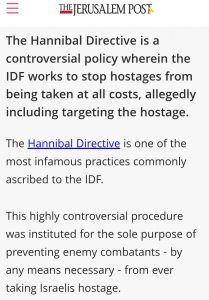
Regarding the use of white phosphorus, the Zionist military cannot deny the fact that it has used it in the past as stated in the Jerusalem Post as follows:

However, as for the recent claims during the recent conflict that Netanyahu’s army of Zionists are using it again, this is still being investigated, so we’ll wait for the reliable and unbiased investigators and experts – among Muslims and non-Muslims – to produce a final report. We neither negate nor affirm until the affair is finalised, but what remains a fact is that the Zionists did use white phosphorous in the past.

Finally, every oppressor who uses these barbaric methods reminds us of what has been stated in Surah Al-Burooj. Allah said:

قُتِلَ أَصْحَٰبُ ٱلْأُخْدُودِ
ٱلنَّارِ ذَاتِ ٱلْوَقُودِ
إِذْ هُمْ عَلَيْهَا قُعُودٌ

Cursed were the People of the Ditch, (the large ditch with) the fire, given fuel (in abundance). While they were sat over it (watching those whom they punished by burning). [9]

Imam As-Sadi [may Allah have mercy upon him] said: This is the greatest type of tyranny and heart-heartedness because they combined disbelief in Allah’s Ayaat and wilful opposition to them, waging war against its adherents and torturing them with this torment, which the extremely heart-breaking, whilst they are present and throwing them into it. And the fact is that they did not take revenge on the believers except due to a characteristic for which they are praised, and by way of which they attain happiness (in this life and the next), which is that they believed in Allah. [10]

Imam Muhammad Ibn Saalih Al-Uthaymeen [may Allah have mercy upon him] said, “They saw the fire burning these people while sitting and joking as if nothing was happening, and Allah’s protection is sought (against this behaviour). This is tyranny that a person sees a human being burnt with fire while he reclines on his couch and is distracted by the conversation and does not care”. [11]


[1] Tafseer As-Sadi.

[2] Tafseer at-Ṭabaree 2/190

[3] Roohul Ma’aanee by Imam Vol 11. page 165. By Imaam al-Aloosee (may Allah have mercy upon him)]

[4] Tafseer As-Sadi. slightly paraphrased

[5] Zaadul Maseer Fee Ilmit Tafseer by Imaam Ibnul Jawzi (may Allah have mercy upon him)

[6] Tafseer As-Sadi. slightly paraphrased

[7]Al-Faslu Fil Milal Wal-Ahwaa Wan-Nihal. 1/177-179 By Ibn Hazm. Publisher: Daar Al-Jeel 1405AH. Al-Milal Wan-Nihal 1/215-219. By Ash-Sharastaanee. Maktabah Al-Halabiy 1406AH. Maqaarinatul Ad’yaan Al-Yahoodiyyah 218-225. Maktabah An-Nahdah Al-Misriyyah

[8] Al-Farqu Baynal Firaq. page 82

[9] https://www.thenoblequran.com/q/#/sura/85/1

[10] Tafsir As-Sadi

[11] Tafsir Juz Amma

The Importance of Truthfulness – By Al-Allamah Rabee Bin Hadi Al-Mad’khali [Part 7]

In The Name of Allah, The Most Merciful, The Bestower of Mercy.

Al-Allamah Rabee bin Hadi Al-Mad’khali, may Allah preserve him, continued….

Kab, may Allah be pleased with him, said: When this news reached me that Allah’s Messenger, peace and blessings of Allah be upon him, was on his way back from Tabuk, I was greatly perturbed. I thought of fabricating false stories and asked myself how I would save myself from his anger on the following day. In this connection, I sought the help of every prudent man from amongst the members of my family and when it was said to me that Allah’s Messenger was about to arrive, all the false ideas banished (from my mind) and I came to the conclusion that nothing could save me but the telling of truth, so I decided to speak the truth and it was in the morning that Allah’s Messenger arrived (in Medina). And it was his habit that as he came back from a journey he first went to the mosque and observed two Rak’ahs of nafl prayer and then sat amongst people.

And as he did that, those who had remained behind him began to put forward their excuses and take an oath before him and they were more than eighty persons. Allah’s Messenger accepted their excuses on the very face of them and accepted their allegiance and sought forgiveness for them and left their secret (intentions) to Allah, until I presented myself to him. I greeted him and he smiled and there was a tinge of anger in that. He then said to me: “Come forward”. I went forward until I sat in front of him. He said to me: “What kept you back? Could you not afford to go in for a ride?” I said: “Allah’s Messenger, by Allah, if I were to sit in the presence of anybody else from amongst the people of the world, I would have definitely saved myself from his anger on one pretext (or the other) and I have also the knack to fall into argumentation, but, by Allah, I am fully aware of the fact that if I were to put forward before you a false excuse to please you, Allah would definitely provoke your wrath upon me, and if I speak the truth you may be annoyed with me, but I hope that Allah would make its end well and, by Allah, there is no valid excuse for me. By Allah, I never possessed so good means, and I never had such favourable conditions for me as I had when I stayed behind you (failed to join the expedition)”. Thereupon, Allah’s Messenger said: “This man told the truth, so get up until Allah gives a decision in your case”. I stood up. [end of hadith]

Indeed, they achieved success through the honour, victory, and rewards they received. So, what beneficial lesson comes from their absence from the Battle of Tabuk, even if it can be explained based on its reasons? In this part, he shared his new circumstances upon the Messenger’s return, revealing that he had not participated in the military campaign due to his desire for the shade and the fruits of the trees. No one else shared this lagging behind except for those steeped in hypocrisy, the weak, and those with legitimate excuses. His sincere discerning heart was burdened with the harshness of pain and sorrow, while at the same time, shaytan suggested to him and attempted to fill his soul with various types of lies; however, by Allah’s Grace and care for him, the darknesses of lies and falsehood were lifted from him due to his truthful faith and sincerity to Allah, the Lord of the entire existence, thus, Allah granted him the greatest means of salvation after faith, and that is truthfulness, especially in times of danger and overwhelming events.

He said, “When I was told that Allah’s Messenger was on his way back, the falsehood was removed from me, and I realised that nothing of it will never save me”. Thus, his truthfulness became more wholesome, as the Messenger of Allah, peace and blessings of Allah be upon him, arrived in the morning. He mentioned that Sunnah often overlooked or forgotten by many Muslims, which is to perform two Rak’ats in the Masjid upon a Muslim’s return from travel. He mentioned the situation of those who gave (lame) excuses (for their absence from the military expedition), meaning the hypocrites, who resorted to lies and falsehood, that they reinforced their lies with oaths, thus, the Prophet could only accept what they displayed apparently, and entrusted their true hidden intentions to Allah, the knower of unseen, who is aware of the treachery of the eyes and what the hearts conceal. However, Ka’b, may Allah be pleased with him, with his understanding and sound intellect, he recognised that lying to Allah’s Messenger, even when fortified by solemn oaths, would not spare him from the wrath of Allah and subsequently the anger of His Messenger. He discerned this truth through his keen insight and intellect after Allah had granted him this, thus, he refused any other thing besides openly declaring the clear reality. [Paraphrased. Refer to Arabic here: sidq ]

To be continued…InShaAllah

Reflections on some statements of Al-al-Allamah Rabee Bin Hadi al-Mad’khali [67 of 80]

In The Name of Allah, The Most Merciful, The Bestower of Mercy.

Hudhaifah, may Allah be pleased with him, reported that the Messenger of Allah, peace and blessings of Allah be upon him, said: “Trials will be presented to the hearts of people like a reed mat woven stick by stick and any heart afflicted by them will have a black mark put into it, but any heart that rejects them will have a white mark put into it. Thus there will be two kinds of hearts: one is pure like a white gemstone and it will not be harmed by any tribulation as long as the heavens and earth endure, and the other is black and dusty like a worn-out vessel, neither recognizing good nor rejecting evil, but rather immersed in its desires.” [Sahih Muslim 144]

We seek refuge with Allah from the trials and desires that cause the hearts to become like a worn out vessel, corrupts them, places them in blindness and darkness; neither recognising good nor rejecting evil, instead immersed in their (evil) desires.

[An Excerpt from Marhaban Yaa Talib Al-Ilm 20-21]

Reflections on some statements of Al-Allamah Rabee Bin Hadi Al-Mad’khali [66 of 80]

In The Name of Allah, The Most Merciful, The Bestower of Mercy.

None follows Allah’s Guidance and knows the station of this guidance, except one whom Allah has given (sound) intellect and certain knowledge. He knows the consequences and outcomes behind matters, where ignorance, kufr, Shirk and (evil) desires will finally take its people, and where (sound) knowledge, guidance, (sound) intellect and understanding will finally take the person upon (its path).

فَإِمَّا يَأْتِيَنَّكُم مِّنِّى هُدًى فَمَنِ ٱتَّبَعَ هُدَاىَ فَلَا يَضِلُّ وَلَا يَشْقَىٰ
وَمَنْ أَعْرَضَ عَن ذِكْرِى فَإِنَّ لَهُۥ مَعِيشَةً ضَنكًا وَنَحْشُرُهُۥ يَوْمَ ٱلْقِيَٰمَةِ أَعْمَىٰ
قَالَ رَبِّ لِمَ حَشَرْتَنِىٓ أَعْمَىٰ وَقَدْ كُنتُ بَصِيرًا
قَالَ كَذَٰلِكَ أَتَتْكَ ءَايَٰتُنَا فَنَسِيتَهَا وَكَذَٰلِكَ ٱلْيَوْمَ تُنسَىٰ

Then whoever follows My Guidance shall neither go astray, nor fall into distress and misery. But whosoever turns away from My Reminder [i.e. neither believes in this Qur’an nor acts on its orders, etc.] verily, for him is a life of hardship, and We shall raise him up blind on the Day of Resurrection. He will say: “O my Lord! Why have you raised me up blind, while I had sight [before].” [Allah] will say: “Like this, Our Ayat [proofs, evidences, verses, lessons, signs, revelations, etc.] came unto you, but you disregarded them [i.e. you left them, did not think deeply in them, and you turned away from them], and so this Day, you will be neglected [in the Hell-fire, away from Allah’s Mercy].” [Surah Taha 123-126]

Ignorance is the cause of turning away from the remembrance of Allah, thus the person wanders blindly in the darkness of ignorance, so his final destination, end and abode is that which Allah [The Blessed and Exalted] stated in this noble verse, that he will be raised up blind, so he will say, “Why have you raised me up blind?” Allah will say to him, “Like this, Our Ayat came unto you, but you disregarded them, and so this Day, you will be neglected [in the Hell-fire, away from Allah’s Mercy].

[An Excerpt from Marhaban Yaa Talib Al-Ilm 17]

The Importance of Truthfulness – By Al-Allamah Rabee Bin Hadi Al-Mad’khali [Part 6]

Al-Allamah Rabee Bin Hadi Al-Mad’khali, may Allah preserve him, continued…

Kab Bin Malik, may Allah be pleased with him, narrated:

I never remained behind Allah’s Messenger, peace and blessings of Allah be upon him, from any expedition which he undertook except the Battle of Tabuk and that of the Battle of Badr. So far as the Battle of Badr is concerned, nobody was blamed for remaining behind as Allah’s Messenger and the Muslims (did not set out for attack but for waylaying) the caravan of the Quraish, but it was Allah Who made them confront their enemies without their intention (to do so). I had the honour to be with Allah’s Messenger on the night of ‘Aqaba when we pledged our allegiance to Islam and it was more dear to me than my participation in the Battle of Badr, although Badr was more popular amongst people as compared with that (Tabuk). And this is my story of remaining back from Allah’s Messenger on the occasion of the Battle of Tabuk. Never did I possess enough means and (my circumstances) more favourable than at the occasion of this expedition. And, by Allah, I had never before this expedition simultaneously in my possession two rides. Allah’s Messenger set out for this expedition in extremely hot season; the journey was long and the land (which he and his army had to cover) was waterless and he had to confront a large army, so he informed the Muslims about the actual situation (they had to face), so that they should adequately equip themselves for this expedition, and he also told them the destination where he intended to go. And the Muslims who accompanied Allah’s Messenger at that time were large in numbers but there was no proper record of them. Ka’b (further) said: Few were the persons who wanted to absent themselves, and were under the impression that they could easily conceal themselves (and thus remain undetected) until revelations from Allah, the Exalted and Glorious (descended in connection with them). And Allah’s Messenger set out on an expedition when the fruits were ripe and their shadows had been lengthened. I had weakness for them and it was during this season that Allah’s Messenger made preparations and the Muslims too along with them. I also set out in the morning so that I should make preparations along with them but I came back and did nothing and said to myself: I have enough (to make preparations) as soon as I like. And I went on doing this (postponing my preparations) until people were about to depart and it was in the morning that Allah’s Messenger set out and the Muslims too along with him, but I made no preparations. I went early in the morning and came back, but I made no decision. I continued to do so until they (the Muslims) hastened and covered a good deal of distance. I also made up my mind to march on and to meet them. Would that I would have done that but perhaps it was not destined for me. After the departure of Allah’s Messenger as I went out amongst people, I was shocked to find that I did not find anyone like me but people who were labelled as hypocrites or the people whom Allah granted exemption because of their incapacity.

This excerpt highlights the significance of the Pledge of Aqabah and its position in his heart, as it embodied profound meanings that represents the robust foundation upon which is established the migration to Madinah by the companions of Allah’s Messenger, the support given by the Ansar, the establishment the Islamic state, and served as the foundation for Jihad and the strength of Islam and the Muslims. From this foundation emerged the various expeditions and campaigns, leading to the defeat of apostasy and the expansion of Islamic armies across the world, illuminating hearts with the light of Iman and guiding them out from darkness into light. It was from this understanding that this noble companion recognised the status of the Pledge of Aqabah, expressing that he would not be pleased with any substitute for it, as he stated: “It was more beloved to me than participation in the battle of badr”.

He spoke about the circumstances surrounding his absence from the Battle of Tabuk with the courage of the truthful, in a clear and illuminated manner, overflowing with truthfulness from a heart exemplifying Iman, and a soul filled with integrity and truthfulness whose similarity is not witness in that type of dreadful situation where the cowardly the hypocrites would resort to lying and false pretenses by fabricating excuses that were swiftly exposed by Allah, leading to their disgrace and ultimately consigning them to the abode of destruction (hell fire).

He clearly stated that his absence was not due to poverty or hardship, nor was it a result of incapacity or weakness, as he had previously participated in the Battle while in a condition less favourable than that of this particular expedition. He said: “Never did I possess enough means and (my circumstances) more favourable than at the occasion of this expedition. And, by Allah, I had never before this expedition simultaneously in my possession two rides”.

He clearly stated the reasons that undermined his resolve in participating in Jihad (Battle of Tabuk, which included the intense heat, the long journey, the perilous vast terrains between Madinah and Tabuk, and the numerous forces of the Romans and Arabs allied with them. He mentioned that the Messenger of Allah informed the people of their duty to prepare themselves for their expedition.

He clearly stated what may be one of the most significant reasons for staying behind (.e. not going for the Tabuk expedition), which is the ripe fruits and good shade. He then clearly expressed it despite the possibility of (being able) to conceal it, but his truthful soul did not allow him except to reveal it, (saying) “I had a weakness for them”, in other words, “My soul inclined towards them”. This represents a profound level of truthfulness that very few individuals attain. He mentioned his internal struggle and hesitation regarding joining the Messenger of Allah.

He mentioned the pain of regret and sorrow that accompanied his state of being left behind, as he found no example of his condition except for a man deeply entrenched in hypocrisy or a person whom Allah has excused due to weakness. This reflects the vitality of his heart and being truthful in his Iman. [Paraphrased. Refer to the Arabic text here sidq ]

A robust and very beneficial relationship

In The Name of Allah, The Most Merciful, The Bestower of Mercy.

Umar Ibn Abdul Azeez, may Allah have mercy upon him, said: Whoever advises his brother to rectify affairs related to his religion and gives him insight into a worldly affair has perfected their relationship and fulfilled his obligation of (brotherhood) to him”. [Tarikh at-Tabari 6/572]

Imam Al-Barbahaaree, may Allah have mercy upon him, stated: “From the Sunnah is that you do not help anyone in disobedience to Allah, whether they be parents or any of the creation. There is no obedience to a human in disobedience to Allah and no one is to be loved for that; rather all of that is to be hated for [the sake of Allah], the Blessed and Most High”.

“From the Sunnah is that you do not help anyone in disobedience to Allah”.

Al-Allamah Salih Al-Fawzan, may Allah preserve him, commented saying: This is a fundamental principle from the fundamental principles of Ahlus Sunnah Wal Jama’ah that has been derived from the statement “There is no obedience to the creation in disobedience to the Creator”. And he, peace and blessings of Allah be upon him, said: “Obedience is only in that which is good”.

Thus, whoever commands disobedience to Allah is not to be obeyed. He is not to be obeyed in disobedience, whether your father, mother, or from the closest of the people to you, a ruler or a king. [Footnote a] He is not to be followed in disobedience. Allah [The Exalted] stated about the Yahud and Nasara when they followed [their Rabis and Monks] in disobedience: [ٱتَّخَذُوٓاْ أَحۡبَارَهُمۡ وَرُهۡبَـٰنَهُمۡ أَرۡبَابً۬ا مِّن دُونِ ٱللَّهِ – They took their rabbis and their monks to be their lords besides Allah (by obeying them in things which they made lawful or unlawful according to their own desires without being ordered by Allah)]. [Al-Tawbah. 31] [Footnote b]

And regarding the statement of Imam Barbahaaree, “Whether they be parents or any of the creation”. Allah [The Exalted] said about parents:

وَوَصَّيۡنَا ٱلۡإِنسَـٰنَ بِوَٲلِدَيۡهِ حَمَلَتۡهُ أُمُّهُ ۥ وَهۡنًا عَلَىٰ وَهۡنٍ۬ وَفِصَـٰلُهُ ۥ فِى عَامَيۡنِ أَنِ ٱشۡڪُرۡ لِى وَلِوَٲلِدَيۡكَ إِلَىَّ ٱلۡمَصِيرُ
وَإِن جَـٰهَدَاكَ عَلَىٰٓ أَن تُشۡرِكَ بِى مَا لَيۡسَ لَكَ بِهِۦ عِلۡمٌ۬ فَلَا تُطِعۡهُمَا‌ۖ وَصَاحِبۡهُمَا فِى ٱلدُّنۡيَا مَعۡرُوفً۬ا‌ۖ وَٱتَّبِعۡ سَبِيلَ مَنۡ أَنَابَ إِلَىَّ‌ۚ َ

And We have enjoined on man (to be dutiful and good) to his parents. His mother bore him in weakness and hardship upon weakness and hardship, and his weaning is in two years give thanks to Me and to your parents, unto Me is the final destination. But if they (both) strive with you to make you join in worship with Me others that of which you have no knowledge, then obey them not, but behave with them in the world kindly, and follow the path of him who turns to Me in repentance. [Surah Al-Ankabut. 8]

There is no obedience to the creation in disobedience to the Creator, regardless who that may be, even if he is the closest of the people to you, such as the two parents; then what about other than them! [1]

Al-Allamah Rabee Bin Hadi Al-Mad’khali, may Allah preserve him, said:

Allah said:

وَلَا تَرْكَنُوا إِلَى الَّذِينَ ظَلَمُوا فَتَمَسَّكُمُ النَّارُ وَمَا لَكُم مِّن دُونِ اللَّهِ مِنْ أَوْلِيَاءَ ثُمَّ لَا تُنصَرُونَ

And incline not toward those who do wrong, lest the Fire should touch you, and you have no protectors other than Allah, nor you would then be helped. [Hud 113]

Do not incline towards the oppressors—those who oppress the people by (shedding) their blood, (seizing) their wealth, and (violating) their honour, or they oppress people in their religion through Bidah and various forms of misguidance, spreading harmful propaganda and calls (ideas) that contradict Islam. Refrain from inclining towards such people; do not assist them or support their falsehoods. The verse includes all these types (of people).

Every follower  of falsehood is an oppressor, every Mubtadi is an oppressor, and everyone who (violates) a Muslim’s honour is an oppressor. Therefore, do not lean towards any of them, thus you are afflicted by the fire. That is because when you incline towards the sinner, the Mubtadi, the oppressor, the criminal, the one who violates people’s honour and those who violate the sanctity of the Islamic legislation, it is as if you are pleased (with that), as if you are aiding and endorsing. A believer must exercise caution to avoid falling into this perilous inclination. A believer should be careful of this type of inclination, for indeed it is from the causes of deviation and misguidance, and Allah’s refuge is sought.

فَلَمَّا زَاغُوا أَزَاغَ اللَّهُ قُلُوبَهُمْ وَاللَّهُ لَا يَهْدِي الْقَوْمَ الْفَاسِقِينَ 

So when they turned away (from the Path of Allah), Allah turned their hearts away (from the Right Path). And Allah guides not the people who are Fasiqun (rebellious, disobedient to Allah)]. [As-Saff 5] [2]

Al-Allamah Zayd Bin Hadi Al-Mad’khali, may Allah have mercy upon him, stated:

There is no (unrestricted or unconditional) allegiance except to Allah’s Messenger, peace and blessings of Allah be upon him, because he is infallible and never speaks out of his desires. As for unrestricted allegiance to personalities whether they are correct or mistaken, this is not permissible for the seeker of knowledge. On the other hand, he should look to such and such Shaikhs as to which of them is upon uprightness and is following the methodology of the pious predecessors. This is the one whom we place our hands on his hands- not out of blameworthy blind following, rather due to the fact that he is upon the truth. So we agree with him upon truth and follow a singular path in obedience to the statement of Allah, The Mighty and Majestic:

[وَأَنَّ هَٰذَا صِرَاطِي مُسْتَقِيمًا فَاتَّبِعُوهُ ۖ وَلَا تَتَّبِعُوا السُّبُلَ فَتَفَرَّقَ بِكُمْ عَن سَبِيلِهِ – And verily, this is my Straight Path, so follow it, and follow not (other) paths, for they will separate you away from His Path] [6:153]

As for the one who selects Shaikhs, leaders and guides, whilst being in agreement with them- in what is correct and wrong- to the extent that they do not leave their methodology whether they are correct or wrong, these are the people who bring evil upon themselves and others. If they do not repent, they are most worthy of being blamed. Thus, the matter – and all praise belongs to Allah- is clear and it is not permissible for a person to be in confusion regarding this . We are with those who follow the straight path-we follow a singular path which Allah, The Mighty and Majestic, has commanded us to follow and which the messenger called us to. Those you follow the wrong path or are mistaken in many matters, or in some, we leave him [i.e. we leave his mistakes]. None is followed in everything except the Messenger of Allah, peace and blessings of Allah be upon him. As for the people, they can be correct or mistaken. Indeed, we do not follow them and we do not follow their footsteps solely because they are Shaikhs, callers to Islam, leaders or guides; instead, you should be with the people of the Salafi Methodology -those who follow the correct methodology and understanding. [3]

Read: https://abukhadeejah.com/ahmad-hanbal-usool-sunnah-innovations-hizbiyyah-differing-sectarianism-call-to-unity-part-3/

Listen: Hizbiyyah; is not from Salafiyyah – By Shaikh Abu Khadeejah, may Allah preserve him.

————————————————–

Footnote a: Imam Al-Barbahaaree on the Manhaj of Dealing With the Rulers

https://www.salafipublications.com/sps/sp.cfm?subsecID=MNJ16&articleID=MNJ160002&pfriend=

The Obligation of Hearing and Obeying the Muslim Rulers

https://www.salafisounds.com/lesson-44-the-aqidah-ibn-abdil-wahhab/

Believer’s Bahaviour Towards Muslim Rulers – [Supplicates For Them….]

Footnote b:

https://abukhadeejah.com/obedience-to-the-scholars-and-rulers-in-making-haram-what-allah-has-made-halal-and-vice-versa-kitab-tawheed-ch-37/


[1]An Excerpt from It-haaful Qaaree Bitta’liqaat Alaa Sharhis Sunnah Lil Imaam Barbahaaree. 2/297-299

[2] An Excerpt from Al-Wasaayaa Al-Manhajiyyah page 20

[3]  العقد المنضد الجديد في الإجابة على مسائل في الفقه والمناهج والتوحيد -(page:144)

Secrets of the hearts

In The Name of Allah, The Most Merciful, The Bestower of Mercy

Allah (The Most High) said: [يَوْمَ تُبْلَى السَّرَائِرُ – The Day when all the secrets (deeds, prayers, fasting, etc.) will be examined (as to their truth)]. [86:9]

Imam As-Sadi, may Allah have mercy upon him, said: Meaning, the secrets of the hearts will be examined. The good and evil that used to be in the hearts will be manifested on the faces (of the people).  Allah (The Most High) said: [يَوْمَ تَبْيَضُّ وُجُوهٌ وَتَسْوَدُّ وُجُوهٌ – On the Day (i.e. the Day of Resurrection) when some faces will become white and some faces will become black].

In this worldly life, many matters are concealed and are not manifested to the people, but on the day of judgement, the righteousness of the righteous (ones) and the immorality (or wickedness) of the wicked (ones) will be manifested and the matters will be made public. [1]

We ask Allah:

اللَّهُمَّ إِنِّي أَسْأَلُكَ العافِيَـةَ فـي الدُّنيا والآخِرَةِ، اللَّهُمَّ إِنِّي أَسْأَلُكَ العَفْوَ والعافِيَـةَ فـي دِيني ودُنْـيايَ وأَهْلِي ومالِي، اللَّهُمَّ اسْتُـرْ عَوْراتِي، وآمِنْ رَوْعاتِي،
اللَّهُمَّ احْفَظْنِـي مِنْ بَـيْنِ يَدَيَّ، ومِنْ خَلْفِي، وعَنْ يَمِيـنِـي، وعَنْ شِمالِي، ومِنْ فَوْقِي، وأَعُوذُ بِعَظَمَـتِكَ أَنْ أُغْتالَ مِنْ تَحْتِـي

O Allah! I ask You for well-being in this life and the Hereafter. O Allāh, I ask You for pardon and well-being in my religion, my worldly affairs, my family and my wealth. O Allaah! Conceal my [faults, shortcomings etc] and safeguard me against everything that will bring me fear and sorrow. O Allaah! Protect me from in front, from behind me, from my right and my left, and from above. And I seek refuge with Your Magnificence from being swallowed up from beneath me.

This great supplication begins with one asking Allaah for [العافِيَـةَ -wellbeing] in the worldly life and the Hereafter. Nothing can be equal to wellbeing, for whoever is granted well-being then indeed he has received his complete share of good. Seeking [العَفْوَ -pardon] necessitates that one is forgiven his sins and they are wiped away. As for [العافِيَـةَ – Well-being], it is safety Allaah bestows on a servant of His- protects him against every punishment and trial, by averting evil from him, protecting him against calamities and ailments [sicknesses], evil affairs and sins. So, the Messenger [sallal laahu alayhi wasallam] asked for wellbeing in the Dunyaa and Aakhirah, as well as wellbeing in his religion, worldly affairs, his family and wealth.

Well-being in one’s religion is protection against everything that will bring dishonour [or disgrace] to one’s religion or deprive him of it.

Well-being in the worldly is to seek protection against everything that will harm the person in his worldly affairs, such as calamities or trials, severe poverty and ailments.

Well-being in the Hereafter is to seek protection against the extreme hardships in the Aakhirah and its various punishments. Well-being in one’s family is that they are protected from trials, calamities and tests; wellbeing in one’s wealth is that it is protected from drowning, burning, theft etc…

[اللَّهُمَّ اسْتُـرْ عَوْراتِي – O Allaah! Conceal my faults, shortcomings etc [ وآمِنْ رَوْعاتِي – safeguard me against every affair that will frighten me and bring sorrow upon me].

[اللَّهُمَّ احْفَظْنِـي مِنْ بَـيْنِ يَدَيَّ، ومِنْ خَلْفِي، وعَنْ يَمِيـنِـي، وعَنْ شِمالِي، ومِنْ فَوْقِي، وأَعُوذُ بِعَظَمَـتِكَ أَنْ أُغْتالَ مِنْ تَحْتِـي – O Allah! Protect me from in front, from behind me, from my right and my left, and from above. And I seek refuge with Your Magnificence from being swallowed up from beneath me] – Meaning: Asking Allah to protect you against destructive things and evils which a person is exposed to from the six directions, for indeed evil can approach from the front, behind, the right, the left, above or below, and he does not know which direction calamity will suddenly come upon him. [2]


[1] Taysir Al-Karim Ar-Rahman Fee Tafsir Kalam Al-Mannan

[2] An Excerpt from Fiqh Al-Ad’iyah Wal Afkaar 3/32-33

Reflections on some statements of Al-Allamah Rabee Bin Hadi Al-Mad’khali [63 of 80]

In The Name of Allah, The Most Merciful, The Bestower of Mercy.

Observe how the countries where revolutions and coups have occurred live in (a state) of misery, torture, and bloodshed. In this is a lesson for those who reflect.

Al-Mujmu Ar-Ra’iq 354