How to Be Patient in These Difficult Times – Shaykh Fawzaan

“The station of patience is tremendous and because of this it has been mentioned in the Quran in more than 70 places.”

REF 1: The Ma’iyyah of Allah explained: http://www.salafitalk.net/st/printthread.cfm?Forum=8&Topic=3712


Make the most of your time and take part in free and paid classes, including classes for your children:

  • salafidawahmanchester.com/Online
  • Learnaboutislam.co.uk
  • Salafischool.co.uk/Online
  • Tuitionclub.org/Online

Current Trials and Calamities and How to Gain Relief from Them – Shaykh Fawzaan

If a person is put to trial and a calamity befalls him, what is the thing which will remove it from him? And how does a person turn to Allaah – The Mighty and Majestic – for protection, deliverance, help – whilst he is in this situation in which he is put to trial through these illnesses?

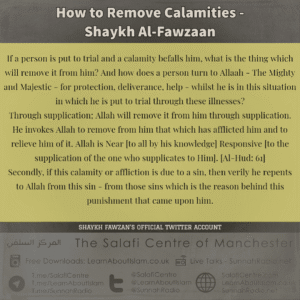
How to Remove Calamities – Shaykh Al-Fawzaan

If a person is put to trial and a calamity befalls him, what is the thing which will remove it from him? And how does a person turn to Allaah – The Mighty and Majestic – for protection, deliverance, help – whilst he is in this situation in which he is put to trial through these illnesses?

Through supplication; Allah will remove it from him through supplication. He invokes Allah to remove from him that which has afflicted him and to relieve him of it. Allah is Near [to all by his knowledge] Responsive [to the supplication of the one who supplicates to Him]. [Al-Hūd:61]

Secondly, if this calamity or affliction is due to a sin, then verily he repents to Allāh from this sin – from those sins which is the reason behind this punishment that came upon him.


Shaykh Fawzan’s Official Twitter Account

Two Obstacles That Prevents Us From Reality When We [Humans] Embark Upon Sin!

In The Name of Allaah, The Most Merciful, The Bestower of Mercy.

Imaam Ibnul Qayyim [rahimahullaah] stated:

The servant does not embark upon that which he has been forbidden except through two ways. [Either] due harbouring evil thoughts about his Lord that if he were to obey Allaah and preferred Him, He [Glorified be He] will not grant him that which is better from the lawful [things]; [or] he acknowledges that [Allaah will grant him something better than the forbidden thing he pursues] and that whoever leaves something for Allaah’s sake, He [Glorified be He] will replace it with something better; but lusts overcomes his patience and desires [overcomes] his intellect. The first affair is due to weakness in knowledge and the second a weakness in intellect and insight. [Ref 1]

Al-Allaamah Abdur-Rahmaan Ibn Yahyah Al-Mu’allimee [rahimahullaah] stated: The human being does not hate truth as a result of considering it to be falsehood, rather he loves truth by way of his Fitra [sound natural disposition], and loves falsehood due to his desires and lusts. The shift towards success or loss defends on what he gives preference to.

Allaah [The Blessed and Exalted] said:

فَأَمَّا مَن طَغَىٰ

وَءَاثَرَ ٱلۡحَيَوٰةَ ٱلدُّنۡيَا

فَإِنَّ ٱلۡجَحِيمَ هِىَ ٱلۡمَأۡوَىٰ

وَأَمَّا مَنۡ خَافَ مَقَامَ رَبِّهِۦ وَنَهَى ٱلنَّفۡسَ عَنِ ٱلۡهَوَىٰ

فَإِنَّ ٱلۡجَنَّةَ هِىَ ٱلۡمَأۡوَىٰ

Then, for him who Tagha (transgressed) and preferred the life of this world (by following his evil desires and lusts), Verily, his abode will be Hellfire; But as for him who feared standing before his Lord, and restrained himself from impure evil desires, and lusts. Verily, Paradise will be his abode.” [An-Naazi’aat. Ayah:37-41]

And you can say: Allaah [The Blessed and Exalted] is on one side and [a person’s evil] desires are on another side [in opposition to what Allaah has commanded and prohibited].  Allaah [The Most High] said:

أَرَءَيۡتَ مَنِ ٱتَّخَذَ إِلَـٰهَهُ ۥ هَوَٮٰهُ أَفَأَنتَ تَكُونُ عَلَيۡهِ وَڪِيلاً

أَمۡ تَحۡسَبُ أَنَّ أَڪۡثَرَهُمۡ يَسۡمَعُونَ أَوۡ يَعۡقِلُونَ‌ۚ إِنۡ هُمۡ إِلَّا كَٱلۡأَنۡعَـٰمِ‌ۖ بَلۡ هُمۡ أَضَلُّ سَبِيلاً

Have you (O Muhammad) seen him who has taken as his ilah (god) his own desire? Would you then be a Wakil (a disposer of his affairs or a watcher) over him? Or do you think that most of them hear or understand? They are only like cattle; nay, they are even farther astray from the Path. (i.e. even worse than cattle]. [Soorah Al-Furqaan. Aayaat 43-44]

And Allaah [The Most High] said:

أَفَرَءَيۡتَ مَنِ ٱتَّخَذَ إِلَـٰهَهُ ۥ هَوَٮٰهُ وَأَضَلَّهُ ٱللَّهُ عَلَىٰ عِلۡمٍ۬ وَخَتَمَ عَلَىٰ سَمۡعِهِۦ وَقَلۡبِهِۦ وَجَعَلَ عَلَىٰ بَصَرِهِۦ غِشَـٰوَةً۬ فَمَن يَہۡدِيهِ مِنۢ بَعۡدِ ٱللَّهِ‌ۚ أَفَلَا تَذَكَّرُونَ

Have you seen him who takes his own lust (vain desires) as his ilah (god), and Allah knowing (him as such), left him astray, and sealed his hearing and his heart, and put a cover on his sight. Who then will guide him after Allah? Will you not then remember? [Soorah Al-Jaathiyah. Ayah 23] [Ref 2]


[Ref 1: An Excerpt from Al’Fawaa-id [page 78]

[Ref 2: An Excerpt from [التَّنْكِيل بِماَ فِي تَأْنِيبِ ٱلْكَوْثَري مِنَ الأباَطِيلVol 2. Page.179 with the checking of Imaam Albaanee (rahimahullaah)]

Character And Its Appropriate Limits or Boundaries– By Imaam Ibnul Qayyim [rahimahullaah]

In The Name of Allaah, The Most Merciful, The Bestower of Mercy.

Imaaam Ibnul Qayyim [rahimahullaah] said:

Akhlaaq [i.e. moral character] have limits. Transgression occurs when one goes beyond its limits and deficiency and humiliation occurs when one falls short.

The limits of Anger are: Praiseworthy bravery and having a dislike for despicable and deficient [behaviour etc.]. This is its perfection; but when one goes beyond its limits, the person transgresses and oppresses; and if his anger is deficient, he’ll behave in a cowardly manner and will not detest despicable [behaviour etc.].

The limits of Eagerness are: To obtain what suffices one’s [needs] in the worldly affairs and employ the [means] to reach them. Humiliation and a waste of [valuable time or opportunity] occurs when a person lacks eagerness; but when he goes beyond its limits, it leads to vehement greed and unpraiseworthy desire.

The limits of Envy are: [Praiseworthy] competition in seeking after perfection and not wanting the other competitor to excel you; [but] if a person goes beyond its limits, it leads to jealous animosity and oppression by way of which a person wishes that the one he envies is deprived of blessings and is eager to harm him. And if a person lacks [what is required of it], it leads to disesteem and a weakness in one’s ambition. The Prophet [sallal-laahu-alayhi-wasallam] said: “There should be no envy except in two [people]: a person whom Allah has given wealth and he spends it in the right way, and a person whom Allah has given wisdom [i.e. religious knowledge] and he judges by way of it and teaches it to the others.”  This type of envy [necessitates praiseworthy] competition between one another and the Haasid [i.e. the one who is envious of his or her competitor] seeks -by way of it- to be similar to the one he envies, whilst not [harbouring that] despised envy which [necessitates that he] wishes that the blessings bestowed upon the envied one should cease to exist.

The limits of Desires are: [Desires are a means] of relaxation for the heart and intellect after exerting oneself in acts of obedience and seeking to accomplish virtuous deeds. However, when a person goes beyond its limits, it leads to a strong and barely uncontrollable emotion and lewdness, and thus the person descends to the level of animals. However, when a person is lacking in desire and does not [utilised it as a means] of seeking after perfection and virtue, it leads to weakness, impotence and humiliation.

The limits of Relaxation are: It gives renewed strength to the self and strengthens one’s mental ability, in order to facilitate [him with the ability] to carry out acts of obedience and accomplish virtuous deeds, and so that one is not weakened by toil and tiredness. However, when a person goes beyond its limits, it leads to unenthusiasm, laziness, waste [of time and opportunity] and many beneficial affairs of a person are missed due to that. And when a person lacks sufficient relaxation, it harms his strength and may even become enfeebled [by way of it].

The limits of Generosity are between two extremes; when one goes beyond its limits, it leads to extravagance and squander. And when a person is lacking in generosity, it leads to miserliness and tight-fistedness.

The limits of Bravery: When a person goes beyond its limits, it leads to recklessness; and when a person lacks bravery, it leads to cowardice and weakness. Its limit is to take action during occasions in which such action is required and to refrain when not required.

The limits of Jealousy: When one goes beyond its limits, it leads to false accusation and [unjustified] evil suspicion against one who is free from blame. And when one lacks jealousy, it leads to heedlessness and a lack of giving importance to one’s honour.

The limits of Humility: When one goes beyond its limits, it leads to indignity and humiliation. And when one lacks humility, it leads to pride and boasting.

Honour has limits. When a person goes beyond its limits, it leads to pride. And when a person lacks honour, it leads to humiliation and indignity.

What gives an upright balance to all these affairs? Justice provides a precise and upright balance for [all the above-mentioned qualities] and this necessitates that a person adheres to the balanced path ordained by the Islamic legislation-the path that is free from exaggeration and negligence. All beneficial affairs of the worldly life and the afterlife are based on this; rather physical well-being cannot be achieved except by way of it, because when some of the elements of the human body are distanced from its appropriate balance -either due to exceeding its limits or falls short – it loses its well-being and strength in accordance with the degree of [this imbalance]. Likewise, when those natural acts, such as sleep, staying up late at night, eating, drinking, sexual intercourse, movement, recreation, seclusion, keeping company with the people and other than that are performed with moderation – neither being excessive nor lacking in what is required – it is regarded to be [upright, appropriate, balanced]; but when a person deviates to one of the two extremes, it is regarded to be a deficiency and will have deficient end results.

And one of the most noble and beneficial sciences is the knowledge regarding the hudood [the appropriate limits], especially the divine limits-the commands and prohibitions [ordained by Allaah (The Most High) and His Messenger (sallal-laahu-alayhi-wasallam)]. The most knowledgeable people are those who have the most knowledge regarding those divine limits, hence they neither include- within those limits- that which is not from them nor remove that which is included in them. Allaah [The Most High] said: [ٱلۡأَعۡرَابُ أَشَدُّ ڪُفۡرً۬ا وَنِفَاقً۬ا وَأَجۡدَرُ أَلَّا يَعۡلَمُواْ حُدُودَ مَآ أَنزَلَ ٱللَّهُ عَلَىٰ رَسُولِهِ – The bedouins are the worst in disbelief and hypocrisy, and more likely to be in ignorance of the limits (Allah’s Commandments and His Legal Laws, etc.) which Allah has revealed to His Messenger]. [Soorah At-Tawbah’ Aayah 97]

Therefore, the most just, balanced and upright people are those who stay within the limits of the Akhlaaq, actions and the deeds legislated in the Islamic legislation- in knowledge and practice. [Source: An Excerpt from ‘Al-Fawaa’id page 207- 209]

Hadeeth: Fear Allaah and Maintain Your Ties of Kinship

In The Name of Allaah, The Most Merciful, The Bestower of Mercy.

Fear Allaah and maintain your ties of kinship.

Shaikh Zayd Bin Haadi [rahimahullaah] said

The hadeeth is very clear in commanding two virtuous acts of worship: A right Allaah is owed and a right owed to the people. As for the right Allaah is owed, it is that one fears Him. Indeed, Allaah [The Mighty and Majestic] commanded -in many places in the Qur’aan- that He should be feared, and from them is His statement:

يَـٰٓأَيُّہَا ٱلَّذِينَ ءَامَنُواْ ٱتَّقُواْ ٱللَّهَ حَقَّ تُقَاتِهِۦ وَلَا تَمُوتُنَّ إِلَّا وَأَنتُم مُّسۡلِمُونَ

O you who believe! Fear Allah (by doing all that He has ordered and by abstaining from all that He has forbidden) as He should be feared. [Obey Him, be thankful to Him, and remember Him always], and die not except in a state of Islam (as Muslims) with complete submission to Allah. [Surah Aal Imraan. Aayah 102]

Allaah [The Mighty and Majestic] said: [يَـٰٓأَيُّہَا ٱلنَّاسُ ٱتَّقُواْ رَبَّكُمُ ٱلَّذِى خَلَقَكُم مِّن نَّفۡسٍ۬ وَٲحِدَةٍ۬ – O mankind! Be dutiful to your Lord, Who created you from a single person (Adam) [Surah An-Nisaa. Aayah 1]

Allaah [Glorified be He said]:

يَـٰٓأَيُّہَا ٱلَّذِينَ ءَامَنُواْ ٱتَّقُواْ ٱللَّهَ وَقُولُواْ قَوۡلاً۬ سَدِيدً۬ا

يُصۡلِحۡ لَكُمۡ أَعۡمَـٰلَكُمۡ وَيَغۡفِرۡ لَكُمۡ ذُنُوبَكُمۡۗ وَمَن يُطِعِ ٱللَّهَ وَرَسُولَهُ ۥ فَقَدۡ فَازَ فَوۡزًا عَظِيمًا

O you who believe! Keep your duty to Allah and fear Him, and speak (always) the truth. He will direct you to do righteous good deeds and will forgive you your sins. And whosoever obeys Allah and His Messenger, he has indeed achieved a great achievement (i.e. he will be saved from the Hellfire and made to enter Paradise). [Surah Al-Ahzaab. Aayaat 7071]

Allaah connected the good in this life and the next to Taqwa [Fear of Him], just is found in His statement:

وَمَن يَتَّقِ ٱللَّهَ يَجۡعَل لَّهُ ۥ مَخۡرَجً۬ا

وَيَرۡزُقۡهُ مِنۡ حَيۡثُ لَا يَحۡتَسِبُ‌ۚ

And whosoever fears Allah and keeps his duty to Him, He will make a way for him to get out (from every difficulty). And He will provide him from (sources) he never could imagine. [Surah At-Talaaq. Aayaat 2-3]; then Allaah said in Aayah 5: [ وَمَن يَتَّقِ ٱللَّهَ يُكَفِّرۡ عَنۡهُ سَيِّـَٔاتِهِۦ وَيُعۡظِمۡ لَهُ ۥۤ أَجۡرًا – And whosoever fears Allah and keeps his duty to Him, He will remit his sins from him, and will enlarge his reward].

These are from the [divine] texts in which Allaah commanded [us] to fear Him. And the reality of Taqwah [Fear of Allaah], as some of the Salaf stated: “It is to act in obedience to Allaah with a light from Allaah [i.e. guided to know and enabled to perform the act sincerely], hoping for Allaah’s reward, abandon disobedience to Allaah with a light from Allaah [i.e. guided to know what is wrong and being enabled to keep away from it sincerely] and out of fearing Allaah’s punishment”.

The statement of the Prophet [sallal laahu alayhi wasallam] in this  hadeeth: “Fear Allaah”, means, perform acts of obedience to Allaah, abandon disobedience to Allaah, fulfil Allaah’s command, keep away from Allaah’s prohibitions, hasten towards good deeds, and distance yourself from evil manners and repugnant deeds.

As for the right owed to the people, this is referred to in the Prophet’s [sallal laahu alayhi wasallam] statement: “Maintain your ties of kinship”. The intent behind this is those related to you through lineage- on the mother’s and father’s side. It is obligated on a person to maintain the ties of kinship with these people as much as one is able- by going to visit them, sending them beneficial advice and through wealth. All these are righteous deeds and a right of relatives. And the aim [or goal] is that one enquires about their circumstances as much as one is able. And if corruption or something harmful enters into a tie of kinship, then one should make an effort to rectify the situation and not cut ties; rather one should make an effort to rectify the evil or mistake, so that Allaah rewards him for  keeping the ties of kinship, and for enjoining good and forbidding evil.

And if a person has a relative who has many female relatives, whilst he is not married and fears for him [i.e.  lest he falls into what is forbidden through direct contact], then keeping the ties of kinship [with this male relative who has many female relatives suffices]. It is not a condition that one speaks [in person] to the one who is not from his Mahaarim (1) in order to keep the ties of kinship; rather if he greats her, it should be behind a Hijaab [something prevents them from seeing one another].

[An Excerpt from ‘At-taleeqaat al-Maleehah Alaa Silsilah Al-Ahaadeeth As-Saheehah. Vol 1. Pages 36-37. Slightly paraphrased]


Ref 1: Mahaarim: Mind map illustration showing the mahrams (male chaperones) of a woman for travel and sittings:

https://www.abukhadeejah.com/mind-map-illustration-showing-the-mahrams-male-chaperones-of-a-woman-for-travel-and-sittings/

The Bondage of Sins In This Dunyaa And Aakhirah, And The Virtue of Tawheed and Repentance

In The Name of Allaah, The Most Merciful, The Bestower of Mercy.

Disobedience is the cause of being in shaytaan’s captivity and a prisoner of lowly desires. A disobedient person is always in the captivity of his devil, the prison of his lusts and leadership of his desires. He is a captive and a shackled prisoner. There is neither a captive whose state of affairs is more evil than that of a captive whose captor is his worst enemy, nor is there a prison more restricted than the prison of desires, and shackles that are more restrictive than the shackles of lust; so how can a heart that is a captive and a shackled prisoner follow the path to Allaah and the home of the afterlife? How can he follow a single path when the heart is shackled and stricken with harm from every angle as a result of the [severity] of its shackles? The likeness of the heart is that of a bird; it distances from harm whenever it flies high and surrounded by harm whenever it lands. It is reported in a hadeeth: ‘’Shaytaan is a wolf to a human being.’’

And just as an unprotected sheep in the midst of wolves is quickly destroyed, likewise if there is no protection from Allaah for the slave, it is inevitable that his wolf will prey on him. He is protected by Allaah through Taqwaah. Taqwaah is a shield and shelter from Allaah between the person and his wolf; just as it is a shield against punishment in this life and the afterlife. Whenever the sheep is closer to its shepherd, it is safer from the wolf and whenever it is distanced from the shepherd, it comes closer to being destroyed. So the sheep is more protected when it is closer to the shepherd, for the wolf only takes away the [sheep, cattle]  that are distanced and far away from the shepherd.

The basis of this affair is that whenever the heart is distanced from Allaah, then harm upon it is quicker, and whenever it is comes closer to Allaah, it is distanced from harm. Being distanced from Allaah is of various levels and some are more severe than others. Being distanced from [Allaah] through disobedience is greater than being distanced from [Allaah] through thoughtlessness; being distanced from [Allaah] through bidah is greater than being distanced from [Allaah] through disobedience, and being distanced from [Allaah] through hypocrisy and shirk is greater than all of that. [Ref 1]

Sin and disobedience is something common in all the nations. It is something that has not cease to exist in the world amongst the Children of Aadam regardless of their different social classes- the common people, the ignorant ones, [the zuhhaad – those who choose to abstain from some of the lawful pleasures of the worldly life which one can do without], those desirous of it [i.e. the pleasures], the leaders and those under their rule.  This affair of [sin and disobedience] is not something specific to this Ummah of Muhammad [sallal laahu alayhi wasallam], such that [the Ummah] and its Prophet are [singled out] with rebuked as a result of that. Sin and disobedience does not negate belief in the Messengers, because it is possible for them to exist alongside belief in the Messengers. And although disobedience diminishes the perfection and completeness of belief in the Messengers, however it does not negate it.

Sins are wiped away through sincere repentance.  Allaah forgives the slave when he repents, even if his sins fill the heavens and are of a great number.  Allaah said: [قُلۡ يَـٰعِبَادِىَ ٱلَّذِينَ أَسۡرَفُواْ عَلَىٰٓ أَنفُسِهِمۡ لَا تَقۡنَطُواْ مِن رَّحۡمَةِ ٱللَّهِ‌ۚ إِنَّ ٱللَّهَ يَغۡفِرُ ٱلذُّنُوبَ جَمِيعًا‌ۚ إِنَّهُ ۥ هُوَ ٱلۡغَفُورُ ٱلرَّحِيمُ  – Say: O Ibaadee [My slaves] who have transgressed against themselves [by committing evil deeds and sins]! Despair not of the Mercy of Allaah, verily Allaah forgives all sins. Truly, He is Oft-Forgiving, Most Merciful. [39:53]

This is the right of the one who repents because repentance wipes away the sin after it [was committed]. Therefore, the one who repents from a sin is like one without that sin.  Tawheed wipes away sins, as [mentioned] in the Hadeeth Al-Qudsiy: ‘’O Son of Adam! If you were to meet Me with enough sins to fill the earth, whilst not associating anything with Me [in worship], I shall meet you with its equivalent in forgiveness.’’  Therefore, strong Tawheed wipes away the sins of the Muslims; but if punished for their sins, they will be removed from the fire as a result of their belief in Tawheed. As for the people of shirk and the disbelievers, their good deeds are nullified as result of the disbelief and shirk they are upon.  They will neither meet their Lord with good deeds in order to obtain safety nor will they be forgiven any of their sins. Allaah [Glorified be He] said: [إِنَّ ٱللَّهَ لَا يَغۡفِرُ أَن يُشۡرَكَ بِهِۦ وَيَغۡفِرُ مَا دُونَ ذَٲلِكَ لِمَن يَشَآءُ‌ۚ  – Verily, Allaah does not forgive (a person) the sin of associating partners with Him in worship (i.e. if one dies in that state without repentance),  but He (Allaah) forgives (sins that are) lesser than that (i.e. lesser than shirk) to whom He pleases]. [4:48]

Allaah [The Most High] said: [ وَقَدِمۡنَآ إِلَىٰ مَا عَمِلُواْ مِنۡ عَمَلٍ۬ فَجَعَلۡنَـٰهُ هَبَآءً۬ مَّنثُورًا – And We shall turn to whatever deeds they did, and We shall make such deeds as scattered floating particles of dust]. [25:23] [Ref 2]


[Ref 1: An Excerpt from ‘Ad-Daa’u Wad-Dawaa’u. page 119-120. slightly paraphrased]

[Ref 2: Source: An Excerpt from ‘Hidaayatul Hayaaraa Fee Ajwibatil Yahood Wan-Nasaaraa. Page 123-124. Slightly paraphrased]

The Man Who Came to Imaam Ibraaheem Bin Ad’ham to Seek Advice Regarding How to Abandon Sin!

In The Name of Allaah, The Most Merciful, The Bestower of Mercy.

Imaam Abdul Ghaniy Al-Maqdisi stated in his book At-tawwaabeen that a man once came to Ibraaheem Bin Adham and said, “O Abu Ishaaq! Indeed I have transgressed against my Nafs [through evil deeds], so present to me that which will be a deterrent for my nafs and will save [or rescue] my heart”. So, Ibraaheem said to him: “If you accept five affairs and fulfil them, neither will you be harmed due to sinning nor will the enjoyment [or delight from it] bring you destruction. The man said, “Mention them to me O Abu Ishaaq”.

Ibraaheem said: “The first affair is that when you want to disobey Allaah – The Mighty and Majestic- do not eat His provision”. The man said, “Where would I eat from when it is case that all that is in the earth is from His provision?” He said, “O you! Is it right that you eat His provision and disobey him?” The man said, “No; mention the second affair to me”.

Ibraaheem said, “If you want to disobey Allaah, do not live anywhere in Allaah’s earth”. The man said, “This is greater than the first affair! When it is the case that the east, the west and whatever is between them belongs to Him, then where would I live?” Ibraaheem said to him, “O you! Is it right that you eat His provision and live on his earth, yet you disobey him?” The man said, “No; mention the third affair”.

Ibraaheem said, “If you want to disobey Him whilst you are being provided from His provision and living on his earth, then do so in a place where He cannot see you”. The man said, “How can that be when it is the case that He knows everything that is hidden”. Ibraaheem said, “O you! Is it right that you eat his provision, live on his earth and you disobey him whilst he sees you and what you do?” The man said, “No; mention the fourth affair”.

Ibraaheem said, “When the angel of death comes to take your soul, tell him, ‘Delay its departure until I perform sincere repentance and perform righteous deeds for the sake of Allaah’”. The man said, “He (the angel) will not accept that from me”. Ibraaheem said, “O you! When it is the case that you cannot repel death until you repent and you know that there is no delay when it comes to you, then how do you hope to escape?” The man said, “Mention the fifth affair”.

Ibraaheem said to him, “When the Zabaaniyah [i.e. guardians of hell] come to you on yawmul qiyaamah to take you to the fire, do not go with them”. The man said, “Neither will they leave me nor accept that from me”. Ibraaheem said to him, “So, how do you hope for safety then?” The man said, “O Ibraaheem! This is enough! This is enough! I seek Allah’s forgiveness and repent to Him.” At-Tawwaabeen 285]


The Danger of Attributing Calamities to Vicissitudes of Time And Not Taking a Divine Admonition From Them– [View of Some of Our Corrupt Forefathers]

In The Name of Allaah, The Most Merciful, The Bestower of Mercy.

Allaah [The Most High] said:

وَمَآ أَرۡسَلۡنَا فِى قَرۡيَةٍ۬ مِّن نَّبِىٍّ إِلَّآ أَخَذۡنَآ أَهۡلَهَا بِٱلۡبَأۡسَآءِ وَٱلضَّرَّآءِ لَعَلَّهُمۡ يَضَّرَّعُونَ

ثُمَّ بَدَّلۡنَا مَكَانَ ٱلسَّيِّئَةِ ٱلۡحَسَنَةَ حَتَّىٰ عَفَواْ وَّقَالُواْ قَدۡ مَسَّ ءَابَآءَنَا ٱلضَّرَّآءُ وَٱلسَّرَّآءُ فَأَخَذۡنَـٰهُم بَغۡتَةً۬ وَهُمۡ لَا يَشۡعُرُونَ

And We sent no Prophet to any town (and they denied him), but We seized its people with suffering from extreme poverty and loss of health and calamities, so that they might humble themselves (and repent to Allah). Then We changed the evil for the good, until they increased in number and in wealth, and said: “Our fathers were touched with evil (loss of health and calamities) and with good (prosperity, etc.)”. So We seized them of a sudden while they were unaware. [Surah Al-A’raaf. Aayaat 94-95]

[وَمَآ أَرۡسَلۡنَا فِى قَرۡيَةٍ۬ مِّن نَّبِىٍّ إِلَّآ أَخَذۡنَآ أَهۡلَهَا بِٱلۡبَأۡسَآءِ وَٱلضَّرَّآءِ لَعَلَّهُمۡ يَضَّرَّعُونَ – And We sent no Prophet to any town (and they denied him), but We seized its people with suffering from extreme poverty and loss of health and calamities, so that they might humble themselves (and repent to Allah)]- Meaning: [The Prophets] called them to worship Allaah alone and forbid them from Shirk, but they did not submit to him, except that Allaah put them to trial through poverty, illnesses and various types of afflictions; so that when afflicted, their souls will be humbled- humble themselves to Allaah and submit to the truth.

However, if that did not bring about any good, their haughtiness continued and their transgression increased, they were given much provision, their bodies were granted wellbeing and the calamity was removed; until they became numerous in number, their provision became abundant, they rejoiced due to Allaah’s blessings and bounty and forgot the calamities they have been through. [وَّقَالُواْ قَدۡ مَسَّ ءَابَآءَنَا ٱلضَّرَّآءُ وَٱلسَّرَّآءُ – And they said, “Our fathers were touched with evil (loss of health and calamities) and with good (prosperity, etc.)”] – Meaning: This is a normal occurrence and it has not ceased to [be the case] in the early and later generations- sometimes they are in a situation of ease and at other sometimes they are in a situation of hardship; sometimes in a situation of happiness and at other times in a situation of grief, in accordance with the changing circumstances in every era and days that are good and days that are not so good. So, they thought that the [calamities] were neither an admonition nor a reminder, nor a gradual plan for their final destruction and punishment; until when they became filled with joy and rejoiced due to what they were granted, and the worldly [life became the most valuable thing in their hearts, minds, thoughts], they were suddenly seized with punishment; [بَغۡتَةً۬ وَهُمۡ لَا يَشۡعُرُونَ   – of a sudden while they were unaware]- Meaning: They did not expect [or perceive] that the destruction will occur and thought that they had all the powers of disposal over that which Allaah gave them, will remain forever and there was not be any change from that.

An Excerpt from Tafsir As-Sadi. Slightly paraphrased

Only Those Who Are Patient Shall Receive Their Rewards In Full, Without Hisaab [Without Limit, Calculation and Estimation]

In The Name of Allaah, The Most Merciful, The Bestower of Mercy.

Question: The questioner asks: What is the status of patience and what is the reward for those who exercise patience?

Answer: Patience has a great status in the sight of Allah (The Most High). The Eemaan of a slave (i.e. a male or female Muslim) cannot be perfect without patience.  Patience is from the best of deeds and its reward has no limits. When it is the case that one good deed is written as ten good deeds and can multiply until it reaches seven hundred or more, then indeed the reward for exercising patience has no limits,  for indeed Allaah ( Glorified and Exalted be He) said:

إِنَّمَا يُوَفَّى الصَّابِرُونَ أَجْرَهُم بِغَيْرِ حِسَابٍ

Only those who are patient shall receive their rewards in full, without Hisaab (without limit, calculation and estimation) [a] [39:10]

Patience is of three types:

[1] The first type patience is when a person exercises patience (whilst striving) to obey Allaah: A Muslim is commanded to exercise patience (whilst striving) to obey Allaah (The Most High), especially the when fulfilling obligations. And the first of those obligations is the prayer, for it is obligatory to establish it at its fixed time together with all its conditions and obligatory acts. [b] Therefore, patience is required in seeking to fulfill the five daily prayers. When a sleeping person hears the Adhaan of Fajr, he strives against his soul and wakes up, and then he performs Wudhu and goes to the Masjid. This is patience whilst seeking to obey Allaah. One also exercises patience in striving to treat his (or her) parents kindly, dealing with them in a beautiful manner and patiently bearing whatever occurs from that. Allaah (The Most High):

وَقَضَىٰ رَبُّكَ أَلَّا تَعْبُدُوا إِلَّا إِيَّاهُ وَبِالْوَالِدَيْنِ إِحْسَانًا ۚ إِمَّا يَبْلُغَنَّ عِندَكَ الْكِبَرَ أَحَدُهُمَا أَوْ كِلَاهُمَا فَلَا تَقُل لَّهُمَا أُفٍّ وَلَا تَنْهَرْهُمَا وَقُل لَّهُمَا قَوْلًا كَرِيمًا

And your Lord has decreed that you worship none but Him. And that you be dutiful to your parents. If one of them or both of them attain old age in your life, say not to them a word of disrespect, nor shout at them but address them in terms of honour. [17:23]

وَاخْفِضْ لَهُمَا جَنَاحَ الذُّلِّ مِنَ الرَّحْمَةِ وَقُل رَّبِّ ارْحَمْهُمَا كَمَا رَبَّيَانِي صَغِيرًا

And lower unto them the wing of submission and humility through mercy, and say: “My Lord! Bestow on them Your Mercy as they did bring me up when I was small.”[17:24]

رَّبُّكُمْ أَعْلَمُ بِمَا فِي نُفُوسِكُمْ ۚ إِن تَكُونُوا صَالِحِينَ فَإِنَّهُ كَانَ لِلْأَوَّابِينَ غَفُورًا

Your Lord knows best what is in your inner-selves. If you are righteous, then, verily, He is Ever Most Forgiving to those who turn unto Him again and again in obedience, and in repentance. [17:25]

A person should also exercise patience in seeking to nurture his (or her) children and teaching them good manners and behaviour.

[2] The second type of patience is when a person exercises patience in seeking to restrain him (or herself) from disobeying Allaah: A person excises this patience in order to prevent him or (herself) from sins and (evil) desires. And among those sins a person should keep away from is that he refrains from violating the honour of the people.

[3] The third type of patience is when a person exercise patience when encountered with Allaah’s decree, which maybe something painful (i.e. a calamity): That is because that which afflicts a person, such as the death of a son (or daughter) or being afflicted with a sickness on a person’s the body, or his (or her) sanity, or what may afflict a relative of his (or hers), it is obligated on a person to exercise patience when these affairs are encountered and should hope for Allaah’s reward for being patient. He should know that all these affairs are from Allaah.  Allah (the most high) said:

مَا أَصَابَ مِن مُّصِيبَةٍ إِلَّا بِإِذْنِ اللَّهِ ۗ وَمَن يُؤْمِن بِاللَّهِ يَهْدِ قَلْبَهُ ۚ

No calamity befalls, but with the Leave [i.e. decision and Qadar (Divine Preordainments)] of Allah, and whosoever believes in Allah, He guides his heart. [64:11]

Alqamah (radiyallaahu-anhu) said: This (ayah) is about a person who is afflicted with a calamity and he knows that it is from Allaah.  So he becomes pleased with what Allaah has decreed and submit to Allaah’s judgement, and he (or she) says: ‘’this is Allaah’s decree. I believe in Allaah and we are pleased with Allaah’s decree.” So Allaah fills his heart with Eemaan and tranquillity, and he (or she) receives a great reward (i.e. due to his patience).

We ask Allaah to include us and you amongst those who exercise patience.

[Source: Fadaa’il Al- A’maal’ pages 11-14’ by Shaikh Muhammad Bin Abdillaah As-Subayyil (rahimahullaah). Abridged and slightly paraphrased]


[a] Tayseerul Kareem Ar-Rahmaan Fee Tafseeri Kalaam Al-Mannaan’ by Imaam Sadi (rahimahullaah)

[b]Conditions, pillars and obligations of the prayer, see  link:

http://www.salafitalk.net/st/viewmessages.cfm?Forum=10&Topic=8984