
[3] Ideologues hiding behind journalism

In The Name of Allah, The Most Merciful, The Bestower of Mercy.

Allaah [The Most High] said:

يُرِيدُونَ أَنْ يُطْفِئُوا نُورَ اللَّهِ بِأَفْوَاهِهِمْ

They want to extinguish Allah’s Light with their mouths [i.e. the Qur’an, the pure Islamic monotheism, and the guidance Allah sent Muhammad with] but Allah will not allow it except that His Light should be perfected even though the disbelievers hate (it). [Soorah At-Tawbah: Ayah: 32]

Imaam Ibn Katheer [may Allah have mercy upon him] said: They wish to destroy the guidance and religion of truth that Allah gave His Messenger through their arguments and fabrications, so their example in this is that of someone who attempts to put out the light of the sun or the moon by blowing at them, but this (person) can never succeed in doing so. (1)

Jason Burke wrote:
Let’s start by stating that nobody has the authority to change the names and descriptions that Allah has given to the various individuals and groups among human beings and the Jinn. Al-Allaamah Saalih Al-Fawzaan [may Allah preserve him] said: Indeed, Allaah created the Jinn and humanity and endowed them with the intrinsic ability to identify Tawheed, submit to Him, and worship Him alone. However, some of them believed, while others did not.

Allah said:

هُوَ ٱلَّذِى خَلَقَكُمۡ فَمِنكُمۡ ڪَافِرٌ۬ وَمِنكُم مُّؤۡمِنٌ۬‌ۚ

He it is Who created you, then some of you are disbelievers and some of you are believers.

While Shaytaan and the proponents of evil wish them disbelief and evil, Allah wishes them Imaan and well-being. Allah [The Exalted] said:

يُرِيدُ ٱللَّهُ لِيُبَيِّنَ لَكُمۡ وَيَہۡدِيَڪُمۡ سُنَنَ ٱلَّذِينَ مِن قَبۡلِڪُمۡ وَيَتُوبَ عَلَيۡكُمۡ‌ۗ وَٱللَّهُ عَلِيمٌ حَكِيمٌ۬
وَٱللَّهُ يُرِيدُ أَن يَتُوبَ عَلَيۡڪُمۡ وَيُرِيدُ ٱلَّذِينَ يَتَّبِعُونَ ٱلشَّہَوَٲتِ أَن تَمِيلُواْ مَيۡلاً عَظِيمً۬ا

Allaah wishes to make clear (what is lawful and what is unlawful) to you and to show you the ways of those before you, and accept your repentance, and Allaah is All-Knower, All-Wise. Allaah wishes to accept your repentance, but those who follow their lusts, wish that you (believers) should deviate tremendously away from the Right Path.

And because of this, Allah sent the Messengers, revealed the Scriptures, and established His Proofs; as a result, there are people who choose to accept the truth and embrace faith, as well as others who choose to reject the truth and embrace unbelief. Indeed, Allah has established the distinctions between believers and unbelievers in this life and the hereafter, and He forbade that the two groups be made equal. And in this life and the hereafter, Allah has outlined recompense and judgment for each of the two groups. He has given each group a distinctive name, such as Mumin for the believer, Kaafir for the disbeliever, Barrun for the upright (righteous one), Faajir for the evildoer, Mushrik for the polytheist, Muwahhid for the monotheist, Faasiq for a sinner, Munaafiq for the hypocrite, Mutee’un the obedient one and Aasee for the disobedient one. He also prohibited equating these disparate identities and attitudes. Allah said:

أَمۡ حَسِبَ ٱلَّذِينَ ٱجۡتَرَحُواْ ٱلسَّيِّـَٔاتِ أَن نَّجۡعَلَهُمۡ كَٱلَّذِينَ ءَامَنُواْ وَعَمِلُواْ ٱلصَّـٰلِحَـٰتِ

Or do those who earn evil deeds think that We shall hold them equal with those who believe (in the Oneness of Allah Islamic Monotheism) and do righteous good deeds?!

Allah said:

أَمۡ نَجۡعَلُ ٱلَّذِينَ ءَامَنُواْ وَعَمِلُواْ ٱلصَّـٰلِحَـٰتِ كَٱلۡمُفۡسِدِينَ فِى ٱلۡأَرۡضِ أَمۡ نَجۡعَلُ ٱلۡمُتَّقِينَ كَٱلۡفُجَّارِ

Shall We treat those who believe (in the Oneness of Allaah Islamic Monotheism) and do righteous good deeds, as Mufsidoon (those who associate partners in worship with Allah and commit crimes) on earth?! Or shall We treat the Muttaqoon (the pious ones), as the Fujjaar (criminals, disbelievers, wicked, etc)?!

That is to say, we have not made them equal since doing so would not comport with Allah’s justice.

Should we renounce the terms Kufr (disbelief), Shirk (ascribing partners to Allah), Kuffaar (unbelievers), and Mushrikeen (polytheists) found in the Qur’an, the Sunnah, and the Books of the Islamic creed? This will be against Allah and His Messenger and a violation of the Book and Sunnah. We will be associated with those who distort the Book of their Lord and the Sunnah of their Messenger if we alter the true meanings of the Shari’ah terms. What defence is then available for (such a crime)? Is it to please the unbelievers? As long as we maintain our religion, the non-believers will never be happy with us. Allah said:

وَدُّواْ لَوۡ تَكۡفُرُونَ كَمَا كَفَرُواْ فَتَكُونُونَ سَوَآءً۬‌ۖ

They wish that you reject Faith, as they have rejected (Faith), and thus that you all become equal (like one another). (2)

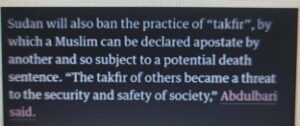
Regarding Jason’s claim that “Sudan will also ban the practice of takfir by which a Muslim can be declared apostate by another and so subject to a potential death sentence,” the statement definitely needs clarification and detail because while it is true that a Muslim can declare another Muslim to be apostate and subject to the prescribed punishment, the question is who among the Muslims has the authority to do so! Indeed, Ahlus Sunnah are fully aware that Takfeer can only be made by the upright scholars of the Islamic world—those who fear Allah and refrain from speaking unless they are well-informed. Find out who can make Takfeer and its guiding principles here:

http://www.salafipublications.com/sps/downloads/pdf/MNJ090006.pdf

Read further here: On Those Who Ought To Declare Takfir and Establish the Hadd Punishment, according to Shaykh Salih al-Fawzaan:

http://www.spubs.com/sps/sp.cfm?subsecID=MNJ09&articleID=MNJ090004&articlePages=1

Islam’s Unapologetic Position On Apostasy – [Unveiling Another Path of The Criminals and Opponents of The Messengers]: https://salafidawahmanchester.com/2022/06/11/islams-unapologetic-position-on-apostasy-unveiling-another-path-of-the-criminals-and-opponents-of-the-messengers/

Regarding the quote from Jason that reads, “The Takfir of others became a threat to the security and safety of society,” it is clear that the act of false (or unjustified) Takfir against a Muslim is a dangerous matter. All Muslim rulers must take action to shut this terrible door in order to stop the contemporary Khaarijites from using Sayyid Qutb’s, Usama Bin Ladin’s, and Ayman Az-Zawahiri’s evil ideology to overthrow Muslim governments and incite violence.

Shaikh Falaah Ismaa’eel [may Allah have mercy upon him] stated: In order to comprehend their danger, it merits noting what Allah’s Messenger [peace and blessings of Allaah be upon him] wished if he were to encounter them and what he would do to them, despite the fact that they hail from the Ummah and from the people of the Qiblah, that he would slaughter them in a manner comparable to that of Aad and Thamood; especially when one considers what Allah’s Messenger said concerning dogs, “Had dogs not been a community amongst the communities, I would have commanded that all of them be killed”. (see footnote I) Therefore, a sensible person examines and considers what the Messenger of guidance and mercy wanted to do to these Khawaarij, notwithstanding their commitment to worship, prayer, fasting, and Qur’anic recitation, in comparison to what he prevented himself and others from doing to dogs. Indeed, this is strong evidence of the peril posed by the persistence of this idea [i.e., Fasle Takfeer] and this kind of people in the Ummah [i.e., the Khawaarij], since they weaken the Ummah and keep it preoccupied with [internal issues, strife, etc.] (3)

Footnote I: “Had dogs not been a community amongst the communities, I would have commanded that all of them be killed”.

Al-Khattaabee [may Allah have mercy upon him] said, “This statement means that the Prophet [peace and blessings of Allah be upon him] hated that a community among the communities and a species among the creation would vanish until they all ceased to exist because, in reality, none of Allah’s creatures exist without some kind of purpose or benefit guiding their existence. Since there is no way to eliminate all of them in this situation, kill the evil ones among them – the black dog – leave the others so that you might use them as guard dogs”. [An Excerpt from Ma’aalim As-Sunan 4/132] [NB: Only the authorities in the Uk are allowed to take the life of an animal and any individual who does so will be found guilty of animal cruelty]

Dogs we can keep: Abdullah Ibn Umar [may Allaah be pleased with him and his father] said, “Allah’s Messenger [peace and blessings of Allaah be upon him] said, ‘Whoever keeps a dog, except a dog for herding livestock or a dog that is trained for hunting, two qiraats [i.e. great reward] will be deducted from his reward each day’”. [Bukhaari 5163 and Muslim 1574]

Imaam Muhammad Ibn Saaleh Al-Uthaymeen [may Allaah have mercy upon him] said, “As a result, there is no need to have a dog to guard a house if it is in the heart of a metropolis. Therefore, having a dog for this reason in such circumstances is forbidden and unlawful, and it reduces a person’s reward by one or two qiraats each day. However, it is acceptable to have a dog to protect the home and those living there if the house is in a rural area and nobody is home. It is more crucial to protect a household’s residents than its animals or agricultural produce”. [An Excerpt from Majmoo Fataawa Ibn Uthaymeen 4/246]

The Hunting Dog

Allah [The Most High] said:

يَسۡـَٔلُونَكَ مَاذَآ أُحِلَّ لَهُمۡ‌ۖ قُلۡ أُحِلَّ لَكُمُ ٱلطَّيِّبَـٰتُ‌ۙ وَمَا عَلَّمۡتُم مِّنَ ٱلۡجَوَارِحِ مُكَلِّبِينَ تُعَلِّمُونَہُنَّ مِمَّا عَلَّمَكُمُ ٱللَّهُ‌ۖ فَكُلُواْ مِمَّآ أَمۡسَكۡنَ عَلَيۡكُمۡ وَٱذۡكُرُواْ ٱسۡمَ ٱللَّهِ عَلَيۡهِ‌ۖ وَٱتَّقُواْ ٱللَّهَ‌ۚ إِنَّ ٱللَّهَ سَرِيعُ ٱلۡحِسَابِ

They ask you [O Muhammad)] what is lawful for them [as food]. Say: “Lawful unto you are At-Tayyibat [all kind of Halal (lawful-good) foods which Allah has made lawful (meat of slaughtered eatable animals, milk products, fats, vegetables, and fruits, etc.)]. And those beasts and birds of prey which you have trained as hounds, training and teaching them [to catch] in the manner as directed to you by Allaah; so eat of what they catch for you, but pronounce the Name of Allah over it, and fear Allah. Verily, Allah is Swift in reckoning”. [Surah Al-Maa’idah. Aayah 4]

Imaam Ibnul Qayyim [may Allaah have mercy upon him] said: Indeed, Allah declared the prey of the untrained hound to be dead meat and forbidden to consume, whereas He declared the prey of the trained hound to be permissible. This is evidence of the nobility of knowledge as Allah did not declare any prey other than that of the trained hound to be lawful. The trained and untrained hound would have been the same if it weren’t for the fact that knowledge and teaching have a unique distinguished virtue and nobility. [An Excerpt Mihtaah Daarus Sa’aadah. 1/55]

https://abukhadeejah.com/dog-as-pets-guard-dogs-sheepdogs-hunting-hounds/


Ref 1: Al-Misbaah Al-Muneer Fee Tahdeeb Tafseer Ibn Katheer

Ref 2: An Excerpt from Al-Bayaan Li-Akhtaa’i Ba’dil Kuttaab. 2/177-180

[Ref 3: An Excerpt from Naz’atut Takfeer. Pages 24-25. slightly paraphrsed]

Which animal do you want to own when you make hijrah?

In Name of Allaah, The Most Merciful, The Bestower of Mercy.

The owners of camels and the owners of sheep praised (the animals in their possession), so the Prophet [peace and blessings of Allaah be upon him] said, “Musa was sent (i.e. as a Messenger) and he was a shepherd; Dawud was sent and he was a shepherd, and I was sent and was a shepherd at Aj’yaad [i.e. a neighbourhood in Makkah]”.

Al-Allaamah Zaid Bin Haadi Al-Mad’khali [may Allaah have mercy upon him] said: Those who look after livestock are different in what they look after: camels, cows and sheep. Ownership depends on what a human being is in need of. So, which type of livestock did the Prophet consider to be better? The hadeeth is proof to show that sheep is better, greater in blessing and more beneficial for their owners. (However), this does not negate the fact that one should be eager to own a camel and a cow, so that he can benefit from them in a number of other ways, such as to obtain milk, carry things and other than that. And Allaah knows best.

[At-taleeqaatul Maleehah Alaa Silsilah Al-Ahaadeeth As-Saheehah vol 1.page 159]

Pay close attention to this, especially when those attributed to teaching and dawah increase!

In The Name of Allaah, The Most Merciful, The Bestower of Mercy.

Al-Allaamah Saaleh Al-Fawzaan [may Allaah preserve him] said:

Allaah [The Most High] stated: [قُلۡ هَـٰذِهِۦ سَبِيلِىٓ أَدۡعُوٓاْ إِلَى ٱللَّهِ‌ۚ عَلَىٰ بَصِيرَةٍ أَنَا۟ وَمَنِ ٱتَّبَعَنِى‌ۖ وَسُبۡحَـٰنَ ٱللَّهِ وَمَآ أَنَا۟ مِنَ ٱلۡمُشۡرِكِينَ – Say (O Muhammad): “This is my way; I invite unto Allah (i.e. to the Oneness of Allah – Islamic Monotheism) with sure knowledge, I and whosoever follows me (also must invite others to Allah i.e. to the Oneness of Allah – Islamic Monotheism) with sure knowledge. And Glorified and Exalted be Allah (above all that they associate as partners with Him). And I am not of the Mushrikun (polytheists, pagans, idolaters and disbelievers in the Oneness of Allah; those who worship others along with Allah or set up rivals or partners to Allah).”

[أَدۡعُوٓاْ إِلَى ٱللَّهِ‌ۚ – I invite unto Allah (i.e. to the Oneness of Allah – Islamic Monotheism)]. This part of the Ayah contains a notification regarding sincerity, because indeed some people call to themselves. It may be that a person propagates, delivers lectures and sermons, but his aim is to become apparent to the people – to receive some status, praised by the people and that people gather around him and become numerous around him. If this is his aim, then he is not one who calls to Allaah; rather he is a caller to himself. The person who abandons Dawah has indeed abandoned a great obligation and the person who is not sincere in Dawah has indeed fallen into a great danger, because Dawah has to be carried out sincerely for the Sake of Allaah and the aim should be to establish the Sharee’ah of Allaah- to guide and benefit the people, whether you are praised or rebuked. As for some people, when they are not praised and promoted, they abandon Dawah. This is a proof that such a caller is not a caller to Allaah, rather he only calls to himself. Therefore, the Muslim should be warned and that his aim in dawah should be sincerity, to benefit the people, free them from Shirk and bidah, free them from those affairs that are in opposition to the sharee’ah and fulfil what is obligated on him.

A great number of people around a person is a not proof that such a person is virtuous, because some of the Prophets were only followed by few people. “A Prophet will come on the day of judgement with a few followers and a Prophet will come with no followers”. [Bukhaari 5705]. So, does this mean that such a Prophet is not virtuous? No, definitely not! A person does not look at the large number of people who are present, because the Prophet [peace and blessings of Allaah be upon him] said to Ali, “If Allaah gives guidance to a single man through you, it is better for you than possessing red camels”. [Bukhaari 3009] (1)

The Shaikh [may Allaah preserve him] also stated, “Ahlus Sunnah Wal Jamaa’ah are not harmed by those who oppose them. If you are with them- all praise is due to Allaah, they are pleased with this because indeed they want good for the people. If you oppose them, you cannot harm them and due to this the Messenger [peace and blessings of Allaah be upon him]said, “There will not cease to be a group of my Ummah who will be manifest upon the truth- not harmed by those who forsake them until the command of Allaah comes to pass (i.e. the day of judgement) whilst they are (still) upon that (truth)”. The one in opposition does not harm except himself. What is given consideration is not the great numbers; rather what is given consideration is to be in agreement with the truth, even if a small number of people were upon it. And even if in some eras there is only one person (upon truth), then he is the one upon truth and he is the Jamaa’ah. The Jamaa’ah does not necessitate great numbers; rather the Jamaa’ah is what is in agreement with the truth – in agreement with the Book and the Sunnah, even if those upon it are few. However, if many come together and (upon) truth, then – all praise is due to Allaah- this is strength. But if the majority oppose it (i.e. the truth), then we side with the truth even if only a few are upon it”. (2)

The Goal Behind Co-operation

Allaah [The Most High] said: [ وَتَعَاوَنُوا عَلَى الْبِرِّ وَالتَّقْوَىٰ ۖ وَلَا تَعَاوَنُوا عَلَى الْإِثْمِ وَالْعُدْوَانِ – Help you one another in Al-Birr and At-Taqwa [virtue, righteousness and piety]; but do not help one another in sin and transgression. [5:2]

Imaam Ibnul Qayyim [may Allaah have mercy upon him] said: This verse contains all the Masaalih (things that will bring about benefit and repel harm) for the salves in their worldly affairs and in the Herefater- amongst themselves or in relation to their relationship with their Lord. That is because every servant finds himself within two circumstances and obligations – either to fulfil the obligations owed to Allaah or the obligations owed to Allaah’s creation. As for the obligations owed to the creation, they include (righteous) association, companionship, aiding one another upon what Allaah loves and obedience to Allaah, and that is the goal behind one’s search for happiness and success in the afterlife. There can be no happiness in the afterlife except through Bir and Taqwaa, because it is basis of all affairs of the religion. A deed cannot be considered an act of obedience to Allaah and an act that gets one close to Allaah until it is based on Eemaan, so that which leads to the performance of that deed is solely due to Eemaan – neither (un-Islamic) customs nor desires, neither seeking praise nor status and other than it; rather it should be solely based on Eemaan and the aim behind it should be to attain Allaah’s reward and seeking after Allaah’s Pleasure. (3)


[Ref 1: An Excerpt from ‘I’aanah Al-Mustafeed Bi-Sharhi Kitaab At-Tawheed’ pages 97-98’ Publisher: Ar-Risaalah Publishers 1st edition 1428AH (Year 2007). Slightly paraphrased]

[Ref 2: An Excerpt from ( لمحة عن الفرق الضالة )– pages 14 -15. slightly paraphrased]

[Ref 3: An Excerpt from ‘Badaa’i At-Tafseer Al-Jaami Limaa Fassarahu Al-Imaam Ibnul Qayyim Al-Jawziyyah’ Vol 1 pages 307-311. Publisher: Daar Ibn Al-Jawziyyah 2nd Ed, 1431AH- Slightly paraphrased]

Hunger strike – Admonition By Imaams (Abdul Azeez Bin Baaz and Nasiruddeen Al-Albaanee)

In The Name of Allaah, The Most Merciful, The Bestower of Mercy.

Imaam Abdul Azeez Bin Baaz [may Allaah have mercy upon him] was asked: “We often hear about hunger strike that leads to death; what is Islam’s ruling on this?”

Answer: This does not have a basis (in Islam). This is something by way of which the enemies seek support for their filthy goals. This conduct does not have a basis (in Islam) and it is not permissible if it leads to harm or death. This is what we believe regarding this affair. This (i.e. hunger strike) was adopted from the enemies of Islam and we do not know of a basis for it (in Islam). (1)

Imaam Al-Albaanee [may Allaah have mercy upon him] was asked: At present, in relation to modern methods, they utilize it to draw people’s attention to a specific issue, such as a hunger strike, civil disobedience, refraining from work, standing still at particular hour as sign of mourning and the like, among other things that have been initiated. What is the Islamic ruling on such behaviour?

The Shaikh responded: I do not believe in the legitimacy of all this behaviour due to two reasons: Firstly, and that is the most most important thing, these methods are from the ways of the nations that do not have a path prepared for them through the divine revelation, which if employed would lead to the desired goal. The Muslims are not like those people because we have the Sharee’ah that has not left out anything, except that if act upon it we’ll be happy in the worldly life before the hereafter. Secondly, these methods, in addition to being a habit of the unbelievers, do not benefit and will never benefit the Muslims even if they remain throughout their lives, while they adhere to them and refrain from employing the divine legislated means that are stipulated by texts. This is my answer to this question.

Questioner: May Allah reward you.

The Shaikh: And you.

Questioner: We elaborate a little on hunger strike.

Shaikh: Go on please.

Questioner: I mean, in reality this includes destruction of the body which Allaah [Glorified and Exalted be He] gave to the human being, so now it means that hunger strike in particular, for whatever reason, includes destruction.

The Shaikh: Refraining from food and drink – undoubtedly – is two types, as it is considered one of the medical methods through which some people treat some of the diseases. Of course, this type is not mentioned in your question.

Questioner: Yes.

The Shaikh: Oh, so then the hunger strike intended in the question is the one that is pursued until a negative effect appears on the person’s body, so that the oppressors sympathize with him by releasing him or comfort him with something, or what is similar. This type of refraining from food and drink is tantamount to self-starvation. All these means are not legislated in the Sharee’ah, together with the fact that it is tantamount to exposing oneself to harm if not death. (2)


[Ref1:https://binbaz.org.sa/fatwas/2470/%D8%AD%D9%83%D9%85-%D8%A7%D9%84%D8%A7%D8%B6%D8%B1%D8%A7%D8%A8-%D8%B9%D9%86-%D8%A7%D9%84%D8%B7%D8%B9%D8%A7%D9%85-%D8%AD%D8%AA%D9%89-%D8%A7%D9%84%D9%85%D9%88%D8%AA].

[Ref 2: An Excerpt from Silsilah Al-Hudaa Wan-Noor  0156]

[2] Tale-carrying is a major sin, but reporting plotters is praiseworthy

In The Name of Allaah, The Most Merciful, The Bestower of Mercy.

Imam at-Tabari narrated in his Tafseer from Ibn Umar, Muhammad Bin Kab, Zaid Bin Aslam and Qataadah that a man (i.e. hypocrite) said during the battle of Tabuk: “Neither have we seen the likes of these Qur’an reciters of ours who love food more than all of us nor the worst liars among us and the most cowardly at the time of battle?!” [i.e. they were referring to the Messenger and his companions]. So, Awf Bin Malik said to him, “You have lied, but rather you are a hypocrite. I’ll certainly inform Allaah’s Messenger [peace and blessings of Allah be upon him] (about this speech of yours)”. Then Awf went to Allaah’s Messenger to inform him and thus found that the Qur’an (i.e. the revelation) preceded him (i.e. the Prophet had already been informed via the revelation). Then that man came hanging onto the girth of the she-camel of Allaah’s Messenger, stumbling over the stones and saying: “We were only talking idly and joking”, so Allaah’s Messenger said, “Was it at Allah, and His Signs and His Messenger that you were mocking?” [Surah At-Tawbah. Aayah 65]

Al-Allaamah Sulaymaan Bin Abdillah Bin Muhammad Bin Abdil Wahhaab stated regarding (Awf’s) statement: “I’ll certainly inform Allaah’s Messenger [peace and blessings of Allah be upon him] (about this speech of yours)”: In this and what is similar neither (contains) backbiting nor tale-carrying, but rather it is an act of sincere devotion to Allaah and sincere (belief in Allaah’s Messenger and adherence to his path), therefore, a differentiation must be made between backbiting and tale-carrying, and between sincere devotion to Allaah and (sincere belief Allaah’s Messenger and adherence to his path). So, mentioning the actions of the wicked sinners to those in charge of the affairs, in order to deter them (from evil) and establish the rulings of the Sharee’ah on them, is (considered) enjoining good and forbidding evil, and not (considered) backbiting and tale-carrying. [Tayseer Al-Azeez Al-Hameed. page 540]

Al-Allaamah Abdur Rahmaan Bin Qaasim stated: “This deed and what is similar to it is (considered) sincere devotion to Allaah and (sincere belief in Allaah’s Messenger and adherence to his path), and it is not (considered) tale-carrying at all. To mention the actions of the wicked sinners to those in charge of the affairs so that they deter them (from evil) is (considered) enjoining good and forbidding evil, and it is not backbiting and tale-carrying”. [Haashiyah Alaa Kitaab at-Tawheed 322] [Paraphrased and Abridged]

روى الطبري في تفسيره عن ابن عمر، ومحمد بن كعب، وزيد بن أسلم، وقتادة، دخل حديث بعضهم في بعض: (أنه قال رجل في غزوة تبوك: ما رأينا مثل قرائنا هؤلاء أرغب بطونًا، ولا أكذب ألسنًا، ولا أجبن عند اللقاء -يعني: رسول الله صلى الله عليه وسلم وأصحابه القراء-. فقال له عوف بن مالك: كذبت، ولكنك منافق، لأخبرن رسول الله -صلى الله عليه وسلم-. فذهب عوف إلى رسول الله -صلى الله عليه وسلم- ليخبره فوجد القرآن قد سبقه، فجاء ذلك الرجل إلى رسول الله -صلى الله عليه وسلم- وقد ارتحل وركب ناقته، فقال: يا رسول الله؛ إنما كنا نخوض ونلعب ونتحدث حديث الركب نقطع به عنا الطريق. قال ابن عمر: كأني أنظر إليه متعلقًا بنسعة ناقة رسول الله -صلى الله عليه وسلم- وإن الحجارة لتنكب رجليه وهو يقول: إنما كنا نخوض ونلعب. فيقول له رسول الله -صلى الله عليه وسلم-: {أبالله وآياته ورسوله كنتم تستهزئون ما يلتفت إليه وما يزيد عليه}).
قال العلامة سليمان بن عبد الله بن محمد بن عبد الوهاب -رحمه الله تعالى- [توفي 1233هــ] في “تيسير العزيز الحميد” (ص٥٤٠): (قوله: “لأخبرن رسول الله صلى الله عليه وسلم”، فيه أن هذا وما أشبهه لا يكون غيبة ولا نميمة، بل هو من النصح لله ورسوله، فينبغي الفرق بين الغيبة والنميمة، وبين النصيحة لله ورسوله، فذكر أفعال المنافقين والفساق لولاة الأمور ليزجروهم ويقيموا عليهم أحكام الشريعة ليس من الغيبة والنميمة).
وقال العلامة عبد الرحمن بن قاسم -رحمه الله تعالى- [توفي سنة 1393 هــ] في “حاشيته على كتاب التوحيد” (ص٣٢٢) : (هذا ونحوه من النصيحة لله ورسوله -صلى الله عليه وسلم-، وليس من النميمة في شيء، فذكر أفعال الفساق لولاة الأمور ليردعوهم، من الأمر بالمعروف والنهي عن المنكر، لا من الغيبة والنميمة).

This Faa’idah was shared by one of our Salafi teachers in London (may Allaah preserve him and all his brothers amongst the teachers) Aameen.

[1] Tale-carrying is a major sin, but reporting and exposing a harmful secret plotter is praiseworthy

In The Name of Allaah, The Most Merciful, The Bestower of Mercy.

Al-Allaamah Saalih Al-Fawzaan [may Allaah preserve him] stated: And the worst (of the tale-carriers) is that one who hastens to destroy the relationship between the students of knowledge and the callers to Islam, split the Jamaa’ah of the Muslims and incite hatred between them. The one who does this is a Nammaam (a tale-carrier). Indeed, Allaah [The Most High] forbade (us) from following and believing such a person even if he swears by Allaah, as Allaah said:

وَلَا تُطِعۡ كُلَّ حَلَّافٍ۬ مَّهِينٍ
هَمَّازٍ۬ مَّشَّآءِۭ بِنَمِيمٍ۬

And obey not everyone who swears much, and is considered worthless, a slanderer, going about with calumnies.

The Prophet [peace and blessings of Allaah be upon him] said: “The tale-carrier will not enter paradise”. Wars may occur due to the Tale Carrier, the Muslims may split and show enmity to one another due to the Tale Carrier, neighbours may boycott one another and one’s household may show enmity to one another and split due to a tale-carrier. Therefore, we must fear Allaah [The Mighty and Majestic] and be mindful of the tale-carrier. (1)

Imaam Abdul Azeez Bin Baaz [may Allaah have mercy upon him] said: This is a threat against the tale carrier. If he is a person upon Tawheed, it is hoped that he will enter paradise, but it is feared that this sin [i.e. tale carrying] will prevent him from entry into paradise for some time and enters him into the hell fire for some time, just as it is case with all other sinners. The sinners [i.e. those who die whilst committing sins lesser than shirk] are under the will of Allaah- if Allaah wishes, He will either punish them or forgive them straight away, or He enters them into hell for some time and paradise thereafter, just as Allaah said: [ إِنَّ ٱللَّهَ لَا يَغۡفِرُ أَن يُشۡرَكَ بِهِۦ وَيَغۡفِرُ مَا دُونَ ذَٲلِكَ لِمَن يَشَآءُ‌ۚ – Verily, Allah forgives not that partners should be set up with him in worship, but He forgives except that (anything else) to whom He pleases]. [Surah An-Nisaa’ Aayah 48] (2)

Narrated Anas Ibn Maalik [may Allaah be pleased with him] that the Prophet [peace and blessings of Allaah be upon him] said, “Do you know what Al-Ad’hu is [i.e. calumny]?” They said, “Allaah and His Messenger know best”. He said, “Transmitting speech from some people to another people in order to destroy their (mutual relationships)”.

Al-Allaamah Zayd Bin Haadi Al-Mad’khali [may Allaah have mercy upon him] said, “The subject matter of this hadeeth is about the dangerous (consequences) of tale-carrying in this Dunyaa and in the Aaakhirah. Indeed, the Prophet [peace and blessings of Allaah be upon him] called it Ad’hu, and the meaning of Ad’hu is to transmit speech from some people to another people in order to corrupt their relationships. And in the hadeeth of Ibn Mas’ud [may allaah be pleased with him], it is explained to mean tale-carrying, and that is to transmit the statement of one person to another person, or from a group of people to another group, or from one country to another one, in order to cause corruption.

This is one of the major sins due to its evil and the punishment (associated with it) in this life and the next. In this worldly life, it may lead to murder, chaos and other similar affairs – events that are in opposition to rectification. And due to this, the scholars say that the tale carrier- the one who transmits speech from one person to another person, or from a group of people to another group, or from one country to another, in order to sow the seeds of corruption- causes more harm than a magician. This is because a magician might only harm one person, but as for the tale-carrier, he might harm many individuals and the trial is prolonged.

Therefore, it is forbidden for a Muslim to transmit speech to cause corruption between those upon brotherhood and those who aid one another upon piety. And even if nothing like this [i.e. fighting, chaos, killing etc] occurs, it is still not permissible to corrupt the relationship between the people by way of lies- sowing the seeds of enmity and hatred between them. The Messenger of Allaah went past two graves and then said, “Both of them (i.e. the two people in these graves) are being punished, and they are not being punished due to (committing the greatest of the major sins), but indeed they are great sins. One of them used not to protect himself from being soiled with his urine, and the other one used to go about with tale-carrying”.

Therefore, what the opposite of this hadeeth (necessitates is that) it is obligatory to bring about reconciliation between the people due to the statement of Allaah[The Exalted]:

[لَّا خَيۡرَ فِى ڪَثِيرٍ۬ مِّن نَّجۡوَٮٰهُمۡ إِلَّا مَنۡ أَمَرَ بِصَدَقَةٍ أَوۡ مَعۡرُوفٍ أَوۡ إِصۡلَـٰحِۭ بَيۡنَ ٱلنَّاسِ‌ۚ – There is no good in most of their secret talks save (in) him who orders Sadaqah (charity in Allah’s Cause), or Ma’ruf (Islamic Monotheism and all the good and righteous deeds which Allah has ordained), or conciliation between mankind. [Surah An-Nisaa. Aayah 114]

However, there is an exception in this affair when it is carried out for the purpose of giving some sincere advice whose benefit cannot be reached nor can harm be repelled except by way of such speech. For example, you hear a person saying that he is lying in wait against your Muslim brother and wishes to kill him, take his wealth or violate his honour, or the like thereof, (whose evil consequences) you have clarified (for this perpetrator in order to stop him), but he refuses to accept your advice. Therefore, you go to the person who is unaware and informed him about it, so that he can take precautions. Therefore, speech based on this type of intention and goal is considered to be sincere advice and it is not tantamount to causing corruption, for indeed you are either going to repel harm or bring about a benefit which one cannot do without (except by way of this transmission). And Allaah knows best. (3)


[Ref 1: An Excerpt from ‘Atta-thab’but Fil-Akhbaar’ pages 34-36. slightly paraphrased]

[Ref 2: https://www.binbaz.org.sa/noor/2527

[Ref 3: At-ta’leeqaat Al-Maleehah Alaa Silsilatil Ahaadeeth As-Saheehah’ 1/27-28]

Some Reasons Behind Increase In Reward On Deeds and The Heavy Weight of Ahlus Sunnah’s Deeds

In The Name of Allaah, The Most Merciful, The Bestower of Mercy.

Some Reasons Behind Increase In Reward On Deeds, Why Ahlus Sunnah’s Deeds Become Heavier Even if little and Ahlul Bidah’s Deeds Become Lighter Even If Numerous

Imaam As-Sadi [may Allaah have mercy upon him] was asked: What are the means and deeds by way of which reward is increased?

Answer: As for the increase of reward for a good deed to ten times the like thereof, this occurs in every righteous action, as Allaah [The Most High] said: [مَن جَآءَ بِٱلۡحَسَنَةِ فَلَهُ ۥ عَشۡرُ أَمۡثَالِهَا‌ۖ   – Whoever brings a good deed shall have ten times the like thereof to his credit]. [Surah Al-An’aam. Aayah 160]

As for an increase beyond this, it has its ways (and means). It can either be related to the performer of the deed (himself or herself) or the deed itself, or the time and the place [i.e., a specific time and place mentioned in the authentic Sharee’ah texts that reward for good deeds are increased in that time period or place].

One of the most important means of increasing (reward for good deeds) is when a person fulfils sincerity to Allaah and adheres to the path of the Messenger [peace and blessings of Allaah be upon him].  This (increase is received) when a deed is legislated [i.e., in the Sharee’ah and not innovated] and the person intends to please Allaah and hopes for His Reward- when this intention is firmly established as the drive and goal behind the deed – due to the person’s belief in Allaah, belief in the Messenger, (obedience) to the command of Allaah, seeking Allaah’s Countenance and Pleasure, just as it has been mentioned in a number of Aayaat and Ahaadeeth. Allaah [The Most High]: [إِنَّمَا يَتَقَبَّلُ ٱللَّهُ مِنَ ٱلۡمُتَّقِينَ – Verily, Allah accepts only from those who are Al-Muttaqun] [Surah al-Maa’idah. Ayah 27] Meaning:  Those who fear Allaah whilst performing deeds with sincerity and adhering to the authentic path of the Messenger.

Also, the Messenger said, “Whoever fasts the month of Ramadhaan, his previous (minor) sins will be forgiven”. “And whoever stands (in the night prayer) during Ramadan out of faith and seeking reward (from Allaah), then all of his previous (minor) sins will be forgiven”. (1) and other texts besides these. And because of this, the apparent actions have more virtue over one another in the sight of Allaah due to the faith and sincerity in the hearts.

Also abandoning the forbidden desires of the soul is included amongst those righteous actions that have virtue over one another due to the different levels of sincerity, if a (person) sincerely abandons them from the bottom of his heart and not out of other than sincerity. The story of the companions of the cave [i.e. in Surah Al-Kahf] is bears witness to this. (2)

Therefore, the means to increasing (reward) is the basis and foundation we have already mentioned, such as sound creed, a strong belief in Allaah and in His Attributes, a strong desire (to worship Allaah) and a fervent desire for goodness. That is because Ahlus Sunnah Wal Jamaa’ah -in truth – and those people of knowledge, who possess knowledge of the perfect and details of the Names and Attributes of Allaah and have a strong desire to meet Allaah (in the Afterlife), the reward for their deeds are greatly increased in a manner in which others who share the same religion can neither reach nor approach in the least. And this is why the pious predecessors used to say, “When Ahlus Sunnah are held back by their deeds [i.e. not having numerous deeds], they are supported by their sound creed”. (3)

Imaam Ibn Rajab [may Allaah have mercy upon him] said: The increase of reward (on a deed) is estimated in accordance with the perfection of a person’s Islaam and strength of sincerity in that action”. [4]


[1] Minor sins forgiven when one fasts the month of Ramadhaan, see article on this link: http://salafitalk.net/st/viewmessages.cfm?Forum=11&Topic=6255

[2] An Excerpt from ‘Al-Fataawaa As-Sadiyyah. Page: 43. Slightly paraphrased]

[3] An Excerpt from ‘Al-Fatawaa As-Sadiyyah page 44 & Sharh Al-Asbaab Wal-A’maal Allatee Yudaa-afu Bihaa Ath-Thawaab page 59-65]

[4] Jaami Al-Uloom Wal-Hikam 2/316]

The Obligation of Hijrah (Migration) to Daarul Islaam (A Muslim Country)

In The Name of Allaah, The Most Merciful, The Bestower of Mercy.

The Obligation of Hijrah to Daarul Islaam – by Imaam Abdul Azeez Bin Baaz and Al-Allaamah Ubaid al-Jaabiri

Imaam Abdul Azeez Bin Baaz [may Allaah have mercy upon him] was asked: What is your advice to brothers and sisters who live in England and do not work, and receive financial aid from the government? Sometimes they get a job, but they do not inform the government. Is this work of theirs a right thing?

Answer: It is obligated on all Muslims residing in Daarul Kufr (1) to migrate to Bilaad Al-Islaamiyyah (2) – if they are able to do so – in which duties of Islam are established. If not able to do that, then (they migrate) to the countries that are lesser in evil, just as a group of the companions migrated – when commanded by the Prophet [peace and blessings of Allaah be upon him] – from Makkah to Abyssinia, because the land of Abyssinia at that time was lesser evil than the evil that befell the Muslims in Makkah before the conquest of Makkah. But, if they cannot, then they must fear Allaah in their place (of residence), beware of what Allah has forbidden them and fulfil what Allaah has enjoined upon them. And there is no sin on them in accepting help and assistance from the non-Muslim state if this does not result in abandoning an obligation or committing a prohibited act, (but) they are not entitled to take assistance except officially as decided by the state, and they are not allowed to lie to obtain it. And it is obligated on all of them to fear Allaah in everything, beware of what Allaah forbids, seek understanding in the Qur’an and Sunnah among themselves and ask the people of knowledge (i.e. the scholars) about what is difficult for them to understand (or regarding a difficult situation that requires a verdict) , even if by correspondence or by phone. May Allaah rectify the circumstances of all Muslims, preserve their religion for them, grant them understanding in it, and protect them from the evil of themselves and the evil of their enemies, for indeed He is magnanimous and generous. [Majmoo Fataawaa Wa Maqaalaat Ash-Shaikh Ibn Baaz 28/238]

Al-Allaamah Ubaid Bin Abdillaah Al-Jaabir [may Allaah have mercy upon him] stated: In the name Allaah and all praise is due to Allaah. May Allaah send His salaah and salaam upon our Prophet Muhammad and his family and all his companions. I say: The establishment of this affair is not excluded from that which the Book of our Lord and the Sunnah of our Prophet demonstrated; and [that which] the Imaams of Knowledge and the Religion [past and present follow(ed), pertaining to migration from the lands of kufr to the lands of Islaam, or from a kaafir land or to another kaafir land in which the Muslim’s Religion and honour is safe. In summary, the one who sits and accompanies me knows that of me. I say, and with Allaah is facilitation of Tawfeeq (i.e. guidance and the ability to act upon it):

Firstly: This Hijrah is from the legislated ordinances of Allaah and He has not abrogated it. He [sallal-laahu-alayhi-wasallam] said: “Hijrah will not cease to continue until repentance ceases to continue, and repentance will not cease to continue until the sun rises from the west”. So, it [hijrah] remains.

Secondly: What is apparent to me concerning Hijrah at present is of two examples [affairs]; [a] Obligation [b] Sunnah. The Obligatory Hijrah: If a person is in a kaafir land (being) put to trial in his religion and honour, and he is unable to establish that which Allaah has enjoined upon him pertaining to his Religion and worship of his Lord, then Hijrah is obligatory upon him on the basis of what has already been clarified; if he is able to make Hijrah, yes, then he migrates to a Muslim land and this is the Asl, or to a Kaafir land in which his Religion and honour is safe, just as the Prophet [peace and blessings of Allaah be upon him] commanded the Muslims to migrate to Habasha [Ethiopia] when the Quraish harmed them; and (he) mentioned that there was a king [in Habasha] who oppresses no one under his protection, or as he said: “(oppresses no one) next to him.” This is what I affirm and adhere to as [religion] to Allaah.

As for the recommended prescribed Hijrah: It is the Hijrah from the land of the disbelievers to the lands of Islaam in order to strengthen his religion, or to gain knowledge, or to earn lawful earnings in the land of Islaam. So when this is established- and if I did say on a day from the days about making hijrah to Birmingham unrestrictedly- then this is a slip [mistake] and I seek Allaah’s forgiveness from this if it was an upright transmission of the trustworthy people of Sunnah. This is the third point or affair.

The Fourth Point: Many amongst the people in Europe or in the Asian States in India or other than it ask; they are put to trial in their Religion by some of the innovators from the brelviyyah- the extremist soofees from the people of Wahdatul Wujood and other than them. So I say them [i.e. those put to trial]: Make Hijrah to Birmingham because Maktabatus Salafiyyah is there. Therefore, my answer to them is not that Birmingham is a land of Hijrah unrestrictedly, for Birmingham is from the cities of Britain and Britain is a Kaafir Land. I urge them to make Hijrah to where they will find the Maktabah, where they will affiliate with Maktabatus Salafiyyah over there [in Britain], and to participate in lessons and muhaadaraat within which are scholars of excellence, from them: Ash-Shaikh Abdullaah Bin Abdur Rahmaan Al-Ghudiyaan from the Committee of Major Scholars and Fatwah Committee of the Kingdom of Saudi Arabia. He delivered lessons to them and has died [rahimahullaah]. So the likes of this Maktbah is worthy of being affiliated to [for] the one who cannot find a place to seek shelter; especially if he has a desire to attain knowledge of the Sharee-ah, particularly in the affair of Aqeedah, the Sunnah and waging war against innovation and its people. This is what I mentioned and I affirm it. And I repeat: if I did establish [affirm] the opposite of that, then it is one of two affairs: [a] It is either a slip [mistake] from me or [b] a distortion [misrepresentation] of (my speech). And that which is from me, then indeed I seek the forgiveness of Allaah from it; and that which is a distortion [misrepresentation] of my speech and a forged saying on me, then I ask Allaah to set it aside between me and my adversaries on yaumul qiyaamah. [End of quote] http://www.salafitalk.net/st/viewmessages.cfm?Forum=9&Topic=12027

Footnotes 1 and 2: Daarul Islaam (or Bilaad Al-Islaamiyyah) is a country whose people are predominantly Muslims, even if the ruler is either a polytheist or does not ascribe to any religion. This land is a Muslim land and it is considered Daarul Islam. As for Daarul Kufr, it is a country whose people are predominantly disbelievers [in Allaah, or disbelievers in both Allaah and His final Messenger Muhammad (peace and blessings of Allaah be upon him)]. For further details listen here:


Let’s Not Be Preoccupied With Excess Food and Drink to The Extent That Maghrib Prayer Is Delayed Without a Need!

In The Name of Allaah, The Most Merciful, The Bestower of Mercy.

Imaam Abdul Azeez Bin Baaz [may Allaah have mercy upon him] was asked: The female questioner says in the last question: “Is it Sunnah when breaking the fast, or breaking of the fast by the fasting person, to eat dates, drink water; then get up to pray Maghrib, then after that eat whatever food and drink he wants?”

Response: Yes; because this is the (deed) in which the two beneficial affairs can be combined together (i.e. break the fast as well as pray Maghrib without unnecessary delay); so he hasten to break the fast with what Allaah has made easy such as wet or dry dates, or water (see footnote a), then he goes to pray with the congregation so that he does not miss the congregational prayer; then he comes back and has dinner. There is no harm in this. However, if – for example – they are a group on a journey, they may eat and have dinner, then pray. If they delay the dinner and offer the prayer after they break their fast, there is no harm in that; but in cities and villages, a person eats what Allaah makes easy for one to break the fast with, then he goes to prayer so that he does not miss the congregational prayer. (1)

Footnote a: Abu Dharr [may Allaah be pleased with him] reported that Allaah’s Messenger [peace and blessings of Allaah be upon him] said, “My Ummah will continue in goodness so long as they hasten to break their fast and delay the pre-fasting meal”. [Saheeh Al-Jaami 7224]

Abu Hurayrah [may Allaah be pleased with him] reported that the Prophet [peace and blessings of Allaah be upon him] said, “The religion will not cease to prevail as long as people hasten to break the fast, because the Jews and the Christians (i.e. those amongst them who deviated from the path of their Prophets) delay it”. (2)

“The religion will not cease to prevail”– Meaning, triumphant and lofty or manifest and clear; “as long as the people hasten to break the fast”– Meaning, they earnestly hasten to break the fast; “because the Jews and the Christians delay it” [i.e. those amongst them who deviated from the path of their Prophets]. At-Teebiy [may Allaah have mercy upon him] said, “In this is proof that upright establishment of the religion of pure Islamic monotheism is by way of opposing the enemies amongst the people of the scripture, and being in agreement with them ruins the religion”. [i.e. what they have innovated in the religion of the Prophets] (3)

Shaikhul Islaam Ibn Taymiyyah [may Allaah have mercy upon him] said, “This is a text regarding (the fact that) triumph of the religion is attained through hastening to break the fast, and it is for the purpose of opposing the Jews and Christians [i.e. those amongst them who deviated, innovated in religion and opposed their prophets]. And when it is the case that opposing them is a reason behind the triumph of the religion, then the purpose of sending the Messengers is so that the religion ordained by Allaah prevails over all others. Therefore, being in opposition to (the deviated people) is one of the greatest goals behind the advent of the Messengers”. (4)

Sahl Ibn Sad [may Allaah be pleased with him] said that Allaah’s Messenger [peace and blessings of Allaah be upon him] said, “The people will not cease to be upon good as long as they hasten to break the fast”. (5)

Imaam An-Nawawi [may Allaah have mercy upon him] said, “In this is an urge to hasten (to break the fast) after the setting of the sun is ascertained. And what this means is that the affair of the Ummah will not ceased being consistent and that they will (remain upon) good if they preserve this Prophetic tradition. If they delay breaking the fast, then this is a sign of corruption”. (6)

They will not cease to be upon good if they do this by acting upon the Sunnah and limit themselves to its prescribed legislated boundaries, and not being over-stringent (through what their) intellects (suggest to them) and changing its principles. The people of the scripture [i.e. those amongst them who deviated] delayed breaking the fast until the stars appeared. (7)

Breaking the fast in the Masjid: Al-Allaamah Abdullaah Bin Humaid [may Allaah have mercy upon him] was asked: Is attendance at the Haram (in Makkah) and breaking the fast over there something desired in the Sunnah or not, for some people obligate that on themselves?

Answer: It is not Sunnah; rather some people break their fast at the Haram in order to be present for Maghrib Salaah. That is because they will miss the Maghrib Salaah if they were to break their fast at home. And it is not the case that breaking the fast at a Masjid has a distinguished virtue; rather it is for the purpose of attending the congregational prayer. So they (i.e. the people) break their fast over there in order to attend the congregational prayer and not miss it. As for merely breaking the fast, it contains the same reward whether the person does so in his house or at another place. They (i.e. the people) only choose it (i.e. the Masjid) because the Salaah is established over there, so that they can perform it at the Kabah and together with the Muslims as a group. This is the aim. (8)

Finally, let us pay attention to this advice of Imaam Abdul Azeez Bin Baaz so that we do not preoccupy ourselves with food and drink to the extent that the Maghrib prayer is delayed without a need, because indeed there is enough time to eat after the Maghrib prayer.


[Ref1:paraphrased https://binbaz.org.sa/fatwas/12020/%D9%83%D9%8A%D9%81%D9%8A%D8%A9-%D8%A7%D9%84%D8%AC%D9%85%D8%B9-%D8%A8%D9%8A%D9%86-%D8%A7%D9%84%D8%A7%D9%81%D8%B7%D8%A7%D8%B1-%D9%88%D8%B5%D9%84%D8%A7%D8%A9-%D8%A7%D9%84%D9%85%D8%BA%D8%B1%D8%A8 ]

[Ref 2: Abu Dawud Number 2353. Hadeeth graded ‘Hasan’ by Imaam Al- Albaanee in Saheeh Abu Dawud. Publisher: Maktabah Al-M’aarif. 1st Edition]

[Ref 3: Awnul Ma’bood Sharh Sunan Abee Daawud. Vol 3. Pages 343-344. slightly paraphrased. Publisher: Daarul Kutub Al-Ilmiyyah. 1st Edition 1419AH (1998)]

[Ref 4: Iqtidaa As-Siraat Al-Mustaqeem 1/209. slightly paraphrased]

[Ref 5: Saheeh Muslim 1098]

[Ref 6: Sharh Saheeh Muslim. Slightly paraphrased. Vol 7 pages 180-181. Publisher: Daar Al-Kutub Al-Ilmiyyah. 1st Edition 1421AH (2000)].

[Ref 7: Fat’hul Baaree Sharh Saheeh Al-Bukhaari Vol 4/ 253. Publisher: Daarus Salaam. 1st Edition 1421AH (2000)]

[Ref 8: Al-Fataawaa Wad-Duroos Fil Masjidil Haraam. pages 528-529]

Sound Creed and Methodology, and Distancing from Path of Ahlul Bidah In Relation to Suhoor and Iftaar

In The Name of Allaah, The Most Merciful, The Bestower of Mercy.

Abu Dharr [may Allaah be pleased with him] reported that Allaah’s Messenger [peace and blessings of Allaah be upon him] said, “My Ummah will continue in goodness so long as they hasten to break their fast and delay the pre-fasting meal”. [Saheeh Al-Jaami 7224]

Abu Hurayrah [may Allaah be pleased with him] reported that the Prophet [peace and blessings of Allaah be upon him] said, “The religion will not cease to prevail as long as people hasten to break the fast, because the Jews and the Christians (i.e. those amongst them who deviated from the path of their Prophets) delay it”. (1)

“The religion will not cease to prevail”– Meaning, triumphant and lofty or manifest and clear; “as long as the people hasten to break the fast”– Meaning, they earnestly hasten to break the fast; “because the Jews and the Christians delay it” [i.e. those amongst them who deviated from the path of their Prophets]. At-Teebiy [may Allaah have mercy upon him] said, “In this is proof that upright establishment of the religion of pure Islamic monotheism is by way of opposing the enemies amongst the people of the scripture, and being in agreement with them ruins the religion”. [i.e. what they have innovated in the religion of the Prophets] (2)

Shaikhul Islaam Ibn Taymiyyah [may Allaah have mercy upon him] said, “This is a text regarding (the fact that) triumph of the religion is attained through hastening to break the fast, and it is for the purpose of opposing the Jews and Christians [i.e. those amongst them who deviated, innovated in religion and opposed their prophets]. And when it is the case that opposing them is a reason behind the triumph of the religion, then the purpose of sending the Messengers is so that the religion ordained by Allaah prevails over all others. Therefore, being in opposition to (the deviated people) is one of the greatest goals behind the advent of the Messengers”. (3)

Sahl Ibn Sad [may Allaah be pleased with him] said that Allaah’s Messenger [peace and blessings of Allaah be upon him] said, “The people will not cease to be upon good as long as they hasten to break the fast”. (4)

Imaam An-Nawawi [may Allaah have mercy upon him] said, “In this is an urge to hasten (to break the fast) after the setting of the sun is ascertained. And what this means is that the affair of the Ummah will not ceased being consistent and that they will (remain upon) good if they preserve this Prophetic tradition. If they delay breaking the fast, then this is a sign of corruption”. (5)

They will not cease to be upon good if they do this by acting upon the Sunnah and limit themselves to its prescribed legislated boundaries, and not being over-stringent (through what their) intellects (suggest to them) and changing its principles. The people of the scripture [i.e. those amongst them who deviated] delayed breaking the fast until the stars appeared. (6)

Is The One Who Provides Suhoor For Needy People The Same As The One Who Provides Iftaar?

Imaam Muhammad Ibn Saalih Al-Uthaymeen [may Allaah have mercy upon him] was asked: In Ramadhaan, one notices the concern people give to providing Iftaar for those needy people who observe the fast – whether it is in the Masaajid or the houses – in order to receive reward just as the Messenger [peace and blessings of Allaah be upon him] said, “Whoever provides Iftaar for a fasting person, he has reward similar to his” [i.e. reward similar to that of the fasting person]. However, we find big tables [i.e. with food and drink] at the time of Iftaar -in the Masaajid- but few people sit to eat, whereas it is very rare to find one who provides Suhoor for a needy fasting person. Therefore, is the reward received by the one who provides Suhoor for the people similar to the one who provides Iftaar?

Answer: I do not know of a (specific) exhortation -as an act of Sunnah- to provide Suhoor for the fasting people, and it is not possible to compare it to providing Iftaar. That is because the fasting person’s need for eating and drinking during Iftaar is much greater than his need for eating and drinking during Suhoor; therefore, we do not go beyond what has been reported in the Sunnah. However, whoever knows someone- from the poor people around him- who is in need of food for Suhoor, then the door is open in this affair [i.e. he can provide that person with food for Suhoor]. (7)

Al-Allaamah Abdullaah Bin Humaid [may Allaah have mercy upon him] was asked: Is attendance at the Haram (in Makkah) and breaking the fast over there something desired in the Sunnah or not, for some people obligate that on themselves?

Answer: It is not Sunnah; rather some people break their fast at the Haram in order to be present for Maghrib Salaah. That is because they will miss the Maghrib Salaah if they were to break their fast at home. And it is not the case that breaking the fast at a Masjid has a distinguished virtue; rather it is for the purpose of attending the congregational prayer. So they (i.e. the people) break their fast over there in order to attend the congregational prayer and not miss it. As for merely breaking the fast, it contains the same reward whether the person does so in his house or at another place. They (i.e. the people) only choose it (i.e. the Masjid) because the Salaah is established over there, so that they can perform it at the Kabah and together with the Muslims as a group. This is the aim. (8)


[Ref 1: Abu Dawud Number 2353. Hadeeth graded ‘Hasan’ by Imaam Al- Albaanee in Saheeh Abu Dawud. Publisher: Maktabah Al-M’aarif. 1st Edition]

[Ref 2: Awnul Ma’bood Sharh Sunan Abee Daawud. Vol 3. Pages 343-344. slightly paraphrased. Publisher: Daarul Kutub Al-Ilmiyyah. 1st Edition 1419AH (1998)]

[Ref 3: Iqtidaa As-Siraat Al-Mustaqeem 1/209. slightly paraphrased]

[Ref 4: Saheeh Muslim 1098]

[Ref 5: Sharh Saheeh Muslim. Slightly paraphrased. Vol 7 pages 180-181. Publisher: Daar Al-Kutub Al-Ilmiyyah. 1st Edition 1421AH (2000)].

[Ref 6: Fat’hul Baaree Sharh Saheeh Al-Bukhaari Vol 4/ 253. Publisher: Daarus Salaam. 1st Edition 1421AH (2000)]

[Ref 7: Fataawaa Alaa At-tareeq Fee Masaa’il Mutanawwi’ah. Fatwa Number 871]

[Ref 8: Al-Fataawaa Wad-Duroos Fil Masjidil Haraam. pages 528-529]