This Ramadhaan Don’t Forget Your Poor Fellow Muslims – Shaykh Khalid Adh-Dhufayree

A powerful reminder by the Shaykh to help our fellow Muslims who are in need.

“Slaves of Allah, do not forget your brothers from those of them who are poor and those who are in need, from your neighbours and those closest to you family and whoever you know. So help them with the expenses of this month Ramadan.”

Ramadhan is the Month of the Quran – Shaykh Fawzaan

"From the first virtues of this month, is that Allah revealed the Quran within it; meaning revelation of the Quran began in this month; and that occurred on the Night of Decree…" Links 🔗 from Video – salafidawahmanchester.com/Online – Online Quran Lessons: Salafischool.co.uk/online – Online Full Day Classes: TuitionClub.org/Online


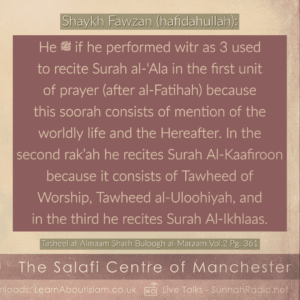
Benefit in Reciting the Specific Suwar in Witr – Shaykh Saalih al-Fawzan

He ﷺ if he performed witr as 3 used to recite Surah al-‘Ala in the first unit of prayer (after al-Fatihah) because this soorah consists of mention of the worldly life and the Hereafter. In the second rak’ah he recites Surah Al-Kaafiroon because it consists of Tawheed of Worship, Tawheed al-Uloohiyah, and in the third he recites Surah Al-Ikhlaas.


Shaykh Fawzan’s Tasheel al-Almaam Sharh Buloogh al-Maraam Vol.2 Pg. 361

Maximise Benefit from your Recitation of the Qur’aan – Shaykh Rabee

Have concern for recitation of the Qur’aan in this noble month, together with pondering and reflecting upon it, taking admonition from its admonitions, heeding what it reprimands, understanding what is lawful and unlawful, understanding the promises and threats and that which is similar in the Noble Quran. And by way of this, the souls are purified and the hearts are illuminated.


From Al-Majmoo of Shaykh Rabee ibn Haadi Al-Madkhalee (Hafidahullah). Vol.15 pg.338

Prepare Yourselves for Ramadhan – Shaykh Abu Abdillah Khalid Adh-Dhufayree

Oh servants of Allah, indeed the hearts of the believers are extremely happy with the coming of Ramadhan. We ask Allah to allow us to reach it, and that he blesses for us fasting and standing in prayer within it, in the manner which Allah – The Mighty and Majestic – is pleased with. And it is fitting for us that we rejoice at its approach, for indeed Allah has prepared in it much good and virtue which is not present in other than this month…


The Perfect Example, The Most Devout And Generous Person at All Times- During Ramadhaan and Other Than It

In The Name of Allaah, The Most Merciful, The Bestower of Mercy.

Narrated Ibn Abbaas [radiyallaahu-anhumaa], “The Prophet [sallal-laahu-alayhi-wasallam] was the most generous amongst the people, and he used to be more so in the month of Ramadaan when Jibreel visited him, and Jibreel used to meet him on every night of Ramadaan till the end of the month. The Prophet [sallal-laahu-alayhi-wasallam] used to recite the Noble Qur’aan to Jibreel, and when Jibreel met him, he used to be more generous than the fair wind [sent by Allaah with glad tidings (rain) in readiness and haste to do charitable deeds]”. [Saheeh al-Bukhaari 1902]

Few Reminders From This Hadeeth

Zain Ibnul Muneer [rahimahullaah] said, “The intent behind the likeness [or comparison] between the Prophet’s [sallal laahu alayhi wasallam] generosity and the fair wind, is that the wind is one of mercy which Allaah [The Exalted] sends and sends down rain that falls everywhere- both on a dead land [i.e. falls on a dry land and revives it] as well as the land that is not dead; [likewise] the Prophet’s [sallal laahu alayhi wasallam] good conduct and benevolence benefits everyone – the poor, the wealthy and the one who has enough – more than the rain that falls [after the arrival of that] fair wind”. [An Excerpt from Fat-hul Baari Sharh Saheeh Al-Bukhaari. Vol 4. Page 150. Hadeeth 1902. Publisher- Daarus Salaam 1421 (Year 2000). 1st Edition). Slightly paraphrased]

Imaam Abdul Azeez Bin Baaz [rahimahullaah] said:

He [sallal-laahu-alayhi-wasallam] was the most generous amongst the people with regards to wealth and giving to the people, and not that he was (only) generous after being asked.  And in the final year [of his life], Jibreel met him twice and he finished the recitation of the [Qur’aan] twice. And from the benefits of [this hadeeth] is that it is more virtuous to study and recite the Qur’aan at night- studying it with the righteous people, the scholars and the good people. The Prophet [sallal-laahu-alayhi-wasallam] recited [the Qur’aan to Jibreel] to receive Allaah reward. [An Excerpt from Al-Hulalul Ibreeziyyah Min Ta’liqaat Al-Baaziyyah Alaa Saheeh Al-Bukhaariy. 2/121. Footnotes numbers: 1, 2 &3]


Holding the Mushaf in The Prayer – Shaykh Abdul Aziz Bin Baaz

What is the legislative ruling on a person who reads from the noble mushaf for taraweeh prayer in Ramadhan, or the night prayer outside of Ramadhan or the eclipse prayer, whilst a person is standing for the prayer and he has the mushaf with him and he reads the long chapters, which he was not able to memorise?

And when he prostrates he places the mushaf on the ground or a table which is close to him and when he stands he takes the mushaf with his hand and recites, and he does this until he has finished his prayer?

Is this also allows in the obligatory prayers?

Benefit us, May Allah benefit you.

Arhaamukum! Arhaamukum ! [Your Relatives of The Womb! Your Relatives of The Womb!] – One of The Final Advice [or Commands] of The Messenger

In The Name of Allaah, The Most Merciful, The Bestower of Mercy.

Ana’s Bin Maalik [radiyallaahu anhu] reported that the Prophet [sallal laahu alayhi wasallam] said – during his illness [i.e. the illness through which he passed away], “Your Arhaam! Your Arhaam!”. [i.e. relatives of the womb]

Shaikh Zayd Bin Haadi [rahimahullaah] said:

This hadeeth contains a precious advice [or command] from the noble Prophet [sallal laahu alayhi wasallam] whose Lord described him in His statement: [لَقَدۡ جَآءَڪُمۡ رَسُولٌ۬ مِّنۡ أَنفُسِڪُمۡ عَزِيزٌ عَلَيۡهِ مَا عَنِتُّمۡ حَرِيصٌ عَلَيۡڪُم بِٱلۡمُؤۡمِنِينَ رَءُوفٌ۬ رَّحِيمٌ۬ – Verily, there has come unto you a Messenger (Muhammad) from amongst yourselves (i.e. whom you know well). It grieves him that you should receive any injury or difficulty. He (Muhammad) is anxious over you (to be rightly guided, to repent to Allah, and beg Him to pardon and forgive your sins, in order that you may enter Paradise and be saved from the punishment of the Hell-fire), for the believers (he is) full of pity, kind, and merciful]. [Surah At-tawbah. Aayah 128]

It is an advice [or a command] about maintaining the ties of kinship, and indeed the command regarding it has been stated in the noble Qur’aan and in the [authentic] Prophetic Sunnah. As for in the Qur’aan, then indeed Allaah [The Blessed and Exalted] said:

يَـٰٓأَيُّہَا ٱلنَّاسُ ٱتَّقُواْ رَبَّكُمُ ٱلَّذِى خَلَقَكُم مِّن نَّفۡسٍ۬ وَٲحِدَةٍ۬ وَخَلَقَ مِنۡہَا زَوۡجَهَا وَبَثَّ مِنۡہُمَا رِجَالاً۬ كَثِيرً۬ا وَنِسَآءً۬‌ۚ وَٱتَّقُواْ ٱللَّهَ ٱلَّذِى تَسَآءَلُونَ بِهِۦ وَٱلۡأَرۡحَامَ‌ۚ إِنَّ ٱللَّهَ كَانَ عَلَيۡكُمۡ رَقِيبً۬ا

O mankind! Be dutiful to your Lord, Who created you from a single person (Adam), and from him (Adam) He created his wife [Hawwa (Eve)], and from them both He created many men and women and fear Allah through Whom you demand your mutual (rights), and (do not cut the relations of) the wombs (kinship) . Surely, Allah is Ever an All-Watcher over you. [Surah An-Nisaa. Aayah 1]

The Prophet [sallal laahu alayhi wasallam] advised [or commanded one] to maintain the ties of kinship and promised reward – in this life and the next – for it. These are upright exhortations [or commands].

The intent behind the word Ar-Rahim – [relation of the womb] – are one’s relatives on the father’s and mother’s side, and they are of different levels [or categories]. Maintaining ties with them aids a person in his worldly affairs to fulfil his needs and makes his affairs easy by the permission of Allaah. And with regards to [deeds related to the] afterlife, it is one of the best deeds through which a servant seeks to get close to Allaah [i.e. to receive the love of Allaah and reward, and repel punishment].

An Excerpt from At-taleeqaat al-maleehah Alaa silsilah al-ahaadeeth As-Saheehah vol 1. Page 62. Slightly paraphrased.