
[3] Ideologues hiding behind journalism

In The Name of Allah, The Most Merciful, The Bestower of Mercy.

Allaah [The Most High] said:

يُرِيدُونَ أَنْ يُطْفِئُوا نُورَ اللَّهِ بِأَفْوَاهِهِمْ

They want to extinguish Allah’s Light with their mouths [i.e. the Qur’an, the pure Islamic monotheism, and the guidance Allah sent Muhammad with] but Allah will not allow it except that His Light should be perfected even though the disbelievers hate (it). [Soorah At-Tawbah: Ayah: 32]

Imaam Ibn Katheer [may Allah have mercy upon him] said: They wish to destroy the guidance and religion of truth that Allah gave His Messenger through their arguments and fabrications, so their example in this is that of someone who attempts to put out the light of the sun or the moon by blowing at them, but this (person) can never succeed in doing so. (1)

Jason Burke wrote:
Let’s start by stating that nobody has the authority to change the names and descriptions that Allah has given to the various individuals and groups among human beings and the Jinn. Al-Allaamah Saalih Al-Fawzaan [may Allah preserve him] said: Indeed, Allaah created the Jinn and humanity and endowed them with the intrinsic ability to identify Tawheed, submit to Him, and worship Him alone. However, some of them believed, while others did not.

Allah said:

هُوَ ٱلَّذِى خَلَقَكُمۡ فَمِنكُمۡ ڪَافِرٌ۬ وَمِنكُم مُّؤۡمِنٌ۬‌ۚ

He it is Who created you, then some of you are disbelievers and some of you are believers.

While Shaytaan and the proponents of evil wish them disbelief and evil, Allah wishes them Imaan and well-being. Allah [The Exalted] said:

يُرِيدُ ٱللَّهُ لِيُبَيِّنَ لَكُمۡ وَيَہۡدِيَڪُمۡ سُنَنَ ٱلَّذِينَ مِن قَبۡلِڪُمۡ وَيَتُوبَ عَلَيۡكُمۡ‌ۗ وَٱللَّهُ عَلِيمٌ حَكِيمٌ۬
وَٱللَّهُ يُرِيدُ أَن يَتُوبَ عَلَيۡڪُمۡ وَيُرِيدُ ٱلَّذِينَ يَتَّبِعُونَ ٱلشَّہَوَٲتِ أَن تَمِيلُواْ مَيۡلاً عَظِيمً۬ا

Allaah wishes to make clear (what is lawful and what is unlawful) to you and to show you the ways of those before you, and accept your repentance, and Allaah is All-Knower, All-Wise. Allaah wishes to accept your repentance, but those who follow their lusts, wish that you (believers) should deviate tremendously away from the Right Path.

And because of this, Allah sent the Messengers, revealed the Scriptures, and established His Proofs; as a result, there are people who choose to accept the truth and embrace faith, as well as others who choose to reject the truth and embrace unbelief. Indeed, Allah has established the distinctions between believers and unbelievers in this life and the hereafter, and He forbade that the two groups be made equal. And in this life and the hereafter, Allah has outlined recompense and judgment for each of the two groups. He has given each group a distinctive name, such as Mumin for the believer, Kaafir for the disbeliever, Barrun for the upright (righteous one), Faajir for the evildoer, Mushrik for the polytheist, Muwahhid for the monotheist, Faasiq for a sinner, Munaafiq for the hypocrite, Mutee’un the obedient one and Aasee for the disobedient one. He also prohibited equating these disparate identities and attitudes. Allah said:

أَمۡ حَسِبَ ٱلَّذِينَ ٱجۡتَرَحُواْ ٱلسَّيِّـَٔاتِ أَن نَّجۡعَلَهُمۡ كَٱلَّذِينَ ءَامَنُواْ وَعَمِلُواْ ٱلصَّـٰلِحَـٰتِ

Or do those who earn evil deeds think that We shall hold them equal with those who believe (in the Oneness of Allah Islamic Monotheism) and do righteous good deeds?!

Allah said:

أَمۡ نَجۡعَلُ ٱلَّذِينَ ءَامَنُواْ وَعَمِلُواْ ٱلصَّـٰلِحَـٰتِ كَٱلۡمُفۡسِدِينَ فِى ٱلۡأَرۡضِ أَمۡ نَجۡعَلُ ٱلۡمُتَّقِينَ كَٱلۡفُجَّارِ

Shall We treat those who believe (in the Oneness of Allaah Islamic Monotheism) and do righteous good deeds, as Mufsidoon (those who associate partners in worship with Allah and commit crimes) on earth?! Or shall We treat the Muttaqoon (the pious ones), as the Fujjaar (criminals, disbelievers, wicked, etc)?!

That is to say, we have not made them equal since doing so would not comport with Allah’s justice.

Should we renounce the terms Kufr (disbelief), Shirk (ascribing partners to Allah), Kuffaar (unbelievers), and Mushrikeen (polytheists) found in the Qur’an, the Sunnah, and the Books of the Islamic creed? This will be against Allah and His Messenger and a violation of the Book and Sunnah. We will be associated with those who distort the Book of their Lord and the Sunnah of their Messenger if we alter the true meanings of the Shari’ah terms. What defence is then available for (such a crime)? Is it to please the unbelievers? As long as we maintain our religion, the non-believers will never be happy with us. Allah said:

وَدُّواْ لَوۡ تَكۡفُرُونَ كَمَا كَفَرُواْ فَتَكُونُونَ سَوَآءً۬‌ۖ

They wish that you reject Faith, as they have rejected (Faith), and thus that you all become equal (like one another). (2)

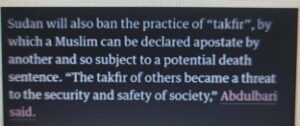
Regarding Jason’s claim that “Sudan will also ban the practice of takfir by which a Muslim can be declared apostate by another and so subject to a potential death sentence,” the statement definitely needs clarification and detail because while it is true that a Muslim can declare another Muslim to be apostate and subject to the prescribed punishment, the question is who among the Muslims has the authority to do so! Indeed, Ahlus Sunnah are fully aware that Takfeer can only be made by the upright scholars of the Islamic world—those who fear Allah and refrain from speaking unless they are well-informed. Find out who can make Takfeer and its guiding principles here:

http://www.salafipublications.com/sps/downloads/pdf/MNJ090006.pdf

Read further here: On Those Who Ought To Declare Takfir and Establish the Hadd Punishment, according to Shaykh Salih al-Fawzaan:

http://www.spubs.com/sps/sp.cfm?subsecID=MNJ09&articleID=MNJ090004&articlePages=1

Islam’s Unapologetic Position On Apostasy – [Unveiling Another Path of The Criminals and Opponents of The Messengers]: https://salafidawahmanchester.com/2022/06/11/islams-unapologetic-position-on-apostasy-unveiling-another-path-of-the-criminals-and-opponents-of-the-messengers/

Regarding the quote from Jason that reads, “The Takfir of others became a threat to the security and safety of society,” it is clear that the act of false (or unjustified) Takfir against a Muslim is a dangerous matter. All Muslim rulers must take action to shut this terrible door in order to stop the contemporary Khaarijites from using Sayyid Qutb’s, Usama Bin Ladin’s, and Ayman Az-Zawahiri’s evil ideology to overthrow Muslim governments and incite violence.

Shaikh Falaah Ismaa’eel [may Allah have mercy upon him] stated: In order to comprehend their danger, it merits noting what Allah’s Messenger [peace and blessings of Allaah be upon him] wished if he were to encounter them and what he would do to them, despite the fact that they hail from the Ummah and from the people of the Qiblah, that he would slaughter them in a manner comparable to that of Aad and Thamood; especially when one considers what Allah’s Messenger said concerning dogs, “Had dogs not been a community amongst the communities, I would have commanded that all of them be killed”. (see footnote I) Therefore, a sensible person examines and considers what the Messenger of guidance and mercy wanted to do to these Khawaarij, notwithstanding their commitment to worship, prayer, fasting, and Qur’anic recitation, in comparison to what he prevented himself and others from doing to dogs. Indeed, this is strong evidence of the peril posed by the persistence of this idea [i.e., Fasle Takfeer] and this kind of people in the Ummah [i.e., the Khawaarij], since they weaken the Ummah and keep it preoccupied with [internal issues, strife, etc.] (3)

Footnote I: “Had dogs not been a community amongst the communities, I would have commanded that all of them be killed”.

Al-Khattaabee [may Allah have mercy upon him] said, “This statement means that the Prophet [peace and blessings of Allah be upon him] hated that a community among the communities and a species among the creation would vanish until they all ceased to exist because, in reality, none of Allah’s creatures exist without some kind of purpose or benefit guiding their existence. Since there is no way to eliminate all of them in this situation, kill the evil ones among them – the black dog – leave the others so that you might use them as guard dogs”. [An Excerpt from Ma’aalim As-Sunan 4/132] [NB: Only the authorities in the Uk are allowed to take the life of an animal and any individual who does so will be found guilty of animal cruelty]

Dogs we can keep: Abdullah Ibn Umar [may Allaah be pleased with him and his father] said, “Allah’s Messenger [peace and blessings of Allaah be upon him] said, ‘Whoever keeps a dog, except a dog for herding livestock or a dog that is trained for hunting, two qiraats [i.e. great reward] will be deducted from his reward each day’”. [Bukhaari 5163 and Muslim 1574]

Imaam Muhammad Ibn Saaleh Al-Uthaymeen [may Allaah have mercy upon him] said, “As a result, there is no need to have a dog to guard a house if it is in the heart of a metropolis. Therefore, having a dog for this reason in such circumstances is forbidden and unlawful, and it reduces a person’s reward by one or two qiraats each day. However, it is acceptable to have a dog to protect the home and those living there if the house is in a rural area and nobody is home. It is more crucial to protect a household’s residents than its animals or agricultural produce”. [An Excerpt from Majmoo Fataawa Ibn Uthaymeen 4/246]

The Hunting Dog

Allah [The Most High] said:

يَسۡـَٔلُونَكَ مَاذَآ أُحِلَّ لَهُمۡ‌ۖ قُلۡ أُحِلَّ لَكُمُ ٱلطَّيِّبَـٰتُ‌ۙ وَمَا عَلَّمۡتُم مِّنَ ٱلۡجَوَارِحِ مُكَلِّبِينَ تُعَلِّمُونَہُنَّ مِمَّا عَلَّمَكُمُ ٱللَّهُ‌ۖ فَكُلُواْ مِمَّآ أَمۡسَكۡنَ عَلَيۡكُمۡ وَٱذۡكُرُواْ ٱسۡمَ ٱللَّهِ عَلَيۡهِ‌ۖ وَٱتَّقُواْ ٱللَّهَ‌ۚ إِنَّ ٱللَّهَ سَرِيعُ ٱلۡحِسَابِ

They ask you [O Muhammad)] what is lawful for them [as food]. Say: “Lawful unto you are At-Tayyibat [all kind of Halal (lawful-good) foods which Allah has made lawful (meat of slaughtered eatable animals, milk products, fats, vegetables, and fruits, etc.)]. And those beasts and birds of prey which you have trained as hounds, training and teaching them [to catch] in the manner as directed to you by Allaah; so eat of what they catch for you, but pronounce the Name of Allah over it, and fear Allah. Verily, Allah is Swift in reckoning”. [Surah Al-Maa’idah. Aayah 4]

Imaam Ibnul Qayyim [may Allaah have mercy upon him] said: Indeed, Allah declared the prey of the untrained hound to be dead meat and forbidden to consume, whereas He declared the prey of the trained hound to be permissible. This is evidence of the nobility of knowledge as Allah did not declare any prey other than that of the trained hound to be lawful. The trained and untrained hound would have been the same if it weren’t for the fact that knowledge and teaching have a unique distinguished virtue and nobility. [An Excerpt Mihtaah Daarus Sa’aadah. 1/55]

https://abukhadeejah.com/dog-as-pets-guard-dogs-sheepdogs-hunting-hounds/


Ref 1: Al-Misbaah Al-Muneer Fee Tahdeeb Tafseer Ibn Katheer

Ref 2: An Excerpt from Al-Bayaan Li-Akhtaa’i Ba’dil Kuttaab. 2/177-180

[Ref 3: An Excerpt from Naz’atut Takfeer. Pages 24-25. slightly paraphrsed]

An Example of Those Who Exceeded The Limits and Those Who Fell Short In The Subject Matter of Purification

In The Name of Allaah, The Most Merciful, The Bestower of Mercy.

Shaikhul Islaam Ibn Taymiyyah [may Allaah have mercy upon him] said:

Allaah [The Exalted] said:

Allaah [The Exalted] said: [ وَكَذَٲلِكَ جَعَلۡنَـٰكُمۡ أُمَّةً۬ وَسَطً۬ا لِّتَڪُونُواْ شُہَدَآءَ عَلَى ٱلنَّاسِ وَيَكُونَ ٱلرَّسُولُ عَلَيۡكُمۡ شَهِيدً۬ا‌ۗ – Thus We have made you [true Muslims real believers of Islamic Monotheism, true followers of – Prophet Muhammad and his Sunnah (legal ways)], a Wasat [just and the best] nation, that you be witnesses over mankind and the Messenger (Muhammad) be a witness over you]. [Surah Al-Baqarah. Verse 143]

Allaah [The Exalted] also said:

وَرَحۡمَتِى وَسِعَتۡ كُلَّ شَىۡءٍ۬‌ۚ فَسَأَكۡتُبُہَا لِلَّذِينَ يَتَّقُونَ وَيُؤۡتُونَ ٱلزَّڪَوٰةَ وَٱلَّذِينَ هُم بِـَٔايَـٰتِنَا يُؤۡمِنُونَ
ٱلَّذِينَ يَتَّبِعُونَ ٱلرَّسُولَ ٱلنَّبِىَّ ٱلۡأُمِّىَّ ٱلَّذِى يَجِدُونَهُ ۥ مَكۡتُوبًا عِندَهُمۡ فِى ٱلتَّوۡرَٮٰةِ وَٱلۡإِنجِيلِ يَأۡمُرُهُم بِٱلۡمَعۡرُوفِ وَيَنۡہَٮٰهُمۡ عَنِ ٱلۡمُنڪَرِ وَيُحِلُّ لَهُمُ ٱلطَّيِّبَـٰتِ وَيُحَرِّمُ عَلَيۡهِمُ ٱلۡخَبَـٰٓٮِٕثَ وَيَضَعُ عَنۡهُمۡ إِصۡرَهُمۡ وَٱلۡأَغۡلَـٰلَ ٱلَّتِى كَانَتۡ عَلَيۡهِمۡ‌ۚ فَٱلَّذِينَ ءَامَنُواْ بِهِۦ وَعَزَّرُوهُ وَنَصَرُوهُ وَٱتَّبَعُواْ ٱلنُّورَ ٱلَّذِىٓ أُنزِلَ مَعَهُ ۥۤ‌ۙ أُوْلَـٰٓٮِٕكَ هُمُ ٱلۡمُفۡلِحُونَ

My Mercy embraces all things. That (Mercy) I shall ordain for those who are the pious, and give Zakat; and those who believe in Our Ayat (proofs, evidences, verses, lessons, signs and revelations, etc.); those who follow the Messenger, the Prophet who can neither read nor write (i.e.Muhammad) whom they find written with them in the Taurat (Torah) (Deut, xviii, 15) and the Injeel (Gospel) (John xiv, 16) , he – commands them for Al-Ma’ruf (i.e. Islamic Monotheism and all that Islam has ordained); and forbids them from Al-Munkar (i.e. disbelief, polytheism of all kinds, and all that Islam has forbidden); he allows them as lawful At-Taiyibat [(i.e. all good and lawful) as regards things, deeds, beliefs, persons, foods, etc.], and prohibits them as unlawful Al-Khaba’ith (i.e. all evil and unlawful as regards things, deeds, beliefs, persons, foods, etc.), he releases them from their heavy burdens (of Allah’s Covenant), and from the fetters (bindings) that were upon them. So those who believe in him (Muhammad), honour him, help him, and follow the light (the Qur’an) which has been sent down with him, it is they who will be successful. [Surah Al-A’raaf. Verses 156-157]

This is why those amongst the Muslims who deviate towards the doubts of the Jews and Christians are commanded to abandon such deviation and follow the straight path – the path which Allaah bestowed on the Prophets, the truthful ones, the martyrs and righteous, and not the path of those who have earned Allaah’s Anger, such as those Jews who disbelieved in the Messiah after having knowledge, and those who went astray such as those Christians who deviated from the path of the Messiah, exaggerated his status by worshipping him and worshipped Allaah based on ignorance And similar to them is the one who [ascribed to Islaam], but goes beyond bounds in avoiding impure things and thus declares impure that which has not been declared impure by Allaah and His Messenger; makes unlawful that which Allaah and His Messenger have not made unlawful, captured by the whispers of shaytaan and forbids the good things which Allaah made lawful for the Muslims, such as the one who holds the opinion that if impurity is removed and there is nothing remaining of it, then the place it was found is still impure if the impurity was not removed by that which has been prescribed as a condition for its removal such as water or other than it; or he holds that good water and other good liquids that have not been affected by something filthy is unlawful merely due to the reason that they have come into contact with some filth. [Footnote a – refer to detail about the ruling on water at the end of this article]

And even worst is the affair of those who excommunicate Muslims who oppose them, as is the view of many of ahlul bidah amongst the Raafidha (Shiites), the Khawaarij and other than them, so if others eat from their utensils, they declare it impure. [Footnote b- refer to detail at the end of this article regarding falsehood of the khawaarij and Raafidha, as well as a hadith regarding utensils]

As for that which many people do (without any sound proof from the texts of the Sharee’ah), such as one who commands a menstruating woman that she must change or wash the first clothing she wore whilst she was on her menses, or forbids a person who is in a state of Janaabah from eating or drinking until he takes a shower (or bath), these opinions are often that of those who resemble those Jews who went astray; rather they resemble the Samaritans.

As for those who resemble the Christians [i.e. those Christians who strayed after abandoning the path of the Messiah and disbelieved in Muhammad], it is for example the affair of the one who has a good suspicion regarding that which is impure, such as those who are in toilets- places of the devils and impurity – and defiled with urine. He neither performs wudhu nor does he take a bath, nor shower after being in a state of Janaabah, neither perform the Salaah nor prays in a state of ablution, whilst knowing that it is known by necessity in the religion that the five daily prayers are obligated on every person and that one has to make Wudhu if he is a state of Hadath and should take a bath when in a state of Janaabah, and cannot perform Tayammum when he is able to make wudhu. (1)

—————————————————————————————

Footnote A: The Ruling On Water:

https://abukhadeejah.com/water-cannot-be-made-impure-by-anything-except-by-something-which-changes-its-smell-taste-and-colour/

https://abukhadeejah.com/water-is-pure-and-nothing-can-make-it-impure-purification-and-the-types-of-water/

Footnote B: Misguidance of The Raafidha and Khawaawij:
http://www.shia.bs/authors/Abu.Iyaad.cfm
https://www.abukhadeejah.com/isis-in-iraq-syria-ibn-kathir-died-774-ah-if-the-khawaarij-ever-gained-strength-in-iraq-and-syria-there-would-be-mass-killing/

The Utensils of non-Muslims: Narrated Abū Thaʿlaba al-Khushni (raḍi Allāhu ʿanhu): I said “O Allāh’s Messenger! We are living in a land inhabited by the People of the Scriptures; can we take our meals in their utensils?” He said, “If you can get utensils other than theirs, do not eat in theirs, but if you cannot get other than theirs, wash them and eat in them” [Agreed upon]


[Ref 1: An Excerpt From Al-Jawaabus Saheeh Liman Baddala Deen Al-Maseeh. 1/204-207]

Peaceful protest is the way forward!

In The Name of Allaah, The Most Merciful, The Bestower of Mercy.

You hear some Muslim afflicted with a corrupt methodology saying, “Muslim authorities are heavy handed when citizens come out in the street to protest unlike what we witness in the West.”

Firstly, the globalists and spiteful secularists call you to their way to destroy stability in your country and corrupt the relationship between you and your society. Do not read the statement of Allaah (The Most High) said:

[وَقَالَ الَّذِينَ كَفَرُوا لِلَّذِينَ آمَنُوا اتَّبِعُوا سَبِيلَنَا وَلْنَحْمِلْ خَطَايَاكُمْ وَمَا هُم بِحَامِلِينَ مِنْ خَطَايَاهُم مِّن شَيْءٍ ۖ إِنَّهُمْ لَكَاذِبُونَ – And those who disbelieve say to those who believe: “Follow our way and we will verily bear your sins,” never will they bear anything of their sins. Surely, they are liars]. [29:12]

Imaam Ibn Katheer [may Allaah have mercy upon him] said: Allaah [The Exalted] related about the disbelievers of Quraish that they said to those amongst them who believed (in the message of Muhammad) and followed the guidance, “Abandon your religion, return to our religion and follow our way. We will verily bear your sins if you have any”, just as a person says, “Do this and your sin is upon my neck”. So, Allaah declared their statement false, saying that never will they bear anything of their (i.e., the believers) sins. Surely, they are liars. That is because no one will bear anything of the sins of others. (1)

Secondly, protests are not allowed in the infallible methodology of the Prophet. Al-Allaamah Rabee Bin Haadi Al-Mad’khali [may Allaah preserve him] was asked, “Going out to demonstrations, revolutions and nurturing the youth upon it; is this from the methodology of Ahlus Sunnah Wal Jamaa’ah or not, whether in or outside the Muslim countries?

Response: This is the methodology of Marx (i.e., Carl Marx), Lenin (i.e., Vladimir Lenin) and those similar to them. It is not from the Islamic methodology. Revolutions, bloodshed, trials and troubles are Marx’s and Lenin’s school of thought. (2)

Al-Allaamah Zayd Bin Haadi Al-Madkhali [may Allaah have mercy upon him] stated: Protests are newly invented matters in the religion. Every newly invented matter in the religion is a bidah, every bidah is misguidance and every misguidance is in the hell fire [i.e., is a path leading to the hell fire]. Allaah’s legislation is perfect and complete-based on The Book and The Sunnah-and we do not know of anything by way of the evidences in the Book and the Sunnah that makes it permissible for a handful of people to gather for demonstrations, which causes disturbance for the people and time wasting. And greater than this [disturbance and time wasting] is abandonment of the prayers [during protests] and the loss of life [i.e., murder]. If one was to kill a Muslim in a single protest, the one [or those] who called to such protests will carry his sins-be it an individual, a group or those who participate. It has been reported in an authentic hadeeth: The termination of the world means less to Allah than the killing of a Muslim [i.e., without right].These protests are nothing but bidah and acts of misguidance advocated by shaytaan; [enticed] by the urge of the evil soul and desires. And these enemies [i.e., shaytaan, the urge of the evil soul and desires] do not come together in any affair except that the religion and worldly affairs are destroyed, just as it is the case in these demonstrations [or protests].

The end results of protests [or demonstrations]: Carnage, destruction, wastage of wealth and time and terrorising those living in peace. And how many disadvantages are there in [that]! It is enough to be considered something sinister due to the fact that the Noble Messengers and the Great Prophets who were put to trial and harmed by their people did not hold protests [or demonstrations]. Neither did they engage in plotting to cause explosions nor committing suicide; rather Islaam has forbidden all of that.

Those who call to protests [or demonstrations] and hold that there is success in it, they are mistaken and they have missed the correct path. Rectification of the affairs can only be by way of the Book and The Sunnah in accordance with the understanding of those scholars who are firmly grounded in knowledge. So, whoever calls the people to this chaos, then indeed he has brought about a means to corrupting the land and the slaves, and what has occurred – in the past and at present- is a witness to that.

Therefore, we warn the students of knowledge that they are not persuaded by the speech of those who allow protests [or demonstrations]. They say that peaceful demonstrations are permissible-as they categorise it into this categorisation- without proofs and concrete evidence from the Book and the Sunnah- neither from the actions of the Messenger and the Noble Sahaabah nor from the Notable Imaams; rather the verdict on protests [or demonstrations] is only what has been stated earlier and as well as what has been written by other than myself [i.e., protests (or demonstrations) are not permissible] (3)

However, neither would a rightly guided Muslim would condone the action of anyone in authority who punishes people without proof from the Sharee’ah; read here on this link: https://salafidawahmanchester.com/2022/02/18/threat-of-punishment-from-lord-of-the-universe-against-brutal-police-and-their-ilk-those-who-beat-people-without-a-justified-reason/ nor condone rebellion against Muslim rulers, read here: https://abukhadeejah.com/the-tyranny-of-the-rulers-a-reason-for-rebellion/

Finally, when the rabble in Muslim countries damage property whilst claiming peaceful protest, the spiteful journalists in the Western media attack Muslim authorities, but read here regarding stance of non-Muslim authorities in the UK towards planned protests against King Charles’s Coronation “Blocking roads, airports and railways could bring prison sentences of 12 months, while people locking on to others, objects or buildings could go to prison for six months and face an unlimited fine. Police have also been empowered to stop and search people if they suspect they are setting out to cause disruption by protesting”.

The Ruling Concerning Street Demonstrations In Non-Muslim Countries (Shaikh Abdullah Al-Bukhari) – By Shaikh Abu Khadeejah [hafidhahullaah]

https://www.abukhadeejah.com/street-demonstrations-in-non-muslim-countries-india/

The Ruling Concerning Street Demonstrations In Non-Muslim Countries (Shaikh Abdullah Al-Bukhari)

Protests, Demonstrations and Civil Disobedience in the Light of Islam (Ethics 3.8) – By Shaikh Abu Khadeejah [hafidhahullaah]

https://www.abukhadeejah.com/protests-demonstrations-and-civil-disobedience-in-the-light-of-islam-ethics-3-8/

Are Street Protests and Demonstrations Legitimate Means of Response to Oppression? ―Answer to Question 5 in the Methodology of the Sunnah – By Shaikh Abu Khadeejah [hafidhahullaah]

https://www.abukhadeejah.com/muslims-are-oppressed-around-the-world-but-salafis-refuse-to-protest-in-the-streets-and-boycott/


[1] Tafseer Ibn katheer

[2] An excerpt from كشف الستار  Page: 18]

[3]Source: الأفنان وتوحيد ابن خزيمة وحديث عن المظاهرات4-4-1432هـ.]

Pay close attention to this, especially when those attributed to teaching and dawah increase!

In The Name of Allaah, The Most Merciful, The Bestower of Mercy.

Al-Allaamah Saaleh Al-Fawzaan [may Allaah preserve him] said:

Allaah [The Most High] stated: [قُلۡ هَـٰذِهِۦ سَبِيلِىٓ أَدۡعُوٓاْ إِلَى ٱللَّهِ‌ۚ عَلَىٰ بَصِيرَةٍ أَنَا۟ وَمَنِ ٱتَّبَعَنِى‌ۖ وَسُبۡحَـٰنَ ٱللَّهِ وَمَآ أَنَا۟ مِنَ ٱلۡمُشۡرِكِينَ – Say (O Muhammad): “This is my way; I invite unto Allah (i.e. to the Oneness of Allah – Islamic Monotheism) with sure knowledge, I and whosoever follows me (also must invite others to Allah i.e. to the Oneness of Allah – Islamic Monotheism) with sure knowledge. And Glorified and Exalted be Allah (above all that they associate as partners with Him). And I am not of the Mushrikun (polytheists, pagans, idolaters and disbelievers in the Oneness of Allah; those who worship others along with Allah or set up rivals or partners to Allah).”

[أَدۡعُوٓاْ إِلَى ٱللَّهِ‌ۚ – I invite unto Allah (i.e. to the Oneness of Allah – Islamic Monotheism)]. This part of the Ayah contains a notification regarding sincerity, because indeed some people call to themselves. It may be that a person propagates, delivers lectures and sermons, but his aim is to become apparent to the people – to receive some status, praised by the people and that people gather around him and become numerous around him. If this is his aim, then he is not one who calls to Allaah; rather he is a caller to himself. The person who abandons Dawah has indeed abandoned a great obligation and the person who is not sincere in Dawah has indeed fallen into a great danger, because Dawah has to be carried out sincerely for the Sake of Allaah and the aim should be to establish the Sharee’ah of Allaah- to guide and benefit the people, whether you are praised or rebuked. As for some people, when they are not praised and promoted, they abandon Dawah. This is a proof that such a caller is not a caller to Allaah, rather he only calls to himself. Therefore, the Muslim should be warned and that his aim in dawah should be sincerity, to benefit the people, free them from Shirk and bidah, free them from those affairs that are in opposition to the sharee’ah and fulfil what is obligated on him.

A great number of people around a person is a not proof that such a person is virtuous, because some of the Prophets were only followed by few people. “A Prophet will come on the day of judgement with a few followers and a Prophet will come with no followers”. [Bukhaari 5705]. So, does this mean that such a Prophet is not virtuous? No, definitely not! A person does not look at the large number of people who are present, because the Prophet [peace and blessings of Allaah be upon him] said to Ali, “If Allaah gives guidance to a single man through you, it is better for you than possessing red camels”. [Bukhaari 3009] (1)

The Shaikh [may Allaah preserve him] also stated, “Ahlus Sunnah Wal Jamaa’ah are not harmed by those who oppose them. If you are with them- all praise is due to Allaah, they are pleased with this because indeed they want good for the people. If you oppose them, you cannot harm them and due to this the Messenger [peace and blessings of Allaah be upon him]said, “There will not cease to be a group of my Ummah who will be manifest upon the truth- not harmed by those who forsake them until the command of Allaah comes to pass (i.e. the day of judgement) whilst they are (still) upon that (truth)”. The one in opposition does not harm except himself. What is given consideration is not the great numbers; rather what is given consideration is to be in agreement with the truth, even if a small number of people were upon it. And even if in some eras there is only one person (upon truth), then he is the one upon truth and he is the Jamaa’ah. The Jamaa’ah does not necessitate great numbers; rather the Jamaa’ah is what is in agreement with the truth – in agreement with the Book and the Sunnah, even if those upon it are few. However, if many come together and (upon) truth, then – all praise is due to Allaah- this is strength. But if the majority oppose it (i.e. the truth), then we side with the truth even if only a few are upon it”. (2)

The Goal Behind Co-operation

Allaah [The Most High] said: [ وَتَعَاوَنُوا عَلَى الْبِرِّ وَالتَّقْوَىٰ ۖ وَلَا تَعَاوَنُوا عَلَى الْإِثْمِ وَالْعُدْوَانِ – Help you one another in Al-Birr and At-Taqwa [virtue, righteousness and piety]; but do not help one another in sin and transgression. [5:2]

Imaam Ibnul Qayyim [may Allaah have mercy upon him] said: This verse contains all the Masaalih (things that will bring about benefit and repel harm) for the salves in their worldly affairs and in the Herefater- amongst themselves or in relation to their relationship with their Lord. That is because every servant finds himself within two circumstances and obligations – either to fulfil the obligations owed to Allaah or the obligations owed to Allaah’s creation. As for the obligations owed to the creation, they include (righteous) association, companionship, aiding one another upon what Allaah loves and obedience to Allaah, and that is the goal behind one’s search for happiness and success in the afterlife. There can be no happiness in the afterlife except through Bir and Taqwaa, because it is basis of all affairs of the religion. A deed cannot be considered an act of obedience to Allaah and an act that gets one close to Allaah until it is based on Eemaan, so that which leads to the performance of that deed is solely due to Eemaan – neither (un-Islamic) customs nor desires, neither seeking praise nor status and other than it; rather it should be solely based on Eemaan and the aim behind it should be to attain Allaah’s reward and seeking after Allaah’s Pleasure. (3)


[Ref 1: An Excerpt from ‘I’aanah Al-Mustafeed Bi-Sharhi Kitaab At-Tawheed’ pages 97-98’ Publisher: Ar-Risaalah Publishers 1st edition 1428AH (Year 2007). Slightly paraphrased]

[Ref 2: An Excerpt from ( لمحة عن الفرق الضالة )– pages 14 -15. slightly paraphrased]

[Ref 3: An Excerpt from ‘Badaa’i At-Tafseer Al-Jaami Limaa Fassarahu Al-Imaam Ibnul Qayyim Al-Jawziyyah’ Vol 1 pages 307-311. Publisher: Daar Ibn Al-Jawziyyah 2nd Ed, 1431AH- Slightly paraphrased]

Hunger strike – Admonition By Imaams (Abdul Azeez Bin Baaz and Nasiruddeen Al-Albaanee)

In The Name of Allaah, The Most Merciful, The Bestower of Mercy.

Imaam Abdul Azeez Bin Baaz [may Allaah have mercy upon him] was asked: “We often hear about hunger strike that leads to death; what is Islam’s ruling on this?”

Answer: This does not have a basis (in Islam). This is something by way of which the enemies seek support for their filthy goals. This conduct does not have a basis (in Islam) and it is not permissible if it leads to harm or death. This is what we believe regarding this affair. This (i.e. hunger strike) was adopted from the enemies of Islam and we do not know of a basis for it (in Islam). (1)

Imaam Al-Albaanee [may Allaah have mercy upon him] was asked: At present, in relation to modern methods, they utilize it to draw people’s attention to a specific issue, such as a hunger strike, civil disobedience, refraining from work, standing still at particular hour as sign of mourning and the like, among other things that have been initiated. What is the Islamic ruling on such behaviour?

The Shaikh responded: I do not believe in the legitimacy of all this behaviour due to two reasons: Firstly, and that is the most most important thing, these methods are from the ways of the nations that do not have a path prepared for them through the divine revelation, which if employed would lead to the desired goal. The Muslims are not like those people because we have the Sharee’ah that has not left out anything, except that if act upon it we’ll be happy in the worldly life before the hereafter. Secondly, these methods, in addition to being a habit of the unbelievers, do not benefit and will never benefit the Muslims even if they remain throughout their lives, while they adhere to them and refrain from employing the divine legislated means that are stipulated by texts. This is my answer to this question.

Questioner: May Allah reward you.

The Shaikh: And you.

Questioner: We elaborate a little on hunger strike.

Shaikh: Go on please.

Questioner: I mean, in reality this includes destruction of the body which Allaah [Glorified and Exalted be He] gave to the human being, so now it means that hunger strike in particular, for whatever reason, includes destruction.

The Shaikh: Refraining from food and drink – undoubtedly – is two types, as it is considered one of the medical methods through which some people treat some of the diseases. Of course, this type is not mentioned in your question.

Questioner: Yes.

The Shaikh: Oh, so then the hunger strike intended in the question is the one that is pursued until a negative effect appears on the person’s body, so that the oppressors sympathize with him by releasing him or comfort him with something, or what is similar. This type of refraining from food and drink is tantamount to self-starvation. All these means are not legislated in the Sharee’ah, together with the fact that it is tantamount to exposing oneself to harm if not death. (2)


[Ref1:https://binbaz.org.sa/fatwas/2470/%D8%AD%D9%83%D9%85-%D8%A7%D9%84%D8%A7%D8%B6%D8%B1%D8%A7%D8%A8-%D8%B9%D9%86-%D8%A7%D9%84%D8%B7%D8%B9%D8%A7%D9%85-%D8%AD%D8%AA%D9%89-%D8%A7%D9%84%D9%85%D9%88%D8%AA].

[Ref 2: An Excerpt from Silsilah Al-Hudaa Wan-Noor  0156]

[2] Even if I was not busy, I do not need to sit at lessons of anyone in the West!

In The Name of Allaah, The Most Merciful, The Bestower of Mercy.

Al-Allaamah Rabee Bin haadi al-Mad’khali [may Allaah preserve him] stated: “The entire life of a person is spent in seeking knowledge – from the cradle to the grave. He does not feel proud to acquire truth from a young or older person”. [Marhaban Yaa Taalibal Ilm. 245-248]

The Shaikh also stated: Seeking knowledge is a great affair, which Allaah – in the Qur’aan – urged (us to seek) and Allaah’s Messenger [peace and blessings of Allaah be upon him] urged (us to seek). Allaah informed (us) that Moosaa [peace be upon him] travelled to seek knowledge: “And (remember) when Musa (Moses) said to his boy-servant: “I will not give up (travelling) until I reach the junction of the two seas or (until) I spend years and years in travelling”. [Surah Al-Kahf. Aayah 60]

Once he was in one of the gatherings of Banee Israa’eel, so a man asked him, “Is there anyone more knowledgeable than you?” He said, “No”. So, Allaah revealed to him, saying: “Certainly, my slave Khidr” [i.e. he is more knowledgeable than you in some affairs]. Allaah narrated this story in the Qur’aan and likewise Allaah’s Messenger [i.e. in the Sunnah]. He [Moosaa] was spoken to directly by Allaah and the Tawraat revealed to him, which contained Hudaa [i.e. that which guides a person to Eemaan, truth and protects one from misguidance] and Noor [i.e. a guiding light in the midst of the darkness of ignorance, confusion, doubts, beliefs and deeds that appear to be truth but are falsehood in reality and evil desires], but when he knew that another person possessed knowledge of that which he does not possess, [Allaah informed us he (Moosaa) said]: [لَا أَبْرَحُ حَتَّىٰ أَبْلُغَ مَجْمَعَ الْبَحْرَيْنِ أَوْ أَمْضِيَ حُقُبًا – I will not give up (travelling) until I reach the junction of the two seas or (until) I spend years and years in travelling]. [Surah Al-Kahf. Aayah 60]

He went on foot – neither had a car nor a riding beast, nor a horse; [rather] he travelled on foot. Allaah [The Mighty and Majestic] said about him: [قَالَ ذَٲلِكَ مَا كُنَّا نَبۡغِ‌ۚ فَٱرۡتَدَّا عَلَىٰٓ ءَاثَارِهِمَا قَصَصً۬ا – Musa (Moses) said: “That is what we have been seeking.” So, they went back retracing their footsteps]. [Surah Al-Kahf. Aayah 64].

[They did this (i.e. Moosaa and his boy servant went back to find Khidr)] for the sake of knowledge, because indeed none knows virtue except the one given virtue. None knows the virtue of knowledge, except those who are virtuous. If one humbles himself due to knowledge, this is honour. Do not lower yourself – even in the presence of the greatest person- for the sake of the Dunyaa; (rather) humble yourself, be well mannered and lower yourself for the sake of knowledge, because it is the loftiest thing, and by way of it, you will be raised in the sight of Allaah and the people. If you lower yourself to acquire knowledge, this can never be humiliation; (rather) it is humility, a proof of good manners, truthfulness in the path of seeking after knowledge and the truth. [Marhaban Yaa Taalibal Ilm. Page 248. Slightly paraphrased]

Allah loves a slave who is pious, self-sufficient and unnoticed

In The Name of Allaah, The Most Merciful, The Bestower of Mercy.

Allaah’s Messenger [peace and blessings of Allaah be upon him] said, “Allah loves a slave who is pious, self-sufficient and unnoticed.” [Saheeh Muslim 2965]

Taqiy- Pious: Fears Allaah [The Mighty and Majestic], so he fulfils Allaah’s commands and keeps away from what Allaah has prohibited. Fulfils Allaah’s commands, such as performance of the prayer and performs it in congregation in the Masjid, pays the zakaat and gives it to the one entitled to it, fasts the month of Ramadhaan, treats orphans with kindness and other types of acts of piety, righteousness and means to doing good.

Ghaniy- self-sufficient: Has no need of the people and suffices himself with Allaah. He does not ask the people anything (I) and does not lower himself to the people (i.e due to being in need of them) (II); rather he is not in need of the people. He knows himself, suffices himself with his Lord and does not pay attention to other than his Lord.

Khafiy- hidden or unnoticed: He does not make himself manifest and does not give importance to manifesting himself amongst the people, to be pointed out or for people to speak about him. You find him between his house and his (local) Masjid vice versa; from his house to his relatives and his brothers, whilst being unnoticed, and makes himself unnoticed. However, this does not mean that if Allaah grants a person knowledge, he confines himself in his house and does not teach the people. This is in opposition to piety (because) teaching the people is better for him than being confined in his house and does not benefit the people with his knowledge, (III) or he sits in his house and does not benefit the people with his wealth; rather if the affair is between being conspicuous- to manifest himself or make himself visible, and between hiding himself (i.e. without a need to make himself manifest), then he chooses to hide himself; but if it is the case that he must make himself apparent, then he has to make himself apparent. This is beloved to Allaah [The Mighty and Majestic]. (1)

Footnotes:

(I) Asking the people: Al-Allaamah Rabee Bin Haadee [may Allaah preserve him] quoted Shaikhul Islaam Ibn Taymiyyah [may Allaah have mercy upon him] who stated, “The initiate affair with regards to asking the creation is that it is forbidden to do so, but it is permissible in when there is a necessity, but it is better to abandon doing so out of reliance on Allaah. [See Qaa’idah Jaleelah Fee at-tawassul Wal-Waseelah. page 7. Publisher Maktabah al-Furqan. 1st Edition 1422 (Year 2001)]

(II) Lowering Oneself: Imaam Ibn Hibbaan [may Allaah have mercy upon him] said, “It is obligated on a sensible person that he adheres to humility and avoids pride. Humility is of two types- the first one is praiseworthy and the other is blameworthy. Praiseworthy humility is that one abandons insolence and mockery. Blameworthy humility is that a person humbles himself in the presence of one who possesses the things of the worldly life and desiring what such a person possesses. Therefore, a sensible person maintains his abandonment of blameworthy humility in all circumstances and he does not depart from praiseworthy humility. [An Excerpt from Rawdatul Uqalaa page 58]

(III) The Scholars are three types: Shaikh Abdullah Al-Bukhaari [may Allaah preserve him] stated, Shaikh Abdullah Al-Bukhaaree [may Allaah preserve him] stated, “Ibn Abee Shaybah [may allaah have mercy upon him] reported in Al-Musannaf and Abu Nu-aym [may Allaah have mercy upon him] in Al-Hilya [5/12] with an authentic chain from Abu Muslim Al-Khawlaani [may Allaah have mercy upon him], who said, ‘The scholars are three types- a man who lives with his knowledge and the people live with it alongside him; a man who lives with his knowledge and none else lives with it alongside him, and as for the third man, the people live with his knowledge and it destroys him’. The intent behind this speech: Indeed the first (man) knows, acts and teaches. As for the second, he knows and acts, but does not teach. As for the third, he knows and teaches, but does not act! We ask Allaah for steadfastness and well-being”. [ المقالات الشرعية– pages: 23-24]

Uqbah Ibn Aamir [may Allaah be pleased with him] said, “I said, ‘O Messenger of Allaah! What is salvation[i.e. to be protected from Allaah’s punishment on the Day of Judgement]?’ He said, ‘Restrain your tongue, keep to your house and weep over your sin'”.

Brief Commentary By Imaam Al-Albaanee [may Allaah have mercy upon him]

Restrain your tongue: Meaning, do not speak, except based on that which benefits you and that which concerns you, as the Prophet [peace and blessings of Allaah be upon him] said, “Whoever believes in Allaah and the Last Day, then let him say what is good or remain silent”.

Keep to your house: Some people may think that this necessitates keeping away from the people completely; rather this is an advice of the Prophet [peace and blessings of Allaah be upon him] that one stays in his house when Fitan becomes rife, so a person realises that there is no benefit in intermingling with the people; rather it becomes obligated on him [or her] to save himself (or herself) by staying indoors. However, this is not permissible in every era and place, because Islaam is established based on the foundation “Arise and warn [i.e. call to Tawheed and warn” against shirk” [Surah Al-Mud-dath-thir’ Aayah 2], and this necessitates that one intermingles with the people to give them dawah. And this why the Messenger [sallal laahu alayhi wasallam] said, “The believer who mixes with people and patiently bears their harm is better than the one who does not mix with people and does not patiently bear their harm.’’ But if intermingling with the people will result in harming the Aqeedah, manners and religion of the Muslim, then he [or she] should adhere to this noble advice of the Prophet that one “Stays in his (or her) house”.

And weep over your sins: This is a constant obligation, whether Muslim lives in isolation from the people [i.e. when the need arises] or intermingles with them. One should take himself [or herself] to account and contemplates on what he [ or she] did during day and night, so that he [or she] remembers his Lord and hopes that he [or she] will be included amongst those seven people [i.e. those who will be provided with shade on the day of judgement when there will be no shade], and amongst them is ‘’the one who remembers Allaah when he is alone, and his eyes fill up with tears.’’ [Al-Bukhaari, no. 620] https://safeshare.tv/x/zoThA-C4aDw


[Ref 1: Explanation of Riyaadus Saaliheen By Imaam Muhammad ibn Saalih Al-Uthaymeen (may Allaah have mercy upon him). Chapter 69. Vol 3. Page 509. Publisher: Al-Maktabah Al-Arabiyyah As-Su’oodiyyah Edition 1425AH. slightly paraphrased]

What can we do for our amazing parents after they have preceded us to the afterlife?

In The Name of Allah, The Most Merciful, The Bestower of Mercy.

Question: The questioner asks: What are the best deeds a person can do in order to please Allaah (The Most High) and (also) benefit one’s parents who have passed away?

Answer: Supplicating for your two parents is one of the best of deeds that will benefit them after they have passed away, fulfilling their promises after they have passed away, keeping the ties of kinship which cannot be done except through them and showing respect and kindness to their friends. It has been reported in a hadeeth on the authority of Abu Usaid Maalik Bin Rabee’ah As-Saa’idee [may Allaah be pleased with him] who said: One day whilst we were with the Messenger [peace and blessings of Allaah be upon him] a man from Banu Salamah came and said: O Messenger of Allaah! Is there anything left by way of honouring and showing kindness towards my parents after their death? He said: Supplicating for them, seeking Allaah’s forgiveness for them, fulfilling their promises (or contracts which they may have left behind) after their death, showing respect and kindness towards their friends and keeping the ties of kinship which cannot be done except through them (i.e. their relatives). [Reported by Abu Dawud, Ahmad and Ibn Maajah] (1)

An Important Affair to Bear In Mind As We Constantly Remember Our Deceased Parents

Usama Bin Zayd [may Allaah be pleased with him] said: “While we were with Allaah’s Messenger [peace and blessings of Allaah be upon him], one of his daughters sent for him to call him and inform him that her child or her son was dying. Allaah’s Messenger told the messenger-bearer to go back and tell her that [ إِنَّ لِلَّهِ مَا أَخَذَ وَلَهُ مَا أَعْطَى وَكُلُّ شَىْءٍ عِنْدَهُ بِأَجَلٍ مُسَمًّ – What Allah had taken belonged to Him, and to him belonged what He granted; and He has an appointed time for everything]. So you order her to exercise patience and seek reward from Allah. The message-bearer went back and said, “She adjures him to come to her”. He got up to go accompanied by Sa’d Bin Ubaadah, Mu’aadh Bin Jabal [may Allaah be pleased with them], and I also went along with them. The child was lifted to him and his soul was feeling as restless as if it was in an old (waterskin). His (Prophet’s) eyes welled up with tears. Sa’d said, “What is this, O Allaah’s Messenger!” He replied, “This is mercy which Allah has placed in the hearts of His servants, and Allaah shows mercy only to those of His servants who are merciful”. [Saheeh Muslim. Number 923]

Imaam An-Nawawi [may Allaah have mercy upon him] stated: This hadeeth is one of the greatest foundations of Islam, which includes many important affairs related to the fundamental principles and branches of the religion, upright behaviour, patience when facing all calamities, worries and illnesses and other distresses. [أن لله تعالى ما أخذ -What Allah had taken belonged to Him] – Meaning: Indeed, the entire universe belongs to Allaah [The Exalted], therefore, he did not take what is yours, but rather He took what belongs to Him in your possession. [وله ما أعطى – and to him belonged what He granted]- Meaning: Indeed, what He has bestowed on you is not outside his ownvership (or dominion), but rather it belongs to Him and He does what He wills [Glorified be He and free is He from all imperfections]. [وكل شيء عنده بأجل مسمى – and He has an appointed time for everything]- Meaning: Do not be in a state of anxiety, because indeed the one – Allaah- who took it away has brought about its appointed time, therefore, it is impossible to delay or advance its appointed time. If you know all of this, then be patient and seek reward through what has befallen you. And Allaah knows best. (2)


[Ref 1: Fadaa’il Al-A’maal pages 28-29’ by Shaikh Muhmammad Bin Abdillaah As-Subayyil (rahimahullaah)]
[Ref 2: Al-Adkaar 150]

[2] Tale-carrying is a major sin, but reporting plotters is praiseworthy

In The Name of Allaah, The Most Merciful, The Bestower of Mercy.

Imam at-Tabari narrated in his Tafseer from Ibn Umar, Muhammad Bin Kab, Zaid Bin Aslam and Qataadah that a man (i.e. hypocrite) said during the battle of Tabuk: “Neither have we seen the likes of these Qur’an reciters of ours who love food more than all of us nor the worst liars among us and the most cowardly at the time of battle?!” [i.e. they were referring to the Messenger and his companions]. So, Awf Bin Malik said to him, “You have lied, but rather you are a hypocrite. I’ll certainly inform Allaah’s Messenger [peace and blessings of Allah be upon him] (about this speech of yours)”. Then Awf went to Allaah’s Messenger to inform him and thus found that the Qur’an (i.e. the revelation) preceded him (i.e. the Prophet had already been informed via the revelation). Then that man came hanging onto the girth of the she-camel of Allaah’s Messenger, stumbling over the stones and saying: “We were only talking idly and joking”, so Allaah’s Messenger said, “Was it at Allah, and His Signs and His Messenger that you were mocking?” [Surah At-Tawbah. Aayah 65]

Al-Allaamah Sulaymaan Bin Abdillah Bin Muhammad Bin Abdil Wahhaab stated regarding (Awf’s) statement: “I’ll certainly inform Allaah’s Messenger [peace and blessings of Allah be upon him] (about this speech of yours)”: In this and what is similar neither (contains) backbiting nor tale-carrying, but rather it is an act of sincere devotion to Allaah and sincere (belief in Allaah’s Messenger and adherence to his path), therefore, a differentiation must be made between backbiting and tale-carrying, and between sincere devotion to Allaah and (sincere belief Allaah’s Messenger and adherence to his path). So, mentioning the actions of the wicked sinners to those in charge of the affairs, in order to deter them (from evil) and establish the rulings of the Sharee’ah on them, is (considered) enjoining good and forbidding evil, and not (considered) backbiting and tale-carrying. [Tayseer Al-Azeez Al-Hameed. page 540]

Al-Allaamah Abdur Rahmaan Bin Qaasim stated: “This deed and what is similar to it is (considered) sincere devotion to Allaah and (sincere belief in Allaah’s Messenger and adherence to his path), and it is not (considered) tale-carrying at all. To mention the actions of the wicked sinners to those in charge of the affairs so that they deter them (from evil) is (considered) enjoining good and forbidding evil, and it is not backbiting and tale-carrying”. [Haashiyah Alaa Kitaab at-Tawheed 322] [Paraphrased and Abridged]

روى الطبري في تفسيره عن ابن عمر، ومحمد بن كعب، وزيد بن أسلم، وقتادة، دخل حديث بعضهم في بعض: (أنه قال رجل في غزوة تبوك: ما رأينا مثل قرائنا هؤلاء أرغب بطونًا، ولا أكذب ألسنًا، ولا أجبن عند اللقاء -يعني: رسول الله صلى الله عليه وسلم وأصحابه القراء-. فقال له عوف بن مالك: كذبت، ولكنك منافق، لأخبرن رسول الله -صلى الله عليه وسلم-. فذهب عوف إلى رسول الله -صلى الله عليه وسلم- ليخبره فوجد القرآن قد سبقه، فجاء ذلك الرجل إلى رسول الله -صلى الله عليه وسلم- وقد ارتحل وركب ناقته، فقال: يا رسول الله؛ إنما كنا نخوض ونلعب ونتحدث حديث الركب نقطع به عنا الطريق. قال ابن عمر: كأني أنظر إليه متعلقًا بنسعة ناقة رسول الله -صلى الله عليه وسلم- وإن الحجارة لتنكب رجليه وهو يقول: إنما كنا نخوض ونلعب. فيقول له رسول الله -صلى الله عليه وسلم-: {أبالله وآياته ورسوله كنتم تستهزئون ما يلتفت إليه وما يزيد عليه}).
قال العلامة سليمان بن عبد الله بن محمد بن عبد الوهاب -رحمه الله تعالى- [توفي 1233هــ] في “تيسير العزيز الحميد” (ص٥٤٠): (قوله: “لأخبرن رسول الله صلى الله عليه وسلم”، فيه أن هذا وما أشبهه لا يكون غيبة ولا نميمة، بل هو من النصح لله ورسوله، فينبغي الفرق بين الغيبة والنميمة، وبين النصيحة لله ورسوله، فذكر أفعال المنافقين والفساق لولاة الأمور ليزجروهم ويقيموا عليهم أحكام الشريعة ليس من الغيبة والنميمة).
وقال العلامة عبد الرحمن بن قاسم -رحمه الله تعالى- [توفي سنة 1393 هــ] في “حاشيته على كتاب التوحيد” (ص٣٢٢) : (هذا ونحوه من النصيحة لله ورسوله -صلى الله عليه وسلم-، وليس من النميمة في شيء، فذكر أفعال الفساق لولاة الأمور ليردعوهم، من الأمر بالمعروف والنهي عن المنكر، لا من الغيبة والنميمة).

This Faa’idah was shared by one of our Salafi teachers in London (may Allaah preserve him and all his brothers amongst the teachers) Aameen.

[1] Tale-carrying is a major sin, but reporting and exposing a harmful secret plotter is praiseworthy

In The Name of Allaah, The Most Merciful, The Bestower of Mercy.

Al-Allaamah Saalih Al-Fawzaan [may Allaah preserve him] stated: And the worst (of the tale-carriers) is that one who hastens to destroy the relationship between the students of knowledge and the callers to Islam, split the Jamaa’ah of the Muslims and incite hatred between them. The one who does this is a Nammaam (a tale-carrier). Indeed, Allaah [The Most High] forbade (us) from following and believing such a person even if he swears by Allaah, as Allaah said:

وَلَا تُطِعۡ كُلَّ حَلَّافٍ۬ مَّهِينٍ
هَمَّازٍ۬ مَّشَّآءِۭ بِنَمِيمٍ۬

And obey not everyone who swears much, and is considered worthless, a slanderer, going about with calumnies.

The Prophet [peace and blessings of Allaah be upon him] said: “The tale-carrier will not enter paradise”. Wars may occur due to the Tale Carrier, the Muslims may split and show enmity to one another due to the Tale Carrier, neighbours may boycott one another and one’s household may show enmity to one another and split due to a tale-carrier. Therefore, we must fear Allaah [The Mighty and Majestic] and be mindful of the tale-carrier. (1)

Imaam Abdul Azeez Bin Baaz [may Allaah have mercy upon him] said: This is a threat against the tale carrier. If he is a person upon Tawheed, it is hoped that he will enter paradise, but it is feared that this sin [i.e. tale carrying] will prevent him from entry into paradise for some time and enters him into the hell fire for some time, just as it is case with all other sinners. The sinners [i.e. those who die whilst committing sins lesser than shirk] are under the will of Allaah- if Allaah wishes, He will either punish them or forgive them straight away, or He enters them into hell for some time and paradise thereafter, just as Allaah said: [ إِنَّ ٱللَّهَ لَا يَغۡفِرُ أَن يُشۡرَكَ بِهِۦ وَيَغۡفِرُ مَا دُونَ ذَٲلِكَ لِمَن يَشَآءُ‌ۚ – Verily, Allah forgives not that partners should be set up with him in worship, but He forgives except that (anything else) to whom He pleases]. [Surah An-Nisaa’ Aayah 48] (2)

Narrated Anas Ibn Maalik [may Allaah be pleased with him] that the Prophet [peace and blessings of Allaah be upon him] said, “Do you know what Al-Ad’hu is [i.e. calumny]?” They said, “Allaah and His Messenger know best”. He said, “Transmitting speech from some people to another people in order to destroy their (mutual relationships)”.

Al-Allaamah Zayd Bin Haadi Al-Mad’khali [may Allaah have mercy upon him] said, “The subject matter of this hadeeth is about the dangerous (consequences) of tale-carrying in this Dunyaa and in the Aaakhirah. Indeed, the Prophet [peace and blessings of Allaah be upon him] called it Ad’hu, and the meaning of Ad’hu is to transmit speech from some people to another people in order to corrupt their relationships. And in the hadeeth of Ibn Mas’ud [may allaah be pleased with him], it is explained to mean tale-carrying, and that is to transmit the statement of one person to another person, or from a group of people to another group, or from one country to another one, in order to cause corruption.

This is one of the major sins due to its evil and the punishment (associated with it) in this life and the next. In this worldly life, it may lead to murder, chaos and other similar affairs – events that are in opposition to rectification. And due to this, the scholars say that the tale carrier- the one who transmits speech from one person to another person, or from a group of people to another group, or from one country to another, in order to sow the seeds of corruption- causes more harm than a magician. This is because a magician might only harm one person, but as for the tale-carrier, he might harm many individuals and the trial is prolonged.

Therefore, it is forbidden for a Muslim to transmit speech to cause corruption between those upon brotherhood and those who aid one another upon piety. And even if nothing like this [i.e. fighting, chaos, killing etc] occurs, it is still not permissible to corrupt the relationship between the people by way of lies- sowing the seeds of enmity and hatred between them. The Messenger of Allaah went past two graves and then said, “Both of them (i.e. the two people in these graves) are being punished, and they are not being punished due to (committing the greatest of the major sins), but indeed they are great sins. One of them used not to protect himself from being soiled with his urine, and the other one used to go about with tale-carrying”.

Therefore, what the opposite of this hadeeth (necessitates is that) it is obligatory to bring about reconciliation between the people due to the statement of Allaah[The Exalted]:

[لَّا خَيۡرَ فِى ڪَثِيرٍ۬ مِّن نَّجۡوَٮٰهُمۡ إِلَّا مَنۡ أَمَرَ بِصَدَقَةٍ أَوۡ مَعۡرُوفٍ أَوۡ إِصۡلَـٰحِۭ بَيۡنَ ٱلنَّاسِ‌ۚ – There is no good in most of their secret talks save (in) him who orders Sadaqah (charity in Allah’s Cause), or Ma’ruf (Islamic Monotheism and all the good and righteous deeds which Allah has ordained), or conciliation between mankind. [Surah An-Nisaa. Aayah 114]

However, there is an exception in this affair when it is carried out for the purpose of giving some sincere advice whose benefit cannot be reached nor can harm be repelled except by way of such speech. For example, you hear a person saying that he is lying in wait against your Muslim brother and wishes to kill him, take his wealth or violate his honour, or the like thereof, (whose evil consequences) you have clarified (for this perpetrator in order to stop him), but he refuses to accept your advice. Therefore, you go to the person who is unaware and informed him about it, so that he can take precautions. Therefore, speech based on this type of intention and goal is considered to be sincere advice and it is not tantamount to causing corruption, for indeed you are either going to repel harm or bring about a benefit which one cannot do without (except by way of this transmission). And Allaah knows best. (3)


[Ref 1: An Excerpt from ‘Atta-thab’but Fil-Akhbaar’ pages 34-36. slightly paraphrased]

[Ref 2: https://www.binbaz.org.sa/noor/2527

[Ref 3: At-ta’leeqaat Al-Maleehah Alaa Silsilatil Ahaadeeth As-Saheehah’ 1/27-28]