Before speaking haphazardly or saying that the matter is Al-Qeel Wal Qaal

بسم الله الرحمن الرحيم
Imam Al-Bukhari, may Allah have mercy upon him, said: Chapter: Avoiding the use of tricks and everybody will get the reward according to his intention. Narrated Umar Ibn al-Khattab, may Allah be pleased with him, that the prophet, peace and blessings of Allah be upon him, said:
“The reward of deeds depends upon the intentions, and every person will get the reward according to what he intended. So, whoever emigrates for Allah and His Messenger, then his emigration will be for Allah and His Messenger, and whoever emigrates to take a worldly benefit or for a woman to marry, then his emigration will be for what he emigrated for”. [Al-Bukhari 6953]
Imam Abdul Aziz Bin Baaz, may Allah have mercy upon him, said: There is no place for trickery in Ibadaat [acts of worship] nor in Mu’aamalaat [i.e. mutual dealings]. Therefore, it is obligatory to approach matters through their appropriate paths [i.e. carrying out deeds without tricks or ulterior motives]. [2]
From time to time—since 1995—we have witnessed an old, worn-out trick resurface. A trick employed by those who wish to evade responsibility for their own wrongdoings. In the past, such behaviour took the form of crude cut-and-paste audios or the selective quoting of a scholar’s words, presented as if they were an ironclad defence. These individuals would claim, “Here is the clarification, here is the statement that addresses my case.” Yet, in truth, such claims were often nothing but smoke and mirrors.
Back then, the damage was limited. Their means of spreading ambiguities and generalities were few. The tools were weak: Paltalk, sluggish forums, and a painfully slow internet. What once took days, weeks, or even months to circulate—today spreads in mere moments. For now we live in the age of Twitter, Instagram, Facebook, and more, where a single click can confused thousands. So what do we find today?
Firstly: A man hears a general statement from a possessor of Shariah knowledge – whether written or recorded, and the speaker may only be offering an observation, a broad judgment, without addressing the intricate details of the incident in question; then comes a translator, who translates the words—sometimes aware of the context, sometimes not. Then, here enters the opportunist- a person whose condition is as clear as the midday sun and knows full well that the statement does not apply to his specific case, rather, he is indeed required to recant, correct, and take responsibility. But instead, he or his supporters cling desperately to the ambiguities of the statement. Or worse, they hide behind the tweet of another, sowing confusion in the minds of the naïve and the unsuspecting.
As for the translator, his position is one of three: Either he is simply unaware of who is twisting the statement, or he lacks the full details of the matter, or he knows, but is unable to clarify due to matters beyond his control, or unwilling. As for the original owner of a statement, if he clarifies what he is referring to—its details, context, and those involved—then his words will not simply be accepted without reflection, regardless of his status or reputation. Rather, they will be considered carefully and thoughtfully. Of course, this should always be done with respect and dignified speech, especially when the one speaking is known to be a person of knowledge. If, however, someone were to transgress and continue upon that path, we would address the matter with an uncompromising tone.
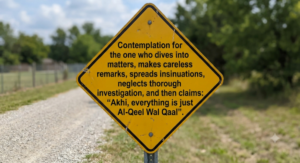
Secondly, regarding the individual who has a big social media audience—who dives into matters, makes careless remarks, spreads insinuations, neglects thorough investigation, and then claims: “Akhi, everything is just Al-Qeel Wal Qaal,” thereby entertaining someone aware of his wrongdoing, while concealing himself behind a victim mentality, and continuing to say that issues are merely based on Al-Qeel Wal Qaal—we say to him:
Imam Ibn al-Qayyim, may Allah have mercy upon him:
“It is obligated on you to give detail and make a distinction, because unrestricted and general (statements)without clarification has indeed corrupted this existence (the world), and misguided the intellects and views in every era”.
Al-Allamah Salih Al-Fawzan, may Allah preserve him, commented on the above statement:
There has to be detail explanation. The one who is not proficient in giving detail should keep quiet, because benefit is not acquired from his speech. And every time error occurs, its cause is due to an absence of detail explanation regarding truth and falsehood. There has to be detail explanation and distinction and not to mix up [affairs]. Indeed, it may be that there is something of truth and falsehood in an opponent’s statement, so all of it is neither deemed to be false nor truth; rather there has to be a distinction between its truth and falsehood. All of it is neither rejected nor accepted; rather a distinction is made regarding the truth and what is correct and the falsehood and error in it. And if you are not proficient in giving detail, then you should not enter into this field. [2]
[1] An Excerpt from Al-Hulalul Ibriziyyah Min at-Ta’leeqaat Al-Baaziyyah Alaa Sahih Al-Bukhari’ 4/353. Footnote 1
[2] An Excerpt from At-Ta-leeqaat Al-Mukhtasar Alaa Al-Qaseedah an-Nooniyyah: 1/216.

Donate
Related Posts
Follow Us
Share
Related Posts
Donate to the Dawah in Manchester

Join the Umrah Trip