Have concern for recitation of the Qur’aan in this noble month, together with pondering and reflecting upon it, taking admonition from its admonitions, heeding what it reprimands, understanding what is lawful and unlawful, understanding the promises and threats and that which is similar in the Noble Quran. And by way of this, the souls are purified and the hearts are illuminated.
From Al-Majmoo of Shaykh Rabee ibn Haadi Al-Madkhalee (Hafidahullah). Vol.15 pg.338
Oh servants of Allah, indeed the hearts of the believers are extremely happy with the coming of Ramadhan. We ask Allah to allow us to reach it, and that he blesses for us fasting and standing in prayer within it, in the manner which Allah – The Mighty and Majestic – is pleased with. And it is fitting for us that we rejoice at its approach, for indeed Allah has prepared in it much good and virtue which is not present in other than this month…
“Whoever reaches the Month of Ramadhan and Allah enables him to benefit in it, then verily Allah has blessed him with a tremendous blessing, (and there) is nothing comparable to it.”
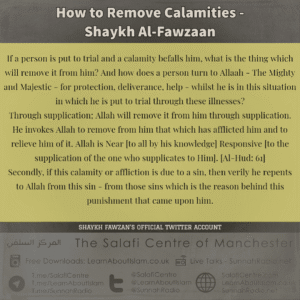
If a person is put to trial and a calamity befalls him, what is the thing which will remove it from him? And how does a person turn to Allaah – The Mighty and Majestic – for protection, deliverance, help – whilst he is in this situation in which he is put to trial through these illnesses?
Through supplication; Allah will remove it from him through supplication. He invokes Allah to remove from him that which has afflicted him and to relieve him of it. Allah is Near [to all by his knowledge] Responsive [to the supplication of the one who supplicates to Him]. [Al-Hūd:61]
Secondly, if this calamity or affliction is due to a sin, then verily he repents to Allāh from this sin – from those sins which is the reason behind this punishment that came upon him.
To any of you that chooses to go forward (by working righteous deeds), or to remain behind (by committing sins), (Al-Muddathir: 37)
This is an evidence that the servant possesses free will and choice; this is a refutation upon the Jabbāriyah, those who say that the servant has no free will or choice rather he is compelled in relation to his actions. They oppose the Mutazilah (1) (Qadariyyah – terms have become synonymous), for the Mutazilah go to extremes in affirming the will of mankind and negating the will of Allāh in contrast to the Jabbāriyah who go to extremes in affirming the will of Allāh and negating free will from mankind; therefore they are in opposite corners.
يَتَقَدَّمَ أَوۡ يَتَأَخَّرَ
Meaning, put forth righteous action or remain behind with disbelief and disobedience. (2) Because righteous actions lead to Paradise and to Allāh, as for actions of disbelief and disobedience then verily they distance a person from Paradise and from Allāh. This is a clear proof that mankind possesses free will and they put forth (righteous actions) and remain behind (in disbelief and sin) as they will. They perform righteous actions as they will and commit sins as they will without being compelled, as the Jabbāriyah claim.
However, when Allāh knows that his servant comes forth towards good, He gives him success. And when Allāh knows his servant turns away from good, he forsakes him, leaves him to himself and to his punishment.
The He (subhānahu wa ta’āla) said,
كُلُّ نَفۡسِۭ بِمَا كَسَبَتۡ رَهِينَةٌ (٣٨)
Every person is a pledge for what he has earned, (38)
Whoever puts forth (good) or remains (in disbelief and sin), all of them will have their deeds presented to them on Yawm al-Qiyāmah.
(1) http://www.aqidah.com/creed/articles/opvus-ibn-battah-al-ukbaree-d-387h-on-what-is-obligatory-to-believe-in-regarding-al-qadaa-wal-qadar.cfm
(2) As is recorded from Ibn ʿAbbās and Qatādah as reported in Tafsīr at-Tabari
Shaykh Abu Abdillah Khālid Dahawī Adh-Dhufayrī (حفظه الله و جزاه الله خيرا):
“There has preceded from myself a warning regarding Salātul Hājah which is called to from time to time. And currently it is being called for to combat this epidemic (Coronavirus), Allah give us and you wellbeing. This prayer is not authentic at all and it is from the newly invented affairs and innovations. Innovations are in opposition to the command of Allah The Most High, and they are a cause for an increase in calamities not an aid or a means to remove them.”
A Warning regarding Salātul Hājah (Prayer of Need) – Shaykh Abu Abdillah Khālid Dahawī Adh-Dhufayrī (حفظهاللهوجزاهاللهخيرا)
That which has spread amongst the request of the people to (perform) Salātul Hājah after Friday Maghrib is an innovated affair and it is not permissible from two angles:
Firstly: Due to the weakness of the reported hadīth regarding Salātul Hājah. There is a fatwa from the Standing Committee, “As for what is called Salātul Hājah, then it has come by way of weak rejected narrations – as far as we know – there is no (authentic) proof established for it and thus it is not correct to base performance (of this prayer) upon those (narrations).”
Shaykh Uthaymīn (rahimahullah) said, “Salātul Hājah has no authentic evidence from the Prophet (sallallāhu alaihi wa salam).”
Shaykh Al-Albāni (rahimahullah) said whilst refuting Sayyid Sābiq in his (Sayyid Sābiq) authenticating of the hadeeth, “He has it authentic whilst in it’s chain of narration is a majhool (an unknown person)?
Indeed in Al-Musnad (Vol.6 pgs 442-443) by way of Maymoon Abee Muhammad Al-Maraa’i Al-Mamimee, Ibn Ma’een said “I do not know him”, ibn ‘Adee said “based upon this he is unknown”. Likewise Ad-Dhahabi said “He is not known”.
And if you want review (go to) “Al-Mīzaan” and “Al-Lisān” and Majma az-Zawā’id”. Vol 2 Pg 278 Tamām Al-Minna
Shaykh ibn Baz (rahimahullah) said, “I do not know a single hadīth which is depended upon for (the authenticity) of Salātul Hājah.”
Secondly: If the hadīth was authentic, then it is an innovation to specify a time for this prayer without a proof, therefore gathering to perform this prayer at one time is from the newly innovated affairs in the Religion.
Shaykh Abu Abdillah Khālid Dahawī Adh-Dhufayrī (حفظه الله و جزاه الله خيرا)
In the Shaykh’s Aqeedah class He said there’s a manhaj benefit we can extract from this hadeeth and it is that Ahlus Sunnah have a Qā’īdah:
قاعدة أهل السنة الاجتماع وليس التجميع
Ahlus Sunnah unite upon the truth and do not merely gather numbers.
الفرق بين التجميع و الاجتماع
Tajmee’: is to gather numbers for the purpose of increasing numbers in your party and group.
Ijtimaa’ – is unity upon the truth; adhering and clinging to the truth.
This is a refutation against the likes of Ikhwan al-Muslimeen – those who have their “golden” principle or as Shaykh Uthaymeen (rahimahullah) called it, “Wooden principle”, saying “We unite upon that which we agree upon and excuse one another for what we disagree about”, gathering numbers is the goal for them.
How is this extracted from the hadeeth?
The Prophet (sallallaahu alaihi wa salam) was on his way to a military expedition; do you need numbers for a military expedition, or not?
However, despite the need for numbers; the Prophet (sallallaahu alaihi wa salam) focused and gave concern to unity upon the truth and that which is pleasing to Allah.
We can see that Ahlul Bid’ah and people of desires clearly oppose this principle.
We ask Allah to reward the Shaykh for bringing this benefit and explaining to us.
The seerah teacher teaching at Markaz Ibnul Qayyim under the supervision of Shaykh Khalid, graduated from Faculty of Hadeeth Madeenah University 20 years ago, gave a really good advice regarding revising, reviewing notes and memorising.
He said once we attended a dawrah of shaykh Ubayd it lasted for one month and the schedule would be as follows
After Fajr – homework to be done by dhuhr
After Dhuhr – homework to be done by asr
After Asr – homework to be done by maghrib
After Maghrib – homework to be done by isha
After Isha – homework to be done for fajr
He said by end of the last lesson we went straight to bed due to tiredness.
But he said in this month we felt we took more benefit than the whole year at the jaamiah.
Why?
Because of the reviewing, revising, and the repetition.
There is huge benefit in repetition and revision for the student in solidifying his knowledge.
Kuwait – 19th February 2019 – 25 Jumada Al-Aakhira 1441
What do you say about the one who says its not a must for him to supplicate for the (Muslim) ruler?
(You say this) because you do not love the ruler, and this is a proof of hypocrisy. The ruler of the Muslims is loved, this is the way of the believers, that they love the Muslim rulers and make dua for their success and their guidance and for them to be aided (by Allah), because their guidance is guidance for the Muslims. And if they are guided, Allah benefits the Muslims by them.
Supplicating for them is from Sincere advice, and the Religion is sincere advice to Allah, his messenger, the rulers of the muslims and the general people. (1)
And the salaf used to supplicate for the Muslim rulers upon the minbar, supplicating for their success and rectification and their guidance because this is rectification of the Muslims and a benefit for the Muslims. (2)
And this (statement) is not possible except from he who has a soul of the khawaarij, a soul of hypocrisy.
And Allah’s refuge is sought.
From the lecture:
أسباب محبة الله
————–
(1) The famous hadith of Tameem Ad-Daarimi (May Allah be pleased with him) as reported in Saheeh Muslim
(2) It is reported that Al-Fudayl bin Ayyad [Allah have mercy on him] said, ‘If I had one supplication that was going to be answered I would make it for the ruler (imam), for the wellbeing and righteousness of the imam means wellbeing for the land and its people.’
Al-Dhahabi, Siyar A’lam Al-Nubala` in his biography of Al-Fudayl b. Ayyad.
We ask Allah The Lord of the Tremendous Throne to rectify the affairs of our Muslim rulers, to make them from the righteous and to benefit Islaam and the Muslims by way of them. آمين
Supplication for the Rulers of the Muslims is from the Methodology of Ahlus Sunnah wal Jamaa’ah, and abandoning it is from the methodology of the innovators.
Imam Ahmad said, “If we only had one supplication that was accepted, we would have supplicated for the ruler, because with his rectification lies the rectification of the Muslims.”
And indeed this sunnah has been abandoned to the extent that people find supplicating for the rulers strange and have bad thoughts regarding whoever does.