Author: Abdullah Jallow

Pan-Africanism, Blackness, and Whiteness on the Scales of Divine Guidance

In The Name of Allah, The Most Merciful, The Bestower of Mercy.

Tawhid – The Original Religion and Path of Humankind and Jinn

Allah, The Most High, stated:

وَمَا خَلَقْتُ ٱلْجِنَّ وَٱلْإِنسَ إِلَّا لِيَعْبُدُونِ

مَآ أُرِيدُ مِنْهُم مِّن رِّزْقٍ وَمَآ أُرِيدُ أَن يُطْعِمُونِ

إِنَّ ٱللَّهَ هُوَ ٱلرَّزَّاقُ ذُو ٱلْقُوَّةِ ٱلْمَتِينُ

And I did not create the jinns and humans except to worship Me. I desire not from them any provision, and nor do I desire that they feed Me. (On the contrary), it is Allāh who is the Great Provider, the possessor of mighty strength. [Adh-Dhariyat 56-58] [1]

Allah said:

وَلَقَدْ بَعَثْنَا فِى كُلِّ أُمَّةٍ رَّسُولًا أَنِ ٱعْبُدُوا۟ ٱللَّهَ وَٱجْتَنِبُوا۟ ٱلطَّٰغُوتَ فَمِنْهُم مَّنْ هَدَى ٱللَّهُ وَمِنْهُم مَّنْ حَقَّتْ عَلَيْهِ ٱلضَّلَٰلَةُ فَسِيرُوا۟ فِى ٱلْأَرْضِ فَٱنظُرُوا۟ كَيْفَ كَانَ عَٰقِبَةُ ٱلْمُكَذِّبِينَ

And verily, We have sent among every nation a Messenger (saying): Worship Allah (Alone), and avoid (or keep away from) from all false deities, i.e. do not worship anything besides Allah. ” Then of them were some whom Allah guided and of them were some upon whom the straying was justified. So travel through the land and see what was the end of those who denied (the truth). [An-Nahl. 36]

Allah said:

كَانَ ٱلنَّاسُ أُمَّةً وَٰحِدَةً فَبَعَثَ ٱللَّهُ ٱلنَّبِيِّۦنَ مُبَشِّرِينَ وَمُنذِرِينَ وَأَنزَلَ مَعَهُمُ ٱلْكِتَٰبَ بِٱلْحَقِّ لِيَحْكُمَ بَيْنَ ٱلنَّاسِ فِيمَا ٱخْتَلَفُوا۟ فِيهِ وَمَا ٱخْتَلَفَ فِيهِ إِلَّا ٱلَّذِينَ أُوتُوهُ مِنۢ بَعْدِ مَا جَآءَتْهُمُ ٱلْبَيِّنَٰتُ بَغْيًۢا بَيْنَهُمْ فَهَدَى ٱللَّهُ ٱلَّذِينَ ءَامَنُوا۟ لِمَا ٱخْتَلَفُوا۟ فِيهِ مِنَ ٱلْحَقِّ بِإِذْنِهِۦ وَٱللَّهُ يَهْدِى مَن يَشَآءُ إِلَىٰ صِرَٰطٍ مُّسْتَقِيمٍ

Mankind were one community and Allah sent Prophets with glad tidings and warnings, and with them He sent the Scripture in truth to judge between people in matters wherein they differed. And only those to whom (the Scripture) was given differed concerning it after clear proofs had come unto them through hatred, one to another. Then Allah by His Leave guided those who believed to the truth of that wherein they differed. And Allah guides whom He wills to a Straight Path. [Al-Baqarah. 213]

Allah said:

وَمَا كَانَ ٱلنَّاسُ إِلَّآ أُمَّةً وَٰحِدَةً فَٱخْتَلَفُوا۟ وَلَوْلَا كَلِمَةٌ سَبَقَتْ مِن رَّبِّكَ لَقُضِىَ بَيْنَهُمْ فِيمَا فِيهِ يَخْتَلِفُونَ

Mankind were but one community (i.e. on one religion – Islamic Monotheism), then they differed (later), and had not it been for a Word that went forth before from your Lord, it would have been settled between them regarding what they differed]. [Yunus. 19]

Ibn Abbas, may Allah be pleased with him and his father, said:

Between Nuh and Adam, all of them used to be upon the true path [worshipping Allah alone], then they differed and started worshipping idols, false deities and images, then Allah sent Messengers with clear proofs and evidences. [2]

Shirk first started amongst the people of Nuh when they exaggerated (the status) of the righteous people and turned away from the call of their Prophet [Nuh] out of pride. They said: “You shall not leave your gods, nor shall you leave Wadd, nor Suwa’, nor Yaghuth, nor Ya’uq, nor Nasr”. [Nuh. Ayah 23]

Imam Al-Bukhari, may Allah have mercy upon him, said:

It has been narrated from Ibn Abbas that these were the names of pious people amongst the people of Nuh, and when they died, Shaytan inspired their people to (prepare) and place idols at the places where they used to sit, and to call those idols by their names. They did so, but did not worship them until those people (who initiated them) had died and the origin of the idols had become obscure, whereupon people began worshipping them”. [3]

All prophets and messengers were Muslims as they submitted to Allah and worshipped Him alone without ascribing partners to Him in worship. Read here:

All The Prophets and Messengers Were Muslims

This is the faith that Allah designated for both humanity and Jinn, aligning perfectly with the sound innate disposition. Allah said:

فَأَقِمْ وَجْهَكَ لِلدِّينِ حَنِيفًا فِطْرَتَ ٱللَّهِ ٱلَّتِى فَطَرَ ٱلنَّاسَ عَلَيْهَا لَا تَبْدِيلَ لِخَلْقِ ٱللَّهِ ذَٰلِكَ ٱلدِّينُ ٱلْقَيِّمُ وَلَٰكِنَّ أَكْثَرَ ٱلنَّاسِ لَا يَعْلَمُونَ

So, set you “O Muhammad” your face towards the religion of pure Islamic Monotheism, worshipping Allah alone by devoting all forms of worship purely for Him. The natural state which Allah determined and upon which He created and moulded mankind. Let there be no change in the creation of Allah “Islamic Monotheism. That is the straight religion, but most of men do not know. [Ar-Rum 30]

Iyaa Ibn Himar, may Allah be pleased with him, reported that the Prophet, peace and blessings of Allah be upon him, said:

Verily, my Lord has commanded me to teach you what you do not know, from what he has taught me this day, “All wealth I bestowed upon them is lawful. I have created all of My servants inclined to worship me alone, but devils come to them who turn them away from their religion. They outlaw what has been made lawful for them, and they command them to associate partners with Me for which no authority has been revealed”. Verily, Allah looked at the people of the earth and He detested all of them, Arabs and non-Arabs alike, except for remnants of the people of the Book”. [Ṣaḥīh Muslim 2865]

All of humanity, the descendants of Adam and Hawa, were created with the purpose of worshiping Allah alone. Throughout history, Allah has sent messengers to guide us back to this divine path whenever we have strayed, often due to the deceptions of shaytan. In light of this truth, the only course left for us is to follow the final Prophet, Muhammad, peace and blessings of Allah be upon him. In this context, concepts like colonization or decolonization become irrelevant; what truly matters is the religion established by our Creator. Ultimately, individuals have been given the free will to choose to submit to Islam, worship Allah alone and follow His last Prophet, Muhammad, peace and blessings of Allah be upon him. They are not forced or coerce, but if they choose other than Islam, they have made a choice for which they will be held accountable in the Hereafter. Allah said:

لَآ إِكْرَاهَ فِى ٱلدِّينِ قَد تَّبَيَّنَ ٱلرُّشْدُ مِنَ ٱلْغَىِّ فَمَن يَكْفُرْ بِٱلطَّٰغُوتِ وَيُؤْمِنۢ بِٱللَّهِ فَقَدِ ٱسْتَمْسَكَ بِٱلْعُرْوَةِ ٱلْوُثْقَىٰ لَا ٱنفِصَامَ لَهَا وَٱللَّهُ سَمِيعٌ عَلِيمٌ

There is no compulsion in religion. Verily, the Right Path has become distinct from the wrong path. Whoever disbelieves in all false deities and believes in Allah (by worshipping Him alone), he has indeed grasped the most trustworthy handhold that will never break. And Allah is All-Hearer, All-Knower. [Al-Baqarah 256]

Allah said:

وَمَن يَبْتَغِ غَيْرَ ٱلْإِسْلَٰمِ دِينًا فَلَن يُقْبَلَ مِنْهُ وَهُوَ فِى ٱلْءَاخِرَةِ مِنَ ٱلْخَٰسِرِينَ

And whoever seeks a religion other than Islam, it will never be accepted of him, and in the Hereafter he will be one of the losers. [Aal Imran 85]

Therefore, what is essential to understand is that an individual faces a choice: to either adhere to the traditions of ancestors after the arrival of the Prophets and Messengers or to wholeheartedly submit to the path of Prophets and Messengers, with Muhammad being the final Messenger, peace and blessings of Allah be upon all of them. True beliefs must align with the revelations given to the Prophets and Messengers, rather than the customs of forebears that contradict their teachings. Sadly, some African Americans and African intellectuals have attempted to muddy this straightforward issue. As African Muslims, we are called to follow the path of the final Prophet in both belief and practice, just like any Muslim around the globe. Cultural customs from any group, whether Arab or non-Arab, are acceptable as long as they do not conflict with the final divine message. It is perfectly fine for individuals from different backgrounds to adopt and celebrate the cultural practices of others, provided these do not contradict the final revelation. We will share insights from scholars on this topic shortly, but for now, it is crucial to reiterate that one must choose between the path of the final Prophet or the ancestral traditions that stand in opposition to divine guidance. Historically, the latter has been a common fallacy among nations when Messengers urged them to return to the right path. Al-Allamah Salih al-Fawzan, may Allah preserve him, stated:

Indeed, polytheistic (practices and beliefs) have become rife within this Ummah due to detachment from (he teachings of)the Qur’an and the Sunnah, blindly following ancestors without proper guidance, elevating the status of deceased figures by constructing (shrines and tombs) over their graves, and due to being ignorant of the islam that Allah instructed His Messenger, peace and blessings be upon him, as Umar Ibn al-Khattab, may Allah be pleased with him, said: “The very foundations of Islam will crumble one by one when a generation arises that is unaware of the ignorance that preceded Islam.” Furthermore, the proliferation of Shubhah—doubts that masquerade as truth but are fundamentally false—has led many astray. Among these misconceptions is the argument used by those who engage in Shirk, both in the past and present, claiming legitimacy by adhering to the beliefs of their forefathers. Allah said:

وَكَذَٰلِكَ مَآ أَرْسَلْنَا مِن قَبْلِكَ فِى قَرْيَةٍ مِّن نَّذِيرٍ إِلَّا قَالَ مُتْرَفُوهَآ إِنَّا وَجَدْنَآ ءَابَآءَنَا عَلَىٰٓ أُمَّةٍ وَإِنَّا عَلَىٰٓ ءَاثَٰرِهِم مُّقْتَدُونَ

And similarly, We sent not a warner before you (O Muhammad) to any town (people) but the luxurious ones among them said: “We found our fathers following a certain way and religion, and we will indeed follow their footsteps.” [Az-zukhruf 23]

Therefore, following ancestors is only praiseworthy if they were upon the truth. Allah [The Most High] said that Yusuf, peace be upon him, said:

وَٱتَّبَعْتُ مِلَّةَ ءَابَآءِىٓ إِبْرَٰهِيمَ وَإِسْحَٰقَ وَيَعْقُوبَ مَا كَانَ لَنَآ أَن نُّشْرِكَ بِٱللَّهِ مِن شَىْءٍ ذَٰلِكَ مِن فَضْلِ ٱللَّهِ عَلَيْنَا وَعَلَى ٱلنَّاسِ وَلَٰكِنَّ أَكْثَرَ ٱلنَّاسِ لَا يَشْكُرُونَ

And I have followed the religion of my fathers, – Ibrahim (Abraham), Ishaque (Isaac) and Ya’qub (Jacob), and never could we attribute any partners whatsoever to Allah. This is from the Grace of Allah to us and to mankind, but most men thank not (i.e. they neither believe in Allah, nor worship Him). [Yusuf. 38]

This doubt was embedded in the souls of the polytheists and they utilised it to oppose the call of the Prophets. Allah said:

وَلَقَدْ أَرْسَلْنَا نُوحًا إِلَىٰ قَوْمِهِۦ فَقَالَ يَٰقَوْمِ ٱعْبُدُوا۟ ٱللَّهَ مَا لَكُم مِّنْ إِلَٰهٍ غَيْرُهُۥٓ أَفَلَا تَتَّقُونَ
فَقَالَ ٱلْمَلَؤُا۟ ٱلَّذِينَ كَفَرُوا۟ مِن قَوْمِهِۦ مَا هَٰذَآ إِلَّا بَشَرٌ مِّثْلُكُمْ يُرِيدُ أَن يَتَفَضَّلَ عَلَيْكُمْ وَلَوْ شَآءَ ٱللَّهُ لَأَنزَلَ مَلَٰٓئِكَةً مَّا سَمِعْنَا بِهَٰذَا فِىٓ ءَابَآئِنَا ٱلْأَوَّلِينَ

And indeed We sent Nuh (Noah) to his people, and he said: “O my people! Worship Allah! You have no other Ilah (God) but Him (Islamic Monotheism). Will you not then be afraid (of Him i.e. of His Punishment because of worshipping others besides Him)?” But the chiefs of those who disbelieved among his people said: “He is no more than a human being like you, he seeks to make himself superior to you. Had Allah willed, He surely could have sent down angels; never did we hear such a thing among our fathers of old]. [Al-Muminoon. 23-24]

So, they used as proof that which their ancestors were upon to oppose that which their Prophet Nuh brought. Allah informed us that the people of Sali said to him: “Do you (now) forbid us the worship of what our fathers have worshipped?”[Hud. 62]

The people of Shu’aib said: “Does your Salat (prayer) (i.e. the prayers which you offer has spoiled your mind, so you) command that we leave off what our fathers used to worship]. [Hud. 87]

Allah informed us about Ibraheem and his people when he silenced them with clear proofs: “What do you worship?” They said: “We worship idols, and to them we are ever devoted”. He said: “Do they hear you, when you call (on them)? “Or do they benefit you or do they harm (you)?” They said: “Nay, but we found our fathers doing so”. [Ash-Shu’ara 70-74]

This is the nature of disbelief! Its people do not have any proof by way of which to repel the truth except these flimsy proofs. [4]

Therefore, a sensible individual understands the reasons behind the misdirection of nations, which often stems from prioritizing the traditions of their ancestors over the teachings of Allah’s Messengers. If you were to inquire about the beliefs of our ancestors from 2000 years ago, we would struggle to categorize them as polytheists, Christians, or Jews. However, what we do know with absolute certainty is that Allah sent Messengers to every nation, including Prophet Isa, peace be upon him, who preached the oneness of Allah, Tawhid. Following his time, Allah sent Muhammad, peace and blessings of Allah be upon him, to both Arabs and non-Arabs, addressing all of humanity and even the Jinn. If you were to ask again about the faith of our forefathers during Muhammad’s era, we could only guess based on the historical accounts regarding that region of West Africa. However, what we do know is that Allah sent Muhammad as the final Messenger, and many sincere followers of the Scriptures acknowledged his Prophethood and accepted Islam. This historical fact is well established. Subsequently, Islam spread throughout Africa, leading to our birth into Muslim families by the Will of Allah. Islam is practiced independently of ancestral customs that contradict divine revelation. This approach does not equate to succumbing to Arab colonialism. Whether it stems from African, Arab, European, or any other cultural background, any practice that stands in opposition to divine revelation is not embraced.

The Messenger, peace and blessings of Allah be upon him] said,

“Indeed, Allah [The Most High] has removed from you the pride of the pre-Islamic period and its boasting about ancestors. One is only a pious believer or a wretched sinner. You are sons of Adam and Adam (was created from) dust. Let the people abandon boasting about their ancestors, for they are merely fuel in Jahannam; or they will become more insignificant in (the sight of) Allah than the beetle which rolls dung with its nose”. [5]

The Messenger [peace and blessings of Allah be upon him] said: “Whoever is held back by his deeds, his (nobility) of lineage will not push him forward”. Imam An-Nawawi, may Allah have mercy upon him, said:

“Its meaning is that the one whose deeds are deficient and he does not catch up with the performers of (good) deeds, then it is obligatory upon him not to crown himself with nobility of lineage and the virtues of his forefathers, whilst he is lagging behind in (performing good) deeds”. [6]

Imam Abdul Azeez Bin Baz [may Allah have mercy upon him] said:

“It is obligated to every Muslim that he does not depend on custom; rather he presents it to the pure Islamic legislation (to be judged), so whatever the Islamic legislation affirms is permissible and whatever it does not affirm is impermissible. The customs of the people are not proof to determine the lawfulness of anything. All the customs of the people in their countries or tribes must be presented to the Book of Allah and the Sunnah of His Messenger [peace and blessings of Allah be upon him] for judgement, so whatever Allah and His Messenger made permissible is permissible, and whatever they forbid, then it is obligatory to abandon it even if it is the custom of the people”. [7]

Imam Muhammad Bin Salih Al-Uthaymeen, may Allah have mercy upon him, said:

“The customs cannot make something that is not legislated (in the divine revelation) as something legislated, because of Allah’s statement: “It is not Al-Birr (piety, righteousness, etc.) that you enter the houses from the back”. [Surah Al-Baqarah. 189], despite the fact that it was something they took as their custom and considered it to be an act of righteousness. Whoever takes something as a custom and believes that it is an act of righteousness, then it should be presented to Allah’s divine legislation [i.e. to be judged]”. [8]

Imam Muhammad Bin Salih Al-Uthaymeen, may Allah have mercy upon him, also said:

“Extremism in relation to customs is stringent adherence to old customs and not diverting to what is better than them. As for if the customs are equal in benefit [i.e. the ones judged to be permissible by the divine legislation], then a person remaining upon what he is upon would be better than going along with the new (or emerging) customs”. [9]

It’s undeniable that Allah sent Prophets and Messengers and provided Scriptures to lead humanity, culminating in the final message delivered by Muhammad, peace and blessings of Allah be upon all of them. Various nations, tribes, and clans accepted Islam, with non-Arabs emerging as significant leaders and scholars. Al-Allamah Salih Aala Ash-Shaikh, may Allah safeguard him, stated:

“When the Muslims conquered the different regions of the earth and Islam spread, the affair became as if it started from the non-Arabs, until the people of Persia and other non-Arabs became the scholars and the Imams of the mosques, and people acquired knowledge from them. It is recorded in Islamic history that many non-Arabs led the Muslims in knowledge, in issuing religious verdicts and many affairs. Take for example Abu Hanifah, may Allah have mercy on him, who was not an Arab, and Imam Al-Bukhari [may Allah have mercy on him] and how his book became an upright example, and there’s none amongst the Muslims except that he (or she) knows Imam Abu Abdillah Muhammad Bin Ismaa’eel Al-Bukhari. And consider other examples – besides Al-Bukhari and Abu Hanifah – amongst the Imams of Islam.

So when Islam came with its implementation, it abolished the differences that were initiated by the people and those non-Arabs became the leaders and Imams of the Arabs; why? Because they carried the religion, raised the banner of pure Islamic monotheism – there is no deity worthy of worship except Allah and Muhammad is the Messenger of Allah, and because there is no distinction in virtue between a non-Arab and an Arab, except through fear of Allah. When the Muslims disciplined themselves with Islam, there was no dispute between them regarding social class by way of that pre-Islamic dispute and distinction, because indeed neither did they accept leadership nor give precedence to anyone based on this; rather they accepted everyone because people are equal in this affair. Quraish’s rulership, the Umayyad rulership and the Abbasid rulership ended; then the rulership of the Mamluks arose and thereafter the rulership of Banee Uthman – meaning in the beginning when it was upright; so the Muslims obeyed them and they became the leaders and rulers, because the Muslims saw that there was welfare for the people in doing so (based on the texts of the Qur’an and the Sunnah, and understanding of the Sahabah). Therefore, class differentiation and its practice was abolished from the beginning; rather no one had any reservation in implementing Islam. So, Islamic history attests to the implementation of this great principle [i.e. sound equality]”. [10]

The subsequent decline and stagnation can be attributed to a deviation from the fundamental tenets of Islam, which has given rise to numerous challenges, including tribalism and various societal dilemmas. Read:

The State of the Ummah: Causes that led to its Weakness and the Means of Rectification (eBook)

However, it is essential to recognise that Muslim scholars have remained acutely aware of these issues throughout Islamic history and continue to engage with them in contemporary discourse. The blame does not lie with Islam itself, despite the misguided assertions of some ignoramuses and certain pan-Africanists advocating for a so-called decolonisation of religion. Such claims reveal a profound ignorance, as they overlook the original faith bestowed by the Creator and fail to address the true root of the problem: a departure from pure monotheism and the teachings of the Prophets, the last of whom is Muhammad. Furthermore, it is important to acknowledge that regardless of an individual’s chosen faith, they will be held accountable for their choices after the Prophets and Messengers have conveyed the message of Islamic Monotheism. However, any form of oppression against people is unequivocally condemned regardless of the race, social status or religion of the victims. The Messenger, peace and blessings of Allah be upon him, said that Allah, The Almighty, said: “O My servants, I have forbidden injustice for Myself and I have forbidden it among you, so do not oppress one another”. [Ṣaḥīḥ Muslim 2577]

The Messenger said: “Whoever would love to be delivered from Hellfire and admitted into Paradise, let him meet his end with faith in Allah and the Last Day, and let him treat people as he would love to be treated.” [Muslim 1844]

It is of utmost significance that any sense of injustice directed towards our race, clan, tribe, or nation does not disrupt our bond with Allah as Muslims. We must resist the allure of pan-Africanist ideologies that may lead us astray and jeopardize our eternal well-being under the guise of pride. Instead, let us embrace a path of piety rooted in the final revelation, for it is the true avenue to salvation. Allah said:

يَٰٓأَيُّهَا ٱلنَّاسُ إِنَّا خَلَقْنَٰكُم مِّن ذَكَرٍ وَأُنثَىٰ وَجَعَلْنَٰكُمْ شُعُوبًا وَقَبَآئِلَ لِتَعَارَفُوٓا۟ إِنَّ أَكْرَمَكُمْ عِندَ ٱللَّهِ أَتْقَىٰكُمْ إِنَّ ٱللَّهَ عَلِيمٌ خَبِيرٌ

O mankind, We have created you from a male (Ādam) and female (Eve) (making you all of equal lineage) and We made you into nations and tribes that you may know one another (and fulfil each other’s rights). Verily, the most honourable of you with Allāh is the most pious of you (and not the noblest in lineage or most affluent) (so do not be boastful and belittle others). Indeed, Allāh is all-Knowing, all-Aware.[11]

Allah said:

تِلْكَ ٱلدَّارُ ٱلْءَاخِرَةُ نَجْعَلُهَا لِلَّذِينَ لَا يُرِيدُونَ عُلُوًّا فِى ٱلْأَرْضِ وَلَا فَسَادًا وَٱلْعَٰقِبَةُ لِلْمُتَّقِينَ

That home of the Hereafter (i.e. Paradise), We shall assign to those who rebel not against the truth with pride and oppression in the land nor do mischief by committing crimes. And the good end is for the pious.[Al-Qasas 83]

Those who depart from this world while associating partners with Allah in worship or rejecting Allah and His final Messenger, without repentance, will face eternal failure. Allah has stated:

إِنَّهُۥ مَن يُشْرِكْ بِٱللَّهِ فَقَدْ حَرَّمَ ٱللَّهُ عَلَيْهِ ٱلْجَنَّةَ وَمَأْوَىٰهُ ٱلنَّارُ وَمَا لِلظَّٰلِمِينَ مِنْ أَنصَارٍ

Verily, whosoever sets up partners in worship with Allah, then Allah has forbidden Paradise for him, and the Fire will be his abode. And for the Zalimun (polytheists and wrong-doers) there are no helpers. [Al-Ma’idah 72]

Allah said:

وَمَن يَبْتَغِ غَيْرَ ٱلْإِسْلَٰمِ دِينًا فَلَن يُقْبَلَ مِنْهُ وَهُوَ فِى ٱلْءَاخِرَةِ مِنَ ٱلْخَٰسِرِينَ

And whoever seeks a religion other than Islam, it will never be accepted of him, and in the Hereafter he will be one of the losers. [Aal Imran 85]

Indeed, there is nothing wrong with either a Muslim or a non-Muslim standing up against oppression and exploitation. Therefore, we assert without hesitation that Africa has the right to call for an end to the post-colonial oppressive systems, just as they stood resolutely against the brutality and greed of colonialists during the colonial period. We agree wholeheartedly that Africa should not be subjected to exploitation through so-called financial aid, foreign military bases, sanctions, debt, NGOs, unequal trade, loans, and so forth. We also support the view that both African and Asian nations have the right to seek liberation from oppression through debt restructuring, strategic partnerships, diversified economies, de-dollarization, fair negotiations, food security, Agro-processing, solar energy, information technology, state-owned mines, pharmaceuticals, and more. It is a fact that other nations have pursued these initiatives for their economic stability, and similarly, Africa and others have the right to do the same. This is simply common sense and does not necessitate adherence to pan-Africanism or any other ideology that contradicts the final revelation ordained by the Creator, for which He will reward or punish humanity and Jinn in the Hereafter. Thus, we clearly state that the oppression and exploitation of African or Asian countries must cease. Our responsibility as African Muslims is to call our societies to Tawhid and Sunnah, following the path of the righteous predecessors, while also addressing any injustices faced by people. All praise is due to Allah for guiding us to Islam, which is indeed enough as a blessing. And Allah knows best.

Read: https://salafidawahmanchester.com/2024/11/16/the-uncivilised-third-world-and-developing-countries/

With regards the concept and Blackness and Whiteness any Muslim with the least insight knows what the Creator has stated, such as the Ayah:

وَمِنۡ ءَايَـٰتِهِۦ خَلۡقُ ٱلسَّمَـٰوَٲتِ وَٱلۡأَرۡضِ وَٱخۡتِلَـٰفُ أَلۡسِنَتِڪُمۡ وَأَلۡوَٲنِكُمۡ‌ۚ إِنَّ فِى ذَٲلِكَ لَأَيَـٰتٍ۬ لِّلۡعَـٰلِمِينَ

And among His Signs is the creation of the heavens and the earth, and the difference of your languages and colours. Verily, in that are indeed signs for people of sound knowledge.[Surah Ar-Rum. Ayah 22]

Allah, The Mighty and Majestic, said:

يَٰٓأَيُّهَا ٱلنَّاسُ إِنَّا خَلَقْنَٰكُم مِّن ذَكَرٍ وَأُنثَىٰ وَجَعَلْنَٰكُمْ شُعُوبًا وَقَبَآئِلَ لِتَعَارَفُوٓا۟ إِنَّ أَكْرَمَكُمْ عِندَ ٱللَّهِ أَتْقَىٰكُمْ إِنَّ ٱللَّهَ عَلِيمٌ خَبِيرٌ

O mankind, We have created you from a male (Ādam) and female (Eve) (making you all of equal lineage) and We made you into nations and tribes that you may know one another (and fulfil each other’s rights). Verily, the most honourable of you with Allāh is the most pious of you (and not the noblest in lineage or most affluent) (so do not be boastful and belittle others). Indeed, Allāh is all-Knowing, all-Aware.

https://www.thenoblequran.com/q/#/search/49_13

Without delving too deeply, there is an ongoing conversation among humanity, alongside many other discussions, about the concepts of whiteness and blackness. As someone from a family that is quite diverse in terms of African inter-tribal blood relations with the Fulani, Mandinka, Wollof, Aku, Sereer, Hausa and others, it is remarkable how Islam has brought us together to the point where our tribal origins are the last thing on our minds. Furthermore, some of our family members, including cousins, nieces and nephews, uncles, and children, are married to individuals of White English descent, Irish descent, Pakistani descent, German, Swedish, Caribbean descent, Kurdish descent, Hispanic descent and so on. And among our close brothers in Islam, there are those married to Indians, Turks, Banghalis, Chinese, Yeminis, Iraqis, Morroccans, Algerians etc. Therefore, we are indeed very diverse, alhamdulillah.

In light of the discussions among people regarding whiteness and blackness, we chose to examine the issue briefly. Whiteness, as some describe it, is a field of critical study that has emerged from Critical Race Theory. It investigates whiteness not as a biological fact but as a socially constructed racial category and a system of privilege. This field explores how the notion of whiteness has been historically influenced by social, economic, and political forces, creating unseen advantages for white individuals and establishing a racial hierarchy that positions whiteness as the societal norm. The theory scrutinizes how this racialization operates, sustains power dynamics, and affects lived experiences, challenging the often-overlooked privileges and standards associated with being white.

In this context, we assert that any race that has held dominance over others, be it black, white, or Asian, has established social systems that grant privileges to some while leaving others disadvantaged. Moreover, even within the tribes of particular nations, there exists oppression and discrimination. Consequently, every occurrence of structural inequality is supported by either prejudice, tribalism, clanism, or racism, none of which align with the teachings of the noble prophets. Thus, we declare that Islam abolishes all of this. Refer to this article – starting on page 10 – which discusses the Conditions Leading Up to the Arrival of the Final Messenger, the Elimination of Social Class Conflict, and the Abolishment of Structural Inequality.

https://salafidawahmanchester.com/wp-content/uploads/2025/06/A-precise-scrutiny-of-Human-Rights_1.pdf

Regarding blackness, some authors do not refer to it as something linked to individuals whose ancestors originate from Africa; instead, they approach it as a cultural phenomenon of being Black. This is because they argue that one can be African American without being Black, just as one can be both African American and Black. They contend from a cultural standpoint that Blackness encompasses a multitude of meanings across the past, present, and future, making it impossible to encapsulate in mere words. It represents a culture, a style, an unwritten constitution, a perspective, a way of life, an expectation, an emotion, a source of motivation, a catalyst for change, radicalism, potential, history, current reality, and future possibilities; it embodies everything. For instance, some might say: I was born to Black parents in a Black neighborhood in the Black city of Atlanta. From an early age, I was immersed in the civil rights movement and its key figures. Some individuals argue that that the notion of “blackness” (referring to black skin) has been utilised to describe both external and internal traits of a “black group” (or “race”). This study outlines the evolution of this concept from ancient times, through the Middle Ages, and into modernity, where it laid the groundwork for developing race theories.

After reviewing various points in this subject on Whiteness and Blackness, I encountered several disturbing racist notions, which, when examined more closely, appear to originate from mere misguidance and a straying from Allah’s path. The two verses mentioned at the start of this article are adequate for believers to grasp that virtue is not defined by race; rather, it is based on piety and righteous deeds, as found in Surah al-Hujurat ayah 13. Thus, there is no need to refer to any of those comments about Blackness and Whiteness, as they are merely expressions of racist ideology. It is also crucial to recognize that, in response to racism, some black individuals have resorted to labeling white people as devils. This clearly stems from misguidance. The solution is simple: we must return to the Creator’s path, who created us from one male and one female, forming us into nations and tribes, and stated that the best among us are those who exhibit piety, end of discussion, with no need for theories or counter-theories regarding Blackness and Whiteness. Nonetheless, this does not imply that we should become complacent when any individual or group from a particular race commits acts of injustice against another race purely based on a flawed sense of racial superiority.

Furthermore, we do not endorse any cultural practices, whether labeled as Whiteness or Blackness, that are in conflict with Allah’s Shariah. In this context, we reject everything that opposes Allah’s Shariah, including any pan-Africanists whose views extend beyond what is prescribed by the Creator in one’s quest for justice.

We express our gratitude to Allah for leading us to Islam and for the blessing of having relatives from diverse clans, tribes, nations, and skin tones. This includes our cousins, wives, in-laws, children, and grandchildren, along with our brothers in Islam from various backgrounds, some of whom have the fairest complexions while others possess a range of skin tones. The one thing that brings us together is Islam.

And Allah knows best.


[1]https://www.thenoblequran.com/q/#/search/51_56

[2] Misbaah Al-Muneer Fee Ta’dheeb Tafseer Ibn Katheer

[3] Al-Bukhaari 4920

[4] An Excerpt from “Muhaadaraat Fil Aqeedah Wad-Dawah” 1/18-20. Slightly paraphrased

[5] Saheeh Sunan Abee Dawud. Hadith Number 5116. Declared ‘Hasan’ by Imaam Al-Albaanee

[6] Sharh Saheeh Muslim – (The Book Pertaining to the Remembrance of Allah, Supplication, Repentance and Seeking Forgiveness). Hadeeth Number 2699; Vol 17 page 18

[7] Majmoo Al-Fataawaa 6/510

[8] Tafseer Surah Al-Baqarah 2/299

[9] Majmoo Al-Fataawaa 7/7

[10] https://youtu.be/wRkeYjcJ728?si=V1cqv_4t4vL_uoVd

[11]https://www.thenoblequran.com/q/#/search/49_13

The Clarity a Person Loses by Enlarging Others’ Flaws

In The Name of Allah, The Most Merciful, The Bestower of Mercy.

Abu Hurairah, may Allah be pleased with him, said: “One of you looks at the speck in his brother’s eye while forgetting the stump in his own eye.” [a]

Al-Allamah Zayd Bin Haadee Al-Madkhalee, may Allah have mercy upon him, said:

This narration shows that it is obligated to  (a person) to pre-occupy himself with his own faults before looking at that of others. It is severe heedlessness that a Muslim is heedless of his faults and delays rectification of himself, yet he criticises others and even though his faults are more and greater than that of others. Therefore, what is obligated to a Muslim and a Muslimah is to strive to prevent oneself from violating Allah’s commands and prohibition. Also, one should strive to call others to the (path of) Allah, so that they are distanced from sins, as sins are a heavy burden on a person in this life and the next, and make them incline towards obedience to Allah that would make their scales of good deeds heavy, earn a person paradise and the pleasure of Allah, and saves him from the anger of Allah and His painful punishment. However, it must be borne in mind that warning against ahlul bidah – those who call to their bidah through speech and books – is not tantamount to seeking after the faults of others, for indeed to warn against ahlul bidah is an established Sunnah- obligated by the Qur’an and the Sunnah. This is because to abandon the mention of a Mubtadi in order to warn against him is tantamount to abandonment of enjoining good and forbidding evil”. Therefore, we must make a distinction in order to know what is commanded and what is prohibited, and the difference between warning and seeking after the faults of others. [Awnul Ahadis Samad Sharh Al-Adab Al-Mufrad’ 2 /205]

Who Is Not Without Hidden Shortcomings?!

Imam Al-Qahtaanee, may Allah have mercy upon him, said:

And You (Allah) have placed love for me within the hearts….And the affection from You is through mercy and kindness….And You have spread – amongst the people – good about me… And conceal my acts of disobedience from their eyes…And you have made my good mention amongst the people common (or widespread)…until you made them all my brothers….By Allaah, if they knew the repugnance of my secret affairs (or inner self)….The one who meets me would have refused to give me Salaams…And they would have turned away from me and loath my companionship…And I would have brought disgrace upon myself after being honored…But you conceal my faults and deficiencies…And you dealt with my sins and transgression with forbearance (i.e. gave me an opportunity to repent)…So all praise and commendations- by way of my thoughts, limbs, and tongue- is Yours….[Refer to first lines of Al-Qahtaanee’s Nooniyyah]


[a] [As-Saheehah 1/74-75- Saheeh Mawqoofan]

[15] Some Extraordinary Personalities of The First Three Generations

In The Name of Allah, The Most Merciful, The Bestower of Mercy.

Tawus Ibn Kaysan, may Allah have mercy upon him

Ibn Kaysan, the Faqee, a role model, the (leading) scholar of Yemen—Abu Abdir Raḥman al-Faarisee, then Al-Yamaanee, Al-Jundee, the Hafidh.

He was among the sons of the Persians whom Kisraa (the Sasanian king) equipped to seize Yemen for him. It was said: He was the Mawla of Basheer Ibn Raysan al-Ḥimyaree; and it was also said: Rather, his allegiance was to Hamdan. I think he was born during the Khilafah of Uthman—may Allah be pleased with him, or prior to that.

He heard (ḥadith) from Zaid ibn Thabit, Aa’isha, Abu Hurayra, Zayd ibn Arqam, and Ibn Abbas. He remained in the company of Ibn Abbas for a period and was regarded among his senior companions. He also narrated from Jabir, Suraqah ibn Malik, Ṣafwa ibn Umayya, Ibn Umar, Abdullah ibn Amr, Ziyad al-A’jam, Ḥijr al-Madri, and a group (of others). He narrated from Muʿadh in mursal form.

Those Who Narrated From Him:

Aṭaa, Mujahid, a number of his peers, his son ʿAbdullah, al-Ḥasan ibn Muslim, Ibn Shihab, Ibrahim ibn Maysara, Abu Az-Zubayr al-Makki, Sulayma at-Taymi, Sulayman ibn Musa Ad-Dimashqi, Qays ibn Saʿd al-Makki, Ikrima ibn Ammar, Usama ibn Zayd al-Laythi, Abdul Malik ibn Maysara, Amr ibn Dinar, Abdullah ibn Abee Najeeh, Ḥanẓalah ibn Abee Sufyan, and many others besides them. His ḥadith appear in the major collections of (Islamic) texts, and it is agreed upon that he is an authority.

Aṭaa ibn Abee Rabah narrated from Ibn Abbas who said: “I think that Ṭawus is among the people of Paradise (InShaAllah)”. Qays Ibn Sa’d said: “He (Tawus) among us is like Ibn Seereen among the people of Basra”.

Sufyan ibn Uyaynah reported from Ibn Abee Najeeh, who said: “Mujahid said to Tawus, ‘O Abu Abdir Rahman! I saw you (in a dream) praying inside the Kaʿbah, and the Prophet, peace and blessings of Allah be upon him, was at its door saying to you: ‘Uncover your face and make your recitation clear’. Tawus said to (Mujahid): ‘Be quiet, and let no one hear this from you’. He (Ibn Abee Najeeh) said: ‘Then it seemed to me that he (Tawus) was happy about the dream'”.

Abdur Razzaq narrated from Dawud Ibn Ibrahim that a lion blocked the people one night on the pilgrimage route, thus, the pilgrims became crowding one another. When it was close to Fajr, the lion departed, so they dismounted and slept, but Tawus stood up and started praying. A man said to him: ‘Will you not sleep?’ He said, ‘Does one sleep during the time before dawn?'”

Abd Ar-Razzaq said: “I heard An-Numan ibn Az-Zubayr As-Ṣan’ani reporting that Muḥammad ibn Yusuf, or Ayyub ibn Yaḥya, sent seven or five hundred Dinars to Tawus. The messenger was told: ‘If the Shaikh accepts it from you, the governor will treat you kindly and clothe you’. So, the man arrived with the money to Ṭawus al-Jundee and wanted him to take it, but he refused. Then Ṭawus became distracted, thus, the man threw the money pouch into a window-opening of the house and told them: ‘He has taken it.’ Then they something about Tawus that displeased them, so they said: ‘Go to him and tell him to give us back our money’. The messenger came to him and said: ‘The money the governor sent to you’. He said: ‘I did not take anything from it’. The messenger returned and they knew he was truthful. So they sent the first man to him. He said: ‘The money I brought you, O Abu Abdir Rahman’. He said, ‘Did I ever take anything from you?’ He said, ‘No.’ Then he looked to where it had been placed, reached out his hand, and found the money pouch with a spider’s web over it. He then took it and returned it to them.

Sufyan said: Ibrahim Ibn Maysarah swore to us while facing the Kabah, saying: “By the Lord of this Sacred Structure! I have never seen anyone — noble or one with low status – in the presence of whom all people were equal, except Tawus”.

Ibn Uyaynah reported from Ibn Abee Najeeh, from his father who said that Tawus said to him, “O Abu Najeeh! The one who speaks while fearing Allah is better than the one who keeps quiet while fearing Allah”.

Ibn Shihab said: “If you had seen Ṭawus, you would know that he would not lie.” Al-A’mash narrated from Abdul-Malik ibn Maysarah, from Tawus who said: “I met fifty of the companions of Allah’s Messenger, peace and blessings of Allah be upon him”.

And Ḥabeeb Ibn Abee Thabit said: “Five men gathered with me, and no one else could gather such a group: Aṭaa, Ṭawus, Mujahid, Sa’eed ibn Jubayr, and Ikrimah”.

Anbasah ibn Abdul Waḥid narrated from Ḥanẓalah ibn Abee Sufyan who said: “I never saw a scholar says ‘I don’t know’ more than Tawus.

Abdur Razzaq narrated from his father who said: “Ṭawus died in Makkah and they did not perform the funeral prayer over him until Hisham ibn Abdil Malik sent the guards. I saw Abdullah ibn al-Ḥasan ibn al-Ḥasan carrying the bier on his shoulder. His cap fell off, and his cloak tore from behind, yet he did not leave the bier until it was placed in the grave”.

He (Tawus) died either in Muzdalifah or Mina. He died in the year 106 AH. It is said that his death occurred on the Day of Tarwiyah (8 Dhul-Ḥijjah). The caliph Hisham ibn Abdil Malik performed the funeral prayer over him.

An Excerpt from Siyar A’lam An-Nubulaa 5/39

[3] Brief Biographies of Some Prominent Contemporary Scholars – Shaikh Abdus Salaam Burgis

In The Name of Allah, The Most Merciful, The Bestower of Mercy.

He – may Allah have mercy upon him, was Abu Abdir Rahman Abdus Salam Bin Burjis Bin Nasir Aala Abdul Karim. The Aala Abdil Karim family is well-known in Hurma within Al Majma’ah Governorate (i.e. which is part of Riyaad Province). This family belongs to the Al Ma’amirah clan of Banu Sa’ad from Banu Tameem. He was born in Riyadh in the year 1387 AH, as recorded in his personal identification card, and he was raised under the care of his parents and their household was one of adherence to the religion and righteousness. The Shaikh – from an early age- was intelligent, resolute, sedulous, and hard working. He memorised the Quran and started seeking knowledge at the age of thirteen. His teachers noticed signs of ingenuity and duiscernment in him, so they gave him extra concern and attention. The Shaikh studied under several scholars from this blessed land, among them:

The Imam Shaikh Abdul Aziz Bin Abdullah bin Baz, may Allah have mercy upon him, who passed away in 1420 AH, whom he accompanied for a period, attended many of his lessons, particularly on “Bulugh al-Maram” by Ibn Hajar, Tafsir Ibn Kathir and other than them among the books.

The Faqih, the Usuli, the Shaikh Muhammad Bin Salih al-Uthaymeen, may Allah have mercy upon him, who passed away in 1421 AH. Shaikh Abdus Salam, may Allah have mercy upon him, traveled to him between the years 1401 and 1403 AH during the school breaks. Similarly, he accompanied Shaikh Muhammad when he started his lessons at Masjid al-Haram (Makkah) in 1402 AH. He used to live with him before (Shaikh Muhammad) relocated his family to Makkah, and at other times. He studied Kitab at-Tawheed with him, Aqidah al-Wasitiyyah, the acts of worship from Zaad al-Mustaqni in Fiqh jurisprudence, Al-Ajurumiyyah in grammar, “Mukhtasar Qawa’id Ibn Rajab by Shaikh Muhammad, and nearly half of Sahih al-Bukhari. Shaikh Muhammad held Shaikh Abdus Salam in high regard and respected him.

Shaikh Abdullah Bin Abdir Rahman Bin Jibreen, may Allah have mercy upon him, whom he accompanied for four years, and studied (under him kitaab) Tawheed by Ibn Khuzaymah and the Nuniyyah by Ibn Al-Qayyim, together with its explanation by Ibn Eesa. Shaikh Abdus Salam memorised approximately a thousand lines from these works. He also studied Zaad al-Mustaqni together with Ar-Rawd al-Murbi and Ma’aarij al-Qubool by Shaikh Hafiz Al-Hakami. Shakh AbdusSalam benefited a lot from Shaikh Ibn Jibreen. [Footnote a]

The Shaikh, Al-Muhaddith, Al-Allamah, Abdullah Bin Muhammad Ad-Duwaysh, may Allah have mercy upon him, who passed away in 1409 AH. During the official vacation periods in Burayah, he studied the Alfiyyah of Al-Iraqi and a portion of Sunan Abu Dawood under him.

Shaikh Abdullah bin Abdir Rahman Bin Ghudayan, may Allah have mercy upon him, who taught at the Higher Judicial Institute.

And others

The Shaikh received his education in the city of Riyadh, starting with his primary education. Then he enrolled in the Shariah Institute at Imam Muhammad bin Saud University, and then at Imam Muhammad Bin Sa’ud University , where he studied at the Shariah Faculty and graduated in 1410 AH. Thereafter, he was appointed as a teacher at the Shariah Institute in Al-Qawi’iyyah, which is approximately 170 km west of Riyadh along the road to Makkah. His ambition then led him to pursue higher studies, thus, he joined the Higher Jucidicial Institute and completed his master’s degree. His master’s thesis was titled: [التوثيق بالعقود في الفقه الإسلامي]

Then he was appointed as a judge in the Ministry of Justice, but he requested to be relieved of his duties, which was granted only after considerable effort. He was then nominated to the Board of Grievances in the city of Jeddah, but he did not stay there except for a week and left the board out of personal preference and a desire for safety. He relocated to Riyadh to lecture at the Higher Judicial Institute and obtained his doctorate in 1422 AH for verification and checking of the of the book [الفوائد المنتخبات شرح أخصر المختصرات] by Uthman Bin Jami, who passed away in 1240 AH, in collaboration with others, under the supervision of the Grand Mufti of the Kingdom, Shaikh Abdul Aziiz Aala Ash-Shaikh. Thereafter, he was appointed as an assistant professor until he passed away, may Allah have mercy on him.

He, may Allah have mercy upon him, possessed a high level of good ettiquettes (manners), humble and well-known for his kindness, warmth, and cheerfulness with his parents, his Shaikhs, household, and friends (companions). Everyone who interacted with him knows this about him, thus, many were affected and grieved by his death, may Allah have mercy upon him. Shaikh Abdus Salam, may Allah have mercy upon him, was an accomplished poet. His poeticc lines reached great heights and exhibiting exquisite delicacy. He has poetic lines that demonstrates this natural gift. His poetry was shared in gatherings and limited to his friends and loved ones and if it were to be compiled, it would surely come together in a fine volume, and may Allah make it easy for someone to gather it.

Shaikh Abdus Salam, may Allah have mercy upon him, was known for his smooth, easy to read wiring style and elegant expressions. He has numerous works that gained widespread recognition, and brought great benefits. The first authorship of the Shaikh was before he was eighteen years old, and they are reputable books that brought about great benefit. These books include, both published and unpublished as follows:

1 القول المبين في حكم الاستهزاء بالمؤمنين
2 إيقاف النبيل على حكم التمثيل
3 التمني
4 عوائق الطلب
5 الإعلام ببعض أحكام السلام
6 الحجج القوية على أن وسائل الدعوة توقيفية
7 ضرورة الاهتمام بالسنن
8 ـالأبيات الأدبية الحاصرة
9  المعتقد الصحيح الواجب على كل مسلم اعتقاده
10 ـإبطال نسبة الديوان المنسوب لشيخ الإسلام ابن تيمية
11 ـ مجموع شعر شيخ الإسلام ابن تيمية.
13 معاملة الحكام في ضوء الكتاب والسنة
14 الأمر بلزوم جماعة المسلمين وإمامهم والتحذير من مفارقتهم،
15 بيان المشروع والممنوع من التوسل
16 التوثيق بالعقود في الفقه الإسلامي
17 ـقطع المراء في حكم الدخول على الأمراء
18 ـالأحاديث النبوية في ذم العنصرية الجاهلية
19  الخيانة: ذمها وذكر أحكامها
20  مشروعية هبة الثواب
21 ـ المحاضرات في الدعوة والدعاة.
22  شرح المحرر في الحديث لابن عبد الهادي ت 744هـ
23  تدوين العقيدة السلفية جهود أئمة الإسلام في نشر العقيدة الإسلامية
24 ـ كتاب في الفقه .
25 ـ تراجم لبعض العلماء
26  بيان مشروعية الدعاء على الكافرين بالعموم
27  ضرب المرأة بين حكم الشرع وواقع الناس

And many other works

A paraphrased excerpt from this website: https://burjes.com/bio-1.html

———————————-

[Footnote a]: Refutation of Shaikh Ibn Jibreen by the People of Knowledge on the Issue of Qutb and Bannaa:

https://www.salafipublications.com/sps/sp.cfm?subsecID=NDV02&articleID=NDV020002&articlePages=1

The Tears Of Ibn Bāz: When Ibn Jibreen and Salmaan al-Awdah Debated Ibn Bāz

https://www.themadkhalis.com/md/articles/ctyzd-bayan-talbis-al-qutbiyyah-part-3—the-allegation-that-shaykh-rabee-made-takfeer-of-shaykh-ibn-jibreen.cfm

https://www.takfiris.com/takfir/articles/owscq-shaykh-ibn-jibreen-was-not-with-the-leninist-takfiri-kharijites-part-3—usama-bin-laden-and-followers-make-takfir-of-the-muslims.cfm

In the Silence of My Heart: A Fierce Conversation with the Nafs on Letting Go or Striking Back

In The Name of Allah, The Most Merciful, The Bestower of Mercy.

Imam Ibn Al-Qayyim, may Allah have mercy upon him, said:

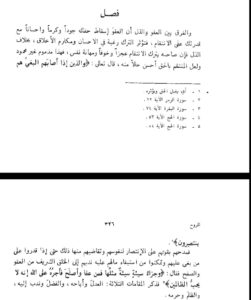
 الفرق بين العفو والذلِّ: أن العفوَ إسقاط حقِّك جُودًا وكرمًا وإحسانًا، مع قدرتك على الانتقام، فتؤثر الترك رغبةً في الإحسان ومكارم الأخلاق، بخلاف الذل، فإن صاحبه يترك الانتقام عجزًا وخوفًا ومهانة نفس، فهذا مذموم غير محمود، ولعل المنتقمَ بالحق أحسنُ حالًا منه

The difference between pardon and humiliation is that pardoning (others) is forgoing your right out of generosity, kindness, and benevolence, despite having the ability to seek revenge. So, you give precedence to abandoning (retaliation) out of a desire for doing good and noble character, as opposed to humiliation because the humiliated one abandons revenge due to inability,  fear, and a sense of personal degradation. This is considered blameworthy and not praiseworthy. It may be that the one who seeks revenge justly is in a better situation than him.

A paraphrased excerpt from “Ar-Ruh” page 325″. Publisher: Dar Kutub Ilmiyyah 1st Edition 1982.


Careful Deliberation Before Sharing Videos of Ourselves On Social Media

In The Name of Allah, The Most Merciful, The Bestower of Mercy.

This brief article serves as a reminder for myself, a gentle reminder for the children of my house and for our beloved youth. Above all, I want to remind myself and my household’s children to embrace good manners and humility wherever they may be. Al-Allamah Rabee Bin Hadi Al-Mad’khali, may Allah have mercy on him, said:

Good manners is a necessity in the path of seeking knowledge, and (when dealing with) scholars and elders. It was said to king Abdul Azeez, may have mercy upon him, “How do you view the people?” He said, “The people in my view are three types: a man who is older than me, so he is placed in my father’s position; a man who is in my age group, so he is placed in my brother’s position, and a man who is younger than me, so he is like my son”. Therefore, a Muslim behaves towards his brothers in this manner- he places the people in these different categories. [1]

All of us must adhere to this noble advice when dealing with one another, regardless of whether we agree or disagree with any person we are dealing with with. As we all desire to uphold sound principles, pursue virtue, Taqwah and Wara, our dealings must reflect these pursuits. I remind myself, the children of my household and the youth – those who grew up in our presence and those whom we know or have met, and all others we do not know, but it is enough that Salafiyyah has created a strong bond between us- that the Messenger, peace and blessings of Allah be upon him, is the greatest criterion, as Imam Sufyan Ibn Uyaynah, may Allah have mercy upon him, used to say:

Indeed, the Messenger, peace and blessings of Allah be upon him, is the greatest criterion [i.e. amongst mankind and Jinn] and all matters are presented to him [i.e. for judgement and judged] based on his manners, path and guidance. Therefore, whatever is in agreement with this is truth, and whatever is in opposition is falsehood. [2]

Take note and let it be absolutely known to you that by citing this above Athar, we are not implying anyone has engaged in falsehood or bidah. Instead, we reference this Athar to remind ourselves of the importance of permanently asking Allah for Tawfeeq, so that we may strive to emulate the greatest criterion among the creation. Similarly, we have not cited this Athar believing we have surpassed anyone in ittiba, nor do we claim to be those who completely avoid all that is unnecessary, or that we are the ones who scrutinise themselves more than everyone else to the extent that we refrain from everything unnecessary. What we truly intend by this Athar is our plea to Allah for Tawfiq, to focus our attention on the greatest criterion among creation, and to strive hard and keep on improving ourselves until we meet our Lord, and not to simply yield to societal pressures or trends, particularly those becoming prevalent on social media.

In this regard, I urge the older children in my home – first and foremost – to employ careful deliberation with regards to social media, particularly through videos, on Twitter, and other platforms. They should critically examine every aspect of why they would decide to appear in a video – whether it is recorded or live-streamed – on Twitter or any other social media site. Whenever someone thinks it is necessary or not a big issue to appear in a video, regardless of the requester’s viewpoint, they should reflect on their own motivations thoroughly. The topic of videos and Dawah, based on various scholars’ statements and opinions, is well known, but at the very least, they should remain attentive to moderation, careful consideration, and self-reflection, which, by the Tawfiq of Allah, will help them assess the necessity of getting involved at any moment, location, or circumstance. This is also a reminder for myself and all our beloved youth.

Similary, I remind myself, the children in my home, and all our beloved youth to behave respectfully, honoring those who are older than us, treating our peers well, and being compassionate towards those younger than us while addressing this issue. Even if we need to be firm and resolute, we should do so with maturity and respect.

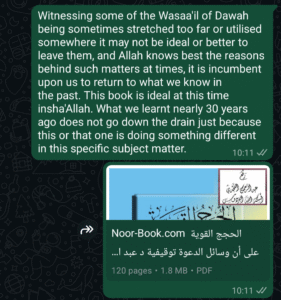
Finally, here is a fantastic book regarding the Wasaa’il of Dawah by the Aalim Shaikh Abdus Salam Burjess, may Allah have mercy upon him. Noor-Book.com الحجج القوية على أن وسائل الدعوة توقيفية د عبد السلام بن برجس كتاب 1027 3


[1] Marhaban Yaa Taalibal Ilm’ pages 123-124
[2] Al-Jaami Li-Akhlaaq Ar-Raawi Wa Aadaab As-Saami’  page 8]

The numbers are absolutely irrelevant

In The Name of Allah, The Most Merciful, The Bestower of Mercy.

Imam Abdul Azeez Bin Baz, may Allah have mercy upon him, said:

Let every Muslim be careful of being deceived by the great numbers [i.e. people upon such and such idea, view, belief, way of life, etc], while saying, “Indeed, the people have become such and such, and have become accustomed to such and such, so I am with them”. This is a great calamity, for indeed many people of the past were destroyed due to this [i.e. blindly following the majority]. O sensible one! It is obligated to you to examine yourself; take account of yourself and adhere to the truth, even if the people abandon it. Beware of what Allah has forbidden, even if the people do it, for indeed the truth is more worthy of being followed, just as Allah [The Most High] said:

وَإِنْ تُطِعْ أَكْثَرَ مَنْ فِي الْأَرْضِ يُضِلُّوكَ عَنْ سَبِيلِ اللَّه ِ

And if you obey most of those on earth, they will mislead you far away from Allah’s Path. [Al An’am. 116]

Allah [The Most High] said:

وَمَآ أَڪۡثَرُ ٱلنَّاسِ وَلَوۡ حَرَصۡتَ بِمُؤۡمِنِينَ

And most of mankind will not believe even if you desire it eagerly]. [Surah Yusuf Ayah 103] [(1)]

Imam Muhammad Ibn Salih Al-Uthaymin, may Allah have mercy upon him, said:

A Muslim is obligated to feel honoured in his religion, to be proud of his religion and adhere strictly to the guidelines ordained by Allah and His Messenger, peace and blessings of Allah be upon him, within this upright religion that Allah has chosen for His servants. He should neither add to nor subtract from it. What is also obligated to a Muslim is that he should not be [إمَّعَةً –  a yes-man] who follows everyone that screams; instead, his character should be in accordance with Allah’s Shariah, aiming to be one who is emulated (in righteousness) and not a follower (in evil), and to serve as a role model rather than merely imitating others. This is because Allah’s Shariah – all praise and thanks be to Allah – is complete in every aspect, as stated in the verse:

الْيَوْمَ أَكْمَلْتُ لَكُمْ دِينَكُمْ وَأَتْمَمْتُ عَلَيْكُمْ نِعْمَتِي وَرَضِيتُ لَكُمُ الإِسْلامَ دِيناً

This day I have perfected your religion for you and completed My favor upon you and have chosen for you Islam as religion. [Al-Ma’idah 3] [(2)]

Al-Allamah Muqbil Bin Hadi Al-Waadi’ee, may Allah have mercy upon him, said:

If numbers are the scale by way of which you judge, then the majority are mostly blameworthy; and if persuasive speech and eloquence is the scale by way of which you judge, then indeed Allah described the Munaafiqoon that they have tongues that utter beautiful speech. Allah said: [وَإِن يَقُولُواْ تَسۡمَعۡ لِقَوۡلِهِمۡ – And when they speak, you listen to their words]. [Al-Munaafiqoon. 4]

Therefore, what is given consideration is that one knows the people of truth by their characteristics – that they call to the Book of Allah and the Sunnah of Allah’s Messenger [peace and blessings of Allah be upon him, his family, and companions], and they neither desire reward from the people nor seeking to be thanked. [(3)]

Al-Allamah Ahmad Bin Yahyah An-Najmi, may Allah have mercy upon him, said:

Know that the truth is that what (has been revealed by) Allah and (given to) His Messenger, peace and blessings of Allah be upon him in the Book and the Sunnah, even if its adherents and those who embrace it are few. What is conveyed in the Islamic legislation is the truth one is commanded to follow, even if the majority of the people free themselves from it and those who follow it are few. Allah stated:

ثُمَّ جَعَلْنَاكَ عَلَىٰ شَرِيعَةٍ مِنَ الْأَمْرِ فَاتَّبِعْهَا وَلَا تَتَّبِعْ أَهْوَاءَ الَّذِينَ لَا يَعْلَمُونَ
إِنَّهُمْ لَنْ يُغْنُوا عَنْكَ مِنَ اللَّهِ شَيْئًا ۚ وَإِنَّ الظَّالِمِينَ بَعْضُهُمْ أَوْلِيَاءُ بَعْضٍ ۖ وَاللَّهُ وَلِيُّ الْمُتَّقِينَ

Then We have put you (O Muhammad) on a plain way of (Our) commandment [like the one which We commanded Our Messengers before you (i.e. legal ways and laws of the Islamic Monotheism)]. So follow you that (Islamic Monotheism and its laws), and follow not the desires of those who know not. Verily, they can avail you nothing against Allah (if He wants to punish you). Verily, the Zalimun (polytheists, wrong-doers, etc.) are Auliya’ (protectors, helpers, etc.) to one another, but Allah is the Wali (Helper, Protector, etc.) of the Muttaqun (pious). [Al-Jaathiya. 18-19]

Therefore, O slave of Allah! Be eager to follow the truth, follow the straight path and the path of early pious predecessors- the companions of the Messenger, and do not feel lonely due to the small numbers of those who follow it and the large numbers of those who oppose it, for indeed Ibrahim, peace be upon him, was an Imam on his own and with Allah lies all success. [(4)]

We ask Allah:

اللَّهُمَّ أَصْلِحْ لِي دِينِي الَّذِي هُوَ عِصْمَةُ أَمْرِي

وَأَصْلِحْ لِي دُنْيَايَ الَّتِي فِيهَا مَعَاشِي

وَأَصْلِحْ لِي آخِرَتِي الَّتِي فِيهَا مَعَادِي

وَاجْعَلِ الْحَيَاةَ زِيَادَةً لِي فِي كُلِّ خَيْرٍ

وَاجْعَلِ الْمَوْتَ رَاحَةً لِي مِنْ كُلِّ شَرٍّ

O Allah! Rectify my religion for me, which is the safeguard of my affairs; rectify my worldly [affairs], wherein is my livelihood; and rectify my Afterlife to which is my return; and make life for me [as a means of] increase in every good and make death for me as a rest from every evil. [Sahih Muslim Number: 2720] [5]


[(1)] An Excerpt from ‘Majmoo Al-Fataawaa 12/ 412

[(2)] Majmu Fatawa 2/301

[(3)] قم المعاند – 2/547

[(4)] An Excerpt from Irshaad As-Saaree Fee Sharh Sunnah Lil-Barbahaaree page: 47

[5]https://salafidawahmanchester.com/2020/12/29/o-allaah-rectify-my-religion-for-me-which-the-safeguard-of-my-affairs-a-tremendous-supplication/

Some Examples From The Imams of Guidance and Piety – Nurturing Genuine Love, Affection and Respect

In The Name of Allah, The Most Merciful, The Bestower of Mercy.

Mujahid, may Allah have mercy upon him, said: “A man passed by Abdullah ibn Abbas, may Allah be pleased with him and his father, so he said: ‘This man loves me.’ It was asked, ‘How do you know that?’ He replied, ‘I love him.'” [1]

Abu Idris Al-Khawlanee, may Allah have mercy upon him, reported: I entered the Damascus Masjid in Syria, then saw a young man with bright teeth and people were gathering around him. When they differed about something, they refer back to him and took his opinion. I asked about him and was told “This is Mu’adh Ibn Jabal”. So, I gave him Salaam and said, “By Allah! I love you for the sake of Allah”. He said: “For Allah’s sake?” I said: “For Allah’s sake”. He said: “For Allah’ sake?!” I said, “For Allah’s sake”. He held my cloak, got me close to him and said: “Rejoice, for indeed I heard Allah’s Messenger, peace and blessings of Allah be upon him, say, ‘Allah, The Mighty and Majestic, said: “My love is guaranteed for those who love one another for My sake, those who sit together for My sake, those who visit one another for My sake, and those who spend on one another for My sake”. [2]

Humayd reported from Al-Hasan, may Allah have mercy upon both of them, that Abu Ad-Dardaa, may Allah be pleased with him, said: “Be a scholar, or a learner, or one who loves (knowledge and its carriers) or one who follows (the truth). And do not be the fifth?” He (Humayd) said: “I said to Al-Hasan, I who is the fifth?” He said: “A Mubtadi”. [3]

A man said to Shahr ibn Hawshab: “Indeed, I love you”. He replied: “Why can you not love me, while I am your brother in faith upon Allah’s Book, your helper in the religion ordained by Allah and my livelihood is given by other than you”.(i.e. Allah) [4]

Imam Adh-Dhahabi, may Allah have mercy upon him, stated about Shaikh Al-Islam Ibn Taymiyyah, may Allah have mercy upon him, “He has those who loved him among the scholars and the righteous, as well as among soldiers and rulers, merchants and dignitaries, and the general public loves him. This is because he is benefits them day and night with his tongue and pen. [5]

Taj Ad-Deen As-Subki, may Allah have mercy upon him, said: “I was often in the company of Adh-Dhahabi, may Allah have mercy upon him, going to him twice daily, in the morning and in the afternoon. As for al-Mizzi, I would only go to see him twice a week. The reason for this was that Adh-Dhahabi showed me great affection and kindness, to the extent that anyone who knew my situation with him would know that he did not love anyone as much as he loved me. I was young at that time and this had a great impact on me”. [6]

Ibn Abbas stood up next to Zaid Bin Thabit [may Allah be pleased with both of them] and held the stirrup of his riding beast. Zaid said to him, “Step aside, O cousin of Allah’s Messenger [peace and blessings of Allah be upon him]”. Ibn Abbas said to him, “This is what we do for our scholars and elders”. [7]

Salamah Bin Kuhail [may Allah have mercy upon him] said: “Ash-Shabi and Ibrahim An-Nakha’i [may Allah have mercy upon upon both of them] never sat together except that Ibrahim remained silent, and both of them were Taabi’een”. [8]

Al-Marwazi [may Allah have mercy upon him] said, “Abu Abdillah [Imam Ahmad – may Allah have mercy upon him] used to be from those who honoured his fellow Muslim brothers the most and those who were older than him. One time, Abu Hammam [may Allah have mercy upon him] came to him on a donkey, so he held the stirrup of the riding beast for him. I witnessed him doing the same for the eldest Shaikhs”. [9]

Idris Bin Abdul Karim said: “Salamah Bin Aasim said to me: “I want to hear Kitaab Al-Adad from khalaf”. I said, “Khalaf?” He said: “Let him come”. When Khalaf entered, he tried to make Salamah sit in the teacher’s place, but he refused, and said: “I will not sit except in front of you”. Then he said, “This is the right of learning”. Khalaf said to him: “Ahmad Ibn Hanbal came to me to listen to the narrations of Abu Awanah, so I tried make him sit and transmit, but he refused and said: “I will not sit except in front of you. We are commanded to be humble in the presence of the one from whom we learn”. [10]

Muhammad Ibn Raafi said: I was with Ahmad (Imam Ahmad) and Ishaq in the company of Abdur Razzaaq when the day of Eidul Fitr arrived, so we went out with Abdur Razzaaq to the Musalla and with us were many people. When we returned, Abdur Razzaaq invited us to lunch, then he said to Ahmad and Ishaq, “Today I saw something strange from both of you. You did not say the Takbir”. Ahmad and Ishaq said, “O father of Abu Bakr! We were waiting for you to say the Takbir so that we could say the Takbir, but when we saw that you did not say the Takbir, we refrained”. Abdur Razzaaq said, “I was waiting for both of you to say the Takbir so that I could say the Takbir”. [11]

Abdullah Bin Ahmad [may Allah have mercy upon him] said: I heard my father [Imam Ahmad – may Allah have mercy upon him] being asked: “Why did you not hear a lot (of hadith) from Ibrahim Bin Sa’d [may Allah have mercy upon him] and indeed he did stay next to you in the house of Amarah?” He said: “We attended his gathering once and he narrated to us. When the second session was held, he saw youth putting themselves forward (or speaking) before the elders, so he became angry and said, ‘By Allah! I will not narrate for a year’. He died and did not narrate (thereafter)”. [12]

Imam As-Sadi, may Allah have mercy upon him, stated about the Mu’allimeen (teachers):

They are the intermediary between the Messenger, peace and blessings of Allah be upon him, and his Ummah with regards to propagation of the religion and clarification of the Shariah. Had it not been for these ones, the people would have been like cattle. They nurture the souls and hearts of the slaves upon the beneficial sciences and sound knowledge. They are the ones who guide the Ummah in the fundamental and subsidiary affairs of their religion, and return them to the rulings related to the duties obligated to them and in their dealings, just as they return them to the affairs pertaining to worship. Through them the Book and the Sunnah are established, and through them is made clear truth from falsehood, guidance as opposed to misguidance, Halal as opposed to Haram, good as opposed to evil, and rectification as opposed to corruption. They are of varying ranks, in accordance with what they establish of knowledge, teaching and benefit- great or small. They have great rights (owed to them) by the ummah and are possessors of a lofty status. Therefore, the people must have love and respect for them. They must recognise their excellence and virtue, and thank them greatly. They are to supplicate for them in private and public, and seek nearness to Allah by having love for them and praising them. They are to proclaim their excellence; guard the hearts (from harbouring evil against them) and the tongues (from) insulting them, for this would tarnish their excellence. [13]

https://salaficentre.com/2025/07/28/we-recall-this-supplication-when-humans-compete-aimlessly-to-receive-the-love-of-others/


[1] Al-Ikhwan page 75 by Ibn Abee Ad-Dunya, may Allah have mercy him.

[2] Ahmad 22030

[3] Jami Bayan Al-Ilm 1/142. By Ibn Abdil Barr, may Allah have mercy upon him.

[4] Kitab Uyun Al-Akhbar 3/15

[5] Ar-Radd Al-Wafir 34

[6] Tabaqat Ash-Shafi’iyyah 10/398

[7] Al-Muntadhim Fee Taareekh Al-Muluk Wal Umam 5/215

[8] Taareekh Dimashq 25/367

[9] Al-Aadaab Ash-Shar’iyyah 1/416

[10] Al-Jaami Li-Akhlaaq Ar-Raawi Wa Aadaab As-Saami 1/198

[11] Siyar A’laam An-Nubula a 9/566

[12] Siyar A’laam An-Nubula 11/317

[13] An Excerpt from Nurul Basaa-ir Wal Albaab Fee Ahkaamil Ibaadaat Wal-Mu’aamalaat Wal Huqooq Wal Aadaab, page: 57-58

Louis René Beres: Please Offer Clarity, Not Half-Truths

In The Name of Allah, The Most Merciful, The Bestower of |Mercy.

Allah, The Exalted, said:

وَلَا تُجَٰدِلُوٓا۟ أَهْلَ ٱلْكِتَٰبِ إِلَّا بِٱلَّتِى هِىَ أَحْسَنُ إِلَّا ٱلَّذِينَ ظَلَمُوا۟ مِنْهُمْ

And argue not with the people of the Scripture, unless it be in (a way) that is better (with good words and in good manner, inviting them to Islamic Monotheism with Allah revelations), except with such of them as do wrong. [Al-Ankabut 46]

In an opinion piece published in the Jerusalem Post by Louis Rene Beres, the focus was on the threat posed by Jihadist groups following the political changes in Syria. The author explored some of the Jihadists’ beliefs, particularly their interpretation of Jihad. While the writer aimed to highlight the dangers of Jihadist violence, the discussion fell short in providing detailed analysis and clarification on crucial points. Additionally, there was a noticeable lack of comparison between the actions of Jihadists and Netanyahu’s Zionist gang where it might have been relevant. It seems Louis chose not to make this comparison, as the central theme of the piece suggests that the primary issue is Jihadi violence rooted in religious beliefs, as indicated by the title, “Dying to kill Jews, other infidels: The jihadi way to conquer mortality.”

Criticism of the Jihadists and warnings about their approach is correct, as all of them, even those that do not pose an immediate military threat to Muslim governments, are indeed quite dangerous. However, the conversation is missing a clear explanation and clarification of the sacred texts referenced, which allows for various interpretations or may be dismissed by pro-Jihadists as lacking solid evidence. Therefore, we will analyse each statement made by Louis where there might be misunderstandings, misconceptions, ambiguity, exaggeration, or a failure to recognise the similarities in specific contexts between the actions of Jihadists and Zionists.

Louis stated: Following the collapse of Bashar al Assad’s regime in Syria, jihadi terror groups are being refashioned and reconfigured across the Middle East. [end of quote]

Response: It remains unclear what specific research Louis has undertaken or whose findings are being referenced in relation to this development. However, it is widely acknowledged that the proponents of Bidah are adept at seizing opportunities, particularly the Khawarij, in times of political turmoil. The Messenger, peace and blessings of Allah be upon him, said: “There will emerge from the east some people from my nation who recite the Quran, but it will not go beyond their throats. Every time a faction of them emerges it will be cut off”. The Prophet repeated it twenty times, adding, “Every time a faction of them emerges it will be cut off, until the False Messiah emerges from their remnants”. [1] The Messenger, peace and blessings of Allah be upon him, also said: “The Dajjal would be followed by seventy thousand Jews of Isfahan wearing Persian shawls”. [2]

It is, therefore, no astonishment to us when the Khawarij, whom we can also refer to as Jihadists, or certain factions within the Jewish community, such as the Zionists, instigate trials and tribulations.

Louis stated: Though there are evident and substantial differences between these groups, they all share a single overriding objective. This common objective is not geopolitical advantage or national self-determination, but “power over death.” Whatever else differentiates jihadi terror group ideologies and tactics from one another, all Islamist groups seek personal redemption through “sacred violence.” [end of quote]

Response: This why the upright scholars of Islam referred to them as Ahlul Bidah Wal Furqah- the advocates of religious innovation and discord, akin to the factions within Zionism and globalism, which, despite their internal differences, are unified by a singular ambition for dominance at any cost and by any means necessary. It is essential to recognise that the perpetrators of such violence extend beyond these Jihadi factions; the Zionists, too, bear the weight of culpability, having engaged in acts of brutality for over seven decades. While the Jihadists justify their violence through distorted texts and exaggeration, figures like Netanyahu similarly invoke religious texts to legitimise their own acts of aggression. [Footnote a]

Louis stated: In essence, jihadist terror is a convenient form of religious sacrifice. Moreover, the jihadi rallying cry, “We love death,” is common to both Sunni and Shia insurgents. In shrieking this perverse cry, no fundamental differences arise between Hayat Tahrir al-Sham (HTS) in Syria, Houthis in Yemen and Hamas/Fatah in Gaza/West Bank. [end of quote]

Response: Jihadist terror signifies a significant deviation from the authentic teachings and practices of the Prophet, extending beyond the realm of mere religious sacrifice. The pious predecessors revered martyrdom, yet they never resorted to the methods employed by today’s Jihadists. Moreover, the mention of Sunni and Shiite insurgencies merely reflects the phenomenon of khuruj, [Footnote b] regardless of the individual’s declared affiliation. Additionally, the identification with Sunniyyah has become a refuge for Jihadists and others who mislead unsuspecting Muslims, while also being exploited by certain demagogues, ideologues, and sensationalists in the media to tarnish the pristine methodology of the Prophet and his companions. It is imperative to clarify this matter, ensuring that pure Sunniyyah is distinguished from Bidah and the paths of those who advocate for innovation in the religion of Islam. [Footnote c]

The jihadi factions emerging in the West Bank, despite their misguided approach to resisting Zionist forces, are undeniably a direct consequence of the brutalities inflicted by Zionism. The Houthis, characterized as Rafidah and Khawaarij, [Footnote d] alongside Hamas, serve as strategic instruments for the Israeli Right. [Footnote e] While Louis astutely recognises the shared characteristics among these divergent groups and sects, it is essential to acknowledge that the jihadists in Palestine are fundamentally a product of Zionist oppression. Consequently, the turmoil we witness is rooted in Bidah, Zionism, and brutality.

Louis stated: Nonetheless, all jihadi forces seek “martyrdom” in order not to die. This is the case even though virtually all terrorist leaders in Hamas, Hezbollah, Islamic Jihad, Fatah enthusiastically prescribe martyrdom for their followers, but not for themselves. [end of quote]

Response: Martyrdom in Islam transcends the confines of the battlefield. [Footnote f] It is essential to recognize that the pursuit of martyrdom in combat must align with the righteous path established by the Prophet, as interpreted and enacted by the Sahabah. The teachings and rulings concerning jihad are well-documented within Islamic tradition, and they should not be shaped or interpreted through the lens of the actions, rhetoric, or ideologies of contemporary jihadists. [Footnote g]

Historically, monarchs, sultans, and emperors actively participated in battles alongside their troops until the very end. In contrast, contemporary heads of state do not engage in physical combat. The reasons for this shift are widely recognized and do not require further discussion. Furthermore, it is important to note that the Jihadists have no legitimate authority to engage in warfare or issue directives. Rather, they are categorized as Khawarij, extremists who adhere to misguided beliefs and innovations in religion. Similarly, while they conceal themselves and incite others to violence, Zionist leaders also command their military forces to execute operations under the pretext of self-defense and retaliation. This has led their armies to engage in actions that have been labeled as genocide. Jihadists find support primarily among those they have misled through slogans and distorted interpretations of texts. In contrast, Zionists have garnered backing from individuals who either feel a historical sense of guilt for past injustices against Jews or those who align with their geopolitical interests in the Middle East. Additionally, some supporters are motivated by distorted beliefs regarding the coming of the Messiah. This support for Zionist agendas has persisted for many years. [Footnote h]

Louis stated: Despite the easily discoverable commonalities of jihadi terror, the evolution of Palestinian criminal violence against Israel displays a unique historical narrative. The original fraternity of Palestinian terrorist groups contained extraordinarily disparate bedfellows. At that time, Israel’s “liquidation” (the primal term used most frequently in the terrorist lexicon) justified all manner of indiscriminate harms. Virtually every Arab enemy of Israel was urged to join in the obligatory war against “Zionists.” Even Marxists and similarly flagrant “unbelievers” found welcome under the same operational tent. [end of quote]

Response: Similarly, the evolution of criminal violence perpetrated by Zionist settlers against Palestinians presents a distinct historical narrative, despite the readily identifiable similarities between Zionist and Globalist transgressions. Zionist transgression is well-known.

Few Examples of Zionist Aggression

The Deir Yassin Massacre: Took place on April 9, 1948, near Jerusalem, during which between 107 to 254 Palestinians were massacred at the hands of the extremist “Stern” gang.

The Nasr al-Din Massacre: Took place in April 1948. Al-Lajjun Massacre: Took place on April 13, 1948, in a Palestinian Arab village in the Jenin District, where the Zionist Haganah gang attacked it and killed 13 people.

The Saliha Massacre: Took place in May 1948, during which 75 Palestinians were massacred.

The Abu Shusha Massacre: Took place on May 14, 1948, near the village of Deir Yassin, and claimed the lives of (50) citizens, including women, men, children, and the elderly.

The Beit Daras Massacre: Took place in northeastern Gaza on May 21, 1948.

The Tantura Massacre: Took place on May 22, 1948, in the occupied city of Haifa, and claimed the lives of about (200) Palestinians.

The Lydda Massacre: Took place on July 12, 1948, in the occupied city of Lydda, and resulted in the massacre of about (500) Palestinians, including (150) who were massacred inside the city’s Grand Mosque. The Zionists threw many of them alive into the town’s wells.

The Dawayima Massacre: Took place on October 29, 1948, when a battalion from the terrorist “Lehi” organization led by Moshe Dayan attacked the village and then began searching homes and shooting at its residents. Entire families were exterminated in the massacre, which resulted in the killing of 200 men, women, and children.

The Zionist massacres did not stop after the Nakba of 1948, but rather their frequency, intensity, and brutality increased in light of the use of more lethal and destructive weapons. Among the most prominent of these massacres were: The Sharafat Massacre, which took place in February 1951, in which 11 Palestinians were massacred, and the rest of the village’s people were displaced. The Bethlehem Massacre took place in January 1952, in which 10 Palestinians were massacred. The Qibya Massacre took place on October 14, 1953, in the village of Qibya, east of Jerusalem, during which (67) Palestinians were massacred, most of whom were women and children, and during which 56 homes were destroyed. The Qalqilya Massacre took place on October 10, 1956, when the occupation forces attacked citizens in the city of Qalqilya in the West Bank, during which about seventy citizens were massacred.

The Kafr Qasem Massacre took place on October 29, 1956, in which 49 Palestinians were massacred, including 11 children, when they were all returning home from work. The Khan Yunis Massacre took place on November 3 and 12, 1956, in which between 280 and 500 Palestinians were massacred.

In 1970, Zionist aircraft struck Bahr al-Baqar Primary School and Abu Zaabal factories, killing more than 150 Egyptian students and workers. In 1980, the extremist Jewish organization Kach attempted to blow up Al-Aqsa Mosque, and a shipment of explosives weighing 120 kg was discovered. The Sabra and Shatila massacre took place in September 1982. This massacre lasted three days, and its direct perpetrators were members of the Lebanese Phalange forces allied with the Zionists led by Ariel Sharon. The Ibrahimi Mosque Massacre took place on February 25, 1994, when a Zionist named “Barog Goldstein” stormed the Ibrahimi Mosque in the city of Hebron, and fired bullets and bombs at the worshipers. This massacre resulted in the massacre of 29 Palestinians. The Qana Massacre took place on April 18, 1995. [3]

There is no doubt that groups have come together, albeit through flawed methods, to challenge Zionists, while Zionists have united various sects and factions to invade Palestine. Today, different Jewish groups exist in Palestine, and nearly all, with a few exceptions, are complicit in the ongoing oppression. Certain Zionists find common ground with various allies, including figures like Tommy Robinson, to advance their objectives. In a similar vein, jihadists, driven by their flawed principles, are anticipated to forge alliances as well. However, Louis has not specified which Marxists have aligned themselves with jihadist factions. The concept of unholy alliances is familiar to those acquainted with Bidah, yet history also reveals instances where Jews collaborated with polytheists in efforts against the final Prophet, Muhammad, peace and blessings of Allah be upon him. Allah said:

أَلَمْ تَرَ إِلَى ٱلَّذِينَ أُوتُوا۟ نَصِيبًا مِّنَ ٱلْكِتَٰبِ يُؤْمِنُونَ بِٱلْجِبْتِ وَٱلطَّٰغُوتِ وَيَقُولُونَ لِلَّذِينَ كَفَرُوا۟ هَٰٓؤُلَآءِ أَهْدَىٰ مِنَ ٱلَّذِينَ ءَامَنُوا۟ سَبِيلًا

Have you not seen those who were given a portion of the Scripture? They believe in Jibt and Taghut and say to the disbelievers that they are better guided as regards the way than the believers (Muslims). [Nisa 51]

Louis stated: Things are now different. The jihadi terrorist fight is now openly oriented to the idea of “holy war” as religious sacrifice. This unhidden orientation is relentless, persistent, and conspicuously barbarous. The October 7, 2023 Hamas rape and murder of Israeli and other noncombatants is the most obvious case in point. In explaining such egregious crimes, history deserves pride of place. [end of quote]

Response: The institution of holy war, or Jihad, within Islam does not endorse the actions described, irrespective of who commits them. A rational individual cannot justify the events of October 7, which targeted non-combatants, nor can they accept any mistreatment of combatants that deviates from the principles outlined in Islamic law. This matter has been thoroughly discussed in the provided link. https://abuiyaad.com/a/amalekite-genocide-doctrine-gaza

While the events of October 7 were undeniably brutal, they pale in comparison to more than seventy years of Zionist violence, both within prison walls and beyond. It is essential to recognize that all acts of atrocity, irrespective of their nature or perpetrator—be it Jihadists, Zionists, globalists, Ba’athists, or others—deserve unequivocal condemnation.

Louis stated: Speaking on official Palestinian Authority TV, on November 7, 2014, a senior Fatah official blessed all Islamic killers of Israelis: “Jerusalem needs blood in order to purify itself of Jews.” Two days later, on November 9, PA television honored these same killers as follows: “Greetings and honor to our heroic martyrs… We stand submissive and humbled by what you gave and sacrificed.” Then on November 14, the PA Ministry of Religious Affairs summarized in Al-Hayat Al-Jadida: “Jerusalem needs sacrifices and blood.” [end of quote]

Response: Violence begets further violence. Should these assertions reflect the belief that non-combatants and unarmed civilians are to be harmed, no individual well-versed in the true essence of Islam would condone such actions. Yet, we find analogous declarations made by Zionists. Explore further on this link: https://salafidawahmanchester.com/2025/01/15/must-take-a-look-at-what-is-happening-in-their-own-backyard-first/

Louis stated: BUT WHO, exactly are these prospective “martyrs?” The deepest roots of jihadi terror originate from cultures that embrace religious views of sacrifice. In these cultures, the purpose of sacrifice extends far beyond any presumed expectations of civic necessity. Rather, this rationale goes to the innermost heart of individual human fear; that is, to the palpable and universal dread of personal death. [end of quote]

Response: The concept of sacrifice within religious contexts transcends mere martyrdom in the battlefield; it permeates every facet of faith, influencing personal conduct and interactions with others. A quintessential illustration of this principle can be found in the lives of Muhammad and his companions. Any deviation from their established path cannot be deemed a true sacrifice; instead, it veers into the realms of extremism or negligence. In Islam, life, death, and sacrifice hold significant meanings, yet they are distinctly separate from the narratives espoused by Jihadists and insurgents. The quest for death driven by extremism aligns with the ideologies of the Khawaarij and the Muta’assibah or Saffakoon among the Jews. “They were a group whose thought was close to that of the Pharisees, but they were very aggressive and believed in assassinating anyone who disagreed with them. They were called Saffaakoon (Those eager to commit Murder). They committed pillage, plunder, and transgressed against everyone who accepts submission to others besides them. Hostility occurred between them and the Pharisees because the Pharisees submitted to the Romans. Some of the researchers consider them to be from the political or nationalistic sects, even though their movement started within a religious framework, but great was their crimes which they committed from one place to another”. [4]

Louis stated: Jihadi enticements are not hard to appreciate. The promised reward for those who sacrifice for jihad is salvation. Says the Qur’an (Sura 2:154): “Do not think that those who are killed in the way of Allah are dead, for indeed they are alive, even though you are not aware.” [end of quote]

Response: Firstly, Jihadi enticements are easy to appreciate by those who do not understand the conditions of Jihad nor the creed and methodology of the pious predecessors, nor are they honestly clarified by those demagogues, ideologues and rabble-rousers who know what Islam truly stands for, but they deceitfully use the Jihadists to slander or blame Islam. The promise of reward in Jihad is not for the one who enters into it with ignorance and transgression. This verse is free from the extremism and misguidance of the Jihadists, instead was revealed regarding those who performed Jihad in obedience and adherence to the Sunnah of the Messenger, and it is something hoped by all those who embark upon Jihad when the Muslim rulers call them to Jihad after its conditions are met. For further clarity, we’ll quote the translation of the verse from the noble Qur’an by Al-Allamah Taqiyuddin Al-Hilali and Dr Muhsin Khan, may Allah have mercy upon them, as well as the commentary by Imam al-Baghawi, may Allah have mercy upon him. Allah said:

وَلَا تَقُولُوا۟ لِمَن يُقْتَلُ فِى سَبِيلِ ٱللَّهِ أَمْوَٰتٌۢ بَلْ أَحْيَآءٌ وَلَٰكِن لَّا تَشْعُرُونَ

And say not of those who are killed in the Way of Allah, “They are dead.” Nay, they are living, but you perceive (it) not. [Al-Baqarah 154]

The verse was revealed concerning the martyrs of Badr, who numbered fourteen individuals—six from the Emigrants and eight from the Helpers. People would often say that those who were killed in the path of Allah had passed away, leaving behind the comforts and pleasures of this world. In response, Allah, Almighty revealed the following:

ولا تقولوا لمن يقتل في سبيل الله أموات بل أحياء ولكن لا تشعرون

And say not of those who are killed in the Way of Allah, “They are dead.” Nay, they are living, but you perceive (it) not.

Similarly, Allah stated regarding the martyrs of Uhud:

وَلَا تَحْسَبَنَّ ٱلَّذِينَ قُتِلُوا۟ فِى سَبِيلِ ٱللَّهِ أَمْوَٰتًۢا بَلْ أَحْيَآءٌ عِندَ رَبِّهِمْ يُرْزَقُونَ

Think not of those who are killed in the Way of Allah as dead. Nay, they are alive, with their Lord, and they have provision. [Aal Imran 169]

Imam Al-Hasan Al-Basri, may Allah have mercy upon him, said: The martyrs are alive in the presence of Allah, and their sustenance is presented to their souls, bringing them joy, just as the torment is shown to the souls of the people of Pharaoh morning and evening, causing them distress. [5]

This verse, therefore, cannot be appropriated by Jihadists, as it was revealed concerning individuals who engaged in Jihad rooted in the authentic tenets of the faith, rather than the misguided innovations and deviations espoused by the Khawarij and Jihadists. Reflect on this once more. https://abukhadeejah.com/salafi-shaikh-fawzaan-on-jihaad-in-our-times-and-the-guidelines-of-jihaad-according-to-islam/

Louis stated: In the Islamist Middle East, where theological doctrine divides humankind into the dar al-Islam (world of Islam) and the dar al-harb (world of war), acts of terror against “unbelievers” have long been defended as an expression of sacredness. For jihadi fighters, individual sacrifice ultimately derives from a feverishly hoped-for conquest of personal death. By adopting atavistic practices, the jihadist expects to achieve an otherwise unattainable immortality. Usually, there is also the expectation of a variety of more sensual or lascivious seductive benefits. [end of quote]

Response: This assertion can only be articulated by one of three individuals: either one who wishes to misrepresent Islam, or someone who intentionally disseminates half-truths, or perhaps an individual merely echoing what they have heard without true understanding, feigning knowledge they do not possess. Firstly, humanity is categorised as Allah has ordained, into believers in Him and the Messengers and those who either disbelieve in Allah and the Messengers, or those who disbelieve in His Messengers. Allah said:

هُوَ ٱلَّذِى خَلَقَكُمْ فَمِنكُمْ كَافِرٌ وَمِنكُم مُّؤْمِنٌ وَٱللَّهُ بِمَا تَعْمَلُونَ بَصِيرٌ

He it is Who created you, then some of you are disbelievers and some of you are believers. And Allah is All-Seer of what you do.

Secondly, territories are classified into three distinct categories: Dar Al-Islam, Dar Al-Kufr, and Dar Al-Harb, with not every Dar Al-Kufr qualifying as Dar Al-Harb. It is a well-established fact among those who engage in the study circles of scholars and their students that a clear distinction is made between “dar al-harb [a territory in conflict with Muslims]” and “dar al-kufr [a territory of disbelief].” Dar al-kufr refers to a region governed by disbelievers, who enforce their own laws and systems. In contrast, dar al-harb denotes a territory ruled by disbelievers, devoid of any treaty, covenant, or peace agreement with Muslim governments. A land may be classified as “dar kufr” yet not as “dar harb” if a covenant or peace agreement exists between Muslims and that territory, stipulating a mutual commitment to avoid conflict until it becomes unavoidable. [Footnote i]

Without a clear understanding of the distinctions between Darul Kufr, Darul Harb, and Darul Islam, the insidious narratives propagated by deceitful writers, demagogues, ideologues, and jihadists would flourish unchecked. These jihadists exploit their misleading narratives, weaving together selective verses to misrepresent their violent actions against both non-Muslims and fellow Muslims. Meanwhile, unscrupulous writers seek to depict Islam as a faith bent on the annihilation of non-believers. In this context, the proponents of Bidah serve as instruments for these manipulative figures. The aspirations for conquest and martyrdom cannot be built upon Bidah, no matter how it is cloaked in the guise of sacredness or promises of eternal rewards. It was imperative that Louis elucidate the definitions of Darul Kufr, Darul Islam, and Darul Harb, emphasising that only legitimate rulers, equipped with the authority of governance, possess the right to declare war or peace in Islam—not jihadists or insurgents. Furthermore, any individual who identifies as a Muslim and breaches a covenant established by Muslim leaders with other nations commits a grave sin; should they harm a non-Muslim under a pact of safety, the consequences are well known. The Prophet, peace and blessings of Allah be upon him, said: “Whoever killed a Mu’ahid (a person who is granted the pledge of protection by the Muslims) shall not smell the fragrance of Paradise though its fragrance can be smelt at a distance of forty years (of traveling)”. [6]

Louis stated: For jihadists, there are certain aspects of sacrificial terror that ought never to be overlooked. This two-sided nature of terror/sacrifice – the sacrifice of “The Jew” and the reciprocal sacrifice of “The Martyr” – is explicitly codified, within the Charter of Hamas and elsewhere, as a “religious problem.” Always, for the Islamist terrorist, the true enemy is “The Jew,” not “The Israeli.” [end of quote]

Response: Terrorism, regardless of the target—be it a Muslim, Christian, Jew, Israeli [Footnote j], Hindu, or any individual—is unequivocally denounced. The identity of the perpetrator, whether a Zionist, Muslim, Christian, or any other, holds no significance in the face of such heinous acts. This is why when certain segments of the biased media persistently inquired about the condemnation of Hamas for the attacks on October 7th, the discerning senior students of knowledge unequivocally articulated Islam’s firm position against all who perpetrate such heinous acts, stating: “Our condemnation is on the basis that such actions are unjust and oppose Divine Legislation and not because of the race or ethnicity or religion of the perpetrators, and thus we are able to maintain moral consistency and integrity. This is unlike Western politicians who are able to swiftly condemn Russia’s invasion of Ukraine, and support Ukraine (the invaded and occupied in this case) with money and weapons for resistance, but unwilling to condemn the genocide and ethnic cleansing of Gazans, while supporting the Mileikowsky regime with bombs, missiles and military hardware to facilitate the execution of that genocide and ethnic cleansing”. [7]

Louis stated: Earlier, Yasser Arafat’s appointed clergy, preaching on the Temple Mount, affirmed an immutable religious precept: “Palestinians spearhead Allah’s war against the Jews. The dead shall not rise, until the Palestinians shall kill all the Jews….” [end of quote]

Response: Should such a declaration be made, despite the absence of concrete evidence or citation from Louis, it remains utterly intolerable and deserving of condemnation, akin to the abhorrent genocidal rhetoric espoused by Netanyahu and other Zionist figures, which is rightly denounced by all individuals possessing a modicum of decency.

Louis stated: Today, when jihadists of any type plan specific tactics of suicide terrorism – that is, when leaders give orders from Turkey, Qatar, Lebanon, Yemen, etc. for “believers” to make sacrifices of themselves – they leave nothing about immortality to chance. Because dying in the act of killing “infidels,” “apostates,” and “unbelievers” is certain to buy freedom from the penalty of dying, these jihadists can conquer mortality by killing themselves. [end of quote]

Response: It is important to avoid ambiguity in discussions like these. Louis should explicitly state which orders were issued for specific incidents. While it is true that terrorism exists in various countries, including those mentioned, we must refrain from vague statements or speculation. What we can assert with certainty is that since 1948, Zionists have engaged in acts of terrorism, as previously noted, under the supervision of their leaders. However, this acknowledgment does not mean we should ignore the atrocities committed by Muslims against unarmed civilians and non-combatants in Palestine or elsewhere. Regarding the sacrifices mentioned, Louis has not provided specific details or evidence about who issued these orders, making it difficult to discuss them further. Claims about killing infidels, apostates, and unbelievers have already been discussed under the subject matter of war and peace. Additionally, discussions about mortality in the afterlife is affirmed because every believer in Allah and His final Messenger is granted eternal life in paradise, even some of them face punishment for sins lesser than major polytheism and disbelief. Conversely, disbelievers face eternal consequences. Furthermore, we have already referenced the meaning of verse [2:154], emphasising those who genuinely adhere to its teachings, rather than interpreting it through the lens of the jihadi narrative that Louis briefly mentions, without clearly differentiating it from the legitimate jihad prescribed in Islam.

Louis stated: IT’S A grand and incomparable bargain, one that deserves much closer note in Jerusalem (and Washington). For Palestinian jihadists in particular, homicide-suicide represents not only the transient “death” of heroic Muslims, but also the required annihilation of a religiously despised Jewish state. Accordingly, the promised bargain is a “win-win” for all jihadi “warriors.” [end of quote]

Response: It’s important to recognize that jihad comes with its own set of rules, and those who break them are responsible for their actions. Additionally, it’s crucial to understand that violence often leads to more violence. While the actions taken by some Palestinians in their struggle against Zionism may seem extreme, it’s essential to consider the far more egregious reality of the 70-year occupation and the suffering endured by the Palestinian people.

Louis stated: Root problem of terror in the Middle East

Though not yet widely understood, the root terrorism problem in the Middle East is jihadi death-fear and the consequent compulsion to sacrifice certain despised “others.” In turn, this often-overriding compulsion stems from the doctrinal belief that killing unbelievers and being killed by unbelievers represents the best available path to personal immortality. [end of quote]

Response: Contemporary terrorism stems from various factors, but at its core lies a lack of genuine devotion rooted in the pure teachings of the prophets. Before the desire for death arises in this context, it is essential that certain ideas take shape, even if those beliefs are often distorted or misapplied. It is not only irrational but also deeply troubling to suggest that the act of killing non-believers is the ultimate route to achieving personal immortality. This perspective overlooks the fundamental truth that Allah created both believers and non-believers, and it is solely His authority to determine who lives and who dies. This narrative should not be propagated based on extremist motivations but should reflect the understanding of the Sahaabah. The Prophet engaged with Jews, Christians, and polytheists, adhering strictly to the commands of his Lord. Additionally, another significant issue is the ongoing brutality faced by Palestinians at the hands of Zionists for over 70 years, who deny them dignity and the right to self-determination. The events leading up to 1948 were also instigated over many years by Christian Zionists to serve their agenda. [Footnote k]

Louis stated: To counter such belief, Israel must think in terms of desacralizing its relentless Islamist adversary and convincing him/her that ritualistic murders of Jews will lead not to paradise and limitless lascivious pleasures, but, as the Qur’an also says, to untold “terrors of the grave.” [end of quote]

Response: The unspoken horrors of the afterlife await those whom Allah has chosen to punish. However, the faithful believer in Allah and His final Messenger shall ultimately find their way to paradise, even if they face retribution for sins that are not as grave as major polytheism or disbelief. In stark contrast, the disbeliever in Allah or His Messenger, or a disbeliever in both of them, is destined to dwell in the flames for eternity. It is quite remarkable that Louis chose not to elaborate on the Islamic teachings regarding the verses misinterpreted by extremists, nor did he seek to liberate Islam from such a misguided approach. Instead, he merely alludes to the repercussions of malevolent actions in the Barsakh. Thus, Louis selectively quoted what served the interests of the Zionists, failing to discern between truth and falsehood in every matter, and did not challenge the Zionists for their misdeeds in the article we are addressing, unless such critiques have been articulated elsewhere unbeknownst to us.

Louis stated: For all jihadi terrorists, the violence-based struggle against Israel and America has never been about land, “settlements” or “self-determination.” Always, it has been about God and immortality. In this regard, Israel and the United States should be reminded that there can be no greater “political” power on earth than “power over death.” This is the case even though any such ultimate power is obviously a contradiction in terms.

In the ongoing reconfiguration of Islamist terror groups following Bashar Assad’s fall in Syria, all of these groups will share a presumed stake in expanding terror violence. Going forward, therefore, Israeli planners will need to factor such adversarial commonality into their counter-terrorism protocols. Pertinent decision-makers will need to understand that transient name changes of regional jihadi organizations are of secondary significance. Whatever the apparent differences between HTS and its predecessors, all groups will continue to embrace terrorism as religious sacrifice. [end of quote]

Response: The ongoing struggle marked by violence stems from the relentless force of Zionism, which has subjected the Palestinian people to suffering for over seven decades. This is compounded by the destructive influence of kharijism, which spills blood across both Muslim and non-Muslim territories, alongside the insatiable greed and hubris of globalism and neocolonialism that have supplanted traditional colonial practices. The concepts of God and immortality have become mere slogans, wielded to rationalise heinous acts. However, Allah, His Messengers, and the divine truth of His religion remain untouched by the machinations of Zionists, kharijites, and globalists. The cycle of murder and devastation is a direct consequence of straying from the path of obedience to Allah and His Messenger.

Imam Ibn Al-Qayyim articulated this profound truth:

Whoever ponders upon the state of affairs of the world will find that every affair of rectification is due to Tawheed, singling out Allah in worship and obedience to His Messenger (Muhammad). And every evil in the world, trial, affliction, scarcity (in livelihood), being overpowered by an enemy and other than that is due to (our) opposition to the Messenger and the call to other than (the way of) Allah and His Messenger. Whoever truly ponders upon this and examines the state of affairs of the world- since its beginning and until the time Allah will take it away and those upon it- he will realise this affair regarding himself and others, in general and specific (circumstances). And there is no Might or Power except with Allah –The Most High, The Most Great. [8]

Louis stated: In the ongoing reconfiguration of Islamist terror groups following Bashar Assad’s fall in Syria, all of these groups will share a presumed stake in expanding terror violence. Going forward, therefore, Israeli planners will need to factor such adversarial commonality into their counter-terrorism protocols. Pertinent decision-makers will need to understand that transient name changes of regional jihadi organizations are of secondary significance. Whatever the apparent differences between HTS and its predecessors, all groups will continue to embrace terrorism as religious sacrifice. [end of quote]

Response: The emergence of present day kharijites and Jihadists, with their varied slogans and affiliations, is an inevitable phenomenon, much like the persistent brutality, land appropriation, and propaganda associated with Zionism. While the jihadi factions in Syria are a relatively recent development, the oppressive actions of Zionists have been a longstanding issue for over seven decades. We denounce all forms of violence and extremism. Perhaps, one of the most compelling admonitions on this subject comes from Prince Turki Al-Faisal, may Allah protect him. Listen: https://www.youtube.com/watch?v=Z3-cWyFcK5w

And Allah knows best

——————————————————-

Footnote a:
https://abuiyaad.com/a/amalekite-genocide-doctrine-gaza
https://abuiyaad.com/a/slaughtering-children-holy-war/print
https://www.abuiyaad.com/a/pharoah-slaughtering-babies

Footnote b:
https://www.sahihmuslim.com/sps/sp.cfm?subsecID=MNJ16&articleID=MNJ160002&pfriend=

The Islamic Condemnation of Extremism and Terrorism. An eBook presentation for non-Muslims and for Da’wah.

The Khawarij Past and Present: ISIS Daesh in Iraq & Syria: Ibn Kathir (died 774 AH): If The Khawarij Ever Gained Strength in Iraq and Syria, There Would Be Mass Killing

Why do these militant Khawārij look upon the rest of humankind and see them as worthless scum who can be killed without regard?

Footnote c:
https://salafidawahmanchester.com/2025/01/05/sunni-shia-divide-a-brief-rebuttal-to-david-ben-basat-at-the-jerusalem-post/

Footnote d:

Who Are The Militant Hoothees?! They Are The Raafidah of Yemen!

Footnote e:
https://www.abuiyaad.com/w/hamas-israeli-right

Footnote f: The martyrs are of five kinds: one who dies of plague; one who dies of stomach ailment; one who is drowned; one who is buried under debris and one who dies fighting in the way of Allah. [Sahih Muslim 1914

Footnote g:

Salafi Shaikh Fawzaan on Jihad in our times and the guidelines of Jihad according to Islam

Footnote h:
https://salafidawahmanchester.com/2024/11/13/the-initial-rise-and-gradual-impact-of-christian-zionism-on-some-european-political-decision-makers/

https://salafidawahmanchester.com/2024/10/08/an-overview-of-christian-zionism-in-america-since-the-arrival-of-the-puritans/

American Christian Zionists’ Media Initiatives Aimed at Influencing Public Opinion, With a Brief Mention of The Concept of Greater Israel

Footnote i:

The Life of the Muhammad in Madinah: Treaties, Conquests and his Death (Islam 1.11)

Are Treaties With The Jews, the State of ‘Israel’ and other Non-Muslims Permitted? Is it Allegiance? Is it Apostasy?

Footnote j: http://www.shariah.ws/articles/duviqgl-shaykh-salih-al-fawzan-the-islamic-shariah-provides-security–for-muslims-and-non-muslims-and-those-who-violate-it-are-kh257rijites-who-are-to-be-fought-and-severely-punished.cfm

http://www.shariah.ws/articles/szsumlh-the-foundation-of-muslim-relations-with-non-muslims-who-do-not-show-aggression-and-hostility.cfm

http://www.shariah.ws/articles/nmsdfkp-islam-and-the-muslims-are-free-and-innocent-of-the-kharijite-extremists.cfm

Footnote k: https://salafidawahmanchester.com/2024/11/13/the-initial-rise-and-gradual-impact-of-christian-zionism-on-some-european-political-decision-makers/

https://salafidawahmanchester.com/2024/10/08/an-overview-of-christian-zionism-in-america-since-the-arrival-of-the-puritans/

American Christian Zionists’ Media Initiatives Aimed at Influencing Public Opinion, With a Brief Mention of The Concept of Greater Israel

[1] Sahih Ibn Majah 174

[2] Sahih Muslim 2944

[3] Compiled from various old Arab Newspapers

[4] Al-Faslu Fil Milal Wal-Ahwaa Wan-Nihal. 1/177-179 By Ibn Hazm. Publisher: Daar Al Jeel 1405AH.

[5] Tafsir Al-Baghawi

[6] Sahih al-Bukhari 6914

[7]https://abuiyaad.com/a/amalekite-genocide-doctrine-gaza

[8] Badaa’i Al-Fawaa’id 3/525-526]