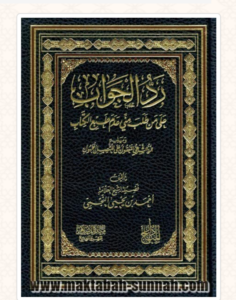
Shaikh Shamsuddeen Al-Afghaanee, may Allah have mercy upon him, said:
Allah, The Most High, guided mankind through Muhammad, peace and blessings of Allah be upon him, and through what he brought of clear manifest evidences and guidance – a guidance that could not be described by those who were proficient in giving descriptions and surpassed the knowledge of those with great perception.
Through this guidance, Allah opened the eyes of the blind ones, the ears of the deaf ones and the hearts of the heedless ones. Allah united them upon one religion- the religion of pure Islamic monotheism; Prophet Ibraaheem’s, peace be upon him, religion of pure monotheism – after they had been in a state of complete disunity, enmity towards one another, destructive and corrupt creeds.
Allah united their hearts and they became true brothers in Islam by way of this great blessing. And thereafter everything that was worshiped besides Allaah- such as graves, trees, stones, graven images, idols etc- ceased to exist and all worship was carried out for Allaah (alone).
The people followed the true Religion of Islamic monotheism, worshipped Allaah alone and established worship sincerely for Allaah, except those whom Allah willed that they were to remain as people of polytheism, hypocrisy and followers of the altered and distorted previous scriptures. The darkness of shirk (polytheism) was dispelled and the banner of Tawheed (pure Islamic Monotheism) was raised in the lands amongst the Arabs and non-Arabs.
The Messenger of Allah returned to his Lord, whilst Islam was established and in authority-superseding all other ways of life and creeds. Then the rightly guided khulafaa of the Messenger [AbuBakr, Umar, Uthmaan and Ali] continued upon this path until the two powerful and great nations at the time- Rome and Persia- ended up in humiliation, degradation and in a state of fear after they had been in a state of security, and thus Caesar was restricted and besieged, and khosrau was subdued and destroyed.
So when the enemies of Islaam saw that they were unable to do away with this religion, they implanted their disbelieving agents within Islam, who pretended to be Muslims in order to foment confusion, trials and tribulations, and spread Shirk (polytheism) by exaggerating the status of the pious people – exalting their graves through (beliefs and practices) that were not ordained by Allaah. So, this Ummah was put to trial through the plots of the [atheist, heretic and hypocrite] Abdullaah Bin Saba, who claimed Uloohiyyah for Ali Ibn Abee Taalib [i.e. that Ali has the right to be worship]. Abdullaah Bin As-Sabah’s followers were known as the Saaba’iyyah, and later on they were known as the rawaafid (shiites), the ismaaliyyah (shittes), the nusayriyah (shiites) and other than them amongst the Baatiniyyah. They used to worship the graves and the dead, and built places of worship and domed (shaped) shrines upon these graves. So, by way of this they revived the practices of the Jews, the Christians and idol worshippers, and thus the practices of the worshippers of graves in this Muslim Ummah manifested itself in deeds of the rawaafid (shiites).
Secondly: The books of Greek philosophy that contained the ideas of grave and idol worship were translated into Arabic, so many of those who attributed themselves to Islam busied themselves with these books, such as the likes of Al- Faraabee, Ibn Sinaa Al-Hanafi, Naseer At- Toosee the advocator of disbelief and polytheism and other than them amongst those who played tricks with Islaam, just as Paul played tricks with Christianity. They were influenced by the ideas of the Greek Philosophers- the creed of grave worship, so they became callers to grave worship through Greek Philosophy.
Thirdly: A people appeared among the Muslims manifesting asceticism. These people were more dangerous to the masses and more severe in misguidance. They were a people who appeared in the garb of the righteous, with tearful eyes smeared with kohl, long flowing beards, elevated turbans, carrying rosary beads and pretending to be calling to the sunnah of the leader of Humankind [Muhammad], whilst secretly practicing the disgraceful acts inherited from the false and vanished religions. And from their plots was that they used to mix manifest lies with the authentic explanations of the Qur’aan and the authentic narrations in order to corrupt the clear proofs of the Qur’aan and the Sunnah. These deviant heretics were known as the holooliyyah, ittihaadiyyah Grave worshippers (see footnote a), such as the likes of al-hallaaj (309ah), ibnul faarid (632ah), ibn arabi (638ah), ibn sina (669ah) etc (1)
Imaam Al-Alusi, May Allah have mercy upon him, said:
It has been reported in a hadith whose authenticity is agreed upon by Al-Bukhari and Muslim that the Messenger, peace and blessings of Allah be upon him, said:
“Indeed, you (Muslims) will follow the way of those before you (i.e. the misguided Jews and Chrsitians), hand span by hand span, cubit by cubit, to the extent that if they entered into the hole of a lizard, you will enter it too”. [Al-Bukhari 1397 & Muslim 4822]
The Prophet, peace and blessings of Allah be upon him, informed us that indeed there will be in his Ummah those who will follow the previous nations – the ignorant people amongst the people of the scriptures and other than them – hand span by hand span as has been explained in the hadith. There is no doubt that what he, peace and blessings of Allah be upon him, informed us has occurred, because indeed he is As-Saadiq Al-Masdooq [the truthful one and the one believed in everything he says] and he does not speak out of his own desires. Certainly those who adhere to his guidance and follow that which has been established in his Sunnah are not the ones intended in this hadith.
Therefore, it has to be the case that the people who follow the footsteps of the Jews and Christians are those who substitute and change (the religion), innovate in religious affairs and distort, imitate the previous nations in their actions and deeds, such as building tombs and mosques on the graves of their righteous people- invoking them during important events, during times when they face very painful situations and other than that (similar) to what the Jews, Christians and idol worshippers used to do. And amongst the extremists and innovators – the grave worshippers – there are those with the traits of the Jews, the Christians and the idol worshippers which attest to the fact that they follow their way hand span by hand span, cubit by cubit, and we shall mention some of this as a clear example of what we intend to point out. One of their traits [i.e. those Jews and Christians who went astray after the departure of their Prophets, as well as the idol worshippers] is that they used to perform acts of worship whilst associating partners with Allaah- associated the righteous people as partners with Allah in worship and considered it as a type of exalting the righteous people that is beloved to Allaah. Also their goal was to have their needs fulfilled and to be granted success through seeking the intercession of the righteous people, because they thought that the righteous people loved that they do so. Indeed, the Qur’aan has informed us of this trait of theirs. Allah [The Exalted] said:
إِنَّآ أَنزَلۡنَآ إِلَيۡكَ ٱلۡڪِتَـٰبَ بِٱلۡحَقِّ فَٱعۡبُدِ ٱللَّهَ مُخۡلِصً۬ا لَّهُ ٱلدِّينَ
أَلَا لِلَّهِ ٱلدِّينُ ٱلۡخَالِصُۚ وَٱلَّذِينَ ٱتَّخَذُواْ مِن دُونِهِۦۤ أَوۡلِيَآءَ مَا نَعۡبُدُهُمۡ إِلَّا لِيُقَرِّبُونَآ إِلَى ٱللَّهِ زُلۡفَىٰٓ إِنَّ ٱللَّهَ يَحۡكُمُ بَيۡنَهُمۡ فِى مَا هُمۡ فِيهِ يَخۡتَلِفُونَۗ
Verily, We have sent down the Book to you (O Muhammad ) in truth: So worship Allah (Alone) by doing religious deeds sincerely for Allah’s sake only, (and not to show-off, and not to set up rivals with Him in worship). Surely, the religion (i.e. the worship and the obedience) is for Allah only. And those who take Auliya’ (protectors and helpers) besides Him (say): “We worship them only that they may bring us near to Allah.” Verily, Allah will judge between them concerning that wherein they differ. [Az-Zumar. 2-3]
The worship devoted by the idol worshippers to them was that they supplicated to them, sought their needs from them, sacrificed animals to them, vowed to them and made oaths to them. Allah said:
وَيَعۡبُدُونَ مِن دُونِ ٱللَّهِ مَا لَا يَضُرُّهُمۡ وَلَا يَنفَعُهُمۡ وَيَقُولُونَ هَـٰٓؤُلَآءِ شُفَعَـٰٓؤُنَا عِندَ ٱللَّهِۚ
And they worship besides Allah things that hurt them not, nor profit them, and they say: “These are our intercessors with Allah]. [Yunus. 18] (2)
Imam Abdul Azeez Bin Baaz, may Allah have mercy upon him] said:
Some people invoke the inhabitant of a grave and others beseech him for help; some make vows to him and others seek assistance from him just as the Quraish pagans and other than them used to do during Al-Jaahiliyyah [i.e. during the period of pre-Islamic Ignorance], because they used to invoke Al-Uzza, Al-laat, Manaat and other idols, and likewise the polytheists-in every era-invoke their idols and those images they worship besides Allaah. They exalt them, invoke, seek assistance and blessings from them. This practice is a plot of shaytaan because what he eagerly wants to achieve is to distance people from the sound Islamic creed through every means. (3)
Du’aa (Invocation), Nadhr (vows), Dhabh (offering sacrifice) etc are acts of worship and can only be carried out for Allaah alone, and not for graves, tombs, shrines and their dead inhabitants
Ad-Du’aa: Invocation: “Your Lord says: O people, invoke Me and supplicate to Me making your worship sincerely for Me alone, and I will answer you, and pardon you and have mercy upon you. Indeed those who disdain to worship Me alone will enter Hell-Fire in disgrace. [Soorah Ghaafir. 60]
So the noble Aayah proves that invocation/supplication (du’aa) is worship, and if that were not the case it would not be said “those who disdain to worship Me alone….” So whoever called upon anyone besides Allaah[The Mighty and Majestic], requesting something which none but Allaah has power over, then he is a mushrik (one who worships others besides Allaah), an unbeliever (kaafir), whether the one he calls upon is living or dead. Whoever requests a living person for something which he is able to do, such as the saying: ‘O so and so give me food’ or ‘O so and so give me a drink,’ then there is no harm in that. But whoever asks a dead person or someone who is absent for that, then he is a mushrik, since the deceased or the absent cannot possibly do that. So in such a case his supplicating to them shows that he believes that they have some control over the creation, and he is therefore a mushrik. It must be noted that du’aa is of two types: (i) Supplication, when a request is made (du ‘aa-u mas’alah) and, (ii) invocation through worship (du’aa-u Ibaadah). So supplication is to request ones needs and is worship when the servant requests that from his Lord.
This is because it involves showing one’s poverty before Allaah [The Most High], and one’s need to turn to Him, and one’s certain faith that He is the one having full power, the Most Generous, the one who gives bounteously and is Most Merciful. Seeking one’s needs from someone else from the creation is permissible if the one to whom the request is made is able to hear and understand it, and has the power to respond to it, like the saying: ‘O so and so give me food.’ As for invocation through worship, then it is that the person does an act of worship seeking reward and fearing punishment, and this is not correct unless directed to Allaah alone. To direct this to anyone else besides Allaah is major shirk which takes a person out of the Religion, and he falls under the threat in the Saying of Allaah[Te Most High], “Your Lord says: O people, invoke Me and supplicate to Me making your worship sincerely for Me alone, and I will answer you, and pardon you and have mercy upon you. Indeed those who disdain to worship Me alone will enter Hell-Fire in disgrace.” [Soorah Ghaafir. 60]
Al- Isti’aanah-Appealing for aid and assistance: The evidence for this act of worship is the verse of the Qur’aan: “O Allaah You alone we worship, and to You alone we appeal for aid” [Soorah al-Faatihah. 5] and in the hadeeth there occurs: “If you seek help, then seek the help of Allaah.” [Reported by at-Tirmidhee and declared Saheeh by Shaykh al-Albaanee in al-Mishkaat (no.5302)]
Al-isti’aanah is to appeal for assistance, and it is of various types:
(i) Appealing for aid and assistance from Allaah – this is an appeal for aid and assistance that comprises complete humility of the servant before his Lord, and to submit and entrust the affair to Him, and to be certain that He is fully sufficient for him. This is not to be except for Allaah, the Most High, alone, and the evidence is the Saying of Allaah, the Most High, “O Allaah You alone we worship, and to You alone we appeal for aid.” [Soorah al-Faatihah]. The fact that this is to be for Allaah, the Most High, alone is shown by the fact that He mentions the word upon which the verb acts before the verb itself, and according to the principles of grammar of the Arabic language, in which the Qur’aan came down, bringing forward that which usually comes afterwards indicates restriction and particularisation. So directing this type to other than Allaah, the Most High, is shirk which takes a person out of the Religion.
(ii) Seeking the help of a person from the creation, in something which he is capable of helping in. Then this will be in accordance with the action in which help is sought. If it is a good action then it is permissible for the person to seek help upon it, and prescribed for a person to help in that, as Allaah [The Most High] says, “And assist one another upon righteous actions and avoidance of sins.” [Soorah Al-Maa’idah. Aayah 2]
If it is a sinful thing, then it is forbidden for the person doing it and for the one who assists, as Allaah, [The Most High] says, “And do not assist one another in abandoning what Allaah has commanded and upon transgressing the limits laid down in the Religion.” [Soorah al-Maa’idah. Aayah 2]
If it is something permissible, then it is allowed for the person to seek help and to be assisted, and the one who is helping may be rewarded for kind treatment and thus it becomes something prescribed for him as Allaah [The Most High] says, “And do good, indeed Allaah loves those who do good.” [Soorah al-Baqarah. Aayah 195]
(iii) Seeking the help of a person from the creation who is alive and present, except that it is something which he is incapable of, then this is futile and useless. For example that he seeks the help of a weak person in order to carry something very heavy.
(iv) Seeking the aid of any deceased person, or the aid of the living in a matter of the hidden and unseen, which they cannot reach. Then this is shirk since it will only be done by a person who believes that those whose help he seeks have some hidden control over the creation.
(v) Seeking help by performing deeds that are beloved to Allaah, the Most High. This is something that is prescribed due to the Saying of Allaah [The Most High], “And seek assistance through patience and Prayer.” [Soorah al-Baqarah. Aayah 45]
The author uses as evidence for the first type the Saying of Allaah [The Most High], “O Allaah You alone we worship, and to You alone we appeal for aid” [Soorah al-Faatihah Aayah 5], and the saying of the Prophet saying: “If you seek help then seek the help of Allaah”. The evidence for seeking refuge (al-isti’aadhah) is the Saying of Allaah, the Most High: “Say: I seek refuge with the Lord of the dawn” [Soorah al-Falaq. Aayah 1] and “Say: I seek refuge with the Lord of mankind”.[Soorah an-Naas Aayah 1]
Al-Isti’aadhah-To seek refuge; which is to seek protection against that which one hates and involves seeking refuge and shelter and protection from someone, and is of various types:
(i) Seeking the refuge of Allaah, the Most High, and this involves ones complete need of Him, attachment to Him, and one’s certain faith in His being sufficient and His perfect protection from everything, whether in the present or the future, small or large, human or not, and the proof is the Sayings of Allaah, the Most High, “Say: I seek refuge with the Lord of the dawn, from the evil of that which He created…” [Soorahal-Falaq. l-2] “Say: I seek refuge with the Lord of mankind; the king of mankind; the one who is worshipped rightfully by mankind; from the evil of Satan who whispers into the hearts of mankind and then withdraws when they remember Allaah…” [Soorah an-Naas. 1-4]
(ii) Seeking refuge in one of Allaah’s attributes, such as His Speech, His Greatness, His Might, and so on. The evidence for this are his sayings: The Prophet said, “I seek refuge in the perfect Words of Allaah from the evil of that which He created” [Reported by Muslim (Eng. transl. 4/ 142l/no.654l)]. He said, “I seek refuge in Your Might that I should not be assailed from below” [Reported by Aboo Daawood (Eng. transl. 3/1408/no. 5056) and declared Saheeh by Shaykh al-Albaanee in Saheeh Sunan Abee Dawood (no. 4239)]. Also his saying in the supplication recited when suffering from pain, “I seek refuge in the Might and Power of Allaah from the evil of what I feel and am wary of.” [Reported by Muslim (Eng. transl. 3/1198/no. 5462) and Ibn Maajah (no. 3522)]. The Prophet said, “I seek refuge in Your Pleasure from Your Wrath” [Reported by Muslim (Eng. transl. l/255/no.986)]. His saying, when Allaah, the Most High, sent down His Saying: “Say He is the One fully able to send punishment upon you from above.” [Soorah al-An’aam (6):65] He said: “I seek refuge in Your Face.” [Collected by al-Bukhaaree (Eng. transl. 9/370/503)].
(iii) Seeking refuge either with the dead, or with living people who are not present and able to grant refuge, then this is shirk. In this regard Allaah, the Most High, says, “And there were men from mankind who used to seek refuge with men of the jinn, and so that only increased them in transgression.” [Soorah al-Jinn. Aayah 6]
Seeking shelter with some person or in some place, or the like, as long as it is something which can serve the purpose of providing shelter. Then this is permissible and the evidence is his saying, speaking about tribulations, “Whoever exposes himself to them will be destroyed by them, and whoever finds a place of shelter or refuge from them, then let him take shelter in it” [Reported by alBukhaaree (Eng. transl. vol. 9/p. 158/no.203) and Muslim (Eng. transl. 4/1495/no.6893)]. He also explained this place of shelter or refuge in his saying, “So whoever has camels should stick to his camels…“ [Reported by Muslim (Eng. transl. 4/1495-1496/no.6896)]. There also occurs in Saheeh Muslim (Eng. transl. 3/91 I/no.4190) from Jaabir that a woman from the tribe of Banoo Makhzoom stole something, so then she was brought to the Prophet and she sought refuge with Umm Salamah. He also reports in his Saheeh (Eng. transl. 4/ 1494/no.6996) from Umm Salamah, from the Prophet that he said: “A man will seek refuge in the House and an army detachment will be sent against him…” However if it is the case that someone is seeking refuge from the evil of an oppressor, then it is obligatory to shelter him and grant him refuge as far as is possible. But if he seeks refuge in order to help him to commit something forbidden, or to flee away from an obligation, then it is forbidden to shelter him.
Al-istighaathah -To seek rescue and deliverance from severe difficulty and destruction, and is of various types:
(i) Seeking deliverance and rescue from Allaah, the Mighty and Majestic, is one of the most excellent and most perfect deeds, and it was the continual practice of the messengers and their followers. The evidence for it is what the Shaykh, rahimahullaah, mentioned, “When you sought aid and deliverance of your Lord and He responded to you that He was sending you a thousand angels in succession to assist you.” [Soorah al-Anfaal. Aayah 9]
This occurred at the battle of Badr when the Prophet saw the polytheists numbering a thousand men, whist his companions were a few more than three hundred and ten. So he entered the palm grove calling earnestly upon his Lord, the Mighty and Majestic, raising up his hands and facing the qiblah, and saying: “O Allaah fulfil that which You have promised me. O Allaah if this small group who are the people of lslaam are destroyed you will not be worshipped upon the earth.” Then he continued calling upon his Lord earnestly, with his hands raised such that his cloak fell from his shoulders. So Aboo Bakr, radiyallaahu ‘anhu, took up his cloak and cast it back upon his shoulders and embraced him from behind and said: “O Prophet of Allaah, your earnest supplication to your Lord will be sufficient for you since he will fulfil what He has promised you,” so this Aayah was sent down. [Reported by Muslim (Eng. transl. 3/960/no.4360)]
(ii) Seeking rescue and deliverance, either from the dead or from those who are living but are not present and able to give aid and rescue, then this is shirk. This is so because it will not be done except by one who believes that those people have some unseen control over the creation, and they have therefore attributed to them a share of the Lordship that is for Allaah, the Most High, alone. Allaah, the Most High, says, “Or is that which you falsely worship along with Allaah better than He Who responds to the one in distress when he calls Him; who removes the harm; and who makes you to succeed those who came before you?! Is there anything that is worshipped besides Allaah that can do these things for you?! Little do you consider the greatness of Allaah and His favours upon you, and the clear proofs He has given you, so you therefore associate others in worship with Him.” [Soorah an-Naml (27):62]
(iii) Seeking aid and rescue from those who are alive, aware of the situation and capable of assistance and rescue. It is permissible to seek aid and rescue from them: Allaah, the Most High, says in the story of Moosaa: “So the man who was upon the same Religion as Moosaa sought the aid of Moosaa against his enemy the copt, so Moosaa struck him forcefully and killed him.” [Soorah al-Qasas. Aayah 15]
(iv) Seeking rescue and aid from a living person who is not capable of assisting him, without believing that he has some hidden power. For example that a drowning person calls for rescue from a person who is paralysed. This is futility and is a mockery of the one whom he seeks rescue from, and is therefore prohibited for this reason. A further reason for its prohibition is that anyone who saw him seeking rescue from the paralysed man may be deceived into thinking that the paralysed man must have some hidden power enabling him to rescue people.
Adh-dhabh- Sacrifice: The evidence is the ayah of the Qur’aan: “Say, O Muhammad, indeed my Prayer, my sacrifice, my living and my dying are all purely and solely for Allaah, Lord of all creation. There is no share of any of that for other than him.” [Soorah al-An’aam. 162-163]. Also the Prophet said: “Allaah has cursed anyone who sacrifices for other than Allaah” [Reported by Muslim (Eng. transl. 3/ 1093- 1094/no.4876)]
Sacrifice is to kill by spilling the blood of the animal in a particular manner, and is done for a number of reasons:
That it is done as an act of worship, such that he intends by it veneration of the one for whom he sacrifices, and intends it as an act of submission to him and a means of nearness to him. So this may not be done except for Allaah, the Most High, and has to be done in the manner which Allaah, the Most High, has prescribed. Directing it to other than Allaah is major shirk and the evidence (as mentioned by the author) is the Saying of Allaah, the Most High, “Say, O Muhammad, indeed my Prayer, my sacrifice, my living and my dying are all purely and solely for Allaah, Lord of all creation. There is no share of any of that for other than Him’ [Soorah al-An’aam (6):162-3]
(ii) That it is done out of hospitality for the guest, or for as wedding feast (waleemah) or the like, then this is something commanded, either as an obligation or a recommendation, as he said “Whoever truly believes in Allaah and the Last Day, then let him treat the guest honourably” [Reported by al-Bukhaaree (Eng. transl. 8/99/no. 156) and Muslim (Eng. transl. 3/935/no. 4286)]. He said to ‘Abdur-Rahmaan ibn ‘Auf, “Give a wedding, feast (waleemah) even if it is only with a single sheep” [Reported by al-Bukhaaree (Eng. transl. 7/72/no.96)]. (iii) That it is done to provide food charitably, or to sell the meat and so on, then this falls under that which is permissible and is in principle according to the Saying of Allaah, the Most High, “Do those mushriks who worship others along with Allaah not see that We have created for them, from what our Hands have created, cattle which they are in charge of, and We have made the cattle subservient to them: so from them are those which they eat the meat of.” [Soorah Yaa Seen. 71-72] Furthermore, it may be something desirable or prohibited depending upon what it leads to.
An-nadhr- Vows: The evidence is the ayah: “They fulfil their vows and they fear a day whose evil is widespread”. [Soorah al-Insaan. 76-:77]
The verse is a proof since Allaah praises them for fulfilling their vows, which shows that Allaah loves that and every action that is beloved to Allaah is worship. This is further supported by the Saying of Allaah, the Most High, “…they fear a day whose evil is widespread.” [al-Insan. 7]
The fulfilling of vows which Allaah, the Most High, has praised are all acts of worship which Allaah, the Mighty and Majestic, has obligated. This is because when a person starts any of the obligatory acts of worship, then he has become duty bound to fulfil and complete them. The proof for this is the Saying of Allaah, the Most High, “Then let them complete the duties of their hajj, and fulfil their vows (e.g. the sacrifice), and let them perform the tawaaf of ifaadah around the ancient House.” [Soorah al-Hajj 29]
Vows by which a person makes a pledge and thus obligates himself to do something or other, or makes some act of obedience to Allaah, that is not obligatory, binding upon himself, then this is disliked, and some of the scholars declared it to be forbidden. This is because the Prophet forbade making vows and said, “It does not bring good, it merely causes the miserly person to spend” [Reported by al-Bukhaaree (Eng. transl. 8/448/no.684) and Muslim (Eng. transl. 3/871/no.4019)]. Yet even so, if a person does go ahead and vow that he will do some act of obedience to Allaah, then it becomes obligatory upon him to perform it as the Prophet said, “Whoever vows to act in obedience to Allaah, then let him obey Him” [Reported by al-Bukhaaree (Eng. transl. 8/449/no.687)].
So in summary vows (an-nadhr) applies to the obligatory acts of worship in general, and to making vows in specific, which is that a person obliges himself to do something for the sake of Allaah, the Mighty and Majestic. The scholars divide the vow into various categories and these are laid out in the books of fiqh (details of Islamic law and regulations). (4)
NB: Whoever directs the above acts of worship to others besides Allaah, then indeed he or she has committed major shirk [major polytheism] which expels a person from the fold of Islam but this is a general ruling. However, in order to declare a specific Muslim individual as one who has left the fold of Islaam due to him or her committing acts of major polytheism, this ruling cannot be given, except by a scholar. Regarding this affair, see the following links:
http://www.manhaj.com/manhaj/articles/wwqny-takfir-and-the-excuse-of-ignorance-shaykh-muhammad-bin-abd-al-wahhaab.cfm
http://www.manhaj.com/manhaj/articles/wvnjp-takfir-and-the-excuse-of-ignorance-shaykh-abd-al-aziz-bin-baz.cfm
http://www.manhaj.com/manhaj/articles/obkwf-takfir-and-the-excuse-of-ignorance-shaykh-saalih-al-fawzaan.cfm
http://www.manhaj.com/manhaj/articles/dkhtd-takfir-and-the-excuse-of-ignorance-shaykh-saalih-al-fawzaan-2.cfm
http://www.manhaj.com/manhaj/articles/gzrsz-takfir-and-the-excuse-of-ignorance-shaykh-saalih-al-fawzaan-3—takfir-of-the-raafidah.cfm
http://www.manhaj.com/manhaj/articles/illhh-takfir-and-the-excuse-of-ignorance-shaykh-saalih-al-fawzaan-4—takfir-of-the-raafidah.cfm
http://www.manhaj.com/manhaj/articles/uufmf-takfir-and-the-excuse-of-ignorance-shaykh-saalih-al-fawzaan-5.cfm
http://www.manhaj.com/manhaj/articles/uncnb-takfir-and-the-excuse-of-ignorance-shaykh-abd-al-muhsin-al-abbaad.cfm
http://www.manhaj.com/manhaj/articles/ecksy-takfir-and-the-excuse-of-ignorance-shaykh-rabee-bin-haadee.cfm
Claims Cannot Change True Reality In The Eyes of Rightly Guided Observers – [Shirk at The Graves, Tombs, Shrines and Mausoleums Can Never Be Called Something Else]
Shaikh Abdullaah Bin Abdur Rahmaan Abaa Batayn [may Allaah have mercy upon him] said:
The entire religion enters into worship, so when a person knows and is certain regarding what ‘Al Ilaah’ means – that it means something worshipped and he knows the reality of what worship is, then it will become clear to him that the one who devotes an act to worship to other than Allah has indeed worshipped that thing and taken it as a god, even if he refrains from naming it an object of worship or a god, and then calls it Tawassul, intercession or what is similar.
A polytheist is a polytheist, whether he accepts or denies it, just as a usurer is a usurer whether he accepts or denies it, even if he does not call what he does usury. The drinker of alcohol is a drinker of alcohol, even if he calls it other than its name. Changing names cannot change the reality of the person (or something) nor does the ruling that apply ceases. When Adee Bin Haatim [may Allaah be pleased with him] heard the statement of Allah:
ٱتَّخَذُوٓاْ أَحۡبَارَهُمۡ وَرُهۡبَـٰنَهُمۡ أَرۡبَابً۬ا مِّن دُونِ ٱللَّهِ
They have taken their priests and monks as lords besides Allah. [at-Tawbah. 31], he said to the Prophet [peace and blessings of Allah be upon him], ”We did not worship them”, so the Prophet said to him, “Do they not forbid what Allah has made lawful and you make it forbidden, and they make lawful what Allah has forbidden and you make it lawful?” He said, “Certainly”, so the Messenger said, “That is your worship of them”.
So, Adee, may Allah be pleased with him, did not think that being in agreement with them in such an affair was tantamount to worshipping them, so the Messenger, peace and blessings of Allah be upon him, informed him that it was tantamount to worshipping them, even though they did not believe that it was an act of worship devoted to them. [Read the detail explanation of this subject matter on footnote b]
Similarly, that which the grave worshippers do, such as invoking the inhabitants of the graves [i.e. the dead], asking them to fulfil their needs, to remove their suffering, seeking closeness to them by offering sacrifices to them and vowing to them, then this is tantamount to worshipping the inhabitants of the graves, even if those who commit such acts do not name it as such or do not believe that it is worship.
Also, those who said to the Prophet, “Set up a Dhaat Anwaat (i.e. a lote-tree in whose vicinity the idolaters used to stay and hang their weapons to seek blessings) for us” did not think that their statement was similar to the statement of the Children of Israel, “Make for us a god”. They [i.e. those new Muslims who were with the Prophet at the Battle of Husnayn] did not think that such statement was tantamount to deifying other than Allah which negates the statement, “There is no deity worthy of worship except Allah”, for indeed they did testify that none has the right to be worshipped except Allah and knew its meaning because they were Arabs, however this affair [i.e. the real implication of the statement “Set up for us a Dhaat Anwaat” was hidden from them because they were new in Islam until the Prophet said to them,
“Allahu Akbar! This is a path that has proceeded (from the people of the past). By Allaah in whose Hand my soul is! You have stated just as the children of Israel said to Musa, peace and blessings of Allah be upon him, “O Musa! Make for us Ilaahan (a deity) as they have Aalihah (deities)!” He (Moosaa) said, “Verily, you are a people who know not (the Majesty and Greatness of Allah and what is obligatory upon you, i.e. to worship none but Allah Alone, the One and the Only God of all that exists)”. You will follow the way of those who came before you”.
If it is said, “Indeed, the prophet, peace and blessings of Allah be upon him, did not declare those new Muslims outside the fold of Islam”, so we say, “This shows that the one who utters a statement that is tantamount to disbelief or out of being ignorant of its meaning, he is to be notified and he becomes aware, he has not disbelieved; but there is no doubt that if they took the Dhaat Anwaat as [an object of worship besides Allah] after the disapproval of the Prophet, then they would have disbelieved”. (5) [Read details on this subject matter- Principles of Takfeer [Rules Applied By Scholars Before Declaring a Muslim to Be Outside The Fold of Islaam. Footnote c]
Those Who Worship Graves, Shrines and Tombs Are Cursed
Aa’isha, may Allah be pleased with her, said, “Allah’s Messenger, peace and blessings of Allah be upon her, said, “May Allah curse the Jews and Christians [i.e. those amongst them who corrupted the religion of their prophets], because they took the graves of their Prophets as places of worship'”. Then Aa’isha said, “Had that not been the case, his grave would be in an open place, but he feared that it would be taken as a place of worship”. [Saheeh Al-Bukhari 1330]
Imam Muhammad Naasiruddeen Al-Albaanee, may Allah have mercy upon him, said:
The statement of Aa’Isha clearly shows why the Prophet was buried in his house and that was to prevent the one who would build a Masjid over him. And it not permissible to use this as evidence to bury others in a house and what supports this is that it is in opposition to the initial Islamic practice, because the Sunnah (legislates) that the deceased are buried in the graveyards. This is why Ibn Urwah, may Allah have mercy upon him, stated in Al-Kawaakib Ad-Daraaree that to be buried in the graveyards of the Muslims was more pleasing to Abu Abdillah (Imam Ahmad) than being buried in the houses, because it poses lesser harm to those who are alive [i.e. a safeguard against grave worship].
And if it is said, ‘The Prophet’s grave is in his house as well as the graves of his two companions (i.e. Abu Bakr and Umar)’, so we say, ‘Aaisha said that the Prophet asked to be buried in his house so that his grave is not taken as a place of worship, because he used to bury his companions at Al-Baqee (i.e. the graveyard) and his practice is more worthy to be followed than that of others. His companions knew that he- in particular – was to be buried in his house, because he said, ‘The Prophets are to be buried where they die’. This protects [the place they are buried from too much noise] and distinguish them from other people. (6)
The late Mufti of Saudi Arabia Imam Abdul Azeez Bin Baaz, may Allah have mercy upon him, said:
Shrines are graves and the Prophetic tradition regarding this affair is that graves are to be raised a hand span from the ground, so that they are recognised as graves and not degraded. This is why in the hadeeth of Sa’d Bin Abee Waqqaas is reported that the grave of the Prophet was raised a hand span and Sa’d also gave orders that the same should be done to his grave. As for building over them, taking them as Masaajid and building domes, this is not permissible. According to the people of knowledge, this is evil, innovation in religion and one of the means to Shirk. And due to this the Prophet stated in an authentic hadeeth: “The curse of Allaah is upon the Jews and Christians [i.e. those Jews who deviated from the pure message of Musa and those Christians who deviated from the pure message of the Messiah], because they took the graves of their Prophets as places of worship”. And in a hadith in Saheeh Muslim, the Prophet forbade that graves should be plastered (made into permanent structures), used as sitting places and building over them. Therefore, it is not permissible to build over graves – neither mosques nor domes, nor other than them, and also they are not to be plastered, because indeed this is one of the means to Shirk – one of the means, because it becomes exalted, invoked besides Allah and help sought from it, and thus shirk occurs. Building over graves- placing domes, mosques and lamps over them are from the means to Shirk, and this is why the Prophet warned against it and cursed those who do so. It is obligated on the Muslims to be warned against this and that they do not build over a grave – neither a Masjid nor other than it, neither a dome nor plastered, neither place lamps on them nor shrouded. All this is not permissible, rather it is from the means to Shirk…. (7)
Who Included The Grave of The Prophet In The Masjid?
Shaikh Abdul Waahid Abu Khadeejah, may Allaah preserve him, stated as follows: The grave of the Prophet (salallāhu ‘alaihi wasallam) was initially outside of his Mosque in Madeenah – the fact is that his house was next door to the Mosque and that is where he was buried after his death. Later, in the time of the rule of Waleed Ibn Abdul-Malik he commanded that Mosque be expanded, and thus the house of the Prophet (salallāhu ‘alaihi wasallam) was included into the Mosque as it was extended. This occurred at the displeasure of the Scholars – and they hated it – from them, Sa’eed Ibn Al-Musayyib (died 94H).
As for the green dome that was erected high over the grave of the Prophet (salallāhu ‘alaihi wasallam), then it was built at the end of the 6th century – it was built by one of the kings of Egypt. So whoever uses the grave of the Prophet (salallāhu ‘alaihi wasallam) in the Mosque as a proof, or the presence of the green dome then, in reality, he has no proof at all. That is because these constructions and affairs were initiated by people ignorant and devoid of knowledge. They had authority and the people were not able to prevent them. So they did what they did due to their claim that they were expressing their love of the Prophet (salallāhu ‘alaihi wasallam) and respect for him. This green dome at the Prophet’s Mosque in Madeenah, over his grave, was a later addition of the sixth century. It was not built or approved by the Companions or by the early scholars and well-known Imāms. (8)
[Footnote a]: Hulooliyyah and ittihaadiyyah]: Hulool- Lit. “Entering” – Divine indwelling. The belief that Allaah dwells within a particular human. i.e. That Allaah dwells in a particular Soofi shaykh, a pious person, a Prophet – This belief is shared by Christians, certain Soofies, certain Shiites, Sikhs and others. Wahdaatul Wujood – Lit – Unity of Existence. The belief that all existence is a single existence and everything we see are only aspects of the Essence of Allaah. This belief is also held by certain Soofies, Hindus and others.
Those who believe in hulool say that Allaah dwells and is incarnate in human beings, High is Allaah above and far removed from that. This was openly called to by some of the extreme Sufis, such as al-Husayn ibn Mansoor al-Hallaaj who was declared to be an unbeliever by the scholars. They ordered that he be executed and he was crucified in the year 309H. The following saying is attributed to him: “Glory to Him who manifested His human nature, Hiding the piercing brightness of His divinity: Till His creation saw Him openly, In the form of one eating and drinking” Attributed by al-Wakeel to the book at Tawaaseen of al Hallaaj (p. 130).
And his saying: “I am the one who loves and the One who is loved is me, We are two spirits who dwell in a single body. So when you see me you see Him, and when you see Him you see us both.”So al-Hallaaj was a believer in hulool and believed in the duality of the divine nature and that the Deity had both a divine and a human nature. Thus the divine becomes incarnate within the human so that the human spirit is the divine nature of the Deity and the body is its human form. Despite the fact that he was killed for his evil apostasy and although some of the Sufis declare themselves free of him, yet others count him as a Sufi, hold that his beliefs were correct, and write down his words. From them is Abdul-‘Abbaas ibn ‘Ataa al-Baghdaadee, Muhammad ibn Khaleef ash? Sheeraazee and Ibraheem an-Nasraabaadhee, as is reported by al-Khateeb al-Baghdaadee.
Wahdatul-Wujood, i.e. that all in existence is a single reality, and that everything we see is only aspects of the Essence of Allaah. The chief claimant of this belief was Ibn ‘Arabee al-Haatimee at-Taa’ee, who was buried in Damascus having died in the year 638H. He himself says about this belief in his book al-Fatoohaat-ul-Makkiyyah: “The slave is the Lord and the Lord is a slave, I wish that I knew which was the one required to carry out the required duties. If I were to say the servant then that is true, or if I were to say the Lord, then how can that be required for Him.” Al-Fatoohaat-ul-Makkiyyah as it is attributed by Dr. Taqiyyuddeen al-Hilaalee in his book al-Hadiyyatul-Haadiyah (p.43).
He also says in al-Fatoohaat: “Those who worshipped the calf worshipped nothing except Allah.” Quoted as Ibn ‘Arabee’s saying by Ibn Tayrniyyah in al-Fataawaa (vol.11), who attributes it to the book al-Fatoohaat. Ibn ‘Arabee is called ‘al-‘Aarif billaah’ (The one having great knowledge of Allaah) by the Sufis, and also ‘al-Qutubul Akbar’ (The great pivot), ‘al-Miskul-Adhfar’ (the sweetest smelling musk), “al-Kibreetul-Ahmar’ (the reddest brimstone), despite his belief in wahdatul-wujood and other calamitous sayings. Indeed he praised Fir’awn (Pharaoh) and declared that he died upon eemaan! Furthermore he speaks against Haroon for his criticism of his peoples worship of the calf, thus directly opposing the text of the Qur’aan. He also held that the Christians were Unbelievers only because they made divinity particular to ‘Eesaa, whereas if they had made it general to all then they would not have been unbelievers. [Despite all the gross deviation of Ibn ‘Arabee and the fact that the scholars declared him to be an Unbeliever, yet he is revered by the Sufis and others who do not distinguish between the truth and falsehood, and those who turn away from accepting the truth even when it is as clear as the sun. But his books, which are filled with clear apostasy, such as al-Fatoohaatul-Makkiyyah and Fusoosul-Hikam are still circulated. He even has a tafseer, which he called at-Tafseerul-Baatin since he holds that there is an apparent and a hidden meaning for every Aayah, so the outer meaning is for the people of Ta’weel. From this group came Ibn Basheesh who said: “O Allaah rescue me from the mire of Tawheed, and drown me in the centre of the sea of unity, and mix me into the state of unity and oneness until I do not see, nor hear, nor sense except through it.” http://www.salafitalk.net/st/viewmessages.cfm?Forum=8&Topic=3528
[Footnote.b]:http://www.salafipublications.com/sps/sp.cfm/sad/…/images/frm/downloads/pdf/frm/nbq/nbq/sad/downloads/pdf/sp.cfm?subsecID=MNJ05&articleID=MNJ050004&articlePages=1
[Footnote c]: http://www.salafipublications.com/sps/sp.cfm?secID=MNJ&subsecID=MNJ09&loadpage=displaysubsection.cfm
[1]Excerpt from Juhoodu Ulamaa Al-Hanafiyyah Fee Ibtaal Aqaa’id Al-Qubooriyyeen. Vol 1. Page 19-25]
[2] Ghaayah Al-Amaanee Radd Alan Nabahaanee. 1/19-20]
[3] Awaamil Islaah Al-Mujtama’ah pages 1-27.
[4] Source: Explanation of the Three fundamental principles. (Translated by Shaikh Abu Talhah Dawud Burbank (may Allaah have mercy upon him and his wife. Aameen)]
[5] Al-Intisaar Li-Hizbil Allaahi Al-Muwahhideen 13-14. Maktabah Ibn al-Jawzee 1305AH
[6] An Excerpt from Tahdheer As-Saajid Min Itti-khaadhil Quboor Masaajid. Pages 14-15]
[7]https://binbaz.org.sa/fatwas/16337/%D8%AD%D9%83%D9%85-%D8%A8%D9%86%D8%A7%D8%A1-%D8%A7%D9%84%D8%A7%D8%B6%D8%B1%D8%AD%D8%A9-%D8%B9%D9%84%D9%89-%D8%A7%D9%84%D9%82%D8%A8%D9%88%D8%B1. paraphrased]
[8] https://www.abukhadeejah.com/decisive-proofs-against-the-sufis-who-take-graves-as-places-of-worship-the-condemnation-of-the-one-who-worships-allah-at-the-grave-of-a-righteous-man-so-how-much-worse-is-the-one-who-actually-worsh/ ]