Introduction to the sound creed

https://salafidawahmanchester.com/wp-content/uploads/2025/05/Introduction-to-The-Sound-Creed.pdf
https://salafidawahmanchester.com/wp-content/uploads/2025/05/Introduction-to-The-Sound-Creed.pdf

Imam Ash-Shawkaanee, may Allah have mercy on him, said:
فاعلم أنه إذا وقع الخلاف بين المسلمين في أن هذا الشيء بدعة او غير بدعة ، أو مكروه او غير مكروه ، او محرم او غير محرم ، او غير ذلك ، فقد اتفق المسلمون : سلفهم وخلفهم ، من عصر الصحابة الى عصرنا هذا – وهو القرن الثالث عشر منذ البعثة المحمدية – أن الواجب الاختلاف في أي أمر من أمور الدين بين الأئمة المجتهدين : هو الرد الى كتاب الله سبحانه ، وسنة رسوله الناطق بذلك
الكتاب العزيز ( ٤ : ٥٩ فإن تنازعتم في شيء فردوه إلى الله والرسول ( ومعنى الرد الى الله سبحانه : الرد الى كتابه
ومعنى الرد إلى رسوله ال : الرد الى سنته بعد وفاته وهذا مما لا خلاف فيه بين جميع المسلمين . فإذا قال مجتهد من المجتهدين
هذا حلال . وقال الآخر : هذا حرام : فليس
أحدهما أولى بالحق من الآخر وإن كان اكثر منه علماً ، أو اكبر منه سنا ، او اقدم منه عصراً لأن كل واحد منهما فرد من أفراد عباد الله ، ومتعبد بما في الشريعة المطهرة، مما في كتاب الله وسنة رسوله ، ومطلوب منه ما طلب الله من غيره من العباد . وكثرة علمه وبلوغه درجة الاجتهاد او مجاوزته لها لا يسقط عنه شيئاً من الشرائع التي شرعها الله لعباده ، ولا يخرجه من جملة المكلفين من العباد
Know that when differing arise among Muslims regarding whether this thing (matter) is a Bidah or not a Bidah, (something) disliked or not disliked, prohibited, or not prohibited, or other than that, there is a consensus among Muslims (i.e. their scholars) —both the early generations and those that followed, from the era of the Companions to the present day, which is the thirteenth century since the advent of the Prophethood—that the obligation in any differing – in any issue among the issues of the religion – between Imams of Ijtihad is to refer back to the Book of Allah, the Exalted, and the Sunnah of His Messenger, as stated in Allāh’s Book:
فَإِن تَنَٰزَعْتُمْ فِى شَىْءٍ فَرُدُّوهُ إِلَى ٱللَّهِ وَٱلرَّسُولِ
And if you disagree among yourselves over anything then refer it back to Allāh and the Messenger. [An-Nisa 59]
The meaning of referring back to Allah, the Exalted, is to refer to His Book, and the meaning of referring to His Messenger, peace and blessings of Allāh be upon him, is to refer to his Sunnah after his passing. This is a matter about which there is no differing among the Muslims.
If a Mujtahid among the Mujtahideen says that this (thing) is lawful while another says this (thing) is unlawful, neither is any of the two more entitled to the truth than the other, even if he possesses more knowledge, older, or closer to the (early era of Islam). This is because each of them is a servant of Allāh among the servants of Allāh, (required) to worship (Allāh) based on what is found in the pure Sharia- that which is found in Allāh’s Book and the Sunnah of His Messenger, and what is required of him is required of other than him among Allāh’s servants. His abundant knowledge, the attainment of the level of Ijtihad, or even surpassing it, does not exempt him from any of the religious laws legislated by Allah for His servants, nor do they exclude him from those who have reached the age in which one is held accountable for his actions among the servants (of Allāh).
Sharh As-Sudoor Bi-Tahreem Raf Al-Qubur pages 1-2

Imam Ibn Muflih, may Allah have mercy upon him, said:
Abdullāh, the son of Imam Ahmad, once said to his father: “O my dear father! Give me some advice”. He replied: “O my dear son! Make an intention to do good, for indeed you will not cease to be upon good as long as you intend good”.
This is great advice- easy for the one who is asked, easy to understand and easy to put into practice by the questioner. The doer of it is rewarded constantly- continuous and ongoing because of its lasting and continuous nature. It applies to all inward acts of the heart that are required by the Shariah, whether related to (one’s dealing with) the Creator or the creation. A person is rewarded for such intentions, and I have not found any scholarly disagreement concerning the reward for them. Shaikh Taqi Ad-Deen, may Allah have mercy upon him, said in his book Kitāb al-Īmān: “Whatever good speech or good deed is intended, then indeed, it is written for a person as one good deed. When it becomes actual speech or action, ten good deeds are recorded for him, up to seven hundred times as much. This is based on the well-known hadith concerning intention”.
Acting upon this advice also necessitates abandoning the actions of the heart that are considered blameworthy by the Shariah, for whoever does them is no longer within Allah’s protection and safeguarding; rather, he may have fallen into something from which evil and punishment are feared. This text demonstrates that a person is held accountable for blameworthy actions of the heart. Similarly, is the statement of Imam Ahmad in the section that comes before the sections on learning the Qur’an and Hadith: “If you would like Allah to continue for you what you love, then persist in doing what He loves”. As for when one neither intends good nor evil, it is far-fetched that a rational person would be completely free of either intention. Then, among good intentions there are some that are obligatory and if abandoned, then without a doubt, one has committed something forbidden.
What a piece of advice this is! How great its impact, and how great its benefit! We ask Allah, The Most High, to grant us and our Muslim brethren the ability to act upon it, grant success in adhering to it, and in all that He loves and is pleased with. Amin. The likes of this (matter) are admonitions (advices) of the Imams of the Muslims—may Allah be pleased with them all. And Allah, Glorified be He, free from all imperfections, knows best.
Al-Aadab Ash-Shar’iyyah 1/159-160. Publisher: Risalah Publishers 1st Edition 1436 [2015]

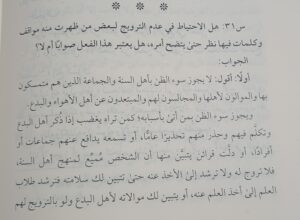
Question 31: Exercising caution by not promoting some of those from whom (certain questionable) stances or statements have manifested until his situation becomes clear: is this action considered to be correct or not?
The Shaikh, may Allah have mercy upon him, responded:
First, I say: it is not permissible to harbour an evil suspicion towards Ahlus Sunnah Wal Jama’ah — those who adhere to it (i.e. the path of Ahlus Sunnah), establish loyalty to its people, sit with them, and distance themselves from the people of (vain) desires and Bid‘ah.
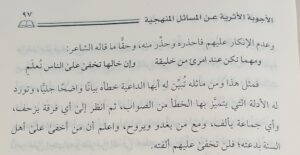
(On the other hand), it is permissible to harbour an evil suspicion towards the one who (manifests) its reasons (or signs that warrant harbouring an evil suspicion), such as the one you see getting angry when the people of Bid‘ah are mentioned- (when they are) spoken against and warned against in general; or you hear him defending them — whether groups or individuals; or there are indications from which manifests that indeed the individual is one who dilutes the methodology of Ahlus Sunnah. (In this case), neither promote him nor direct (people) to take knowledge from him until the safety of his situation is clear to you. Then, you may guide students of knowledge to take knowledge from him; or it becomes clear to you that he is allied with the people of Bid‘ah, even by promoting them or not denouncing them. [Footnote a] Then beware of him and warn against him. And (indeed) what the poet said is true: “And whatever a person may possess of a trait, even if he thinks it is hidden from people, it will (eventually be known”.
Thus, O caller to the path of Allah! With regards to this person and the one like him, you should clarify his mistake to him in a clear and explicit manner, and present to him the proofs by which truth is distinguished from falsehood. Then observe to which group he inclines, which people he associates with, and with whom he comes and goes. And know that whoever conceals his Bid‘ah from Ahlus Sunnah, his companionship and affiliations will not be hidden from them. [end of quote] [Source: al-Ajwibah Al-Athariyyah an al-Masāʾil al-Manhajiyyah: Khamsūna Suʾālan wa Jawāban pages 96-97. Paraphrased]
We ask: Provide us with only one example where Shaikh Abu Iyaad, may Allah preserve him, became angry or defended any person of Bidah – individual or group – when they were mentioned and criticised! Provide us with one clear example, with clear, unambiguous evidence, where Shaikh Abu Iyaad dilutes the methodology of Ahlus Sunnah Wal Jama’ah! Provide us with one example where Shaikh Abu Iyaad promotes any man of Bidah or directs people to benefit from them! Provide us with one situation where Shaikh Abu Iyaad associates with Ahlul Bidah—whether individuals, groups, or anyone connected to them in any way! Therefore, we ask once more, “Where is the clear, unambiguous evidence for the Tabdee against Shaikh Abu Iyaad, claiming he is a plant?”
[1] Still Waiting! Where’s The Clear Unambiguous Knowledge-Based Shariah Proof for the Tabdee?
[2] Still Waiting! Where’s The Clear Unambiguous Knowledge-Based Shariah Proof for the Tabdee?
[3] Still Waiting! Where’s The Clear Unambiguous Knowledge-Based Shariah Proof for the Tabdee
[4] Still Waiting! Where’s The Clear Unambiguous Knowledge-Based Shariah Proof for the Tabdee
[5] Still Waiting! Where’s The Clear Unambiguous Knowledge-Based Shariah Proof for the Tabdee
[6] Still Waiting! Where’s The Clear Unambiguous Knowledge-Based Shariah Proof for the Tabdee
[7] Still Waiting! Where’s The Clear, Unambiguous, Knowledge-Based Shariah Proof for the Tabdee
[8] Still Waiting! Where’s The Clear, Unambiguous, Knowledge-Based Shariah Proof for the Tabdee
[9] Still Waiting! Where’s The Clear, Unambiguous, Knowledge-Based Shariah Proof for the Tabdee
[10] Still Waiting! Where’s The Clear, Unambiguous, Knowledge-Based Shariah Proof for the Tabdee
[11] Still Waiting! Where’s The Clear, Unambiguous, Knowledge-Based Shariah Proof for the Tabdee
[12] Still Waiting! Where’s The Clear, Unambiguous, Knowledge-Based Shariah Proof for the Tabdee
[13] Still Waiting! Where’s The Clear, Unambiguous, Knowledge-Based Shariah Proof for the Tabdee
Footnote a: https://salafidawahmanchester.com/2026/06/03/amicable-and-fruitful-discussions-with-mature-friends-on-enjoining-good-and-forbidding-evil/

Imam Ibn Muflih, may Allah have mercy upon him, said:
Know that hearts become weak and sick, and they may even perish (degenerate) due to heedlessness, sins, and abandoning (the purpose for which) they were created, such as the deeds of the hearts that are required in the Shariah. The greatest of this is associating partners with Allah. (On the other hand), they become alive, strengthened, sound through pure monotheism, vigilant and awake by fulfilling (the purpose for which) they were created, since an opposite is removed by its opposite, and a thing is affected by the reverse of what previously affected it. Abdullah ibn al-Mubarak said, may Allah have mercy upon him, said:
I have seen that sins bring death to hearts, and persistence in them may lead to humiliation. Abandoning sins is the life of hearts, and it is better for your soul to disobey them.
Allah, The Most High, said:
أَوَمَن كَانَ مَيْتًا فَأَحْيَيْنَٰهُ وَجَعَلْنَا لَهُۥ نُورًا يَمْشِى بِهِۦ فِى ٱلنَّاسِ كَمَن مَّثَلُهُۥ فِى ٱلظُّلُمَٰتِ لَيْسَ بِخَارِجٍ مِّنْهَا
Is he who was dead and We gave him life and set for him a light (of Belief) whereby he can walk amongst men, like him who is in the darkness from which he can never come out? [Al-An’am 122] [1]
Imam Ibn Al-Qayyim, may Allah have mercy upon him, said about this Ayah:
He (this person) is given both light and life, just as the one who turns away from the (Qur’an and Sunnah) receives both death (a misguided heart) and darkness (misguidance). Ibn Abbas, may Allah be pleased with him and his father, and all the Mufassirun said that such a person that he used to be an unbeliever, then Allah guided him. And regarding Allah’s statement:
وَجَعَلْنَا لَهُ نُورًا يَمْشِي بِهِ فِي النَّاسِ
And set for him a light whereby he can walk amongst men.
This includes a number of (things) and one of them is that he walks amongst the people with light, while the people are in darkness, thus, his example and theirs is like that of a people who got lost during nightfall and could not find their way, while he had light whereby he could walk in the road, and could see as well as see what he is to be cautious of. The second is that he walks amongst them with his light, so they borrow from it due to their need for it. The third is that he walks with his light on the day of judgement on the bridge of as-Siraat, while the people of Shirk and Nifaaq remain in the darkness of their Shirk and Nifaq. [2]
It is reported in Al-Bukhari and Muslim, or in Ṣaḥīḥ Muslim from Hudhayfah ibn al-Yaman, may Allah be pleased with him, [who said that Allāh’s Messenger – peace and blessings of Allah be upon him said]: “When a servant (of Allah) commits a sin, a black spot is marked upon his heart. Then, if he commits another sin, another black spot is marked upon his heart, until it becomes dark and covered over. At that point, it no longer recognises what is good nor rejects what is evil, except for whatever inclination of desire it has absorbed.[Sahih Muslim 144]
Thus, (vain) desire is one of the greatest diseases and opposing it is one of the greatest remedies. The human soul is prone and inclined towards ignorance and wrongdoing (if it is not guided), as Allah The Most High said:
إِنَّا عَرَضْنَا ٱلْأَمَانَةَ عَلَى ٱلسَّمَٰوَٰتِ وَٱلْأَرْضِ وَٱلْجِبَالِ فَأَبَيْنَ أَن يَحْمِلْنَهَا وَأَشْفَقْنَ مِنْهَا وَحَمَلَهَا ٱلْإِنسَٰنُ إِنَّهُۥ كَانَ ظَلُومًا جَهُولًا
Truly, We did offer Al-Amanah (the trust or moral responsibility or honesty and all the duties which Allah has ordained) to the heavens and the earth, and the mountains, but they declined to bear it and were afraid of it (i.e. afraid of Allah’s Torment). But man bore it. Verily, he was unjust (to himself) and ignorant (of its results). [Al-Ahzab 72]
As a result of its ignorance, it (the soul) thinks that its cure is found in following its (vain) desire, even though it is its greatest disease and the cause of its ruin. It (ignorantly and wrongfully) places the disease in the place of the remedy and the remedy in place of the disease, thus, various ailments and diseases arise from this. However, despite this, it declares itself innocent and blames its Lord, The Mighty and Majestic, through what his situation manifests and may even clearly utter this blame with the tongue and does not accept advice due to wrongdoing and ignorance.
Due to this, the hadith reported by Ibn Abbas – regarding the supplication for distress (a)– combines an affirmation of Allah’s perfect Lordship over all the creation, necessitates His oneness and that none deserves to be worshipped, feared or placing hope on anyone, except Him, Glorified be He, free from all imperfections, The Most High. In (this du’aa also is an affirmation) of His absolute Greatness, which necessitates an affirmation of every perfection. It contains the affirmation of His forbearance, which necessitates the perfection of His mercy and beneficence. Thus, the heart’s knowledge of this, necessitates its engagement in the acts of worship of the heart that are required by the Shariah, experiences a delight and joy that repels what has afflicted it, or at least diminishes it based on the strength or weakness of this knowledge- similar to a sick person who receives something that strengthens his natural physical condition. These Divine Attributes are profoundly suitable for relieving what afflicts the heart. The more a person pays closer attention to this, tastes and experiences it directly more than (others), the (effects) of it become more manifest to him than to others. [3]
—————————————————
[a] Ibn Abbas, may Allah be pleased with him, reported that Allah’s Messenger, peace and blessings of Allah be upon him, used to say during times of distress:
لا إلَهَ إلَّا اللهُ العَظيمُ الحَليمُ، لا إلَهَ إلَّا اللهُ رَبُّ العَرشِ العَظيمِ، لا إلَهَ إلَّا اللهُ رَبُّ السَّمَواتِ ورَبُّ الأرضِ، ورَبُّ العَرشِ الكَريمِ
There is no god worthy of worship except, the Magnificent, the Forbearing. There is no god worthy of worship except Allah, Lord of the Mighty Throne. There is no god worthy of worship except Allah, Lord of the heavens and Lord of the earth, and Lord of the Noble Throne. [Al-Bukhari 6346 and Muslim 2730]
[1] An Excerpt from Al-Aadab Ash-Shar’iyyah 1/205-205. Risalah Publishers. 1st Editiion 1436 [2010]
[2] An Excerpt from Al-Fawaa’id. pages 140-144
[3] An Excerpt fronm Al-Aadab Ash-Shar’iyyah 1/205

I am ease regardless of my companion’s temperament as long as he is truthful and just upon the path of the pious predecessors
Amr Ibnul Aas, may Allah be pleased with him, was one of those given authority and so was Abu Ubaydah Ibn Al-Jarrah, may Allah be pleased with him. Khalid Ibn Al-Walid, may Allah be pleaded with him, was given preference over them due to his bravery and usefulness in Jihad. When Abu Bakr, may Allah be pleased with him, passed away, Umar Ibn Al-Khattab, may Allah be pleased with him, gave Abu Ubaydah, may Allah be pleased with him, authority over all of them because Umar Ibn Al-khattab used to be tough for the sake of Allah, thus he appointed Abu Ubaydah because he was soft. Abu Bakr was soft and Khalid was tough. Therefore, the soft one gave authority to the tough one and the tough one gave authority to the soft one to balance the affairs.
An Excerpt from “Adwaa Min Fatawaa Shaikh Al-Islam Ibn Taymiyyah” By Al-Allamah Salih Al-Fawzan 2/568-569

The Arabic text of this article was shared by our close companion and friend, Ustadh Abu Tasneem (Mushaf Al-Banghali), who suggested that I share it in the English language. May Allah bless him and his family Ameen.
The Shaikh: What is the worth (value) of love for the sake of Allah? What do you say (i.e. your opinion)? Please raise your finger if you have an answer to this question; go ahead.
The Shaikh: This answer is a correct statement in its essence, but it is not the (intended) answer to the question.
The Shaikh: This is a closer definition of love for the sake of Allah, but it is not a complete definition. My question is about the value that two individuals who love each other for Allah’s sake must give (bestow) to one another. I do not mean the rewards in the Hereafter. I would like to know what practical evidence exists to demonstrate love for the sake of Allah between two individuals. It is possible for two men to love each other, but it is superficial and not real. What is the proof of love (for the sake of Allah) in reality?
The Shaikh: This is a characteristic of love or some characteristics of love.
The Shaikh: Please proceed.
The Shaikh: This is an answer to a different question. It is a correct answer to another question; please proceed.
The Shaikh: Distance from (avoid) Qadqadah (speech built on may be, may not), as it may not yield any (meaningful) answers.
The Shaikh: (Will) find (the sweetness of faith)…
The Shaikh: “To love a man only for the sake of Allah”, this is not the (real) answer. This (hadith) is a sign (or an effect) of love for the sake of Allah. What is this sign (or effect)? It is a sweetness experienced in his heart. The question was not about the effects of love for the sake of Allah. Please continue.
The Shaikh: What do you have and what do I want? Answer the question.
The Shaikh: This is the answer, well done. This is the answer. The explanation of this is that if I (truly) love you for the sake of Allah, I will offer you sincere advice, and you should reciprocate in kind. For this reason, this mutual advice is quite rare among those who claim to love one another for the sake of Allah, The Mighty and Majestic. While this love may contain some degree of sincerity, it is not complete, as each of us tends to consider the feelings of the other (i.e. at the expense of sincere advice). We fear annoying (one another), making (one another) startled (creating distance). Let him live with us (i.e. we prefer to keep each other at the expense of sincere advice).
By (the phenomenon of) time (which Allah manifests through His creation of night and day and in which the servants perform their deeds). Indeed, (all of) mankind is in loss. Except those who believe (in Allāh, His Angels, Books, Prophets, the Last Day and the Divine Decree) and work righteous deeds (which are sincere and correct) and mutually advise each other (in calling to and abiding by) the truth and mutually advise each other with patience (in facing the inevitable harms brought by calling to the truth). [Paraphrased excerpt. Your feedback welcome to improve this paraphrase] https://alathar.net/home/esound/index.php?op=codevi& coid=158162

Al-Allamah Rabee Bin Haadi Al-Mad’khali- may Allah have mercy upon him- stated:
Destructive good thought is to have good thoughts about the people of falsehood, whether they are disbelievers, innovators in religious matters, or sinners.
The disbelievers’ rejection of the Messengers, severe disbelief in the Messengers and their message were driven by their evil thoughts about the people of truth, and holding good thoughts about ancestors, their false religions, and disbelief.
Ahlul Bidah, such as the Rawaafid, the khawarij, the Sufiyyah, the Murji’ah, the Qadariyyah, and the proponents of false partisanship are destroyed by good thoughts about their Shaikhs, figureheads, and corrupt creeds.
On the other hand, they are destroyed by their evil thoughts about the truth and its adherents. Abul Hasan Al-Maribi and his followers have a share of both these destructive good thoughts and destructive evil thoughts
Majmu 13/363-364

It has been reported from Qays ibn Abi Hazim, may Allah have mercy upon him, who said:
When Umar ibn al-Khattab, may Allah be pleased with him, arrived in Sham, its scholars and elders came out to meet him. They said, ‘Ride this mule so that people will see you’. He said: ‘Indeed, you see the matter from here’, then while pointing to the sky, he said: ‘Instead the matter (regarding nobility, honour, recognition etc) is really up there. Leave me on my way.”
Tarikh Dimashq 4/44
Abdullah Bin Salam, may Allah be pleased with him, walked in the marketplace while carrying a bundle of firewood. It was said to him: “Has Allaah not given you enough wealth [to prevent you from] this?” He said, “Certainly, but I want to repel pride. I heard Allah’s Messenger, saying:
‘The one with the weight of a grain of mustard seed of pride will not enter paradise'”.
Al-Allamah Zaid Bin Hadi Al-Mad’khali, may Allah have mercy upon him, said:
This hadith is clear proof regarding the fact that pride is forbidden and that is one of the major sins. And because of this, a person is forbidden to characterise himself with pride-mocking at the people and rejecting the truth. Indeed, the Prophet, peace and blessings of Allah be upon him, described pride in his statement,
“Pride is to reject the truth and belittle the people”- meaning: rejects the truth and does not accept it; mocks at the people and does not consider them to be nothing by looking down on them and raising himself above them- either due to his abundant wealth, high [social] status, lineage or due to other reasons.
In this hadith, there is proof to show that a Muslim servant of Allah- the sensible and smart one – guards himself, places himself in a situation that is pleasing to Allah and disciplines himself with the Islamic manners. And when it is the case that the soul is weak and can be misguided, thus Abdullah Bin Salam, may Allah be pleased with him, desired to discipline his soul by carrying a bundle of firewood on his back or his head, even though he was able to hire someone else to carry it on his behalf; but he desired something that was very important and that was to repel pride from his soul, and place himself in a situation of humility, which Allah loves to see from His slaves.
An Excerpt from “at-Taliqat Al-Malihah Alaa Silsila Al-Ahadjth As-Sahihah. 1/269
It is narrated from Maymun ibn Mihran, may Allah have mercy upon him, who said:
“Al-Hamdani, may Allah have mercy upon him, reported to me that he saw Uthman ibn Affan, may Allah be pleased with him, riding a female mule and his boy servant was on it behind him, while he was the khalifah”.
Hilyah Al-Awliya 1/60
One day, Abdullah Ibn Mas’ud, may Allah be pleased with him, came out then the people followed him; he said to them: “Do you have a need?” They said, “No, but we want to walk together with you”. He said, “Go back, for indeed it is humiliation for the one following and a trial for the one followed”.
Az-Zuhd 195 by Imaam Ahmad
Hisham bin Hassan, may Allah have mercy upon him, said:
They (some people) mentioned humility in the presence of Al-Hasan Al-Basri, may Allah have mercy upon him, while he kept quiet until they spoke a lot about it. Then he said to them: ‘I see you speaking profusely about humility’. They said: ‘O Abu Sa’eed! What is humility?’ He said: ‘He (a person) exits his house and does not meet a Muslim, except thinking that the other is better than him'”.
Az-Zuhd 1598 By Imam Ahmad, may Allah have mercy upon him.
Imam Fudayl Ibn Iyad, may Allah have mercy upon him, said:
“If you are able not to be known, do so. Is there anything against you if you are unknown? Is there anything against you if you are not praised? Is there anything against you if you are considered blameworthy in the sight of the people but praiseworthy in the sight of Allah, The Mighty and Majestic?!”
Hilyah Al-Awliyaa 8/89
Khalaf Bin Tamim, may Allah have mercy upon him, said:
I saw Ath-Thawree, may Allah have mercy upon him, at Makkah and many people came to him, so he said, “To Allah do we belong! I fear that Allah has made this Ummah to be lost when the people are in need of the likes of me”.
Siyar A’lam An-Nubula 7/275
Imam Abu Bakr Ibn Al-Arabi Al-Maliki, may Allah have mercy upon him, said: Muhammad Bin Qasim Al-Uthmani, may Allah have mercy upon him, told me more than once:
“I arrived in Fustat one day, then I went to the gathering of Shaikh Abi Al-Fadl Al-Jawhari, may Allah have mercy upon him, and there I witnessed a statement that he uttered to the people. And that which he stated – in the first gathering when I sat with him – was that ‘The Messenger, peace and blessings of Allah be upon him, طلق – i.e. he did divorce, ظاهر – i.e. he did utter the statement to a wife, ‘You are like my mother’s back’, and آلى – i.e. he made an oath to abandon his wives for a month”.
When he (i.e. Shaikh Abi Al-Fadl Al-Jawhari) left, I followed him until I reached his house with a group of people; then he sat with us in the vestibule and acquainted them with my affair because he saw a stranger [i.e. I (Muhammad Bin Qasim)] and did not know the person among those who came to him before. When most of them departed from him, he said to me, “I see that you are a stranger; do you have anything to say?” I said, “Yes”. He said to his companions, “Excuse him from having to speak in your presence”, so, they got up and I stayed alone with him. I said to him, “I attended your gathering today so that Allah may bless me (with some of the knowledge you possess), and I heard you say, ‘Allah’s Messenger [peace and blessings of Allah be upon him] آلى – i.e. he once made an oath to abandon his wives for a month and what you said was true; طلق – i.e. he did divorce women, and what you said was true, and you said that Allah’s Messenger, peace and blessings of Allah be upon him, ظاهر i.e. he did utter the statement to a wife, ‘You are like my mother’s back’, but this never happened and can never be correct to say that it happened because Az-Zihaar [i.e. to say to one’s wife, ‘You are like my mother’s back’ (i.e. unlawful for me to approach)] is an evil statement and false speech, and this can never be uttered by the Prophet, peace and blessings of Allah be upon him”. He hugged and kissed my forehead, and said, “I repent from this statement. May Allah reward you on my behalf as a good teacher”.
I departed from his presence, and the next day I went early to his gathering, but he was in the Central Masjid before me and was sitting on the pulpit. When I entered the Masjid and thus he saw me, he called out at the top of his voice (saying), “Welcome, my teacher. Make room for my teacher”. So, the people turned towards me and their eyes stared at me! O Abu Bakr! And you know me – meaning, he (i.e. Muhammad Bin Qasim Al-Uthmani) was indicating to Ibn Al-Arabi about his extremely shy character because when someone greeted him by surprise, he would feel shy – due to his extreme shyness – and turned red as if his face was painted with Gulnaar (pomegranate blossom). He (i.e. Muhammad Bin Qasim) continued, “People hastened towards me, raising their hands towards me (i.e. acknowledging me) and nudging me until I reached the pulpit, and I did not know in which part of the earth I was due to my extreme shyness (i.e. shocked), whilst the Masjid was overcrowded with people and I sweated due to shyness. Then the Shaikh turned towards the people and said to them, ‘I am your teacher and this is my teacher! Yesterday, I told you that Allah’s Messenger آلى – i.e. he once made an oath to abandon his wives for a month; طلق – i.e. he did divorce women, and ظاهر i.e. he once uttered the statement to a wife, ‘You are like my mother’s back’, and neither did a single one of you give me the correct understanding nor respond to me, but he (i.e. Muhammad Bin Qaasim) followed me to my house and said such and such to me. I repeat (i.e. right now) what took place between him and I, repent from yesterday’s statement, and return to the truth. Whoever hears it from those who were present, let him not rely on what he says, and let the one who is present convey this affair to the absent one. May Allaah reward him with good’”. Then he (i.e. Shaikh Abee Al-Fadl) started supplicating a lot and the people responded with Aameen.
Ibn Al-Arabi stated – after narrating this incident- “So look – may Allah have mercy upon you – at this firm adherence to the religion and an acknowledgment of the people of knowledge given by this man – whose leadership was manifest and whose worth was well known- to a stranger whom he neither knew nor where he came from! Follow his example and you’ll be led aright”. [Ahkam Al-Qur’an 1/248-249]
———————————
Zihaar: Allah [The Exalted] says:
ٱلَّذِينَ يُظَـٰهِرُونَ مِنكُم مِّن نِّسَآٮِٕهِم مَّا هُنَّ أُمَّهَـٰتِهِمۡۖ إِنۡ أُمَّهَـٰتُهُمۡ إِلَّا ٱلَّـٰٓـِٔى وَلَدۡنَهُمۡۚ وَإِنَّہُمۡ لَيَقُولُونَ مُنڪَرً۬ا مِّنَ ٱلۡقَوۡلِ وَزُورً۬اۚ وَإِنَّ
Those among you who make their wives unlawful (Az-Zihar) to them by saying to them “You are like my mother’s back.” They cannot be their mothers. None can be their mothers except those who gave them birth. And verily, they utter an evil statement and a lie. [Surah Al-Mujaadilah. Ayah 2]
Despite Abū Bakr ibn al-Anbārī’s (strong) memorisation, he, may Allah have mercy upon him, was a Zahid and a humble person. Abu al-Ḥasan ad-Daraqutni, may Allah have mercy upon him, reported that he attended one of his gatherings on a Friday during which he was dictating. He misread a name that he cited in the chain of transmission of a ḥadīth: it was Ḥibbana, but he either said Ḥayyanu, Ḥayyana, or Habbanu. Abu al-Ḥasan said:
“I considered it too grave that an error should be transmitted from someone like him due to his virtue and lofty status. I was in awe of him and hesitant to notify him. Then when the dictation ended, I went to the one who was taking the dictation, mentioned the mistake to him, informed him of the correct word, and then left. Then I attended his gathering the following Friday, so, Abu Bakr said to the one taking the dictation:
‘Make it known to those present in the gathering that we misread such-and-such a name when we dictated the ḥadith on such-and-such an occasion last Friday, and that a young man notified me regarding the correct name, which is such-and-such. And inform that young man that we referred back to the original source and found it as he said'”.
Tarikh Baghdad 4/301
The Mufti, Al-Allamah Salih Al-Fawzan, may Allah preserve him, in the introduction of his book titled:
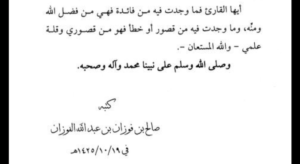
O reader! So, whatever benefit you find in it is from Allah’s bounty and His grace (favor), and whatever shortcomings or mistakes you find in it are from my own shortcomings and limited knowledge.
والله المستعان
Written by Salih Bin Fawzan Bin Abdillah Al-Fawzan on 19/10/1425H
Al-Allamah Rabee Bin Hadi Al-Mad’khali, may Allah have mercy upon him, said:
Accepting Advice and Wholehearted Submission to The truth is One of the Great Obligations (Obligated) to all Muslims
All praises be to Allāh, and may peace and blessings be upon Allah’s Messenger, his family, his companions, and those who follow his guidance. To proceed:
I came across what some internet websites have disseminated (or posted) regarding a statement attributed to me, that I stated during one of my lectures: “If the Messenger of Allah disowned (or freed himself) from you through (or upon) the tongue of our Lord”. I said it while citing (or utilising as proof) the statement of Allah, the Exalted:
إن الذين فرقوا دينهم وكانوا شيعا لست منهم في شيء
“Verily, those who divide their religion and break up into sects (all kinds of religious sects), you (O Muhammad) have nothing to do with them” [3] regarding the prohibition of splitting (divergent sects, groups, parties). Then I stated: “How can we, my brothers, not fear while we choose this splitting and live with it for generations and ages?”
I seek Allah’s forgiveness – a hundred times – for this ugly (disgusting) and false statement. I request the removal of this statement from all cassettes (recordings) in which it appears, and I emphasise that anyone who possesses a recording containing this statement should delete it. And I say: Indeed, this statement is ugly (disgusting) and false; exalted is Allah above it, and free is He from it. That is because He, The Exalted, is free from any resemblance to the created things, as He, Glorified be He and free from all imperfections, says:
لَيْسَ كَمِثْلِهِۦ شَىْءٌ وَهُوَ ٱلسَّمِيعُ ٱلْبَصِيرُ
There is nothing like (similar) to Him, and He is the All-Hearer, the All-Seer.
Likewise, He, The Mighty and Majestic, says:
قُلْ هُوَ ٱللَّهُ أَحَدٌ
ٱللَّهُ ٱلصَّمَدُ
لَمْ يَلِدْ وَلَمْ يُولَدْ
وَلَمْ يَكُن لَّهُۥ كُفُوًا أَحَدٌۢ
Say (with a firm, resolute statement): “He is Allāh, (who is) uniquely One (in His perfect names, attributes, actions, and His right to worship). Allāh, the Eternal, Self-Sufficient Master (of utmost perfection in His attributes, to whom all creatures turn for their needs whilst He has none). He did not beget (such that He became a father) nor was He begotten (such that He became a son). And there is none equal, similar or comparable to Him (in His perfect names, attributes and actions).” https://www.thenoblequran.com/q/#/sura/112/1
And He, the Most High, said:
هَلْ تَعْلَمُ لَهُۥ سَمِيًّا
Do you know of any that is worthy of His name (due to having similarity to Him)?
In these noble verses are an affirmation of the Attributes of His Perfection and the descriptions of His majesty, while also exalting Him above attributes and descriptions of deficiency and the likeness to created beings. Neither is anyone similar nor comparable to Him in His Dhat (Self), and His Attributes, nor in any of His Magnificent Attributes.
Ahlus Sunnah Wal Jama’ah affirm all of the attributes mentioned in the Qur’an and Sunnah without Tashbih, Ta’teel, Takyeef, or Tamtheel with regards to anything of His Attributes, such as Ascension above His Throne – above all of His creations, His Highness, Descent, Hearing, Sight, Ability, Iraadah, knowledge, Speech, and Wisdom, and the fact that He, The Exalted, is the Creator, the Provider, Giver of Life, and Causer of Death, among the other affirmed Names and Lofty Attributes of His. Ahlus Sunnah affirm them without Takyeef, Tamtheel, Tashbih, or Ta’teel, standing in opposition to Ahlul Ahwa (the sects upon vain desires in their creed), such as the Jahmiyyah, Khawarij, Mu’tazilah, Rawaafid, and Ash’ariyyah.
And all praises be to Allah, I am from those whom Allah blessed with this methodology, which I firmly believe in the depth of my inner-self. I teach it, advocate for it, and defend it as a student and a teacher; calling to it with all my ability, establishing allegiance and enmity based on it from the beginning of my life (i.e. when he became acquainted with it). This statement, which I made during my lecture- in which I called to this path and urged those who oppose it to revise it – is extremely hated to me. This ugly (repugnant, disgusting) statement was a slip of the tongue on my part and had someone alerted me at the moment I uttered it, I would have rejected and distanced myself from it. It is not justified for anyone who comes across it to remain silent about it. It is akin to the statement made by the man whom the Prophet, peace and blessings of Allah be upon him, cited as an example, who said out of overwhelming happiness: “O Allah! You are my servant and I am Your Lord”.
Allah’s Messenger, peace and blessings of Allah be upon him, stated, “He (i.e. this man) erred due to overwhelming happiness.” Nevertheless, I experience profound pain from it and strongly condemn it for both myself and others (.e. not to utter this statement).
I beseech Allah, the Generous Lord of the Mighty Throne, to forgive me for all my sins, both those I have concealed and those I have made known. I ask for forgiveness for my slips and errors, including those of the pen, the tongue, the limbs, and the heart. “All the children of Adam commit mistakes, and the best of those who err are the repentant.” I beseech Allah to make me among the repentant and the purified. Accepting advice and adhering to the truth is one of the most obligatory duties for all Muslims, regardless of the source. It is not permissible for a Muslim to belittle or disdain the advisor, no matter their status. I seek refuge in Allah from rejecting advice or defending any wrong or falsehood that originates from me, for such behavior is characteristic of the corrupt, arrogant, obstinate, and those who, when given a reminder do not reflect (or take heed). I seek refuge in Allah from these ugly (repugnant, disgusting) traits. I ask Allah to include me among those about whom He said:
وَٱلَّذِینَ إِذَا ذُكِّرُوا۟ بِـَٔایَـٰتِ رَبِّهِمۡ لَمۡ یَخِرُّوا۟ عَلَیۡهَا صُمࣰّا وَعُمۡیَانࣰا
And those who, when they are reminded of the Signs of their Lord, fall not deaf and blind thereat.
I advise myself and all Muslims to adhere to this methodology and remain steadfast in it, to accept the advice of those who advise, and to follow the path of the righteous predecessors in mutual advice, enjoining one another upon truth, and accepting guidance, in consideration (and application) of Allah’s statement:
وَٱلْعَصْرِ
إِنَّ ٱلْإِنسَٰنَ لَفِى خُسْرٍ
إِلَّا ٱلَّذِينَ ءَامَنُوا۟ وَعَمِلُوا۟ ٱلصَّٰلِحَٰتِ وَتَوَاصَوْا۟ بِٱلْحَقِّ وَتَوَاصَوْا۟ بِٱلصَّبْرِ
By (the phenomenon of) time (which Allah manifests through His creation of night and day and in which the servants perform their deeds). Indeed, (all of) mankind is in loss. Except those who believe (in Allāh, His Angels, Books, Prophets, the Last Day and the Divine Decree) and work righteous deeds (which are sincere and correct) and mutually advise each other (in calling to and abiding by) the truth and mutually advise each other with patience (in facing the inevitable harms brought by calling to the truth).
And in consideration (and application) of Allah’s statement:
والمؤمنون والمؤمنات بعضهم أولياء بعض يأمرون بالمعروف وينهون عن المنكر
The believers, men and women, are Auliya’ (helpers, supporters, friends, protectors) of one another, they enjoin good and forbid evil.
Among the signs of upright guidance, uprightness, truthfulness (in statement and action), and salvation in this worldly and the Hereafter is to be steadfast upon the Book and the Sunnah, and to follow this methodology in belief, action, manners, and in enjoining good and forbidding evil, addressing shortcomings with wisdom and through (honourable, straight forward, honest) ways.
And I beseech Allah, The Mighty and Majestic, to grant success to this Ummah, particularly Ahlus Sunnah Wal Jama’ah, to advance this great methodology, unite their word upon it, and enable them to achieve (or attain upright) leadership, dignity, and honour in this worldly life; enable them to adhere to this methodology that will lead them to safety and salvation in the Hereafter. Indeed, my Lord is All-Hearing of supplications.
May peace and blessings be upon our Prophet Muhammad, his family, and his companions.
Written by:
Rabee Bin Hadi Al-Mad’khali
8/7/1425 AH
Makkah Al-Mukarramah

Anas Bin Malik, may Allah be pleased with him, said that Allah’s Messenger, peace and blessings of Allah be upon him, said:
“There are not two people who love each other for the sake of Allah, and then they split from each other, except that it is due to a sin of one of them”. (a)
Al-Allamah Zayd Bin Hadi Al-Mad’khali, may Allah have mercy upon him, said:
This Hadith shows that to love one another- the religious and worldly benefits it contains – is legislated in the Shariah. And regarding the religious benefits of this love, (it brings about) co-operation upon righteousness and piety. As for its worldly benefits, it (results in attaining those) necessities of life that are sought after. Those who love one another are attached to each other and remain upon that until one of them commits a sin that leads to the destruction of this legislated love- the love that was established for the sake of Allah and for the sake of Islamic brotherhood. Therefore, it is a good thing that the person abandons the sin he committed- the cause of separation between them, so that brotherhood for the sake of Allah is restored as it was before, and so that both the religious and worldly benefits of that brotherly love can continue. The basis of the sin committed by one of them may have occurred without any external influence (i.e. it was solely the person’s fault), or it may have occurred due to tale-bearing and instigated by some of the devils amongst mankind- those who hasten to caused corruption in the earth.
Loving one another for the sake of Allah – The Mighty and Majestic- carries reward that has been mentioned in the Shariah texts. Abu Hurairah- may Allah be pleased with him- reported that the Prophet- peace and blessings of Allah be upon him- said: “Allah will give shade to seven on the day when there will be no shade but His”’…and amongst those people are “Two people who love each other only for the sake of Allah and they meet and part in Allah’s cause only”. (b)
Anas – may Allah be pleased with him- reported that the Prophet – peace and blessings of Allah be upon him- said
“Whoever possesses the following three qualities will have the (delight) of faith: the one whom Allah and His Messenger become dearer to him than anything else; the one who loves a person and he loves him only for the sake of Allah, and the one who hates to revert to disbelief as he hates to be thrown into the fire”. (c)
Therefore, O Muslim! After you have understood this, then take a severe warning regarding the causes – both statements and deeds- that will ruin the love that has been legislated for the Muslims to have for one another, both males and females. Hasten towards the virtue of brotherhood and love for one another for the sake of Allah due to its great and numerous rewards. Abu Hurairah reported that Allah’s Messenger said, “Allah will say on the Day of Judgement, ‘Where are those who love each other for the sake of My Glory? Today, I will shelter them in my shade on a day when there is no shade but mine [i.e. the shade from Allah’s Throne (d)]”
Awn Al-Ahad As-Samad Sharh Al-Adab Al-Mufrad 1/445-446
One of those sins committed against the people is false Tabdee and other false accusations. They must be recanted!
[a] As-Sahihah 637
[b]Al-Bukhari 660
[c] Al-Bukhaari 16
[d]Fath Al-Baaree 4/63 [Also Shaikh Rabee (hafidhahullaah) has a Risaalah on this topic. Visit link: http://www.rabee.net/ar/articles.php?cat=8&id=149