Author: Abdullah Jallow

The Power of Gratitude and Contentment in a Meaningful Life Rooted in Virtuous Competition

In The Name of Allah, The Most Merciful, The Bestower of Mercy.

Abu Hurairah, may Allah be pleased with him, narrated that Allah’s Messenger, peace and blessings of Allah be upon him, said:

“Look at those who are below you and do not look at those above you, for it is more suitable lest you look down on Allah’s blessings”. [Sahih Muslim. 2963]

Al-Allamah Salih Al-Fawzan, may Allah preserve him, commented as follows:

A person should neither be covetous nor anxious due to what afflicts him, instead he should exercise patience and be hopeful, whether he is poor, sick or other than that. The worldly life is a place of trial and test, thus, one should not become anxious due to calamities and trials. And what makes this matter easier for a person is the guidance given by the Prophet, peace and blessings of Allah be upon him, in this hadith, “Look at those who are below you and do not look at those above you, for it is more suitable lest you look down on Allah’s blessings”.

A poor person should look at the one who is poorer and should not look at a wealthier (person) because if Allah willed, He would have placed you in the same situation as that poor person who has nothing. You have something – your daily nourishment, while that one poorer than you has nothing, not even his daily nourishment. You are in a better situation, therefore, praise Allah for this and do not look at the wealthier people because that will lead you to harbour anger against Allah and displeased with His divine Will, thus saying, “Why can I not be like so and so; why am not like the wealthy people?” This is the meaning of looking down on the blessing you have. But if you look at the person below you, it will make you thankful because your situation is better than that of many people. Therefore, the one in good health should look at the sick person and then praise Allah for granting him good health. The one who is sick should look at the one who is sicker than him and then praise Allah for being less sick than the person who is sicker than him. This [hadith embodies] a great principle, therefore, “look to the one below you” in wealth, health and in other matters.

However, this should not be the case in matters related to acts of worship. In matters related to acts of worship, you should not look at the one below you. You should not look at the lazy people and those who neglect their religious duties, instead you should look at the righteous and God fearing people so that you can join them in performing good deeds and be similar to them. Therefore, with regards to matters related to the religion, you should not look at the one below you, instead you should look at the one above you in the religion. Why do not want to be like him; why do you not want to be like the righteous people; why do not want to emulate the God fearing scholars? If you are a student of knowledge, you should not be satisfied with the sciences of the religion you have acquired; instead you should seek to increase in knowledge as long as you are alive.

An Excerpt from ‘Tasheel Al- il’haam Bi-Fiqh Al-Ahadith Min Bulugh Al-Maram’ Hadeeth Number 1438’ 6/168-169. Publisher: Dar Al-Imam Ahmad’ 1st Edition 1430AH – Year 2009

[10] Be Vigilant Against Subtle Repackaged Shubuhaat In Some WhatsApp Groups

In The Name of Allah, The Most Merciful, The Bestower of Mercy.

Allah, The Most High, said:

وَاتَّقُوا فِتْنَةً لا تُصِيبَنَّ الَّذِينَ ظَلَمُوا مِنْكُمْ خَاصَّةً‏
وَاعْلَمُوا أَنَّ اللَّهَ شَدِيدُ الْعِقَابِ‏

And fear a trial (of affliction) which does not affect (only) those who have done wrong among you in particular. And know that Allāh is severe in punishment. [Al-Anfal 25]

وَاتَّقُوا فِتْنَةً لا تُصِيبَنَّ الَّذِينَ ظَلَمُوا مِنْكُمْ خَاصَّةً‏

And fear a trial (of affliction) which does not affect (only) those who have done wrong among you in particular.

Imam As-Sadi, may Allah have mercy upon him, said:

Rather, it afflicts the perpetrator of oppression and others as well. This is because when oppression is apparent and is not stopped or resisted, then indeed, its punishment (afflicts) both the perpetrator and other than him. This Fitna is averted through forbidding evil, suppressing the people of evil and corruption, and so that they are not able to commit sins and oppression as much as possible (to prevent it). [1]

Clarification for the one who says: “Akhi, is it not enough that only one Shaikh deals with it; why are these other Mashayikh involved?!”

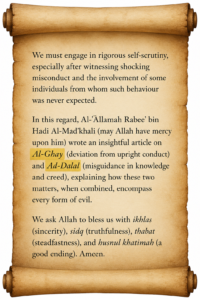
Al-Allamah Rabee Bin Hadi Al-Mad’khali, may Allah have mercy upon him, stated in his refutation against Dr Ibrahim Ar-Ruhayli, may Allah recitify his affair:

Allah’s Messenger, peace and blessings of Allah be upon him, once urged the poets among his companions to disparage the Quraish. Aishah narrated that Allah’s Messenger said, “Lampoon the Quraish, for it will hurt them more than arrows”. He sent word to Ibn Rawahah, saying, “Lampoon them”. So he lampooned them but it was not good enough. Then he sent word to Ka’b Bin Malik, then he sent word to Hassan bin Thabit. When he entered upon him, Hassan said, “Now you have sent for this lion who wreaks vengeance then waves his tail about”, then he stuck out his tongue and moved it. He said, “By the One Who sent you with the Truth, I shall tear them with my tongue as leather is torn”. Allah’s Messenger said, “Do not be hasty. AbuBakr is most knowledgeable about their lineage, and I share a lineage with them. (Wait) until he summarises my lineage for you”. Hassan went to him, then he came back and said, “O Allah’s Messenger! He has summarized your lineage for me. By the One Who sent you with the Truth, I shall draw you out from them as a hair is drawn out of the dough”. Aishah said, “I heard Allah’s Messenger say to Hassan, “The Ruhul Qudus (i.e. Jibreel) will continue to support you, so long as you are defending Allah and His Messenger”. She said, “I heard Allah’s Messenger say, “Hassan has lampooned them and has satisfied himself and others”. [Sahih Muslim. Number 2490]

Al-Bara’ah Bin Aazib, may Allah be pleased with him, narrated that he heard Allah’s Messenger, peace and blessings of Allah be upon him, saying to Hassaan Bin Thabit, may Allah be pleased with him, “Lampoon them and Jibril is with you”. [Bukhaari 3213]

So when the people of falsehood become overbearing towards the people of truth through evil speech, defamation, lies and praising (other) people of falsehood, then the people of truth cannot (do anything else) except to subdue the people of falsehood- clarifying their oppressive (behaviour, views etc), their barefaced lies and unveiling their falsehoods. [2]

The Shaikh, may Allah have mercy upon him, also spoke about the Fard Kifayah in the context of Jihad (Footnote a), saying:

For example, Jihad one of the Furud al-Kifaayaat (Communal obligations), thus, if one person goes for Jihad in order to repel a threat faced by Islam and the Muslims, will the legislated Islamic goal of this Jihad be fulfilled by one person; or if hundreds of people went but neither the legislated Islamic goal is fulfilled nor is the threat repelled, would it be permissible for the scholars to remain silent in such circumstances; or is it obligated that they exhort the people to go for Jihad in order to fulfil this communal obligation? (This is because) there has to be sufficient numbers of people to fulfil this (Communal) obligation in order to put a stop to the threat face by the rest of the Muslims. If this sufficient number is not reached, then all the Muslims are regarded to be sinful in such a case and held responsible for the harm that comes to Islam and the Muslims. Similarly is the same thing stated regarding enjoining good and forbidding evil, because there has to be sufficient numbers to prevent the Fitnah, if one, ten or twenty are unable to do so. Therefore, it becomes clear that many of the students- those who ascribe themselves to the Sunnah-who seek from the Scholars to clarify their stances have sought after something appropriate and correct if there is a sound reason for seeking after it. It is not to be regarded as a mistake, but the mistaken one is he who declares those students to be mistaken. The silence of the scholars at the time of need or necessity to clarify the truth is tantamount to concealment of the truth and it is from those grave mistakes that will result in corruption, trials, splitting of the people into two groups, two parties, boycotting one another and so on. [3]

Footnote a:

Salafi Shaikh Fawzaan on Jihad in our times and the guidelines of Jihad according to Islam

May Allah bless the Mashayikh-Shaikh Bilal As-Salimy and others for taking upon an important Fard Al-Kifayah to enjoin good and forbid evil.


[1] An Excerpt from Tafseer As-Sadi

[2] An Excerpt from Bayaan Maa Fee Naseehati Ibrahim Ar-Ruhayli Minal Khalal Wal Ikhlaal. p 23-25

[3] An Excerpt from Bayaan Maa Fee Naseehati Ibrahim Ar-Ruhayli Minal Khalal Wal-Ikhlaal. p 62-63

The Fitnah of Every Person Who Is Overwhelmed By Fitnah

In The Name of Allah, The Most Merciful, The Bestower of Mercy.

The Fitnah of Every Person Who Is Overwhelmed By Fitnah — Through Sinful Carriers of Knowledge and Ignorant Devout Worshippers

Imam Sufyan ath-Thawree, may Allah have mercy upon him, said:

“It is said: Seek refuge in Allah from the fitna of the ignorant devout worshipper and the fitna of the sinful (wayward, wicked, corrupt etc) scholar, for their Fitna is a trial for every Maftun (one overwhelmed by Fitna).” [1]

Imam Ibn al-Qayyim, may Allah have mercy on him, said:

“For indeed the people emulate their scholars and devout worshippers, so, if the scholars are sinful and the devout worshippers are ignorant, then the calamity will become widespread through them (i.e. these two types of people) and severe for both the prominent (influential people) and the commoners.” [2]

We ask Allah:

اللَّهُمَّ إِنِّي أَسْأَلُكَ فِعْلَ الْخَيْرَاتِ وَتَرْكَ الْمُنْكَرَاتِ وَحُبَّ الْمَسَاكِينِ وَأَنْ تَغْفِرَ لِي وَتَرْحَمَنِي وَإِذَا أَرَدْتَ فِتْنَةَ قَوْمٍ فَتَوَفَّنِي غَيْرَ مَفْتُونٍ أَسْأَلُكَ حُبَّكَ وَحُبَّ مَنْ يُحِبُّكَ وَحُبَّ عَمَلٍ يُقَرِّبُ إِلَى حُبِّكَ

O Allah! I ask of you the doing of the good deeds, avoiding the evil deeds, loving the Masakin, and that You forgive me, and have mercy upon me. And when You have willed trial among the people, then cause me to die without being put to trial. And I ask You for Your love, the love of whomever You love, and the love of the deeds that bring one nearer to Your love.’” Allah’s Messenger said: “Indeed it is true, so study it and learn it.” [Sahih at-Tirmidhi 3235] [3]

اللَّهُمَّ أَصْلِحْ لِي دِينِي الَّذِي هُوَ عِصْمَةُ أَمْرِي

وَأَصْلِحْ لِي دُنْيَايَ الَّتِي فِيهَا مَعَاشِي

وَأَصْلِحْ لِي آخِرَتِي الَّتِي فِيهَا مَعَادِي

وَاجْعَلِ الْحَيَاةَ زِيَادَةً لِي فِي كُلِّ خَيْرٍ

وَاجْعَلِ الْمَوْتَ رَاحَةً لِي مِنْ كُلِّ شَرٍّ

O Allah! Rectify my religion for me, which is the safeguard of my affairs; rectify my worldly [affairs], wherein is my livelihood; and rectify my Afterlife to which is my return; and make life for me [as a means of] increase in every good and make death for me as a rest from every evil. [Saheeh Muslim Number: 2720] [4]

اللَّهُمَّ إِنِّي أَسْأَلُكَ فِعْلَ الْخَيْرَاتِ وَتَرْكَ الْمُنْكَرَاتِ وَحُبَّ الْمَسَاكِينِ وَأَنْ تَغْفِرَ لِي وَتَرْحَمَنِي وَإِذَا أَرَدْتَ فِتْنَةَ قَوْمٍ فَتَوَفَّنِي غَيْرَ مَفْتُونٍ أَسْأَلُكَ حُبَّكَ وَحُبَّ مَنْ يُحِبُّكَ وَحُبَّ عَمَلٍ يُقَرِّبُ إِلَى حُبِّكَ

O Allah! I ask of you the doing of the good deeds, avoiding the evil deeds, loving the Masakin, and that You forgive me, and have mercy upon me. And when You have willed trial among the people, then cause me to die without being put to trial. And I ask You for Your love, the love of whomever You love, and the love of the deeds that bring one nearer to Your love.’” Allah’s Messenger said: “Indeed it is true, so study it and learn it.” [Sahih at-Tirmidhi 3235] [5]

اللهم أرني الحق حقاً وارزقني إتباعه ، وأرني الباطل باطلاً وارزقني اجتنابه

O Allah! Show me the truth as truth and bless me with (the ability) to follow it, and show me falsehood as falsehood and bless me with (the ability) to avoid it. [Sharh Madhahib Ahl As-Sunnah 40] [6]


[1] Akhlaq al-Ulama by p. 63 by Imam Al-Aajurree, may Allah have mercy upon him.

[2] Miftaḥ Dar As-Sa‘adah 1/160

[3]https://salafidawahmanchester.com/2021/01/01/o-allaah-let-me-live-if-life-is-good-for-me-and-let-me-die-if-death-is-good-for-me/

[4]https://salafidawahmanchester.com/2020/12/29/o-allaah-rectify-my-religion-for-me-which-the-safeguard-of-my-affairs-a-tremendous-supplication/

[5]https://salafidawahmanchester.com/2026/02/14/three-safeguards-against-performative-alliance-culture/

[6]https://salafidawahmanchester.com/2026/01/27/the-measure-of-truth-is-not-the-one-who-utters-it/

gray clouds

[27] The Character Trait Most Hated By The Messenger

In The Name of Allah, The Most Merciful, The Bestower of Mercy.

Aa’ishah, may Allah be pleased with her, narrated:

“There was no traite more hated to Allah’s Messenger, peace and blessings of Allah be upon him, than lying. A man would speak based on lies in the presence of the Prophet, peace and blessings of Allah be upon him, and he would not be content until he knew that he had repented.” [Sahih Tirmidhi 1973]

Al-Allamah Rabee Bin Hadi Al-Mad’khali, may Allah have mercy upon him, said:

لا يجوز الكذب لا على كفار ولا على أهل بدع، ولا على أحد، لا يجوز، تفتري على أحد تقول فلان فيه وفيه والجماعة الفلانية فيها وفيها، نعوذ بالله، لا يجوز، نحن نبين ما عندهم من الضلال ننقله من كتبهم أو من الوسائل الأخرى بالحرف، ثم نناقشها علميا، هذا الذي نفعله، ونسأل الله أن كل السلفيين يفعل هذا، ولا نرى أبدا، ونعوذ بالله، لا نرى لمسلم أن يفتري على مسلم أو كافر أبدا

It is neither permissible to lie, neither about disbelievers nor about the people of Bidah, nor anyone.

It is not permissible to fabricate (things) about anyone, saying “so-and-so has this and that,” or “such-and-such group has this and that.” We seek refuge in Allah, it is not permissible.

We clarify (or elucidate) that which is with them of misguidance, quoting it from their books or other sources word for word, then we discuss it based on knowledge. This is what we do, and we ask Allah that all the Salafis do this.

We seek refuge in Allah; we never see (as permissible for a) Muslim to fabricate lies about (another) Muslim or a disbeliever, never. [Abridged and Paraphrased]

هل يجوز الكذب على أهل البدع وغيرهم من أهل الضلال؟

[2] Recent Acquaintance by Some of Us with Other Students of the Senior Scholars After 30 Years

In The Name of Allah, The Most Merciful, The Bestower of Mercy.

Imam Ibn Al-Jawzi, may Allah have mercy upon him, said:

I have met the Mashayikh; their circumstances were different and their stations of knowledge varied. The most beneficial of them for me in companionship was the scholar who acted upon his knowledge, even though there were others more knowledgeable than him.

I met Abdul Wahhab Al-Anmaatee, who adhered to the principles of the pious predecessors. Backbiting was not heard in his gatherings (a) nor did he seek any reward for sharing hadith. Whenever I read to him the hadiths related to Raqaa’iq, he would weep and his tears would flow continuously. As a young person at that time, his weeping profoundly affected my heart. He embodied the characteristics of the scholars whose descriptions we had heard in the reports.

I met Abu Mansur Al-Jawaaleeqee, who was notably quiet and very meticulous in his speech. Even when asked about a clear matter, which some of his young students would quickly answer, he paused to ensure accuracy. He fasted and kept quiet a lot. I benefited from these two men more than I benefitted from others. I understood from this situation that guidance through action is more effective than verbal instruction. The truly impoverished one is the person who spends their life acquiring knowledge without applying it, missing out on the pleasures of this world and the goodness of the hereafter, ultimately proceeding as one bankrupt in deeds with strong proofs against him. [1]

Who Is Shaikh Nizar, may Allah preserve him

DOC-20250614-WA0011

We ask Allah:

اللَّهُمَّ إِنِّي أَسْأَلُكَ فِعْلَ الْخَيْرَاتِ وَتَرْكَ الْمُنْكَرَاتِ وَحُبَّ الْمَسَاكِينِ وَأَنْ تَغْفِرَ لِي وَتَرْحَمَنِي وَإِذَا أَرَدْتَ فِتْنَةَ قَوْمٍ فَتَوَفَّنِي غَيْرَ مَفْتُونٍ أَسْأَلُكَ حُبَّكَ وَحُبَّ مَنْ يُحِبُّكَ وَحُبَّ عَمَلٍ يُقَرِّبُ إِلَى حُبِّكَ

O Allah! I ask of you the doing of the good deeds, avoiding the evil deeds, loving the Masakin, and that You forgive me, and have mercy upon me. And when You have willed trial among the people, then cause me to die without being put to trial. And I ask You for Your love, the love of whomever You love, and the love of the deeds that bring one nearer to Your love.’” Allah’s Messenger said: “Indeed it is true, so study it and learn it.” [Sahih at-Tirmidhi 3235] [2]

اللَّهُمَّ أَصْلِحْ لِي دِينِي الَّذِي هُوَ عِصْمَةُ أَمْرِي

وَأَصْلِحْ لِي دُنْيَايَ الَّتِي فِيهَا مَعَاشِي

وَأَصْلِحْ لِي آخِرَتِي الَّتِي فِيهَا مَعَادِي

وَاجْعَلِ الْحَيَاةَ زِيَادَةً لِي فِي كُلِّ خَيْرٍ

وَاجْعَلِ الْمَوْتَ رَاحَةً لِي مِنْ كُلِّ شَرٍّ

O Allah! Rectify my religion for me, which is the safeguard of my affairs; rectify my worldly [affairs], wherein is my livelihood; and rectify my Afterlife to which is my return; and make life for me [as a means of] increase in every good and make death for me as a rest from every evil. [Saheeh Muslim Number: 2720] [3]

اللَّهُمَّ إِنِّي أَسْأَلُكَ فِعْلَ الْخَيْرَاتِ وَتَرْكَ الْمُنْكَرَاتِ وَحُبَّ الْمَسَاكِينِ وَأَنْ تَغْفِرَ لِي وَتَرْحَمَنِي وَإِذَا أَرَدْتَ فِتْنَةَ قَوْمٍ فَتَوَفَّنِي غَيْرَ مَفْتُونٍ أَسْأَلُكَ حُبَّكَ وَحُبَّ مَنْ يُحِبُّكَ وَحُبَّ عَمَلٍ يُقَرِّبُ إِلَى حُبِّكَ

O Allah! I ask of you the doing of the good deeds, avoiding the evil deeds, loving the Masakin, and that You forgive me, and have mercy upon me. And when You have willed trial among the people, then cause me to die without being put to trial. And I ask You for Your love, the love of whomever You love, and the love of the deeds that bring one nearer to Your love.’” Allah’s Messenger said: “Indeed it is true, so study it and learn it.” [Sahih at-Tirmidhi 3235] [4]

اللهم أرني الحق حقاً وارزقني إتباعه ، وأرني الباطل باطلاً وارزقني اجتنابه

O Allah! Show me the truth as truth and bless me with (the ability) to follow it, and show me falsehood as falsehood and bless me with (the ability) to avoid it. [Sharh Madhahib Ahl As-Sunnah 40] [5]


[1]An Excerpt from “Saydul Khatir”. page 138

[2]https://salafidawahmanchester.com/2021/01/01/o-allaah-let-me-live-if-life-is-good-for-me-and-let-me-die-if-death-is-good-for-me/

[3]https://salafidawahmanchester.com/2020/12/29/o-allaah-rectify-my-religion-for-me-which-the-safeguard-of-my-affairs-a-tremendous-supplication/

[4]https://salafidawahmanchester.com/2026/02/14/three-safeguards-against-performative-alliance-culture/

[5]https://salafidawahmanchester.com/2026/01/27/the-measure-of-truth-is-not-the-one-who-utters-it/


Close-up view of an illuminated vintage light bulb with glowing filament against a dark background.

Stopping oppression: an obligation and a right, not favour!

In The Name of Allah, The Most Merciful, The Bestower of Mercy.

Stopping oppression: a right and obligation, not favour! Unstopped if we can—harm to ourselves; while oppressed aided, even if unbelievers

Allah’s Messenger, peace and blessings of Allah be upon him, said:

“Help your brother, whether he is an oppressor or he is an oppressed one”. People asked: “O Allah’s Messenger! It is all right to help him if he is oppressed, but how should we help him if he is an oppressor?” The Prophet said: “By preventing him from oppressing others.” [1]

After Abu Bakr, may Allah be pleased with him, praised Allah and Exalted Him, he said:

O people! You recite this verse and place (or apply) it in other than its rightful place:

عَلَيْكُمْ أَنْفُسَكُمْ لَا يَضُرُّكُمْ مَنْ ضَلَّ إِذَا اهْتَدَيْتُمْ

Take care of your ownselves. If you follow the right guidance, no hurt can come to you from those who are misled from the straight path. [Al-Ma’idah 105]

Indeed, we heard the Prophet, peace and blessings of Allah be upon him say:

“When the people see an oppressor and do not prevent him Allah will soon punish them all”. I heard Allāh’s Messenger, peace and blessings of Allah be upon him. say: “If acts of disobedience are done among any people and do not change them though they are able to do so, Allah will soon punish them all.” [2]

Aa’isha, may Allah be pleased with her, narrated:

There was a black slave girl belonging to an Arab tribe and they freed her but she remained with them. The slave girl said:

“Once one of their girls (of that tribe) came out wearing a red leather scarf decorated with precious stones. It fell from her or she placed it somewhere. A kite (i.e. a medium to alarge long-winged bird of prey) passed by that place, saw it lying there and mistaking it for a piece of meat, flew away with it. Those people searched for it but they did not find it. So they accused me of stealing it and started searching me and even searched my private parts.”

The slave girl further said: “By Allah! While I was standing (in that state) with those people, the same kite passed by them and dropped the red scarf and it fell amongst them. I told them, ‘This is what you accused me of and I was innocent and now this is it.”

Aisha added, “That slave girl came to Allah’s Messenger, peace and blessings of Allah be upon him, and submitted in Islam. She had a tent or a small room with a low roof in the Masjid. Whenever she visted me, she had a conversation with me and whenever she sat with me, she would recite the following, ‘The day of the scarf (band) was one of the wonders of our Lord, verily He rescued me from the disbelievers’ town’ Aisha added, ‘Once I asked her, what is the matter with you? Whenever you sit with me, you always recite these poetic verses.’ So she told me the whole story'”. [al-Bukhari 439]

Al-Hafidh Ibn Hajr, may Allah have mercy upon him, stated:

In the hadith is that it is permissible to stay overnight and sleep in the Masjid for those Muslims – whether a man or woman – who do not have a place to live if that would not lead to trouble.

The permissibility of placing a covering in the Masjid by way of a tent and the like.

To leave the land where a person is put to trial in the hope of relocating to a better place for oneself just as what happened to this woman.

The virtue of migrating from the land of disbelief.

Allah’s response to the supplication of an oppressed person even if he (or she) is a disbeliever because the context of this hadith shows that she became a Muslim after arriving in Medinah. Allah knows best. [3]

Imam Abdul Azeez Bin Baz, may Allah have mercy upon him, stated:

This oppressed woman was aided by Allah, for indeed Allah aids a person (even) an unbeliever.

Exit the Masjid if menses begin in the Masjid or stay out of necessity. [see footnote a]

There is no harm in erecting a tent for a woman who is in need until a safe place is found.

There’s no harm in sleeping in the Masjid if that would not lead to harm. [4]

—————————-

Footnote a: There is a difference of opinion regarding whether a woman on her menses is allowed in the Masjid. Visit link in which Shaikh Abu Khadeejah [may Allah preserve him, has transmitted the opinion of Imam Al-Albaanee [may Allah have mercy upon him] on this subject matter, but take note that other scholars hold a different position.https://abukhadeejah.com/menstruating-women-can-visit-the-masjid-recite-the-quran-read-from-the-mushaf/

May Allah aid all those who are oppressed. May Allah aid those who are able to stop oppression and are doing so, in private and public, such as Shaikh Fawwaz Al-Mad’khali and others Amin.


[1] Al-Bukhari 2444

[2] Sahih Abi Dawud 4338

[3] Fath Al-Bari Sharh Sahih Al-Bukhari 1/692. Publisher: Dar As-Salam. 1st Edition 1421AH (Year 2000)]

[4] Al-Hulal Al-Ibreeziyyah Min at-Ta’leeqaat Al-Baaziyyah Ala Sahih Al-Bukhari 1/141-142

[1] Recent Acquaintance by Some of Us with Other Students of the Senior Scholars After 30 Years

In The Name of Allah, The Most Merciful, The Bestower of Mercy.

Imam Ibn Al-Jawzi, may Allah have mercy upon him, said:

I have met the Mashayikh; their circumstances were different and their stations of knowledge varied. The most beneficial of them for me in companionship was the scholar who acted upon his knowledge, even though there were others more knowledgeable than him.

I met Abdul Wahhab Al-Anmaatee, who adhered to the principles of the pious predecessors. Backbiting was not heard in his gatherings (a) nor did he seek any reward for sharing hadith. Whenever I read to him the hadiths related to Raqaa’iq, he would weep and his tears would flow continuously. As a young person at that time, his weeping profoundly affected my heart. He embodied the characteristics of the scholars whose descriptions we had heard in the reports.

I met Abu Mansur Al-Jawaaleeqee, who was notably quiet and very meticulous in his speech. Even when asked about a clear matter, which some of his young students would quickly answer, he paused to ensure accuracy. He fasted and kept quiet a lot. I benefited from these two men more than I benefitted from others. I understood from this situation that guidance through action is more effective than verbal instruction. The truly impoverished one is the person who spends their life acquiring knowledge without applying it, missing out on the pleasures of this world and the goodness of the hereafter, ultimately proceeding as one bankrupt in deeds with strong proofs against him. [1]

Who Is Shaikh Bilal As-Salimy, may Allah preserve him

Biography of Shaykh Bilal As-Salimy & Clarification of a Doubt (1)

We ask Allah:

اللَّهُمَّ إِنِّي أَسْأَلُكَ فِعْلَ الْخَيْرَاتِ وَتَرْكَ الْمُنْكَرَاتِ وَحُبَّ الْمَسَاكِينِ وَأَنْ تَغْفِرَ لِي وَتَرْحَمَنِي وَإِذَا أَرَدْتَ فِتْنَةَ قَوْمٍ فَتَوَفَّنِي غَيْرَ مَفْتُونٍ أَسْأَلُكَ حُبَّكَ وَحُبَّ مَنْ يُحِبُّكَ وَحُبَّ عَمَلٍ يُقَرِّبُ إِلَى حُبِّكَ

O Allah! I ask of you the doing of the good deeds, avoiding the evil deeds, loving the Masakin, and that You forgive me, and have mercy upon me. And when You have willed trial among the people, then cause me to die without being put to trial. And I ask You for Your love, the love of whomever You love, and the love of the deeds that bring one nearer to Your love.’” Allah’s Messenger said: “Indeed it is true, so study it and learn it.” [Sahih at-Tirmidhi 3235] [2]

اللَّهُمَّ أَصْلِحْ لِي دِينِي الَّذِي هُوَ عِصْمَةُ أَمْرِي

وَأَصْلِحْ لِي دُنْيَايَ الَّتِي فِيهَا مَعَاشِي

وَأَصْلِحْ لِي آخِرَتِي الَّتِي فِيهَا مَعَادِي

وَاجْعَلِ الْحَيَاةَ زِيَادَةً لِي فِي كُلِّ خَيْرٍ

وَاجْعَلِ الْمَوْتَ رَاحَةً لِي مِنْ كُلِّ شَرٍّ

O Allah! Rectify my religion for me, which is the safeguard of my affairs; rectify my worldly [affairs], wherein is my livelihood; and rectify my Afterlife to which is my return; and make life for me [as a means of] increase in every good and make death for me as a rest from every evil. [Saheeh Muslim Number: 2720] [3]

اللَّهُمَّ إِنِّي أَسْأَلُكَ فِعْلَ الْخَيْرَاتِ وَتَرْكَ الْمُنْكَرَاتِ وَحُبَّ الْمَسَاكِينِ وَأَنْ تَغْفِرَ لِي وَتَرْحَمَنِي وَإِذَا أَرَدْتَ فِتْنَةَ قَوْمٍ فَتَوَفَّنِي غَيْرَ مَفْتُونٍ أَسْأَلُكَ حُبَّكَ وَحُبَّ مَنْ يُحِبُّكَ وَحُبَّ عَمَلٍ يُقَرِّبُ إِلَى حُبِّكَ

O Allah! I ask of you the doing of the good deeds, avoiding the evil deeds, loving the Masakin, and that You forgive me, and have mercy upon me. And when You have willed trial among the people, then cause me to die without being put to trial. And I ask You for Your love, the love of whomever You love, and the love of the deeds that bring one nearer to Your love.’” Allah’s Messenger said: “Indeed it is true, so study it and learn it.” [Sahih at-Tirmidhi 3235] [4]

اللهم أرني الحق حقاً وارزقني إتباعه ، وأرني الباطل باطلاً وارزقني اجتنابه

O Allah! Show me the truth as truth and bless me with (the ability) to follow it, and show me falsehood as falsehood and bless me with (the ability) to avoid it. [Sharh Madhahib Ahl As-Sunnah 40] [5]


[1]An Excerpt from “Saydul Khatir”. page 138

[2]https://salafidawahmanchester.com/2021/01/01/o-allaah-let-me-live-if-life-is-good-for-me-and-let-me-die-if-death-is-good-for-me/

[3]https://salafidawahmanchester.com/2020/12/29/o-allaah-rectify-my-religion-for-me-which-the-safeguard-of-my-affairs-a-tremendous-supplication/

[4]https://salafidawahmanchester.com/2026/02/14/three-safeguards-against-performative-alliance-culture/

[5]https://salafidawahmanchester.com/2026/01/27/the-measure-of-truth-is-not-the-one-who-utters-it/


The removal of Amanah – One of our youth benefitted me today

In The Name of Allah, The Most Merciful, The Bestower of Mercy.

Allah, The Most High, said:

وَذَكِّرْ فَإِنَّ ٱلذِّكْرَىٰ تَنفَعُ ٱلْمُؤْمِنِينَ

And remind, for verily, the reminder benefits the believers. [Adh-Dhariyat 55]

Today, one of those beloved young brothers, may Allah protect us, him, and all our younger and older brothers in the different regions of the earth- who grew up in our midst in Manchester, known to us since he was just 4 or 5 years old, with whom I frequently converse on the phone. He shares insights that benefit me from what he learns from the scholars and Shuyukh in the Muslim lands, the Shuyukh and the students of knowledge in the UK. Our conversations are often friendly and humorous, providing a light-hearted break after work or during weekends when I’m not with my elder companions. He spoke to me about the decline of trustworthiness and quoted a hadith that I had never encountered before in this specific wording regarding the topic. He greatly benefitted me with this hadith, prompting me to share it with my brothers as a reminder for myself first and foremost. May Allah grant us all the Tawfiq to be honest in all our dealings and may Allah make this beloved younger brother of mine the coolness of the eyes of his parents Amin.

The Hadith

Hudhayfah, may Allah be pleased with him, narrated: Allah’s Messenger, peace and blessings of Allah be upon him, told us two narrations, one of which I have seen (happening) and I am waiting for the other. He told us that indeed Amanah was preserved in the roots of the hearts of men (in the beginning) and then they learnt it from the Qur’an, and then they learnt it from the (Prophet’s) Sunnah. He also told us about its disappearance, saying:

“A man will go to sleep whereupon Amanah will be taken away from his heart, and only its trace will remain, resembling the traces of fire. He then will sleep whereupon the remainder of the Amanah will also be taken away (from his heart) and its trace will resemble a blister which is raised over the surface of skin, when an ember touches one’s foot; and in fact, this blister does not contain anything. So there will come a day when people will deal in business with each other but there will hardly be any trustworthy persons among them. Then it will be said that in such-and-such a tribe there is such-and-such person who is trustworthy (or honest), and a man will be admired for his intelligence, good manners and strength, though indeed he will not have belief equal to a mustard seed in his heart.”

The narrator added:

There came upon me a time when I did not mind dealing with anyone of you, for if he was a Muslim, his religion would prevent him from cheating; and if he was a Christian, his Muslim ruler would prevent him from cheating; but today I cannot deal except with so-and-so and so-and-so. [Al-Bukhari 6497 and Muslim 143]

“Indeed Amanah was preserved in the roots of the hearts of men (in the beginning)”.

Imam Al-Qurtubi, may Allah have mercy upon him, said:

Amanah is everything given to a person as a duty to preserve (or safeguard) and entrusted with it. In this regard, religious duty is called an Amanah in Allah’s statement:

إِنَّا عَرَضْنَا ٱلْأَمَانَةَ عَلَى ٱلسَّمَٰوَٰتِ وَٱلْأَرْضِ وَٱلْجِبَالِ

Truly, We did offer Al-Amanah (the trust or moral responsibility or honesty and all the duties which Allah has ordained) to the heavens and the earth, and the mountains… [al-Ahzab 72] [1]

He (the Messenger) also told us about its disappearance, saying:

“A man will go to sleep whereupon Amanah will be taken away from his heart, and only its trace will remain, resembling the traces of fire. He then will sleep whereupon the remainder of the Amanah will also be taken away (from his heart) and its trace will resemble a blister which is raised over the surface of skin, when an ember touches one’s foot; and in fact, this blister does not contain anything”.

Al-Hafidh Ibn Hajr, may Allah have mercy upon him, said:

The essence of the khabar (i.e. this narration, report) is that it warns about the removal of Amanah, and that a person who is described as trustworthy will be striped of it until he becomes treacherous after once being trustworthy. This happens – as it is witnessed – to the one who intyermingles with treacherous people, for indeed, he becomes treacherous because a companion follows the example of his companion. [2]

Listen to Sharh of The Hadith By Al-Allamah Salih Al-Fawzan, may Allah preserve him:

Finally, we remind ourselves about the importance of Amanah in gatherings, making sure that we keep private conversations confidential and refrain from spreading rumours, but also making sure that we do not hide for anyone who conspires to harm people in private regardless of how many times he claims that Amanah has been violated. Read here:

[1] “Private Gatherings Are Amanah, No Tale-Carrying” — Identifying an Ambiguity Within This Statement

Additionally, we should be cautious about whom we trust to learn our religion from. Imam Muhammad Ibn Salih Al-Uthaymin, may Allah have mercy upon him, said:

We add trustworthiness as an additional characteristic alongside proficiency because proficiency is a strength and it has to be accompanied by trustworthiness. Allah said:

إِنَّ خَيۡرَ مَنِ ٱسۡتَـٔۡجَرۡتَ ٱلۡقَوِىُّ ٱلۡأَمِينُ

Verily, the best of men for you to hire is the strong, the trustworthy. [Al-Qasas. 26]

It may be that a scholar is proficient and vast in knowledge, able to derive and explain subsidiary issues from fundamental principles, as well as categorise, distinguish and place different subject matters in their appropriate place, but he is not trustworthy and might misguide you from where you do not know”. [3]

However, Ahlus Sunnah will remain: The Prophet, peace and blessings of Allah be upon him, said:

“There will not cease to be a group amongst my Ummah upon the truth; neither will they be harmed by those who betray them nor those who oppose them until the command of Allah arrives [i.e. the day of judgement]”. [Al-Bukhari]

Al-Allamah Salih Al-Fawzan, may Allah preserve him, stated:

This group will not cease to exist in the Ummah. The Ummah will not be deprived of this Sunni Group. This Taa’ifah (Group) can be one group. If it adheres to the Qur’an and the Sunnah, it is the Taa’ifah Al-Mansurah (The Victorious Group), even if it is only one. The Ummah will not lose this Sunni Group, this good group, and all praise be to Allah, until the command of Allah comes to pass (i.e. the Day of Judgment]. “They will not be harmed by those who forsake them”. Amongst the people are those who forsake them and those who oppose them, but they will not be harmed. This is from Allah’s Grace upon His servants and that He will establish the truth for the one who aids the truth and call to it, even if evil is rife. There will be those who adhere to good, call to it and spread it amongst the people. Not all the Ummah will be misguided, rather, some will remain upon truth, but they might be strangers, as the Prophet, peace and blessings of Allah be upon him, said, “Islam began as a strange thing and it will return as a strange thing, and glad tidings to the strangers”. They asked, “Who are the strangers O Messenger of Allah?” He said, “They are those who will be upright when the people become corrupt”.. and in another version of this hadith “Those who rectify what the people have corrupted”. These are the strangers because the majority of the people oppose them, belittle, forsake and keep away from what they are upon, but this will not harm them. “They will never be harmed by those who forsake them nor by those who oppose them”. Allah will make them remain so that His Proofs remain amongst the creation until the end of time.

This group maybe in the East, the West, or the North etc…They are not in a specific place, but they are present. Whoever wants will find it. It is present and all praise is due to Allah. Alhamdulil laah, we – at present – are upon a correct methodology, upon a sound methodology; our methodology is that which the Qur’an and sunnah necessitate, our learning is based upon the Qur’an and the Sunnah. We study Tafsir, hadith and its explanation, the Aqeedah of the pious predecessors and that which they were upon. Alhamadulil laah at present we are upon a correct path, a sound methodology and straight path. We ask Allah to keep us firm upon it until we meet him, neither substituting nor changing it. [4]

We ask Allah:
اللَّهُمَّ أَصْلِحْ لِي دِينِي الَّذِي هُوَ عِصْمَةُ أَمْرِي
وَأَصْلِحْ لِي دُنْيَايَ الَّتِي فِيهَا مَعَاشِي
وَأَصْلِحْ لِي آخِرَتِي الَّتِي فِيهَا مَعَادِي
وَاجْعَلِ الْحَيَاةَ زِيَادَةً لِي فِي كُلِّ خَيْرٍ
وَاجْعَلِ الْمَوْتَ رَاحَةً لِي مِنْ كُلِّ شَرٍّ

O Allah! Rectify my religion for me, which is the safeguard of my affairs; rectify my worldly [affairs], wherein is my livelihood; and rectify my Afterlife to which is my return; and make life for me [as a means of] increase in every good and make death for me as a rest from every evil. [Saheeh Muslim Number: 2720] [5]


[1] Al-Muf’him Limaa Min Tal’khees Kitab Muslim 1/356 by Imam Al-Qurtubi – rahimahullah. Publisher Dar Ibn Kathir 8th Edition 1444H [2023]

[2] Fath al-Bari 13/39

[3] An Excerpt from Sharh Hilya Talib Al-Ilm. p22

[4] Paraphrased: https://youtu.be/5T4j_gPQMVc?si=3PI_CCDm7Twe_cKf

[5]https://salafidawahmanchester.com/2020/12/29/o-allaah-rectify-my-religion-for-me-which-the-safeguard-of-my-affairs-a-tremendous-supplication/

Fight This Disease Relentlessly—Its Ugliness Does Emerge During Fitnah

In The Name of Allah, The Most Merciful, The Bestower of Mercy.

Damratah Bin Thalabah, may Allah be pleased with him, said that Allah’s Messenger, peace and blessings of Allah be upon him, said:

“The people will not cease to be upon good as long as they do not envy one another.

Al-Allamah Zaid Bin Haadi Al-Mad’khali [may Allah have mercy upon him] said:

The hadith is clear in its prohibition against envy. What is intended by envy is when one wishes that the blessing bestowed upon another person should cease, regardless whether the envier wants that blessing for himself or for another person, or wants that the blessing given to the one he envies should cease- whether the blessings is related to an affair of the religion or a worldly affair. Envy is forbidden and the command to seek Allah’s protection from the evil of an envier has been stated in the Qur’an:

وَمِن شَرِّ حَاسِدٍ إِذَا حَسَدَ

“And from the evil of the envier when he envies”.

Therefore, one should be careful of envy! Indeed the Prophet said, “Do not envy one another”. [1]

Imam Ibn Al-Qayyim, may Allah have mercy upon him, said:

There are three types of envy.

The first type is very little and does not lead the (envier) to harm (others)-either by way of (hatred in) his heart, (speech of the) tongue or (deeds of the) hand; rather the person has some envy in his heart but he only deals with his Muslim brother through what Allaah loves.

The second type is that the envier desires that the blessing (bestowed on the one he envies) should cease. He hates that Allah should give blessings to His slaves; rather he (desires) that the envied person should remain in that state (of deprivation).

The third type is Al-Ghibtah and it is when a person wishes to be like another person without desiring that the blessing possessed by that person should cease. The person who has this type of envy is not blamed; rather this is very similar to praiseworthy competition to excel another in good deeds. [2]

Mu’aawiyah Bin Abee Sufyan, may Allah be pleased with him and his father, said:

“I am able to please all the people [i.e. with regards to what is lawful] except the one who is envious of a blessing [bestowed on others] because never will he be pleased until that blessing ceases”. [3]

Reminder

Some Subtle Emotional Barriers Behind Refusal of Truth by Rational Minds


[1] at-Taleeqaat Al-Maleehah Alaa Silsilah Al-Ahaadeeth as-Saheehah. Page 1/270.

[2]: Badaa’i Al-Fawaa-id 2/237

[3]: Tarikh Baghdad 59/200

a group of tall rocks

A Brief Reflection on Early Turkic Participation in the History of the Ummah

In The Name of Allah, The Most Merciful, The Bestower of Mercy.

In the year 22 AH, the Islamic armies proceeded to the lands of Al-Baab to conquer it. Those lands were inhabited by the Turks, and there the commander of the Islamic army, Abdur Rahman Ibn Rabee’ah, met the Turkish king Shahr Baraz. He asked Abdur Rahman to make peace and showed willingness to participate in the Islamic army to fight the Armenians.

Abdur Rahman sent him the commander Saraqah Ibn Amr, so he received Suraaqah and accepted him. Then he wrote to the Khaleefah Umar Ibn Al-Khattab, may Allah be pleased with him, informing him of the matter, Umar agreed to what he did and as a result of that, a peace treaty was made and no fighting occurred between the Turks and the Muslims; but rather everyone proceeded to the Armenian lands to conquer them and spread Islam there.

The Islamic armies marched to conquer the lands in northeastern Persia until the call to the path of Allah spread in those lands after the fall of the Persian empire, which was an impregnable barrier in front of the Islamic armies. As a result of the Islamic conquests, the door was open for the people of those countries and regions to move freely, including the Turks. Contact was made with the Muslims, and the Turks embraced Islam and joined the ranks of the Mujahideen to spread Islam and raise the word of Allah.

During the Khilafah of Uthman Bin Affaan, may Allah be pleased with him, Tabaristan was conquered, and then the Muslims crossed the Jeihon River in the year 31 AH. They went to the lands beyond the river, and many Turks entered the religion of Islam, became defenders of it and participated in Jihad to spread the call to the path of Allah.

The Islamic armies continued to advance in those regions, then Bukhara was conquered during the Khilafah of Mu’aawiyah Bin Abee Sufyan, may Allah be pleased with him and his father, and these victorious armies penetrated until they reached Samarkand. And as soon as the era of the Islamic state appeared, all the countries beyond the river came under the justice of Islamic rule and these peoples lived under a well established Islamic civilisation.

The number of Turks in the court of the caliphs and the Abbasid princes increased and they began to assume leadership and administrative positions in the state, they became soldiers, leaders and writers, and were calm and obedient until they gained the ranks. And when Al-Mu’tasim al-Abbasi took over the caliphate, he opened the doors to Turkish influence and assigned them to the leadership positions of the state, thus they became involved in state affairs, his policy was aimed at reducing the Persian influence, which had free hand in the administration of the Abbasid state since the era of Al-Ma’mun’s caliphate. Al-Mu’tasim’s interest in the Turkish caused a state of severe discontent between the people and the soldiers. Al-Mu’tasim feared the people’s vengeance so he established a new city, Samarra, about 125 km from Baghdad, where he lived with his soldiers and supporters. Since that date, the Turks began to appear in important roles on the stage of Islamic history, until they established a large Islamic state that had strong ties to the successors of the Abbasid state, known as the Seljuk state. [1]

Jihad in our times and the guidelines of Jihaad according to Islam

https://www.abukhadeejah.com/salafi-shaikh-fawzaan-on-jihaad-in-our-timesand-the-guidelines-of-jihaad-according-to-islam/


[1] An Excerpt from Ad-Dawlah Al-Uthmaaniyyah Awaamil An-Nuhood Wa Asbaab As-Suqoot. 6/23-24