You are not Aware of it! – Al-Imaam Al-Uthaymeen

وَعَسَىٰٓ أَن تَكۡرَهُواْ شَيۡـًٔا وَهُوَ خَيۡرٌ لَّكُمْۖ وَعَسَىٰٓ أَن تُحِبُّواْ شَيۡـًٔا وَهُوَ شَرٌّ لَّكُمْۗ وَٱللَّهُ يَعۡلَمُ وَأَنتُمۡ لَا تَعۡلَمُونَ

and it may be that you dislike a thing which is good for you and that you like a thing which is bad for you. Allah knows but you do not know. (2:216)

Al-Allaamah al-Uthaymeen (rahimahullah):

Do not dislike something which Allah has chosen (decreed), for indeed Allah has chosen something which has a tremendous benefit in it, you are just not aware of it!


Sharh Riyadh as-Saaliheen v.3 pg.309

Revise two books of Scholars already taught by Elder Students of Knowledge more than 10 years ago

In The Name of Allah, The Most Merciful, The Bestower of Mercy.

Explanation of kitaab At-Tawheed by Shaikh Abu Talhah

[may Allah have mercy upon him and his wife]

This Playlist is a “remastering” of the ‘Explanation Kitāb at-Tawhīd’ series done by Abu Talhah Dawood Burbank Rahimahullah. The original lessons took place from 1997 onwards for several years. These lessons were digitalised and uploaded from the original cassette recordings around 10 years ago, however, the sound quality was very poor. Also, those original uploads contained duplicate files etc..

Forty Hadith of Imaam An-Nawawi by Shaikh Abu Iyaad [may Allah preserve him]

Explanation of the Book of Tawheed | Abu Iyaad

Explanation of Imaam an-Nawawi’s Forty Hadeeth – Abu Iyaad Amjad Rafiq

[1] “Humanity has consumed all resources that our planet can regenerate” – Scaremongering by a Pathetic French Mulhid

In The Name of Allah, The Most Merciful, The Bestower of Mercy.

Allah says:

قُلۡ أَٮِٕنَّكُمۡ لَتَكۡفُرُونَ بِٱلَّذِى خَلَقَ ٱلۡأَرۡضَ فِى يَوۡمَيۡنِ وَتَجۡعَلُونَ لَهُ ۥۤ أَندَادً۬ا‌ۚ ذَٲلِكَ رَبُّ ٱلۡعَـٰلَمِينَ
وَجَعَلَ فِيہَا رَوَٲسِىَ مِن فَوۡقِهَا وَبَـٰرَكَ فِيہَا وَقَدَّرَ فِيہَآ أَقۡوَٲتَہَا فِىٓ أَرۡبَعَةِ أَيَّامٍ۬ سَوَآءً۬ لِّلسَّآٮِٕلِينَ
ثُمَّ ٱسۡتَوَىٰٓ إِلَى ٱلسَّمَآءِ وَهِىَ دُخَانٌ۬ فَقَالَ لَهَا وَلِلۡأَرۡضِ ٱئۡتِيَا طَوۡعًا أَوۡ كَرۡهً۬ا قَالَتَآ أَتَيۡنَا طَآٮِٕعِينَ
فَقَضَٮٰهُنَّ سَبۡعَ سَمَـٰوَاتٍ۬ فِى يَوۡمَيۡنِ وَأَوۡحَىٰ فِى كُلِّ سَمَآءٍ أَمۡرَهَا‌ۚ وَزَيَّنَّا ٱلسَّمَآءَ ٱلدُّنۡيَا بِمَصَـٰبِيحَ وَحِفۡظً۬ا‌ۚ ذَٲلِكَ تَقۡدِيرُ ٱلۡعَزِيزِ ٱلۡعَلِيمِ

Say (O Muhammad ): “Do you verily disbelieve in Him Who created the earth in two Days and you set up rivals (in worship) with Him? That is the Lord of the ‘Alamin (mankind, jinns, and all that exists). He placed therein (i.e. the earth) firm mountains from above it, and He blessed it, and measured therein its sustenance (for its dwellers) in four Days equal (i.e. all these four ‘days’ were equal in the length of time), for all those who ask (about its creation). Then He Istawa (rose over) towards the heaven when it was smoke, and said to it and to the earth: “Come both of you willingly or unwillingly.” They both said: “We come, willingly.” Then He completed and finished from their creation (as) seven heavens in two Days and He made in each heaven its affair. And We adorned the nearest (lowest) heaven with lamps (stars) to be an adornment as well as to guard (from the devils by using them as missiles against the devils). Such is the Decree of Him the All-Mighty, the All-Knower. [Surah Fussilat. Ayaat 9-12]

[وَجَعَلَ فِيہَا رَوَٲسِىَ مِن فَوۡقِهَا وَبَـٰرَكَ فِيہَا وَقَدَّرَ فِيہَآ أَقۡوَٲتَہَا فِىٓ أَرۡبَعَةِ أَيَّامٍ۬ سَوَآءً۬ لِّلسَّآٮِٕلِينَ – He placed therein (i.e. the earth) firm mountains from above it, and He blessed it, and measured therein its sustenance (for its dwellers) in four Days equal (i.e. all these four ‘days’ were equal in the length of time), for all those who ask (about its creation)] – Al-Hasan [may Allah have mercy upon him] said, “Allah determined the provision of His servants (humans and Jinns) and the animals”. (1)

Jaabir [may Allah be pleased with him] narrated that Allah’s Messenger [peace and blessings of Allah be upon him] said, “O people, fear Allah and be moderate in seeking a living, for no soul will die until it has received all its provision, even if it is slow in coming. So fear Allah and be moderate in seeking provision; take that which is permissible and leave that which is forbidden”. [Saheeh Ibn Maajah 1756]

The above texts and many others in the infallible revelation establish the fact that all creatures on this earth will continue to receive their provision until the end of time. However, a pathetic French secularist (Mulhid) says:

Shaikh Abu Khadeejah [may Allah preserve him] said:

“According to biased and indoctrinated scientists, who are educated in Western universities and institutions funded by their governments and huge multi-national companies, another cause of poverty is population growth in countries that cannot afford to feed the extra mouths. This however is a false notion, since the world has enough farmland, resources, water, cattle, fish, and wild game to support entire nations and continents. The European colonialist powers spent many centuries (400 to 500 years) conquering Asia, Africa, the Far East, the Americas, and elsewhere, and they stripped the natural resources of those conquered lands – then they took the natural resources, wealth, and humans (as slaves), and built their industrial revolution on that plundered wealth on the back of wealth and human resource they pillaged unjustly from others. Today, when those nations wish to build their economies, strengthen their independence, increase their populations, and build their defenses in order to make their nations strong, they are prevented through international treaties related to health and social engineering, goods embargos, tariffs, climate-control measures, etc. Then they are told that they are poor because their nations have too many mouths to feed! The reality, however, is that the African continent and other regions across Allah’s world have enough land, fertile pastures, animals, mineral wealth, oil, gas, iron ore, copper, gold and silver, etc., to be able to feed employ and their nations”. (2)

Second, we remind this pathetic Mulhid that sins, transgression and greed lead to calamities on the earth. https://salafidawahmanchester.com/2019/12/04/the-relationship-between-sinning-and-ones-circumstances/

Finally, this pathetic Mulhid must remind their oppressive bosses to refrain from eating their share of resources and that of others. The Colonial and Post-Colonial Mentality of the French Mutaffifoon and Their Ilk:
https://salafidawahmanchester.com/2023/08/09/the-colonial-and-post-colonial-mentality-of-the-french-mutaffifoon-and-their-ilk/

To be continued…InShaaAllah


Ref 1: An Excerpt from Zaadul Maseer Fee ilmit Tafseer. By Imaam Ibn Al-Jawzi (may Allah have mercy upon him)

Ref 2: https://abukhadeejah.com/the-causes-of-poverty-in-light-of-climate-change-population-growth-and-other-factors-part-ii-ethics-2-4/

[10] Abu Makkah – False contextualisation of an Ayah in Surah Hud

In The Name of Allah, The Most Merciful, The Bestower of Mercy.

False contextualisation of an Ayah in Surah Hud in reference to Shaikh Abu Khadeejah’s critique of Muhammad Abdur Razzaaq


Allah [The Exalted] said:

وَلَا تَلْبِسُوا الْحَقَّ بِالْبَاطِلِ وَتَكْتُمُوا الْحَقَّ وَأَنتُمْ تَعْلَمُونَ

And mix not truth with falsehood, nor conceal the truth while you know (the truth).
[Surah Al-Baqarah. Ayah 42]

Imaam Ibnul Qayyim [may Allah have mercy upon him] said:

Allah forbade (us) from mixing truth with falsehood and thus leading to the concealment of the truth. Mixing truth with false is by mixing the two until one of them is confused with the other. This is forgery and deceit by way of which what is made apparent is the opposite of what it is in reality. Likewise, when the truth is confounded with falsehood, the culprit manifests falsehood in the image of truth and speaks with a statement that carries two meanings- a correct meaning and a false meaning, so the listener is under the illusion that the speaker intends the correct meaning, whilst he intends the corrupt meaning. (1)

While attempting to twist reality, mix truth with untruth, and conceal the truth, Abu Makkah [may Allah guide him] employed another false analogy -under the cover of knowledge, proof, and sound extrapolation – to portray Shaikh Abu Khadeejah [may Allah preserve him] as an extreme oppressor!

Abu Makkah stated:

Where is Waheed from the manners of the Noble Prophet Nuh alayhis Salaam:

وَلَآ أَقُولُ لِلَّذِينَ تَزۡدَرِىٓ أَعۡيُنُكُمۡ لَن يُؤۡتِيَہُمُ ٱللَّهُ خَيۡرًا‌ۖ ٱللَّهُ أَعۡلَمُ بِمَا فِىٓ أَنفُسِهِمۡ‌ۖ

“nor do I say of those upon whom your eyes look down that Allah will never grant them any good. Allah is most knowing of what is within their souls”.

When extracting benefits from the story of Nuh alayhis Salaam Shaykh as-Sadi states that: Vilifying the hearts of the believers is a trait inherited from the enemies of the Messengers.

Ibn Abdil-Barr mentions in his at-Tamheed, “They have an Ijmaa (consensus) that the rulings of this Dunya is based on the apparent and the hidden affairs is left for Allah”.

Waheed Alam should have shame on himself, pity his own heart, and repent to Allah from such a vile statement”. [End of quote]


Response:

In the above quote, Abu Makkah vehemently disputed Shaikh Abu Khadeejah’s assertion that Muhammad Abdur Razzaaq [may Allah guide him] is afflicted with a disease in the heart as a result of his false alliances with the Musaafiqah extremists and ahlul bidah. Imam Ibn Al-Qayyim [may Allah have mercy upon him] said, “The diseases of the heart are two types: (I) Shubhah (a false affair that is considered or disguised as truth or reality) and Shak (doubt). (II) Shahwah (vain or unbridled desires) and Ghay (i.e. deviation from the straight path)”. (2)

Indeed, we agree with Abu Makkah that only Allah knows the secrets of the heart; however, he attempted to use this sound belief – in this particular discussion – to confound truth with falsehood, and turned a blind eye to the fact that his companion was judged based on his false alliances with Musaafiqah extremists and ahlul bidah – a classic illustration of what many of us have witnessed over the years from some of those who would affirm a mighty affair related to Aqeedah while – from what is witnessed – manifesting ulterior motives due to co-operating with ahlul bidah or defending oppressors, and thus they deliberately apply what they affirm in the wrong context. Is there any other reason Abu Makkah and Muhammad would have supported Musaafiqah extremists and collaborate with ahlul bidah besides the fact that they are either afflicted with the disease of Shubhah or Shahwa?! The only other reason would be insanity, and if that were the case, we would not have responded to Abu Makkah because the pen has been lifted from the insane. However, neither Abu Makkah nor Muhammad is insane.

According to Abu Makkah, Imaam As-Sadi stated that one of the attributes inherited from the opponents of the Messengers is that they vilify the hearts of the believers! We could not determine whether his quote from Imaam As-Sadi was in reference to the aforementioned Ayah, or if he was quoting the Imaam from elsewhere in his Tafseer, or from another book of the Imaam, or if he was citing from someone else’s annotation of the Imaam’s Tafseer, or whether he was quoting from a different print of the Imaam’s Tafseer. That because we could not find this statement of the Imaam in the explanation of this Ayah (i.e. Ayah 31, Surah Hud). Therefore, we transmit here what is found in the copy that is in our possession as follows:

 وَلَا أَقُولُ لَكُمْ عِندِي خَزَائِنُ اللَّهِ وَلَا أَعْلَمُ الْغَيْبَ وَلَا أَقُولُ إِنِّي مَلَكٌ وَلَا أَقُولُ لِلَّذِينَ تَزْدَرِي أَعْيُنُكُمْ لَن يُؤْتِيَهُمُ اللَّهُ خَيْرًا ۖ اللَّهُ أَعْلَمُ بِمَا فِي أَنفُسِهِمْ ۖ إِنِّي إِذًا لَّمِنَ الظَّالِمِينَ

وَلا أَقُولُ لَكُمْ عِنْدِي خَزَائِنُ اللَّهِ وَلا أَعْلَمُ الْغَيْبَ وَلا أَقُولُ إِنِّي مَلَكٌ أي: غايتي أني رسول الله إليكم، أبشركم، وأنذركم، وأما ما عدا ذلك، فليس بيدي من الأمر شيء، فليست خزائن الله عندي، أدبرها أنا، وأعطي من أشاء، وأحرم من أشاء، ( وَلا أَعْلَمُ الْغَيْبَ ) فأخبركم بسرائركم وبواطنكم ( وَلا أَقُولُ إِنِّي مَلَكٌ ) والمعنى: أني لا أدعي رتبة فوق رتبتي، ولا منزلة سوى المنزلة، التي أنزلني الله بها، ولا أحكم على الناس، بظني.

وَلا أَقُولُ لِلَّذِينَ تَزْدَرِي أَعْيُنُكُمْ أي: ضعفاء المؤمنين، الذين يحتقرهم الملأ الذين كفروا لَنْ يُؤْتِيَهُمُ اللَّهُ خَيْرًا اللَّهُ أَعْلَمُ بِمَا فِي أَنْفُسِهِمْ فإن كانوا صادقين في إيمانهم، فلهم الخير الكثير، وإن كانوا غير ذلك، فحسابهم على الله.

إِنِّي إِذًا أي: إن قلت لكم شيئا مما تقدم لَمِنَ الظَّالِمِينَ وهذا تأييس منه، عليه الصلاة والسلام لقومه، أن ينبذ فقراء المؤمنين, أو يمقتهم، وتقنيع لقومه، بالطرق المقنعة للمنصف

And I do not say to you that with me are the Treasures of Allah, nor that I know the Ghaib (unseen); “nor do I say I am an angel, and I do not say of those whom your eyes look down upon that Allah will not bestow any good on them. Allah knows what is in their inner selves (as regards belief etc). In that case, I should, indeed be one of the Zalimun (wrong-doers, oppressors, etc.).

[وَلَآ أَقُولُ لِلَّذِينَ تَزۡدَرِىٓ أَعۡيُنُكُمۡ – nor do I say of those upon whom your eyes look down upon]- Meaning, those believers with a lower status in society about whom the chiefs – who disbelieved – look down upon; [لَن يُؤۡتِيَہُمُ ٱللَّهُ خَيۡرًا‌ۖ ٱللَّهُ أَعۡلَمُ بِمَا فِىٓ أَنفُسِهِمۡ‌ۖ – that Allah will never grant them any good. Allah is most knowing of what is within their souls]- Meaning, if they are sincere in their faith, they will receive abundant good, but if not, then their reckoning is with Allah. [إِنِّىٓ إِذً۬ا – In that case]- Meaning, if I were to say to you any of the things mentioned (i.e. that with me are Allah’s Treasures, I know the unseen, I am an angel, or that those believers you look down upon will not be bestowed any good), [لَّمِنَ ٱلظَّـٰلِمِينَ – I should, indeed be one of the Zalimun (wrong-doers, oppressors, etc.)]. [end of quote]

Observation a: We could not find the statement transmitted by Abu Makkah from Imaam As-Sadi regarding opponents of the Messengers vilifying the hearts of the believers, but maybe it is found elsewhere, and Allah knows best.

Observation b: This Ayah does not support the point Abu Makkah was desperately attempting to make about Shaikh Abu Khadeejah’s criticism of Muhammad Abdur Razzaaq, whether or not he mentioned any references. Imaam Ibn Al-Qaayim [may Allah have mercy upon him] quoted Az-Zujaaj [may Allah have mercy upon him] as follows: [وَلَآ أَقُولُ لِلَّذِينَ تَزۡدَرِىٓ أَعۡيُنُكُمۡ لَن يُؤۡتِيَہُمُ ٱللَّهُ خَيۡرًا‌ۖ ٱللَّهُ أَعۡلَمُ بِمَا فِىٓ أَنفُسِهِمۡ‌ۖ – nor do I say of those upon whom your eyes look down upon that Allah will never grant them any good. Allah is most knowing of what is within their souls]- Meaning, “If you claim that they simply follow me without thinking, then I don’t need to observe what’s going on in their hearts. If I observe someone singling out Allah in worship, I will deal with them based on what I see and delegate knowledge of what is in their souls to Allah”. (3)

Indeed, what is absolutely clear from this Ayah is that the poor believers were scorned and their Imaan was vilified when they performed good deeds and obeyed Prophet Nuh [peace be upon him]. As a result, this circumstance cannot be comparable to that of a person who purposefully opposes the Sunnah by collaborating with ahlul bidah and supporting Musaafiqah extremists, implying that such a person is either afflicted with Shubhah or Shahwah- the two diseases of the heart!

Amazing is Abu Makkah’s situation, for he defends someone who does something terribly wrong, but when that person is rebuked and warned of the consequences, he argues that people are vilifying his heart! Umar Ibn Al-Khattaab [may Allah be pleased with him] and will quote it again as follows: “People were (sometimes) judged by the revealing of a Divine revelation during the lifetime of Allah’s Messenger but now there is no longer any more (new revelation). Now we judge you by the deeds you practice publicly, so we will trust and favour the one who does good deeds in front of us, and we will not call him to account about what he is really doing in secret, because Allah will judge him for that; but we will not trust or believe the one who presents to us an evil deed even if he claims that his intentions were good”. [Saheeh Bukhaari. Number 2641]

Indeed, Abu Makkah [may Allah rectify his affair and distance him from deception] uses the Ayah (Hud 31) out of context in reference to Shaikh Abu Khadeejah’s critique of Muhammad Abdur Razzaaq, whose blameworthy and false affiliations are as visible as the midday sun.

To be continued…InShaaAllah


Ref 1: An Excerpt from “Badaa’i At-Tafseer Al-Jaami Limaa Fassarahu Al-Imaam Ibnul Qayyim. 1/124

Ref 2: An Excerpt from “At-Tib An-Nabawiy” page 3 with comments by Al-Allaamah Muhammad Haamid Al-Faqee (may Allah have mercy upon him)

Ref 3: An Excerpt from “Badaa’i At-Tafseer Al-Jaami Limaa Fassarahu Al-Imaam Ibnul Qayyim. 2/54

The People of Bidah On The Day of Aa’shooraa (Rawaafid, Nawaasib, and other Ignoramuses)

In The Name of Allah, The Most Merciful, The Bestower of Mercy.

Hishaam Bin Urwah [may Allah have mercy upon him] used to say, “Do not question the people about what they have innovated (in the religion) today because they have prepared answers for it; rather, question them about the Sunnah because they do not know it.” (1)

Ibn Aqeel [may Allah have mercy upon him] said, “If the truthful ones were to keep silent and the falsifiers speak, then the creation would have relinquished what they have witnessed (of truth) and reject what they have not witnessed. So when the devout ones desire to revive the Sunnah, the people would reject it and think that it is bidah”. (1.1)

Shaikh Al Islam Ibn Taymiyyah [may Allah have mercy upon him] was asked if there is any authentic hadeeth from the Prophet [peace and blessings of Allah be upon him] regarding what people do on the day of Aashooraa, such as applying kohl and Hena, shaking hands, taking a bath, preparing food such as barley and other grains, and manifesting happiness; if there are no authentic proofs, is this considered bidah or not? And do the deeds of the other group (i.e. the Raafidah Shiites) have a basis in the religion or not, such as mourning, showing grief, purposefully making oneself thirsty and scarring oneself, sobbing, reciting (poems), fainting as a result of that and slapping the face?

Response: All the praises and thanks be to Allah, Lord of the entire existence. There is no authentic hadeeth from the Prophet [peace and blessings of Allah be upon him] or his companions in this regard, and none of the Imams, including the four Imams (Abu Hanifah, Malik, Ahmad, and Shaafi’ee), have recommended it.  Neither the scholars who authored and collated the texts that are relied on for their authenticity nor the companions and their students reported anything authentic or weak regarding this from the Prophet, neither in the authentic books of hadith nor in the Sunan. The virtuous first three generations of Islam knew nothing about these reports; however, some of those who came after the first three virtuous generations of Islam have transmitted reports to this effect, such as “Whoever applies kohl on the day of Aashooraa will not be sore-eyed in that year.” “Whoever bathes on Aashooraa will not get sick that year.” They also transmitted reports that Adam’s repentance took place on the day of Aashooraa, the virtue of prayer on this day, and that it was the day Nuh’s ark landed on Mount Judi, the day Ya’qub was reunited with Yusuf, and the day Ibraaheem was saved from the fire, etc. They also transmitted fabricated reports and lies attributed to the Prophet saying, “Whoever gives to his family on the day of Aashooraa, Allah will give him throughout the year.” All of these reports are lies attributed to the Prophet. (2)

Then an ignorant and transgressive group arose, consisting of either disbelieving hypocrites or misguided individuals. They declared (so-called) allegiance to the Prophet’s household and observed Aashooraa as a day of mourning, misery, and wailing. They practice pre-Islamic ignorance-related deeds such as slapping the face, tearing their clothes, and calling to pre-Islamic ignorance-related slogans and disbelief. However, Allah and His Messenger instructed that when new disasters occur, (one) exercises patience, hopes for Allah’s reward, recalls one’s misdeeds, and repents, as Allah (The Most High) said:

وَبَشِّرِ الصَّابِرِينَ
الَّذِينَ إِذَا أَصَابَتْهُم مُّصِيبَةٌ قَالُوا إِنَّا لِلَّهِ وَإِنَّا إِلَيْهِ رَاجِعُونَ
أُولَٰئِكَ عَلَيْهِمْ صَلَوَاتٌ مِّن رَّبِّهِمْ وَرَحْمَةٌ ۖ وَأُولَٰئِكَ هُمُ الْمُهْتَدُونَ

But give glad tidings to As-Saabireen (the patient ones, etc.). Who, when afflicted with calamity, say: “Truly! To Allah, we belong and truly, to Him, we shall return.” They are those on whom are the Salaam (i.e. blessings, etc.) (i.e. who are blessed and will be forgiven) from their Lord, and (they are those who) receive His Mercy, and it is they who are the guided ones. [Soori Al-Baqarah: Ayaat 55-57]

And it has been reported in the Saheehayn (Bukhaari and Muslim) from the Prophet that he said, “He is not from us, he who slaps his cheeks, tears his clothes and calls to the slogans of the pre-Islamic period of ignorance” (3)

They also recite mournful poems and relate reports that are full of lies. And the truth in them merely renews their (exaggerated and mistaken way of grieving), bigoted allegiance, incitement to hatred and conflict, initiating trials between the people of Islam as a result of that, and reviling those who were first to enter Islam. Even an eloquent person cannot explain the evil of these people (i.e. the Raafidah) and their harm to the people of Islam. [Visit http://www.shia.bs/index.cfm ]

However, they (i.e. Raafidah) are opposed by another group of people who are either Nawaasib (footnote a) or ignoramuses, thus they confront corruption with corruption, lying with lies, evil with evil, and bidah with bidah. On the day of Aashooraa, they write poems conveying joy and happiness, apply kohl, dye their garments a different colour, spend extra on their families, and cook the food they do not normally cook. These people regard the day of Aashooraa as an occasion comparable to the days of celebration and happiness [i.e. the two Eids]. The Raafidah, on the other hand, observe it as a day of mourning, grief, and suffering [i.e. inflicting injuries on oneself]. In this matter, both groups are mistaken and have exited the authentic Prophetic path. Allah’s Messenger, the rightly guided Khulafaa, or any of the Muslims’ Imams, such as Maalik, Ath-Thawree, Al-Layth Bin Sa’d, Abu Haneefah, Al-Awzaa’ee, Ash-Shaafi’ee, Ahmad Bin Hanbal, and Ishaaq Bin Raahawayh, never legislated these deeds. (4)


Footnote a: Imam Muhammad Ibn Saalih Al-Uthaymeen [may Allah have mercy upon him] said: The Nawaasib are the ones who propagate hostility towards the Prophet’s family, slander and revile them, so they are the opposite of the Rawaafid (i.e. those who exaggerate the status of the Prophet’s family until they worship them). (5)

Ref 1: Quoted by Imaam Aloosee (may Allah have mercy upon him) in “Ghaayatul Amaanee Fee Ar-Radd Alaa An-Nabahaanee”. 1/367

Ref 1.1: Shifaa As-Sudoor Fee Ziyaaratil Mashaahid Wal-Quboor. Page 148

Ref 2: Majmoo al-Fataawaa 25/299-312

Ref 3: Al-Fataawaa Al-Kubraa page 1/200

Ref 4: Majmoo al-Fataawaa 25/299-312

Ref 5: Sharh Al-Aqeedah Al-Waasitiyyah 2/283

Reflection On Tawheed When Thunder Is Heard

In The Name of Allah, The Most Merciful, The Bestower of Mercy.

Allah [The Exalted] said:

هُوَ ٱلَّذِى يُرِيڪُمُ ٱلۡبَرۡقَ خَوۡفً۬ا وَطَمَعً۬ا وَيُنشِئُ ٱلسَّحَابَ ٱلثِّقَالَ
وَيُسَبِّحُ ٱلرَّعۡدُ بِحَمۡدِهِۦ وَٱلۡمَلَـٰٓٮِٕكَةُ مِنۡ خِيفَتِهِۦ وَيُرۡسِلُ ٱلصَّوَٲعِقَ فَيُصِيبُ بِہَا مَن يَشَآءُ وَهُمۡ يُجَـٰدِلُونَ فِى ٱللَّهِ وَهُوَ شَدِيدُ ٱلۡمِحَا

It is He who shows you the lightning, as a fear and as a hope. And it is He Who brings up (or originates) the clouds, heavy (with water). And Ar-Ra’d (thunder) glorifies and praises Him, and so do the angels because of His Awe, He sends the thunderbolts, and therewith He strikes whom He wills, yet they (disbelievers) dispute about Allah. And He is Mighty in strength and Severe in punishment. [Surah Ar-Ra’d. Ayaat 12-13]

Imaam Ibnul Qayyim [may Allah have mercy upon him] said, “When Abdullah Ibn Az-Zubayr [may Allaah be pleased with him and his father] used to hear thunder, he would stop speaking and then say:

سُبْحانَ الَّذِي يُسَبِّحُ الرَّعْدُ بِحَمْدِهِ، وَالمَلائِكَةُ مِنْ خِيْفَتِهِ

Glorified be One and free is He from all imperfection, Whom the thunder glorifies and praises Him, and so do the angels because of His Awe. [Declared authentic by Imaam Al-Albaanee in Al-Kalim At-Tayyib 157]

Imam As-Sadi [may Allaah have mercy upon him] stated:

“It is He who shows you the lightning, as fear and as a hope”- Meaning, fear of the thunderbolts, destruction, and various types of harm to the crops and what is similar to them. And hoping for its good and benefits. “And it is He Who brings up (or originates) the clouds”– Meaning, heavy rain that benefits the people and the land. “And Ar-Ra’d (thunder) glorifies and praises Him”- Meaning, the sound that is heard from the clouds which makes the people terrified is under the absolute control of its Lord and glorifies and praises Him. “And so do the angels because of His Awe”- Meaning, they glorify and praise their Lord with a fear that is founded upon knowledge of the greatness of the One whom they fear (i.e. Allaah), and the complete and perfect Sovereignty and Dominion that is His.

And when it is the fact that He alone is the One Who gives rain to the servants and the clouds which is a source of their provision and that He alone is the One in absolute control of everything, and all the mighty creations – which people fear and leaves them in a state of uneasiness – are under His control, and He is the One Mighty in Power, then He alone is the One who has the right to be worshipped without partner. This is why He said in the following verse:

لَهُ ۥ دَعۡوَةُ ٱلۡحَقِّ‌ۖ وَٱلَّذِينَ يَدۡعُونَ مِن دُونِهِۦ لَا يَسۡتَجِيبُونَ لَهُم بِشَىۡءٍ إِلَّا كَبَـٰسِطِ كَفَّيۡهِ إِلَى ٱلۡمَآءِ لِيَبۡلُغَ فَاهُ وَمَا هُوَ بِبَـٰلِغِهِۦ‌ۚ وَمَا دُعَآءُ ٱلۡكَـٰفِرِينَ إِلَّا فِى ضَلَـٰلٍ۬

For Him (Alone) is the Word of Truth (i.e. none has the right to be worshipped but He). And those whom they (polytheists and disbelievers) invoke, answer them no more than one who stretches forth his hand (at the edge of a deep well) for water to reach his mouth, but it reaches him not, and the invocation of the disbelievers is nothing but an error (i.e. of no use). [Surah Ar-Ra’d. Verse 14]

Allah [The Most High] alone has the right to be worshipped. One’s acts of worship have to be carried out sincerely for the sake of Allah [The Exalted] and likewise, Allah alone has the right to be invoked when one seeks the fulfillment of a specific need. Allah alone has the right to be loved [i.e. the love that necessitates that a person devotes all acts of worship to Allah alone].

Allah alone has the right to be worshipped with Al-Kawf [Fear (1)]; Ar-Rajaa [Hope and longing (2)]; Ar-Raghbah [Fervent Desire (3)]; Ar-Rahbah [Dread (4)] and Al-Inaabah [turning to Allah in repentance (5)]. That is because Allaah alone is the possessor of all the Names and Attributes of perfection – [and free is He from all imperfections, deficiencies, weaknesses, similarities, co-equals, faults, shortcomings etc] – which makes Him the only deity worthy of worship. Any other thing taken as a deity besides Him is false.

وَٱلَّذِينَ يَدۡعُونَ مِن دُونِهِۦ لَا يَسۡتَجِيبُونَ لَهُم بِشَىۡءٍ

And those whom they (polytheists and disbelievers) invoke cannot respond to them with a thing]- Meaning: The idols and false deities that are associate as partners with Allah in worship cannot respond with a thing to those who invoke and worship them- neither can they respond to their requests in this life nor in the afterlife;

إِلَّا كَبَـٰسِطِ كَفَّيۡهِ إِلَى ٱلۡمَآءِ لِيَبۡلُغَ فَاهُ وَمَا هُوَ بِبَـٰلِغِهِۦ‌

No more than one who stretches forth his hand (at the edge of a deep well) for water to reach his mouth, but it reaches him not.

This is an excellent similitude regarding the invocation of the one who invokes other than Allah, for he is like one who stretches his hand at the edge of a deep well [to get some] water, even though it is impossible to reach it by doing so. This is the case regarding the one who invokes false deities besides Allah because he will not reach his goal. Allaah said in another Ayah:

إِنَّ ٱلَّذِينَ كَذَّبُواْ بِـَٔايَـٰتِنَا وَٱسۡتَكۡبَرُواْ عَنۡہَا لَا تُفَتَّحُ لَهُمۡ أَبۡوَٲبُ ٱلسَّمَآءِ وَلَا يَدۡخُلُونَ ٱلۡجَنَّةَ حَتَّىٰ يَلِجَ ٱلۡجَمَلُ فِى سَمِّ ٱلۡخِيَاطِ‌ۚ وَڪَذَٲلِكَ نَجۡزِى ٱلۡمُجۡرِمِينَ

Verily, those who belie Our Ayat (proofs, evidences, verses, lessons, signs, revelations, etc.) and treat them with arrogance, for them the gates of heaven will not be opened, and they will not enter Paradise until the camel goes through the eye of the needle (which is impossible). Thus do We recompense the Mujrimun (criminals, polytheists, sinners, etc.). [Surah Al-A’raaf. Verse 40]

وَمَا دُعَآءُ ٱلۡكَـٰفِرِينَ إِلَّا فِى ضَلَـٰلٍ۬

And the invocation of the disbelievers is nothing but an error (i.e. of no use)]: Meaning: They invoke false deities; therefore their invocation is tantamount to misguidance. As for Allaah, He is the True King of the entire creation and the only deity worthy of worship, therefore, to worship Him alone is the truth and it is what will definitely benefit a person in this life and the next. [Source: An Excerpt from Tayseer al-Kareem Ar-Rahman Fee Tafseer Kalaam al-Mannaan). slightly paraphrased]

————————————————-

Footnotes:

Ref 1: Al-Kawf [Fear]: Fear is to be frightened and is a result of expecting something which will bring about destruction, harm or injury, and Allaah, the one free of all imperfections and the Most High, forbade having fear of the allies of the Satan, and He commanded fear of Himself alone. Fear is of three types: (i) Natural fear, such as a person’s fear of predatory animals, fire, or drowning. This is something for which a person is not to be blamed. Allaah, the Most High, said about Moosaa, “So he entered in the morning in Pharaoh’s city in a state of fear, awaiting events.” [Soorah al-Qasas (28): 18] However if this fear is, as mentioned by the author, a cause of his leaving an obligation or doing something forbidden, then it is forbidden. Since whatever causes an obligation to be abandoned, or causes something forbidden to be done is itself forbidden (haraam). The evidence here is the Saying of Allaah, the Most High, “So do not fear them, but fear Me and beware of disobeying Me, if you are truly Believers.” [Soorah Aal-‘Imraan (3):175] Furthermore fear of Allaah, the Most High, is sometimes something praiseworthy, and is sometimes something that is not praiseworthy. It is praiseworthy when it prevents you from being disobedient to Allaah, and causes you to fulfil the obligatory duties and to avoid what is forbidden. So if this goal is reached, then the heart settles and is at peace, and is dominated by joy at the blessings of Allaah and hope for His reward. It is something that is not praiseworthy when it causes a person to despair of Allaah’s Mercy and to give up hope altogether. In such a case the person will give up and may continue in sin due to the fact that he totally gives up hope. (ii) Reverential fear, that he fears something and takes that as his religion. This is to be for Allaah, the Most High, alone. Directing such reverential fear to anyone other than Allaah, the Most High, is major shirk. (iii) Secret supernatural fear, such as fearing someone buried in a grave, or a person thought to be pious, who is far away and cannot affect him, yet still he has secret fear for him. This is also mentioned by the scholars as being a case of shirk. The evidence for hope and longing (ar-rajaa) is the Saying of Allaah the Most High: “So whoever hopes to see His Lord and be rewarded by Him, then let him make his worship correct and make it purely and sincerely for Him; and let him not make any share of it for anyone other than Him” [71] [Soorah al-Kahf (18):110]. [Source: English translation of the ‘Three fundamental principles’ by Abu Talhah (may Allaah have mercy upon him and his wife)]

Ref 2: Ar- Rajaa [Hope and longing] is that a person wishes for something that may be attained and is close, and it may be something that is far off but treated as being something close. This earnest hope which comprises humility and submission may not be directed except to Allaah, the Mighty and Majestic, and directing it to anyone other than Allaah, the Most High, is shirk. This shirk will either be lesser shirk or major shirk depending upon the state of the heart of the person in this case. The author uses as evidence the Saying of Allaah, the Most High, “So whoever hopes to see His Lord and be rewarded by Him, then let him make his worship correct and make it purely and sincerely for Him; and let him not make any share of it for anyone other than Him.” [Soorah al-Kahf (18):11O] ‘Hope’ which is praiseworthy is only that which is found in a person who acts in obedience to Allaah and hopes for reward from Him, or a person who repents from sin and hopes that his repentance is accepted. As for a person who hopes despite the fact that he does not act, then this is delusion and false hopes, and is something blameworthy. [Source: English translation of the ‘Three fundamental principles’ by Abu Talhah (may Allaah have mercy upon him and his wife)]

Ref 3: Ar-Raghbah [Fervent Desire] and Ref 4: Ar-Rahbah [Dread]: Ar-Raghbah is the love and desire to reach that which is beloved. Ar-Rahbah is fear which causes one to flee away from the cause of fear. So it is a fear that is accompanied by action. Allaah [The Most High] said: [إِنَّهُمۡ ڪَانُواْ يُسَـٰرِعُونَ فِى ٱلۡخَيۡرَٲتِ وَيَدۡعُونَنَا رَغَبً۬ا وَرَهَبً۬ا‌ۖ وَڪَانُواْ لَنَا خَـٰشِعِينَ – They used to hasten to acts of devotion and obedience to Allaah, and they used to worship Allaah upon love and desire, and upon fear, and were reverent and humble before Allaah] [21:90]

In this noble Ayah, Allaah, the Most High, describes the most loyal and sincere of His servants as worshipping Allaah, the Most High, upon raghbah and rahbah, whist being humble and submissive to Him. The du’aa (invocation) here covers both invoking Allaah through acts of worship, and supplication. So they call upon Allaah out of earnest desire for what is with Him, and hoping for His reward, whilst also fearing His punishment as a result of their sins. So the Believer should hasten to Allaah, the Most High, upon fear and earnest desire; with regard to actions of obedience his hope and earnest desire should predominate, so that he is keen to perform them and hopes that they will be accepted; and with regard to whenever he thinks of committing a sin, then fear should predominate so that he will flee away from doing it and be saved from its consequent punishment. Some scholars say that the aspect of hope should pre-dominate when a person is ill, and the aspect of fear when he is well. They say this since a person who is ill feels subdued and weakened and it may be that his appointed time is near, so that he may die, and he should do so whilst thinking good of Allaah, the Mighty and Majestic. But when healthy he is energetic and has hope of remaining for a long time, and this may lead him to be exuberant and carefree, so fear should predominate in order to be safe from that. It is also said that the earnest hope and fear should be equal so that his hope does not lead him to feel safe from Allaah, and his fear does not cause him to despair of Allaah’s mercy, since both of these are evil and cause a person’s destruction. [Source: English translation of the ‘Three fundamental principles’ by Abu Talhah (may Allaah have mercy upon him and his wife)]

Ref 4: Ar-Rahbah: [وَإِيَّـٰىَ فَٱرۡهَبُونِ – And have dread of Me]. And it is a type of Khawf (fear). Ar-Rahbah and Al-Khawf have one and the same meaning.

Ref 5: Al-Inaabah [turning to Allaah in repentance]: Allaah [The Most High] said: [وَأَنِيبُوٓاْ إِلَىٰ رَبِّكُمۡ وَأَسۡلِمُواْ لَهُ – So turn, O you people, repentantly and obediently to your Lord, and submit obediently to Him] [39:54]

Al-Inaabah is to turn to Allaah, the Most High, in obedience, and avoiding disobedience to Him, and its meaning is close to that of repentance (tawbah), except that it is more subtle in meaning, and conveys the sense of dependence upon Allaah and fleeing for refuge to Him, and it cannot be except for Allaah. What is meant by the Saying of Allaah, the Most High, “…submit obediently to Him” is: Islaam as prescribed and required of us in the Sharee’ah and that is to submit to the laws and commandments of Allaah. This is because submission to Allaah, the Most High, is of two types: (i) Submission of all the creation, which is to submit to whatever He has decreed should exist and occur in the creation about which the creation has no choice. So this is general and covers everyone in the heavens and the earth, the Believers and the unbelievers, the righteous and the wicked. No one can possibly disdain and depart from this. The evidence for it is the Saying of Allaah, the Most High, “And to Him everyone in the heavens and the earth submit, willingly or unwillingly, and to Him you will all be returned.” [Soorah Aal-‘Imraan (3):83] (ii) Submission to the laws and prescriptions of Islaam, and this is to submit in obedience. This is particular to those who are obedient to Allaah, the Messengers and those who follow them upon good. The evidences for this in the Qur’aan are many, and from them is the Aayah mentioned by the author [Soorah az-Zumar (39): 5] [Source: English translation of the ‘Three fundamental principles’ by Shaikh Abu Talhah (may Allaah have mercy upon him and his wife)]

[8] Enemies of The Qur’an Seek After The Impossible Through Their Wanton Behaviour

In The Name of Allah, The Most Merciful, The Bestower of Mercy.

A Reminder to Those Who Rely On The Protection of Militant Secularists Who Deceive and Shelter Them to Disrespect The Qur’an In The Name of Free Speech

Allah [The Exalted] said:
مَثَلُ ٱلَّذِينَ ٱتَّخَذُواْ مِن دُونِ ٱللَّهِ أَوۡلِيَآءَ كَمَثَلِ ٱلۡعَنڪَبُوتِ ٱتَّخَذَتۡ بَيۡتً۬ا‌ۖ وَإِنَّ أَوۡهَنَ ٱلۡبُيُوتِ لَبَيۡتُ ٱلۡعَنڪَبُوتِ‌ۖ لَوۡ ڪَانُواْ يَعۡلَمُونَ –

The likeness of those who take Awliya’ (protectors and helpers) other than Allah is as the likeness of a spider, who builds (for itself) a house, but verily, the frailest (weakest) of houses is the spider’s house, if they but knew]. [Surah Al-Ankabut. Verse 41]

Allah stated that they are weak and that those whom they regard as protectors and helpers are weaker than they are. In light of their frailty and their goal behind taking others as protectors and helpers other than Allah, they are similar to a spider who builds a house that is the frailest and weakest of houses. According to this parable, the polytheists become considerably weaker when they accept others as protectors and helpers besides Allah, and they do not gain (anything) from those they take as protectors and helpers besides Allah, just as Allah (stated in another verse):

وَٱتَّخَذُواْ مِن دُونِ ٱللَّهِ ءَالِهَةً۬ لِّيَكُونُواْ لَهُمۡ عِزًّ۬ا
كَلَّا‌ۚ سَيَكۡفُرُونَ بِعِبَادَتِہِمۡ وَيَكُونُونَ عَلَيۡہِمۡ ضِدًّا

And they have taken (for worship) Aaliha (gods) besides Allah, that they might give them honour, power and glory (and also protect them from Allah’s Punishment etc.). Nay, but they (the so-called gods) will deny their worship of them, and become opponents to them (on the Day of Resurrection).

And Allah [The Most High] said:
وَٱتَّخَذُواْ مِن دُونِ ٱللَّهِ ءَالِهَةً۬ لَّعَلَّهُمۡ يُنصَرُونَ
لَا يَسۡتَطِيعُونَ نَصۡرَهُمۡ وَهُمۡ لَهُمۡ جُندٌ۬ مُّحۡضَرُونَ

And they have taken besides Allah Aaliha (gods), hoping that they might be helped (by those so-called gods). They cannot help them, but they will be brought forward as a troop against those who worshipped them (at the time of Reckoning). [Surah Yaa Seen. Verses 74-75]

And after mentioning the destruction of the nations of the Mushrikoon, Allah said:
وَمَا ظَلَمۡنَـٰهُمۡ وَلَـٰكِن ظَلَمُوٓاْ أَنفُسَہُمۡ‌ۖ فَمَآ أَغۡنَتۡ عَنۡہُمۡ ءَالِهَتُہُمُ ٱلَّتِى يَدۡعُونَ مِن دُونِ ٱللَّهِ مِن شَىۡءٍ۬ لَّمَّا جَآءَ أَمۡرُ رَبِّكَ‌ۖ وَمَا زَادُوهُمۡ غَيۡرَ تَتۡبِيبٍ۬

We wronged them not, but they wronged themselves. So their Aaliha (gods), other than Allah, whom they invoked, profited them naught when there came the Command of your Lord, nor did they add aught (to their lot) but destruction. [Surah Hud. Verse 101]

These four verses in the Qur’an demonstrate that the one who seeks protectors and helpers other than Allah–through whom he wants to empower himself, act arrogantly, and prevail–will achieve nothing but the contrary, and there is much more regarding this matter throughout the Qur’an. This is one of the finest parables and clearest evidence of the falsity of Shirk and the deprivation of the one who commits Shirk, and that he will achieve the reverse of what he seeks. (1)

Allah gave this similitude about those who worship others besides Him, seeking honour, strength, and benefit by way of that, however, Allah says that the affair is the polar opposite of the goal they desire since they are similar to a spider that constructs a house to shelter itself from the heat, cold, and injury; but the spider’s house is the frailest and weakest of all dwellings. The spider is one of those weak animals, and its house is one of the weakest of homes, and building its house does little to improve its strength beyond that. The same is true for those who take protectors and helpers other than Allah; they are in need and powerless to do anything when they take protectors and helpers other than Allah to seek honour and assistance through them; as a result, they exacerbate their weakness and feebleness by relying on them in many of their affairs related to their well-being and entrusting it to them, however, the (so-called protectors and helpers) desert them, so they do not obtain anything, not even the tiniest benefit. They would not have taken them (as protectors and helps besides Allah) if they had been aware of the reality of knowledge, their situation, and that of those whom they consider to be protectors and helpers besides Allah. Rather, they would have freed themselves from them and taken Allah as their Protector and Helper- the Lord Who is able to do all things, the One Who Bestows His Special Mercy on the Believers; Who – when a servant takes Him as his Protector and an Ally, He suffices him, looks after both his religious and worldly affairs, increases him in strength upon strength in his heart [i.e. Iman], his body [i.e. grant him the ability to seek after what is beneficial] (2)


[Ref 1: An Excerpt from ‘Badaa’i At-tafseer Al-Jaami Lima Fassarahu Al-Imaam Ibnul Qayyim. Vol 2. Page299-300. Slightly paraphrased]

[Ref 2: An Excerpt from Tafseer As-Sadi. Slightly paraphrased]

[1] Some of Islam’s Outstanding Characteristics

In The Name of Allah, The Most Merciful, The Bestower of Mercy.

Imam As-Sadi [may Allah have mercy upon him] said:

All praise be to Allah; we praise Him, seek His Help, seek His Forgiveness, and repent to Him. We seek refuge in Allah from the evils of ourselves and the evils of our actions. Whoever Allah guides, none can misguide, and whoever Allah allows to stray (due to a perversion in their heart), there is no guide for such a person. I bear witness that none has the right to be worshipped except Allah, alone without a partner; and that Muhammad is His servant and Messenger [peace and blessings of Allah be upon him].

To proceed: Indeed, the religion of Islam conveyed by Muhammad [peace and blessings of Allah be upon him] is the most complete and greatest of religions, the loftiest and most exalted. It possesses beautiful traits, perfection, righteousness, mercy, justice, and wisdom, all of which attest to Allah’s perfection, His All-Encompassing Knowledge, and Wisdom. It attests to the fact that Allah’s Prophet is a true Messenger of His, as well as a truthful and trustworthy one who does not speak out of his own desires; rather [إن هو إلا وحي يوحى – It (the Qur’an and Sunnah) is only an Inspiration that is inspired (to him)]. [Surah An-Najm. Aayah 4]

My goal with this annotation is to show – based on what I know – the basis of the virtues of this magnificent religion, even though my understanding and awareness would be severely lacking (as I endeavour to) express the majesty, beauty, and perfection that is contained in it. My remarks would be inadequate in explaining it in general, let alone in depth. However, if something is not fully understood and its aim cannot be reached or is only partially reached, a person should not discard what one knows from it due to the inability to understand what one does not know, because Allah does not burden a soul beyond its capability. Allah said: [فاتقوا الله ما استطعتم – So fear Allah as much as you can]. [Surah Al-Taghabun. Ayah 16]

Acquaintance with this knowledge (i.e. Islam’s outstanding characteristics) provides numerous benefits, including the following:

Engaging in this topic, which is the most honourable and elevated topic, is one of the most virtuous and righteous deeds. Acquaintance with it, searching for it, reflecting on it, and choosing every avenue that leads to it is the best thing that a servant of Allah can be preoccupied with, and the time spent on it is in one’s favour rather than the reverse.

One of the greatest of good deeds, which Allah and His Messenger have commanded, is to acknowledge and speak about Allah’s blessings. There is no question that the research in this matter is a recognition, a discourse, and a contemplation regarding Allah’s loftiest blessings which He has bestowed on His servants, and that is the Islamic religion, apart from which no other religion is approved by Allah. Thus, this discourse serves as means of thanking Allah for His blessings and requesting more of them.

People’s levels of faith and perfection vary greatly, therefore the faith and certainty of a servant of Allah becomes stronger the more they understand this religion, rejoice in it, revere, and adore it since it is evidence of all the fundamentals of faith and its principles.

Explaining Islam’s virtues, which are recognised by everyone of upright natural inclination and intellect, is one of the greatest invitations to the religion. If men (Footnote a) call to this religion while explaining its realities and welfare, that would be completely sufficient in attracting the people to it without much need to confront the opponents’ doubts and refutation of the religions that oppose Islam because of what they would see regarding its agreement with the welfare for both religious and worldly affairs, rectification of deeds and hearts. That is because Islam repels all doubts that contradict it, and it is truth backed by precise explanations and proofs that lead to certainty. If some of the proofs about this religion are revealed, it becomes the most compelling cause for its acceptance and will be preferred above other (paths). (Footnote b) (1)

——————————————

Footnote a:

The Role of Women in the Field of Knowledge and Education Throughout the History of Islaam

Footnote b:

https://salafidawahmanchester.com/2023/05/08/the-religion-is-protected-through-detailing-truth-and-refutation-against-all-callers-to-misguidance/

https://salafidawahmanchester.com/2019/04/06/the-religion-is-established-through-clarification-of-truth-and-refutation-against-falsehood-a-brief-faaidah-by-shaikh-abdullaah-al-bukhaari/


[Ref 1: An Excerpt from Ad-Durar Al-Mukhtasar Fee Mahaasin Ad-Deen Al-Islaamiy. pages 5-9. slightly paraphrased]

Those Who Burn The Qur’an to Anger Believers Are Trapped By Their Own Fear!

In The Name of Allah, The Most Merciful, The Bestower of Mercy.

Those Who Burn The Qur’an to Anger Believers Are Trapped By Their Own Fear That Islam Cannot Be Stopped From Spreading

Shaikhul Islaam Ibn Taymiyyah [may Allaah have mercy upon him] said:

When the polytheists denied the Qur’an and made every effort to invalidate it, along with the fact that they were challenged to present something comparable, ten chapters, or even one chapter, this demonstrated to the people of sound understanding that they were powerless to oppose it despite their arduous efforts and the powerful means they employed (to oppose it); but if they had adhered to it as opposed to resisting and trying to invalidate it, their incapacity to resist it would not have become apparent.

When the magicians opposed Musa (peace and blessings of Allah be upon him), Allah nullified what they presented, and it was through this that Allah manifested the truth of what Musa conveyed. This is one of the differences between the signs of the Prophets and their proofs, which are known as “True Miracles”, and that which is made to resemble them from the paranormal acts of the magicians and devilish activities. This is due to the fact that these two affairs differ in a number of ways. Allah said:

هَلۡ أُنَبِّئُكُمۡ عَلَىٰ مَن تَنَزَّلُ ٱلشَّيَـٰطِينُ
تَنَزَّلُ عَلَىٰ كُلِّ أَفَّاكٍ أَثِيمٍ۬

“Shall I inform you (O people!) upon whom the Shayatin (devils) descend? They descend on every lying (one who tells lies), sinful person”.

And among these distinguishing signs is that which Allah has made clear in the verses that challenge the opponents and the signs given to the Prophets, which cannot be challenged by anything, much less greater than them; nor is it possible for anybody to nullify them, as opposed to the paranormal deeds of magicians and devils, because it is possible to challenge them with something similar and stronger, and it is possible to nullify them.

Similarly, when all the enemies of the Prophets among the criminals – the devils among men and Jinn, who inspire one another with embellished speech through deception – reveal their proofs to support the legitimacy of their religions, which are opposed to the religion of the Messengers; utilised deceit through the fabrication of narratives and the presentation of what is presented as fact to be believed, then through explanation, manifest evidence, and thereafter through the sword, the hand, and weaponry (see footnote a), this serves as a means for demonstrating the sound beliefs that Allah has promised to give the upper hand over all other religions.

Allah [The Exalted] said:

لَقَدۡ أَرۡسَلۡنَا رُسُلَنَا بِٱلۡبَيِّنَـٰتِ وَأَنزَلۡنَا مَعَهُمُ ٱلۡكِتَـٰبَ وَٱلۡمِيزَانَ لِيَقُومَ ٱلنَّاسُ بِٱلۡقِسۡطِ‌ۖ وَأَنزَلۡنَا ٱلۡحَدِيدَ فِيهِ بَأۡسٌ۬ شَدِيدٌ۬ وَمَنَـٰفِعُ لِلنَّاسِ وَلِيَعۡلَمَ ٱللَّهُ مَن يَنصُرُهُ ۥ وَرُسُلَهُ ۥ بِٱلۡغَيۡبِ‌ۚ إِنَّ ٱللَّهَ قَوِىٌّ عَزِيزٌ۬

Indeed We have sent Our Messengers with clear proofs, and revealed with them the Scripture and the Balance (justice) that mankind may keep up justice. And We brought forth iron wherein is mighty power (in matters of war), as well as many benefits for mankind, that Allah may test who it is that will help Him (His religion), and His Messengers in the unseen. Verily, Allah is All-Strong, All-Mighty]. [Surah Al-Hadeed. Aayah 25]

As a result of what Allah establishes through clear signs and proofs, the wholesome truth is given superiority over falsehood, what is beneficial is given superiority over frivolity, guidance is given superiority over misguidance, truthfulness is given the upper hand over that which cannot be proven to be true, the path to good conduct and behaviour is given the upper hand over deviation, uprightness is given the upper hand over corruption, and accuracy is given superiority over error. This is a test for humankind in which the evil people are differentiated from the good people. Allah [The Exalted] said:

مَّا كَانَ ٱللَّهُ لِيَذَرَ ٱلۡمُؤۡمِنِينَ عَلَىٰ مَآ أَنتُمۡ عَلَيۡهِ حَتَّىٰ يَمِيزَ ٱلۡخَبِيثَ مِنَ ٱلطَّيِّبِ

“Allah will not leave the believers in the state in which you are now, until He distinguishes the wicked from the good”. [Surah Aal Imraan. Aayah 179]

Allah [The Exalted] said:
الٓمٓ
أَحَسِبَ ٱلنَّاسُ أَن يُتۡرَكُوٓاْ أَن يَقُولُوٓاْ ءَامَنَّا وَهُمۡ لَا يُفۡتَنُونَ
وَلَقَدۡ فَتَنَّا ٱلَّذِينَ مِن قَبۡلِهِمۡ‌ۖ فَلَيَعۡلَمَنَّ ٱللَّهُ ٱلَّذِينَ صَدَقُواْ وَلَيَعۡلَمَنَّ ٱلۡكَـٰذِبِينَ
أَمۡ حَسِبَ ٱلَّذِينَ يَعۡمَلُونَ ٱلسَّيِّـَٔاتِ أَن يَسۡبِقُونَا‌ۚ سَآءَ مَا يَحۡكُمُونَ

Alif-Laam-Meem. Do people think that they will be left alone because they say: “We believe,” and will not be tested. And We indeed tested those who were before them. And Allah will certainly make (it) known (the truth of) those who are true, and will certainly make (it) known (the falsehood of) those who are liars, (although Allah knows all that before putting them to test). Or do those who do evil deeds think that they can outstrip Us (i.e. escape Our Punishment)? Evil is that which they judge! ]

Fitna is a test, just as Allaah stated that Musa [peace be upon him] said:
إِنۡ هِىَ إِلَّا فِتۡنَتُكَ تُضِلُّ بِہَا مَن تَشَآءُ وَتَہۡدِى مَن تَشَآءُ

“It is only Your Trial by which You lead astray whom You will, and keep guided whom You will”.

In other words, it is your trial and test that causes those who oppose the Messengers to be misguided and those who follow them to be guided. For a human being, a trial is like exposing gold to the bellows, which separates the good parts from the impurities; similarly, truth is like pure gold, and anytime it is exposed to heat, its quality improves. Falsehood, on the other hand, is like something tainted and veiled in mist, and when investigated, its corruption manifests. So, whenever an observer observes the religion of truth (Islam), and whenever an arguer argues on its behalf, its proof manifests, assurance is enhanced, the faith of believers is increased, and its light glows in the hearts of humankind, and Jinn. As for when a person makes an argument in favour of false religion and tries to establish its crooked structure, Allah establishes those who throw the truth against the falsehood, destroying it, and it becomes obvious that the person making the argument is an idiot, a liar, lost, dim-witted, and unstable; contradictions, heresies, disbelief, misguidance, ignorance, and absurdity are manifested from such a religion, along with the fact that it makes clear to all men that adherents of false religions are the most misguided, and to the extent that corruption is manifested from such a religion of that which was unknown to the majority of men. [An Excerpt from Al-Jawaab As-Saheeh Liman Baddala Deen Al-Maseeh. Vol 1/121-122. Slightly paraphrased]

Footnote a: Jihaad: https://www.abukhadeejah.com/salafi-shaikh-fawzaan-on-jihaad-in-our-times-and-the-guidelines-of-jihaad-according-to-islam/

[3] Ideologues hiding behind journalism

In The Name of Allah, The Most Merciful, The Bestower of Mercy.

Allaah [The Most High] said:

يُرِيدُونَ أَنْ يُطْفِئُوا نُورَ اللَّهِ بِأَفْوَاهِهِمْ

They want to extinguish Allah’s Light with their mouths [i.e. the Qur’an, the pure Islamic monotheism, and the guidance Allah sent Muhammad with] but Allah will not allow it except that His Light should be perfected even though the disbelievers hate (it). [Soorah At-Tawbah: Ayah: 32]

Imaam Ibn Katheer [may Allah have mercy upon him] said: They wish to destroy the guidance and religion of truth that Allah gave His Messenger through their arguments and fabrications, so their example in this is that of someone who attempts to put out the light of the sun or the moon by blowing at them, but this (person) can never succeed in doing so. (1)

Jason Burke wrote:

Let’s start by stating that nobody has the authority to change the names and descriptions that Allah has given to the various individuals and groups among human beings and the Jinn. Al-Allaamah Saalih Al-Fawzaan [may Allah preserve him] said: Indeed, Allaah created the Jinn and humanity and endowed them with the intrinsic ability to identify Tawheed, submit to Him, and worship Him alone. However, some of them believed, while others did not.

Allah said:

هُوَ ٱلَّذِى خَلَقَكُمۡ فَمِنكُمۡ ڪَافِرٌ۬ وَمِنكُم مُّؤۡمِنٌ۬‌ۚ

He it is Who created you, then some of you are disbelievers and some of you are believers.

While Shaytaan and the proponents of evil wish them disbelief and evil, Allah wishes them Imaan and well-being. Allah [The Exalted] said:

يُرِيدُ ٱللَّهُ لِيُبَيِّنَ لَكُمۡ وَيَہۡدِيَڪُمۡ سُنَنَ ٱلَّذِينَ مِن قَبۡلِڪُمۡ وَيَتُوبَ عَلَيۡكُمۡ‌ۗ وَٱللَّهُ عَلِيمٌ حَكِيمٌ۬
وَٱللَّهُ يُرِيدُ أَن يَتُوبَ عَلَيۡڪُمۡ وَيُرِيدُ ٱلَّذِينَ يَتَّبِعُونَ ٱلشَّہَوَٲتِ أَن تَمِيلُواْ مَيۡلاً عَظِيمً۬ا

Allaah wishes to make clear (what is lawful and what is unlawful) to you and to show you the ways of those before you, and accept your repentance, and Allaah is All-Knower, All-Wise. Allaah wishes to accept your repentance, but those who follow their lusts, wish that you (believers) should deviate tremendously away from the Right Path.

And because of this, Allah sent the Messengers, revealed the Scriptures, and established His Proofs; as a result, there are people who choose to accept the truth and embrace faith, as well as others who choose to reject the truth and embrace unbelief. Indeed, Allah has established the distinctions between believers and unbelievers in this life and the hereafter, and He forbade that the two groups be made equal. And in this life and the hereafter, Allah has outlined recompense and judgment for each of the two groups. He has given each group a distinctive name, such as Mumin for the believer, Kaafir for the disbeliever, Barrun for the upright (righteous one), Faajir for the evildoer, Mushrik for the polytheist, Muwahhid for the monotheist, Faasiq for a sinner, Munaafiq for the hypocrite, Mutee’un the obedient one and Aasee for the disobedient one. He also prohibited equating these disparate identities and attitudes. Allah said:

أَمۡ حَسِبَ ٱلَّذِينَ ٱجۡتَرَحُواْ ٱلسَّيِّـَٔاتِ أَن نَّجۡعَلَهُمۡ كَٱلَّذِينَ ءَامَنُواْ وَعَمِلُواْ ٱلصَّـٰلِحَـٰتِ

Or do those who earn evil deeds think that We shall hold them equal with those who believe (in the Oneness of Allah Islamic Monotheism) and do righteous good deeds?!

Allah said:

أَمۡ نَجۡعَلُ ٱلَّذِينَ ءَامَنُواْ وَعَمِلُواْ ٱلصَّـٰلِحَـٰتِ كَٱلۡمُفۡسِدِينَ فِى ٱلۡأَرۡضِ أَمۡ نَجۡعَلُ ٱلۡمُتَّقِينَ كَٱلۡفُجَّارِ

Shall We treat those who believe (in the Oneness of Allaah Islamic Monotheism) and do righteous good deeds, as Mufsidoon (those who associate partners in worship with Allah and commit crimes) on earth?! Or shall We treat the Muttaqoon (the pious ones), as the Fujjaar (criminals, disbelievers, wicked, etc)?!

That is to say, we have not made them equal since doing so would not comport with Allah’s justice.

Should we renounce the terms Kufr (disbelief), Shirk (ascribing partners to Allah), Kuffaar (unbelievers), and Mushrikeen (polytheists) found in the Qur’an, the Sunnah, and the Books of the Islamic creed? This will be against Allah and His Messenger and a violation of the Book and Sunnah. We will be associated with those who distort the Book of their Lord and the Sunnah of their Messenger if we alter the true meanings of the Shari’ah terms. What defence is then available for (such a crime)? Is it to please the unbelievers? As long as we maintain our religion, the non-believers will never be happy with us. Allah said:

وَدُّواْ لَوۡ تَكۡفُرُونَ كَمَا كَفَرُواْ فَتَكُونُونَ سَوَآءً۬‌ۖ

They wish that you reject Faith, as they have rejected (Faith), and thus that you all become equal (like one another). (2)

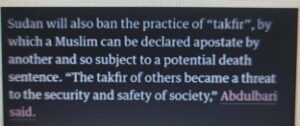
Regarding Jason’s claim that “Sudan will also ban the practice of takfir by which a Muslim can be declared apostate by another and so subject to a potential death sentence,” the statement definitely needs clarification and detail because while it is true that a Muslim can declare another Muslim to be apostate and subject to the prescribed punishment, the question is who among the Muslims has the authority to do so! Indeed, Ahlus Sunnah are fully aware that Takfeer can only be made by the upright scholars of the Islamic world—those who fear Allah and refrain from speaking unless they are well-informed. Find out who can make Takfeer and its guiding principles here:

http://www.salafipublications.com/sps/downloads/pdf/MNJ090006.pdf

Read further here: On Those Who Ought To Declare Takfir and Establish the Hadd Punishment, according to Shaykh Salih al-Fawzaan:

http://www.spubs.com/sps/sp.cfm?subsecID=MNJ09&articleID=MNJ090004&articlePages=1

Islam’s Unapologetic Position On Apostasy – [Unveiling Another Path of The Criminals and Opponents of The Messengers]: https://salafidawahmanchester.com/2022/06/11/islams-unapologetic-position-on-apostasy-unveiling-another-path-of-the-criminals-and-opponents-of-the-messengers/

Regarding the quote from Jason that reads, “The Takfir of others became a threat to the security and safety of society,” it is clear that the act of false (or unjustified) Takfir against a Muslim is a dangerous matter. All Muslim rulers must take action to shut this terrible door in order to stop the contemporary Khaarijites from using Sayyid Qutb’s, Usama Bin Ladin’s, and Ayman Az-Zawahiri’s evil ideology to overthrow Muslim governments and incite violence.

Shaikh Falaah Ismaa’eel [may Allah have mercy upon him] stated: In order to comprehend their danger, it merits noting what Allah’s Messenger [peace and blessings of Allaah be upon him] wished if he were to encounter them and what he would do to them, despite the fact that they hail from the Ummah and from the people of the Qiblah, that he would slaughter them in a manner comparable to that of Aad and Thamood; especially when one considers what Allah’s Messenger said concerning dogs, “Had dogs not been a community amongst the communities, I would have commanded that all of them be killed”. (see footnote I) Therefore, a sensible person examines and considers what the Messenger of guidance and mercy wanted to do to these Khawaarij, notwithstanding their commitment to worship, prayer, fasting, and Qur’anic recitation, in comparison to what he prevented himself and others from doing to dogs. Indeed, this is strong evidence of the peril posed by the persistence of this idea [i.e., Fasle Takfeer] and this kind of people in the Ummah [i.e., the Khawaarij], since they weaken the Ummah and keep it preoccupied with [internal issues, strife, etc.] (3)

Footnote I: “Had dogs not been a community amongst the communities, I would have commanded that all of them be killed”.

Al-Khattaabee [may Allah have mercy upon him] said, “This statement means that the Prophet [peace and blessings of Allah be upon him] hated that a community among the communities and a species among the creation would vanish until they all ceased to exist because, in reality, none of Allah’s creatures exist without some kind of purpose or benefit guiding their existence. Since there is no way to eliminate all of them in this situation, kill the evil ones among them – the black dog – leave the others so that you might use them as guard dogs”. [An Excerpt from Ma’aalim As-Sunan 4/132] [NB: Only the authorities in the Uk are allowed to take the life of an animal and any individual who does so will be found guilty of animal cruelty]

Dogs we can keep: Abdullah Ibn Umar [may Allaah be pleased with him and his father] said, “Allah’s Messenger [peace and blessings of Allaah be upon him] said, ‘Whoever keeps a dog, except a dog for herding livestock or a dog that is trained for hunting, two qiraats [i.e. great reward] will be deducted from his reward each day’”. [Bukhaari 5163 and Muslim 1574]

Imaam Muhammad Ibn Saaleh Al-Uthaymeen [may Allaah have mercy upon him] said, “As a result, there is no need to have a dog to guard a house if it is in the heart of a metropolis. Therefore, having a dog for this reason in such circumstances is forbidden and unlawful, and it reduces a person’s reward by one or two qiraats each day. However, it is acceptable to have a dog to protect the home and those living there if the house is in a rural area and nobody is home. It is more crucial to protect a household’s residents than its animals or agricultural produce”. [An Excerpt from Majmoo Fataawa Ibn Uthaymeen 4/246]

The Hunting Dog

Allah [The Most High] said:

يَسۡـَٔلُونَكَ مَاذَآ أُحِلَّ لَهُمۡ‌ۖ قُلۡ أُحِلَّ لَكُمُ ٱلطَّيِّبَـٰتُ‌ۙ وَمَا عَلَّمۡتُم مِّنَ ٱلۡجَوَارِحِ مُكَلِّبِينَ تُعَلِّمُونَہُنَّ مِمَّا عَلَّمَكُمُ ٱللَّهُ‌ۖ فَكُلُواْ مِمَّآ أَمۡسَكۡنَ عَلَيۡكُمۡ وَٱذۡكُرُواْ ٱسۡمَ ٱللَّهِ عَلَيۡهِ‌ۖ وَٱتَّقُواْ ٱللَّهَ‌ۚ إِنَّ ٱللَّهَ سَرِيعُ ٱلۡحِسَابِ

They ask you [O Muhammad)] what is lawful for them [as food]. Say: “Lawful unto you are At-Tayyibat [all kind of Halal (lawful-good) foods which Allah has made lawful (meat of slaughtered eatable animals, milk products, fats, vegetables, and fruits, etc.)]. And those beasts and birds of prey which you have trained as hounds, training and teaching them [to catch] in the manner as directed to you by Allaah; so eat of what they catch for you, but pronounce the Name of Allah over it, and fear Allah. Verily, Allah is Swift in reckoning”. [Surah Al-Maa’idah. Aayah 4]

Imaam Ibnul Qayyim [may Allaah have mercy upon him] said: Indeed, Allah declared the prey of the untrained hound to be dead meat and forbidden to consume, whereas He declared the prey of the trained hound to be permissible. This is evidence of the nobility of knowledge as Allah did not declare any prey other than that of the trained hound to be lawful. The trained and untrained hound would have been the same if it weren’t for the fact that knowledge and teaching have a unique distinguished virtue and nobility. [An Excerpt Mihtaah Daarus Sa’aadah. 1/55]

https://abukhadeejah.com/dog-as-pets-guard-dogs-sheepdogs-hunting-hounds/


Ref 1: Al-Misbaah Al-Muneer Fee Tahdeeb Tafseer Ibn Katheer

Ref 2: An Excerpt from Al-Bayaan Li-Akhtaa’i Ba’dil Kuttaab. 2/177-180

[Ref 3: An Excerpt from Naz’atut Takfeer. Pages 24-25. slightly paraphrsed]