[10] O Faris Al-Hammadi! The time has arrived for your deceitful and absurd statements to be unveiled for all to see! [Examine thoroughly before hastily claiming that proper etiquette has been disregarded in interactions with Faris]

In The Name of Allah, The Most Merciful, The Bestower of Mercy.

Al-Allamah Ubaid Bin Abdillah Al-Jabiri, may Allah have mercy upon him, was asked: If I heard a scholar’s statement in an audio recording or read it in a book that a certain individual is an innovator, yet I did not see any proof, am I obligated to exercise caution regarding this individual and be satisfied that he is an innovator, or should I wait until I obtain evidence of that?

Response: All praise is due to Allah the Lord of all that exists. May Allah send His Salutations of peace and blessings upon our prophet Muhammad, his family, and companions. To proceed: I say: Indeed, Ahlus Sunnah do not issue a judgment on Bidah concerning any individual unless they are fully acquainted with him, thoroughly assess what he follows, and are well-versed in their methodology both in general and in detail. This perspective brings us to two matters:

The first one involves a situation where a scholar or group of scholars has deemed someone an innovator, and this view is not contested by other scholars from Ahlus Sunnah. Bear in mind! I say that others from Ahlus Sunnah do not disagree with him, so we accept their criticism of the individual in question. We accept their speech and exercise caution regarding this individual in question. As long as a Sunni scholar has passed judgment on him – criticised by a Sunni scholar, while the rest of Ahlus Sunnah among the contemporaries of this scholar – his brothers and sons- did not object, his speech must be accepted. This is because this Sunni scholar who issued the criticism did not do so except based on a matter that is clear to him and established upon evidence. This is something about the religion ordained by Allah, and the one who criticises or praises others is aware of their accountability for what he says and the judgment they make. He knows that he is answerable to Allah even before the people question him.

The second one involves a situation where an individual has faced criticism from a scholar or scholars, resulting in a judgment that topples his status, making it obligatory to exercise caution regarding him. However, others have deemed this person trustworthy and aligned with the Sunnah, offering judgments that contradict those of the critics. In such cases, as long as both groups of scholars adhere to the Sunnah and are regarded as trustworthy and people of integrity in our view, we should examine the evidence. This is why they (i.e. the Scholars) say: “The one who knows serves as proof against the one who does not know”. A critic who states that a certain individual is both an innovator and a deviant, while providing evidence from that person’s writings, cassette tapes, or reliable narrators, compels us to accept the critic’s speech and abandon the praise from those who oppose the criticism. This is because the critics have presented evidence that may not be known to others, or because the individuals offering praise may not have encountered (any negative information) about the criticised person; instead, their commendation is based on their prior knowledge and (belief) that the individual adhered to the Sunnah.

Consequently, the individual who has been criticised and against whom evidence has been presented is deemed unreliable, with the proof resting with the one who provided the evidence. It is incumbent upon the one who is in search of truth to adhere to the evidence without deviating to the right or left, nor claiming, “I choose to abstain” because we have not been obligated with this by the Salaf. It is a duty to accept the statements of the one who has established the evidence. A Sunni scholar who defends those criticised is excused, and we uphold his status and honour. We acknowledge the virtues and high status he possesses, by the will of Allah.

A scholar from Ahlus Sunnah is only human. He can become distracted and forgetful, and he may be misled by evil people, or there may have been a time when he viewed someone as trustworthy, only for that person to later be deemed untrustworthy, and this person deceives him. Numerous witnesses can attest to this situation, as many individuals who have lost their credibility due to evidence are, in reality, people who wage war against the Sunnah and its followers.

They come along bearing copies of their books, presenting them to distinguished scholars—individuals revered for their leadership and virtue – while the true nature of this trickster and plotter remains concealed from this noble scholar, who, had he been aware, would have seen this individual’s standing diminish in his eyes. Consequently, the scholar offers commendations based solely on what he has heard. If this book is published, it is circulated by his supporters, who cultivate a favourable image of him. Thus, some contend, “So-and-so has praised him—Al-Albaanee, Ibn Baaz, or Ibn Al-Uthaymeen has lauded this work.” Yet, these scholars are not to be blamed; rather, it is the trickster who has remained shrouded from their view. So, what remains? We establish the evidence against this deceiver, trickster, and plotter based on what is found in his books. We establish the manifest clarifications against him from his books and we say to the one who argues with us, “Take it, this is his speech”. Consequently, it is obligated to you to be fair and be free from that wild and zealous attachment, and from the desires that blind a person. It is obligated to you that your search should be for the truth. [End of quote] [Refer to Arabic text at the end of this article]


Observations

[I] The Shaikh, may Allah have mercy upon him, said: Bear in mind! I say that others from Ahlus Sunnah do not disagree with him, so we accept their criticism of the individual in question. We accept their speech and exercise caution regarding this individual in question. As long as a Sunni scholar has passed judgment on him – criticised by a Sunni scholar, while the rest of Ahlus Sunnah among the contemporaries of this scholar – his brothers and sons- did not object, his speech must be accepted. This is because this Sunni scholar who issued the criticism did not do so except based on a matter that is clear to him and established upon evidence. This is something about the religion ordained by Allah, and the one who criticises or praises others is aware of their accountability for what he says and the judgment they make. He knows that he is answerable to Allah even before the people question him. [End of quote]

Observation: Indeed, before Faris attempts to present excuses for Dr. Muhammad Ibn Haadee or attempts to manipulate the narrative to suggest that the matter is exclusively between Dr. Muhammad and Al-Allaamah Rabee, he must recognise that no prominent senior scholar in the realm of Al-Jarh Wat Ta’deel in our time supports Dr. Muhammad’s Tabdee against those senior students. Not only do they oppose his stance, but they also insistently call upon him to furnish evidence, which he has yet to provide. For instance, Shaikh Abu Iyadh has provided the requests of Shaikh Rabee on link 1 at the end of this article.

Is it considered good etiquette to intervene after scholars have presented their well-founded arguments and then declare oneself a mediator while contradicting established principles? Furthermore, Faris explicitly mentioned that those who engage in this issue in a way he finds unsuitable are acting out of foolishness and are influenced by Shaytaan. Therefore, who truly deserves the label of bad manners: those adhering to the sound principles of Salafiyyah to uphold justice, or Faris, who attacks them?

[II] The Shaikh, may Allah have mercy upon him, said: “In such cases, as long as both groups of scholars adhere to the Sunnah and are regarded as trustworthy and people of integrity in our view, we should examine the evidence. This is why they (i.e. the Scholars) say: “The one who knows serves as proof against the one who does not know”. A critic who states that a certain individual is both an innovator and a deviant, while providing evidence from that person’s writings, cassette tapes, or reliable narrators, compels us to accept the critic’s speech and abandon the praise from those who oppose the criticism. This is because the critics have presented evidence that may not be known to others, or because the individuals offering praise may not have encountered (any negative information) about the criticised person; instead, their commendation is based on their prior knowledge and (belief) that the individual adhered to the Sunnah. Consequently, the individual who has been criticised and against whom evidence has been presented is deemed unreliable, with the proof resting with the one who provided the evidence. It is incumbent upon the one who is in search of truth to adhere to the evidence without deviating to the right or left, nor claiming, “I choose to abstain” because we have not been obligated with this by the Salaf. It is a duty to accept the statements of the one who has established the evidence. A Sunni scholar who defends those criticised is excused, and we uphold his status and honour. We acknowledge the virtues and high status he possesses, by the will of Allah”. [End of quote]

Observation: In this context, Al-Allamah Rabee, Al-Allamah Ubaid, Shaikh Abdullah Al-Bukhari, and others have rejected the Tabdee issued by Dr. Muhammad, and no one is more knowledgeable about this issue than they are. Similarly, the senior students in the West, including those at Spubs and their peers among the senior Tullabul Ilm, are well-informed about this matter and its evidence-based arguments, all of which refute Dr. Muhammad’s Tabdee against these esteemed students of knowledge. Dr. Muhammad’s criticisms lack the necessary evidence to substantiate his Tabdee, which is the basis for the scrutiny he faces. Therefore, why is Faris obscuring this issue and attempting to frame it as a dispute solely between Shaikh Rabee and Dr. Muhammad? Furthermore, he disparages those who seek justice based on thorough knowledge, labeling their pursuit as foolishness or influenced by Shaytaan. This behaviour is a reflection of poor manners; do not be misled into supporting their claims of good conduct, as the height of bad manners is to deny the truth and attack those who seek its clarification.

It is well established among scholars and senior students in the West that those senior students oppressed by Dr Muhammad adhere to Salafiyyah. Their commitment to Salafiyyah is not subject to doubt based on Dr. Muhammad’s conjectures or the Musaafiqah’s desires. Certainty does not simply vanish due to the unfounded doubts that have led Dr. Muhammad to make an erroneous judgment. Does Faris expect us to ignore these issues for the sake of convenience? Remain vigilant and do not hastily conclude that Faris deserves leniency or that the strong criticism aimed at him is a sign of bad manners. As previously stated, what could be worse than bad manners than to hide the truth, misrepresent it, and then attack those who seek clarity?  Is it truly good manners for Faris to come forward and present a distorted view of the real issues at hand? While he promotes the idea of good manners, he lacks the courage to confront Dr. Muhummand about his treatment of those senior students, despite being in the wrong. Therefore, before you rally behind Faris or advocate for a gentle approach towards him, it’s essential to address this issue directly and demand that he takes a definitive stance, rather than resorting to verbal attacks against those seeking justice.

[III] The Shaikh, may Allah have mercy upon him, stated: “A scholar from Ahlus Sunnah is only human. He can become distracted and forgetful, and he may be misled by evil people, or there may have been a time when he viewed someone as trustworthy, only for that person to later be deemed untrustworthy, and this person deceives him. Numerous witnesses can attest to this situation, as many individuals who have lost their credibility due to evidence are, in reality, people who wage war against the Sunnah and its followers. They come along bearing copies of their books, presenting them to distinguished scholars—individuals revered for their leadership and virtue – while the true nature of this trickster and plotter remains concealed from this noble scholar, who, had he been aware, would have seen this individual’s standing diminish in his eyes. Consequently, the scholar offers commendations based solely on what he has heard. If this book is published, it is circulated by his supporters, who cultivate a favourable image of him. Thus, some contend, “So-and-so has praised him—Al-Albaanee, Ibn Baaz, or Ibn Al-Uthaymeen has lauded this work.” Yet, these scholars are not to be blamed; rather, it is the trickster who has remained shrouded from their view. So, what remains? We establish the evidence against this deceiver, trickster, and plotter based on what is found in his books. We establish the manifest clarifications against him from his books and we say to the one who argues with us, “Take it, this is his speech”. Consequently, it is obligated to you to be fair and be free from that wild and zealous attachment, and from the desires that blind a person. It is obligated to you that your search should be for the truth”. [End of quote]

We reiterate that the senior students whom Dr. Muhummand has labeled with Tabdee continue to uphold Salafiyyah, and no one’s adherence to Salafiyyah should be questioned based on mere speculation or personal desires. Their integrity cannot be challenged without substantial evidence. Faris is so intent on safeguarding his own reputation that he resorts to blocking our Twitter accounts when we shared Shaikh Abu Iyaad’s comprehensive explanation on these issues. However, he shows little concern for the dignity of others—those unjustly targeted by Dr. Muhummand’s harsh ruling of Tabdee. Instead, he shamefully misrepresents the situation as a dispute solely between Dr. Muhummand and Al-Allaamah Rabee, suggesting it should be dismissed. This is merely an attempt to divert attention from the real issue, which is Dr. Muhummand’s flawed judgment of Tabdee. Furthermore, those who have been wronged by Dr. Muhummand are not adversaries of the Sunnah, and anyone who claims otherwise must provide clear proof; otherwise, they are spreading a serious falsehood. Therefore, Dr. Muhummand’s Tabdee must be categorically rejected without any doubt. The true deceivers in this matter are those like Faris, who distort the narrative to imply that the issue pertains only to Dr. Muhummand and Al-Allaamah Rabee. Faris’s misguided statements imply that all responsibilities related to this matter should be disregarded, whether he states this openly or remains silent, unless he offers a proper clarification. See pic 2

To be continued InShaAllah

Link 1: https://x.com/AbuIyaadSP/status/1018974451269033986

Pic 2:


الموقف الصحيح من إختلاف العلماء في الجرح و التعديل لفضيلة الشيخ/ عبيد الجابري حفظه الله

الموقف الصحيح من إختلاف العلماء في الجرح و التعديل لفضيلة الشيخ/ عبيد الجابري حفظه الله

فضيلة الشيخ عبيد بن عبد الله الجابري – حفظه الله –
************************************************** *

الحمد لله رب العالمين ، وصلى الله وسلم على نبينا محمد ، وعلى آله وصحبه أجمعين ، أما بعد ، رداً على السائل الذي قال .. إذا سمعتُ كلام العالم في شريط أو قرأتُ له في كتاب عن شخص ما أنه مبتدع ولم أر منه دليلا على ذلك، فهل يلزمني أن أحْذر من هذا الشخص وأن أقتنع بأنه مبتدع أم أتريّث حتى أجد الدليل على ذلك؟.

أقول فإن أهل السنة لا يحكمون على أحد ببدعة إلا وقد خَبَرُوه وسَبَرُوا ما عنده – تماماً – وعرفوا منهجه – تماماً – جملةً وتفصيلاً، ومن هنا هذه المسألة تستدعي منّا وقفتين:
الوقفة الأولى: فيمن حَكم عليه عالم أو علماء بأنه مبتدع ، ولم يختلف معهم غيرهم ممن هم أهل سنة مثلهم، تفطنوا، أقول : لم يختلف معهم غيرهم فيه ممن هم أهل سنة، فإنا نقبل جرحهم له، فإنا نقبل قولهم ونحذَره ، مادام أنه حَكَم عليه وجَرَحه عالم سني ، ولم يظهر بقية أهل السنة الذين هم أقران هذا العالم من إخوانه وأبنائه العلماء فلابد من قبوله، لأن هذا العالم السني الذي جرح رجلاً : فإنه لم يجرحه إلا بأمر بان له وقام عنده عليه الدليل ،لأن هذا من دين الله، والذي يجرّح أو يُعدّل يعلم أنه مسؤول عما يقول ويفتي به أو يحكم به ويعلم أنه مسؤول من الله تعالى قبل أن يسأله الخلق.

الوقفة الثانية: إذا كان هذا الشخص الذي جرحه عالم أو علماء حكموا عليه بما يُسقطه ويوجب الحذر منه قد خالفهم غيرهم وحكموا بعدالته وأنه على السنة أو غير ذلك من الأحكام المخالفة لأحكام الآخرين المجرحين له، فمادام أن هؤلاء على السنة وهؤلاء على السنة وكلهم أهل ثقة عندهم وذَووا أمانة عندنا ففي هذه الحال ننظر في الدليل، ولهذا قالوا: «من عَلِمَ حُجَّة على من لم يَعْلَم» الجارح قال في فلان من الناس إنه مبتدع منحرفٌ سعيه وأتى بالأدلة مِن كُتب المجروح أو من أشرطته أو من نقل الثقاة عنه، فهذا موجب علينا قبول قوله وترك المعدِّلين الذين خالفوا مَنْ جرَّحه، لأن هؤلاء المجَرِّحين له أتَوا بأدلة خَفِيَتْ على الآخرين لسبب من الأسباب أو أن المعدِّل لم يقرأ ولم يسمع عن ذلك المجرّح، وإنما بنى على سابقِ عِلمِه به، وأنه كان على سنة، فأصبح هذا المجروح الذي أقيم الدليل على جرحه مجروحا والحجة مع من أقام الدليل، وعلى من يطلب الحق أن يتبع الدليل و لا يتلمّس بُنيات الطريق ذات اليمين وذات الشمال، أو يقول أقف بنفسي، فهذا لم نعهده عند السلف، وهذه الأمور تكون فيما لا يسوغ فيه الاجتهاد في أصول العقائد وأصول العبادات، فإن المصير إلى قبول من أقام الدليل واجب حتمي، وذاك العالم السني الذي خالف الجارحين، له عذره، يبقى على مكانته عندنا وعلى حرمته عندنا، ونستشعر أنه له إن شاء الله ما كان عليه من سابقة الفضل وجلالة القدر، هذا وسعه ، والعالم من أهل السنة، السلفي، بَشَرٌ يذهل، ينسى، يكون عُرضة للتلبيس من بطانة سيئة، أو كان قد وَثِقَ بذلك الرجل المجروح فلَبَّسَ عليه، والشواهد على هذا كثيرة، فكثير من السَّـقَط والذين هم في الحقيقة حربٌ على السنة وأهلِها يأتون بنماذج من كتبهم يقرؤونها على علماء أجلّة مشهود لهم بالفضل والإمامة في الدين، ويُخفي ذلك اللعّاب الماكر عن ذلك العالم الجليل الإمام الفذ الجهبذ ما لو عَلِمَه لسقط عنه، فهذا العالم يُزكِّي بناءً على ما سَمِع، فإذا طُبِع الكتاب وانتشر وتناقلته الأيدي وذاع صيته وإذا بالمجادلين يقولون زكَّاه فلان، فلان: الألباني – رحمه الله – ، أو ابن باز – رحمه الله -، أو ابن العثيمين – رحمه الله – ، زكّى هذا الكتاب فهؤلاء العلماء – رحمة الله عليهم – معذورون، ومن التَّبعة سالمون – إن شاء الله تعالى – في الدنيا والآخرة ، وإنما هذا لعَّاب أخفى ولبّس على ذلك العالم، إذن ماذا بقي؟ نقيم على ذلك الملبِّس اللعاب الدساس الماكر مِنْ كُتبه، يقيم عليه البيِّـنة من كتبه، ومن جادلنا فيه نقول خذ، هذا هو قولُه، هل تظن أنه عَرَضهُ بهذه الصورة على من سمَّينا من أهل العلم ومن هو على نفس النهج فأقرُّوه؟ الجواب كلا، إذن يجب عليك أن تكون مُنْصفا متجردا من العاطفة الجياشة المندفعة ومن الهوى الذي يُعمي ويجب عليك أن تكون طُلبتُك الحق، نعم.

الطالب: جزاكم الله خيرا وأحسن الله إليكم، هذا السائل يقول: ما الواجب على عوام السلفيين في دعاة اختلف العلماء في تعديلهم وتجريحهم سواء علموا أخطاءهم أم لم يعلموها؟

الشيخ: أقول لمعشر السلفيين والسلفيات مَنْ بلَغَتْهم مشافهةً هذه المحادثة مني ومَن ستبلغهم عبر من صاغوا الأسئلة وأَلقَوْها علينا، أقول: أنصحكم إن كنتم تحبون الناصحين ألاّ تقبلوا شريطا ولا كتابا إلا ممن عرفتم أنه على السنة مشهودٌ له بذلك واشتهر بها ولم يظهر منه خلاف ذلك، وهذه قاعدة مطَّردة في حياته وبعد موته، فمن مات وهو فيما نحسبه على السنة فهو عندنا عليها ونسأل الله أن يثبته عليها في الآخرة كما ثبته عليها حيا… آمين، هذا أولا.

ثانيا: إذا خفي عليكم أمرُ إنسان اشتهرتْ كتبه وأشرطته وذاع صيته فاسألوا عنه ذوي الخِبْرة به والعارفين بحاله، فإن السنة لا تخفى ولا يخفى أهلها، فالرجل تزكّيه أعماله، تزكّيه أعماله التي هي على السنة، وتشهد عليه بذلك ويذكره الناس بها حيا وميتا، وما تَسَتَّرَ أحدٌ بالسنة وغرّر الناس به حتى التـفُّوا حوله وارتبطوا به وأصبحوا يعوِّلون عليه ويقبلون كل ما يصدر عنه إلاّ فَضحَه الله سبحانه وتعالى وهتك ستره وكشف للخاصة والعامة ما كان يُخفي وما كان يُكنُّ من الغش والتلبيس والمكر والمخادعة، يهيّئ الله رجالا فضلاء فطناء حكماء أقوياء جهابذة ذوي علم وكياسة وفـِقهٍ في الدين يكشف الله بهم ستر ذلكم اللعاب الملبِّس الغشاش، فعليكم إذا بُيِّنَ لكم حال ذلك الإنسان الذي قد ذاع صيته وطبَّق الآفاق وأصبح مرموقا يشار إليه بالبنان، أصبح عليكم الحذر منه مادام أنه حذَّرَ منه أهل العلم والإيمان والذين هم على السنة، فإنهم سيكشفون لكم بالدليل، ولا مانع من استكشاف حال ذلك الإنسان الذي حذَّر منه عالم أو علماء بأدب وحسن أسلوب فإن ذلك العالم سيقول لك: رأيتُ فيه كذا وكذا وفي الكتاب الفلاني كذا وفي الشريط الفلاني كذا وإذا هي أدلة واضحة تكشف لك ما كان يخفيه وأن ذلكم الذي طَبَّق صيته الآفاق وأصبح حديثه مستساغا يُخفي من البدع والمكر ما لا يظهره من السنة.

وأمر ثالث: وهو أن مَنْ عَلِمَ الخطأ وبان له فلا يسوغ له أن يقلِّد عالما خَفِيَ عليه الأمر، وقد قدمت لكم أَمسي أن اجتهادات العلماء غير معصومة، ولهذا لا يجوز أن تُتخذ منهجا، نعم.

من شريط مفرغ بعنوان “ضوابط التعامل مع أهل السنة وأهل الباطل”.

فضيلة الشيخ عبيد بن عبد الله الجابري – حفظه الله –
************************************************** *

الحمد لله رب العالمين ، وصلى الله وسلم على نبينا محمد ، وعلى آله وصحبه أجمعين ، أما بعد ، رداً على السائل الذي قال .. إذا سمعتُ كلام العالم في شريط أو قرأتُ له في كتاب عن شخص ما أنه مبتدع ولم أر منه دليلا على ذلك، فهل يلزمني أن أحْذر من هذا الشخص وأن أقتنع بأنه مبتدع أم أتريّث حتى أجد الدليل على ذلك؟.

أقول فإن أهل السنة لا يحكمون على أحد ببدعة إلا وقد خَبَرُوه وسَبَرُوا ما عنده – تماماً – وعرفوا منهجه – تماماً – جملةً وتفصيلاً، ومن هنا هذه المسألة تستدعي منّا وقفتين:
الوقفة الأولى: فيمن حَكم عليه عالم أو علماء بأنه مبتدع ، ولم يختلف معهم غيرهم ممن هم أهل سنة مثلهم، تفطنوا، أقول : لم يختلف معهم غيرهم فيه ممن هم أهل سنة، فإنا نقبل جرحهم له، فإنا نقبل قولهم ونحذَره ، مادام أنه حَكَم عليه وجَرَحه عالم سني ، ولم يظهر بقية أهل السنة الذين هم أقران هذا العالم من إخوانه وأبنائه العلماء فلابد من قبوله، لأن هذا العالم السني الذي جرح رجلاً : فإنه لم يجرحه إلا بأمر بان له وقام عنده عليه الدليل ،لأن هذا من دين الله، والذي يجرّح أو يُعدّل يعلم أنه مسؤول عما يقول ويفتي به أو يحكم به ويعلم أنه مسؤول من الله تعالى قبل أن يسأله الخلق.

الوقفة الثانية: إذا كان هذا الشخص الذي جرحه عالم أو علماء حكموا عليه بما يُسقطه ويوجب الحذر منه قد خالفهم غيرهم وحكموا بعدالته وأنه على السنة أو غير ذلك من الأحكام المخالفة لأحكام الآخرين المجرحين له، فمادام أن هؤلاء على السنة وهؤلاء على السنة وكلهم أهل ثقة عندهم وذَووا أمانة عندنا ففي هذه الحال ننظر في الدليل، ولهذا قالوا: «من عَلِمَ حُجَّة على من لم يَعْلَم» الجارح قال في فلان من الناس إنه مبتدع منحرفٌ سعيه وأتى بالأدلة مِن كُتب المجروح أو من أشرطته أو من نقل الثقاة عنه، فهذا موجب علينا قبول قوله وترك المعدِّلين الذين خالفوا مَنْ جرَّحه، لأن هؤلاء المجَرِّحين له أتَوا بأدلة خَفِيَتْ على الآخرين لسبب من الأسباب أو أن المعدِّل لم يقرأ ولم يسمع عن ذلك المجرّح، وإنما بنى على سابقِ عِلمِه به، وأنه كان على سنة، فأصبح هذا المجروح الذي أقيم الدليل على جرحه مجروحا والحجة مع من أقام الدليل، وعلى من يطلب الحق أن يتبع الدليل و لا يتلمّس بُنيات الطريق ذات اليمين وذات الشمال، أو يقول أقف بنفسي، فهذا لم نعهده عند السلف، وهذه الأمور تكون فيما لا يسوغ فيه الاجتهاد في أصول العقائد وأصول العبادات، فإن المصير إلى قبول من أقام الدليل واجب حتمي، وذاك العالم السني الذي خالف الجارحين، له عذره، يبقى على مكانته عندنا وعلى حرمته عندنا، ونستشعر أنه له إن شاء الله ما كان عليه من سابقة الفضل وجلالة القدر، هذا وسعه ، والعالم من أهل السنة، السلفي، بَشَرٌ يذهل، ينسى، يكون عُرضة للتلبيس من بطانة سيئة، أو كان قد وَثِقَ بذلك الرجل المجروح فلَبَّسَ عليه، والشواهد على هذا كثيرة، فكثير من السَّـقَط والذين هم في الحقيقة حربٌ على السنة وأهلِها يأتون بنماذج من كتبهم يقرؤونها على علماء أجلّة مشهود لهم بالفضل والإمامة في الدين، ويُخفي ذلك اللعّاب الماكر عن ذلك العالم الجليل الإمام الفذ الجهبذ ما لو عَلِمَه لسقط عنه، فهذا العالم يُزكِّي بناءً على ما سَمِع، فإذا طُبِع الكتاب وانتشر وتناقلته الأيدي وذاع صيته وإذا بالمجادلين يقولون زكَّاه فلان، فلان: الألباني – رحمه الله – ، أو ابن باز – رحمه الله -، أو ابن العثيمين – رحمه الله – ، زكّى هذا الكتاب فهؤلاء العلماء – رحمة الله عليهم – معذورون، ومن التَّبعة سالمون – إن شاء الله تعالى – في الدنيا والآخرة ، وإنما هذا لعَّاب أخفى ولبّس على ذلك العالم، إذن ماذا بقي؟ نقيم على ذلك الملبِّس اللعاب الدساس الماكر مِنْ كُتبه، يقيم عليه البيِّـنة من كتبه، ومن جادلنا فيه نقول خذ، هذا هو قولُه، هل تظن أنه عَرَضهُ بهذه الصورة على من سمَّينا من أهل العلم ومن هو على نفس النهج فأقرُّوه؟ الجواب كلا، إذن يجب عليك أن تكون مُنْصفا متجردا من العاطفة الجياشة المندفعة ومن الهوى الذي يُعمي ويجب عليك أن تكون طُلبتُك الحق، نعم.

الطالب: جزاكم الله خيرا وأحسن الله إليكم، هذا السائل يقول: ما الواجب على عوام السلفيين في دعاة اختلف العلماء في تعديلهم وتجريحهم سواء علموا أخطاءهم أم لم يعلموها؟

الشيخ: أقول لمعشر السلفيين والسلفيات مَنْ بلَغَتْهم مشافهةً هذه المحادثة مني ومَن ستبلغهم عبر من صاغوا الأسئلة وأَلقَوْها علينا، أقول: أنصحكم إن كنتم تحبون الناصحين ألاّ تقبلوا شريطا ولا كتابا إلا ممن عرفتم أنه على السنة مشهودٌ له بذلك واشتهر بها ولم يظهر منه خلاف ذلك، وهذه قاعدة مطَّردة في حياته وبعد موته، فمن مات وهو فيما نحسبه على السنة فهو عندنا عليها ونسأل الله أن يثبته عليها في الآخرة كما ثبته عليها حيا… آمين، هذا أولا.

ثانيا: إذا خفي عليكم أمرُ إنسان اشتهرتْ كتبه وأشرطته وذاع صيته فاسألوا عنه ذوي الخِبْرة به والعارفين بحاله، فإن السنة لا تخفى ولا يخفى أهلها، فالرجل تزكّيه أعماله، تزكّيه أعماله التي هي على السنة، وتشهد عليه بذلك ويذكره الناس بها حيا وميتا، وما تَسَتَّرَ أحدٌ بالسنة وغرّر الناس به حتى التـفُّوا حوله وارتبطوا به وأصبحوا يعوِّلون عليه ويقبلون كل ما يصدر عنه إلاّ فَضحَه الله سبحانه وتعالى وهتك ستره وكشف للخاصة والعامة ما كان يُخفي وما كان يُكنُّ من الغش والتلبيس والمكر والمخادعة، يهيّئ الله رجالا فضلاء فطناء حكماء أقوياء جهابذة ذوي علم وكياسة وفـِقهٍ في الدين يكشف الله بهم ستر ذلكم اللعاب الملبِّس الغشاش، فعليكم إذا بُيِّنَ لكم حال ذلك الإنسان الذي قد ذاع صيته وطبَّق الآفاق وأصبح مرموقا يشار إليه بالبنان، أصبح عليكم الحذر منه مادام أنه حذَّرَ منه أهل العلم والإيمان والذين هم على السنة، فإنهم سيكشفون لكم بالدليل، ولا مانع من استكشاف حال ذلك الإنسان الذي حذَّر منه عالم أو علماء بأدب وحسن أسلوب فإن ذلك العالم سيقول لك: رأيتُ فيه كذا وكذا وفي الكتاب الفلاني كذا وفي الشريط الفلاني كذا وإذا هي أدلة واضحة تكشف لك ما كان يخفيه وأن ذلكم الذي طَبَّق صيته الآفاق وأصبح حديثه مستساغا يُخفي من البدع والمكر ما لا يظهره من السنة.

وأمر ثالث: وهو أن مَنْ عَلِمَ الخطأ وبان له فلا يسوغ له أن يقلِّد عالما خَفِيَ عليه الأمر، وقد قدمت لكم أَمسي أن اجتهادات العلماء غير معصومة، ولهذا لا يجوز أن تُتخذ منهجا، نعم.

من شريط مفرغ بعنوان “ضوابط التعامل مع أهل السنة وأهل الباطل”.
[9] O Faris Al-Hammadi! The time has arrived for your deceitful and absurd statements to be unveiled for all to see! [Brother, did you advise Faris privately prior to rebuking him?]

In The Name of Allah, The Most Merciful, The Bestower of Mercy.

Al-Allaamah Muqbil Bin Haadee Al-Waadi’ee, may Allah have mercy upon him, was asked: “What is the difference between criticism and advice?”

Response: The difference between criticism and advice is that advice can be in private between the one advising and the one being advised, and it can be with gentleness and mildness. 

فَقُولَا لَهُ قَوْلًا لَّيِّنًا لَّعَلَّهُ يَتَذَكَّرُ أَوْ يَخْشَىٰ 

And speak to him (i.e. Fir’awn) mildly, perhaps he may accept admonition or fear Allah]. [Taa Haa. 44]

As for criticism, it can be recorded in books and mentioned in councils (sittings), and our predecessors, may Allah have mercy on them, combined between the two. Imam Adh-Dhahabi, may Allah have mercy upon him, said, “Ratan, and who is Ratan? (i.e. Ratan Bin Abdillah Al-Hindi)? A liar amongst the big liars who claimed that he accompanied the Prophet after six years has elapsed”.

Imam Ash-Shafi’ee said, may Allāh have mercy upon him, said: “The narration on the authority of Haram Bin Uthman is Haraam (forbidden)”.

When Suwayd Bin Sa’eed narrated, “He who is infatuated, abstains, conceals (his infatuation) and then dies, he dies as a martyr”, Yahya Bin Ma’een said, “If I had a horse and a spear, I would have carried out a military expedition against Suwayd”.

Aban Ibn Abi Ayyash was a Zahid, a devout worshipper, and a virtuous person, but he used to mix up in his transmission of hadith. Shu’bah was asked to refrain from (speaking) about Aban Ibn Abi Ayyash, so he said, “I will see (or wait)”. Then he advised him saying, “Indeed, (this affair is) religion, I can’t except to speak about Aban Ibn Abi Ayyash”. (1)

Imam Al-Albaanee, may Allah have mercy upon him, was asked: The statement of some people or the stipulation of some of them is that it is more correct that advice must be given before refutations are printed- a copy must be sent to the one refuted so that it can be looked into. They say this is from the methodology of the pious predecessors.

Response: This is not a prerequisite, but if feasible and it is hoped that affinity would be established through this approach – to avoid publicising the matter, then it is undoubtedly a good thing. However, as for making it a prerequisite first and foremost, and a general prerequisite, there is no wisdom in this at all. As we all know, people are like the gold and silver mines, therefore, if you are aware that someone is aligned with us on the right path and is receptive to advice, then you write to him without exposing their mistakes. From your perspective, this is considered beneficial. However, it is important to note that this is not a prerequisite, and even if it were, it would be practically impossible to fully implement. How would you obtain their contact information and establish correspondence? Moreover, can you guarantee a response from them? These aspects are purely speculative. Fulfilling this condition is extremely challenging, hence it is not regarded as a prerequisite. [2]

Imam Abdul Azeez Bin Baz, may Allah have mercy upon him, was asked, “When should advice be given in private or openly?”

Response: The person giving advice does what is best. If he determines that it is more beneficial to advise discreetly, they do so secretly. Conversely, if he believes it is more beneficial to offer advice openly, he does so openly. However, if the sin occurs in secret, the advice can only be given privately. If he is aware of his brother’s sins in secret, he offers advice in secret and does not expose him. On the other hand, if the sin is committed openly and witnessed by others, such as someone consuming alcohol at a gathering, it is necessary to openly express disapproval. Similarly, if someone encourages others to engage in alcohol consumption or to fornicate, he should address them by saying, “O my brother! This behaviour is not permissible. [3]

Al-Allamah Rabee Bin Haadi Al-Mad’khali, may Allah preserve him, was asked: “Our Shaikh, one of the affairs that have become circulated and have aroused an intense feeling among the Salafis, is that there are people who claim that advice is obligatory before warning. Is there a statement you can give in this matter?”

Response: I answered this question before – may Allah bless you. We have been put to trial with these types of affairs, so you find a person spreading falsehoods, lies, and slander against others- both about individuals and in general; and if you give him advice or (respond with) criticism or something, he says, “Why did they not warn me, why did they not advise me, and why did they not explain to me”. Corrupt excuses. We seek from these people to repent to Allah and return to the truth with complete good manners and humility, and to leave such excuses. Assume that this one made a mistake and did not speak, and did not advise you, then (still) return to the truth and reprimand him thereafter. As for spreading (trouble) amongst the people and persisting in your falsehood and mistakes, and saying, “They did not do and they did”, this is empty talk. It is obligated to a believer to return to Allah (in obedience, repentance, etc). You publish your mistakes in books, tapes, etc. If you hid your mistakes and committed them in the darkness of your house – (known only to) you and Allah, then this person discovers you, he would have advised you – between you and him. As for disseminating your statements and (publicising) deeds in the world, then someone comes and publishes- meaning, replies to you (or rebuts you), there is nothing wrong with this -May Allah bless you. Leave these excuses that (arise) from many of the people of falsehood who are rebellious in falsehood and stubbornness. [4]

Faris has taken to social media with an unrestrained fervour, expressing his opinions without a hint of trepidation or discretion for quite some time. This prompted us to address some of his doubts, deceptions, insults, and misrepresentations outlined in posts 1 to 8. The insights shared by the senior scholars are more than sufficient for those genuinely seeking clarity, while they serve as a harsh reality check for those attempting to dilute the sound methodology surrounding this issue. Had Faris chosen to keep his misguided notions to himself, we would have offered him counsel in private. However, his belief in the validity of his erroneous views, which he feels compelled him to broadcast publicly, warrants nothing less than a public admonishment.

To be continued…InShaAllah


[1] Ghaarah Al-Ashritah 1/71

[2] Silsilah Al-Hudaa Wan-Noor. Number 63

[3] Majallah Al-Islaah. (Number 17/241). Date: 23/6/1993

[4]https://rabee.net/alfatawi/%D8%B4%D9%8A%D8%AE%D9%86%D8%A7-%D9%85%D9%86-%D8%A7%D9%84%D8%A3%D9%85%D9%88%D8%B1-%D8%A7%D9%84%D8%AA%D9%8A-%D8%B5%D8%A7%D8%B1%D8%AA-%D8%AA%D8%B1%D9%88%D8%AC-%D9%88%D8%B5%D8%A7%D8%B1%D8%AA-%D8%B9%D8%B7/

We have no time to defend ourselves, rather, we defend the Sunnah- By Al-Allamah Muqbil Bin Haadee

In The Name of Allah, The Most Merciful, The Bestower of Mercy.

Al-Allamah Muqbil Bin Haadee al-Waadi’ee, rahimahullaah, said:

“All praise belongs to Allaah, we mention the noble ‘Ulamaa with good, we direct people to them the likes of Shaykh Badee’ ad-Deen al-Bakistaanee as-Sindee, Shaykh al-Albaanee…Shaykh Rabee’ and Ibn Baaz. Our books are full of advising people to sit with those scholars and to benefit from them and their books. As for if you intend (by your question) that there is nothing with us except Tajreeh (refutation) for the people of innovation, then that is correct since they are the ones who initiate it:

لَّا يُحِبُّ ٱللَّهُ ٱلْجَهْرَ بِٱلسُّوٓءِ مِنَ ٱلْقَوْلِ إِلَّا مَن ظُلِمَ وَكَانَ ٱللَّهُ سَمِيعًا عَلِيمًا

 Allah does not like that the evil should be uttered in public except by him who has been wronged. And Allah is Ever All-Hearer, All-Knower.  [Surah an-Nisaa: 148]

So they are the ones who initiate (the revilement) and make people flee from us. So at times they say (about us that we are) ‘people of Takfeer (ejecting people from Islaam).’ And other times they say we are ‘Mutashaddidoon’ (harsh), and they say that we do not know anything from the current affairs. And on occasions they say (about us that) we only know ‘Hadathana wa Akhbarana’ (he narrated to us and he informed us – i.e. knowledge of Hadeeth). And the Prophet (ﷺ) said:  “When two people revile/insult one another, (the sin of) what they say is upon the first one (i.e. the one who initiated it), so long as the wronged one does not transgress.” [Saheeh Muslim (no.2587]

So we are defenders of the Sunnah, not (defenders of) our own selves. We hear people reviling and insulting us but we do not reply to them. The people of Sa’dah authored: ‘The Decisive Speech In Refuting The Slanderer and Liar’ – they are talking about me but I did not reply to them… And we did not refute them – all praise be to Allaah – until the people of Sa’dah died. We have no time to defend ourselves, rather, we defend the Sunnah even if it is by biting with our molar teeth. We will never let anyone speak ill of the Sunnah of the Messenger (ﷺ), whether he is a Shi’ite, a Soofee or from the Muslim Brotherhood. We sacrifice ourselves and our honour for the Sunnah.” Source: [Fadaa’ih wa Nasaa’eh, p.153-155, Shaykh Muqbil b. Haadee al-Waadi’ee, Daar al-Haramain, First Edition, 1419H/1999CE]

Translated by Ustadh Abu Abdillah Bilal Al-Kashmiri – may Allah preserve him.

[1] Figureheads and Groups of Misguidance, Imposters and Deceivers

In The Name of Allah, The Most Merciful, The Bestower of Mercy.

He is known as Al-Husayn Ibn Mansoor Al-Hallaaj, also referred to as Abu Mughith or Abu Abdillah. His ancestry traces back to a fire worshipper from Persia. He was raised in Waasit, although some accounts suggest he spent his formative years in Tastar. His journey led him to Baghdad and subsequently to Makkah, where he resided in the vicinity of Masjid Al-Haraam, enduring both extreme heat and cold. For many years, he lived without shelter, subsisting on minimal food and water during breakfast for an entire year, driven by a commitment to self-discipline and devotion to worship. He often positioned himself on a rock under the intense sun at the mountain of Abu Qubays.

He accompanied several Sufi figureheads, including Junaid Bin Muhammad, Amr Bin Uthmaan Al-Makkee, and Abul Husayn An-Nooree. Al-Khateeb Al-Baghdaadee said: “The Sufis hold differing opinions regarding Al-Hallaaj; many assert that he does not belong to their ranks and should not be associated with their tradition. This (differing) extends to earlier figures such as Abul Abbas Bin Ataa Al-Baghdaadee, Muhammad Bin Khafeef Az-Sheeraazee, and Ibrahim Bin Muhammad An-Nasraabaadhee An-Naysaabooree, who recognised Al-Hallaaj as being on the right path and documented his teachings. Ibn Khafeef even stated, ‘Al-Husayn Bin Mansoor is a learned scholar.’ Abu Abdir Rahman As-Sulamee, whose full name was Muhammad Ibnul Husayn, recounted hearing Ibrahim Ibn Muhammad An-Nasraabaadhee share insights from Al-Hallaaj regarding the soul, subsequently addressing a critic by saying, ‘If there is anyone, after the Prophets and the truthful, who embodies monotheism, it is Al-Hallaaj.’ Furthermore, Abu Abdir Rahmaan noted that he heard Mansoor Bin Abdillah recount Shiblee’s words: ‘Al-Husayn Bin Mansoor and I are essentially the same, except that he manifested himself while I chose to remain concealed.’ Those who denied Al-Hallaaj’s association with the Sufis attributed his actions to sorcery, asserting that his beliefs align with those of heretics”.

Al-Hallaaj’s pronouncements reflected the concept of Hulool, [a] and he composed poetry associated with Sufiyyah. Since his execution, there has been ongoing debate among the people concerning his legacy. However, the rightly guided jurists, Imams, and scholars reached a consensus that he warranted execution by the authorities, deeming him a foolish and concealed disbeliever, as well as a sorcerer. This perspective was similarly held by the majority of early Sufis. Nevertheless, within the Sufi community, there exists a faction—previously mentioned—that idealises his situation, misled by his external demeanour and unable to comprehend the reality of his speech. Initially, he dedicated himself to worship; however, he lacked knowledge, and his practices were not grounded in the authentic divine path that leads to the pleasure and reverence of Allah. Consequently, Al-Hallaaj contributed more to corruption than to reform. Imam Sufyaan Bin Uyaynah, may Allah have mercy upon him, said: “Those among our scholars who fall into corruption bear a resemblance to the Jews, while those among the worshippers who become corrupt resemble the Christians.” This is the reason Al-Hallaaj engaged in the concepts of Hulool and Ittihaad, ultimately aligning himself with the ranks of corruption and deviation. His situation changed, and he traveled to various places, showing people that he was a guide to the way of Allah. It is well-known that he went to India, learned magic, and claimed, “I use it to call people to the way of Allah.” In India, people spoke of him as someone who helps others in tough times. In Khurasan, they called him the special one, while in Persia, he was known as Abu Abdillah, a man who avoided worldly pleasures. In Khuzestan, he was also called Abu Abdillah, the mysterious one who chose to stay away from worldly pleasures.

Al-Khateeb Al-Baghdaadee conveyed through his chain of narration that Al-Hallaaj stated, “The wisdom of both the early and later generations can be distilled into four statements: loving what is exalted, detesting the despicable, adhering to divine revelation, and maintaining a fear of straying.” It is evident that Al-Hallaaj faltered in the latter two aspects, as he neither adhered to the revelation nor maintained steadfastness; instead, he strayed from these principles and ultimately fell into Bidah and misguidance. Abdur Rahmaan As-Sulamee narrated from Amr Bin Uthmaan Al-Makkee, who stated: “While I was strolling through one of the narrow streets of Makkah, reciting the Qur’an alongside Al-Hallaaj, he listened to my recitation and remarked, ‘I can express something akin to this.’ Thus, I chose to distance myself from him.”

Al-Khateeb Al-Baghdaadee reported, “Mas’ud Bin Nasir conveyed to me that Ibn Bakur Az-Sheeraazee mentioned he heard Abu Zur’ah At-Tabaree state, ‘The situation regarding Husayn Bin Mansoor Al-Hallaaj among the populace is one of differing; some have embraced him while others have dismissed him. However, I recall Muhammad Bin Yahyah Ar-Raazee asserting, ‘I heard Amr Bin Uthmaan denouncing Hallaaj, expressing, ‘Had I the means, I would have slain him myself.’ I inquired, ‘What did you discover with the Shaikh?’ He replied, ‘I recited a verse from the Book of Allah, to which Al-Hallaaj responded, ‘I might be able to produce a statement similar to this.'”

Abu Zur’ah At-Tabaree reported, “I heard Abu Yaqub Al-Aqta state, ‘I arranged the marriage of my daughter to Al-Husayn Al-Hallaaj because I observed that he was adhering to the right path and was diligent in his worship. However, it soon became evident to me that he was a magician, a deceiver, and a malevolent disbeliever.'” This union occurred in Makkah, and the wife was Umm Husayn, the daughter of Abee Yaqub Al-Aqta. She gave birth to a son named Ahmad Ibn Al-Husayn Bin Mansur. In his treatise, Abul Qasim Al-Qushayree discusses the topic of “Safeguarding the hearts of the Mashaayikh.” He recounts an incident in which Amr and Ibn Uthmaan visited Al-Hallaaj in Makkah, where they discovered him engaged in writing on sheets of paper. Amr inquired about his activity, to which Al-Hallaaj responded that he was engaged in a contest with the Qur’an. Following this encounter, Amr stated that he supplicated against Al-Hallaaj, resulting in the latter’s subsequent lack of success. Additionally, Amr expressed his disapproval of Abu Yaqub Al-Aqta for marrying his daughter to Al-Hallaaj.

Amr Bin Uthmaan authored numerous treatises in which he denounced Al-Hallaaj and cautioned the populace against him, disseminating these writings to various regions. Meanwhile, Al-Hallaaj roamed the lands, moving in all directions, and began to present himself as a proponent of the path of Allah, employing a variety of deceptive tactics. He persisted in this behaviour until divine retribution was brought upon him—a punishment that is inescapable for those who commit transgressions. Consequently, he was executed in accordance with Islamic law, which is applied solely to those deemed heretical. He intended to challenge the Qur’an in the sacred vicinity of the Ka’bah, the very place where Jibreel delivered the Qur’an, and indeed, Allah says:

وَمَن يُرِدۡ فِيهِ بِإِلۡحَادِۭ بِظُلۡمٍ۬ نُّذِقۡهُ مِنۡ عَذَابٍ أَلِيمٍ۬

And whoever inclines to evil actions therein or to do wrong (i.e. practice polytheism and leave Islamic Monotheism), him We shall cause to taste a painful torment]. [Al-Hajj. 25]

Trickery: Al-Khateeb Al-Bagdaadee narrated that Al-Hallaaj instructed one of his trusted associates to journey to a mountainous region, providing the following guidance: “Demonstrate your commitment to worship, virtue, and self-restraint to the people. Once they are drawn to you, develop their affection and trust, then reveal to them that you have been stricken with blindness. After a period, disclose that you are also crippled. If they rush to offer you assistance, respond by saying, ‘O benevolent individuals! Your efforts will not benefit me.’ Subsequently, inform them that you have had a dream in which you encountered Allah’s Messenger, peace and blessings be upon him, who conveyed to you, ‘You will only find healing through a Qutb [b], who will arrive on a specific day and month, and his characteristics are as follows.’ At that designated time, I [Al-Hallaaj] will present myself to you.”

The individual, who was an associate of Al-Hallaaj, traveled to that region and took up residence there. He dedicated himself to acts of worship, demonstrated piety, and engaged in the recitation of the Qur’an. Over time, the local populace came to trust and admire him. He then revealed to them that he was afflicted with blindness. Subsequently, he disclosed that he had been enduring a chronic illness, prompting the community to earnestly seek a remedy for his condition, though their efforts proved fruitless. He addressed them, saying, “O benevolent people! Your endeavours have yielded no results, and I have seen the Messenger of Allah, peace and blessings be upon him, in a dream. He informed me that my healing lies solely in the hands of a Qutb, who will arrive on a specific day and month.” Consequently, the people began to escort him to the Masjid, honouring him in anticipation of the Qutb’s arrival as he had foretold. After a period, Al-Hallaaj entered the region quietly, clad in a white woolen garment. He proceeded to the Masjid, occupying a designated spot where he engaged in worship, remaining indifferent to those around him. The people recognised him from the description provided by the individual feigning illness, and they approached him, offering greetings and gently touching him (i.e. as a gesture of admiration and respect).

When the designated time arrived, the people informed the one who was feigning illness about the man in the Masjid. He then asked them to describe the individual. After they provided the description, he remarked, “That is the person of whom I was informed in a dream, that my healing lies in his hands. Please take me to him.” They assisted him and positioned him before Al-Hallaaj. He addressed Al-Hallaaj, saying, “O Abu Abdillah! I had a dream in which I saw Allah’s Messenger,” and proceeded to recount his dream. Al-Hallaaj raised his hands in supplication, then spat into his palms and applied the spittle to the man’s face, resulting in the restoration of his sight as if he had never been blind. He then took some of the spittle and applied it to the man’s legs, enabling him to stand and walk before the gathered crowd, including the leaders and dignitaries of the land, as if he had never suffered from any ailment. The onlookers exclaimed, “Allah is the Greatest! Glorified be Allah!” They praised Al-Hallaaj with an adoration that only amplified the falsehood he had presented to them.

Al-Hallaaj remained with them for a period during which they honoured and revered him. As he prepared to leave, he expressed a desire for them to collect substantial wealth on his behalf. He stated, “I do not need worldly possessions; we have attained this level of piety by renouncing such things. However, it is possible that this companion of mine has brothers and friends among the Abdaal [c], who are diligently striving in the path of Allah at Tartus, engaging in pilgrimage and charitable acts, and they require assistance to continue on this journey.” Subsequently, the man who had been suffering from a chronic illness but was now healed, affirmed, “The Shaikh speaks the truth. Allah has restored my sight and granted me health so that I may dedicate my life to serving Allah and performing hajj alongside our virtuous Abdaal brothers.” He then encouraged the people to contribute wealth. Al-Hallaaj departed, while the man remained with the community until they amassed a considerable amount of wealth, including gold and silver. Once the wealth was collected, he delivered a farewell address and left, subsequently reuniting with Al-Hallaaj to share the gathered riches.

An Incident Regarding a Man Who Witnessed Al-Hallaaj’s Tricks

The witness recounted, “I had often heard tales of Al-Hallaaj’s miracles and longed to witness one for myself. Therefore, I approached him and offered my greetings. He inquired, ‘Do you seek something at this moment?’ I replied, ‘I wish for fresh fish.’ He then entered his home and was absent for an hour. Upon his return, he presented me with a fish that was gasping for air, and his two feet covered in mud. He explained, ‘I prayed to Allah, and He instructed me to go to the riverbed to fetch this fish for you. The mud on my feet is from that area.’ I suggested, ‘If you are willing, you may take me to your home so that I can observe and bolster my faith. I will believe in you unless something contrary is revealed to me.’ He responded, ‘Come in.’ Once inside, he locked the door, sat down, and put on an act. I explored the house but found no other access or information, leaving me bewildered by his situation.”

I observed a barrier in my path, which I shook, causing it to yield. Behind it, I discovered a door that provided access. Upon entering, I found myself in a vast orchard filled with a variety of fresh fruits and an abundance of food. There was a large pond teeming with fish of various sizes. I waded into the water and caught one fish, resulting in my feet becoming muddy, similar to the state of his feet. I then approached the door and called out, “Open the door; I trust you.” However, upon noticing my muddy condition, he became alarmed and attempted to attack me. In self-defense, I struck him in the face with the fish and exclaimed, “O enemy of Allah! You have wearied me today.” After managing to escape, I encountered him again a few days later. He greeted me with a smile and warned, “Do not disclose this. I have not seen anyone; otherwise, I would have sent someone to kill you in your sleep.” It became clear to me that he intended to eliminate me if I revealed what I knew, and I chose to remain silent until he was ultimately crucified. [An Excerpt from Al-Bidaayah Wan-Nihaayah. 11/132-137]

An Explanation Concerning The Khawaariq [Phenomena ascribed to occurrences that transcend the ordinary or typical] and The Deceivers – By Shaikh Al-Islam Ibn Taymiyyah

The Khawaariq, through which the devils lead astray the children of Adam, manifest in various forms, such as when devils assume the likeness of an individual who is either absent or deceased, among other similar instances. This phenomenon has misled numerous individuals who identify as Muslims or as adherents of the Scriptures. Their beliefs are founded on two main points: Firstly, they assert that anyone from whom these khawaariq arise is a Wali, and in Christian terminology, is regarded as a Qadees A’dheem, or a great saint. Secondly, they claim that such individuals are infallible, meaning that all they convey is the truth and all their directives are just. It is entirely possible that an individual did not exhibit any phenomena that deviate from the norm—whether or not it is connected to sound knowledge and piety—or any extraordinary occurrences associated with malevolent deeds. Instead, the individual may have simply engaged in the deceptions characteristic of liars and wicked sinners. The deceptions employed by such individuals are indeed numerous, leading observers to mistakenly perceive them as remarkable events that defy the ordinary. However, this is not the case, nor do these deceptions resemble those attributed to monks. Several authors have documented the tricks of monks, including an account of one who purportedly transformed water into oil. In this instance, as the oil accumulates within the lighthouse, the water level diminishes, causing the oil to rise, thereby misleading onlookers into believing that the water has been converted into oil. Numerous similar instances exist among the deceptions of certain Christians, as all that these individuals—who have distorted the teachings of the Messiah (peace and blessings of Allah be upon him)—claim to be extraordinary are either the work of devils or mere tricks, devoid of any connection to the miracles performed by the righteous.

Similarly, the deviated people – those who seek to change the teachings of Muhammad, peace and blessings of Allah be upon him, engage in practices that are not sanctioned by Allah and His Messenger. They establish these practices as a form of worship, prioritising them over the divinely ordained path. For instance, they may choose to prioritise the sounds of tambourines and high-pitched flutes over the recitation of Allah’s Book. This leads individuals into a state of ecstasy and a trance influenced by Shaytaan, resulting in them speaking in an unfamiliar language. Upon regaining their composure—much like a possessed individual who, under the influence of a jinn, reveals the thoughts and feelings instilled by shaytaan—they find themselves unable to recall their initial utterances. The heretics seek to substitute the teachings of the Messengers, whether they pertain to the religion of the Messiah or that of Muhammad, peace and blessings of Allah be upon them. Among these individuals are those who advocate for heretical beliefs, lead others astray, and include disbelievers, polytheists, apostates, and others. Notable figures among them are Musaylimah the liar, Al-Aswad Al-Unzee, Al-Haarith Ad-Dimashqee, Baba Rumi, and others who have engaged in actions deemed to be from the Khawaariq, often misrepresented as miracles, but which are, in truth, associated with the works of devils.

The tricksters are abundant and do not possess the status of Awliyaa of Allah. Their purported extraordinary actions, which deviate from the norm, are often linked to the malevolent practices of soothsayers and magicians, or they are simply deceptive tricks. Unlike those who are aligned with demonic forces, these individuals intentionally fabricate lies and engage in deceit. Among them are those who mislead others into believing that their actions are miraculous, akin to those of the righteous, while some are fully aware that their deeds stem from diabolical influences, yet they persist in these actions to fulfill their own objectives.

The purpose of this discourse is to highlight that numerous activities deemed unconventional, often referred to as miracles, may actually stem from satanic influences or deceptive practices. This leads individuals to mistakenly believe they are witnessing genuine miracles performed by virtuous individuals. In truth, actions rooted in Shirk and malevolent behavior can only originate from demonic forces. This includes instances where individuals invoke celestial bodies, call upon deceased or absent persons, make oaths using obscure phrases with unknown meanings, or utilise names associated with devils. Additionally, seeking assistance through immoral actions and oppression results in deeds that, while appearing extraordinary, are ultimately from the devils.

The righteous have miracles similar to those of the pious individuals within this Ummah, the disciples of the Messiah, and others who follow the authentic and unaltered faith of the Messiah. However, the presence of miracles in the lives of these righteous individuals does not imply that they are infallible like the Prophets, peace and blessings of Allah be upon them. A righteous person, referred to as a Wali, may indeed exhibit miraculous abilities, yet they can still err in their thoughts, perceptions, or interpretations of what they hear, see, or understand from the revealed Scripture.

Consequently, the assertions made by individuals other than the Prophets may be accepted or dismissed (based on the available evidence). In contrast, it is incumbent upon individuals to sincerely affirm all that the Prophets have communicated concerning matters of the unseen and to comply with their commands. Therefore, Allah has obligated that a person must believe in all that the Prophets have conveyed, while there is no obligation to accept the statements of others. Allah states:

قُولُوٓاْ ءَامَنَّا بِٱللَّهِ وَمَآ أُنزِلَ إِلَيۡنَا وَمَآ أُنزِلَ إِلَىٰٓ إِبۡرَٲهِـۧمَ وَإِسۡمَـٰعِيلَ وَإِسۡحَـٰقَ وَيَعۡقُوبَ وَٱلۡأَسۡبَاطِ وَمَآ أُوتِىَ مُوسَىٰ وَعِيسَىٰ وَمَآ أُوتِىَ ٱلنَّبِيُّونَ مِن رَّبِّهِمۡ لَا نُفَرِّقُ بَيۡنَ أَحَدٍ۬ مِّنۡهُمۡ وَنَحۡنُ لَهُ ۥ مُسۡلِمُونَ

Say (O Muslims), “We believe in Allah and that which has been sent down to us and that which has been sent down to Ibrahim (Abraham), Isma’il (Ishmael), Ishaque (Isaac), Ya’qub (Jacob), and to Al-Asbat [the twelve sons of Ya’qub (Jacob)], and that which has been given to Musa (Moses) and ‘Iesa (Jesus), and that which has been given to the Prophets from their Lord. We make no distinction between any of them, and to Him we have submitted (in Islam).” [Al-Baqarah. 136]

Allah, The Exalted, says:
لَّيۡسَ ٱلۡبِرَّ أَن تُوَلُّواْ وُجُوهَكُمۡ قِبَلَ ٱلۡمَشۡرِقِ وَٱلۡمَغۡرِبِ وَلَـٰكِنَّ ٱلۡبِرَّ مَنۡ ءَامَنَ بِٱللَّهِ وَٱلۡيَوۡمِ ٱلۡأَخِرِ وَٱلۡمَلَـٰٓٮِٕڪَةِ وَٱلۡكِتَـٰبِ وَٱلنَّبِيِّـۧنَ

It is not Al-Birr (piety, righteousness, and each and every act of obedience to Allah, etc.) that you turn your faces towards east and (or) west (in prayers); but Al-Birr is (the quality of) the one who believes in Allah, the Last Day, the Angels, the Book, the Prophets. [Al-Baqarah 177]

The Muslims unanimously agree that anyone who denies the Prophethood of even a single Prophet, whose Prophethood is well-known, is considered a disbeliever or an apostate. There is no differentiation among the Prophets; one cannot accept some while rejecting others. Allah says:

إِنَّ ٱلَّذِينَ يَكۡفُرُونَ بِٱللَّهِ وَرُسُلِهِۦ وَيُرِيدُونَ أَن يُفَرِّقُواْ بَيۡنَ ٱللَّهِ وَرُسُلِهِۦ وَيَقُولُونَ نُؤۡمِنُ بِبَعۡضٍ۬ وَنَڪۡفُرُ بِبَعۡضٍ۬ وَيُرِيدُونَ أَن يَتَّخِذُواْ بَيۡنَ ذَٲلِكَ سَبِيلاً
أُوْلَـٰٓٮِٕكَ هُمُ ٱلۡكَـٰفِرُونَ حَقًّ۬اۚ وَأَعۡتَدۡنَا لِلۡكَـٰفِرِينَ عَذَابً۬ا مُّهِينً۬ا

Verily, those who disbelieve in Allah and His Messengers and wish to make distinction between Allah and His Messengers (by believing in Allah and disbelieving in His Messengers) saying, “We believe in some but reject others,” and wish to adopt a way in between. They are in truth disbelievers. And We have prepared for the disbelievers a humiliating torment. [An-Nisaa. 150-151] [An Excerpt from “Al-Jawaabus Saheeh Liman Baddala Deen Al-Maseeh”. Vol 1. 284-287]

Al-Allamah Rabee Bin Hadi Al-Mad’khali, may Allah preserve him, stated:

Among the Dajjaals – liars – whom the Messenger of Allah, peace and blessings be upon him, cautioned against were Musaylimah the Liar from Yamaamah and Al-Aswad Al-Unzi, both of whom falsely claimed prophethood. Consequently, a significant number of Arabs turned away from Islam; thus, Allah brought about their destruction, along with others, and their trial concluded through the swords wielded by the companions of the Messenger of Allah. Among the liars who claimed prophethood was Mukhtar Bin Abee Ubayd Ath-Thaqafee, the liar regarding whom the Messenger remarked, “A liar will emerge from Thaqeef and bloodshedder”. [d] The liar referred to was Al-Mukhtaar, while the bloodshedder was al-Hajjaaj. Among those who asserted prophethood were Al-Harith, known as the liar, and Ghulaam Ahmad Al-Qadiyaanee Al-Hindee, who garnered a following spread across the globe, claiming that prophethood continues to this day. Each lair is accompanied by other malevolent liars, akin to their leader.

Among the liars was the Jew, the wicked Abdullah Ibn Saba, who falsely professed to be a Muslim and incited numerous individuals against the Rightly Guided Caliph Uthmaan Bin Affaan, may Allah be pleased with him, ultimately leading to his martyrdom during that trial. He is recognised as the originator of the Raafidha Shiite doctrine and its abhorrent principles, which include an exaggerated reverence for the family of the Prophet, to the extent of deifying them. Many adherents regard Ali, may Allah be pleased with him, as an object of worship, asserting that he was designated by the Prophet as his successor in leadership. Such claims are fabrications; they also assert that Ali will return to enact vengeance upon Abu Bakr and Umar, may Allah be pleased with them, as well as five hundred Caliphs from the Banee Umayyah and Banee Abbas. This nefarious individual, Ibn Saba, instigated the disparagement of the Prophet’s companions and other matters related to the trial he initiated, which heretics propagate and firmly uphold, alongside the leaders of the Raafidha—those deceivers who inundate the world with lies and slanders. Their belief system is fundamentally rooted in lies and misguidance.

Among the prominent figures of Bidah and misguidance, including Jahm Bin Safwaan, leaders of the Khawaarij, the Mutazilah, the Huloolee Sufis, and grave worshippers such as Nidhaam Al-Mutazilee, Hallaaj the heretic, Ibn Arabi the heretic, Ibn Sab’een, At-Tilimsaanee, and others among the heretics – liars who concealed themselves within Islam, infiltrating the ranks of the people of Tasawwuf, as this group has proven to be a fertile ground for such individuals. Similarly, the Raafidah provides ample space for the heretics.

Among the liars in this era: The political leaders, including secularists and Baathists (Arab Nationalists), and many people who promote enticing slogans under the banner of Islam, such as Islamic socialism, Islamic democracy, and the call Wahdatul Adyan, along with various other erroneous assertions made in Islam’s name. These claims emerge from groups that profess to elevate Islam and aim to restore the Islamic Ummah to its former greatness; however, their actions only serve to lead people further into misguidance and ignorance, and we seek refuge in Allah.

This presents a more severe danger to the people and the youth, therefore, it is obligated to the Muslims and the students of knowledge to exercise utmost vigilance regarding such people. They must alert the Muslim community to their schemes and intentions, as well as expose their hidden agendas. Furthermore, Muslims should steadfastly adhere to the teachings of the Qur’an and the Sunnah of the Prophet, emulating the Salafus Saaleh (pious predecessors) in their beliefs, methodologies, loyalty, and disassociation. Therefore, Muslims should engage with these individuals in the same manner as the Salafus Saaleh—by exercising caution, issuing warnings, revealing their concealed matters, and highlighting their shortcomings, all in the interest of safeguarding the religion and providing sincere counsel to the Muslims.

Concerning the ongoing struggle between those who uphold the truth and those who support falsehood throughout history and across various locations, it is essential to recognise that the truth will ultimately prevail, as promised by Allah. The religion He has established will triumph, and the followers of truth will gain superiority over those who propagate falsehood. It is inevitable that falsehood and its proponents will face defeat and ultimately fail. Consequently, it is imperative for the followers of truth—specifically the pure Ahlus Sunnah—to remain steadfast and resilient. They must diligently engage in all efforts that support the religion ordained by Allah, encompassing its beliefs, commands, prohibitions, rulings, and methodologies. Furthermore, they should ensure that the truth is upheld against falsehood in all its manifestations, whether it be outright disbelief, hypocrisy disguised as Islam, overt innovations, or innovations that masquerade as Islamic.

Allah, The Exalted, says:
هو الذي أرسل رسوله بالهدى ودين الحق ليظهره على الدين كله ولو كره المشركون

It is He Who has sent His Messenger (Muhammad) with guidance and the religion of truth (Islam), to make it superior over all religions even though the Mushrikun (polytheists, pagans, idolaters, disbelievers in the Oneness of Allah) hate (it)]. [at-Tawbah. 33]

Ahlul Ahwaa (the people of vain desires) share a common animosity with them, therefore, there is nothing else other than that the followers of truth must utilise the prescribed methods to actualise this promise, which is a duty of the scholars of Ahlus Sunnah. Wherever the adherents of the Salafi methodology and their students are or wherever they go, it is obligated to them step up and support one another to raise the truth, Tawheed, and Sunnah, and subdue Bidah, misguidance, and doubts; establishing Allah’s evidence against all the various misguided individuals and exposing the reality of deceivers and impostors. They should know that their adversaries have escalated their schemes and strategies, particularly in their efforts to silence many among Ahlus Sunnah and the adherents of truth, thereby preventing them from challenging falsehood disguised as truth. This category of people among the adherents of falsehood is more dangerous at employing deceit, duplicity, and feigning possession of qualities they do not actually have; as the Messenger, remarked, “The one who claims to possess what he does not is akin to the one who wears two garments of falsehood.” [e]

We find them as ones foremost in extolling the people of falsehood, making their affair appealing (or pleasing), while simultaneously being the most vehement in disparaging the followers of truth and its advocates. They have established corrupt principles to support falsehood and those who adhere to misguided methodologies, waging war against the proponents of truth through the formulation of schemes and abhorrent actions, manifesting their animosity towards the followers of truth, and hastening – without boredom and tiredness- to instruct the youth to resist the advocates of truth, striving diligently to bolster falsehood and undermine its adherents. We beseech Allah, the Exalted, to elevate His Word and guide these individuals or to relieve the Ummah from their evil. Indeed, our Lord is responsive to supplication. May Allah’s peace and blessings be upon our Master Muhammad, his family, and companions until the Day of Judgment.

https://rabee.net/audio/%D8%AE%D8%B7%D9%88%D8%B1%D8%A9-%D8%A7%D9%84%D9%83%D8%B0%D8%A8-%D9%88%D8%A2%D8%AB%D8%A7%D8%B1%D9%87-%D8%A7%D9%84%D8%B3%D9%8A%D8%A6%D8%A9-%D9%88%D9%85%D9%88%D9%82%D9%81-%D8%A7%D9%84%D8%A5%D8%B3%D9%84/

Read:: The Reality Of Sufi Shaikhs By Shaikh Abu Khadeejah- may Allah preserve him: https://www.salafisounds.com/the-reality-of-sufi-shaikhs-by-abu-khadeejah/


[a] Hulool: https://www.salafitalk.net/st/viewmessages.cfm?Forum=8&Topic=3528

[b] What is a Qutb according to the heretical Sufis? A Qutb is a so-called saint or Sufi leader who has a divine relationship with Allah. He transmits knowledge which makes him the axis of the Sufi path and he is not known.

[c] Who are the Abdaal according to the heretical Sufis? They are the so-called seven Awliya and each of them controls one of the seven continents of the world.

[d] Sahih Muslim 2545

[e] Sahih Muslim 2129

Part 8: O Faris Al-Hammadi! The time has arrived for your deceitful and absurd statements to be unveiled for all to see! [Self-styled Peacemaker and Deceiver]

In The Name of Allāh, The Most Merciful, The Bestower of Mercy.

Allāh, The Exalted, says:

وَإِن طَآٮِٕفَتَانِ مِنَ ٱلۡمُؤۡمِنِينَ ٱقۡتَتَلُواْ فَأَصۡلِحُواْ بَيۡنَہُمَا‌ۖ فَإِنۢ بَغَتۡ إِحۡدَٮٰهُمَا عَلَى ٱلۡأُخۡرَىٰ فَقَـٰتِلُواْ ٱلَّتِى تَبۡغِى حَتَّىٰ تَفِىٓءَ إِلَىٰٓ أَمۡرِ ٱللَّهِ‌ۚ فَإِن فَآءَتۡ فَأَصۡلِحُواْ بَيۡنَہُمَا بِٱلۡعَدۡلِ وَأَقۡسِطُوٓاْ‌ۖ إِنَّ ٱللَّهَ يُحِبُّ ٱلۡمُقۡسِطِينَ
إِنَّمَا ٱلۡمُؤۡمِنُونَ إِخۡوَةٌ۬ فَأَصۡلِحُواْ بَيۡنَ أَخَوَيۡكُمۡ‌ۚ وَٱتَّقُواْ ٱللَّهَ لَعَلَّكُمۡ تُرۡحَمُونَ

If two parties among the believers should fight (each other), then make settlement between them (through the Book of Allāh). But if one of them revolts against the other (and refuses compliance with the judgement of Allāh’s Book), then fight you (all) against the one that revolts until it complies with the command of Allāh. Then if it complies (by returning to truth), then make reconciliation between them (by making the transgressing party abide by) justice and act justly (between them). Verily, Allāh loves those who are just. The believers are but brothers (to one another in Islām), so make reconciliation between your brothers (individuals or parties) (if they differ or fight). And fear Allāh (in all of your affairs by not opposing His command and not disobeying Him) that you may receive mercy. [1]

In this discourse, we shall present a selection of insights from Imam Ibn Al-Qayyim concerning reconciliation amidst conflict.

Quote: “Allah commanded the reconciliation between the two warring factions initially. However, if one side oppresses the other, then the obligation shifts to fighting against the transgressor rather than seeking peace, as they are unjust. Attempting to reconcile in the face of such injustice undermines the rights of the oppressed group. Many unjust individuals who claim to be peacemakers often mediate between the powerful oppressor and the weak victim in a way that favours the powerful, believing they have achieved harmony, while in reality, they deny the oppressed their rightful claims. This is injustice; rather, the wronged party should be allowed to reclaim their rights. They can then be asked, with their consent, to forgo a portion of their rights without favouritism towards those in power, ensuring that there is no coercion involved in favouring others”.

Quote: “A reconciliation that permits the forbidden and prohibits the permissible is akin to an agreement that forbids a lawful act, allows an unlawful act, enslaves a free person, alters lineage, waives an obligation, suspends a punishment, or inflicts injustice on a third party. The permissible reconciliation among Muslims is one that is based on Allāh’s Pleasure and the satisfaction of both parties involved (based on justice). This represents the most just and rightful form of settlement, grounded in knowledge and fairness. The mediator should be well-informed about the circumstances, aware of their responsibilities, and committed to justice. The merit of this role is even greater than that of the (voluntary) fasting and prayer of a person, as the Prophet, peace and blessings of Allāh be upon him, said: ‘Shall I not inform you of something more excellent in degree than (voluntary) fasting, prayer and almsgiving?’ The people replied: ‘Certainly O Prophet of Allah!’ He said: “It is working for reconciliation between people, and spoiling it is the shaver (destruction)”. [Abu Dawud 4919]

The Prophet, peace and blessings of Allah be upon him, said: “Whoever has wronged his brother, should ask for his pardon (before his death), as (in the Hereafter) there will be neither a Dinar nor a Dirham. (He should secure pardon in this life) before some of his good deeds are taken and paid to his brother, or, if he has done no good deeds, some of the bad deeds of his brother are taken to be loaded on him (in the Hereafter). [Al-Bukhari 6534] [2] [End of quotes]

Observations: “A reconciliation that permits the forbidden and prohibits the permissible is akin to an agreement that forbids a lawful act, allows an unlawful act, enslaves a free person, alters lineage, waives an obligation, suspends a punishment, or inflicts injustice on a third party”. [End of quote]

Deceitful Faris navigates this situation in a manner that will absolve Dr Muhammad Bin Hadi from a binding obligation, thereby perpetrating injustice upon others. He further distorts the narrative by insinuating that the dispute is between Al-Allamah Rabee and Dr. Muhammad Bin Hadi. [3] Notably absent from Faris’s discourse is the crucial obligation that Dr Muhammad Bin Hadi bears to retract the unfounded Tabdee against those senior students, thus willfully overlooking the rightful claim of these senior students to be exonerated from such a reprehensible and erroneous judgement. The duplicitous Faris is not only warned against engaging in such deceit but is also urged to refrain lest this lead him to make judgements based on personal desires. May Allah safeguard us and him from such calamity. The Prophet, peace and blessings of Allah be upon him, said: “The judges are three: one will go to Paradise and two to Hell. A man who knows the truth and judges with it will enter paradise; a man who knows the truth but judges with the opposite of it will enter the fire, and a man who judges for the people based on ignorance will enter the fire”. [Abu Dawud 3573]

Indeed, Al-Allamah Rabee, may Allah protect him, Al-Allamah Ubaid Bin Abdillah Al-Jabiri, may Allah bestow His mercy upon him, and Shaikh Abdullah Al-Bukhari, may Allah protect him, resolutely opposed this injustice and categorically denounced Dr Muhammad’s conduct. Notably, Al-Allaamah Rabee explicitly called for evidence to substantiate the claims of Tabdee against those senior students. Yet, Faris, the self-styled peacemaker and deceiver, attempts to distort the narrative by suggesting that the matter is between Dr Muhammad and Al-Allaamah Rabee and that it must be buried, even though the core issue revolves around the retraction of an unfounded Tabdee. Faris has blatantly failed to clarify this crucial point. Allah, The Exalted, said:

وَإِن تَلۡوُ ۥۤاْ أَوۡ تُعۡرِضُواْ فَإِنَّ ٱللَّهَ كَانَ بِمَا تَعۡمَلُونَ خَبِيرً۬ا

And if you distort your witness or refuse to give it, verily, Allah is Ever Well-Acquainted with what you do.

Imam Ibn Al-Qayyim, may Allah have mercy upon him, said:

Allah, Glorified be He and free is He from all imperfections, mentions two reasons that will inevitably lead to the concealment of truth, then He warned against them and issued a threat: the first of them is distortion and the second is to turn away from giving truthful witness. That is because when a proof that supports the truth is manifested and the one who wants to repel it finds no way of doing so, he refrains from mentioning it and thus becomes a silent devil, and sometimes he distorts it. Distortion is of two types -distorting words and meanings. Distorting words occur when one utters a word in a context in which it does not establish the truth – either adding to the word, omitting something from it, or substituting it with something else to the extent that the listener is made to believe something, whilst something else is intended, just as the Yahood [i.e. those Yahood who disbelieved in the Prophet and hated him in Madeenah] used to distort words when giving Salaam to the Prophet [i.e. saying As-Saamu Alayka (death be upon you), instead of saying Assalaamu alaykum)]. This is one type of distortion. The second type of distortion is related to meanings – distorting the wording, giving it an interpretation that is not intended by the one who uttered it and pretending not to know its unintended meaning; or dropping other meanings intended by it. Allah, The Exalted, says: [وَإِن تَلۡوُ ۥۤاْ أَوۡ تُعۡرِضُواْ فَإِنَّ ٱللَّهَ كَانَ بِمَا تَعۡمَلُونَ خَبِيرً۬ا – and if you distort your witness or refuse to give it, verily, Allah is Ever Well-Acquainted with what you do]. [4]

Read: Al-Allamah Rabee Challenges Dr. Muhammad to provide his proofs:

https://twitter.com/AbuIyaadSP/status/1018974451269033986/photo/1

Read: Documents and Resources to Counter The Doubts of The Musafiqah:
https://www.manhaj.com/manhaj/print.cfm?uyryh

To be continued…InShaAllah


[1] https://www.thenoblequran.com/q/#/verse/49/9
https://www.thenoblequran.com/q/#/verse/49/10

[2] Excerpts from “I’laam al-Muwaqqi’een 1/84-86

[3] Faris’s deceitful tweet:

[4] An Excerpt from ‘Badaa’i At-Tafseer Al-Jaami Limaa Fassarahu Al-Imaam Ibn Al-Qayyim. 1/300-303

Brief Observation On Elon Musk’s Proposal “The second thing is to change the education so that a new generation of murderers is not created”

In The Name of Allah, The Most Merciful, The Bestower of Mercy.

Allah [The Exalted] said:

وَإِذَا قُلۡتُمۡ فَٱعۡدِلُواْ وَلَوۡ ڪَانَ ذَا قُرۡبَىٰ‌ۖ

And when you testify, be just, even if (it concerns) a near relative. [1]

Imaam As-Sadi [may Allah preserve him] stated: When you testify by way of a statement to judge between people, differentiate between them in a discourse, and speak regarding matters and circumstances, be just in your speech, adhere to truthfulness regarding those you love and those you hate, be fair and do not conceal what needs to be made clear because it is forbidden and tantamount to injustice to divert (from justice and fairness) when speaking against the one you hate. [2]

When Elon Musk visited the Zionists in Palestine recently, he expressed his thoughts about the blueprint for prosperity after the current conflict ends. He said, “And then the second thing is to change the education so that a new generation of murderers is not created”. [End of quote]

First, no rational person would support Hamas or any other group that attacks some of the defenceless civilians and non-combatants under Netanyahu’s Zionist/Far-right government, if this comment was made in light of such transgression. Shaikh Abu Iyad, may Allah preserve him, stated: “We condemn everyone who opposes the Divine Legislation by killing innocent civilians, including non-combatant men, the elderly, women, children, priests, monks, and the likes, no matter who they are, Muslim or non-Muslim, whether ISIS, al-Qaeda, Hamas, Boko Haram or Benjamin Mileikowsky, the IDF, Settlers, and their likes. Our condemnation is on the basis that such actions are unjust and oppose Divine Legislation and not because of the race or ethnicity or religion of the perpetrators, and thus we are able to maintain moral consistency and integrity”. https://abuiyaad.com/a/amalekite-genocide-doctrine-gaza

Second, no group needs more education than the Zionist supporters of Netanyahu’s Zionist/far-right regime, given their inclination towards mass murder and racism, as well as their justification of transgressions committed under the guise of self-defence. Recently, Zionist Netanyahu quoted the abrogated Hebrew Bible and the destruction of Amalak to try and justify the murder of defenceless women and children in Gaza. Read here: https://abuiyaad.com/a/amalekite-genocide-doctrine-gaza

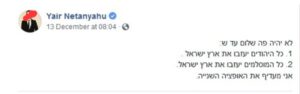
Netanyahu’s son, Yair Netanyahu, stated on Facebook in 2018: “There will not be peace in here until 1. All the Jews leave the land of Israel. 2. All the Muslims leave the land of Israel. I prefer the second”.

When rebuked for this vile arrogance, he increased in arrogance saying, “Why are people who have been calling for years to evacuate the settlers and establish a Palestinian state free of Jews shocked by this post?” When Facebook deleted his post, he shared a screenshot of the original post and rebuked them, saying: “thought police”. He was then blocked for 24 hours over his violation of Facebook’s community guidelines.


In 2006, the Zionist Prime Minister Ehud Olmert said, “Israeli lives are worth more than Palestinian ones”.

The Independent Newspaper


In 2012, the Zionist Interior Minister Eli Yishai said, “The goal of the operation is to send Gaza back to the Middle Ages. Only then will Israel be calm for 40 years”.


In 2021  the Zionist far-right Finance Minister Bezalel Smotrich said, “You are here by mistake because Ben Gurion didn’t finish the job and throw you out in 1948”.

The times of Israel


Female Zionist, Tally Gotliv – a Zionist lawyer, politician, and a member of the Knesset for the Likud party of Zionist Netanyahu- stated recently on X (twitter) regarding retaliation: “Jericho Missile! Jericho Missile! Strategic alert. Before considering the introduction of forces. Doomsday weapon! This is my opinion. May God preserve all our strength”.


Ben Gvir Itamar- a Zionist lawyer, far-right politician, the Minister of National Security since 2022, a member of the Knesset, and leader of Otzma Yehudit – stated on X (Twitter): “As long as Hamas does not release the hostages, the only thing that needs to enter Gaza are hundreds of tons of explosives from the airforce, not an ounce of humanitarian aid”

Indeed, whoever carries out research will neither forget nor become oblivious to the fact that the conflict since 1948 stems from the Zionist movement and the consequences of its paramilitary actions in Palestine. This situation was established in part because of Zionist terrorist groups like Lehi, Haganah, and Irgun. These terrorist groups were responsible for the Nakba, the migration of the Palestinian people from their homeland, as well as sabotage, and attacks on civilian infrastructure, railways, and airfields. Furthermore, these terrorist groups and their commanders assimilated into the Zionist state when it declared independence. In addition to the Palestinian people, the British Mandate in Palestine was the target of these terrorist attacks. As one of the first significant acts of terrorism in the Middle East’s modern history, the King David Hotel bombing in Jerusalem in 1946 was a prime example. Therefore, the priority must be to educate and deradicalise Zionists and their adherents because, before their rise to power, Jews and Muslims coexisted despite the latter’s practice of a path that is considered abrogated in the Sight of Allah.

The poem, titled “The Friendship Song,” was shared by some Zionist online news outlet before being removed. Here is an excerpt from it:

Here the IDF is crossing the line

To annihilate the swastika bearers

In another year there will be nothing there

And we will return safely to our home within a year

We will annihilate them all

And then return to ploughing our fields

Recently, Zionist Arieh King, deputy mayor of Jerusalem, stated in a deleted tweet regarding some Palestinian non-combatant males detained by the Zionist army for interrogation to determine their Hamas affiliation:

There is no need to comment on his statement that the arrested non-combatant Palestinians are subhuman because we know who is behaving like spotted hyenas on a rampage and slaying nearly over 30000 Palestinians at present, including children. However, we will comment on both his statements referring to those non-combatants as ants and his statement “To protest the memory of Amalek, we will not forget.”

Indeed, even the ants during the time of Prophet Sulayman, peace be upon him and his father, knew that they would not be oppressed. Allah says:

وَحُشِرَ لِسُلَيۡمَـٰنَ جُنُودُهُ ۥ مِنَ ٱلۡجِنِّ وَٱلۡإِنسِ وَٱلطَّيۡرِ فَهُمۡ يُوزَعُونَ
حَتَّىٰٓ إِذَآ أَتَوۡاْ عَلَىٰ وَادِ ٱلنَّمۡلِ قَالَتۡ نَمۡلَةٌ۬ يَـٰٓأَيُّهَا ٱلنَّمۡلُ ٱدۡخُلُواْ مَسَـٰكِنَڪُمۡ لَا يَحۡطِمَنَّكُمۡ سُلَيۡمَـٰنُ وَجُنُودُهُ ۥ وَهُمۡ لَا يَشۡعُرُونَ
فَتَبَسَّمَ ضَاحِكً۬ا مِّن قَوۡلِهَا وَقَالَ رَبِّ أَوۡزِعۡنِىٓ أَنۡ أَشۡكُرَ نِعۡمَتَكَ ٱلَّتِىٓ أَنۡعَمۡتَ عَلَىَّ وَعَلَىٰ وَٲلِدَىَّ وَأَنۡ أَعۡمَلَ صَـٰلِحً۬ا تَرۡضَٮٰهُ وَأَدۡخِلۡنِى بِرَحۡمَتِكَ فِى عِبَادِكَ ٱلصَّـٰلِحِينَ

And there were gathered before Sulaiman (Solomon) his hosts of jinns and men, and birds, and they all were set in battle order (marching forwards). Till, when they came to the valley of the ants, one of the ants said: “O ants! Enter your dwellings, lest Sulaiman (Solomon) and his hosts crush you, while they perceive not.” So he [Sulaiman (Solomon)] smiled, amused at her speech, and said: “My Lord! Inspire and bestow upon me the power and ability that I may be grateful for Your Favours which You have bestowed on me and my parents, and that I may do righteous good deeds that will please You, and admit me by Your Mercy among Your righteous slaves.” [Surah An-Naml. Ayaat 17-19]

The ant sought an excuse for (Sulayman’s) army if they would have harmed its colony because they were unaware of their presence, and it blamed its colony if they failed to take safeguards by not entering their dwelling place. Sulaymaan [peace be upon him] smiled as a result of this because it is something that should amaze and make someone smile. [3] The ant knew Sulaymaan’s affair and that of his army, exalted Sulaymaan’s authority, and excused them if they crushed its colony because that would have occurred unintentionally. Sulaymaan heard the ant’s speech and understood it, so he smiled due to being amazed by the ant’s eloquence, advice, and fine expression. [4]

Indeed, this is only one of the Prophets’ and Messengers’ remarkable manners. They never intended to hurt anyone; rather, even those small animals (the ants) were assured that Prophet Sulayman [peace be upon him] and his subjects would not harm them intentionally- neither in speech nor deed. Compare this to the attitude of Zionists, who make a speech calling for mass murder and then launch a purposeful bombing campaign to kill thousands of noncombatant Palestinians, whilst certain that the innocent victims will include thousands of children. Compare how the ant advised its colony to enter their dwellings to avoid being unintentionally harmed by Prophet Sulaymaan’s army to how the Zionist army tells non-combatant Palestinians to relocate to this or that area for safety, then conflict begins in the same area they designated as a safe-haven. As a result, Elon Musk must remember that Zionists require more education and deradicalization than anyone else.

As for Mr. King’s statement “To protest the memory of Amalek, we will not forget”, this link contains its appropriate response. https://abuiyaad.com/a/amalekite-genocide-doctrine-gaza


Read articles by Shaikh Abu Iyaad [may Allah preserve him]:

Professor of Jewish Studies David J Wasserstein: How Islam Saved the Jews

https://abuiyaad.com/a/how-islam-saved-jews

The Just and Kind Dealings of the Prophet (ﷺ) with the Jews
https://abuiyaad.com/a/prophet-dealings-jews


[1] Translator: Shaikh Abu Iyaad. NobleQur’an

[2] An Excerpt from Tafseer as-Sadi. Slightly paraphrased

[3] An Excerpt from ‘Badaa’i At-Tafseer Al-Jaami Limaa Fassarahu Al-Imaam Ibnul Qayyim Al-Jawziyyah’ 2/279-282)

[4] An Excerpt from Tafseer As-Sadi

[7] O Faris Al-Hammadi! The time has arrived for your deceitful and absurd statements to be unveiled for all to see! [A question put to Faris “Everywhere I see Tabdee.”]

In The Name of Allah, The Most Merciful, The Bestower of Mercy.

قال ابن القيم: وعـلـيك بالتفصيل والتبيين فالإجمال والإطلاق دون بيان
قد أفسدا هذا الوجود وخبـطا الأذهان والآراء كل زمـان

Imam Ibn Al-Qayyim, may Allah have mercy upon him, said:

“It is obligated to you to provide detailed explanations and clarifications, as generalisations and unrestricted (speech) without elaboration (clarification) have corrupted the existence and confused minds and opinions throughout all times”.

Al-Allamah Salih Al-Fawzan, may Allah preserve him, stated:

There has to be a detailed explanation. The one who is not proficient in giving details should keep quiet because benefit is not acquired from his speech. And every time an error occurs, its cause is due to an absence of detailed explanation regarding truth and falsehood. There has to be detailed explanation and distinction and not mix-up. Indeed, it may be that there is something of truth and falsehood in an opponent’s statement, so all of it is neither deemed to be false nor true; rather there has to be a distinction between its truth and falsehood. All of it is neither rejected nor accepted; rather a distinction is made regarding the truth and what is correct and the falsehood and error in it. And if you are not proficient in giving details, then you should not enter into this field. [1]

13th August 2024 Faris was asked: Everywhere I see  Tabdee”. Then Faris added: “Tabdee’ meaning Calling someone a deviant Or labeling him as a deviant”. 

Firstly, [تبديع- Tabdee] in the Arabic Language does not mean “deviant” in the English language; rather, Tabdee in the English Language means to declare someone a [مبتدع (Mubtadi)- an innovator in religious matters].  He can be excused for translating Tabdee as deviant because English is not his first language. Secondly, not every [deviant – منحرف (Munharif)]  is a [Mubtadi – innovator in religious matters]; but every Mubtadi is a Munharif. Thirdly, as for Tabdee [declaring a person a Mubtadi (an innovator in religious matters)], Al-Allamah Ubaid Bin Abdillah Al-Jabiri, may Allah have mercy upon him, was asked: “The questioner says: Assalaamu alaykum Warahmatullaahi Wabarakaatuhu. We hear a statement from some of the Mashaayihk of Ahlus Sunnah, “This man is from the people of Bidah”. Is it understood that he is a Mubtadi (an innovator) or not?

Response: What I know is that this statement holds two interpretations (applications) according to Ahlus Sunnah. The first of them, which is often intended, is that he is a Mubtadi (an innovator in religion). He is aware of the truth yet remains obstinate. He rejects (truth), but not deviation; knows the Sunnah, but refuses to follow it and follows Bidah. He practices Bidah while knowing it is Bidah. The other meaning is that this man engages in Bidah, even though he is not a Mubtadi because what we know regarding the methodology of Ahlus Sunnah Wal Jamaa’ah is that they do not declare a specific person a Mubtadi until the proofs are established against him. [2]

In addition, concerning the intricate aspects of this matter about Tabdee and the various classifications of individuals along with their errors, we present an elaborate discourse by Al-Allamah Rabee Bin Hadi, may Allah protect him, as translated by Shaikh Abu Khadeejah, may Allah protect him. https://abukhadeejah.com/shaikh-rabee-establishment-of-proof-in-declaring-a-person-to-be-an-innovator/

As we delve deeper into this matter, it is essential to address the duplicity of Faris, who must once again be held accountable for his glaring double standards. He cautions against labelling people deviant, yet readily defends Dr. Muhammad Bin Hadi, who issues the judgment of Tabdee against some senior students of knowledge, [a] and similarly excuses Shaikh Sulayman Ar-Ruhayli, who stands in defence of Dr. Muhammad. He asserts that “Anybody who claims something, he has to give us a dalil”, however, has deceitful Faris inquired of Dr. Muhammad Bin Hadi regarding the proof for the Tabdee of senior students of knowledge before offering his defense of him and his ally, Shaikh Sulayman Ar-Ruhayli? This is the sad reality of a two-faced individual, a deceiver who ultimately undermines himself through the very dishonesty he attempts to conceal. Faris exposes his absurd double standards, even as he believes he is persuading others and disseminating guidance.

In the statement it is asserted that certain individuals have labeled Shaikh Abdur Razzaaq Al-Badr as a deviant, interpreting the term “Tabdee” in this manner. However, the source of this declaration is unknown, leaving us with no obligation to delve into the issue further. Without specifying the individual or group responsible for such a claim, the discourse remains unsubstantiated. Thus, if neither the inquirer nor Faris discloses the identity of those who deem Shaikh Abdur Razzaaq deviant, it parallels the unfounded conjectures of Tommy Robinson. Concerning Abdul Aziz Farhan, we find ourselves without any information regarding his circumstances, and thus we refrain from commenting on those whose situations remain unclear to us. In contrast, the duplicitous Faris is chastised for his nonsensical ramblings, charlatanism, and ludicrous opinions—all purportedly in the service of Dawah and the defense of the truth.

In conclusion, the statement that Tabdee is seen everywhere, which was inaccurately translated as deviant, is an overstatement that lacks credible support. Unless the claimant explicitly identifies the individuals labeled as deviant and provides information, it remains merely an inflated assertion, akin to the hyperboles of Nigel Farage. However, it is imperative to emphasise that clarity is essential, a principle upheld by esteemed scholars like Al-Allamah Rabee and others, who adeptly differentiate between those who guide and those who mislead. “Classifying people according to their beliefs, religions, and characteristics —particularly in the context of rendering judgments and establishing principles—is not an innovated or a new (aspect) of knowledge; rather, it is knowledge of Al-Jarh Wat Tadeel (the science of criticism and commendation within Islam); and this practice will endure within this Ummah as long as the cycle of day and night persists. Those who endeavour to extinguish the light of this discipline for the sake of their party or out of concern for their beloved ones—individuals who have been justly criticized—are, without a doubt, misguided who lead others astray. Classifying people with discernment and truth serves as a safeguard for the religion ordained by Allah. It is a combatant among the combatants facilitated by Allah through which is repelled the distortions of those two exceed the limits, the false claims of the falsifiers, and the false interpretations of the ignorant ones; the deviations of the innovators in religious matters, the schemes of the Khawaarij, and all the (deviant) sects that arise from the Ummah of As-Saadiq Al-Ameen [the Messenger Muhammad (peace and blessings of Allah be upon him)- the truthful and trustworthy one].” [3]

———————————-

[a]

To be continued…InShaAllah.


[1] An Excerpt from “at-Ta’leeqaat Al-Mukhtasar Alaa Al-Qaseedah an-Nooniyyah” 1/216

[2] Al-Haddul Faasil Bayna Mu’aamalah Ahl As-Sunnah Wa Ahl Al-Baatil 60

[3] Tasneefun Naas page 6

[6] O Faris Al-Hammadi! The time has arrived for your deceitful and absurd statements to be unveiled for all to see! [Deceitful Faris Attempts to Divert From The Core Issue Concerning Certain Individuals Who Ardently Support Dr. Muhammad at The Cost of The Recantation Demanded From Him]

In The Name of Allah, The Most Merciful, The Bestower of Mercy.

Shaikh Al-Islam Ibn Taymiyyah, may Allah have mercy on him, said:

ﻭﻟﻴﺲ ﻟﻠﻤﻌﻠﻤﻴﻦ ﺃﻥ ﻳﺤﺰﺑﻮﺍ ﺍﻟﻨﺎﺱ
ﻭﻳﻔﻌﻠﻮﺍ ﻣﺎ ﻳﻠﻘﻲ ﺑﻴﻨﻬﻢ ﺍﻟﻌﺪﺍﻭﺓ ﻭﺍﻟﺒﻐﻀﺎﺀ،
ﺑﻞ ﻳﻜﻮﻧﻮﻥ ﻣﺜﻞ ﺍﻷﺧﻮﺓ ﺍﻟﻤﺘﻌﺎﻭﻧﻴﻦ ﻋﻠﻰ
ﺍﻟﺒﺮ ﻭﺍﻟﺘﻘﻮﻱ ﻛﻤﺎ ﻗﺎﻝ ﺗﻌﺈﻟﻰ
وَتَعَاوَنُوا عَلَى الْبِرِّ وَالتَّقْوَى وَلا تَعَاوَنُوا عَلَى الإثْمِ وَالْعُدْوَانِ
وليس لأحد منهم أن يأخذ على أحد عهداً بموافقته على كل ما يريده وموالاة من يواليه ومعاداة من يعاديه،بل من فعل هذا كان من جنس جنكز خان وأمثاله الذين يجعلون من وافقهم صديقاً واليا، ومن خالفهم عدوَّا باغيا، بل عليهم وعلى أتباعهم عهد الله ورسوله بأن يطيعوا الله ورسوله ويفعلوا ما أمر الله ورسوله ويحرموا ما حرم الله ورسوله ويرعوا حقوق المعلمين كما أمر الله ورسوله، فإن كان أستاذ أحد مظلوماً نصره، وإن كان ظالماً لم يعاونه على الظلم بل يمنعه منه كما ثبت في الصحيح أنه قال:
(انصر أخاك ظالماً أو مظلوماً. قيل: يا رسول الله: أنصره مظلوماً فكيف أنصره ظالماً؟. قال تمنعه من الظلم فذلك نصرك إياه).
وإذا وقع بين معلم ومعلم أو تلميذ وتلميذ أو معلم وتلميذ خصومة ومشاجرة لم يجز لأحد أن يعين أحدهما حتى يعلم الحق، فلا يعاونه بجهل ولا بهوى، بل ينظر في الأمر، فإذا تبين له الحق أعان المحق منهما على المبطل سواء كان المحق من أصحابه أو أصحاب غيره، وسواء كان المبطل من أصحابه أو أصحاب غيره، فيكون المقصود عبادة الله وحده وطاعة رسوله واتباع الحق والقيام بالقسط
قال تعالى
يا أيها الذين آمنوا كونوا قوامين بالقسط شهداء لله ولو على أنفسكم أو الوالدين والأقربين، إن يكن غنياً أو فقيراً فالله أولى بهما، فلا تتبعوا الهوى أن تعدلوا وإن تلووا أو تعرضوا فإن الله كان بما تعملون خبيراً

It not allowed for educators to foster (illegal) partisanship among the people, nor to engage in actions that may incite enmity and hatred between them. Instead, they ought to be brothers, collaborating upon righteousness and piety, as Allah, The Exalted, says:

وَتَعَاوَنُوا عَلَى الْبِرِّ وَالتَّقْوَىٰ ۖ وَلَا تَعَاوَنُوا عَلَى الْإِثْمِ وَالْعُدْوَانِ

Help another in Al-Birr and At-Taqwa (virtue, righteousness and piety); but do not help one another in sin and transgression. [Al-Maa’idah. 2]

It is not permissible for any of them to receive a pledge from anyone to agree with him in everything he wants – having allegiance to the one he is allied to and enmity towards their adversaries. Whoever does this mirrors the behaviour of Genghis Khan and his ilk (in this affair), who take as loyal friends those who agree with them and the ones who oppose them as a rebellious enemy. Instead, it is obligated to them and their followers (i.e. the educators and students) to fulfil the covenant of Allah and His Messenger in obedience to Allah and His Messenger- doing what Allah and His Messenger have commanded, declaring unlawful what Allah and His Messenger have declared unlawful, and safeguarding the rights of the educators in a manner commanded by Allah and His Messenger.

Therefore, if one’s teacher is oppressed, he should help him; but should the teacher be the one perpetrating oppression, he should not help him in his act of oppression, as has been clearly articulated in the authentic books of hadeeth that the Prophet, peace and blessings of Allah be upon him, stated: “Help your brother, whether he is an oppressor or he is an oppressed one. People asked, “O Allah’s Messenger! It is all right to help him if he is oppressed, but how should we help him if he is an oppressor?” The Prophet said, “By preventing him from oppressing others.” [Al-Bukhaari 2444]

In the event of an argument or dispute arising between an educator and another educator, or between a student and another student, it is not permissible for anyone to help one of them until he knows the truth. Assistance should not be rendered out of ignorance or (vain) desires; rather, one examines the matter. Once the truth becomes clear, he helps the one who deserves to be helped against the one who is in error regardless of whether the one who deserves help is one’s companion or the companion of someone else, or whether the one who erred is one’s companion or the companion of someone else. Thus, the objective is only to worship Allah alone, obedience to Allah’s Messenger, adhere to truth, and establish justice. Allah, The Exalted, says:

يا أيها الذين آمنوا كونوا قوامين بالقسط شهداء لله ولو على أنفسكم أو الوالدين والأقربين، إن يكن غنياً أو فقيراً فالله أولى بهما، فلا تتبعوا الهوى أن تعدلوا وإن تلووا أو تعرضوا فإن الله كان بما تعملون خبيراً

O you who believe! Stand out firmly for justice, as witnesses to Allah; even though it be against yourselves, or your parents, or your kin, be he rich or poor, Allah is a Better Protector to both (than you). So follow not the lusts (of your hearts), lest you may avoid justice, and if you distort your witness or refuse to give it, verily, Allah is Ever Well-Acquainted with what you do. [Surah An-Nisaa. Ayah 135] [End of quote] [Majmoo Al-Fataawaa. 28/15-17] [Paraphrased]

Undoubtedly, the preceding discourse is lucid, and we beseech Allah to include us among those who steadfastly uphold justice, unyielding to fear or favouritism. The crux of the matter lies in the fact that certain individuals, such as Shaikh Sulayman Ar-Ruhayli, have chosen to openly support Dr. Muhammad Bin Hadi without any valid rationale, prompting Al-Allamah Rabee Bin Hadi Al-Mad’khali to issue a caution against him. There exists no uncertainty regarding Dr. Muhammad Bin Hadi’s situation, as he has overtly defied what is permissible and engaged in unequivocally impermissible actions by declaring Tabdee without substantiation. Similarly, there is no doubt concerning Dr. Sulayman Ar-Ruhayli’s stance, as he persistently and publicly endorses Dr. Muhammad Bin Hadi. Anyone who grasps the gravity and consequences of Dr. Muhammad’s actions will undoubtedly recognise the sound rationale behind Al-Allamah Rabee’s caution directed at those who openly endorse him. Furthermore, Shaikh Abu Iyadh has elaborated on several principles related to this issue, which can be found in the following link, commencing at the 52-minute mark: https://mixlr.com/albaseerah/showreel/narration-from-the-salaf-regarding-creed-and-methodology

Also read: Documents and Resources for Countering the Doubts of the Muṣaʿfiqah
https://www.manhaj.com/manhaj/articles/uyryh-documents-and-resources-for-countering-and-exposing-the-musafiqah.cfm

Furthermore, Shaikh Abu Iyadh presents a profound classification of individuals concerning Dr. Muhammad Bin Hadi’s Fitna. Please see the details here: https://www.manhaj.com/manhaj/assets/docs/types-of-people-mbh-fitnah.pdf

It is imperative to remain vigilant against the schemes of the duplicitous Faris, who attempts to misrepresent the situation as a conflict solely between Dr. Muhammad and Al-Allamah Rabee. [a] This portrayal is far from the truth, as we have elucidated throughout this series. The crux of the matter lies in the fact that Dr. Muhammad faced censure primarily due to his unwarranted Tabdee of those senior students of knowledge. Consequently, it is neither appropriate for Shaikh Sulayman to extend his defense of Dr. Muhammad—an action that prompted Al-Allamah Rabee to justly warn against Shaikh Sulayman for supporting an unjust figure—nor is it acceptable for the likes of the duplicitous Faris to conflate truth with falsehood in an attempt to rationalise his misleading narratives, all while promoting individuals without transparency or integrity. Thus, the only recourse left is for all parties involved to urge Dr. Muhammad to retract his erroneous tabdee and to absolve themselves from such transgressions.

In closing this article, we would like to share the exquisite advice imparted by some of the scholars of Ahlus Sunnah, including Shaikh Abdus Salam Burgess, may Allah’s mercy be upon him.

Imam Abu Bakr Ibn Al-Arabi Al-Maliki, may Allah have mercy upon him, said: Muhammad Bin Qaasim Al-Uthmaanee, may Allah have mercy upon him, told me more than once: “I arrived in Fustat one day, then I went to the gathering of Shaikh Abee Al-Fadl Al-Jawharee, may Allah have mercy upon him, and there I witnessed a statement that he uttered to the people. And that which he stated – in the first gathering when I sat with him – was that ‘The Messenger, peace and blessings of Allah be upon him, طلق – i.e. he did divorce, ظاهر – i.e. he did utter the statement to a wife, ‘You are like my mother’s back’, and آلى – i.e. he made an oath to abandon his wives for a month”.

When he (i.e. Shaikh Abee Al-Fadl Al-Jawharee) left, I followed him until I reached his house with a group of people; then he sat with us in the vestibule and acquainted them with my affair because he saw a stranger [i.e. I (Muhammad Bin Qaasim)] and did not know the person among those who came to him before. When most of them departed from him, he said to me, “I see that you are a stranger; do you have anything to say?” I said, “Yes”. He said to his companions, “Excuse him from having to speak in your presence”, so, they got up and I stayed alone with him. I said to him, “I attended your gathering today so that Allah may bless me (with some of the knowledge you possess), and I heard you say, ‘Allah’s Messenger [peace and blessings of Allah be upon him] آلى – i.e. he once made an oath to abandon his wives for a month and what you said was true; طلق – i.e. he did divorce women, and what you said was true, and you said that Allah’s Messenger, peace and blessings of Allah be upon him, ظاهر i.e. he did utter the statement to a wife, ‘You are like my mother’s back’, but this never happened and can never be correct to say that it happened because Az-Zihaar [i.e. to say to one’s wife, ‘You are like my mother’s back’ (i.e. unlawful for me to approach)] is an evil statement and false speech, and this can never be uttered by the Prophet, peace and blessings of Allah be upon him”. He hugged and kissed my forehead, and said, “I repent from this statement. May Allah reward you on my behalf as a good teacher”.

I departed from his presence, and the next day I went early to his gathering, but he was in the Central Mosque before me and was sitting on the pulpit. When I entered the Masjid and thus he saw me, he called out at the top of his voice (saying), “Welcome, my teacher. Make room for my teacher”. So, the people turned towards me and their eyes stared at me! O Abu Bakr! And you know me – meaning, he (i.e. Muhammad Bin Qaasim Al-Uthmaanee) was indicating to Ibnul Arabi about his extremely shy character because when someone greeted him by surprise, he would feel shy – due to his extreme shyness – and turned red as if his face was painted with Gulnaar (pomegranate blossom). He (i.e. Muhammad Bin Qaasim) continued, “People hastened towards me, raising their hands towards me (i.e. acknowledging me) and nudging me until I reached the pulpit, and I did not know in which part of the earth I was due to my extreme shyness (i.e. shocked), whilst the Masjid was overcrowded with people and I sweated due to shyness. Then the Shaikh turned towards the people and said to them, ‘I am your teacher and this is my teacher! Yesterday, I told you that Allah’s Messenger آلى – i.e. he once made an oath to abandon his wives for a month; طلق – i.e. he did divorce women, and ظاهر i.e. he once uttered the statement to a wife, ‘You are like my mother’s back’, and neither did a single one of you give me the correct understanding nor respond to me, but he (i.e. Muhammad Bin Qaasim) followed me to my house and said such and such to me. I repeat (i.e. right now) what took place between him and I, repent from yesterday’s statement, and return to the truth. Whoever hears it from those who were present, let him not rely on what he says, and let the one who is present convey this affair to the absent one. May Allaah reward him with good’”. Then he (i.e. Shaikh Abee Al-Fadl) started supplicating a lot and the people responded with Aameen.

Ibnul Arabi stated – after narrating this incident- “So look – may Allah have mercy upon you – at this firm adherence to the religion and an acknowledgment of the people of knowledge given by this man – whose leadership was manifest and whose worth was well known- to a stranger whom he neither knew nor where he came from! Follow his example and you’ll be led aright”. [(1)] [End of quote]

This narrative serves as a profound reminder for individuals like Dr. Muhammad, compelling them to reflect on the esteemed figures who came before us. Despite their remarkable knowledge and revered status among the populace, their profound reverence for Allah led them to humbly retract their positions in public, devoid of hesitation or fear of losing their esteemed reputation. Similarly, this should inspire individuals like the duplicitous Faris to embrace the truth rather than evade it, resorting to baseless tirades and disparaging remarks. It also demonstrates his misguided assertion that those who pursue Dr. Muhammad’s matters in a manner he disapproves are engaged in something tantamount to foolishness; rather, it is, in fact, Faris who embodies such folly by attempting to obscure the truth through his attacks. Furthermore, there exists no rationale for Shaikh Sulayman to support Dr. Muhammad. Instead, the story recounted by Abu Bakr Ibn Al-Arabi should serve as a poignant reminder for all who seek justice in this ongoing discourse.

Shaikh Abdus Salaam Burgess, may Allah have mercy upon him, said, “It is obligated to a student to recant a mistake, just as it is obligated to a teacher to return to the truth when he errs. He should not be deterred from returning to the truth upon reassessing a statement and discovering that it contradicts what is correct, as this reflects a commitment to fairness and humility. Therefore, one must adhere to what is correct, regardless of whether it is presented by someone younger or older. It is a blessing for a teacher to have a student who notifies him of his errors and guides him toward what is correct so that he does not remain in ignorance. This requires that one express gratitude to Allah, The Exalted, followed by gratitude to the individual through whom one was guided (to the truth), be it a student or another person”. [2] [End of quote]

This succinct yet impactful counsel deserves our utmost attention. Notably, the esteemed Shaikh Abdus Salaam Burgess, may Allah have mercy upon him, a cherished confidant of Dr. Muhammad Bin Hadi, held him in the highest regard, even composing a heartfelt poem in his honour. Thus, Dr. Muhammad and his loyal supporters must heed this invaluable wisdom, especially in light of the duplicitous Faris, who relentlessly seeks to exploit the shadows for his unpraiseworthy ambitions regarding this matter. There exists no justification for such endeavours, save for the pressing need to acknowledge and rectify the grave errors—specifically, the erroneous Tabdee issued by Dr. Muhammad—and to insist upon this accountability.

Imam Muhammad Ibn Saalih Al-Uthaymeen, may Allah have mercy upon him, said: It is obligated to a person to return to the truth wherever he finds it; even if it opposes his statement, he should return to (the truth) because this is nobility for him in the Sight of Allah, nobility in the eyes of the people, safer for his state of accountability and vindication, and it will not harm him. Therefore, do not think that if you abandon your statement for what is correct, this will lower your status among the people; rather, this will raise your status and people will know that you only follow the truth. As for the stubborn one- remains as he is, and rejects the truth, this is an arrogant person, and Allah’s refuge is sought. This happens to some people, even to students of knowledge, and Allah’s refuge is sought. It becomes clear to him – after discussion – regarding what is correct and that what is correct is contrary to what he said yesterday, however, he remains in his opinion. Shaytan makes him preoccupied with thinking that if returns (to what is correct), the people will denounce him and say, “This person is a yes-man who makes a different statement every day”. This (i.e. if the people were to utter this view about him) does not harm if he returns to what is correct. [(3)] [End of quote]

We remind ourselves that it does not matter who makes the truth apparent to us. Allah [The Exalted] said: [وَٱلَّذِینَ إِذَا ذُكِّرُوا۟ بِـَٔایَـٰتِ رَبِّهِمۡ لَمۡ یَخِرُّوا۟ عَلَیۡهَا صُمࣰّا وَعُمۡیَانࣰا – And those who, when they are reminded of the Signs of their Lord, fall not deaf and blind thereat]. [Surah Al-Furqan. Ayah 73]

Imam Muhammad ibn Saalih Al-Uthaymeen, may Allah have mercy upon him, commented on this Ayah: The one who gives the reminder is not made known, so it includes everyone who gives the reminder; and to show that their acceptance of the reminder is not due to the specific person who gives the reminder, because there are people who do not accept the truth except from a specific person. If it comes from another person, he does not accept it, such as what the People of the Scripture did to the Prophet [peace and blessings be upon him], and also other than them. They do not accept the truth except from a specific group or a specific person. Allah said:

[وَلَئِنْ أَتَيْتَ الَّذِينَ أُوتُوا الْكِتَابَ بِكُلِّ آيَةٍ مَا تَبِعُوا قِبْلَتَكَ – And even if you were to bring to the people of the Scripture (Jews and Christians) all the Signs, they would not follow your Qiblah (prayer direction)]. [Surah Al-Baqarah. Ayah 145]

So here (in this Ayah), Allah said: [إِذَا ذُكِّرُوا – And those who, when they are reminded].

The one who gives the reminder is not made known, which shows that they accept the truth because it is the truth- not due to who says it. They do not accept or reject reminder due to the specific person who gives the reminder, but rather they accept it because it is a reminder. This is the Faa’idah behind not mentioning the doer of the action (i.e. the one who gives the reminder). [(4)]

[a] A tweet revealing the duplicitous nature of Faris, who attempts to frame the basis of the affair as a problem between Dr. Muhammad and Al-Allamah Rabee Bin Hadi Al-Mad’khali.

To be continued…InShaAllah


[1]: Ahkaam Al-Qur’aan 1/248-249

[2] An Excerpt from ‘Awā’iq at-Talab pg. 52 Slightly paraphrased

[3]: Sharh Riyaadus Saaliheen 3/537. slightly paraphrased

[4] An Excerpt from “Tafseer Surah Al-Furqan2 shared by our Salafi brother Abdul Malik (Abu Zakariyyah Al-Congoli (may Allah preserve him)

[5] O Faris Al-Hammadi! The time has arrived for your deceitful and absurd statements to be unveiled for all to see! [Duplicitous Faris seeks to divert attention from serious issues that are as evident as the midday sun.]

In The Name of Allah, The Most Merciful, The Bestower of Mercy.

Faris Reminded About The Riba of The Tongue

Allah’s Messenger, peace and blessings of Allah be upon him] said, “Verily, the worst act of usury is to attack the honour of a Muslim without a just cause”. (1) Meaning: The greater in evil and the more strictly prohibited is to unleash your tongue against the honour of a Muslim by insulting him, acting haughtily towards him, and speaking ill of him through abusive language or slander. This becomes a stricter prohibition because honour is more valuable than wealth. “Without a just cause”. This shows there are instances in which it is allowed to refer to someone negatively by using language like “such and such is an oppressor or transgressor” or “such and such is an innovator (in religious affairs) and an open sinner” to warn others is allowed. (2)

This has been referred to as usury because the transgressor receives his honour and then goes above and beyond it as if he has added an increase that infringes on the boundaries concerning the honour of a Muslim, which is more valuable than his wealth. According to At-Teebee, may Allah have mercy upon him, “From the standpoint of emphasis, honour is included in the categories of wealth. Usury is classified into two types: that which is conventional and is described as what is added to debts, and that which is not unconventional, such as verbally disparaging someone’s honour.” Al-Qaadhee, may Allah have mercy upon him, said, ”Violating a Muslim’s honour means dealing with him more than he deserves of what is to be said about him, or more than is permitted to be said about him, which is why it is compared to usury and regarded as one of its types. Then it is considered to be worse because it contains more harm and is more serious in corruption”. (3)

Duplicitous Faris asserts that the matter concerning Dr Muhammad Bin Hadi “Must be buried” [a], claiming that any further pursuit in a manner he deems inappropriate is sheer folly and a manifestation of Shaytaan’s influence. [b] Nevertheless, it is undeniable that Dr Muhammad Bin Hadi has exceeded acceptable bounds in his remarks about those senior students of knowledge, labelling them with Tabdee. [c] In contrast, Faris conveniently overlooks this issue, offering ludicrous justifications and resorting to insults against those who seek transparency and fairness. Thus, one must ponder: who truly embodies the essence of dimwittedness in this situation—the advocates for justice and clarity, or Faris, who willfully ignores the glaring truth? Faris is the one embodying this characteristic in this situation, as Imam Ibn Al-Athir, may Allah have mercy upon him, said: “The essence of foolishness is placing something in an inappropriate place while being aware of its ugliness”. [An-Nihaayah 1/442]

Furthermore, the misstep of Dr Muhammad Bin Hadi, stemming from the unfounded Tabdee he has proclaimed against those senior students of knowledge, constitutes a grave act of Dhulm (oppression). It is indisputable that the cunning Faris is fully cognizant of the perils associated with such oppression. The Prophet, peace and blessings of Allah be upon him, said that Allah said: “Allah Almighty said: O My servants, I have forbidden injustice for Myself and I have forbidden it among you, so do not oppress one another”. [4] The Prophet, peace and blessings of Allah be upon him, said: “Beware of oppression, for indeed oppression will be darkness on the Day of Resurrection….” [5]

In light of the profound warnings against oppression found in these two Prophet reports, among numerous others we have not cited, one cannot help but ponder the motives of the duplicitous Faris. He insists that the matter concerning Dr Muhammad Bin Hadi “must be buried,” asserting that any pursuit of it, particularly in a manner he disapproves of, is sheer folly and a manifestation of Shaytaan’s influence. Yet, Dr. Muhammad has to retract his unfounded Tabdee, which undeniably constitutes oppression. Thus, who truly deserves the label of an airhead, engaging in a pursuit tainted by Shaytaan’s whispers? Is it those who rightfully demand Dr. Muhammad to renounce his oppressive stance, or is it Faris, who willfully deceives himself into believing that this matter is resolved? Imam An-Nawawi, may Allah have mercy upon him, said: “The reality of a fool is that he does what harms him while knowing its ugliness”. [Sharh Sahih Muslim 18/136]

In addition to speaking of others more than they merit, an act akin to usury and injustice as stated in the hadith cited at the beginning of this article, Dr. Muhammad has remained stubborn, even when faced with robust counterarguments. He has no proof to establish the Tabdee, yet continues to cling to his misconceptions. Thus, we must quote Al-Allamah Abdur Rahmaan Bin Yahyah Al-Mu’allimee, may Allah bestow His mercy upon him, regarding the perils of persisting upon error as follows:

To oppose desires – by way of action – for the sake of the truth is a manifest affair due to the obligation and difficulty it involves, and this can be viewed from different angles: A person sees that by acknowledging the truth, it would necessitate that he has acknowledged that he was upon falsehood because a person is nurtured upon a religion, creed, school of thought or views, which he acquired from his nurturer and teacher, considers it to be the truth and followed it for a long time. Then when it becomes clear to him that (the religion, creed, view, or school of thought) is false, it becomes difficult for him to acknowledge, just like when his forefathers, ancestors or the one he follows are upon a (particular) way and its falsity is clarified for him because he sees that their deficiencies necessitate his own deficiencies, and an acknowledgement of their misguidance or errors necessitates his own.

It may be that clinging to falsehood gave him prestige, fame and a livelihood, so it becomes difficult for him to acknowledge that (what he is upon is) falsehood and thus all those benefits (i.e. the fame, prestige, livelihood etc) would disappear. It may be that a person is upon ignorance or falsehood, then another person comes along and clarifies the proofs for him, so he sees that by acknowledging such proofs, it would necessitate that he is lacking (in understanding) and that it was that person who guided him. And due to this we find that it is not difficult for some of those attributed to knowledge to acknowledge their mistakes when it becomes manifest to them in their research and studies, but it becomes difficult for them if it was others who clarified such mistakes.

When another person clarifies the truth for him, he sees that acknowledging such truth would necessitate an acknowledgement of the clarifier’s virtue, knowledge and correctness due to that clarification, and thus that becomes great in the eyes of the people and many people follow him [i.e. the person who clarified the truth]. So you will find some of those attributed to knowledge being eager to prove the mistakes of other scholars even if that is done by way of falsehood due to envy and seeking to diminish their status amongst the people. To oppose desires for the sake of the truth -in affairs of knowledge and creed- can indeed be difficult to accomplish, therefore it requires (sincere) research and contemplation. In this regard, one needs to ask the scholars and benefit from them, adhere to the fear of Allah, and seek Allah’s Tawfeeq and guidance. [6]

In light of the treacherous obstacles that hinder an individual from embracing the unveiled truth, one must ponder why the duplicitous Faris is intent on concealing the reality that Dr Muhammad has stubbornly refused to retract his erroneous Tabdee against those senior students. However, Faris asserts that his affair “Must be buried”, suggesting that any pursuit of it, in a manner he deems inappropriate, is sheer folly and a manifestation of Shaytaan’s influence. Thus, who truly deserves the label of blockhead: those who insist that Dr Muhammad renounce his misguided Tabdee and return to the path of truth, or the duplicitous Faris himself? Indeed, Faris is the fool in this specific matter! Ar-Raghib, may Allah have mercy upon him, said, “Foolishness is an individual’s failure to arrive at the correct conclusion in most instances and placing a statement in other than its appropriate place”. [Muhaadaraat al-Adbaa /25]

In conclusion, it must be made known that in essence, the heart of the matter does not revolve around Al-Allamah Rabee or Dr. Muhammad Bin Hadi; it was fundamentally about the Tabdee that Dr. Muhammad levied against certain distinguished senior students of knowledge. This prompted a rebuke from Al-Allamah Rabee, Al-Allamah Ubaid, Shakh Abdullah Al-Bukhari, and others. The duplicitous Faris endeavours to depict this situation as a quarrel between Al-Allamah Rabee and Dr. Muhammad, advocating that “It must be buried”. Such a narrative may easily mislead the naive seeker of truth into viewing it as a trivial personal dispute. Faris needs to uphold justice and sincerity in his expressions and positions. Thus, we leave him with these significant reminders by Shaikh Al-Islam Ibn Taymiyyah, may Allah have mercy upon him:

“Allah loves speech with knowledge and justice, and to give (everything) the rights that belong to it, and to place the people in their rightful positions”. [7]

“It is well known that the mere aversion of those who disagree or the affection of those who agree does not serve as (proof) for the soundness or corruption of a statement unless it is based on guidance from Allah; rather, using it as a proof is akin to following one’s desires without guidance from Allah; for an individual’s adherence to what they desire is to accept a statement and action they love while rejecting those they hate without guidance from Allah”. [8]

“Speech about the people has to be with knowledge and justice, and not by way of ignorance and oppression”. [9]

“The one who follows the path of justice will exalt the one worthy of being exalted and he will love and ally with him; he will give the truth its due right, exalt the truth and show mercy to the creation”. [10]

———————————————————–

[a]

[b] Faris 9th August 2024 Video (1)

[c] https://www.manhaj.com/manhaj/print.cfm?uyryh

https://twitter.com/AbuIyaadSP/status/1018974451269033986/photo/1

To be continued InShaAllah


[1] Abu Daawud 4876

[2] An Excerpt from ‘Awnul Mabood Sharh Sunan Abee Daawud’ 13/152

[3] An Excerpt from ‘Mirqaatul Mafaateeh Sharh Mishkaat Al-Masaabeeh’ 8/3157

[4] Muslim 2577

[5] Muslim 2578

[6] An excerpt from ‘At-Tankeel Bimaa Fee Ta’need Al-Kawthariy Minal Baatil’ 2/180-181 with the checking of Imaam Albaanee (rahimahullaah).

[7] Majmoo Al-Fataawaa: 12/205]

[8] Majmoo Al-Fataawaa 4/189-190]

[9] Minhaajus Sunnah: 4/337]

[10] Minhaajus Sunnah: 4/544

Part 4: O Faris Al-Hammadi! The time has arrived for your deceitful and absurd statements to be unveiled for all to see! [Faris hit us and wept; preceded us and lodged a complaint]

https://twitter.com/AbuIyaadSP/status/1018974451269033986/photo/1

In The Name of Allah, The Most Merciful, The Bestower of Mercy.

Abu Ad-Darda, may Allah be pleased with him, reported that the Prophet, peace and blessings of Allah be upon him, said: “The heaviest (deed) on the scale is good manners”.

Al-Allamah Zayd Bin Hadi Al-Mad’khali, may Allah have mercy upon him, said:

This hadith serves as evidence regarding the virtue of good manners and the obligation to be good-mannered. The knowledge of the Shariah forms the foundation of manners. When Allah bestows knowledge of the Shariah upon an individual, it leads them towards exhibiting good manners. Consequently, a Muslim demonstrates good manners towards others through good dealings-assisting the vulnerable, honouring guests, greeting others with Salaam, imparting knowledge, and enjoining good and forbidding evil. All these are fruitful outcomes of good manners. An individual cannot exhibit good manners unless he is among those who adhere to the commands of Allah and refrain from acts of disobedience. This implies that his conduct must align with the obligations set forth by the Shariah. He fulfills Allah’s commands and is shy to fall short concerning that which Allah has commanded him. He avoids disobedience, prohibited actions, and evil deeds out of shyness before Allah and a desire to be merciful to himself, as such actions can lead to punishment in both this life and the hereafter. Furthermore, he applies this to all that Allah has commanded, steering clear of what Allah has prohibited and detested.

Being good-mannered includes:

Fulfilling Allah’s rights most perfectly, neither negligent nor exceeding the legislated boundaries of the Shariah. To exhibit good manners towards one’s family, first and foremost towards one’s wife, son, daughter, and others in the family, so that this fosters an environment of harmony, cooperation, and positive feelings among all family members, preventing any form of division or estrangement.

To exhibit good manners towards parents by being dutiful to them, refraining from being undutiful, showing compassion, and supplication for them, treating them with kindness, whether they are living or deceased, by making supplications for them, spending in charity on their behalf, and speaking of them positively.

To exhibit good manners towards extended family members from both the paternal and maternal sides. To exhibit good manners towards neighbours, regardless of whether they are Muslims or not. Neighbours have rights; a Muslim neighbour is entitled to the rights associated with both their faith and their status as a neighbour, while a relative who is also a neighbour holds three sets of rights: those of a Muslim, a neighbour, and a family member.

To exhibit good manners towards one’s companions by pleasantly speaking to them and fulfilling the rights of companionship. To exhibit good manners towards one’s Shuyookh—those Shuyookh of Ahlus Sunnah from whom knowledge is sought—by showing them respect, interacting with them kindly, and consistently supplicating for their well-being, as a teacher imparts significant benefits to their students. In contrast, regarding Ahlul Bidah Wad-Dalaal, even if some of them engage in study with others, their teachings, and learning yield no true benefit.

To exhibit good manners towards fellow students, whether in school settings, during specific gatherings, at designated lessons in the Masjid, or in any other location. An individual should embody good manners, which should be reflected in their speech, actions, interactions, and adherence to promises. This includes fostering love among one another as prescribed by Shariah and nurturing affection for one another for the sake of Allah. The significance of this noble act is highlighted in the hadith, “The heaviest thing on the scales is good manners.” This implies that good manners represent the most substantial deed in the realm of virtuous actions, as they pave the way for all commendable deeds while countering various forms of wrongdoing. And Allah knows best. [1]

Deceitful Faris stated about good manners:

Observation: O Faris! Concealing truth and then claiming to be forbearing is not commendable; rather, it is the patience in upholding the truth that deserves recognition. Imam Ahmad exemplified adherence to the truth while also demonstrating exemplary character. In contrast, you remain silent regarding the truth and claim that seeking clarification about Dr. Muhammad Bin Hadi is tantamount to foolishness. You have even suggested that engaging in this matter is influenced by Shaytaan, despite your conscious choice to avoid openly acknowledging that Dr. Muhammad has committed oppression and transgression by issuing a false Tabdee, which has been challenged and rebutted by several scholars. Nevertheless, he remains unyielding. Is it considered good manners to remain silent about the truth when you can speak? Have you not reflected on the trials that Imam Ahmad endured for advocating the truth? We should remind you of this account before sharing a link concerning Imam Ahmad’s patience. Muhammad Ibn Bandaar As-Sabbaak Al-Jurjaani, may Allah have mercy upon him, said: I said to Ahmad Ibn Hanbal, may Allah have mercy upon him: “It is difficult for me to say that this one is a weak (narrator) and that one is a liar”. Ahmad said, “If you remain silent and I remain silent, then when will the ignorant distinguish between the authentic and the flawed (narration)”. [2] Read below: https://abukhadeejah.com/benefits-in-the-manhaj-by-studying-the-life-and-legacy-of-the-imam-of-ahlus-sunnah-ahmad-ibn-hanbal-161ah-241ah/#:~:text=Imam%20Ahmad%20(rahimahull%C4%81h)%20was%20raised,him%20upon%20piety%20and%20virtue.

Deceitful Faris said:

Observation: O Faris! This assertion can be wielded for both truth and falsehood; thus, a discerning individual needs to scrutinise the reality of the one who employs it as evidence for their own stance. The basis of the rebuttals against you lies in your lack of decorum, your cunning rhetoric, and your deceit regarding the truth in the matter concerning Dr. Muhammad Bin Hadi. Consequently, this statement serves as a testament against you rather than in your favour. As Al-Allamah Zayd, may Allah bestow His mercy upon him, articulated, that good manners also entail promoting virtue and prohibiting evil. Yet, not only have you abstained from advocating for righteousness and denouncing wrongdoing in this instance, but you have also dismissed our quest for truth as folly and a manifestation of Shaytaan’s influence, even though Dr. Muhammad Bin Hadi transgressed against those senior students of knowledge, whom he unjustly labeled with a false Tabdee and has continued without remorse. Thus, you have become your own adversary through your engagement in sophistry and obfuscation. You have wronged us by equating our earnest pursuit of truth with foolishness and the whispers of Shaytaan, however, you seek to portray yourself as the victim. This behaviour is nothing short of a lamentable and desperate attempt to play the victim, as eloquently expressed by the poet.

ضربني وبكى
سبقني واشتكى

He hit me and wept; preceded me and lodged a complaint.

Many of us can easily recall the mischievous escapades of our younger siblings, who would stealthily damage our treasured possessions. When we would confront them, our parents—especially our mothers—would often swiftly reprimand us, unaware of the mischief instigated by the little one. This sibling rivalry, a playful yet irritating game, has no place in the noble pursuit of Dawah. Therefore, do not be among those who instigate trouble and then feign victimhood when justly confronted. Such behaviour is akin to dishonesty, particularly in the context of Dawah. While it is clear that your actions may be rightly condemned, you have sought to twist this rightful criticism into an undeserved rebuttal and rebuke. Allah says:

وَلَا تَلْبِسُوا الْحَقَّ بِالْبَاطِلِ وَتَكْتُمُوا الْحَقَّ وَأَنتُمْ تَعْلَمُونَ

And mix not truth with falsehood, nor conceal the truth while you know (the truth)].

Imaam Ibn Al-Qayyim, may Allah have mercy upon him, said: “Allah has prohibited the amalgamation of truth with falsehood, thus this leads to the obscuring of the truth. The act of blending truth with falsehood results in a situation where one may be mistaken for the other. This constitutes forgery and deception, whereby what is presented is contrary to its actual nature. Similarly, when truth is intertwined with falsehood, the perpetrator presents falsehood disguised as truth and articulates statements that possess dual interpretations—one that is accurate and another that is misleading. Consequently, the listener may be misled into believing that the speaker is conveying the accurate interpretation, while the speaker intends the corrupt meaning”. [3]

Read: Dr Muhammad Bin Hadi and the Musafiqah

https://twitter.com/AbuIyaadSP/status/1018974451269033986/photo/1

https://www.manhaj.com/manhaj/print.cfm?uyryh

In conclusion, after I shared the Rudud provided in the aforementioned links, compiled by Shaikh Abu Iyadh, may Allah protect him, Faris opted to block my Twitter account. Therefore, I have enlisted the help of a brother to share some of his tweets, ensuring that our dialogue continues until he either ceases his remarks or offers a sincere apology for deeming our pursuit of truth as foolish and a product of Shaytaan’s influence. It is indeed a paradox, as none could be more foolish and more influenced by Shaytaan than he and those who deliberately overlook the unjust Tabdee issued by Dr. Muhammad Bin Hadi, and then attempt to assign blame to the innocent.

To be continued InShaAllah


[1] An Excerpt from “at-Ta’leeqaat Al-Maleehah Alaa Al-Ahaadeeth As-Saheehah. 1/38-39

[2] Al-Kifaayah Fee Ilm Ar-Riwaayah 1/63

[3] An Excerrp from “Badaa’i At-Tafseer Al-Jaami Limaa Fassarahu Al-Imaam Ibnul Qayyim’ 1/124