Tag: tawheed

Tremendous Glad Tidings for the Muwahhid – Day 10 – Shaykh Fawzan

It is narrated that Mu’adh bin Jabal (May Allah be pleased with him) said: I was riding behind the Prophet ﷺ on a donkey and he said to me “O Mu’adh, do you know what is the right of Allah on his slaves and what is the right of the slaves upon Allah?”

I responded: “Allah and His Messenger know best.” He continued, “The Right of Allah upon His slaves is to… ”


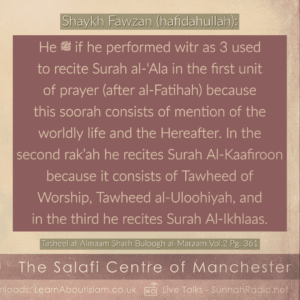
Benefit in Reciting the Specific Suwar in Witr – Shaykh Saalih al-Fawzan

He ﷺ if he performed witr as 3 used to recite Surah al-‘Ala in the first unit of prayer (after al-Fatihah) because this soorah consists of mention of the worldly life and the Hereafter. In the second rak’ah he recites Surah Al-Kaafiroon because it consists of Tawheed of Worship, Tawheed al-Uloohiyah, and in the third he recites Surah Al-Ikhlaas.


Shaykh Fawzan’s Tasheel al-Almaam Sharh Buloogh al-Maraam Vol.2 Pg. 361

The Bondage of Sins In This Dunyaa And Aakhirah, And The Virtue of Tawheed and Repentance

In The Name of Allaah, The Most Merciful, The Bestower of Mercy.

Disobedience is the cause of being in shaytaan’s captivity and a prisoner of lowly desires. A disobedient person is always in the captivity of his devil, the prison of his lusts and leadership of his desires. He is a captive and a shackled prisoner. There is neither a captive whose state of affairs is more evil than that of a captive whose captor is his worst enemy, nor is there a prison more restricted than the prison of desires, and shackles that are more restrictive than the shackles of lust; so how can a heart that is a captive and a shackled prisoner follow the path to Allaah and the home of the afterlife? How can he follow a single path when the heart is shackled and stricken with harm from every angle as a result of the [severity] of its shackles? The likeness of the heart is that of a bird; it distances from harm whenever it flies high and surrounded by harm whenever it lands. It is reported in a hadeeth: ‘’Shaytaan is a wolf to a human being.’’

And just as an unprotected sheep in the midst of wolves is quickly destroyed, likewise if there is no protection from Allaah for the slave, it is inevitable that his wolf will prey on him. He is protected by Allaah through Taqwaah. Taqwaah is a shield and shelter from Allaah between the person and his wolf; just as it is a shield against punishment in this life and the afterlife. Whenever the sheep is closer to its shepherd, it is safer from the wolf and whenever it is distanced from the shepherd, it comes closer to being destroyed. So the sheep is more protected when it is closer to the shepherd, for the wolf only takes away the [sheep, cattle]  that are distanced and far away from the shepherd.

The basis of this affair is that whenever the heart is distanced from Allaah, then harm upon it is quicker, and whenever it is comes closer to Allaah, it is distanced from harm. Being distanced from Allaah is of various levels and some are more severe than others. Being distanced from [Allaah] through disobedience is greater than being distanced from [Allaah] through thoughtlessness; being distanced from [Allaah] through bidah is greater than being distanced from [Allaah] through disobedience, and being distanced from [Allaah] through hypocrisy and shirk is greater than all of that. [Ref 1]

Sin and disobedience is something common in all the nations. It is something that has not cease to exist in the world amongst the Children of Aadam regardless of their different social classes- the common people, the ignorant ones, [the zuhhaad – those who choose to abstain from some of the lawful pleasures of the worldly life which one can do without], those desirous of it [i.e. the pleasures], the leaders and those under their rule.  This affair of [sin and disobedience] is not something specific to this Ummah of Muhammad [sallal laahu alayhi wasallam], such that [the Ummah] and its Prophet are [singled out] with rebuked as a result of that. Sin and disobedience does not negate belief in the Messengers, because it is possible for them to exist alongside belief in the Messengers. And although disobedience diminishes the perfection and completeness of belief in the Messengers, however it does not negate it.

Sins are wiped away through sincere repentance.  Allaah forgives the slave when he repents, even if his sins fill the heavens and are of a great number.  Allaah said: [قُلۡ يَـٰعِبَادِىَ ٱلَّذِينَ أَسۡرَفُواْ عَلَىٰٓ أَنفُسِهِمۡ لَا تَقۡنَطُواْ مِن رَّحۡمَةِ ٱللَّهِ‌ۚ إِنَّ ٱللَّهَ يَغۡفِرُ ٱلذُّنُوبَ جَمِيعًا‌ۚ إِنَّهُ ۥ هُوَ ٱلۡغَفُورُ ٱلرَّحِيمُ  – Say: O Ibaadee [My slaves] who have transgressed against themselves [by committing evil deeds and sins]! Despair not of the Mercy of Allaah, verily Allaah forgives all sins. Truly, He is Oft-Forgiving, Most Merciful. [39:53]

This is the right of the one who repents because repentance wipes away the sin after it [was committed]. Therefore, the one who repents from a sin is like one without that sin.  Tawheed wipes away sins, as [mentioned] in the Hadeeth Al-Qudsiy: ‘’O Son of Adam! If you were to meet Me with enough sins to fill the earth, whilst not associating anything with Me [in worship], I shall meet you with its equivalent in forgiveness.’’  Therefore, strong Tawheed wipes away the sins of the Muslims; but if punished for their sins, they will be removed from the fire as a result of their belief in Tawheed. As for the people of shirk and the disbelievers, their good deeds are nullified as result of the disbelief and shirk they are upon.  They will neither meet their Lord with good deeds in order to obtain safety nor will they be forgiven any of their sins. Allaah [Glorified be He] said: [إِنَّ ٱللَّهَ لَا يَغۡفِرُ أَن يُشۡرَكَ بِهِۦ وَيَغۡفِرُ مَا دُونَ ذَٲلِكَ لِمَن يَشَآءُ‌ۚ  – Verily, Allaah does not forgive (a person) the sin of associating partners with Him in worship (i.e. if one dies in that state without repentance),  but He (Allaah) forgives (sins that are) lesser than that (i.e. lesser than shirk) to whom He pleases]. [4:48]

Allaah [The Most High] said: [ وَقَدِمۡنَآ إِلَىٰ مَا عَمِلُواْ مِنۡ عَمَلٍ۬ فَجَعَلۡنَـٰهُ هَبَآءً۬ مَّنثُورًا – And We shall turn to whatever deeds they did, and We shall make such deeds as scattered floating particles of dust]. [25:23] [Ref 2]


[Ref 1: An Excerpt from ‘Ad-Daa’u Wad-Dawaa’u. page 119-120. slightly paraphrased]

[Ref 2: Source: An Excerpt from ‘Hidaayatul Hayaaraa Fee Ajwibatil Yahood Wan-Nasaaraa. Page 123-124. Slightly paraphrased]

Only Those Who Are Patient Shall Receive Their Rewards In Full, Without Hisaab [Without Limit, Calculation and Estimation]

In The Name of Allaah, The Most Merciful, The Bestower of Mercy.

Question: The questioner asks: What is the status of patience and what is the reward for those who exercise patience?

Answer: Patience has a great status in the sight of Allah (The Most High). The Eemaan of a slave (i.e. a male or female Muslim) cannot be perfect without patience.  Patience is from the best of deeds and its reward has no limits. When it is the case that one good deed is written as ten good deeds and can multiply until it reaches seven hundred or more, then indeed the reward for exercising patience has no limits,  for indeed Allaah ( Glorified and Exalted be He) said:

إِنَّمَا يُوَفَّى الصَّابِرُونَ أَجْرَهُم بِغَيْرِ حِسَابٍ

Only those who are patient shall receive their rewards in full, without Hisaab (without limit, calculation and estimation) [a] [39:10]

Patience is of three types:

[1] The first type patience is when a person exercises patience (whilst striving) to obey Allaah: A Muslim is commanded to exercise patience (whilst striving) to obey Allaah (The Most High), especially the when fulfilling obligations. And the first of those obligations is the prayer, for it is obligatory to establish it at its fixed time together with all its conditions and obligatory acts. [b] Therefore, patience is required in seeking to fulfill the five daily prayers. When a sleeping person hears the Adhaan of Fajr, he strives against his soul and wakes up, and then he performs Wudhu and goes to the Masjid. This is patience whilst seeking to obey Allaah. One also exercises patience in striving to treat his (or her) parents kindly, dealing with them in a beautiful manner and patiently bearing whatever occurs from that. Allaah (The Most High):

وَقَضَىٰ رَبُّكَ أَلَّا تَعْبُدُوا إِلَّا إِيَّاهُ وَبِالْوَالِدَيْنِ إِحْسَانًا ۚ إِمَّا يَبْلُغَنَّ عِندَكَ الْكِبَرَ أَحَدُهُمَا أَوْ كِلَاهُمَا فَلَا تَقُل لَّهُمَا أُفٍّ وَلَا تَنْهَرْهُمَا وَقُل لَّهُمَا قَوْلًا كَرِيمًا

And your Lord has decreed that you worship none but Him. And that you be dutiful to your parents. If one of them or both of them attain old age in your life, say not to them a word of disrespect, nor shout at them but address them in terms of honour. [17:23]

وَاخْفِضْ لَهُمَا جَنَاحَ الذُّلِّ مِنَ الرَّحْمَةِ وَقُل رَّبِّ ارْحَمْهُمَا كَمَا رَبَّيَانِي صَغِيرًا

And lower unto them the wing of submission and humility through mercy, and say: “My Lord! Bestow on them Your Mercy as they did bring me up when I was small.”[17:24]

رَّبُّكُمْ أَعْلَمُ بِمَا فِي نُفُوسِكُمْ ۚ إِن تَكُونُوا صَالِحِينَ فَإِنَّهُ كَانَ لِلْأَوَّابِينَ غَفُورًا

Your Lord knows best what is in your inner-selves. If you are righteous, then, verily, He is Ever Most Forgiving to those who turn unto Him again and again in obedience, and in repentance. [17:25]

A person should also exercise patience in seeking to nurture his (or her) children and teaching them good manners and behaviour.

[2] The second type of patience is when a person exercises patience in seeking to restrain him (or herself) from disobeying Allaah: A person excises this patience in order to prevent him or (herself) from sins and (evil) desires. And among those sins a person should keep away from is that he refrains from violating the honour of the people.

[3] The third type of patience is when a person exercise patience when encountered with Allaah’s decree, which maybe something painful (i.e. a calamity): That is because that which afflicts a person, such as the death of a son (or daughter) or being afflicted with a sickness on a person’s the body, or his (or her) sanity, or what may afflict a relative of his (or hers), it is obligated on a person to exercise patience when these affairs are encountered and should hope for Allaah’s reward for being patient. He should know that all these affairs are from Allaah.  Allah (the most high) said:

مَا أَصَابَ مِن مُّصِيبَةٍ إِلَّا بِإِذْنِ اللَّهِ ۗ وَمَن يُؤْمِن بِاللَّهِ يَهْدِ قَلْبَهُ ۚ

No calamity befalls, but with the Leave [i.e. decision and Qadar (Divine Preordainments)] of Allah, and whosoever believes in Allah, He guides his heart. [64:11]

Alqamah (radiyallaahu-anhu) said: This (ayah) is about a person who is afflicted with a calamity and he knows that it is from Allaah.  So he becomes pleased with what Allaah has decreed and submit to Allaah’s judgement, and he (or she) says: ‘’this is Allaah’s decree. I believe in Allaah and we are pleased with Allaah’s decree.” So Allaah fills his heart with Eemaan and tranquillity, and he (or she) receives a great reward (i.e. due to his patience).

We ask Allaah to include us and you amongst those who exercise patience.

[Source: Fadaa’il Al- A’maal’ pages 11-14’ by Shaikh Muhammad Bin Abdillaah As-Subayyil (rahimahullaah). Abridged and slightly paraphrased]


[a] Tayseerul Kareem Ar-Rahmaan Fee Tafseeri Kalaam Al-Mannaan’ by Imaam Sadi (rahimahullaah)

[b]Conditions, pillars and obligations of the prayer, see  link:

http://www.salafitalk.net/st/viewmessages.cfm?Forum=10&Topic=8984

Dhaat Anwaat – [A Brief Warning Against Grave Worship In The Ummah]- By Shaikh Saaleh Aala Ash-Shaikh

In The Name of Allaah, The Most Merciful The Bestower of Mercy.

Tawaaf [Circumambulation] around a grave, stroking them [with one’s hands] and seeking blessings from them are acts of shirk. Circumambulation is an act of worship and it has not been legislated in any [other place] besides the Ka’bah and likewise walking between Safaa and Marwa is [only legislated at Safaa and Marwa].

Stroking [graves], seeking blessings from them and hoping to be benefited –in this life and the next- by way of such acts is [tantamount to] deification. It is similar to what the pre-Islamic idolaters used to do with their gods. Whoever hopes [for reward, blessings etc] through [these acts of worship at the] graves, then indeed he has exalted that which Allaah has not legislated to be exalted.

The proof to show that these practices are acts of Shirk is the hadeeth of Abee Waaqid Al-Laythee [radiyallaahu-anhu] who said: “We went out with the Messenger of Allaah [sallal-laahu-alayhi-wasallam] to the [military] campaign to Hunayn, while we were new converts from disbelief to [Islaam]. The idol worshippers had a lote tree in [whose vicinity] they used to stay and hang their weapons, and it [i.e. this lote-tree] was called Dhaat Anwaat. So when we went pass a tree, we said, ‘O Messenger of Allaah! Set up a Dhat Anwat for us just as they have a Dhaat Anwaat’. So the Messenger of Allaah [sallal-laahu-alahi-wasallam] said, ‘Allaah is the Greatest! This is a path that has proceeded [from the people of the past]. By Allaah in whose Hand my soul is! You have stated just as the children of Israa’eel stated to Moosaa [alayhis-salaam], ‘O Moosaa! Make for us an ilaahan (a god) as they have aalihah (gods)’. He (Moosaa) said: ‘Verily, you are a people who know not (the Majesty and Greatness of Allah and what is obligatory upon you, i.e. to worship none but Allah Alone, the One and the Only God of all that exists)’”. [Reported by Ahmad and Tirmidhee and it is a sound hadeeth.]

Those [new Muslims] wanted to perform that act of worship in that particular place and (also) to seek blessings; so the Messenger of Allaah [sallal-laahu-alayhi-wasallam] referred to what they sought after as worship of another deity besides Allaah. That [act they sought after] is a means to Shirk, but after the Messenger of Allaah [sallal-laahu-alayhi-wasallam] clarified the affair for them, they turned in repentance and obedience to [Allaah and His Messenger]. Seeking blessings from graves, circumambulation round them and stroking them is more severe [acts of shirk and sin] than what those [new Muslims] sought after.

[Source: An Excerpt from ‘Al-Min’dhaar Fee Bayaani Katheer Minal Akhtaa Ash-Shaa’i’ah page: 11’. slightly paraphrased]


The State of The Believing Servant at The Time of Departure From This World

In The Name of Allaah, The Most Merciful, The Bestower of Mercy.

The following is the wording of Imaam Ahmad [rahimahullaah] with authentic additions compiled and authenticated by Imaam Al-Albaani [rahimahullaah] in ‘Ahkaamul-Janaa`iz (pp.198-202).

Al Baraa Ibn Aazib [radiyallaahu-anhu] said: “We went out with the Prophet [sallal laahu alayhi wasallam] to a funeral of a man from the Ansaar; so we came to the grave and he [sallal laahu alayhi wasallam] had a stick, with which he was prodding the earth. He began looking towards the sky, and looking towards the earth, and raising his gaze and lowering it three times, and then he said: ‘Seek Allaah’s refuge from the Punishment of the Grave!’ …two or three times, and then he [sall Allaahu alaiyhi wa sallam said: ‘O Allaah, I seek your refuge from the Punishment of the Grave’. …three times; and then he [sallal laahu alayhi wasallam] said: ‘The believing servant, when he is departing from this world and going on to the Hereafter, some angels from the heaven descend upon him with white faces as if their faces were the sun. With them, there are shrouds from the shrouds of Paradise and perfume for embalming from the perfume of Paradise, until they sit at a distance away from him that can be reached by the sight.

And then the Angel of Death comes, until he sits by his head and he says, ‘O Pure soul! (and in one narration – at rest), come out to forgiveness from Allaah and His Pleasure!’ So it comes out flowing just like a drop of fluid flows out of a vessel. So he takes it – and in one narration – when his soul comes out, then every angel between the Heavens and the Earth makes supplication for it and every angel in the Heaven and the Gates of the (lowest) Heaven are opened for him. And there are no inhabitants (i.e. angels) present at any gate except that they make supplication to Allaah that his soul be taken up towards their direction.

So when he (the Angel of Death) takes it, he does not leave it in his hand even for the blink of an eye until he takes it and places it in that shroud and in that perfume – and that related to the statement of Allaah [The Exalted] ‘Our Messengers take his soul in Death, and they do not fall short in their duty.’ And a smell comes from him like the smell of the purest musk found on the face of the earth. Then they ascend with it (the believing soul) and they do not pass by any (group of angels) except that they say, ‘What is this pure soul?’ So they say, ‘It is so and so, the son of so and so’. …mentioning him by the finest names which he used to be called in this world, until they take him to the lowest heaven and they request that it be opened for him, so it is opened for him. And then the closest ones from every heaven accompany him to the next heaven until he reaches the seventh heaven – and Allaah [The Mighty and Majestic] says, ‘Write down the record of My servant in Illiyyeen (the highest heaven)!’ And what will explain to you what is Illiyyoon? (in it will be) the written down record. Witnessed by those drawn close.’ So he [sallal laahu alaiyhi wa sallam] said, ‘Then his record will be written down in Illiyyeen’; then it will be said, ‘Return him to the earth, for I have promised them that- from it I created you, and to it I shall return you, then I shall take you out from it again’. So he will be returned to the earth and his soul will be returned to his body, and he will hear the striking of the feet of his companions when they depart from him going away (from his grave). Then two stern angels will come to him, and they will be very abrupt with him, they will make him sit up and they will say to him, ‘Who is your Lord?’ So he will say, ‘My Lord is Allaah’. They will say to him, ‘What is your religion?’ So he will say, ‘My religion is Islaam’. So they will say to him, ‘What was this man who was sent amongst you?’ He will say, ‘He is Allaah’s Messenger [sal Allaahu alaiyhi wa sallam]’. So they will say to him, ‘How did you know?’ So he will say, ‘I read the Book of Allaah, and I believed in it, and I affirmed it’.

This will be the last trial the believer will face. So that is about what Allaah, the Mighty and Majestic said: ‘Allaah will make those who are believers firm, with the firm statement [i.e. the shahaadah] in the life of this world.’ Then a caller will call from the heavens: ‘My Servant has spoken the Truth, so give him a bed from Paradise, and give him clothing from Paradise and open for him a door towards Paradise.’ So its gentle breeze and fragrance will come to him, and his grave will be expanded for him as far as the eye can see. And then there will come to him (in one narration there will be shown to him) a man with a handsome face, with fine clothing, with a beautiful scent, and he will say, ‘Receive good news of that which is pleasing for you! Receive good news of pleasure from Allaah and of gardens containing everlasting delight! This is your day which you were promised’. So he will reply to him, ‘And you, – may Allaah give you good tidings – who are you? Your face is the face of one who comes with good’; so he will say, ‘I am your righteous deeds. For by Allaah, I have not known you except to be quick upon obedience to Allaah, slow to disobey Him, so may Allaah reward you with good’. And then a gate will be opened for him from Paradise and a gate from the Fire, and he will say, ‘This would have been your place had you been disobedient to Allaah, but Allaah has exchanged this for you instead of it’. And when he sees what is in Paradise, he will say, ‘O My Lord, hasten the establishment of the Hour so that I can return to my family and what is for me!’ So it will be said to him, ‘Be calm’.

And he [sall Allaahu alaiyhi wa sallam] said: And as for the kaafir (disbelieving servant) (and in one narration – the faajir, the wicked one), when he is departing from this world and going on to the Hereafter, then angels descend upon him from the Heaven – angels who are severe and stern with dark faces, having sack- cloths from the Fire. So they will sit at a distance from him that the sight can reach, and then the Angel of Death will come until he sits by his head and says, ‘O foul and filthy soul! Come out to the Wrath of Allaah and His Anger!’ So it (his soul) will scatter throughout his body. So he will drag it out, just as a pronged roasting- fork with many prongs is pulled through wet wool. The veins and tendons will be torn along with it. And he will be cursed by every angel between the Heaven and the Earth and by every angel in the Heaven. The gates of the Heaven will be locked. There will not be any inhabitants of any gate except that they make supplication to Allaah that his soul should not ascend towards their direction. So he will take it (the soul) and when he takes it, he will not leave it in his hand even for the blink of an eye until he places it in that sack cloth. And there will come out from him a smell like the worst stench of the foulest corpse rotting upon the earth. So they will take it up, and they will not pass by any group of angels except that they say, ‘What is this foul soul?’ So they will say, ‘So and so, the son of so and so’. …mentioning the worst names which he used to be called in this world, until they reach the lowest heaven, and request is made for him that it be opened but it will not be opened for him. Then he [sall Allaahu alaiyhi wa sallam] recited: ‘The gates of the Heaven will not be opened for them (the disbelievers) nor will they enter Paradise until a camel passes through the eye of a needle.’ So he [sall Allaahu alaiyhi wa sallam] said: ‘So Allaah [The Mighty and Majestic] will say: ‘Write his record in sijjeen (the lowest earth)!’ Then it will be said: ‘Return My Servant to the Earth because I have promised them that from it I created you, and to it I shall return you and from it I will bring you out another time’.  So his soul will be thrown down from the Heaven until it lands in his body. Then he [sall Allaahu alaiyhi wa sallam] recited: ‘And whoever commits shirk along with Allaah, then it is as if he had fallen down from the Heaven and been snatched by birds – or the wind had carried him and thrown him in a far-off place.’ So his soul will be returned to his body and he will hear the footsteps of his companions when they are departing from him, and two angels will come to him who are stern. And they will be stern with him, and they will make him sit up and they will say to him, ‘Who is your Lord?’ So he will say: ‘Haah, haah… I don’t know’. So they will say to him, ‘What is your religion?’ So he will say: ‘Haah, haah… I don’t know’. So they will say: ‘So what do you say about this man who was sent amongst you?’ So he will not be able to mention his name. So it is said: ‘Muhammad’. So he will say, ‘Haah, haah…I do not know. I heard the people saying this’. It will be said: ‘You do not know and you did not recite (or learn)’. So then a caller from the Heavens will call: ‘He has lied, so give him bedding from the Fire, and open for him a door to the Fire’. So its heat and scorching wind will come upon him, and his grave will be constricted upon him until his ribs cross over. Then there will appear to him a man with an evil looking face with foul clothing, smelling of an evil stench and he will say, ‘Receive news which will upset you. This is your day which you were promised’. So he will say: ‘And may Allaah give you news of evil! Who are you? For your face is the one who comes with evil’. So he will say: ‘I am your foul deeds. I have not known you except being slow upon obedience to Allaah, quick to disobey Allaah, so may Allaah reward you with evil’….to the end of the hadeeth

O Allaah! Grant us Your Mercy In This Dunyaa and Aakhirah, And Protect us From Evil In This Dunyaa And Aakhirah Aameen


O Two Companions of The Prison! Are Many Different Lords Better or Allah, The One, The Irresistible?

In The Name of Allaah, The Most Merciful, The Bestower of Mercy.

 Allaah (The Most High) informed us that Yusuf (alayhis-salaam) said to his companions in the prison:

يَـٰصَٮٰحِبَىِ ٱلسِّجۡنِ ءَأَرۡبَابٌ۬ مُّتَفَرِّقُونَ خَيۡرٌ أَمِ ٱللَّهُ ٱلۡوَٲحِدُ ٱلۡقَهَّارُ

مَا تَعۡبُدُونَ مِن دُونِهِۦۤ إِلَّآ أَسۡمَآءً۬ سَمَّيۡتُمُوهَآ أَنتُمۡ وَءَابَآؤُڪُم مَّآ أَنزَلَ ٱللَّهُ بِہَا مِن سُلۡطَـٰنٍ‌ۚ إِنِ ٱلۡحُكۡمُ إِلَّا لِلَّهِ‌ۚ أَمَرَ أَلَّا تَعۡبُدُوٓاْ إِلَّآ إِيَّاهُ‌ۚ ذَٲلِكَ ٱلدِّينُ ٱلۡقَيِّمُ وَلَـٰكِنَّ أَڪۡثَرَ ٱلنَّاسِ لَا يَعۡلَمُونَ

O two companions of the prison! Are many different lords (gods) better or Allah, the One, the Irresistible? You do not worship besides Him but only names which you have named (forged), you and your fathers, for which Allah has sent down no authority. The command (or the judgement) is for none but Allah. He has commanded that you worship none but Him (i.e. His Monotheism), that is the (true) straight religion, but most men know not. [12:39-40]

[يَـٰصَٮٰحِبَىِ ٱلسِّجۡنِ ءَأَرۡبَابٌ۬ مُّتَفَرِّقُونَ خَيۡرٌ أَمِ ٱللَّهُ ٱلۡوَٲحِدُ ٱلۡقَهَّار- O two companions of the prison! Are many different lords (gods) better or Allah, the One, the Irresistible?] Meaning: Lords that are deprived of the ability to act and are weak-neither able to benefit nor harm; neither able to give nor withhold. And they are various types, (such as) trees, stones, angels, dead people and other than them from those various objects of worship that are taken as objects of worship by the polytheists. Are those objects of worship better or Allaah? [Allaah]–The only One Who has Attributes of absolute perfection; ٱلۡوَٲحِدُ The one singled out in His Essence, His Attributes and Actions, and He  has no partner in any of that.

[ٱلۡقَهَّارُ] The Irresistible- the one to whom everything has submitted due to His absolute subjugation of everything and His absolute dominion over everything–whatever He wills takes place and whatever He does not will cannot take place; (and)  مَّا مِن دَآبَّةٍ إِلَّا هُوَ ءَاخِذُۢ بِنَاصِيَتِہَآ‌ۚ– There is not a moving (living) creature but He has grasp of its forelock.

It is known that the one whose affair and description is as such is superior to (those) different gods, which are mere names–neither do they possess perfection nor actions [I.e. they have not created anything nor are they in control of anything]. So because of this [Allaah (The Most High) said that Yusuf (alayhis-salaam) said to them]:

[مَا تَعۡبُدُونَ مِن دُونِهِۦۤ إِلَّآ أَسۡمَآءً۬ سَمَّيۡتُمُوهَآ أَنتُمۡ وَءَابَآؤُڪُم— You do not worship besides Him but only names which you have named (forged), you and your fathers]; Meaning: You gave them names and called them gods, whilst they are nothing. They have no attribute of Uloohiyyah (i.e. attributes of absolute perfection-free from all deficiencies, weakness etc) and [مَّآ أَنزَلَ ٱللَّهُ بِہَا مِن سُلۡطَـٰنٍ‌] – for which Allah has sent down no authority; rather Allaah has sent down clear proofs to prohibit them and clarified its falsity.

And if Allaah did not send down any authority for it, then neither can it be a (sound) path nor a means (of worship), nor does it have any proof. That is because to Allaah (alone) belongs the judgement and He is the one who gives commands and prohibitions. And He (alone) is the One Who legislate the divine laws and rulings, and He is the one that commanded you أَلَّا تَعۡبُدُوٓاْ إِلَّآ إِيَّاهُ‌ۚ ذَٲلِكَ ٱلدِّينُ ٱلۡقَيِّمُ– That you worship none but Him (i.e. His Monotheism), that is the (true) straight religion]; Meaning: The straight religion that leads to every good and the other religions besides it are not upright; rather they are crooked and will lead to every evil.

[وَلَـٰكِنَّ أَڪۡثَرَ ٱلنَّاسِ لَا يَعۡلَمُونَ –But most men know not] – Meaning: They do not know the reality of affairs, even though the distinction between worshipping Allaah alone and associating partners with Him in worship is a clear and manifest affair (i.e. there is no doubt about the falsity of worshipping others and the absolute proof that Allaah alone has the right to be worship). However due to many people not possessing knowledge of this affair, they fall into shirk.

[An Excerpt from Tayseer Al-Kareem Ar-Rahmaan Fee Tafseer Kalaam Al-Mannaan. slightly parapherased]

Skin Without Flesh and Body Without Soul!

In The Name of Allaah, The Most Merciful, The Bestower of Mercy

Allaah [The Most High] said: [ لَن يَنَالَ اللَّهَ لُحُومُهَا وَلَا دِمَاؤُهَا وَلَٰكِن يَنَالُهُ التَّقْوَىٰ مِنكُمْ ۚ كَذَٰلِكَ سَخَّرَهَا لَكُمْ لِتُكَبِّرُوا اللَّهَ عَلَىٰ مَا هَدَاكُمْ ۗ وَبَشِّرِ الْمُحْسِنِينَ – It is neither their meat nor their blood [i.e. the animals we sacrifice] that reaches Allah, but it is piety from you that reaches Him. Thus have We made them subject to you that you may magnify Allah for His Guidance to you. And give glad tidings (O Muhammad) to the Muhsinun (doers of good)]. [Surah Al-Hajj. Ayah 37]

[لَن يَنَالَ اللَّهَ لُحُومُهَا وَلَا دِمَاؤُهَا – It is neither their meat nor their blood] – meaning: The aim [or goal] behind them [i.e. the animals slaughtered as sacrifice] is not just to merely slaughter them, for neither does their meat nor blood reach Allaah because Allaah is [الْغَنِيُّ الْحَمِيدُ -The Independent One Who is Free of all Needs and The One Who is Deservedly Praised]; rather what reaches Allaah is the sincerity [in your hearts in relation to the performance of the deed]; hope for Allaah’s reward and having a righteous intention; [وَلَٰكِن يَنَالُهُ التَّقْوَىٰ مِنكُمْ ۚ – But it is piety from you that reaches Him].

So with regards to this, there is an urge towards sincerity in [the act] of sacrifice and that one’s intention is to seek the Face of Allaah [alone], and not out of boasting, show off and to be heard; nor merely following a custom. Likewise, this is [the goal behind] all acts of worship, for if they are not connected to sincerity and piety, then they are similar to skins that have no flesh and a body that has no soul.


[Source: An Excerpt from Tayseer Al-Kareem Ar-Rahmaan Fee Tafseer Kalaam Al-Mannaan’ by Imaam Sadi (rahimahullaah). Slightly paraphrased. Publisher Daar Ibn Hazm 1st ed. 1424 (Year 2003)]

Allaah Says the Truth, And He Guides to the Right Way – [By Imaam As-Sadi (rahimahullaah)]

In The Name of Allaah, The Most Merciful, The Bestower of Mercy.

Allaah (The Most High) said: [وَاللَّهُ يَقُولُ الْحَقَّ وَهُوَ يَهْدِي السَّبِيلَ  – Allaah Says the Truth, And He Guides to the Right Way (33: 4)]

This noble ayah makes it absolutely clear that Allaah speaks the truth -truthfulness and certainty in His narratives; justice and wisdom in that which He has commanded and prohibited. Everything Allaah has stated is truth, absolute credibility and beneficial for the slaves. It is a source of wellbeing in their creed and manners, and in their religious and worldly affairs. Everything Allaah has commanded is an act of righteousness, a quality of perfection, a benefit and a blessing; and everything Allaah has forbidden is evil, harmful and corruption, whether in the affairs of the worldly life or the religion. The entire Islamic legislation is an explanation of this great principle, which Allaah has mentioned in this Ayah and other than it.

Then Allaah says [وَهُوَ يَهْدِي السَّبِيلَ  – And He (Allaah), guides to the right way]; It is the path leading to the truth which Allaah has mentioned, and by way of which Allaah establishes judgements. Allaah suffices (us) and clarifies this truth for (us) through clear perceptible evidences (i.e. sound evidences that agree with the upright innate human fitrah and the uncorrupted intellect) and divine evidences, as Allaah stated in another Ayah:

[سَنُرِيهِمْ آيَاتِنَا فِي الْآفَاقِ وَفِي أَنفُسِهِمْ حَتَّىٰ يَتَبَيَّنَ لَهُمْ أَنَّهُ الْحَقُّ  – We will show them Our Signs in the universe, and in their own selves, until it becomes manifest to them that (this Qur’aan) is the truth (41:53)]


[Source: Ad-Dalaa-il Al-Qur’aaniyyah Fee Annal Uloom Wal-A’maal An-Naafi-a Al-Asriyyah Daakhilatun Fid Deenil Islaamiy’ page 6′ by Imaam As-Sadi (rahimahullaah)]